Saved Bookmarks
This section includes 7 InterviewSolutions, each offering curated multiple-choice questions to sharpen your Current Affairs knowledge and support exam preparation. Choose a topic below to get started.
| 1. |
A mobile phone lies along the principal axis of a concave mirror as shown in Fig. Show by suitable diagram, the formation of its image. Explain why the magnification is not uniform, and distortion will occur depending on the location of the mobile with respect to the mirror. |
Answer» SOLUTION :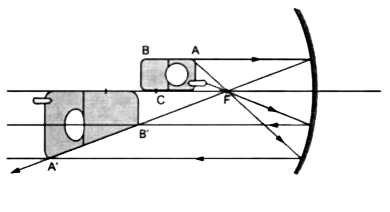 The position of the image of DIFFERENT parts of the MOBILE phone depends on their position with RESPECT to the mirror. The image of the part which is on the plane perpendicular to principal axis will be on the same plane. It will of the same size, i.e., B'C = BC. The images of the other parts of the phone are getting MAGNIFIED in accordance with their object distance from the mirror. |
|
| 2. |
A parallel plate capacitor (Fig. 8.7) made of circular plates each of radius R = 6.0 cm has a capacitance C = 100 pF. The capacitor is connected to a 230 V ac supply with a (angular) frequency of 300" rad s"^(-1) . (a) What is the rms value of the conduction current? (b) Is the conduction current equal to the displacement current? (c) Determine the amplitude of B at a point 3.0 cm from the axis between the plates. |
|
Answer» Solution :(a) `I_("rms") =V_("rms") OMEGA C=6.9 mu A` (b) Yes. The derivation in Exercise 8.1(b) is true even if i is oscillating in TIME. (c ) The formula `B =(mu_(0) r)/(2 pi R^(2)) i_(d)` goes through even if `i_(d)` (and therefore B) oscillates in time. The formula shows they oscillate in phase. Since `i_(d)= i`, we have `B_(0)=(mu_(0) r)/(2 pi R^(2)) i_(0)`," where "B_(0) and i_(0)` are the amplitudes of the oscillating magnetic FIELD and CURRENT, respectively. `i_(0) =sqrt(2) I_("rms")=9.76 mu A.` For `r=3 cm, R=6 cm, B_(0)=1.63xx10^(-11) T.` |
|
| 3. |
When the wavelength of scattered light is increased, then its scattering effect |
|
Answer» DECREASES |
|
| 4. |
A magnetic needle lying parallel to a magnetic field requires W units of work to turn it through 60^@ The torque required to keep the needle in this position will be |
|
Answer» a) `2W` |
|
| 5. |
A ball is thrown vertically upwards from the top of a tower.Velocity at a point 'h' m vertically below the point of projection is twice the downward velocity at a point 'h' m vertically above the point of projection.The maximum height reached by the ball above the top of the tower is |
| Answer» ANSWER :D | |
| 6. |
A wire ABCD is bent in the form shown here in the figure. Segments AB and CD are of length 1m each while the semicircular loop is of radius 1m. A current of 5A flows from A towards the end D and the whole wire is placed in a magnetic field of 0.5 T direction out of the page. The force acting on the wire is . |
|
Answer» 40 N `|VEC(F)|= |vec(F)_(AB)| + |vec(F)_(BC)|+ |vec(F)_(CA)|` or `F = Bi xx 1 + Bi xx 2 + Bi xx 1` or `F= 4 Bi = 4 xx 0.5 xx 5= 10N` |
|
| 7. |
A resistor R and 2 muF capacitor in series are connected through a 200 V direct supply. Across the capacitor is a neon bulb that lights up at 120 V. Find the value of R to make the bulb light up 5 s after the switch has been closed. (Take "log"_10 2.5=0.4) |
|
Answer» `1.7xx10^5 Omega` `1-e^(-t//RC)=V_C/epsilon=120/200=3/5` `e^(t//RC)=2.5` or LOG `e^(t//RC)=log_e` 2.5 `t/(RC)=2.3026 log_102.5 =0.92` `R=t/"0.92 C"=5/(0.92xx2xx10^(-6))=2.7xx10^6 Omega` |
|
| 8. |
In a briprism experiment, if the separation between the magnified images of the slit is 4.5 mm and that between the diminished images of the slit is 2mm, What is the distance between the coherent virtual sources? |
|
Answer» Solution :The distance between the COHERENT virtual SOURCES, `d=sqrt(d_(1)d_(2)) = sqrt((4.5)(2)) = sqrt(9)=3` mm |
|
| 9. |
Assertion (A) : Direction of induced emf in a circuit is predicted by Lenz's law. Reason (R) : Lenz's law is a consequence of the law of conservation of energy. |
|
Answer» If both assertion and reason are TRUE and the reason is the correct EXPLANATION of the assertion. |
|
| 10. |
What is frequency modulation?and (b) frequency deviation? |
| Answer» Solution :When the modulation WAVE is SUPERIMPOSED on a HIGH FREQUENCY carrier wave in a manner that the amplitude of the modualated wave is same as that of the carrier wave but it.s frequency is modified in accordance with the amplitude of the modulation wave, the process is called frequency modulation. The MAXIMUM swing of the frequency of modulated wave from the carrier frequency is called frequency deviation. | |
| 11. |
In the figure two inifinitely long wires carry equal currents i. Each follows a 90^(@) arc on the circumference of the same circle of radius R. Show that the magnetic field vecB at the center of the same as the field vecB a distance R below on infinite straight wire carrying a current i to the left. |
|
Answer» |
|
| 12. |
In the circuit shown in Fig., find the value of R_. |
|
Answer» Solution :Let the current through the various arms be as shown in Fig. Follow from the solution of question 39, `I_B//I_C=.01//1=1//100` `I_(E)=I_(B)+I_(C)=I_C/100=I_C~~I_C` In closed circuit `AB_(1)CEDA` `I_(C)R_(C)+V_(CE)+I_(E)R_(E)=V_(C C)or I_(C)(R_C+R_(E))=V_(C C)-V_(CE)=12-3=9...(i)` In closed circuit AB_(1)GHJDA `(I_B+I)R_B+IR+IR=V_(C C)=12 or I_(B)I_(R)+I(R_(B)+R)=12` or`I_C/betaR_(B)+I(R_(B)+R)=12...(II)` Let V be the potential difference across H and J, then `V=IR=V_(BE)+I_(E)R_(E)=V_(BE)+I_(C)R_(E)=0.5+I_(C)R_(E)or I=(0.5+I_(C)R_(E)//R` Putting this value of I in (ii), we get `I_C/betaR_(B)+1/R(1/2+I_(C)R_(E))(R_(B)+R)=12 or (I_C R_B)/beta+1/R[1/2R_B+1/2R+I_CR_(E)R_B+I_CR_(E)R]=12` or `I_C R_R + beta [1/2R_(B)+1/2R+I(C)_R_(E)R_(B)+I_(C)R_(E)R]=12beta R` or `I_C[R_(B)R+beta R_(E)(R_(B)+R)]+1/2beta(R_(B)+R)=12betaR` or `I_(C)[(100xx10^(3))(20xx10^(3))+100xx(10^(3))(100xx10^(3)+20xx10^(3))]+1/2xx100[100xx10^(3)+20xx10^(3)]=12xx100xx20xx10^(3)` or `I_(C)[2xx10^(9)+12xx10^(9)]+6xx10^(6)=24xx10^(6) or I_(C)=((24-6)10^(6))/((12+2)xx10^(9))=9/7xx10^(-3)A` Putting value of I_ in (i), we get `9/7xx10^(-3)(R_(C)+10^(3))=9 or R_(C)+10^(3)=7xx10^(3) or R_(C)=7xx10^(3)-10^(3)=6xx10^(3)Omega=6kOmega` |
|
| 13. |
Select the odd on out |
|
Answer» The movement of water across a semi permeable MEMBRANE is affected by the amount of substances dissolved in it |
|
| 14. |
The amplifiers X, Y and Z are connected in series. If the voltage gains of X, Y and Zare 10, 20 and 30, respectively and the input signal is 1 mV peak value, then what is the output signal voltage (peak value) (i)if dc supply voltage is 10V? (ii) if dc supply voltage is 5V? |
|
Answer» Solution :`A_(v)=(v_(0))/(v_(i))` `therefore (A_(v))_(1)xx (A_(v))_(2)xx(A_(v))_(3)=(v_(0))/(v_(i))` `therefore v_(0)=v_(i)xx(A_(v))_(1)xx(A_(v))_(2)xx(A_(v))_(3)` `therefore (v_(0))_("MAX")=(v_(i))_("max")xx(A_(v))_(1)xx(A_(v))_(2)xx (A_(v))_(3)` `therefore (v_(0))_("max")=(1xx10^(-3))(10)(20)(30)=6V` (i) When SUPPLY voltage is 10 V `therefore (v_(0))=6V (because 6V lt 10V)` (ii) When supply voltage is 5V `(v_(0))_("max")=5V (because 5V lt 6V)` |
|
| 15. |
A double slit S_1-S-2 is illuminated by a coherent light of wavelength lamda. The slits are separated by a distance d. A plane mirror is placed in front of the double slit at a distance D_1, from it and a screen sum is placed behind the double slit at a distance D_2, from it .The screen sum receives only the light reflected by the mirror. Find the fringe-width of the interference pattern on the screen. |
|
Answer» `D=2D_1+D_2` `So fringe width= (Dlamda)/d=((2D_1+D_2)lamda)/d` |
|
| 16. |
Find the half life of ""_(238)U if one gram of ""^(238)U emits 1.24 xx 10^4 alpha-particles per second. Avogardro No. = 6.025 xx 10^(23). |
|
Answer» |
|
| 17. |
Let E=E_0 sin [10^6x-omegat] be the electric field of plane electromagnetic wave, the value of omega is |
|
Answer» `0.3 xx 10^(-14) " RAD" s^(-1)` |
|
| 18. |
Two capillary tubes of diameters 3.0 mm and 6.0 mm are joined together to form a U-tube open at both ends. If the U-tube is filled with water, what is the difference in its levels in the two limbs of the tube ? Surface tension of water at the temperature of the experiment is 7.3xx10^(2)N//m. Take the angie of contact to be zero and density of water to be 10^(3)kg//m^(3)(g=9.8m//s^(2)) |
|
Answer» `5mm` `=(2xx7.3xx10^(-2))/(3xx10^(-3))=48.7Pa`. Similarly for the second bore, pressure difference `=97.3 Pa`. Consequently , the level difference in the TWO bores is `[(48.7)/(10^(3)xx9.8)]m=5.0mm`. The level in the narrower bore is higher. (Note, for zero angle of contace, the radius of the meniscus equals radius of the bore. The concave side of the surface in each bore is at `1 "atm"`). |
|
| 19. |
Answer the following: (a) Name the em waves which are used for the treatment of certain forms of cancer. Write their frequency range. (b) Thin ozone layer on top of stratosphere is crucial for human survival. Why? (c) An em wave exerts pressure on the surface on which it is incident. Justify. |
|
Answer» Solution :X RAYS of `GAMMA` rays Range : `0^18` HZ to `10^22` Hz |
|
| 20. |
Three electromagnetic waves travel through a certain point P along an x axis. They are polarized parallel to a y axis, with the following variations in their amplitudes. Find their resultant at P. E_(1)=(8.00 mu V // m)sin[(2.0 xx 10^(14) "rad" // s)t] E_(2)=(5.00 mu V // m)sin[(2.0 xx 10^(14) "rad" // s)t+55.0^(@)] E_(3)=(5.00 mu V // m)sin[(2.0 xx 10^(14) "rad" // s)t-55.0^(@)] |
| Answer» SOLUTION :`(13.7 mu V // m) sin[(2.0 xx 10^(14) RAD // s)]` | |
| 21. |
(A): When a conducting wire loop which is inside a uniform magnetic field directed perpendicular to its planes is moving with uniform velocity, an e.m.f is induced in it.(R) : When magnetic flux linked with a conducting wire loop changes with time an e.m.f is induced in the coil. |
|
Answer» Both .A. and .R. are TRUE and .R. is the CORRECT EXPLANATION of .A. |
|
| 22. |
Which of the following is true for photon |
|
Answer» `E=(HC)/(lamda)` |
|
| 23. |
Calculate the magnifying power of a reading glass of focal length of 4 cm? |
|
Answer» SOLUTION :M = 1+D/fcdotD = 25CM, F = 4CM. THEREFORE M = 1+25/4 = 1+6.25 = 7.25 |
|
| 24. |
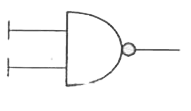
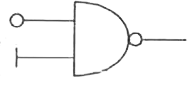
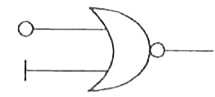
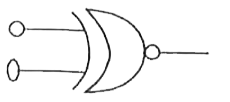
Which of the following gates will have an output of 1 ? |
|
Answer»
|
|
| 25. |
Show that area of circular patch of light on water as seen from a water medium is A=pi h^(2)//(n^(2)-1) where symbolshaves their usual meaning. |
Answer» Solution :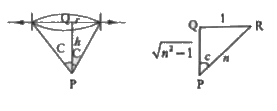 `TANC=(1)/(SQRT(n^(2)-1))` `and tanC=(r)/(h)` `THEREFORE r=(h)/(sqrt(n^(2)-1))` Area `=PIR^(2)` `thereforeA=(pi h^(2))/(n^(2)-1)` |
|
| 26. |
On what the number of photoelectrons emitted from a metal surface depends ? |
| Answer» Solution :It depends up only on INTENSITY of the INCIDENT LIGHT and is independent of it,s FREQUENCY. . | |
| 27. |
A photo cell is illuminated by a small bright source placed (1)/(2) m away. When the same source of light is placed m away. Which of the following is true about the electrons emitted by the photo cathode |
|
Answer» Each carry ONE quarter of their PREVIOUS ENERGY |
|
| 28. |
Milk is poured into a cup of tea and is mixed with a spoon. Is this an example of reversible process ? Give reason for your answer. |
| Answer» Solution :When milk is mixed in tea, certain AMOUNT of work DONE is on the SYSTEM which appears in the from of heat. The milk can not be separated from the tea with the RECOVERY of same work from heat. So this is not a reversible process | |
| 29. |
Two rods A and B of the same material and length have their radii r_(1) and r_(2). If they are rigidly fixed at one end and twisted at other end by the same couple, then the ratio of their angles of twist is : |
|
Answer» `(r_(1)^(2))/(r_(2)^(2))` `rArrtheta=(tau2l)/(pietar^(4))` `rArrthetaprop1/(r^(4))` `therefore(theta_(1))/(theta_(2))=(r_(2)^(4))/(r_(1)^(4))` So the correct CHOICE is (d). |
|
| 30. |
Light enters in a glass slab of refractive index 3/2 and covers a distance 20 cm. The optical path of it is |
|
Answer» 40 cm |
|
| 31. |
If image obtained from concave mirror of focal length f is (1/n)^(th) times of object, then find object distance. |
|
Answer» `f/n` `therefore -1/n=(f)/(f-u)` `(because` IMAGE FORMED is SMALL,hence real) `therefore`u-f=nf `therefore` u= nf+f `therefore` u = (n+1)f |
|
| 32. |
Answer the following questions: Why are the brake-drums of a car heated when the car moves down a hill at constant speed ? |
| Answer» Solution :Here the SPEED of the car is not increasing, the gravitational potential energy is converted into INTERNAL energy (HEAT) of the break-drum which are heated | |
| 33. |
A : The accelerationdue to gravityfor an is independent from its mass. R : The value of 'g ' dependson the mass of planet . |
|
Answer» If both ASSERTION & Reasonare true . Andthe reasonis the correct explanationof theassertion , then mark (1) |
|
| 34. |
What is principle of reversibility? |
| Answer» Solution :The principle of REVERSIBILITY statesthat light will follow exactly the same PATH if its DIRECTION of travel is REVERSED. | |
| 35. |
A light wave of frequency 4 xx 10^14 Hz and speed 3 xx 10^8 m//s enters glass of R.I. 1.5. What is the change in its wavelength? |
|
Answer» `2.5 XX 10^-6 m` |
|
| 36. |
Two coherent sources are placed 0.9 mm apart and the fringes are observed one metre away. If it produces the second dark fringe at a distance of 10 mm from the central fringe. The wavelength of monochromatic light is x xx 10^(-4) cm, What is the valye of x ? |
|
Answer» |
|
| 37. |
A particle performing S.H.M. with amplitude 'A' and period T. The average values of magnitude of distance over a half period is |
|
Answer» DEPENDS UPON periodic time |
|
| 38. |
The ionization energy of the electron in the hydrogen atom in its ground state is 13.6 eV. The atoms are excited to higher energy levels to emit radiation of 6 wavelengths. During which of the following transitions will the maximum wavelength radiation be emitted ? |
|
Answer» N=3 to n=1 `:.n^(2)-n-12=0` `:.(n-4)(n+3)=0 or n=4` 
|
|
| 39. |
Newton’s law of gravitation and Kepler’s law of planet for any motion are not derivable from each other. |
|
Answer» |
|
| 40. |
In a resonance-column experiment, a long tube, open at the top, is clamped vertically. By a separate device water level inside the tube can be moved up or down. The section of the tube from the open end to the water level acts as closed organ pipe. A vibrating tuning fork is held above the open, and the water level is gradully pushed down. The first and the second resonances occur when the water levelis 24.1 cm and 74.1cm respectively below the open end. The diameter of the tube is |
| Answer» ANSWER :B | |
| 41. |
A vessel contains mixture of hydrogen and oxygen gases in the ratio of their masses equal to 1:5. The ratio of mean kinetic energies of two gasses is |
|
Answer» 1:1 |
|
| 42. |
In each question, there is a table having 3 columns and 4 rows. Based on the table, there are 3 questions. Each question has 4 options (a), (b), ( c) and (d), ONLY ONE of these four options is correct. The particle is projected in projectile motion with velocity u at an angle theta with horizontal is represented by y=Px-Qx^(2). Answer the questions by appropriately matching the information given in the three columns of the following table. For which quantity of projectile motion P and Q are linearly dependent to each other and what is the relation between them? |
| Answer» Answer :D | |
| 43. |
A bat flies at a steady speed of 4 ms^(-1) emitting sound of f= 90 xx 10^(3) Hz. If is flying horizontally towards a vertical wall. The frequency of the reflected sound as detected by the ball will be : (take velocity of sound in air as 330 ms^(-1) ) |
|
Answer» `92.1 xx 10^(3)` Hz `v. = ((v + mu_(0))/(v - u_(s)) ) ` v ` v. = ((350 + 5)/(330 - 4) ) xx 90 xx 10^(3)` `v. = 92.1 xx 10^(3) `Hz. So correct choice is a. |
|
| 44. |
A current I = 5 amp flow through a thin wire as shown in the figure. (a) Find the magnetic field produced by the current at point O in the figure. (b) If there exists an external magnetic field B = (14 hat(i) + 14 hat(j))T. Calculate the torque acting on the wire. |
|
Answer» |
|
| 45. |
An electron moves with a velocityvec = (3 xx 10^6 hat i +4 xx 10^(+6) hat j)m/s through a magnetic field of strength B= (0.03 hat(i) + 0.15 hat (j)) T. Calculate the force on the electron. |
| Answer» Solution :`5.28 xx 10^(14) hat k` NEWTON | |
| 46. |
Solve for current values in figure. |
|
Answer» Solution :APPLYING Kirchhoff.s first law at the junction B we have `i_(1)+i_(2)=i_(3)"….(1)"` Applying Kirchhoff. second law to loop ABEFA `-12+i_(2)xx1.5-i_(1)xx1+8=0` `i_(1)=1.5i_(2)=-4"…..(2)"` From loop BCDEB `-(i_(2)xx1.5)-(i_(3)xx9)+12=0` `1.5i_(2)+9i_(3)=12".....(3)"` `"on SOLVING "i_(1)=-1A and i_(3)=1A` |
|
| 47. |
The multiplication of 10.610 with 0.210 upto correct number of significant figure is |
|
Answer» 2.2281 |
|
| 48. |
Krichhoff's first law deals with conservation of |
|
Answer» energy |
|
| 49. |
Estimate the number of mean lives elapsed, when the number of atoms in a radioactive sample decrease to 5% of the original value. |
|
Answer» Solution :Let the REQUIRED number of mean lives ELAPSED be .m., then `t=m lt tau gt=m/lambda` N=5% of `N_0=1/20N_0` But, `N=N_0e^(-lambdat)` `therefore N_0/20 = N_0 e^(-m)`or , `e^m`=20 or , m=LN 20 = ln 2+ ln 10 = 0.693 + 2.303 `APPROX` 3 `therefore` At the end of about three average lives, the number of atoms (undecayed) would fall to 5%. |
|
| 50. |
Doping of arsenic in silicon leads to which type of semiconductor? |
| Answer» SOLUTION :It LEADS to p-type SEMICONDUCTOR. | |