

Saved Bookmarks
This section includes 7 InterviewSolutions, each offering curated multiple-choice questions to sharpen your Current Affairs knowledge and support exam preparation. Choose a topic below to get started.
| 1. |
Four wires each of length 2.0 metres are bent into four loops P,Q,R and S and then suspended into uniform magnetic field. Same current is passed in each loop. Which statement is correct? |
|
Answer» <P>COUPLE on LOOP P will be the highest |
|
| 2. |
Molar heat capacity of a gas at constant pressure . |
| Answer» Solution :Molar heat capacity of a gas at constant PRESSURE is defined as the quantity of heat required to RAISE the TEMPERATURE of ONE mole of the gas through one degree `( 1^(@)C or 1 K )`, when its pressure is kept constant . | |
| 3. |
If the frequency of ac source in series LCR circuit is increased,how does the current in the circuit chgange ? Draw the graph showing the variation of current with frequency. |
Answer» Solution :As the FREQUENCY INCRESES, the current in a series LCR CIRCUIT first increses, attains a amaximum value and then DECRESES.
|
|
| 4. |
A block of mass m kg is sliding from rest on an inclined rough surface of inclination theta as shown in the figure under the action of three forces, weight, normal and frictional force only. The magnitudeof forces are 20N, 40N and 50N not necessarily in the same order. The value of g is 10m//s^(2). Now match the physical quantity in List-I with their magnitude in List-II in SI unit and select the correct answer using the codes given below the lists: (assume that the coefficient of kinetic friction is less than 1). |
|
Answer» `{:(P, Q,R,S),(2,3,1,4):}` 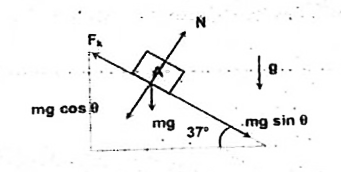 `N=MG cos theta = 50 XX (4)/(5)=40N` `f_(X)=mu mg cos theta=0.5xx50xx(4)/(5)=20N` `mg sin theta=50xx(3)/(5)=30N` `a=(30-20)/(5)=2m//s^(2)` |
|
| 5. |
For ionising an excited hydrogen atom the energy required will be: |
|
Answer» LESS than 3.4 EV |
|
| 6. |
Assertion : Short wave bands are used for transmission of radio waves to a large distance. Reason : Short waves are reflected by ionosphere |
|
Answer» |
|
| 7. |
Refractive index of a glass as light ray passes from air to glass is given by n=(sini)/(sinr). In a centain experiment , I and r ware found to be 45^@ pm3^@ and 30^@pm3^@, then error in n is nearly |
|
Answer» 0.28 |
|
| 8. |
For sample of ""^(66)Cu, 7/8 of it decays in 15 min. The half-life of sample is: |
|
Answer» 5 min `N/N_(0)=(1/2)^(t/T)," here N"=1/8 N_(0) ("AMOUNT LEFT")` `1/8=(1/2)^(t/T) RARR (1/2)^(3)=(1/2)^(t/T) therefore t/T=3` `t=3T rArr 15 =3T therefore T=5"min"` |
|
| 9. |
The area to be covered for TV telecast is doubled. Then the height of the transmitting antenna will have to be |
|
Answer» doubled |
|
| 10. |
Define the magnifying power of a compound microscope when the final image is formed at infinity. Why must both the objective and the eyepiece of a compound microscope has short focal lengths ? Explain. |
|
Answer» Solution :The angular magnification (or magnifying POWER) of a microscope is DEFINED as the ratio of the angle subtended by the final image at the eye to the angle subtended by the object at the eye when seen directly. Angular magnification of a compound microscope when final image in a microscope is FORMED at infinity, is given by the relation : `m=-L/f_(0).D/f_(e)` Here L = length of microscope, D = least distance of DISTINCT vision, `f_0` = focal length of OBJECTIVE lens and `f_(e)` = focal length of eye piece. As magnifying power m is inversely proportional to both `f_0` and `f_(e)`, hence we prefer both objective and eyepiece to be of short focal lengths so as to have a high value of magnifying power |
|
| 11. |
The atomic mass of ""_(7)N^(15) is 15.000108 a.m.u. and that of ""_(8)O^(16) is 15.994915 a.m.u. If mass of proton is 1-007825 a.m.u., then the minimum energy provided to remove the least tightly bound proton is : |
|
Answer» 0.013018MeV `""_(8)O^(16)-""_(7)N^(15)=""_(1)P^(1)` =MASS of ONE proton in nucleus `(15-994915-15.000108)" a.m.u.=mass of "_(1)p^(1)` Mass of one proton in nculeus =0.994807 a.m.u. But mass of one proton outside nucleus =1.007825 a.m.u. Mass DEFECT =(1.007825-0.994807) a.m.u. =0.13018 a.m.u. `=0.013018 xx 931MeV=12.13MeV` =ENERGY required to remove proton. |
|
| 12. |
A nucleus of mass M initially at rest splits into two fragments of masses M/3 and (2M)/3. Find the ratio of de-Broglie wavelength of the fragments. |
|
Answer» Solution :Following the LAW of conservation of MOMENTUM , `M/3 nu_1 +(2M)/3nu_2=0` or `|M/3nu_1| =|(2M)/3nu_2|` `lambda =h/(MV)RARR |(lambda_1)/(lambda_2)|=|(2M/3nu_2)/(M/3nu_1)|=1` |
|
| 13. |
Which one of the following thickness of lead would be least effective in stopping beta rays? |
|
Answer» 0.04 m |
|
| 14. |
An alpha particle can be produced in certain radioactive decays of nuclei and consists of two protons and two neutrons. The particle has a charge of q = +2e and a mass of 4.00 u, where u is the atomic mass unit, with 1 u = 1.661 xx 10^(-27)kg. Suppose an alpha particle travels in a circular path of radius 4.50 cm in a uniform magnetic field with B = 1.20 T. Calculate (a) its speed, (b) its period of revolution, (c ) its is kinetic energy, and (d) the potential difference through which it would have to be accelerated to achieve this energy. (e) If the field magnitude is doubled what is the ratio of the new value of kinetic energy to the initial value ? |
| Answer» SOLUTION :(a) `2.60 xx 10^(6) m//s`, (b) `1.09 xx 10^(-7) s`, (c ) `140 xx 10^(5) eV`, (d) `7.00 xx 10^(4) V`, (e) 4 | |
| 15. |
(A) : The correctness of an equation is verified using the principle of homogeneity. (b) : All unit less quantities are dimensional less. |
|
Answer» Both A &B are TRUE |
|
| 16. |
A heavy but uniform rope of length L is suspended from a ceiling, If the rope is given a sudden sideways jerk at the bottom, how long will it take for the pulse to reach the ceiling? |
| Answer» SOLUTION :`SQRT(4L//g)` | |
| 17. |
A static charge cannot produce em waves. why ? |
| Answer» SOLUTION :A STATIC charge has only a steady electric field and has no ASSOCIATED MAGNETIC field. | |
| 18. |
A shunt of resistance 1 Omegais connected across a galvanometer of 120 Omegaresistance. A current of 5.5 ampere gives full scale deflection in the galvanometer. The current that will give full scale deflection in the absence of the shunt is nearly : |
|
Answer» 5.5 AMPERE |
|
| 19. |
Statement - I : Charge is invariant. Statement -II : Charge does not depends on speed or frame of reference. |
|
Answer» If both Statement-I and Statement-II are true, and Statement-II is the CORRECT EXPLANATION of Statement -I. |
|
| 20. |
Can the image obtained in case of simple microscope be taken on a screen? |
| Answer» SOLUTION :The image in case of a SIMPLE microscope is VIRTUAL and hence cannot be TAKEN on a screen. | |
| 21. |
In the grease spot photometer, a lamp with dirty chimney is foundto balance an electric lamp of constant illuminating power at a distance of 0.1 m from the spot. When the chimney is cleaned, the electric lamp has to be shifted by 2 cm to obtain a balance. Calculate the precentage of light absorbed by the dirty chimney |
|
Answer» |
|
| 22. |
For reduce in Ohmic loss transmission of electric power at very far distance of electric power is done at very high voltage ? |
|
Answer» Solution :`rArr` To reduce Ohmic loss transmission of electric power is done at very HIGH voltage. `rArr` Generally power station which produce electricity are very far from homes and factories. `rArr` Poweris transmitted by cables. `rArr` Length of cables is very large hence their resistance is also very large `[R alpha l ]` . Consider resistance of this cable be `R_(C)`. `rArr` Consider resistarnce a device be R. and voltage applied be V and current flowing through it is I then power, P = VI `rArr` Power DISSIPATED in cable be `P_(c)` then , `P_(c) = I^(2) R_(c) "" `....(1) But P = VI , then I = `(P)/(V)` `therefore P_(c) = (P^(2) R_(c))/(V^(2))"" ` [ From equation (1) ] `rArr` Thus , power dissipated is inversely proportional to `V^(2) ` hence to minimize this power `(P_(c))` voltage is transmitted at very high VALUE then power in cable will be reduced. `(V)/(I) = R_(eq) = R_(S) = `equivalent resistance `R_(S) = R_(1) + R_(2)` This can be extended for .n . NUMBER of resistors with different value. `R_(eq) = R_(S) = R_(1)) + R_(2) + .... + R_(n)` `therefore R_(eq) = sum_(i=1)^(n) `Ri `rArr` If .n. resistors of equal value (R) are connected in series, then equivalent resistance`R_(eq) = R_(S) = ` NR `rArr` Thus, in series connection of resistors equivalent resistance is larger than largest value of resistance. |
|
| 23. |
Light incident normally on a plane mirror attached to a galvenometer coil reflects backward as shown in figure. A current in the coil produes a deflection of 3.5^(@) if the mirror. The displacement of the reflected spot of light on ascreen placed 1.0 m away is |
|
Answer» `27.5 m` The reflected rays gets deflected by an amount TWICE the angle of deflection , i.e., `2theta = 7.0^(@):. tan 2 theta = d/2` `rArr d = 2 XX tan 7^(@)= 2 xx 0.1227 = 0.245 m = 24.5 cm` |
|
| 24. |
State, briefly, an efficient way of making a permanent magnet. Write two properties to select suitable materials for making permanent magnets. |
|
Answer» Solution :If an iron rod is burried inside the earth, along the north-south-direction. After some days, the rod becomes a magnet. ITIS possible only when the earth itself behaves like a magnet. The two properties of permanent magnet are as : (i) Its RETENTIVITY is very HIGH. (II) Its hysteresis loss is very high. |
|
| 25. |
A carbon film resistor has cololur code green, black, violet, gold. The value of the resistor is |
|
Answer» `50M Omega` |
|
| 26. |
The magnitude of the induced current in a closed circuit is equal to the time rate of change of magnetic flux through the circuit. |
| Answer» Solution :FALSE - Magnitude of induced EMF is EQUAL to the time rate of change of magnetic FLUX through the given circuit. | |
| 27. |
Given below is the graph between frequency (V) of the incident light and Maximum KE(E_k) of emittedf photoelectrons.Define the terms Work function |
| Answer» Solution :(i) The minimum amount of energy REQUIRED to emit an electron from metal surface. (II) The minimum amount of FREQEUNCY required to emit an electron below which no PHOTOELECTRIC effect- | |
| 28. |
Doubly ionised helium atoms and hydrogen ions are final velocities of helium and of the hydrogen ions is : |
|
Answer» 2 Here q= CHARGE on helium ION `:.` q= change on HYDROGEN ion `:. (q)/(q.)=(2)/(1) and (M_(h))/(M_(he))=(1)/(4)` From eqn. `(1),((v_(he))^(2))/((v_(h))^(2))=(q)/(q)xx(M_(h))/(M_(he))` From eqn . `=(2)/(1)xx(1)/(4)=(1)/(2)` `:. (v_(he))/(v_(h))=(1)/(sqrt(2))` |
|
| 29. |
Consider standrad cases for force on current carrying conductors. In the given table, Column I shows the action of current on the element, Column II shows the effect of the current in the element, Column II shows the effect of the current in the element and Column III shows the figure of the element under force of current and magnetic field and its equivalent figure in general mechanical form. What happens when a finite length current carrying wire is kept parallel to another infinite length current carrying wire ? |
| Answer» Answer :B | |
| 30. |
The breakdown in a reverse biased p-n junction diode is more likely to occur due to |
|
Answer» large velocity of the minority charge carriers if the doping concentration is small. If doping level is kept high, then electric field in the depletion layer is strong from the BEGINNING itself (because of high BARRIER potential), because of which, the charges FREED in the depletion layer obtain tremendous high velocity, which in turn, release the charge carriers further by colliding with the atoms in the depletion layer. Rate of this process increases with the increase in reverse voltage. Finally, breakdown occurs at some reverse voltage. Thus, option (D) is also correct. |
|
| 31. |
(a) State the working principle of a potentiometer with help of the circuit diagram , explain how the internal resistance of a cell is determined. How are the following affected in the potentiometer circuit when(i) the internal resistance of the driver cell increases and (ii) the series resistor connected to the driver cell is reduced ? Justify your answer. 5 |
|
Answer» Solution :(b) If theinternal resistance of driver cell is increased then I GIVEN in the POTENTIOMETER circuit GETS reduced. Hence, balancing length of thepotentiometer WIRE increases. When theseries resistance to the driver cell is reduced then CURRENT I in thepotentiometer circuit given by thedriver cell increases. Therefore potentialgradient in the potentiometer wire increases, hence, balancing length decreases. |
|
| 32. |
A rocket is fired vertically from the earth with an acceleration of 2g, where g is the gravitational acceleration. On an inclined plane inside the rocket, making an angle theta with the horizontal, a point object off mass m is kept. The minimum coefficient of friction mu_m in between the mass and the inclined surface such that the mass does not move is: |
|
Answer» `TAN 2THETA` |
|
| 33. |
To create AND gate require ……NAND gate. |
|
Answer» 0 |
|
| 34. |
Consider standrad cases for force on current carrying conductors. In the given table, Column I shows the action of current on the element, Column II shows the effect of the current in the element, Column II shows the effect of the current in the element and Column III shows the figure of the element under force of current and magnetic field and its equivalent figure in general mechanical form. What happens when an arbitrary current carrying loop is placed in a magnetic field ( perpeendicular to the plane of loop ) ? |
| Answer» Answer :A | |
| 35. |
Two heating elements of resistances R_1 and R_2when operated at a constant supply of voltage, V,consume powers P_1 and P_2 respectively. Deduce the expressions for the power of their combination when they are, in turn, connected in (i) series and (ii) parallel across the same voltage supply. |
|
Answer» SOLUTION :When heating elements of RESISTANCES `R_1` and `R_2`are operated at a constant supply of VOLTAGE V, power consumed by these are respectively `P_1 = (V^2)/(R_1) " and" P_2 = (V^2)/(R_2)` (i) When the two heating elements are connected in SERIES across the same supply voltage V, then resultant resistance `R_s= R_1 + R_2` ` therefore ` Resultant power of series COMBINATION`P_s = (V^2)/(R_s) = (V^2)/((R_1 + R_2)` `(1)/(P_s)= (R_1 + R_2)/(V^2) = (R_1)/(V^2) + (R_2)/(V^2) = (1)/(P_1)+ (1)/(P_2)` (ii) When the two heating elements are connected in parallel across the same supply voltage V, then resultant resistance `R_P`is given by the relation `(1)/(R_P) = (1)/(R_1) + (1)/(R_2)rArr (V^2)/(R_P) = (V^2)/(R_1) + (V^2)/(R_2) `or`P_P = P_1 + P_2` |
|
| 36. |
Two coherent sources of intensity ratio beta interfere. Then the value of (I_(max)-I_(min))(I_(max)+I_(min)) is |
|
Answer» `(1+BETA)/sqrtbeta` |
|
| 37. |
Which of the following statement is incorrect for an object executing S.H.M. : |
|
Answer» The value of ACCELERATION is maximum at theextreme points |
|
| 38. |
(A): Low frequency audio signals can not be transmitted directly over long distances (B) : To transmit low frequency audio signals over long distances, the audio signals are super imposed on a high frequency carrier signal |
|
Answer» ASSERTION and reason are true and reason is the CORRECT explanation of assertion |
|
| 39. |
A black body at a hot temperature of 227^(@)C radiates heat at a rate of 10" cal cm"^(-2)" s"^(-1). At a temperature of 727^(@)C the rate of heat radiated per unit area in cal cm^(-2)s^(-1) will be |
|
Answer» 200 `(E_(2))/(E_(1))=(2)^(4)""rArrE_(2)=10xx16`. `rArrE_(2)=160"cal cm"^(-2)"sec"^(-1)`. Thus CORRECT choice is (b). |
|
| 40. |
In a two dimensional motion, instantaneous speed v_(0) is a positive constant. Then which of the following are necessarily true? |
|
Answer» The ACCELERATION of the PARTICLE is zero |
|
| 41. |
A needle floating on the surface of water moves away on adding a drop of alcohol to one side of the needle because - |
|
Answer» a. ALCOHOL has HIGHER density than water |
|
| 42. |
In figure 6.12 C_(1)=9muF,C_(2)=6muF,C_(3)=4muF and 6_(4)=6muF The potential of poitn a is 10 V and that of b is 35 V calculate the potentials of the terminal of the key S (i) when it is open and (ii) when it is closed. Also calculate the charge that passes through S when it is clossed. |
|
Answer» |
|
| 43. |
Two indentically charged spheres are suspended by strings of equal lengths. The strings make an angle of 30^(@) with each other. When suspended in a liquid of density 0.8 g. cm^(-3), the angle remains the same. What is the dielelectric constant of the liquid. The density of the material of the spheres is 1.6 g. cm^(-3) |
|
Answer» Solution :LET A and B be the equilibrium positions of the two spheres in both cases [Fig.] Suppose, AB=r, charge of each sphere =q, mass of each sphere =m. When thesystem is in air, tension in the string `=T_(1)` and repulsive force between the spheres `F_(1) =1/(4PI epsilon_(0))q^(2)/r^(2)` At equilibrium, `F_(1) =T_(1) sin 15^(@)`..........(1) and `mg = T_(1) cos 15^(@)`........(2) From EQUATIONS (1) and (2), `F_(1)/(mg) =(T_(1)sin 15^(@))/(T_(1) cos 15^(@)) = tan 15^(@)` or `F_(1) = mg tan15^(@)` or `1/(4pi epsilon_(0)).q^(2)/r^(2) mg tan 15^(@)` 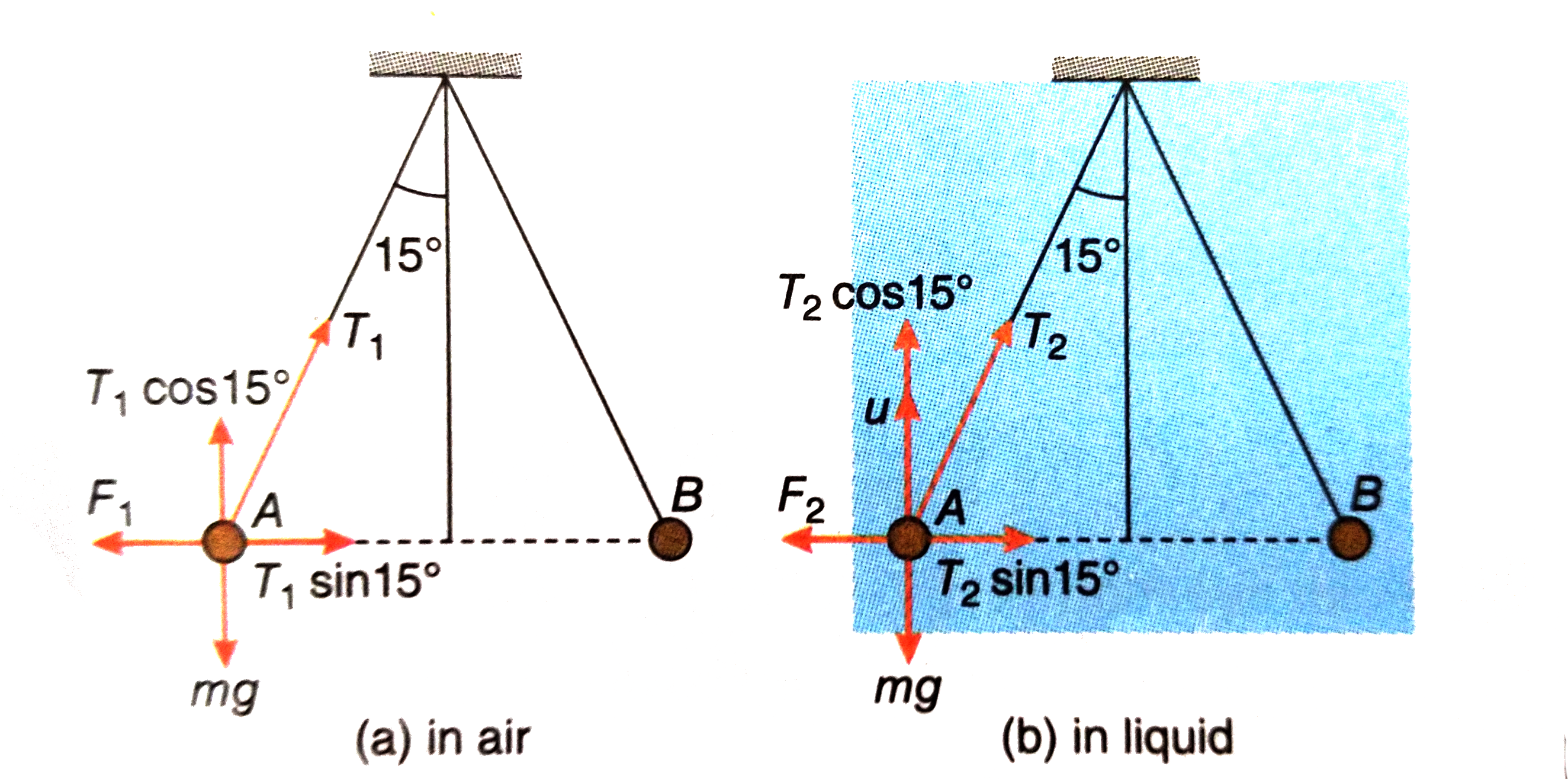 When the spheres are suspended in the liquid, tension in the string `=T_(2)`, UPTHRUST by the liquid on each sphere =u and repulsive force between the two spheres, `F_(2) =1/(4pi epsilon_(0)).q^(2)/r^(2)` [where k=dielectric constant of the medium]. Now at equilibrium, `F_(2) = T_(2) sin 15^(@)`......(4) and `mg-u = T_(2) cos 15^(@)`.........(5) From equations (4) and (5), `F_(2)/(mg -u) = tan 15^(@)` or, `F_(2) =(mg-u) tan 15^(@)` or, `1/(4pi epsilon_(0)k).q^(2)/r^(2) =(mg-u) tan 15^(@)`.........(6) Form equations (3) and (6), we get `k = (mg)/(mg-u)`....(7) Let volume of the sphere =V, the density of the material of the sphere =d and density of the liquid `=d_(l)`. `therefore m = Vd` and `u=Vd_(1)g)` HENCE, from equations (7) , we get `x=(Vdg) /(Vdeg-Vd_(l)g) =d/(d-d_(1))` or, `x =(1.6)/(1.6 -0.8)[therefore d=1.6 g//cm^(3)` and `d_(l) = 0.8 g//cm^(3)]` or, k=2 Hence, required dielectric constant is 2. |
|
| 44. |
A compound microscope with an objective of 1.0 cm focal length and an eyepiece of2.0 cm focal length has a tube length of 20 cm. Calculate the magnifying power of the microscope, if the final image is formed at the near point of the eye. |
|
Answer» SOLUTION :Here `f_(0) = 1.0 cm, f_(e) = , L = 20` cm and we know that the distance of near point of eye D = 25 cm. MAGNIFYING power of microscope `n=KL/f_(0) (1+D/f_(0)) = 20/1 XX (1 + 25/2) = 20 xx 13.5 = 270` |
|
| 45. |
When 1 muF capacitor is connected across V = 100 sqrt2 sin(100t)Volt, current passing through milliammeter connected in the circuit is ……... |
|
Answer» 10 Comparing with `V=V_m sin (omegat)` …(2) We get `V_m=100sqrt2` Volt `omega=100 "rad"/s` Now, `X_C=1/(omegaC)=1/(100xx1xx10^(-6))=10^4 Omega` Now, `I=V/Z=V/X_C =(V_m//sqrt2)/X_C=100/10^4=10^(-2)A` `THEREFORE` Reading OBTAINED in milliammeter `=10^(-2) xx 10^3` mA =10 mA |
|
| 46. |
A charge q is located at centre of a cube of edge length 'a' The electric flux through any force |
|
Answer» `(Q)/( in_0) ` |
|
| 47. |
The ratio of r.m.s. value of an A.C. voltage and its mean value over half cycle is .... |
|
Answer» `SQRT2:1` `=(2V_0)/pi` and r.m.s. value `=V_0/sqrt2` `therefore` Ratio = `(ltVgt)/V_"rms" = (2V_0)/pixxsqrt2/V_0 =(2sqrt2)/pi` |
|
| 48. |
Before the neutrino hypothesis, the beta process was thought to be the transition, n rarr p+bare. If the was true, show that if the neutron was at rest, the proton and electron would emerge with fixed energies and calculate them. Experimentally, the electron energy was found to have a large range. |
|
Answer» Solution :We are supporting that `beta` decay is due to the transition `n rarr p+e^(-)` Suppose before beta decay, neutron is at rest. `:. p_(n)=0 and E_(n)=m_(n)c^(2)` After `beta` decay, form conservation of linear momentum, we have `vecp_(n)=vecp_(p)+vecp_(e)=0:. |vecp_(p)|=|vecp_(e)|=p`, say. `E_(p) =(m_(p)^(2) c^(4)+p_(p)^(2) c^(2))^(1//2) and E_(e)=(m_(e)^(2) c^(4)+p_(e)^(2) c^(2))^(1//2)=(m_(e)^(2) c^(4)+p_(p)^(2) c^(2))^(1//2)` form conservation of energy, `E_(p)+E_(e)=E_(n)` i.e., `(m_(p)^(2) c^(4)+p_(p)^(2) c^(2))^(1//2)+(m_(e)^(2) c^(4)+p_(e)^(2) c^(2))^(1//2)=m_(n)c^(2).......(i)` Now, `m_(p)c^(2)=936MeV , m_(n)c^(2)=938MeV` and `m_(e)c^(2)=0.51MeV`. As energy difference between `m_(p)c^(2)` and `m_(n)c^(2)` is small, therefore pc will be small. `:. PCLT lt m_(p)c^(2)`. However, pc may be greater than `m_(e)c^(2)`. therefore, form (i) `m_(p)c^(2)+(p^(2)c^(2))/(2m_(p)^(2)c^(4))~=m_(n)c^(2)-pc` To first order of APPROX. `pc~=m_(n)c^(2)-m_(p)c^(2)=938MeV-936MeV=2MeV` This GIVES us the momentum of proton or neutron. `:. E_(p)=(m_(p)^(2) c^(4)+p^(2) c^(2))^(1//2)=sqrt((936)^(2)+2^(2)) ~=936MeV` and `E_(e)=(m_(e)^(2) c^(4)+p^(2) c^(2))^(1//2)=sqrt((0.51)^(2)+2^(2))~=2.06MeV` |
|
| 49. |
The phase difference between the current and voltage of a LCR series a.c. circuit at resonance is |
| Answer» ANSWER :A | |
| 50. |
An open pipe in 2nd harmonic is in resonance with frequency/. Now one end of the tube is closed and frequency is increased to f, such that the resonance again occurs in nth harmonic, then find n and the relationbetween f_(1),f_(2) |
|
Answer» SOLUTION :In CASE `-lambda=l:.f_(1)=(V)/(lambda)=(v)/(l)` In case `(2), lambda=(4l)/(n) :. f_(2)=(v)/(lambda)=(nv)/(4l)` Here n is a odd number `f_(2)=(n)/(4)f_(1)` for FIRST resonance `n=5, f_(2)=(5)/(4) f_(1)` and since `f_(2) GT f_(1)`. |
|