Saved Bookmarks
This section includes 7 InterviewSolutions, each offering curated multiple-choice questions to sharpen your Current Affairs knowledge and support exam preparation. Choose a topic below to get started.
| 1. |
The resistance of a metal is given by R=(V)/(I), where V is potential difference and I is the current. In a circuit the potential difference across resistance is V=(8+-0*5) V and current in resistance, I=(4+-0*2)A. And current in resistance with its percentage error : |
|
Answer» `(2+-5*6%)` ohm `(DeltaR)/(R)xx100=(DELTAV)/(V)xx100+(DeltaI)/(I)xx100` `=(0*5)/(8)xx100+(0*2)/(4)xx100=11*25%` `:.R=(2+-11*25)OMEGA.` HENCE correct CHOICE is `(d)`. |
|
| 2. |
Obtain the de Broglie wavelengthassociated with thermal neutron at roon temperature30^(@)C. |
|
Answer» Solution :`T=273+30=303K, k=1.38xx10^(-23)` Thermal neutrons kinetic theory of gases. `therefore` Kinetic ENERGY of a thermal neutron is given by, `K=(3)/(2)kT=(3)/(2)xx1.38xx10^(-23)xx303=0.627xx10^(-20)J` `lambda=(h)/(SQRT(2mK))=(6.625xx10^(-34))/(sqrt(2xx1.67xx10^(-27)xx0.627xx10^(-20)))=1.45xx10^(-10)m` |
|
| 3. |
Derive an expression for the torque experienced by a dipole due to a uniform electric field. |
|
Answer» Solution : Torque experienced by an electric dipole in the uniform electric field: Consider an electric dipole of dipole moment `vecp` placed in a uniform electric field `vecE` whose field lines are equally spaced and point in the same direction. The CHARGE +q will experience a force qe in the direction of the field and charge -q will experience a force `vecE` in a direction opposite to the field. Since the EXTERNAL field E is uniform, the total force acting on the dipole is zero. Torque la into the paper These two forces acting at different points will constitute Torque on dipole a couple and the dipole experience a torque. This torque tends to rotate the dipole. (Note that electric field lines of a uniform field are equally spaced and point in the same direction). The total torque on the dipole about the point O `tau=vec(OA)xx(-qvecE)+vec(OB)xxqvecE` USING right-hand corkscrew rule, it is found that total torque is perpendicular to the plane ol the paper and is directed into it. The magnitude of the total torque `vectau=|(vecOB)||sintheta+|vec(OB)||qvecE|sintheta` `vectau=qE2asintheta` ...(2) where is the angle MADE by `vecp` with `vecĒ`. Since p = 2AQ, the torque is written in terms of the vector product as `vectau=vecpxxvecE` The magnitude of this torque is t = pe sin 0 and is maximum when `theta=90^(@)` This torque tends to rotate the dipole and align it with the electric field `vecE`. Once `vecp` is aligned with `vecE`, the total torque on the dipole becomes zero. 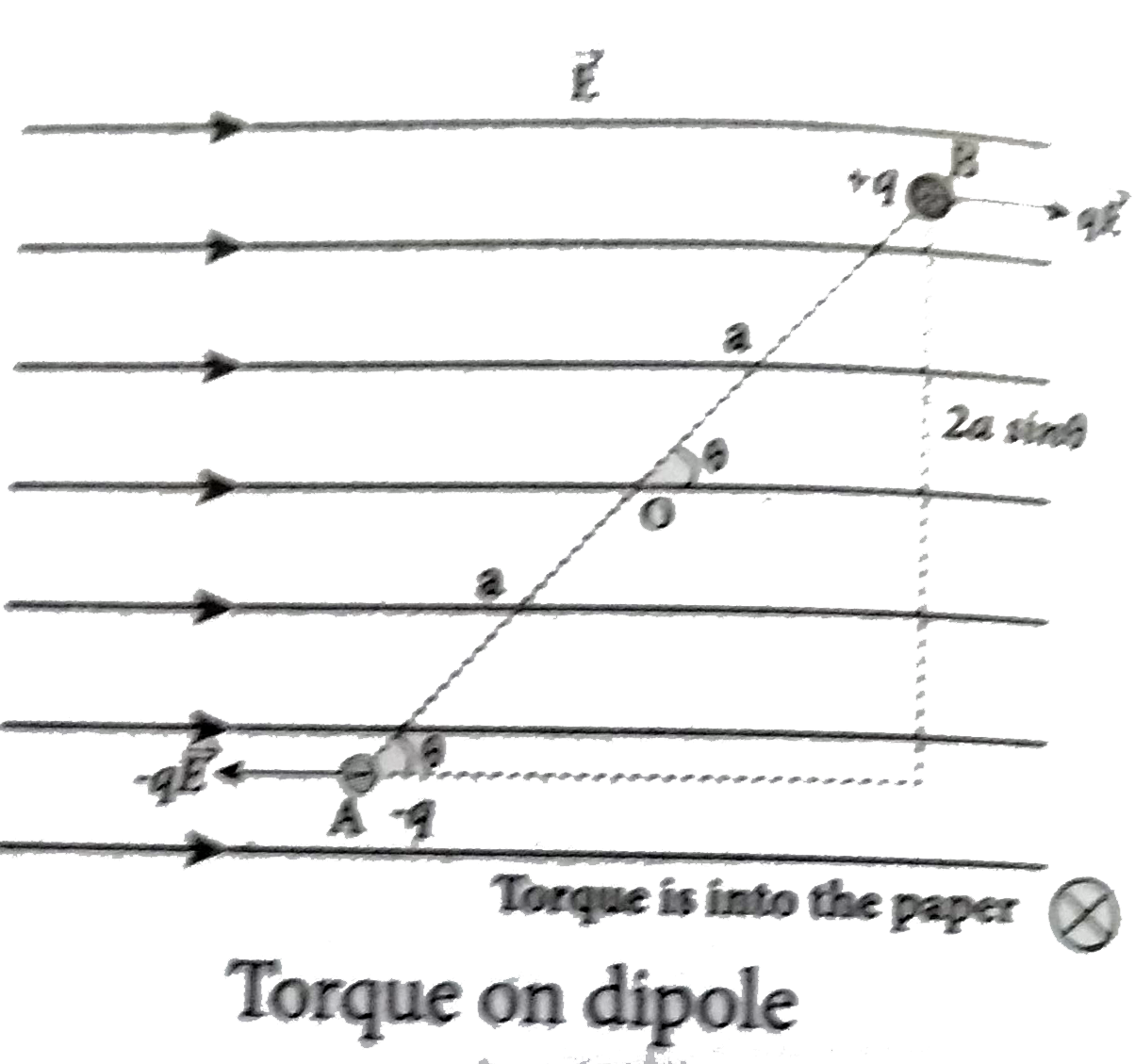
|
|
| 4. |
The given graph represents V-I characterstic for a semiconductor device Which of the following satetement is correct? |
|
Answer» It is `V-I` characterstic for SOLAR cell where point A represented OPEN circuit voltage and point `B` short circuit current |
|
| 5. |
An equiconvex lens with radii of curvature of amgnitude r each, is put over a liquid layer poured on top of a plane mirror. A small needle with its tip on the principal axis of the lens is moved along the axis until its inverted real image coincides with the needle itself, Fig. The distance of needle from lens is measured to be a. On removing the liquid layer and repeating the experiement, the distance is found to be b. Given that two values of distances measured represent the real lenght velues in the two cases, obtain a formula for refractive index of the liquid. |
|
Answer» SOLUTION :Here, COMBINED FOCAL length of glass lens and liquid lens, `F = a`, and Focal length of convex lens, `f_(1) = b`. if `f_(2)` is focal length of liquid lens, then `(1)/(f_(1)) + (1)/(f_(2)) = (1)/(F)` `(1)/(f_(2)) = (1)/(F) - (1)/(f_(1)) = ((1)/(a) - (1)/(b))` The liquid lens is plano concave lens for which `R_(1) = - r, R_(2) = oo` From `(1)/(f_(2)) = (mu - 1)((1)/(R_(1)) - (1)/(R_(2)))` `((1)/(a) - (1)/(b)) = (mu - 1) ((1)/(- r) - (1)/(-oo))` `:. (mu - 1) = (r )/(b) - (r )/(a)` `mu = 1 + (r)/(b) + (r )/( a)` 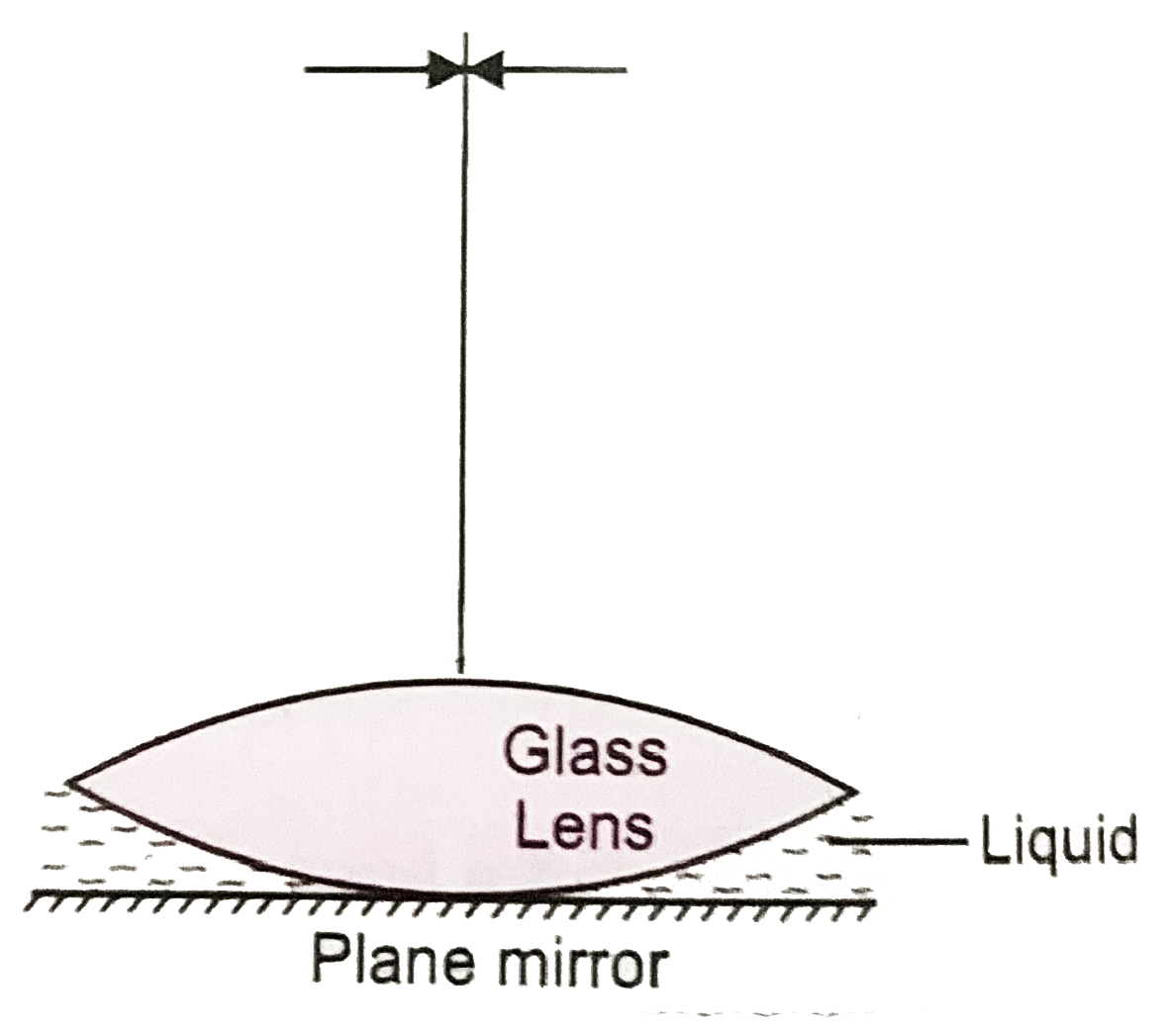
|
|
| 6. |
The force per unit charge is known as |
|
Answer» ELECTRIC flux |
|
| 7. |
Four times In Fraunhoffer diffraction by single slit having width d. The perpendicular light of wavelength lambda incident on it. The distance between slit and screen is D. If the linear width of central maximum is halve to the width of slit then=..... |
|
Answer» `SQRT((lambdaD)/(4))` `x_(1)=(lambdaD)/(d)` `:.`Linear width of central maximum `=x_(1)+x_(1)` `=2x_(1)` `=(2lambdaD)/(d)` but from GIVEN DATA `(2lambdaD)/(d)=(d)/(2)` `:. d^(2)=4 lambdaD "" :. d=sqrt(4lambdaD)` |
|
| 9. |
Theemf of a batteryis 2 Vanditsinternalresistance is 0.5 Omega. The maximum power which it can deliver to any external circuit will be |
|
Answer» 8 watt |
|
| 10. |
A negligibly small current is passed through a wire of length 15 m and uniform cross-section6.0 xx 10^(-7)m^2 , and its resistance is measured to be 5.0 Omega . What is the resistivity of the material atthe temperature of the experiment ? |
|
Answer» Solution :Here L = 15 , A ` = 6.0 xx 10^(-7) m^2 and R = 5.0 Omega` `THEREFORE RHO = (RA)/(l) = (5.0 xx 6.0 xx 10^(-7) )/(15) = 2 xx 10^(-7) Omega m` |
|
| 11. |
A train carriage moves along the x-axis with a uniform acceleration veca. An observer A in the train sets a ball in motion on the frictionless floor of the carriage with a velocity vecu relative to the carriage. The direction of vecu makes an angle with the x-axis. Let B be an observer standing on the ground outside the train. The subsequent path of the ball will be |
|
Answer» A straight LINE with respect to OBSERVER A |
|
| 12. |
A spherical conductor of radius 2 cm is uniformly charged with 3 nC. What is the electric field at a distance of 3 cm from the centre of the sphare ? |
|
Answer» `3 XX 10^(6)V m^(-1)` `E = (9 xx 10^(9) xx3 xx 10^(-9))/((3 xx 10^(-2))^(2)) = 3 xx 10^(4) V//m` |
|
| 13. |
The electrostaic potential of a charged body representsthe degree of electrification of the body. It detemines the direction of flowof charge betweentwo chargedbodies placed in contact with eachother. Charegealways flows a body at higher potentialto anotherbody at lower potential. The flow of charge stopsas soonas the potentials of the two bodies become equal. Electrostatic potential in electrically corresponds to levelin case fo liquids ,pressure in case of gases and temperaturein case of heat. Due to a pointchargeq in air, electrostatic potentials at a distance r from the charge is V = (q)/(4pi in_(0) r) The SI unit of potential is volt. Read the above passage and answer the follwing questions : (i) The capacity of a bodyA is 100 timesthe capacity of body B and charge on A is 10 times the charge on B. When A and B are put in contact with eachother, will charge flow from A to Bto A ? Why ? (ii) Calcualte the potential in air at a point 1 meter away from chargeof 1muC. (iii) What values of life do yo+-earnfrom theconcept of electric potential ? |
|
Answer» Solution :(i)`V_(A) = (q_(A))/(C_(A)) and V_(B) = (q_(B))/(C_(B)) :. (V_(B))/(V_(A)) = (q_(B))/(C_(B)) xx(C_(A))/(q_(A)) = (C_(A))/(C_(B)) xx (C_(A))/(q_(A)) = 100xx (1)/(10) = 10` `V_(B) gt V_(A)` `:.` CHARGE wouldflow fromB to A, as potentialof B is greater than POTENTIAL of A. (ii) From `V = (q)/(4pi in_(0) r) = ((10^(-6))xx9xx10^(9))/(1) = 9xx10^(3)` volt. (iii) The concept of potential emphasises taht chargesflowsfrom a body at higherpotential to a body at lowerpotential . In dayto day life, knowledgeflows from a personof higher learninglevelto thethe person of lowerlearninglevel. If we happen to havesome health problem, we mustalways seek the opinion of asuper specialistin the field concerned. The knowledge and INFORMATION the super specialist have is of muchhigher level. The line of treatmentadopted by himis going to cure us. The QUACKS who might have more knowledge of avariety of other fields SHALL be of no use. |
|
| 14. |
A particle of mass m and change q enter the region between twocharged plates. The length of the plate is L and there is a uniform electric field 'E' between those plates as shown. Charge q enters into the field with an initial speed U as shown. Find the vertical deflection of the particle at the far edge of the plate? |
|
Answer» Solution :Here charged particle EXPERIENCES force along vertical DIRECTION which is equal to EQ. As a RESULT its acceleration in the vertical direction is `(Eq)/(m)`. Along the horizontal direction, its velocity doesnot change. Time taken by the CHARGE to reach the other end of the plate is `t=(L)/(U)` During this time its vertical deflection is given by `y=(1)/(2) at^(2)` `y=(1)/(2) (Eq)/(m)((L)/(U))^(2) =(EqL^(2))/(2mU^(2))` |
|
| 15. |
Whichamongthe curvescannot possibly representelectrostatic fieldlines ? |
| Answer» SOLUTION :`9.81 xx10^(-4)` MM | |
| 16. |
In Young's double slit experiment with a mono - chromatic light of wavelength 4000 A^(@), the fringe width is found to be 0.4 mm. When the slits are now illuminated with a light of wavelength 5000A^(@) the fringe width will the |
|
Answer» 0.32 mm |
|
| 17. |
vecB is the magnetic field perpendicular to the plane of the coil, then flux linked with coil is given by phi= .... [Area of coil =A] |
|
Answer» `phi=AB` `phi=AB cos 0^@ =AB` |
|
| 18. |
A particle of mass m is kept on the axis of a fixed circular ring of mass M and radius R at a distance x from the centre of the ring. Find the maximum gravitational force between the ring and the particle. |
|
Answer» |
|
| 19. |
An object is projected from the earth's surface with escape velocity at 30^(@) with horizontal. What is the angle made by the velocity with horizontal when the object reaches a height 2R from the earth's surface ? R is the radius of the earth. Horizontal can be considered as a line parallel to the tangent at the earth's surface just below the object . |
|
Answer» `30^(@)` |
|
| 20. |
In an experiment on photoelectric effect, the slope of the cut-offf voltage versus frequency of incident light is found to be 4.12xx10^(-15)V s. calculate the value of Planck's constant. |
|
Answer» Solution :As per Einstein.s photoelectric EQUATION, slope of `V_(0)-v` graph is `(h)/(E)=4.12xx10^(-15)V` s `THEREFORE`Planck.s constant `h=4.12xx10^(-15)xxe=4.12xx10^(-15)xx1.6xx10^(-19)=5.59xx10^(-34)Js`. |
|
| 21. |
Consider a two-particle system with particles having masses m_1and m_2 . If the first particle is pushed towards the centre of mass through a distance d, by what distance should the second particle be moved, so as to keep the centre of mass at the same position? |
|
Answer» `(m_2)/(m_1)d` `(m_1v_1 + m_2v_2)/(m_1 + m_2) = 0` Where, `v_1 andv_2` are the velocities of PARTICLES 1 and 2, respectively. `implies m_1(dr_1)/(dt) + m_2(dr_2)/(dt) = 0 ""[ :' v_1 = (dr_1)/(dt) and v_2 = (dr_2)/(dt)]` `implies m_1 dr_1 + m_1dr_2 = 0` `dr_1 and dr_2` represent the CHANGE in displacement of particles. Let `2^(nd) particle has been displaced by distancex. `implies` m_1(d) + m_2(x) = 0 "or" x = - (m_1d)/(m_2)` . 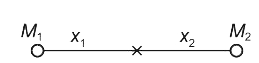 `X_(CM) = (m_1x_1 + m_2x_2)/(m_1 + m_2) "".....(i)` After MOVING `m_1`through a distancetowards CM and to keep the position of CM UNCHANGED, letbe the shift of`m_2`. `X_(CM) = (m_1(x_1 - d) + m_2(x_2 + d'))/(m_1 + m_2) "".....(iii)` From Eqs. (i) and (ii), we get `(m_1x_1 + m_2x_2)/(m_1 + m_2) = (m_1(x_1 -d)+m_2(x_2 + d))/(m_1 + m_2) implies -m_1d + m_2d' = 0 "":. ""d' = (m_1)/(m_2)d` . |
|
| 22. |
In case of three plane mirrors meeting at a point to form a corner of a cube, if incident light suffers one reflection on each mirror, |
|
Answer» The EMERGENT ray is ANTI - parallel to incident one |
|
| 23. |
A block is lying on an inclined plane which makes an angle of 60^@ with the horizontal. If coefficient of friction between the block and the plane is 0.25 and g = 10 ms^(-2), the acceleration of block when it is moves along the plane will be |
|
Answer» `2.5 MS^(-2)` |
|
| 24. |
Tyre of a bicycle has volume 2 xx 10^(-3) m^(3). Initially the tube is filled 75% of its volume by air at atmospheric pressure 10^(5)Nm^(-2). When a rider is on the bicycle, the area of contact of tyre with road is 24 xx 10^(-4) m^(2). The mass of rider with bicycle is 120kg. If a pump delivers a volume 500 cm^(3)of air in each stroke, then the number of strokes required to inflate the tyre is (g = 10 ms^(-2)) |
|
Answer» 10 `=(F)/(A) + p_("atm") = (120 xx 10)/(24 xx 10^(-4)) + 1 xx 10^(5) = 6 xx 10^(5) (N)/(m^(2))` Number of moles of air in the tube `n_(1) + (pV)/(RT) = (6 xx 10^(5) xx 2 xx 10^(-3))/(RT)` Volume of these moles at atmospheric pressure is `V_(1) = (nRT)/(p_("atm")) = (6 xx 10^(5) xx 2 xx 10^(-3))/(1 xx 10^(5))` `=12 xx 10^(-3)m^(3)` Initial volume of air inside tyre `V_(0) = (75)/(100) xx 2 xx 10^(-3) = 1.5 xx 10^(-3) m^(3)` So, to inflate the tube volume to be pumped in is `V_(2) - V_(1) - V_(0) = (12 - 1.5) xx 10^(-3)` `=10.5 xx 10^(-3) m^(3)` HENCE, number of strokes of pump required `=N = (V_(2))/(V_("pump")) = (10.5 xx 10^(-3))/(500 xx 10^(-6)) = 21` |
|
| 25. |
An infinite number of electric charges each equal to 5 nano - coulombs (magnitude) are placed along X-axis at x = 1 cm, x = 2 cm, X = 4 cm, x = 8 cm ....... and so on. In this setup if the consecutive charges have opposite sign, then the electric field at x = 0 (1/(4 pi epsilon_0) = 9 xx 10^(9) N - m^2//c^2) |
|
Answer» `12 xx 10^(4) N//C` |
|
| 26. |
Two large parallel metal carry charges +Q and –Q respectively . A test charge q_0 placed between them experiences a force F. If the separation between the plants is doubled, then the force on the test charge will be |
|
Answer» F |
|
| 27. |
A shell of mass 0.02 kg is fird by a gun of mass 10 kg. If the muzzle speed of the shell is 600 ms^(-1), what is the recoil speed of the gun? |
|
Answer» 0.12 m/s |
|
| 28. |
Two lightsources have intensity of light as I_(0), What is the intensity at a point where the two light waves have a phase difference of pi//3? |
|
Answer» Solution :LET the INTENSITIES be `I_(0)`. The resultant intensity is, `I=4I_(0)COS^(2)(phi//2)` Resultant intensity when, `phi=pi//3,isI=41_(0)cos^(2)(pi//6)` `1=41_(0)(sqrt(3)//2)^(2)=31_(0)` |
|
| 29. |
Two batteries of emf 12V and 6V and internal resistance 2Omega and 1Omega are connected in parallel and the combination is connected to a resisor of 2Omega through a key. Find the potential difference between the positive and negative terminals of the batteries (a) When key is open, b) when key is closed. Find the emf and internal resistance of a single cell which would be equivalent to the combination. |
|
Answer» |
|
| 30. |
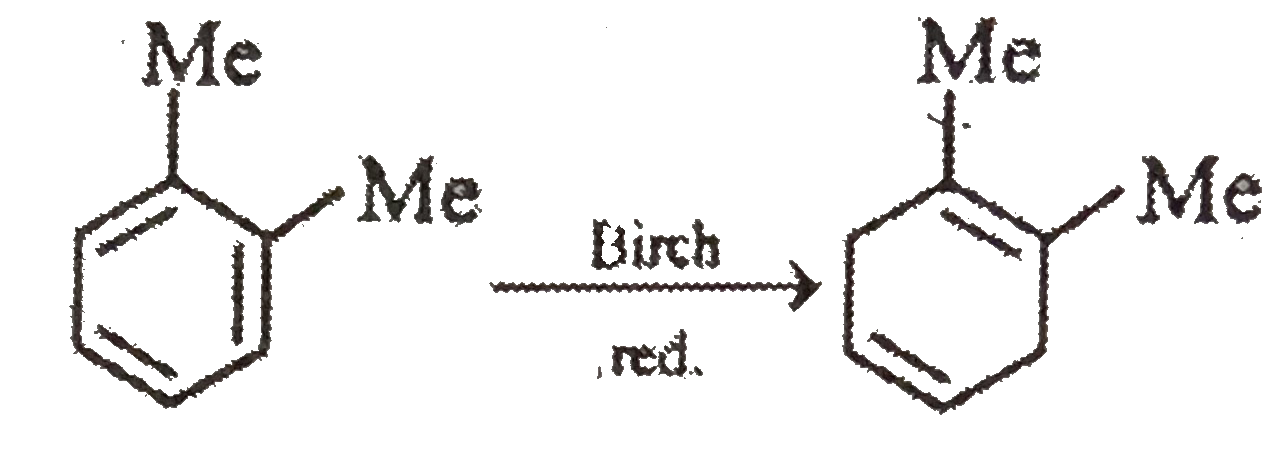
(A) would be - |
|
Answer»
|
|
| 31. |
Do material have same color, when viewed by reflected light or through transmitted light ? |
| Answer» Solution :It is not necessary. A material may REFLECT ONE COLOR strongly and transmit other color. | |
| 32. |
The ratio of the radii of the nuclei ._13Al^27 and ._52Te^125 is |
|
Answer» `5:3` |
|
| 33. |
There is small air bubble inside a glass sphere (mu = 1.5) of radius5 cm. The bubbleis at 'O' at 7.5cmbelow the surfaceof the glass. The sphere is placedinsidewater (mu = (4)/(3)) such thatthe top surfaceof glass is 10cm belowthe surfaceof water. The bubbleis viewednormally from air. Findthe apperentdepth of the bubble. |
|
Answer» |
|
| 34. |
Assertion:Semiconductors have -ve temperature coefficient of resistance. Reason: As temperature of a semiconductor increases, number density of charge carriers also increases. |
|
Answer» Both ASSERTION and REASON are correct, but REA SON is not PROPER explanation. |
|
| 35. |
A ray of light from a denser medium strikes a rarer medium. The reflected and refracted rays makean angle of 90^@ with each other. The angles of reflection and refraction are r and r'. The critical angle would be |
|
Answer» `SIN^(-1)(TAN R)` |
|
| 36. |
The dimensions of resistivity in terms of M, L, T and Q, where Q stands for the dimensions of charge is 7 |
|
Answer» `ML^(3)T^(-1)Q^(-2)` |
|
| 38. |
In a double slit experiment, two coherent sources have slightly different intensities I and (I + delta I), such that delta I lt lt I. Show that resultant intensity at maxima is near 4 I, while that at minima is nearly (delta I)^(2)//4 I. |
|
Answer» Solution :From `I = I_(1) + I_(2) + 2sqrt(I_(1)I_(2)) cos phi` `I_(MAX) = I_(1) + I_(2) + 2sqrt(I_(1)I_(2)) cos 0^(@) = I + (I + DELTA I) + 2 sqrt(I(I + delta I))` As `DELTAI lt lt I`, therefore, `I_(max)I + I 2 I = 4I` Again from`I = I_(1) + I_(2) + 2sqrt(I_(1)I_(2)) cos phi` `I_(min) = I + (I + deltaI) + 2sqrt(I(I + deltaI)) cos 180^(@) = 2I + delta I - 2 I(1 + (delta I)/(I))^(1//2)` `= 2 I + delta I - 2 I [1 + (1)/(2) (delta I)/(I) + ((1)/(2)((1)/(2) - 1))/(2!)((delta I)/(I))^(2)] = 2 I + delta I - 2 I - delta I + (1)/(4)I((delta I)/(I))^(2) = (delta I)^(2)/(4I)` |
|
| 39. |
The pulley A and C are fixed while the pulley B is movable. A mass M_2 is attached to pulley B , while the string has masses M_1 and M_3 at the two ends. Find the acceleration of each mass . |
|
Answer» Solution :The force acting on masses ` M_1 , M_2 and M_3` are shown in figure . Let ` a_2 and a_3` be upward accelerationof masses ` M_1 and M_3 and a_2` the DOWNWARD acceleration of mass `M_2` . For motion of mass `M_1 ` ` T-M_1 g = M_1 a_1 `....... (1) For motion of mass `M_3` `T-M_3g = M_3 a_3` ........ (2) For motion of mass `M_2` `M_2g - 2T= M_2 a_2` ......... (3) Let ` l_1 , l_2 , l_3` be the lengths of VERTICAL portions of the string between pulley at any instant. `M_1` goes up through ` x , M_2` goes down through y and `M_3` goes up through z. Then ` l_1 + 2l_2 + l_3 = ( l_1 - x) + 2 (l_2 + y) + l_3 -z` `implies x + z = 2y implies (d^(2) x)/( dt^(2)) + (d^(2) z)/(dt^(2)) = 2(d^(2) y)/(dt^(2))` ` a_1 + a_3 = 2a_2 implies a_2 =(a_1 + a_3)/( 2) `.......... (4) From (1) , ` a_1 =(T)/(M_1) - g ` ....... (5) 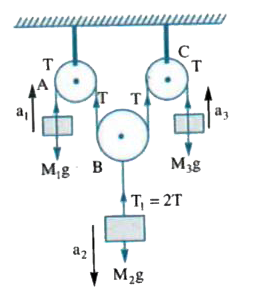 From (2) ` , a_3 = (T)/(M_3)-g` ............ (6) substituting ` a_1 and a_3 ` is (4) , we get ` a_2 =(T)/(2) ((1)/(M_1) + (1)/(M_3))-g`......... (7) From (3) , `T=(M_2(g-a_2))/(2)` .......... (8) substituting this value in (7) , we get `a_2 =(M_2)/(4) (g-a_2)((1)/(M_1 ) + (1)/(M_3))-g or a_2 = (M_2 (g-a_2) (M_3+M_1))/(4M_1M_3)-g` ` or 4M_1M_3 a_2 _ M_2(M_1 + M_3) g -M_2(M_1 + M_3) a_2- 4M_1 M_3 g ` `or [4M_1M_3 + M_2(M_1 + M_3)]a_2 = (M_1 + M_3) M_2 g - 4M_1 M_3 g ` ` a_2 = ((M_1 + M_3) M_2 g - 4M_1 M_3g)/(4M_1 M_3 + M_2(M_1 + M_3))` `a_2=(M_1M_2 + M_2 M_3 - 4M_1 M_3)/(M_1 M_2 + M_2M_3 + 4M_1 M_3 )g`...... (9) substituting value of T from (8) in (5) ` a_1 =(M_2(g-a_2))/(2M_1)-g` Substituting value of`a_2` in above equation , we get ` a_1 =(-M_1 M-2 + 3M_2 M_3- 4M_1 M_3)/(M_1 M_2 + M_2M_3 + 4M_1 M_3)g` ........ (10) SIMILARLY from (6) and (9) `a_3=(3M_1M_2 - M_2 M_3 - 4M_1 M_3)/( M_1 M_2 + M_2 M_3 -4M_1 M_3)` ........ (11) |
|
| 41. |
Two plane mirrors are parallel to each other an spaced 20 cm apart. An object is kept in between them at 15cm from A out of the following at which point on image is not formed in mirror A (distance measured from (d) Between 0 and + o. Ans. (b) + 1] mirror A) |
|
Answer» 15cm |
|
| 42. |
The current density in a wire of radius a varies with radial distance r as J=(J_0r^2)/a, where J_0is a constant. Choose the incorrect statement. |
|
Answer» Total CURRENT passing through the cross-section of the WIRE is`I=(piJ_0a^3)/2` |
|
| 43. |
Root mean square velocity of gas molecules is independent of |
|
Answer» ABSOLUTE TEMPERATURE of GAS |
|
| 44. |
The instantaneous values of alternating current and voltages in a circuit are given as i=(1)/(sqrt(2))sin(100pit) e =(1)/(sqrt(2))sin(100pit+pi//3) volt The average power in watts consumed in the circuit is |
|
Answer» `(1)/(4)` |
|
| 45. |
A bar magnet is released into a copper ring directly below it with its axis vertical The acceleration of the magnet will be |
|
Answer» EQUAL to g |
|
| 46. |
Three charges of magnitude q, 2q and 8q are to be placed on a line of length 9 cm in such a way that the potential energy of the system of charges is minimum. Determine the positions of the charges. |
|
Answer» |
|
| 47. |
Define the peak value of an AC. |
| Answer» SOLUTION :The peak value of an AC is the maximum value attained by that AC voltage/current in EITHER half cycle. | |
| 48. |
What is the deviation produced by a thin prism of angle 8^(@) and of R.I. 1.5? |
|
Answer» `((MU - 1))/A` |
|
| 49. |
A capacitor is charged steadily from a DC source. Correct variation of potential difference across the plates of capacitor with charge on the plates of capacitor is |
|
Answer»
|
|
| 50. |
The potential difference across the 3Omega register shown in figure is: |
|
Answer» Zero |
|