

Saved Bookmarks
This section includes 7 InterviewSolutions, each offering curated multiple-choice questions to sharpen your Current Affairs knowledge and support exam preparation. Choose a topic below to get started.
| 1. |
A converging beam of light is intercepted by a slab of thickness t andrefractive index mu, By what distance will the convergence point be shiffted? Illustrate the answer. |
| Answer» SOLUTION :`X=(1-1/mu)` | |
| 2. |
In a toy truck the volume of its tyre tube is 2000 cm^(3) in which air is filled at a pressure of 2xx10^(5)N/m^(2). When the tube gets punctured, its volume reduces to 500 cm^(3). Find the number of moles of air leaked out in the puncture. Given that the atmospheric pressure is 1xx10^(5) N/m^(2) and atmospheric temperature is 27^(@)C. |
| Answer» SOLUTION :`0.14` MOLES | |
| 3. |
The stoppingpotentialforphoto electronsdoes notdepend on |
|
Answer» the INTENSITY ofincidentlight |
|
| 4. |
A can of cookies is made to move along an x axis from x=0.25 mto x= 2.25 m by a force with a magnitude given by F= exp (-4x^(2)), with x in meters and F in newtons. ( Here exp is the exponential function.) How much work is done on the can by the force ? |
|
Answer» |
|
| 5. |
A star moves away from the earh at a speed of 0.8 c whileemitting light of frequency6 xx 10^(14) Hz . Whatfrequency will be observed on the earth ( in unitsof10^(14)Hz) ? ( c=speed of light ) |
|
Answer» 0.24 `:. v'=6 XX 10^(14)(1-(0.8c)/(c))` `=6 xx 10^(14) xx 0.2 =1.2 xx 10^(14) Hz ` `:.` In units of `10^(14) Hz `, v'=1.2 |
|
| 6. |
Given ver c=2 hat i+hat j+hat k and vec P=2 hat i+3 hat j+hat k angular momentum vec L is: |
| Answer» Answer :C | |
| 7. |
The capacity of a parallel plate condenser is given by, |
|
Answer» C = QV |
|
| 8. |
A series LCR circuit with R = 20 Omega , L =1 .5H and C= 35 muF is connected to a variable-frequency 200V ac supply. When the frequency of the supply equals the natural frequency of the circuit,what is the average power transferred to the circuit in one complete cycle ? |
|
Answer» Solution :Here resonance has taken PLACE `( :. omega = omega_(r )` ). HENCE average power transferred PER one cycle is maximum EQUAL to , `P = ( V_(rms)^(2))/( R )``( :.` At resonance , `| Z | = ` min = R ) `= ( ( 200)^(2))/( 20)` `= 2000W` |
|
| 9. |
A system consits of a uniformly charged sphere of radius R and a surrounding medium filled by a charge with the volume density rho=alpha/r, where alpha is a positive constant and r is the distance from the centre of the sphere. Find the charge of the sphere for which the electric field intensity E outside the sphere is independent of R. |
|
Answer» `alpha/(2epsilon_(0))` `UNDERSET(s)intE.ds=(Q_(enc))/(epsi_(0))` `E4pir^(2)=(1)/(epsi_(0))(q+underset(R)overset(r)int(alpha)/(r)(4pir^(2))dr),` `E4pir^(2)=((q-2pialphaR^(2)))/(epsi_(0))+(4pialphar^(2))/(2 epsi_(0))` The intensity E does not depend on R if `(q-2pialphaR^(2))/(epsi_(0))=0or q=2pialphaR^(2)` |
|
| 10. |
Two waves travelling in opposite directions produce a standing wave. The individual wave functions are y_(1) = (4.0 cm) sin (3.0 x - 2.0t) y_(2) = (4.0 cm) sin (3.0 x + 2.0t) where x and y are in cm (a) Find the maximum displacement of a particle ofthe medium at x = 2.3 cm (b) Find the position of the nodes and antinodes. |
|
Answer» Solution :(a) When the two waves are summed, the result is a standing wave whose mathematical representation is given by equation, with A = 4.0 CM and K = 3.0 RAD/cm`y = (2A sin kx) cos omegat = [(8.0 cm) sin (3.0 x)] cos (2.0t)` Thus, the maximum displacement of a particle at the position x = 2.3 cm is `y_(max) = [(8.0 cm) sin 3.0x]_(x = 2.3 cm)` ` = (8.0 m) sin (6.9 rad) = 4.6cm`(b) Because `k = 2PI //lambda = 3.0` rad/cm, we see that `lambda` ` = 2pi//3cm` Therefore, the antinodes are located at `x = n((pi)/(6.0))` cm (n = `1, 3, 5,.....) and the nodes are located at ` x = n (lambda)/(2) (pi)/(6.0)` cm (n = 1, 2, 3,......) |
|
| 11. |
A horizontal force F is applied to a block of mass m on a smooth fixed inclined plane of inclination thetato the horizontal as shown in the figure. Resultant force on the block up the plane is: |
|
Answer» `F sin THETA + MG COS theta` |
|
| 12. |
The refractive index of diamond is 2 and the velocity of light in diamond in cm per second is approximately: |
|
Answer» `6xx10^10` |
|
| 13. |
The refractive indices of glass and water with respect to air (1)/(2) and (1)/(sqrt(3)) respectively. Then the refractive index of are glass with respect to water is |
|
Answer» `(1)/(sqrt3)` `therefore ""^(w)mu_(g)=(""^(a)mu_(g))/(""^(a)mu_(g))=(1//2)/(1//sqrt3)=(sqrt3)/(2)` |
|
| 14. |
In a single-slit diffraction pattern, how does the angular width of central maximum change, when (i) slit width is decreased, (ii) distance between the slit and screen is increased, and (iii) light of smaller visible wavelength is used ? Justify your answer in each case. |
|
Answer» Solution :We know that ANGULAR width of central maximum of diffraction pattern of a single-SLIT is given by `alpha=2theta=(2lamda)/(a)` (a) if slit width .a. is decreased, the angular width will increase because `alphaprop(1)/(a)`. (ii) Increase of distance between the slit and the screen does not affect the angular width of diffraction MAXIMA. (iii) If light of smaller VISIBLE wavelength is used, the angular width is decreased because `alphaproplamda.` |
|
| 15. |
The clouds are generally white. Why? |
| Answer» Solution :ACCORDING to Rayleigh SCATTERING, larger particles like DUST PRESENT in the atmosphere do not scatter light selectively. Dust particles scatter light of all colours almost EQUALLY and hence clouds are white in colours. | |
| 16. |
A radioisotope with At. wt. 99 has a half-life of 6 hours. A solution with 10^(-12) gm of this isotope is provided to perum, Then Activity of solution in beginning is |
|
Answer» `7.02 xx 10^(8)//hr` B.E.=mass defect in ENERGY units. Then, `160.6=(10 xx 1.007825 +10 xx 1.008655-M) xx 931` `rArr M=19.9924 a.m.u.` |
|
| 17. |
How low frequency e.m.w. behave ? |
| Answer» SOLUTION :They are unaffected by EXTERNAL ELECTRIC and MAGNETIC FIELDS. | |
| 18. |
What will be the inputs of A and B for Boolean expression (bar(A + B))+(bar(A.B))=1 ? |
|
Answer» 0,0 |
|
| 19. |
A radioisotope with At. wt. 99 has a half-life of 6 hours. A solution with 10^(-12) gm of this isotope is provided to perum, Then Activity at the end of one hour is |
|
Answer» `3.13 xx 10^(8)//hr` `N=N_(0) (1//2)^(1//6) =5.417 xx 10^(9)` Activity after one hour is `(dN //DT)t=1hr=lambda N=6.26 xx 10^(8)hr` |
|
| 20. |
The distance of the closest approach of an alpha- particle fired at a nucleus with kinetic energy K is r_(0). The distance of the closest approach when the alpha-particle is fire at the same nucleus with kinetic energy 2K will be |
|
Answer» `(r_(0))/(2)` `r_(0)=(2Ze^(2))/(4pi epsi_(0)xxK)` where `2kze^(2)` are constant `:.r_(0)= prop (1)/(K)` `:. ((r_(0))_(2))/((r_(0))_(1))=(K_(1))/(K_(2))=(K)/(2K)` `:.(r_(0))_(2)=((r_(0))_(1))/(2)=(r_(0))/(2) [ :. (r_(0))_(1)=r_(0)]` |
|
| 21. |
Two capacitor 3muFand 6 muF are connected in series across a potential difference of 120 V. Then the potential difference across 3muF capacitor is : |
|
Answer» 40 V |
|
| 22. |
Consider the following statement A and B and identify the correct answer A) When light falls on two polariod sheets having their axes mutually perpendicular it is completely extinguished B) When polyvinyl alcohol is subjected to a large strain the molecules get oriented parallel to the direction of strain then meterial becomes dichoric |
|
Answer» A is FALSE but B is TRUE |
|
| 23. |
Find the kinetic energy of a neutron emerging as a result of the decay of a stationary Sigma^(-) hyperon(Sigma^(-)rarrn+pi^(-)). |
|
Answer» Solution :We have `O=vec(pn)+vec(p_(PI))`....(1) `m_(Sigma)C^(2)=E_(N)+E_(pi)` or `(m_(Sigma)c^(2)-E_(n))^(2)=E_(pi)^(2)` or `m_(Sigma)^(2)c^(4)-2m_(Sigma)c^(2)E_(n)=E_(pi)^(2)-E_(n)^(2)=c^(4)m_(pi)^(2)-c^(4)m_(n)^(2)` because (1) implies `E_(pi)^(2)-E_(n)^(2)=m_(pi)^(2)c^(4)-m_(n)^(2)-m_(n)^(2)c^(4)` Hence `E_(n)=(m_(Sigma)^(2)+m_(n)^(2)-m_(pi)^(2))/(2m_(Sigma))c^(2)` and ` T_(n)=((m_(Sigma)^(2)+m_(n)^(2)-m_(pi)^(2))/(2m_(Sigma))-m_(n))c^(2)=((M_(Sigma)-m_(n))^(2)-m_(pi)^(2))/(2m_(Sigma))c^(2)` Substitution gives `T_(n)= 19.55MeV` |
|
| 24. |
a. Give the expression for the radius of a nucleus. b. What is the ratio of the nuclear radii of ""_(79)^(197)Au and ""_(47)^(107)Ag? c. What is the ratio of their nuclear densities ? |
|
Answer» Solution :a. `R = R_0A^(1/3)` b. `(R_1)/(R_2) = ((197)/(107))^(1/3) ~~1.23` C. Ratio is one. |
|
| 25. |
Explain in detail the nuclear force. |
|
Answer» Solution :Nucleus contains protons and NEUTRONS. From electrostatics, we learnt that like charges repel each other. In the nucleus, the protons are separated by a distance of about a few Fermi`(10^(-15)m)`, they must exert on each other a very strong repulsive force. For example, theelectrostatic repulsive force between two protons separated by a distance `10^(-15)m`. `F xx k xx(q^(2))/(r^(2)) = 9 xx 10^(9) xx(1.6 xx 10^(-19))^(2)/(10^(-15))^(2)approx 230 N` The acceleration experienced by a proton due to the force of 230 N is `alpha = (F)/(m) = (230N)/(1.67 xx 10^(-27) kg) approx 1.4 xx 10^(29) ms^(-2)` This is nearly `10^(28)` times greater than the acceleration due to the gravity. So if theprotons in the nucleus experience only the ELECTROSTATIC force, then the nucleus would fly apart in an instant.From this observation, it was concluded that there must be a strong attractive force between protons to overcome the repulsive Coulomb.s force. This attractive force which holds the nucleus together is called strong nuclear force . Afew properties of strong nuclear force are (i) The strong nuclear force is of very short range, ACTING only up to a distance of a few Fermi. But inside the nucleus,the repulsive coulomb force or attractive gravitational force between the neutons. So nuclear force is the strongest force innature. (ii) The strong nuclear force is attractive and acts with an equal strength between proton-proton, proton-neutron, and neutron - neutron. (iii) Strong nuclear force does not ACT on the electrons. So it does not alter the CHEMICAL properties of the atom. |
|
| 26. |
In ...... atomic model there is descrete distribution of mass. |
|
Answer» THOMSON |
|
| 27. |
Internal resistance of a cell depends on |
|
Answer» CONCENTRATION of electrolyte |
|
| 28. |
Figure shows a metal rod of uniform cross section A, with variable thermal conductivity given by k(x)=k_(0) sec((pi)/(6L)x). If the end A is maintained at temperature T_(0), the rod carries a thermal current I_(0) (from B to A) in steady state and (I_(0)L)/(k_(0)AT_(0))=(pi)/3, find the temperature of the end B of the rod. Let's say this temperature is k T_(0), find integer value k. |
|
Answer» `impliesT=T_(0)+(6I_(0)L)/(pik_(0)A)sin((pi)/(6Lx))` `impliesT=2T_(0)` at `x=L` |
|
| 30. |
An electric bettle has two coils. When one coil is switched on it takes 15 minutes and the other takes 30 minutes to boil certain mass of water. The ratio of times taken by them, when connected in series and in parallel to boil the same mass of water is : |
|
Answer» `1:3` |
|
| 31. |
A T.V transmission tower at a particular station has height 160 m, earth's radius is 6400 km. Coverage range of antenna is |
|
Answer» 55.8 KM = 45.25 km. |
|
| 32. |
A solenoid of length 'l' has N turns of wire closely spaced, each turn carrying a current i. If R is cross sectional radius of the solenoid, the magnetic induction at 'P'(only axial component). |
|
Answer» `(mu_0I N)/2 sqrt(R^2+I^2))` |
|
| 33. |
Two circular coils A and B are facing each other in shown figure. The current I through A can be alterned |
|
Answer» there will be repuision between A and B if I is increased |
|
| 34. |
A river is of width 120m which flows at a speed pf 8ms^(-1). If a man swims with a speed of 5ms^(-1) at an angle of 127^(@) with the stream, his drift on reaching other bank is |
|
Answer» 50 m |
|
| 35. |
When thermal radiations incident on athermanous medium, the temperature of the medium |
|
Answer» increases |
|
| 36. |
For a few minutes before sunrise and for a few minutes after sunset we can see the sun - explain with proper reason. |
Answer» Solution :As the height above the earth.s SURFACE increases, the density of air decreases. Any ray coming obliquely from near the horizon gradually enters denser layers from later of air. So due to refraction, the ray bends towards the GROUND. This incident happens when the sun is below the horizon just after sunset and just before sunrise [FIG. 2.76]. If we see along the direction of the rays REACHING US, the sun appears raised in position in the sky above the horizon. 
|
|
| 37. |
An electron in an unexcited hydrogen atom acquired an energy of 12.1 eV. To what energy level did it jump? How many spectral lines may be emitted in the course of its transition to lower energy levels? Calculate the corresponding wavelengths. |
|
Answer» |
|
| 38. |
A galvanometer of resistanece 40Omega gives a deflection of 5 divisions per mA. There are 50 divisions on the scale. Calculate the maximum current that can pass through it when a shunt resistance of 2Omega is connected. |
|
Answer» |
|
| 39. |
A current flows in a conductor from west to east . What is the direction of the magnetic field at a point below the conductors ? |
| Answer» SOLUTION :TOWARDS NORTH . | |
| 40. |
Which of the following logic gate is an universal gate? |
|
Answer» OR The NAND and NOR gate are USED as universal gates . |
|
| 41. |
The property of electromagnetic wave that remains unchanged when it moves from one medium to another is |
| Answer» SOLUTION :FREQUENCY | |
| 42. |
A p-n junction diode is a |
|
Answer» linear device. |
|
| 43. |
Draw Hysterisis curve (B to H) and explain. |
Answer» Solution :The RELATION between `OVERSET(to) (B) and overset(to) (H)` in ferromagnetic materials is complex. It is often not linear and it depends on the MAGNETIC history of the sample.  Figure depicts the behaviour of the material through one cycle of magnetisation. Let the material be unmagnetised initially. We place it in a solenoid and increase the current through the solenoid. The magnetic field B in the material rises and saturates as depicted in the curve OA. This behaviour represents the alignment and merger of domains until no further enhancement is possible. It is pointless to increase the current (and HENCE the magnetic intensity `H= mu_(0) nI`)beyond this B is not increase. Now by decrease H and reduce it to zero. At `H=0, Bne 0`. This is represented by the curve `ab`. The value of B at H = 0 is called retentivity. In figure `B_R ~1.2 T` where the subscript R denotes retentivity. The domains are not completely randomised even though the external driving field has been removed. Next, the current in the solenoid is reversed and slowly increased. Certain domains are flipped until the net field inside stands nullified. This is represented by the curve `bc`. The value of H at C is called coercivity. In figure it is `H_C ~ 90 A//m.` As the reversed current is increased in magnitude, we once again obtain saturation. This is represented by curve `cd`. The saturated magnetic field `B_S ~ 1.5 T`. Next, the current is reduced (curve `de` ) and reversed (curve `ea`). This cycle repeats itself. Here, the curve `Oa` does not retrace itself as H is reduced. For a given value of H, B is not unique but it also depends on the value of B of the previous magnetisation. This phenomenon is called hysterisis. The word hysterisis means lagging behind. |
|
| 44. |
A neutron causes fission in ""_(92)U^(235) producing ""_(40)Zr^(97), Te^(134) and some neutrons. What is at no. of Te and how many neutrons are released? |
|
Answer» 82,7 `92=40+z rArr z=52` Conserving mass number, `235=97+134+x` `x=4` |
|
| 46. |
The electrical conductivity of pure germanium can be increased by a) increasing the temperature b) doping acceptor impurities c) doping donor impurities d) irradiating ultraviolet light on it |
|
Answer» Only a and B are CORRECT |
|
| 47. |
A point charge q is placed at a point on the axis of a non-conducting circular plate of radius r at a distance R(gt gtr) from its center. The electric flux associated with the plate is |
|
Answer» `(QR^(2))/(4piepsilon_(0)R^(2))` |
|
| 48. |
State the expression for the total energy of a particle performing linear SHM. What conclusions can be drawn from the expression for the total energy ? |
|
Answer» Solution :CONSIDER a particle of mass m performing SHM with AMPLITUDE A and period `T=(2pi)/(omega)'" where "omega=sqrt((k)/(m))` is the APPROPRIATE constant related to the system. The total energy of the particle is `E=(1)/(2) kA^(2)=(1)/(2) m omega^(2)A^(2)` Conclusions : The total energy of the particle (1) is independent of the position of the particle and thus remains constant when m, `omega and A` are constant, (2) is proportional to the mass of the particle `(E prop m),` (3) is proportional to the square of the amlitude `(E prop A^(2))`, (4) is inversely proportional to the square of the period T of the SHM (as `omega=2pi//T)`, (5) is proportional to the square of the frequency f of the SHM (as `omega=2pif`). |
|
| 49. |
The shape of wave front at large distance is approximately ........ |
|
Answer» plane |
|
| 50. |
A rectangular conducting loop of length l and breadth b enters a uniform magnetic field B as shown below. The loop is moving at constant speed v and at t = 0 it just enters the field B. Sketch the following graphs for the time interval t = 0 to t = (3l)/(v). (ii) Induced emf versus times |
Answer» SOLUTION :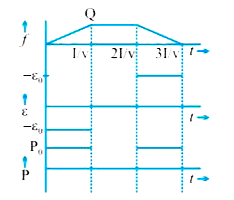 (ii) `epsilon_(0) = BV b` |
|