

Saved Bookmarks
This section includes 7 InterviewSolutions, each offering curated multiple-choice questions to sharpen your Current Affairs knowledge and support exam preparation. Choose a topic below to get started.
| 1. |
In many experimental set-ups, the source and screen are fixed at a distance say D and the lens is movable. Show that there are two positions for the lens for which an image is formed on the screen. Find the distance between these pionts and the ratio of the image sizes for these two points. |
Answer» Solution :  `rArr` According to LAW of reversibility of light , ray, we con interchange the positions of object and its image for a given convex lens. Now, according image for a given convex lens. Now , according to lens formula, `1/f = 1/v - 1/u...... (1)` Now,according to sign convetion in above figure, `therefore - u + v= D ......(2)` `therefore u = - (D- v)` Placing above vlaue in EQUATION (1), `1/f = 1/v + 1/(D-v)` `therefore 1/f = (D)/(v(D-v))` `therefore 1/f = ((D-v)+v)/(v(D-v))` `thereforeD v - v^2 = Df` `therefore Dv - v^2 = Df` `therefore v^2 - Dv + Df= 0 `........(3) `therefore v = (D pm sqrt(D^2 - 4Df)/(2))` `rArr`Above is quadratic equaiton in terms of v whose two roots are, `v = (-(-D) pm sqrt((-D)^2-4(1)(Df)))/(2(1))` `thereforev= (D pm sqrt(D^2-4Df))/(2)`.....(4) `rArr` From equation (2) and (4) `rArr` From equation (2) and (4) `u = - (D -(D pm sqrt(D^2-4Df))/(2))` ` = -((2D-D pm sqrt(D^2 - 4Df))/(2))` `thereforeu = - (D/2 pm sqrt(D^2 - 4Df)/(2))`......(5) `rArr` From equations (4) and (5), we can say that `(i) if u_1 = D/2 + (sqrt(D^2 - 4Df))/(2) ` then `v_1 = D/2 + sqrt((D^2-4Df))/2` (ii) if `u_2 = D/2- (sqrt(D^2 - 4Df))/(2)` then `v_2 = D/2+ sqrt(D^2 - 4Df)/(2)` `rArr` Now, for above two object distances, if distance between corresponding tow positions of lens is d then , `d = D/2 + sqrt(D^2-4Df)/(2)-(D/2 - sqrt(D^2 - 4D f)/(2))` `d = sqrt(D^2- 4Df)` If `mu_1 = D/2 + d/2` then image distance is `v_1 = D/2 - d/2` and MAGNIFICATION `m_1 = (v_1)/(u_1) = (D/2-d/2)/(D/2+d/2)= (D-d)/(D+d)` Now if `u_2 = D/2 -d/2` then `v_2 = D/2 + d/2` and magnification `m_2 = (v_2)/(u_2) = (D+d)/(D-d)` `therefore ` Ration `(m_2)/(m_1) = ((D+d)/(D-d))^2` `rArr` NOTE : Here for real roots of equation (3), `D^2 - 4Dg GT 0` `thereforeD^2 gt 4Df` `therefore D gt 4f` `thererfore D_("min") = 4f` `rArr`Minimum distance between object and its real image obtained by convex lens should be 4f (where f = focal length of that convex lens ). |
|
| 2. |
According to Newton's law, every force is accompanied by an equal and opposite force. How can a movement ever take place? |
| Answer» Solution :Action and REACTION act on different bodies. HENCE, MOTION BECOMES possible. | |
| 3. |
A sphere, a cube and a thin circular plate of same material and mass are heated to 200^(@)C. Which one will cool slowest under conditions ? |
|
Answer» Sphere Hence CORRECT CHOICE is (a). |
|
| 4. |
How much paddy did the landlord give to Gafur? |
|
Answer» PADDY which lasted only for TWO months |
|
| 5. |
Source (s ) of a mangnetic field is (are) |
|
Answer» an ISOLATED magnetic pole |
|
| 6. |
If water has a surface tension of 7 xx 10^-2 N/m and an angle of contact with glass is zero, it rises in a capillary of diameter 0.5 mm to a height |
|
Answer» 70 cm |
|
| 7. |
The formula F = H tan theta can be used in the case of two magnetic fields F and H when the field are inclined to each other at |
| Answer» ANSWER :B | |
| 8. |
For a given impact parameter (b), if the energy increase then the sacttering angle (theta) will |
|
Answer» DECREASE |
|
| 9. |
A parallel plate capacitor of plate area A and plate separation d is charged to a potential V are disconnected. A slab of dielectric constant K is then inserted between the plates of the capacitor so as to fill the space between the plates. The work done on the system during the process of inserting the slab is |
|
Answer» `(epsi_0AV^2)/(d ) (1-1/K)` |
|
| 10. |
Assertion (A) A thermocouple refrigerator is based on the Peltier effect. Reason (R) A thermocouple may be used as a radiation detector |
|
Answer» If both ASSERTION and REASON are TRUE, and Reason is the correct explanation of Assertion. |
|
| 11. |
From a cylinder of radius R, a cyclinder of radius R/2 is removed, as shown . Current flowing in the remaning cylinder is l. magnetic field strength is : |
|
Answer» zero at point A |
|
| 12. |
In the previous example, calculate the magnitude of the tension in the cord. |
|
Answer» Solution :Since the magnitude of a has been determined, we can use either of the TWO ORIGINAL equations to calculate `F_(T)`. Using equation (2), `Mg- F_(T)=Ma` (because it's simpler), we find `F_(T)=Mg-Ma=Mg-M. (3)/(4)g=(1)/(4)Mg=(1)/(4)(10)(10)=25 N` As you can see, we WOULD have found the same answer if we'd used equation (1) : `F_(T)-F_(f)=ma IMPLIES F_(T)=F_(f)+ma= MU mg+ma= mu mg+m. (3)/(4)g= mg(mu +(3)/(4)) = (2)10(0.5+0.75)= 25 N` |
|
| 13. |
A rectangular conducting loop of length l and breadth b enters a uniform magnetic field B as shown below. The loop is moving at constant speed v and at t = 0 it just enters the field B. Sketch the following graphs for the time interval t = 0 to t = (3I)/(v). (i) Magnetic flux versus time |
Answer» SOLUTION :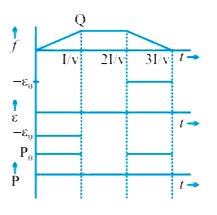 (i) `PHI = BLB` |
|
| 14. |
An electric charge ocillating harmonically is a source of _____________ of same frequency. |
| Answer» SOLUTION :e.m. WAVES | |
| 15. |
Define resistivity of a material and discuss the factors on which it depends. |
|
Answer» Solution :Resistivity (SPECIFIC resistance `rho`) of the MATERIAL of a conductor is defined as the resistance of unit length and unit area of cross-section of the conductor. And `rho=(m)/(n e^(2)tau)` Thus resistivity of the material of a conductor depends upon (i) `rhoprop(1)/(n)` i.e., resistivity is INVERSELY proportional to the NUMBER density of electrons (number of electrons per unit VOLUME) inside the conductor. (ii) `rhoprop(1)/(tau)` i.e. resistivity is inversely proportional to the average relaxation time of the free electrons in the conductor. The value of n depends upon the nature of conductor and `tau` depends upon the temperature of the conductor. |
|
| 16. |
Momentum of photon having 1 MeV energy is |
|
Answer» `7xx10^(-24)` `(1.6)/(3)xx10^(-21)` `=(16)/(3)xx10^(-22)` `~~5xx10^(-22)` kgm/s |
|
| 17. |
In the arrangement shown in figure, the current through 5Omega resister is: |
|
Answer» 2 A |
|
| 18. |
Plot the T-S diagram (i.e. the entropy vs temperature dependence) (a) for an adiabatic process, (b) for an isothermic process. |
Answer» SOLUTION :
|
|
| 19. |
What is the role o f coolant in nuclear reactors? |
| Answer» Solution :The coolant is used to remove the HEAT PRODUCED in fission and passes it to the water in the heat EXCHANGER. | |
| 20. |
The image of a small electric bulb fixed on the wall of a room is to be obtained on the opposite wall 3m away by means of a large convex lens. What is the maximum posible focal length of the lens required for the purpose ? |
|
Answer» Solution :`(1)/(v) - (1)/(U) = (1)/(f) - u + v = 3,` here, v = 3 + u ` (1)/(3+ u) - (1)/(u) = (1)/(f)"i.e.," f = - ((u^(2) + 3u)/(3) ) ` For .f. to be MAXIMUM , `(df)/(du) ` = 0 ie., `(df)/(du) = - (1)/(3) [ 2u + 3]= 0therefore u = (-3)/(2)"" therefore v = 3 + u = 3 - (3)/(2) = (3)/(2) ` `therefore (1)/(f) = (1)/((3)/(2)) - (1)/((-3)/(2)) = (2)/(3) + (2)/(3) = (4)/(3) "" therefore f = (3)/(4) = 0.75` m |
|
| 21. |
The gravitational field due to a mass distribution is E=(K)/(x^(3)) in the x-direction (K is a constant). Taking the gravitational potential to be zero at infinity, its value at a distance x is |
|
Answer» `(K)/(x)` `V=overset(oo)underset(x)INT E.DX=overset(oo)underset(x)int(K)/(x^(3))dx=(K)/(2x^(2))` |
|
| 22. |
Which of the following is not a dimensional constant ? |
|
Answer» gravitational CONSTANT G |
|
| 23. |
Explain the concept of colour code for carbon resistors. |
|
Answer» Solution :Color code for carbon resistors: Carbon resistors consists of a cermic core, on which a thin layer of crystalline carbon is deposited. These resistors are inexpensive, stable and compact in size. Color rings are used to incicate the VALUE of the resistance according to the rules. THREE coloured rings are used to indicate the values of a resistor: the first two rings are significant FIGURES of resistances, the third ring indicates the DECIMAL multiplier after them. The fourth color, silver or gold, shows the TOLERANCE of the resistor at 10% or 5%. If there is no fourth ring, the tolerance is 20%. For the resistor, the first digit = 5 (green), the second digit = 6 (blue), decimal multiplier = `10^(3)` (orange) and tolerance = `5%` (gold). The value of resistance `=56xx10^(3)Omega` or `56k Omega` with the tolerance value `5%`. |
|
| 24. |
A nucleus undergoes beta-decay. How does its (i) mass number, (ii) atomic number change ? |
| Answer» Solution :The MASS number of nucleus REMAINS unchanged but its atomic number increases by ONE. | |
| 25. |
Two satellites of masses 100 kg and 400 kg orbit around the earth in circular orbits of the same radius. The ratio of the orbital speed of 100 kg satellite to the orbital speed of400 kg satellite is, |
|
Answer» a)`r_1/r_2` |
|
| 26. |
What is the meaning of 'unconscious'? |
|
Answer» fainted |
|
| 27. |
A plano-convex lens behaves as a concave mirror of focal length 30 cm when its plane surface is silvered and as a concave mirror of focal length 10 cm when its curved surface is silvered. What is the radius of curvature of curved surface and muof the material of lens? |
| Answer» SOLUTION :R=30 CM and `MU` = 1.5 | |
| 28. |
Huygen's principle allows us to determine, |
|
Answer» Shape of wavefront at any instant, if the shape of wavefront at EARLIER TIME is not known. |
|
| 29. |
A carbon resistor of (47pm 4.7)kOmega is to marked with rings of different colours for its identification. The colour code sequence will be |
|
Answer» Violet - YELLOW - Orange - Silver |
|
| 30. |
What is potential energy of a dipole ? |
|
Answer» Solution :The work done in rotating a DIPOLE in the magenatic field is STORED into as potential energy 1 U= MH `[cos theta_1- cos theta_2]` when MAGNET rotates from `thita_1` to `thita _2` against a torque. Let `theta _1=90^@` and `theta_2=theta` Then U = - MH cos Q = - `vec M vec H` For `theta = 0^@`, U= + MH (minimum) For `theta = 90^@`,U = 0 `theta = 180^@`, U = - MH (maximum) |
|
| 31. |
.^(131)I is an isotope of Iodine that beta decays to an isotope of Xenon with a half-life of 8 days. A small amount of a serum labelled with .^(131)I is injected into the blood of a person. The activity of the amount of .^(131)I injected was 2.4 xx 105 Becquerel (Bq). It is known that the injected serum will get distributed uniformly in the blood stream in less than half an hour. After 11.5 hours, 2.5 ml of blood is drawn from the person's body, and gives an activity of 115 Bq. The total volume of blood in the person's body, in liters is approximately (you may use ex e^(x) ~~ 1 + x "for" |x| < < 1 and In 2~~ 0.7) |
|
Answer» |
|
| 32. |
Electronic configuration of some elements are given: A: 1s^(2) 2s^(2) B: 1s^(2) 2s^(2) 2p^(6) C: 1s^(2) 2s^(2) 2p^(6) 3s^(2) D: 1s^(2) 2s^(2) 2p^(3) E: 1s^(2) 2s^(2) 2p^(5) The most ionic compound will be formed between - |
|
Answer» A and D |
|
| 33. |
What percentage of a radioactive substance will left undecayed after four half-life periods? |
| Answer» SOLUTION :`N//N_(0) =1//2^(4) = 1//6 = 6.25%` | |
| 34. |
Explain the use of Zener diode as a voltage regulator. |
|
Answer» SOLUTION :When the ac input voltage of a rectifier fluctuates, its rectified output also fluctuates. To get a constant dc voltage from the dc unregulated output of a rectifier a zener diode can be used. The circuit diagram of a dc voltage regulatorusing a zener diode is shown in figure.  The unregulated dc voltage (filtered output of a rectifier) is connectedto the zener diode which through a series resistance `R_(S)` such that the zener diode is REVERSE biased. If the input voltage increases, the current through `R_(S)` and zener diode also increases. This increases the voltagedrop across `R_(S)` without any change in the vltage across the zener diode. This is because in the breakdown region, zener voltage REMAINSCONSTANT even though the current through the zener diode changes. Similarly, if the inputvoltage DECREASES the current through `R_(S)` and zener diode also decreases. The voltage drop across `R_(S)` decreaseswithout any change in the voltage across the zener diode. Thus, any increase\decrease in the inputvoltage results in increase\decrease of the voltage drop across `R_(S)` without any change in voltage across the zener diode. Thus, the zener diode acts as a change in voltage across the zener diode we have to select thezener diode according to the required output voltage and ACCORDINGLY the series rresistance `R_(S)`. |
|
| 35. |
If the length of a simple pendulum is increased by 2%, then the time period |
|
Answer» increases by 1% THEREFORE `T_(2)/T_(1) = sqrt(I_(2)/I_(1)) = sqrt((1.02 l_(1))/l_(1)) = 1.01` THUS, time period INCREASED by 1%. |
|
| 36. |
Three objective focal lengths (f) and two eye piece focal lengths (f) are available for a compound microscope. By combining these two, the magnification of microscope will be maximum when: |
|
Answer» `f_(0)=f_(e)` |
|
| 37. |
Who is Think Tank? |
|
Answer» Secretary |
|
| 38. |
Weak back-ground noise from a classroom set up the fundamental stationary wave in a card-board tube of length 80 cm with two open end. What frequency do you hearfrom the tube (a) Ifyou jam your ear against one end ? |
|
Answer» |
|
| 39. |
In a current carrying long solenoid the field produced does not depend upon |
|
Answer» number of turns PER unit length |
|
| 40. |
Weak back-ground noise from a classroom set up the fundamental stationary wave in a card-board tube of length 80 cm with two open end. What frequency do you hearfrom the tube (b) If your move your ear away enough so that the tube has two open ends. Take v = 320 m/s. |
|
Answer» |
|
| 41. |
A force F = (x hat i+2y hat j)N is applied on an object of mass 10 kg, Force displaces the object from position A(1, 0) m to position B(3, 3) m then the work done by the force is (x and y are meter) |
|
Answer» 8 J |
|
| 42. |
A chargeQ is placed at the centreof the line joiningtwocharges q and q. The system of three chargesto be in equilibrium, what should be the value of Q? |
|
Answer» Solution :Here Q is in equilibrium as it is at the centre and net force on it is ZERO For equilibrium of q, net force on it must be zero `(1)/(4pi in_(0)) (Qq)/( (R//2)^(2)) +(1)/(4pi in_(0)) (q^(2))/(r^(2))=0` where r is seperation between q and q `rArrQ=(-q)/(4)` |
|
| 43. |
Light waves can be polarised as they are |
|
Answer» TRANSVERSE waves |
|
| 44. |
According to Classical theory, the Rutherford's model of atom is: |
|
Answer» Stable |
|
| 45. |
A nucleus of Ux_1 has a half life of 24.1 days. How long a sample of Ux_1 will take to change to 90% of Ux_2. |
|
Answer» 80 DAYS `N=N_0-90%` of `N_0 = N_0/10` As N=`N_0e^(-lambdat)` `therefore N_0/10=N_0e^(-lambdat)` or `1/10 = e^(-lambdat)` or `10=e^(lambdat)` or `log_e10= lambdat` `therefore t=1/lambda_"log"_e 10=(2.303 log 10)/0.02870 = (2.303xx1)/0.02876 `= 80 days |
|
| 46. |
Assertion:The couple acting on a body is not equal to the rotational KE of the body Reason: Couple and KE have different dimensions |
|
Answer» both Assertion and Reason are both are both wrong |
|
| 47. |
A room has AC run for 5 hours a day at a voltage of 220V. The wiring of the room consists of Cu of 1mm radius and a length of 10m. Power consumption per day is 10 commerical units. What fraction of its goes in the joule heating in wires? What would happen if the wiring is made of aluminium of the same dimensions. |
|
Answer» SOLUTION :Power consumption in 1 day (5 hours) P. = 10 unit `therefore `Power consumed in 1 hour, P ` = (P.)/(5) = (10)/(5) = 2 `unit. `therefore P = 2 ` kW `"" [ because 1 " unit = 1000 Watt" ] ` `therefore P = 2000 (J)/(s)` Power dissipated in resistor P = VI `therefore 2000 (J)/(s) = 220V x I` `therefore J = (2000)/(220) = 9` A Resistance of wire R = `(rho l)/(A)` A = AREA of cross section of wire power consumed in CURRENT carrying conductor, P = `I^(2) R = I^(2) (rho l)/(pi r^(2))` `therefore P = (9)^(2) xx 1.7 xx 10^(-8) xx (10)/((3.14 xx 10^(-3))^(2))` `therefore P = 81 xx (17)/(3.14 ) xx 10^(-1)` `therefore P= 4.38` W `therefore P approx 4 ` W ` therefore `Power used in conductor, `= ("power used")/("total power") xx 100 % ` = `(4)/(2000) xx 100 %` 0.2% Power consumed in aluminium wire = 4 `xx (rho_(Al))/(rho_(Cu))` P. = `4 xx (2.7 xx 10^(-8))/(1.7 xx 10^(-8))` `= 4 xx 1.588` `approx 4 xx 1.6` `= 6.4 (j)/(s)` Power consumed in aluminium in percentage, `Delta P = (P.)/(P ) xx 100 `% = `(6.4)/(2000) xx 100 %` = 0.32 % |
|
| 48. |
The examples of paramagneticferrognetic and diamgneticmaterials are respectively |
|
Answer» ALUMINIUM silver NICKEL |
|
| 49. |
The angle of polarisation for any medium is 60^(@), what will be the critical angle for this? |
|
Answer» <P>`sin^(-1)((1)/(sqrt(3)))` `:. MU=(1)/(sqrt(3))` Critical angle, `sin C=(1)/(mu)=(1)/(sqrt(3))` |
|
| 50. |
What is the area of the plates of a 2 F parallel plate capacitor, given that the separation between the plates is 0.5 cm ? [You will realise from your answer why ordinary capacitors are in the range of uF or less. However, electrolytic capacitors do have a much larger capacitance (0.1 F) because of very minute seperation between the conductors.] |
|
Answer» Solution :Here `C = 2 F, d = 0.5 cm = 5 XX 10^(-3) m` From the RELATION `C = (epsi_0A)/d`, we have AREA of each plate `A = (C.d)/(epsi_0) = (2 xx 5 xx 10^(-3))/(8.85 xx 10^(-12)) = 1.13 xx 10^9 m^2 or 1130 km^2`. |
|