

Saved Bookmarks
This section includes 7 InterviewSolutions, each offering curated multiple-choice questions to sharpen your Current Affairs knowledge and support exam preparation. Choose a topic below to get started.
| 1. |
Assertion: A glass ball is dropped on concrete floor can easily get broken compared if it is dropped on wooden floor. Reason: On concerte floor glass ball will take less time to come to rest. |
|
Answer» If both ASSERTION and REASON are TRUE and reason is the correct EXPLANATION of assertion. |
|
| 2. |
A charged particle is accelerated through a potential difference of 12 kV and acquires a speed of 10 m/s. It is then injected perpendicularly into a magnetic field of strength 0.2T. Find the radius of circle described by it |
| Answer» Answer :D | |
| 3. |
Give an expression for the voltage and current in a transformer . |
| Answer» SOLUTION :`V=V_0sin(OMEGA)t I=I_0sin(omega)t` | |
| 4. |
One way in which the operation of an n-p-n transistor differs from that of a p-n-p transistor is that |
|
Answer» the EMITTER junction is reverse biased in the n-p-n. |
|
| 5. |
Light is incident normally on a diffraction grating through which first order diffraction is seen at 32^(@).The second order diffraction will be seen at : |
|
Answer» `84^(@)` for n = 2, `theta = theta_(2)` `therefore sin theta_(2) = (2 lambda)/(d) = 2 sin theta_(1) = 2 sin 32^(@) gt 1`. This is not possible so SECOND order diffraction is not occuring. |
|
| 6. |
In the circuit shown in the figure R_(X) is a variable resistance. find the equivalent resistance (R_(AB)) between A and B in terms of R and R_(X). What are the possible range of values of R_(AB) ? |
|
Answer» `(4)/(3) R lt R_(AB) lt (3)/(2)R` |
|
| 7. |
A metallic wire of diameter 0.3 mm and length 3m is stretched by hanging a weight of 2 kg . If the elongation produced is 2 mm |
|
Answer» Young MODULUS is `4.16 XX 10^(11) N//m^2` |
|
| 8. |
The circuit is shown in the following figure. The potential at points A, B, C, D and O are given. The currents in the resistance R_(1), R_(2) and R_(3) are in the ratio of 4:2:1. What is the ratio of resistance R_(1),R_(2),R_(3) and R_(4) ? |
|
Answer» `3:2:12:16` |
|
| 9. |
Thethree resistances A, B and C have values 3R, 6R and R respectively . When some potential differenceis applied across the network, the thermal powers dissipated by A, B and C are is the ratio |
|
Answer» `2 : 3 : 4` |
|
| 10. |
A filmof soap solution is formed in a rectnagular wire frame of length 10 cm and breadth 5 cm . The surface energy of the film , if the surface tension of soap solution is 0.035N/m is |
|
Answer» `5.5xx10^(-4)` J |
|
| 11. |
How is junction diode formed ? Discuss the working of a junction diode as a full-wave rectifier. |
Answer» Solution :Formation of junction diode. When a p-type crystal is placed in contact with n-type crystal so as to form one piece, the assembly so obtained is called p-n junction or junction diode or crystal diode. The surface of contact of p-type and n-type CRYSTALS is called junction. In the psection, holes are the majority carriers while in n-section, the majority carriers are electrons. Due to high concentration of different types of charge carriers in the two sections, holes from p-region diffuse into n-region and electrons from n-region diffuse into p-region. In both cases, when an electron meets a hole they cancel the effect of each other and as a result, a thin layer at the junction becomes devoid of charge carriers. This is called depletion 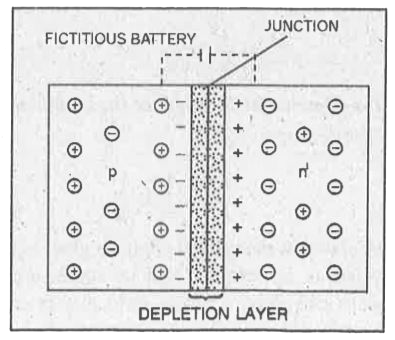 layer as shown in the figure. The thickness of depletion layer is of the order of `10^(-6)` m. Due to the migration of holes and electrons, the two sections of the junction diode no longer remain NEUTRAL. The p-section of the junction diode becomes slightly negative, while the n-section is rendered positive. Due to this, there is a potential gradient in the depletion layer, negative on the p-side and positive on the n-side. In other 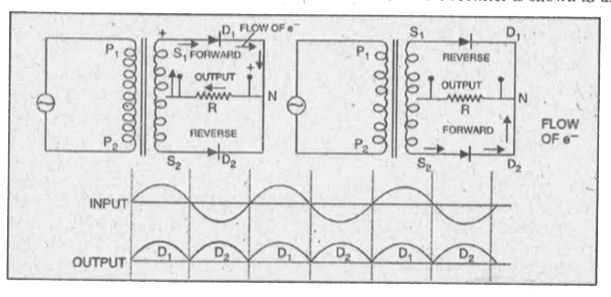 Working. During the positive half of input `AC, D_1` is forward biased and `D_2` reverse biased. Hence the current flows through the upper circuit as shown. During negative half, lower portion (`D_2`) is forward biased and upper (`D_1`) is reverse biased. words, it appears as if some fictitious battery is connected across the junction with its negative POLE connected topregion and positive pole connected to n-region. The potential difference developed across the junction diode due to migration of majority carriers is called potential barrier. Full wave RECTIFIER. The circuit diagram using junction diode as full wave rectifier is shown in the figure. Thus during each half, we get the current either from `D_1` and from `D_2`. The output voltage is unidirectional. |
|
| 12. |
What are intrisic and extrinsic semiconductors ? |
|
Answer» SOLUTION :Pureform of semiconductorsare called instrinsicsemiconductors. When IMPURE atoms areadded to increase their CONDUCTIVITY, they are called extrinsicsemiconductors. |
|
| 13. |
A particle moving in straight line cover half the distance with speed 3 ms^-1. The other half is covered in two equal time intervals with speed 4.5 ms^-1 and 7.5 ms^-1 respectively. The average speed of the particle during motion is |
|
Answer» `4 ms^(-1)` 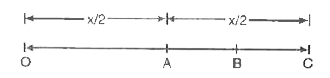 Since AB and BC are COVERED in EQUAL time intervels say `t_2` `:. 4.5 t_(2)+7.5t_(2)=(x)/(2)implies t_(2)=(x)/(24)` `:.` TOTAL time taken, `t=(x)/(6)+(x)/(24)+(x)/(24)=(x)/(4)`. `:.` Average speed =`(x)/(x//4)=4 m//s` |
|
| 14. |
Let E_(n)=(-1)/(8epsilon_(0)^(2)) (me^(4))/(n^(2)h^(2)) be the energy of the n^(th) level of H-atom. If all the H-atom are in the ground state and radiation of frequency (E_(2)-E_(1))//h falls on it, |
|
Answer» it will not be absorbed at all Is the energy of NTH level of hydrogen atom. If all the H-atom are in ground state, (n=1), then the radiation of frequency `(E_(2)-E_(1))//h` falling on it may not be absorbed by some of the atoms and move them to the first excited state (n=2). All atoms may not be excited to n=2 state. Further, as `(E_(2)-E_(1))//h` is sufficient only to TAKE the atom form n=1 state to n=2 state, no atoms shall make a transition to n=3 state. CHOICES (b) and (d) are correct. |
|
| 15. |
A charge 'q' is distributed over two concentric hollow conducting sphere of radii r and R(>r) such that their surface charge densities are equal. The potential at their common centre is |
|
Answer» zero |
|
| 16. |
A circular coil of 20 turns and radius 10 cm is placed in a uniform magnetic field of 0.10 T normal to the plane of the coil. If the current in the coil is 5.0 A, what is the (a) Total torque on the coil, (b) Total force on the coil, (c) Aerage force on each electron in the coil due to the magnetic field? (The coil is made of copper wire of cross-sectional area 10^(-5) m^(2), and the free electron density in copper is given to be about 10^(29) m^(-3)) . |
|
Answer» Solution :(a) Torque on the coil `TAU = B I A N sin THETA = 0"" [ :. theta = 0^@]` (b) Total FORCE on the coil `F = B I L sin theta = 0 "" [ :. theta = 0^@]` (c) Average force on each electron in the coil due to magentic field `F = B e v_d`, where `v_d` is the draft speed of electrons `= Be cdot 1/(e nA) "" [ :. I = n e A v_d]` `= B I/(n A) = (0.10 XX 5.0)/(10^(29) xx 10^(-5)) = 5.0 xx 10^(-25) N`. |
|
| 17. |
An object is placed at a distance of 15 cm from a convex lens of focal length 10 cm. On the other side of thelens a convex mirror is placed at its focus such that the image formed by the combination coincides with the object itself. The focal length of the convex mirror is |
|
Answer» 20 cm |
|
| 18. |
Rain is falling vertically with a speed of 1 ms^(-1) . A woman rides a bicycle with a speed of 1.732 ms^(-1)in east to west direction. What is the direction in which she should hold her umbrella ? |
Answer» Solution : In Fig. vr represents the velocity of rain and v , the velocity of the bicycle, the woman is riding. Both these velocities are with respect to the ground. Since the woman is riding a bicycle, the velocity of rain as experienced by: 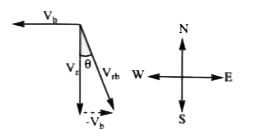 her is the velocity of rain relative to the velocity of the bicycle she is riding. That is `V_(rb) =V_(t)-V_(b)` This relative velocity vector as SHOWN in Fig. makes an angle `THETA`with the VERTICAL. It is given by: `tan theta =v_(b)/v_(r) =SQRT(3)/1 = sqrt(3) = 60^(@)` Therefore, the woman should hold her umbrella at an angle of about 60° with the vertical towards the west. |
|
| 19. |
A point charge q is placed at the centre of the edge of a cubical box. Find the total flux associated with that box. |
| Answer» Solution :If q is placed as SHOWN, three more identical cubes are required to enclose. That CHARGE completely. Then the total flux through all faces of 4 cubes is `(q)/(in_(0))`. Now contribution of this flux through each cube (given) is `(q)/(4 in_(0))`. Here it is interesting to note that the faces which have common EDGE on which the given charge is kept have no flux and hence the flux `(q)/(4in_(0))` emerges through the remaining four faces of the cube. | |
| 20. |
The unit of permittivity in free space (epsilon_(0)) is ...................... . |
|
Answer» |
|
| 21. |
A galvanometer of resistance 100Omega gives full scale deflection with 0.01 A current .How much resistaance should be connected in parallel with it to convert it into an ammeter of range 10A ? |
|
Answer» `0.100 OMEGA` |
|
| 23. |
An imaginary space rocket launched from the Earth moves with an acceleration w^'=10g which is the same in every instantaneous co-moving inertial reference frame. The boost stage lasted tau=1.0 year of terrestrial time. Find how much (in per cent) does the rocket velocity differ from the velocity of light at the end of the boost stage. What distance does the rocket cover by that moment? |
|
Answer» Solution :In the INSTANTANEOUS rest frame `v=V` and `W^'=(w)/((1-V^2/c^2)^(3//2))` (from 1.365a) So, `=(dv)/((1-V^2/c^2)^(3//2)=w^'dt` `w^'` is constant by assumption. THUS INTEGRATION GIVES `v=(w^'t)/(sqrt(1+((w^'t)/(c))^2)` Integrating once again `x=c^2/w(sqrt(1+((w^'t)/(c))^2)-1)` |
|
| 24. |
Velocity of the body on reaching the ground is same in magnitude in the following cases a) a body projected vertically from the top of tower of height 'h' with velocity 'u' b) a body thrown down wards with velocity 'u' from the top of tower of height 'h' c) a body projected horizontally with a velocity 'u' from the top of tower height 'h' d) a body dropped from the top tower of height 'h' |
|
Answer» a, d, C and d are CORRECT |
|
| 25. |
When light of wavelength λ is incident on a metal surface ,stopping potential is found to be V_circ . When light of wavelength nλ is in incident on the same metal surface ,stopping potential is found to be V_circ/(n+1). The threshold wavelength of the metal is |
|
Answer» `n^3λ` |
|
| 26. |
An electron and proton move in same direction with equal kinetic energy.Ratio of de-Broglie wavelength will be…. |
|
Answer» `(m_(2))/(m_(p))` `therefore In lambda =(h)/(sqrt(2mK)),(h)/(sqrt(2K))` is constant. `therefore lambda prop (1)/(sqrt(m))` `therefore (lambda_(e))/(lambda_(p))=sqrt((m_(p))/(m_(e)))` |
|
| 27. |
Energy of an electron in n th orbit of hydrogen atom is (k = (1)/(4 pi epsilon_(0))) |
|
Answer» `- (2PI^(2)K^(2)me^(4))/(n^(2)H^(2))` |
|
| 28. |
The solution of x + 2y = 1.5 and 2x + y = 1.5 is |
|
Answer» X = 1 and y = 1 |
|
| 29. |
If the length of a wire is doubled and its cross-section is also doubled, then its resistance will |
|
Answer» BECOME 4 times |
|
| 30. |
If kinetic energy of particle is made 16 times,percentage change in its de-Broglie wavelength will be……. |
|
Answer» 25 `lambda=(h)/(p)=(h)/(sqrt(2mK))` `therefore lambda PROP(1)/(sqrt(K))[because h,2,m` are same] `therefore (lambda_(2))/(lambda_(1))=sqrt((K_(1))/(K_(2)))=sqrt((1)/(16))=(1)/(4)` `therefore lambda_(2)=(lambda_(1))/(4)` `therefore` Percentage change, `=(lambda_(2)-lambda_(1))/(lambda_(1))XX100=((lambda_(1))/(4)-lambda_(1))/(lambda_(1))xx100%` `=-(3lambda_(1))/(4lambda_(1))xx100%` |
|
| 31. |
In the wave propagation phenomenon, phase difference of oscillation of two particles having distance à from each other is ...... |
| Answer» Answer :A | |
| 32. |
Which of the following phenomenon is not common for light and sound ? |
|
Answer» INTERFERENCE |
|
| 33. |
When an electron and a proton are both placed in an electric field ........ |
|
Answer» (A) the ELECTRIC forces acting on them are equal in magnitude as well as direction. But `m_(e) ne m_(0), therefore a_(e) ne a_(p)` So, options (C) and (D) are WRONG. And `vecF_(e) =-evecE` and `vecF_(p) = +evecE` `therefore` Direction is opposite for electric forces. `therefore |vecF_(e)| =|vecF_(p)|` so, only magnitudes of forces are same. |
|
| 34. |
An electron is in a quantum state for which the magnitude of the orbital angular momentum is 6sqrt(2)h//2pi. How many allowed values of the z component of the angular momentum are there? |
|
Answer» 4 |
|
| 35. |
When the uncharged capacitor is charged through a resistor 'R' by a battery of emf 'epsilon’' as shown, the time taken to get charge that is 50% of the equilibrium value would be |
|
Answer» (In 2)RC |
|
| 36. |
An electron moving with a speed of 10^(7)ms^(-1) traces a circular path of radius 0-57 cm, when subjected to a magnetic field of 10^(-2) T perpendicular to the direction of motion of electron, what is elm ? |
|
Answer» `1.76xx10^(9)C//kg^(-1)` `=1*76xx10^(11)C kg^(-1)` |
|
| 37. |
Three point charges, each with charge q and mass 'm', are connected by three strings of equal length 'e whose other end is connected to a fixed point P. They form an equilateral triangle of side 'a' in a horizontal plane. The tension in each string will be |
|
Answer» `sqrt((mg)^2-(q^2/(4piepsilon_0a^2)SQRT3)^2)` |
|
| 38. |
The instantaneous velocity is given by the motion is _____. |
|
Answer» |
|
| 39. |
A machine gun fires n bullets per second and the mass of each bullet is m. If the speed of the bullet is upsilon then, the force exerted on the machine gun is: |
|
Answer» nmg HENCE CORRECT choice is (b) |
|
| 40. |
Whenare two object just resolved ? Explain . How can the resolvingpower of a compound microscope be increased ? Use relevant formula tosupport youranswer . |
|
Answer» Solution :Whentwo objectsplacednearby and their separate and distinct CLEAN image is formed byan instrumentthe objects are resolved. Here, central maxima of diffraction PATTERN of onelies on `1^(st)` SECONDARY minima of the other. Resolving power of a MICROSCOPE `= 1/d = 2mu (sin theta)/(lambda)`. Increasing`mu` and `theta` increases resolvingpower anddecreasing`lambda`. |
|
| 41. |
What is displacement current? Mention its need. |
|
Answer» SOLUTION :The currentdue to changingelectric field(time varying ELECTRIC field ) is called displacement current. It HELPS to remove the inconsistency of Ampere.s CIRCUITAL LAW. |
|
| 42. |
An electron is at a distance of 10 m from a charge of 10c.Its total energy is 15.6xx10^(-10) J.Its de-Broglie wavelength at this point is…….. .(h=6.625xx10^(-34))J.s ,m_(e)=9.1xx10^(-31)kg, K=9xx10^(9)SI |
|
Answer» Solution :Potential energy of an electron ,`U=-(kq(e))/(R )` `therefore U=-(9xx10^(9)xx10xx1.6xx10^(-19))/(10)` `therefore U=-14.4xx10^(-10)J` Now total energy E=Kinetic energy K+potential energy U `therefore`K=E-U `=15.6xx10^(-10)+14.4xx10^(-10)` `therefore K=30xx10^(-10)J` But K`=(p^(2))/(2m_(e))` `therefore p=SQRT(2km_(e))` `lambda=(h)/(sqrt(2km_(e)))=(6.625xx10^(-34))/(sqrt(2xx30xx10^(-10)xx9.1xx10^(-31)))` `therefore lambda=8.97xx10^(-15)m` |
|
| 43. |
Twelve equal wires each of resistance r are joined to form a skeleton cube. Find the equivalent resistance between two corners on the same edge of the cube. |
|
Answer» Solution :Method-I CONNECT a source between points 1 and 2. Let current `i` enter through point 1 into the network . The network is symmetrical about dotted lines. The currents above and below dotted line are symmetrically distributed as shown in fig. By junction RULE at 1, we have `i= x+ 2y` `therefore R_(12) = V/i= V/(x+2y) ""....(i)`  In close loop 1-2-9-10-1 , we have `-rx + V=0 ` or `x= (V)/r ""....(ii)` In close loop 1-4-3-2-1 `-rz-rz-ry+rx=0` (or) `x-2y - z =0""....(iii)` In close loop `4-8-7-3-4 ` `-r(y-z) - r xx 2(y-z) + rz=0` or `-4(y-z) + z =0` or `4Y+ 5z=0""....(iv)` From equations (iii) and (iv) , we GET `-4y + 5(x-2y) = 0 ` or `5x=14y` Since `x = V/r therefore y= 5/(14) xx V/r` Now `R_(12) = V/(x+2y) = (V)/(V/r + 2 xx(5V)/(14r)) =(7r)/(12` Method II: Out previous knowledge reveals that points 3 and 6 must be at the same potential . So must be 4 and 5 . If points of equal potential are joint by a wire, the currents in the circuit do not change. The given network of resistors can be reduced successively as shown in figure.  `R_(12) =(rxx(7r)/(5))/(r+(7r)/(5)) = 7/(12) r` |
|
| 44. |
Find the force of attraction between the plates of a parallel plate capacitor. |
|
Answer» Solution :Let d be the distance between the plates. Then the capacitor is C = `(epsilon_(0)A)/(d)` Energy STORED in a capacitor, U = `(q^(2))/(2C) = (q^(2).d^(2))/(2 epsilon_(0)A) ` Energy MAGNITUDE of the force is, `|F| = (dU)/(dx) = (d)/(dx) [ (q^(2) x)/(2 epsilon_(0) A) ] "" [ x = d ]` = `(q^(2))/(2 epsilon_(0)A) [ (d)/(dx) (x) ] ` F = `(q^(2))/(2 epsilon_(0)A)` |
|
| 45. |
At one instant a bicyclist is 30.0 m due east of a park's flagpole, going due south with a speed of 10.0 m/s. Then 30.0 s later, the cyclist is 40.0 m due north of the flagpole, going due east with a speed of 10.0 m/s. For the cyclist in this 30.0 s interval, what are the (a) magnitude and (b) direction of the displacement, the ( c) magnitude and (d) direction of the average velocity, and the (e) magnitude and (f) direction of the average acceleration? |
| Answer» Solution :(a) 50.0 m, (b) `127^(@)(53^(@)"NORTH of due WEST")`, ( c) 1.67 m/s, (d) `127^(@)(53^(@)"north of due west")`, (e) `0.471m//s^(2)`, (F) `45^(@)or135^(@)` | |
| 46. |
Figure shows two capacitors C_1 and C_2 connected with 10 V battery and terminal A and B are earthed. The graphs shows the variation ofpotential as one moves from left to right. Then the ratio C_1//C_2 is |
|
Answer» `5//2` `(C_(1))/(C_(2))=(V_(2))/(v_(1))=(2)/(3)` |
|
| 47. |
When p-n junction diode is forward biased |
|
Answer» the DEPLETION region is reduced and barrier HEIGHT is INCREASED |
|
| 48. |
When object O moves towards a fixed lens mirror combination, select correct choice/choices: |
|
Answer» Image moves TOWARDS NEGATIVE x-axis |
|
| 49. |
Assertion : Heating enegineersuse u-values , rather than k-valueswhen calculatingheatlosses through walls, windows and roots . Reason : The u-values of a singlebrick wallis1.7Wm^(-2)K^(-1) |
|
Answer» If both the assertion and reason are true statement ANDREASON is correct explanation of the assertion . |
|
| 50. |
A cube has a side of length 1*2xx10^(-2)m. |
|
Answer» `1.7xx10^(-6)m^(3)` Hence correct choice is `(a)`. |
|