Saved Bookmarks
This section includes 7 InterviewSolutions, each offering curated multiple-choice questions to sharpen your Current Affairs knowledge and support exam preparation. Choose a topic below to get started.
| 1. |
The phase difference between two waves represented by y_(1) = 10^(-6) sin [ 100 t + (x)/(50) + 0.5 ]m y_(2) = 10^(-6) co [ 100 t + (x)/(50) ] m Where x is in metre and t in seconds, is : |
|
Answer» 0.5 radian `y_(2) = 10^(-6) sin[ 100 t+ (x)/(50) ]= 10^(-6) sin [ (pi)/(2) + 100 t + (pi)/(2) ]` `therefore` phase diff. Between two WAVES = `(pi)/(2) - 0.5` = `(3.14)/(2) - 0.5` = 1.07 rad. Correct choice is (b). |
|
| 2. |
What is dark current ? |
| Answer» SOLUTION :Dark CURRENTS are REVERSE biased CURRENT when no LIGHT falls on photodiode . | |
| 3. |
What do you understand by positive flux? |
| Answer» SOLUTION :`vec(B), THETA = 0^(0) "i.e." PHI= BA cos 0^(0) = BA`, magnetic flux is +ve | |
| 4. |
Obtain the binding energy (in MeV) of a nitrogen nucleus (""_(7)^(14)N) , given m (""_(7)^(14)N) =14.00307 u. |
| Answer» SOLUTION :104.7 MEV | |
| 5. |
The distance between plates of a parallel plate capacitor is 5d. Let the positively charged plate is at x=0 and negatively charged plate is at x=5d. Two slabs one of conductor. and other of a dielectric of equal thickness d are inserted between the places as shown in figure.Potential versus distance graph will look like : |
|
Answer»
|
|
| 6. |
4 identical balls of radius R and mass m are lying a gravity free space. The balls are in contact and there centres are forming vertices of a square of side 2R in horizontal plane. One identical ball travelling vertically with a speed v hits the four balls symmetrically. The collision is perfectly elastic. The centre of the 4 stationery ball are at (R, R, 0), (R, -R, 0) and (-R, -R,0) initially. The speed of ball which was intitially travelling with speed v just after collision is |
|
Answer» SOLUTION :`V-(4V)/(3)=V_(2)` `V_(2)=-V//3` |
|
| 7. |
4 identical balls of radius R and mass m are lying a gravity free space. The balls are in contact and there centres are forming vertices of a square of side 2R in horizontal plane. One identical ball travelling vertically with a speed v hits the four balls symmetrically. The collision is perfectly elastic. The centre of the 4 stationery ball are at (R, R, 0), (R, -R, 0) and (-R, -R,0) initially. The speed of ball 1 after collision is : |
|
Answer» `(sqrt(2))/(3)v` `1=(v_(1)=(v_(2))/(sqrt(2)))/(v//sqrt(2))`.....(`2`) `v_(1)=(sqrt(2)v)/(3)` |
|
| 8. |
A charge Q is imparted to two identical capacitors in paralle. Separation of the plates in each capacitor is d_0. Suddenly, the first plate of the first capacitor and the second plate of the second capacitor start moving to the left with speed v, then |
|
Answer» charges on the two CAPACITORS as a function of time are `(Q(d_0-VT))/(2d_0), (Q(d_0+vt))/(2d_0)`. Leq `q_(1)` and `q_(2)` be the instantaneous charges on capacitors. SINCE they are in parallel, then `(q_(1))/(C_(1))=(q_(2))/(C_(2))` and `q_(1)+q_(2)=Q` `C_(1)=(epsilon_(0)A)/(d_(0)+vt),C_(2)=(epsilon_(0)A)/(d_(0)-vt)` So `(q_(1))/(q_(2))=(C_(1))/(C_(2))=(d_(0)-vt)/(d_(0)+vt)` or `q_(2)((d_(0)-vt)/(d_(0)+vt))+q_(2)=0` So `q_(2)=(Q(d_(0)+vt))/(2d_(0))` and `q_(1)=(Q(d_(0)-vt))/(2d_(0))` HENCE, option (a) is correct and option (b) is INCORRECT. `i=(-dq_(1))/(dt)` or `(dq_(2))/(dt)` or `i=(Q_(v))/(2d_(0))` Which does not depend on time. So option (d) is correct and option (c) is incorrect. |
|
| 9. |
Two cells of emf's approximately 5V and 10V are to be accurately compared using a potentiometer of length 400 cm. |
|
Answer» The battery that runs the potentiometer should have VOLTAGE of 8V. Potential difference between two voltage drop across two end of wire of potentiometer should be more than emf of cell whose emf value is tobe measured. Here, emf of cell given si 5V and 10 V. hence , emf of MAIN cell should be more than 5 V and 10 V means should be 15 V. Hence. 4 V drop will be VARIABLE resistance . |
|
| 10. |
(a) Calculate the electric potential at points P and Q as shown in the figure below. (b ) Suppose the charge +9muC is replaced by -9muC find the electrostatic potentials at points P and Q ( c) Calculate the work done to bring a test charge +2muC from infinity to the point P. Assume the charge +9muC is held fixed at origin and +2muC is brought from infinity to P. |
|
Answer» SOLUTION :(a) Electric potential at point P is given by `V_(p)=(1)/(4piepsilon_(0))(q)/(r_(p))=(9xx10^(9)xx10^(-6))/(10) =8.1xx10^(3)V` Electric potential at point Q is given by `V_(Q)=(1)/(4piepsilon)(q)/(r_(Q))=(9xx10^(-6))/(16)=5.06xx10^(3)V` Note that the electric potential at point Q is less than the electric potential at point P. If we put a positive CHARGE at P it moves from P to Q . However if we place a negative charge at P it will move towards the charge `+9muC` . The potential difference between the points P and Q is given by `DeltaV=V_(P)-V_(Q)=+3.04xx10^(3)V` (b) Suppose we replace the charge `+9muC"by"-9muC` then the corresponding potentials at the points P and Q are `V_(p)=-8.1xx10^(3)V, V_(Q)=-5.06xx10^(3)V` Note that in this case electric potential at the point Q is HIGHER than at point P. The potential difference or voltage between the points P and Q is given by `DeltaV=V_(p)-V_(Q)=-3.04xx10^(3)V` (c) The electric potentail V at a point P due to some charge is defined as the work done by an external force to bring a unit positive charge from infinity to P. So to bring the q amount of charge from infinity to the point P work done is given as follows. W=qV `W_(Q)=2xx10^(-6)xx5.06xx10^(3)J=10.12xx10^(-3)J` . |
|
| 11. |
Derive the expression for magnetic field at a point on the axis of a circular current loop. |
|
Answer» Solution :Consider a current loop of radius R carrying a steady current I. let .P. be a point at a distance .Y. from the center of the current loop on its axis. Let .dl. be the current element as shown. The magnetic field due to it is given by BIOT- savart.s law. `dvecB=mu_0/(4r) (I|vec(dl)xxvecr|)/r^3` But `r^2=x^2 +R^2` The displacement vector `vecr` from `vec(dl)` to the AXIAL point P is in the X-Y plane. HENCE `|vec(dl)xxvecr|=rdl`  `therefore dB=mu_0/(4pi) (I|vec(dl)xxvecr|)/r^3 =mu_0/(4pi)(Ir.dl)/r^3 =mu_0/(4pi) (I. dl)/r^2 =mu_0/(4pi) (I dl)/(x^2+R^2)` The component of magnetic field along X-direction is `dB_x = dB cos theta` `cos theta = R/r = R/(x^2+R^2)^(1//2)` `dB=mu_0/(4pi) (I dl)/r^2 R/(x^2+R^2)^(1//2) = mu_0/(4pi) (I dl) /((x^2+R^2)) R/(x^2+R^2)^(1//2)` `therefore dB=(mu_0 IR)/(4pi(x^2+R^2)^(3//2)dl` Therefore the total magnetic field at P due to the loop `B=(mu_0. IRdl)/(4pi(x^2+R^2)^(3//2))` `therefore` As `int dl = 2piR "" B=(mu_0 IR^2)/(2(x^2+R^2)^(3//2))=mu_0/2(IR^2)/((x^2+R^2))^(3//2)` |
|
| 12. |
In figure what is the voltage needed to maintain 15V across the load resistance R_(L) of 2K, assuming that the series resistance R is 200Omega and the zener requires a minimum current of 10mA to work satisfactorily? What is the zener rating required? |
|
Answer» |
|
| 13. |
Outside walks were so valued that the author did not stop his morning and evening walks even in |
|
Answer» RAINY SEASON |
|
| 14. |
Figure 22-8e is identical to Fig 22-8a except that particle 4 is now included. It has charge q_(4)= -3.20 xx 10^(-19)C, is at a distance (3)/(4) R from particle 1, and lies on a line that makes an angle theta=60^(@) with the x axis. What is the net electrostatic electrostatic electrostatic force vecF_("1, net") on particle 1 due to particle 2 and 4? |
|
Answer» Solution :KEY IDEAS The net force `vecF_("1, net")` is the vector sum of `vecF_("1, net")` and a new force `vecF_(14)` acting on PARTICLE 1 due to particle 4. Because particles 1 and 4 have charge of opposite signs, particle 1 is attracted to particle 4. Thus, force `vecF_(14)` on particle 1 is directed toward particle 4, at angle `theta=60^(@)`, as indicated in the free-body diagram of Fig. 22-8f. Four particles: We can rewrite `Eq. 22-4` as `F_(14)=(1)/(4PI epsilon_(0)) (|q_(1)||q_(4)|)/(((3)/(4)R)^(2))` `=(8.99xx10^(9)N*m^(2)//C^(2))xx ((1.60xx10^(-19)C)(3.20xx10^(-19)C))/(((3)/(4))^(2)(0.0200m)^(2))` `=2.05xx10^(-24)N`. Then from Eq. 22-7, we can write the net force on `vecF_("1.net")` particle 1 as `vecF_("1, net")=vecF_(12)+vecF_(14)`. Because the forces `vecF_(12) and vecF_(14)` are not directed ALONG the same axis, we cannot sum simply by combining their magnitudes. Instead, we must add them as vectors, using ONE of the following methods. Method 1.summing directly on a vector-capable calculator. For `vecF_(12)`, we enter the MAGNITUDE `1.15xx10^(-24)` and the angle `180^(@)` For `vecF_(14)`, we enter the magnitude `2.05xx10^(-24)` and the angle `60^(@)`. Then we add the vectors. Method 2. Summing in unit-vector notation. First we rewrite `vecF_(14)` as `vecF_(14)=(F_(14) cos theta) hati+(F_(14) sin theta) hatj`. Substituting `2.05xx10^(-24)N` for `F_(14) and 60^(@)` for `theta`, this becomes `vecF_(14)=(1.025xx10^(-24)N)hati+(1.775xx10^(-24)N)hatj`. Then we sum: `vecF_("1, net")=vecF_(12)+vecF_(14)` `= -(1.15xx10^(-24)N)hati+(1.025xx10^(-24)N)hati+(1.775xx10^(-24)N)hatj` `=( -1.25xx10^(-25)N)hati+(1.78xx10^(-24)N)hatj`. (Answer) Method 3. Summing components axis by axis. The sum of the x components gives us `F_("1, net, x")=F_(12,x)+F_(14,x)=F_(12)+F_(14)cos 60^(@)` `= -1.15xx10^(-24)N+(2.05xx10^(-24)N)(cos60^(@))` `= -1.25xx10^(-25)N`. The sum of the y components gives us `F_("1, net, y")=F_(12,y) +F_(14,y)=0+F_(14)sin60^(@)` `=(2.05xx10^(-24)N) (sin60^(@))` `=1.78xx10^(-24)N`. The net force `vecF_("1, net") ` has the magnitude `F_("1, net")= sqrt(F_("1, net, x")^(2)+F_("1, net, y")^(2))=1.78xx10^(-24)N`. (Answer) To find the direction of `vecF_("1, net")`, we take `theta ="tan"^(-1)(F_("1, net,y"))/(F_("1,net,x"))=-86.0^(@)`. However, this is an unreasonable result because `vecF_("1,net") ` must have a direction between the directions of `vecF_(12)` and `vecF_(14)`. To correct `theta`, we add `180^(@)`, obtaining `=86.0^(@)+180^(@)=94.0^(@)` (Answer) |
|
| 15. |
Light of described at a place by the equation E=(100)[sin5xx10^(15)]t+sin(8xx10^(15))t] falls on a metal surface having work function 2.0 eV. Calculate the maximum kinetic energy of the photoelectrons. |
|
Answer» Solution :The light contains TWO DIFFERENT frequencies. The one with large frequency will cause photoelectrons with largest kinetic energy. This larger frequency is `v=(omega)/(2pi)=(8xx10^(16))/(2pi)Hz` The MAXIMUM kinetic energy of the photoelectrons is `K_(MAX)=hv-W` `=(4.14xx10^(-15)eVs)xx((8xx10^(15))/(2pi)s^(-1))-2.0eV` `=5.27eV-2.0eV=3.27eV` |
|
| 16. |
The intensity of the polarized light transmitted through the analyzer is given by |
|
Answer» Brewster.s law |
|
| 17. |
A kid of height 1.1 ft is sleeping straight between focus and centre of curvature along the principal axis of a concave mirror of small aperture. His head is towards the mirror and is 0.5 ft from the focus of the mirror. How a plane mirror should be placed so that the image formed by it due to reflected light from concave mirror looks like a person of height 5.5 ft standing vertically. Draw the ray diagram. Find the focal length of the concave mirror. |
|
Answer» Now, for image formation of `A` and `B` by CONCAVE mirror, `u_(A)=-(F+1.6),f=-F` `u_(B)=-(F+0.5),f=-F` `v_(A)=(u_(A)f)/((U-f))=(-(F+1.6)(-F))/((-F-1.6+F))=(-(F+1.6))/(1.6)` `v_(B)=(-F(F+0.5))/(0.5)` size of the image `=|v_(B)|-|v_(A)|` `RARR 5.5=(F(F+0.5))/(0.5)-(F(F+1.6))/(1.6)` `F=2ft` The plane mirror should be placed at angleof `45^(@)` with `-ve x-` axis (as show) to get the requred vertical image `A"B"` From Newton's formula, `xy=f^(2)` so for `A,(1.1+0.5)y=f^(2)......(i)` and for `B,` `(0.5)xx(y+5.5)+f^(2) ....(ii)` from `(i)` and `(ii)` `f=2ft`. 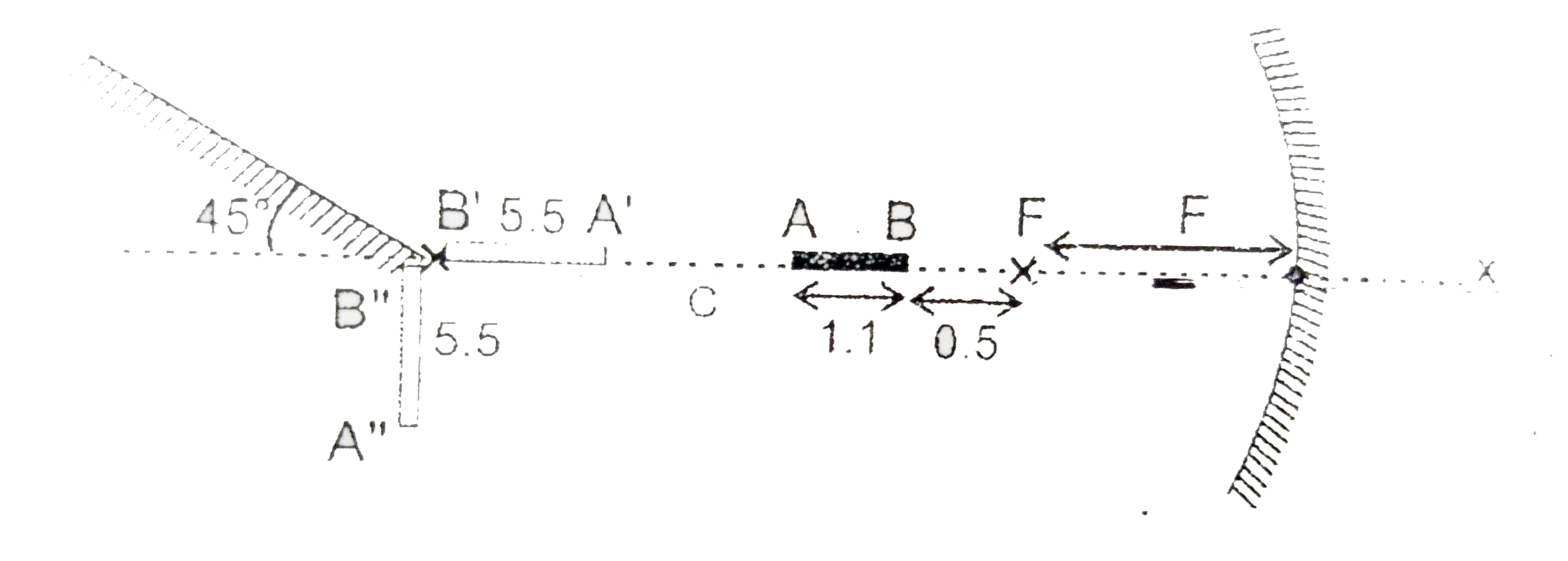
|
|
| 18. |
Area of B-H curve measures the energy loss |
|
Answer» By the specimen |
|
| 19. |
A body coated black at 600 K surrounded by armosphere at 300 K has cooling rate 80, the same body at 900 K, surrounded by the same atmosphere, will have cooling arte : |
|
Answer» `4r_(0)` `:.(E_(2))/(E_(1))=(T_(2)^(4))/(T_(1)^(4))""("NEGLECTING "T_(0)^(4)`) `:.(E_(2))/(E_(1))=((900)/(600))^(4)=(81)/(16)rArrE_(2)=(81)/(16)r_(0)`. Correct choice is (d). |
|
| 20. |
A screw gauge gives the following reading when used to measure the diameter of a wire. Main scale reading : 0 mm Circular scale reading : 52 divisions Given that 1 mm on main scale corresponds to 100 divisions of the circular scale. The diameter of wire from the above data is : |
|
Answer» `0.052` cm `:.` LEAST COUNT `=(1)/(100)mm=0.01mm=0.001cm` `:.` Diameter of the wire is `52xx0.001cm=0.052cm` So, the correct choice is `(a)`. |
|
| 21. |
If C = A + b then |
|
Answer» `VECC` is always greater than `|vecA|` |
|
| 22. |
Explain the use of the junction diode as a half wave rectifier by drawing a circuit and draw input and output waves. |
Answer» Solution :The HALF wave rectifier is made of a transformer, a junction diode and a load resistance `R_(L)`.  The primary coil of transformer is connected to a.c. mains voltage. The secondary coil of transformer is connected in series with junction diode and load resistance `R_(L)`. This circuit is called half wave rectifier. The required AC voltage is obtained between ends A and B of the secondary of transformer. During the first positive half of a.c. voltage the end A is positive with respect to B as a result p-n junctiondiode will be in forward bias and current flows through load resistance`R_(L)` from direction X to Y. Now, during the second half cycle, A becomesnegative with respect to B as a result p-n junction diode will be in reverse bias and no current will flow in load resistance `R_(L)`. During the half cycle of incoming cycles, the current flow in `R_(L)` in the X to Y direction. The reverse saturated current for diode is zero so it is ignored. The reverse breakdown voltage of the diode must be sufficiently higher than the peak ac voltage at the secondary of the transformer to protect the diode from reverse breakdown. The a.c. voltage to the ends of `R_(L)` and the waveform of rectified voltage are shown in the figure below.  Figure shows the waveform of voltage parallel to `R_(L)` for input a.c. and output a.c. This type of input receivesvoltages in ONE direction only during half cycle of each full cycle of a.c. but no voltage is received during the second half cycle , hence it is called half wave rectifier. D.C. current flowing through `R_(L)` and as a result the voltage developed ACROSS `R_(L)` is ALSO a DC voltage and only one junction diode is used. |
|
| 23. |
What are characteristic of em. Waves? |
|
Answer» SOLUTION :They PROPAGATE in the form of time varing ELECTRIC and magnetic fields These are produced by accelerating electric charges. |
|
| 24. |
The Wien's displacement law expressed relation between : |
|
Answer» colour of light and temperature `lamda_(m)T=b`. CORRECT choice is (d). |
|
| 25. |
In which of the following statements, the obtained impure semiconductor is p-type ? |
|
Answer» GERMANIUM is doped with bismuth |
|
| 26. |
Electric charge is uniformly distributed along a long straight wire of radius 1 mm. The charge per cm length of the wire is Q coulomb. Another cylindrical surface of radius 50 cm and length 1 m symmetrically encloses the wire. The total electric flux passing through the cylindrical surface is |
|
Answer» `Q/epsi_(0)` |
|
| 27. |
Rainbow is formed due to |
|
Answer» TOTAL internal REFLECTION |
|
| 28. |
How will the diffraction pattern of single slit change when yellow light is replaced by blue light ? The fringes will be : |
|
Answer» Remain unchanged |
|
| 29. |
Ferromagnetic substances have ................. Magnetic moment. |
|
Answer» |
|
| 30. |
(i) Show that the de-Broglie's wavelength of electrons accelerated through a potential V volts can be expressed as lamda=(h)/(sqrt(meV)). What is the de-Broglie wavelength of a 2kg object moving with a speed of 1ms^(-1) ? (ii) Calculate the ratio of the accelerating potential required to accelerate (i) a proton and (ii) an alpha particle to have the same de-Broglie wavelength associated with them. [Given: mass of proton =1.6xx10^(-27)kg. Mass of alpha-particle=6.4xx10^(-27)kg]. |
|
Answer» |
|
| 31. |
AB is potentiometer write resistance per unit length 0.09 Omega//cm and epsilon is anunknown emf of a battery to be measured. epsilon cannot be measured using the potentiometer shown if the value of epsilon is (select the most appropriate answer) |
|
Answer» GREATER than `8.0 V` Hence `EPSILON` greater then `9v` cannot be measured. |
|
| 32. |
Figure shows two charged particles on an x axis : -q = -3.20 xx 10^(-19)C at x = -3.00m and q = 3.20 xx 10^(-19)C at = + 3.00 m. What are (a) magnitude and (b) direction (relative to the positive direction of the x axis) of the net electric field produced at point P at y = 4.00 m? (c ) What is the magnitude of the net field if y is doubled ? |
| Answer» SOLUTION :(a) `1.38 xx 10^(-10)N//C`, (B) `180^(@)`, (c ) `2.77 xx 10^(-11) N//C` | |
| 34. |
First diffraction minimum due to a single slit of width 1.0xx10^(-5) cm is at 30^@. Then wavelength of light used is, |
|
Answer» 400 A `LAMBDA=(dsintheta)/(n)=(1xx10^(-5)xxsin30^(@))/(1)=0.5xx10^(-7)` `lambda=500A` |
|
| 35. |
In the above problem, minimum value of t for which the intensity at point P on the screen exactly in front of the upper slit becomes maximum. |
|
Answer» 0.167s |
|
| 36. |
The energy of an em waves is of the order of 15 Kev. To which part of the spectrum does it belong ? |
|
Answer» `gamma-rays` |
|
| 37. |
A unifrom magneticfiled is restricated with in a region if radiusr. The magneticfieldchange with time at a rate (dB)/(dt).Loop 1 of radiusRgt r encloses the regionr andloop 2 of radius R is outside the region ogf magnetic feield as show in the figure. Then , the emf generated is |
|
Answer» ZERO in loop 1 and Zero in loop 2 |
|
| 38. |
The self-inductance of a coil increases when the coil is wound on a soft iron core, because .... |
|
Answer» soft iron has a very high PERMITTIVITY. |
|
| 39. |
The dominant mechanisms for motion of charge carriers in forward and reverse biased silicon p-n junctions are, |
|
Answer» DRIFT in forward bias, DIFFUSION in REVERSE bias |
|
| 40. |
Demonstrate that the angular momentum M of the sytem of particles relative to a point O of the reference frame K can be represented as M=overset~M+[r_Cp], where overset~M is its proper angular momentum (in the reference frame moving translationally and fixed to the centre of inertia), r_C is the radius vector of the centre of inertia relative to the point O, p is the total momentum of the system of particles in the reference frame K. |
|
Answer» Solution :On the basis of solution of problem, we have concluded that, "in the C.M. frame, the angular momentum of system of particles is INDEPENDENT of the choice of the point, relative to which it is determind" and in accordance with the problem, this is denoted by `vecM`. We denote the angular momentum of the system of particles, relative to the point O, by `vecM`. Since the internal and PROPER angular momentum `overset~vecM`, in the C.M. frame, does not depend on the choice of the point `O^'`, this point may be taken coincident with the point O of the K-frame, at a given moment of time. Then at that moment, the radius VECTORS of all the particles, in both reference FRAMES, are equal `(overset(rarr')r_i=vecr_i)` and the velocities are related by the equation, `vecv_i=overset~vecv_1+vecv_c`, (1) where `vecv_c` is the velocity of C.M. frame, relative to the K-frame. Consequently, we may write, `vecM=summ_i(vecr_ixxvecv_i)=summ_i(overset(rarr')r_ixxoverset~vecv_i)+summ_i(vecr_ixxvecv_c)` or, `vecM=overset~vecM+m(vecr_cxxvecv_c)`, as `summ_ivecr_i=mvecr_c`, where `m=summ_i`. or, `vecM=overset~vecM+(vecr_cxxmvecv_c)=overset~vecM+(vecr_cxxvecp)` |
|
| 41. |
In the figure shown two particles m & M are interconnected by an inextensible and light string. M is in equilibrium due to revolution of particle m in horizontal plane as shown in the figure. Now M is pulled down slowly through a distance l/2. Find the change in angular speed of particle m. |
|
Answer» |
|
| 42. |
What Rutherford's experiment could not explain ? |
| Answer» SOLUTION :DISTRIBUTION of ELECTRON and STABILITY of ATOM | |
| 43. |
A splash is thrown up with a velocity 29.23 ms^(-1) distance travelled in last second of upward motion is |
|
Answer» 2.3 m |
|
| 44. |
Two slits are made 1 min apart and the screen is placed 1 m away from the slits. What is the firnge separation when blue green light of wavelength 500 nm is used? |
|
Answer» SOLUTION :`lamda=500xx10^(-9)=5xx10^(-7)m,d=1XX10^(-3)m,D=1m` `beta=(D lamda)/d=(1xx5xx10^(-7))/(1xx10^(-3))=5xx10^(-4)m` |
|
| 45. |
Find the natural vibration frequency and the quasielatic force coefficient of an S_(2) molecule if the wavelength of the red and voilet satellites, closests to the fixed line, in the vibration specturm of Raman scattering are equal to 346.6 and 330.0 nm. |
|
Answer» Solution :As in the PREVIOUS problem `omega= pic((1)/(lambda_(V))-(1)/(lambda_(R)))=(pi c(lambda_(R)-lambda_(V)))/(lambda_(R)lambda_(V))= 1.368xx10^(14)rad//s` The FORCE constant `x` is defined by `x= mu omega^(2)` where `mu=` reduced mass of the `S_(2)` MOLECULE. SUBSTITUTION gives `x=5.01N//cm` |
|
| 46. |
Diffraction pattern from a single slit of width 0.25 mm is observed with light of wavelength 5890Å . Angular separation between first order minimum and third order maximum, falling on the same side, is |
|
Answer» `5.89xx10^(-3) "RAD"` |
|
| 47. |
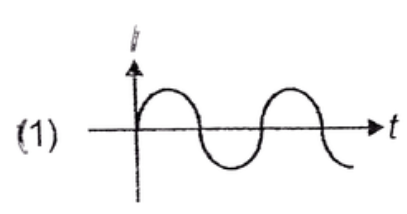
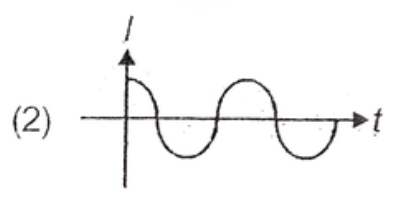
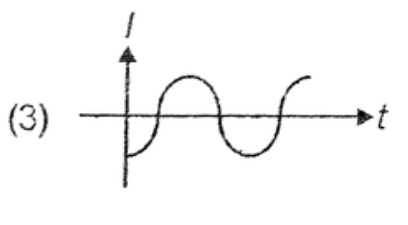
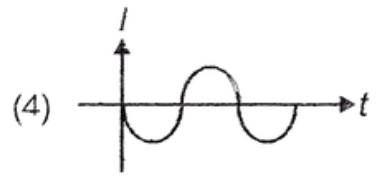
In problem No. 1 which of the following graphs best represents the current flowing from X to Y ? |
|
Answer»
|
|
| 48. |
(c) Derive the expression for the affective capacitance of a series combination of n capacitors. |
Answer» Solution :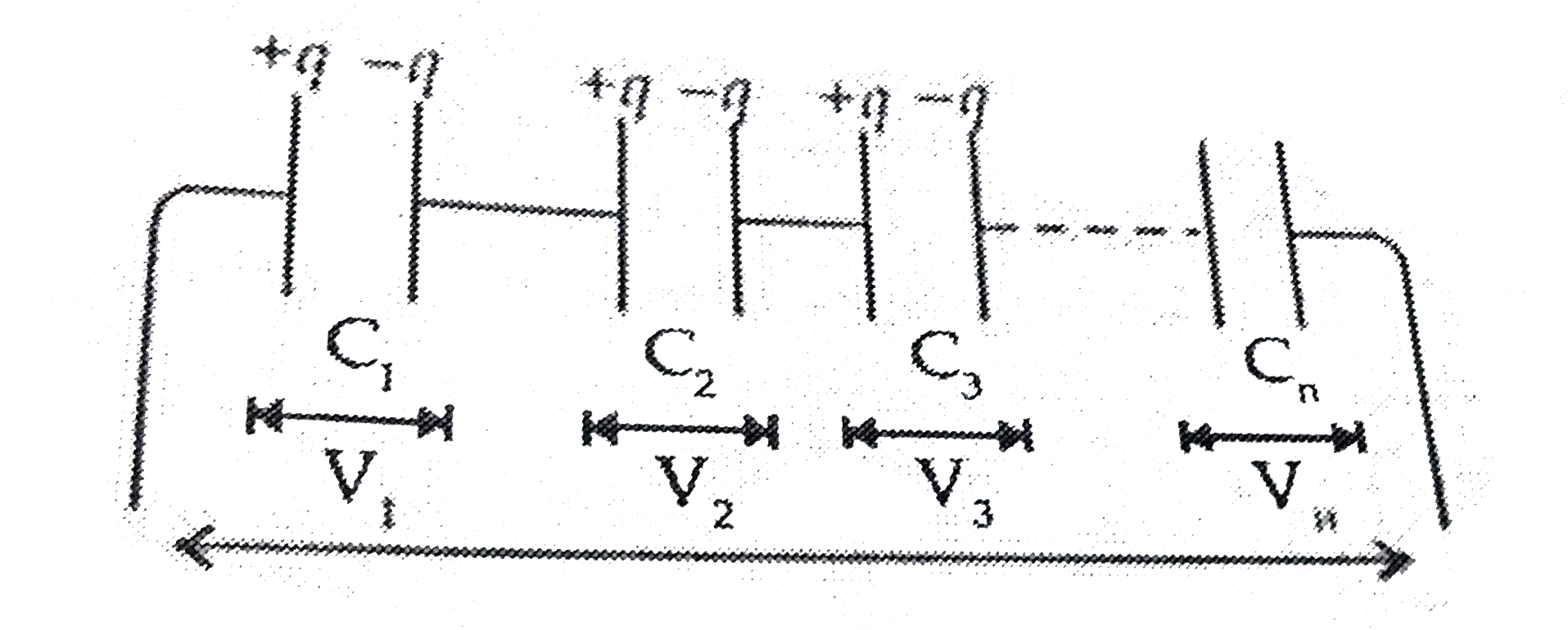 Let `V_(1),V_(2),V_(3).......V_(n)` be the potential DIFFERENCE across the PLATES of n capacitors. Then, `V=V_(1)+V_(2)+V_(3)+.......V_(n)` `V=(q)/(C_(1))+(q)/(C_(2))+(q)/(C_(3))+......(q)/(C_(n))=q[(1)/(C_(1))+(1)/(C_(2))+(1)/C_(3)+......(1)/(C_(n))]......(i)` Let C be the equivalent capacitance of series combination, Then, `V=(q)/(C)""....(iii)` From (i) and (ii) `(q)/(C)=q[(1)/(C_(1))+(1)/(C_(2))+(1)/C_(3)+......(1)/(C_(n))]implies(1)/(C)=(1)/C_(1)+(1)/(C_(2))+(1)/C_(3)+......(1)/(C_(n))`. |
|
| 49. |
For destructive interference to take place between two monochronic light waves of wavelength the path difference should be |
|
Answer» `((2n-1)LAMBDA)/4` |
|