Saved Bookmarks
This section includes 7 InterviewSolutions, each offering curated multiple-choice questions to sharpen your Current Affairs knowledge and support exam preparation. Choose a topic below to get started.
| 1. |
निम्न में से कौनसी संख्या 2.3 तथा 2.4 के मध्य स्थित है : |
|
Answer» 2.3445 |
|
| 2. |
Find the potential difference between point A and B in an electric field barE=(2hati+3hatj+4hatk)NC^(-1) where barr_(A)=(hati+2hatj+hatk)m and barr_(B)=(2hati+hatj-2hatk)m. |
|
Answer» Solution :We know that `dV= -barE.dbarr` `V_(AB)=V_(A)-V_(B)= -int_(A)^(B) barE.dbarr` `= -int_("(2,1,-2)")^("(1,-2,1)") (2hati+3hatj+4hatk).(dxhati+dyhatj+dzhatk)` `=-int_("(2,1,-2)")^("(1,-2,1)") (2dx+3dy+4dz)` `= -(2x+3y+4z)|_("(2,1,-2)")^("(1,-2,1)")=-1` VOLT |
|
| 3. |
A head maze is a maze formed by tall rows of hedge. After entering, you search for the center point and then for the exit. Shows the entrance to such a maze and the first two choice we make at the junctions we encounter in moving from point I to point c. We undergo three displacements as indicated in the overhead view of d _(1) = 6. 00 m theta _(1) = 40^(@) d _(2) = 8. 00 m theta _(2) =30^(@) d _(3) = 5. 00 m theta_(3) = 0^(@). where the last segment is parallel to the superimposed x axis. When we reach point c, what are the magnitude and angle of our net displacement vecd _(net) from point i? |
|
Answer» Solution :To evaluate we find the x and y components of each disp[lacement .Asan example, the components for the first displacement are shown We draw similar diagrams for the outer two displacements and then we apply the x part of to each displacement, using angle relative to the positive direction of the x axis ` d _(1x ) = (6.00m) cos 40^(@)=4.60m` ` d _(2x) = (8.00m) cos (-60^(@)) =4.00m` ` d_(3x) = (5.00m) cos 0^(@) =5.00m.` Equation then gives us `d _(n etx) = + 4.60m+ 4.00 m + 5.00 m` `13.60m`. Similarly, to evaluate we apply the y part of each displacement: `d _(1y) = (6.00m) SIN 40^(@)=3.86m` `d _(2Y) = (8.00 m) sin (-60^(@)) =-693m` `d _(3y) = (5.00m) sin 0^(@) =0m.` Equation then gives us `d _(nety ) =+ 3.86 m - 6.93 m + 0 m` `=- 3.07m.` Next we use these components of `vecd _(net)` to construct the vector as shown in the components are in a head-to-tail arrangement and form the legs of a right triangle, the vector forms the hypotenuse, We find the magnitude and angle of `vecd _(net)` with The magnitude is ` d _(n et)= sqrt ( d _(n etx) ^(2)+ d _(n ety) ^(2))` `= sqrt ((13.60 m)^(2)) + (3.07m) ^(2) = 13.9m.` To find the angle ( measured from the positive direction of x), we take an inverse tangent: `theta = tan ^(-1) ((d _(n ety ))/( d _(n et.y)))` `= tan ^(-1) ((-3.07m)/( 13.60))=-12.7 ^(@).` The angle is NEGATIVE because it is measured clockwise from positive x. We must always be alert when we take an inverse tangent on a calculator. The answer it displays is mathematically correct but it may not be the correct answer for the physical situation. In those cases, we have to add `180^@` to the displayed answer, to reverse the vector. To check, we always need to draw the vector and its components as we did in Fig. 3-16d. In our physical situation, the figure shows us that `theta= -12.7^@` is a reasonable answer, whereas -`12.7^@ + 180^@ = 167^@` is clearly not. We can see all this on the graph of tangent VERSUS angle in Fig. 3-12c. In our maze problem, the argument of the inverse tangent is -3.07/13.60, or -0.226. On the graph draw a horizontal line through that value on the vertical axis. The line cuts through the darker plotted branch at -12.7o and also through the lighter branch at `167^@` 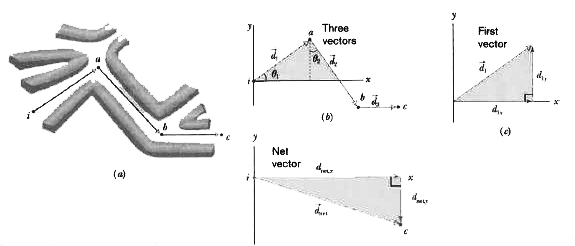 Figure (a) Three displacemnts through a hedge maze. (b) The displacement vectors. (c) The first DISPLACEMET vector and its components (d) The net displacement vectorand its components . |
|
| 4. |
Current in a coil falls from 2.5a to 0.0a in 0.1 second inducing an emf of 200v.calculate the value of self inductance . |
|
Answer» SOLUTION :`E - L (dI)/(DT)` `200 = L (2.5)/(0.1)=25L` `L = 8H` |
|
| 5. |
Answer the following questions: (a) The angle subtended at the eye by an object is equal to the angle subtended at the eye by the virtual image produced by a magnifying glass. In what sense then does a magnifying glass provide angular magnification? |
| Answer» Solution :(a) Even though the absolute IMAGE SIZE is bigger than the object size, the angular size of the image is equal to the angular size of the object. The MAGNIFIER helps in the FOLLOWING way: without it object would be placed no closer than 25 CM, with it the object can be placed much closer. The closer object has larger angular size than the same object at 25 cm. It is in this sense that angular magnification is achieved. | |
| 6. |
Magnetic field at the centre of a Bohr's hypotheticalhydrogen atom in the n^(th) orbit of the electron is |
|
Answer» directly proportional to charge of electron e Magnetic FIELD at the centre of Bohr.s HYPOTHETICAL orbit `B=(mu_0I)/(2r_n) = (mu_0 eupsilon)/(2r_n)` ….(i) where `r_n` is the radius of `n^(TH)` orbit. The electric force between the nucleus and electron in the `n^(th)` orbit provides the centripetal force for circular motion. `therefore e^2/(4piepsilon_0r_n^2)=(mv_n^2)/r_n` or `r_n=e^2/(4piepsilon_0mv_n^2)`....(ii) According to Bohr.s quantisation condition `mv_n r_n=nħ` or `v_n=(nħ)/(mr_n)` ...(iii) From equations (ii) and (iii) , we get `r_n=(4pi epsilon_0 ħ^2 n^2)/(me^2)` Then equation (i) becomes `B=(mu_0e)/(2r_n) (v_n/(2pir_n))=(mu_0e)/(4pi) ((nħ//mr_n))/r_n^2` `=(mu_0enħ)/(4pim)=((me^2)/(4piepsilon_0ħ^2n^2))^3=(mu_0pim^2e^7)/(8epsilon_0^3 h^5 n^5) [ because ħ=h/(2pi)]` `therefore B prop 1/n^5` |
|
| 8. |
A magnetic needle suspended by a silk thread is vibrating in the earth's magnetic field. If the temperature of the needle is increases by 500^(@) C , then |
|
Answer» time period decreases |
|
| 9. |
Which one of the following represent travelling wave |
|
Answer» `y=Asqrt(x-VT)` |
|
| 10. |
An inductor 200 mH, capacitor 500 uF, resistor 10 Omegaare connected in series with a 100 V variable frequency a.c. source. Calculate : (i) frequency at which power factor in the circuit is unity, (ii) current amplitude at this frequency, (iii) Q-factor. |
|
Answer» Solution :It is GIVEN that L = 200 mH `=0.2 H, C = 500 muF = 5 xx 10^(-4) F, R = 10 Omega` and `V_(rms) = 100 V` (i) Power factor of the circuit is unity when Z = R or `X_(L) = X_(C)` and for this angular frequency `omega = 1/sqrt(LC) = 1/ sqrt(0.2 xx 5 xx 10^(-4)) = 100 s^(-1)` (ii) Current amplitude at this frequency `I_(m) = sqrt(2) I_(rms) - sqrt(2) V_(rms)/R = (sqrt(2) xx 100)/10 = 14.1 A` (iii) Q-factor `=X_(L)/R = (Lomega)/R = (0.2 xx 100)/10 =2` |
|
| 11. |
A thermodynamic system undergoes a cyclic process ABC as shown in the diagram. The work done by the system per cycle is |
|
Answer» `-750` J `= 1/2 xx 300 xx 5 = 750` J Since the work done by the system is in ANTICLOCKWISE direction, work done by the system will be negative i.e., -750 J. |
|
| 12. |
Two point masses of 0.3 kg and 0.7 kg are fixed at the ends of a rod of length 1.4 m and of negligible mass. The rod is set rotating about an axis perpendicular to its length with a uniform angular speed. The point on the rod through which the axis should pass in order that the work required for rotation of the rod is minimum, is located at a distance of |
|
Answer» 0.42 in from mass of 0.3 kg `I=mr^2` for POINT mass. `THEREFORE I=I_1+I_2` `=0.3x^2+ 0.7 (1.4-x)^2` `=0.3x^2+0.7(1.96+x^2-2.8x)` `=x^2+1.372-1.96x` The work done for rotation of the rod is stored as rotational kinetic ENERGY, `1/2Iomega^2`, of rod `W=(Iomega^2)/2=1/2 (x^2-1.372-1.96x)omega^2` For work done to be minimum , `(dW)/(dx)=0` `therefore d/(dx)[(x^2+1.372-1.96x)]omega^2/2=0` 2x+0-1.96=0 2x=1.96 x=0.98 m 
|
|
| 13. |
The natural frequency of a LC series circuit is equal to |
|
Answer» `1/(2PI) SQRT(LC)` |
|
| 14. |
How many electrons , protons and neutrons are there in 12g of ""_(6)C^(12)and in 14g of ""_(6)C^(14) (Take Avogadro number N = 6xx 10^(23) ) |
|
Answer» Solution :The number of atoms in 12 G of `""_(6)C^(12)=` Avogadro number `= 6 xx10^(23)` The number of electrons in 12 g of `""_(6)C^(12)= 6 xx6xx10^(23)` `= 36 xx10^(23)` The number of protons in 12 g of `""_(6)C^(12)= 36 xx10^(23)` The number of NEUTRONS in 12 g of `""_(6)C^(12)` `= (A-Z) xx 6 xx 10^(23) = 6xx 6 xx 10^(23)= 36 xx10^(23)` Similarly number of electrons in 14 g of `""_(6)C^(14)= 36 xx10^(23)` Number of protons in 14 g of `""_(6)C^(12) = 36 xx10^(23)` Number of neutrons in 14 g of `""_(6)C^(14) = (A-Z) xx 6 xx10^(23) ` `= (14 -6) xx 6 xx10^(23)= 48 xx 10^(23)` |
|
| 15. |
A sound absorber attenuates the sound level by 20 dB. The intensity decreases by a factor of : |
|
Answer» 10000 ` THEREFORE L = 10 log_(10)" " (I_(1))/(I_(0)) "" rArr "" 100 = 10 log_(10)" "(I_(1))/(I_(0))` `rArr "" (I_(1))/(I_(0)) = 10^(10)"" `.... (i) Since sound absorber attenuates the sound level by 20 dB. `therefore` (100 -20) dB= 10 log `(I_(2))/(I_(0))` `rArr "" 80= 10"log" (I_(2))/(I_(0)) rArr (I_(2))/(I_(0)) = 10^(8)` .... (ii) Dividing (ii) by (i) `(I_(2))/(I_(1)) = (10^(8))/(10^(10)) = (1)/(100) ` `rArr "" I_(2) = (I_(1))/(100) ` . so correct choice is (c). |
|
| 16. |
A parallel plate capacitor is made by stacking n equally spaced plates connected alternatively. If the capacitance between any two adjacent plates is ‘C’, then resultant capacitance is: |
|
Answer» Nc |
|
| 17. |
If the translational rms speed of the water vapor molecules (H_2 O) in air is 648 m/s, what is the translational rms speed of the carbon dioxide molecules (CO_2) in the same air? Both gases are at the same temperature. |
|
Answer» 239 m/s |
|
| 18. |
The photo electric work function of a metal is 1 eV. Light of wave length lamda=3000A^(@) falls on it. The velocity of emitted photo electron is approximately |
| Answer» Answer :D | |
| 19. |
A parallel plate capacitor is made by stacking n equally spaced plates connected alternatively. If the capacitance between any two plates is C, then the resultant capacitance is: |
|
Answer» 3 |
|
| 20. |
In the above question if a constant force F is applied on the rod. Find the velocity of the rod as a function of time assuming it started with zero initial velocity. |
Answer» Solution :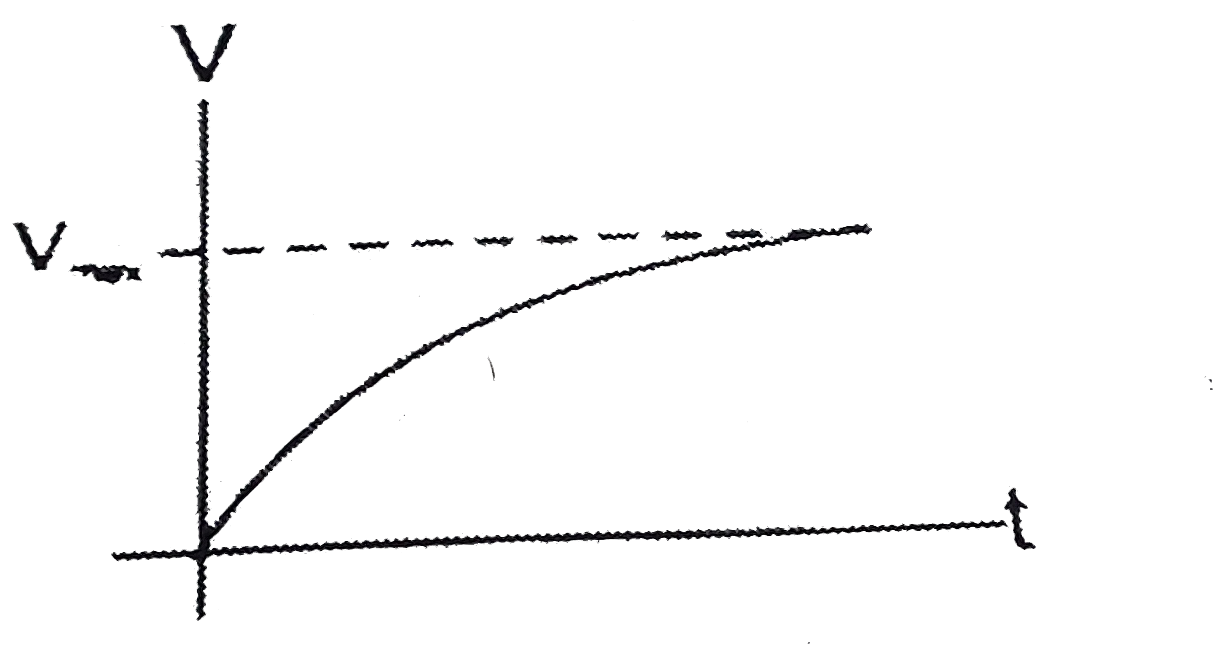 `m(DV)/(dt)=F-ilB`….(1) `"" i=(BLV)/(R+r)`……(2) `m(dv)/(dt)=F-(B^(2)l^(2)v)/(R+r)` let `K=(B^(2)l^(2))/(R+r) implies int_(0)^(l)(dV)/(F-Kv)=int_(0)^(t)(dt)/(m)` `-[ln(F-KV)]_(0)^(v)=(t)/(m) implies ln((F-kV)/(F))= -(Kt)/(m)` `F-KV=Fe^(-kt//m) implies V=(F)/(K)(1-e^(-kt//m))` |
|
| 21. |
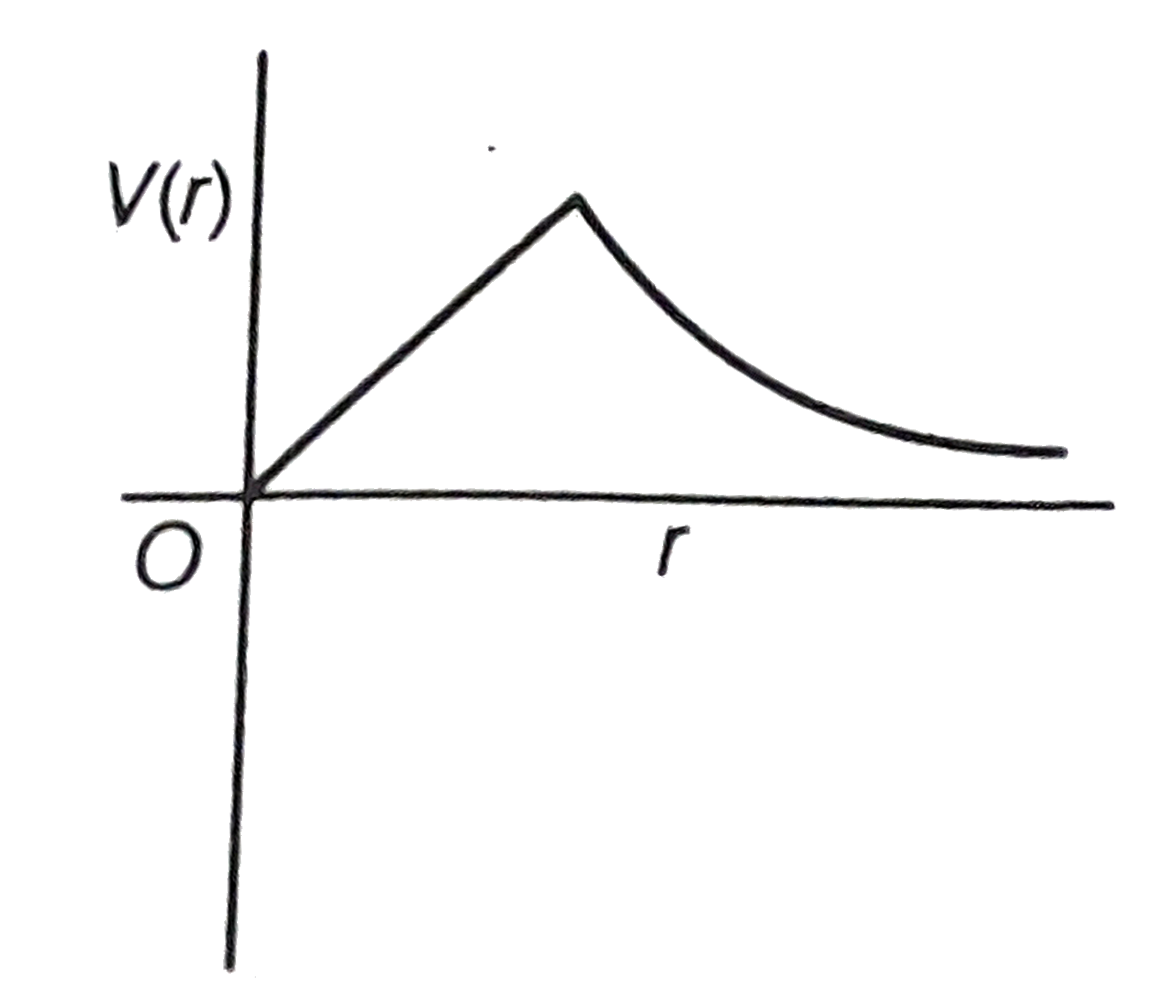
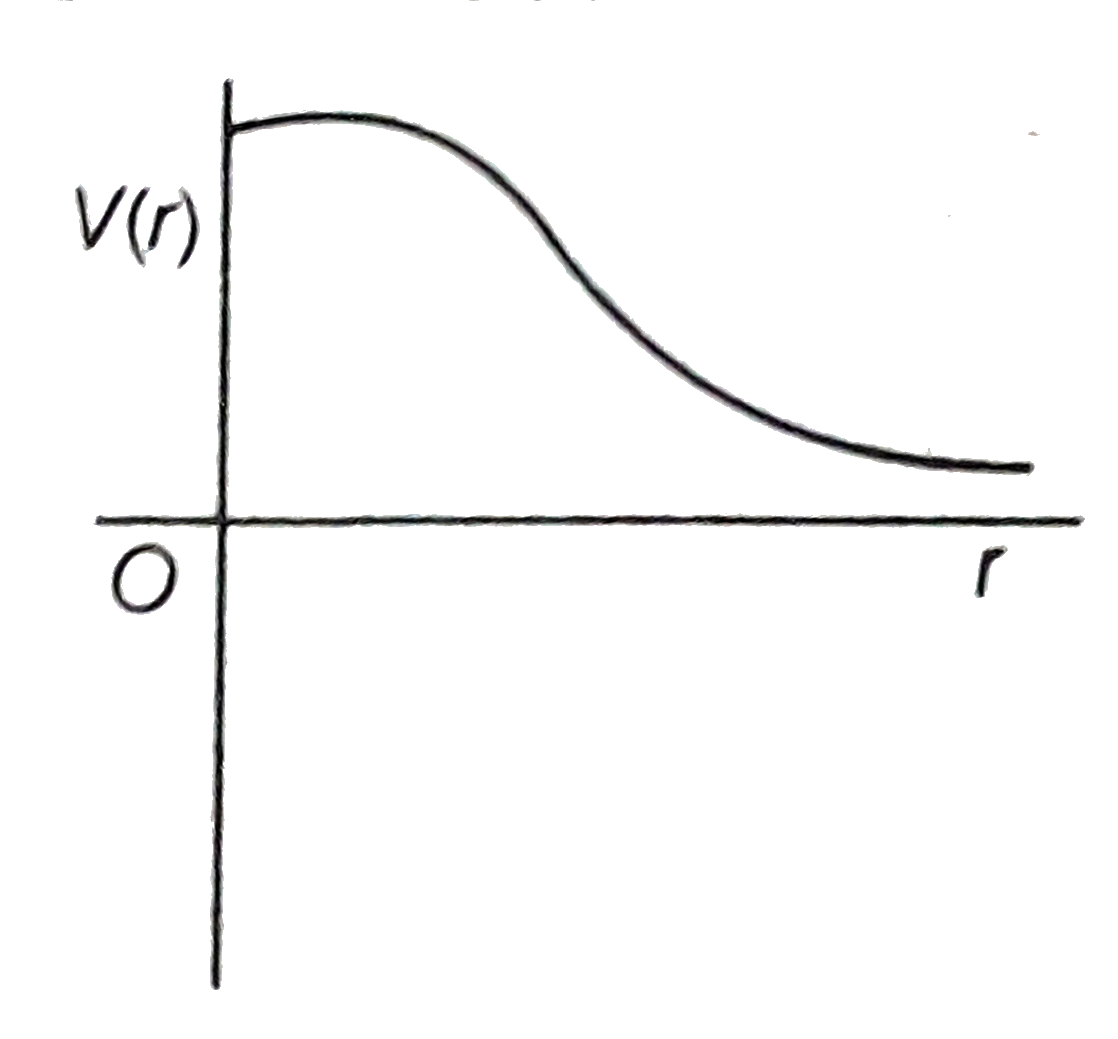
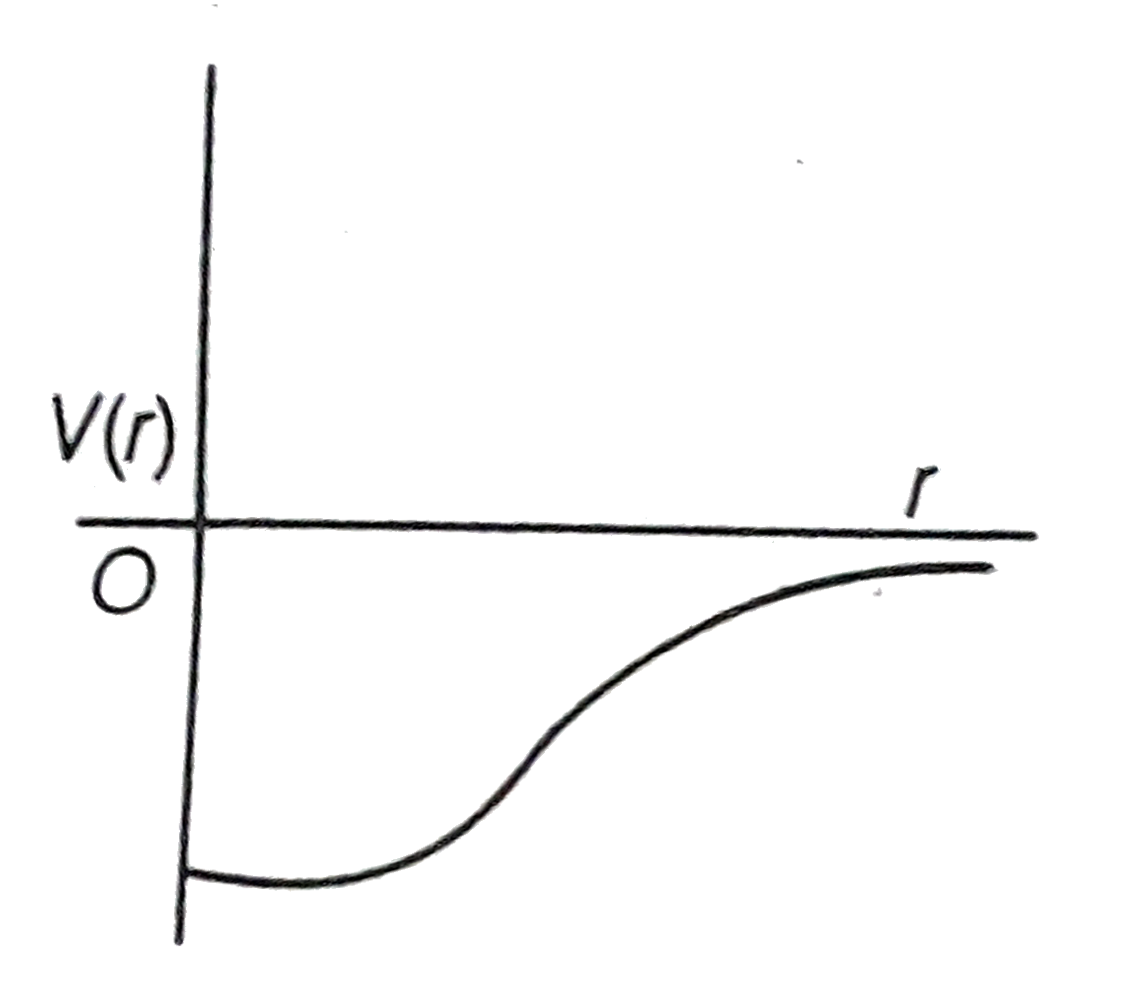
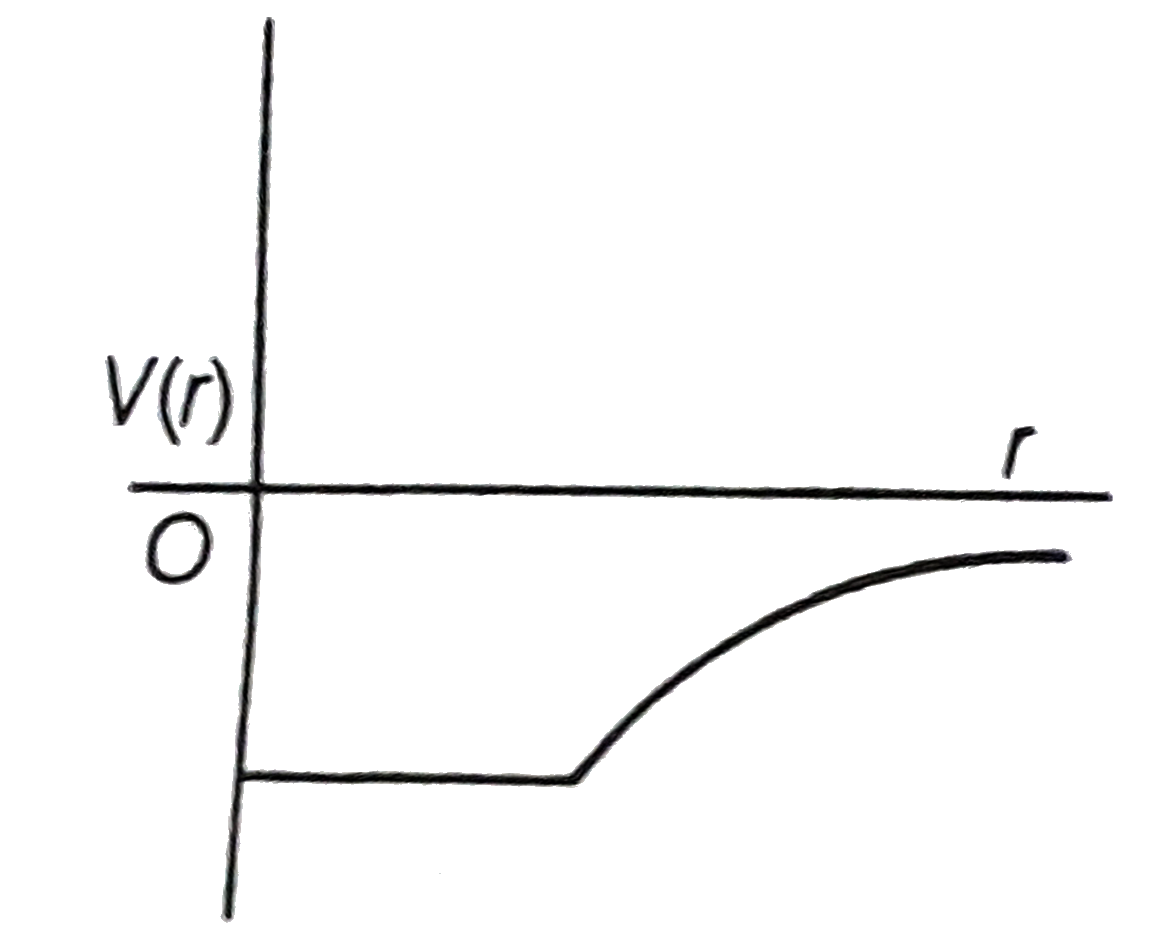
Which of thefollowingmost closely depicts the correctvariation of the gravitational potential V(r )due toa large planet of radius R and unifrom mass denisty ? |
|
Answer»
`V_(in)=-(GM)/(2r^(3))(3R^(2)-r^(2))` clearly v will b maximum at centre and minimum at the surfaceaso the valueof potential is negatve (as `r lt R)`so the GRAPH given in option c is hte correct ONE |
|
| 22. |
A circular coil of 100 turns has a radius of 10 cm and carries a current of 5A. The magnetic field at a point on the axis of the coil at a distance of 5 cm from the centre of the coil is : |
|
Answer» `2.25xx10^(-3)T` |
|
| 23. |
In the arrangement shown, a screen is placed normal to the line joining the two point coherent sources S_(1) and S_(2). The interference pattern consist of concentric circles. lambda is the wavelength of light (D gt gt d). if d = 0.5 mm, lambda = 5000 A^(@), D = 1m, at the point 'O' lying on the intersection of screen and the line joining the sources, the order of the fringe formed is |
|
Answer» 1000 TH DARK fringe |
|
| 24. |
In a sonometer wire, the tension is maintained by suspending a 50.7kg mass from the free end of the wire. The suspended mass has a volume of 0.0075cm^3. The fundamental frequency of vibration of the wire is 260Hz. If the suspended mass is completely submerged in water, the fundamental frequency will 40y Hz. Find y |
|
Answer» |
|
| 25. |
In the arrangement shown, a screen is placed normal to the line joining the two point coherent sources S_(1) and S_(2). The interference pattern consist of concentric circles. lambda is the wavelength of light (D gt gt d). The radius of the n^(th) bright ring is |
|
Answer» `(N LAMBDA D)/(d)` |
|
| 26. |
In the arrangement shown, a screen is placed normal to the line joining the two point coherent sources S_(1) and S_(2). The interference pattern consist of concentric circles. lambda is the wavelength of light (D gt gt d). The phase difference of the interfering light at point P is |
|
Answer» `(2pi)/(LAMBDA) d COS theta` |
|
| 27. |
Light of intensity 10^(-5) W//m^2 falls on a sodium photocell of surface area 2 cm ^2 . Assuming that top 5 layers of sodium absorb the incident energy , the estimated time required for photoelectric emission considering wave model of light is approximately. ("given" rho=0.971 gm//c""c, "mass"=23 gm//mol, "work function" =2eV, "Atomic number"=11) |
|
Answer» `10^5` SEC |
|
| 28. |
A block of mass 'm' is connected to the lower end of a massless vertically suspended spring. The ball is displaced slightly downward and released, it oscillates up and down. Match the coloum I and column II |
| Answer» SOLUTION :`(A) rarr (p, Q, R) (B) rarr (p, q) (C ) rarr (p, r) (D) rarr (p, r)` | |
| 29. |
(A): Only a change in magnetic flux will maintain an induced current in the coil. (R): The presence of large magnetic flux through a coil maintains a current in the coil if the circuit is continuous |
|
Answer» Both A and R are true and R is the correct EXPLANATION |
|
| 30. |
Describe brifly, with the help of a labelled diagram, the basic elements of an A.C. generator.State its underlying princilple.Show diarammatically how an alternating emf is generated by a loop of wire rotating in a magnetic field.Write the expression for the instantaneous value of the emf induced in the rotating loop. |
|
Answer» Solution :Basic elements of an `A.C.` generator An `A.C` generator consists of a rotor shatt on which a coil is mounted.A magnetic field is created around an armature coil with the HELP of permanent magnets. The terminals of the coil are connected to two slip rings.Carbon brushes are attached to slip rings so as to make connection with an external circuit. Underlying principle of an `A.C.` generator The underlying principle responsible for the working of an `A.C.` generator is electromagnetic induction.According to this principle.if a conductor is placed in a varying magnetic field, then current is INDUCED in the conductor. Generation of an alternating `e.m.f.` by loop of wire ROTATING in a magnetic field Expression of the instantaneous VALUE of the induced `e.m.f.` in a rotating loop `epsilon=NBAomegasin omegat` Where `N`=NUMBER of turns in armature coil `B`=Magnetic field vector `A`=Area vector of the coil `omega`=Angular speed 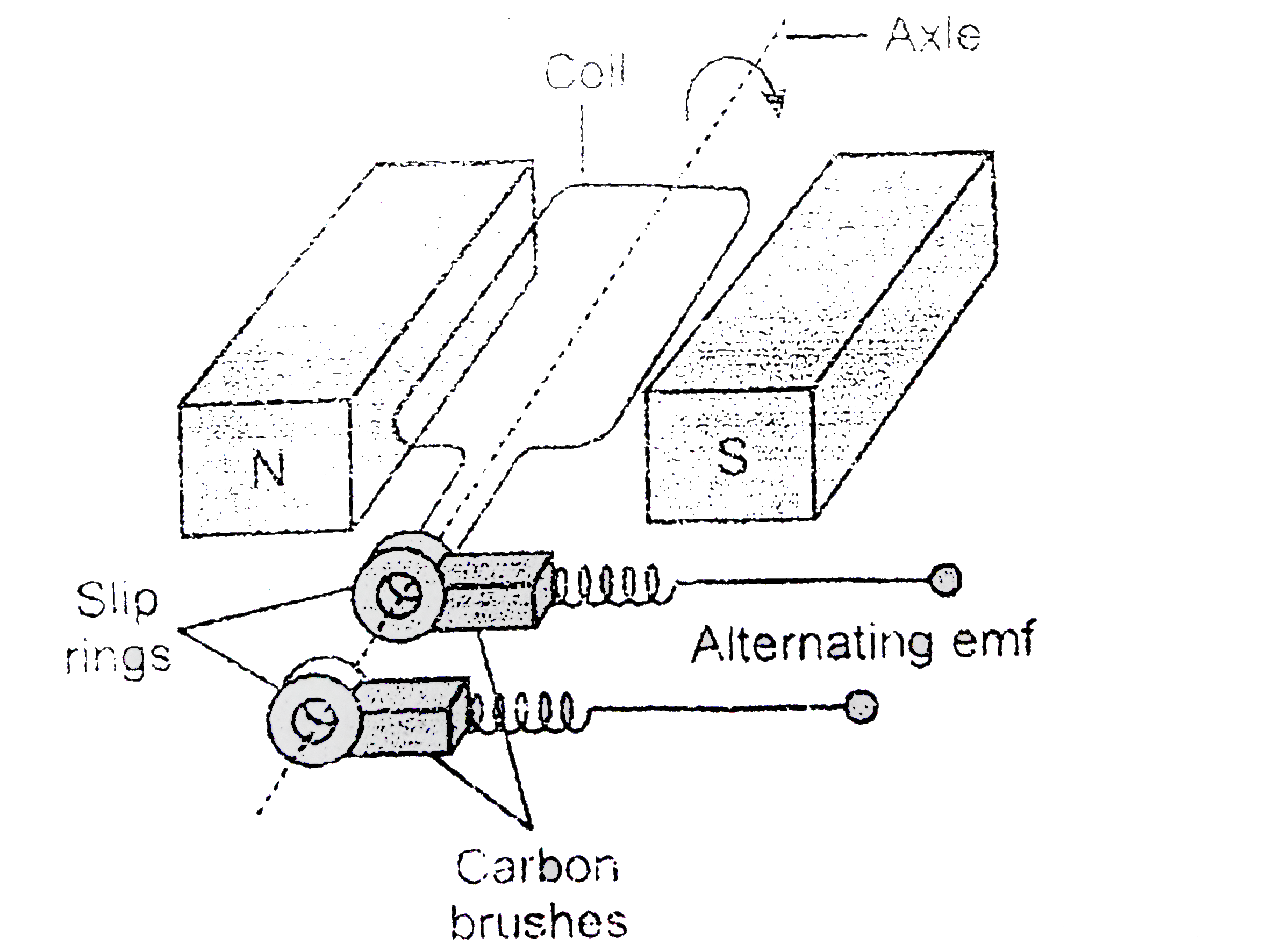 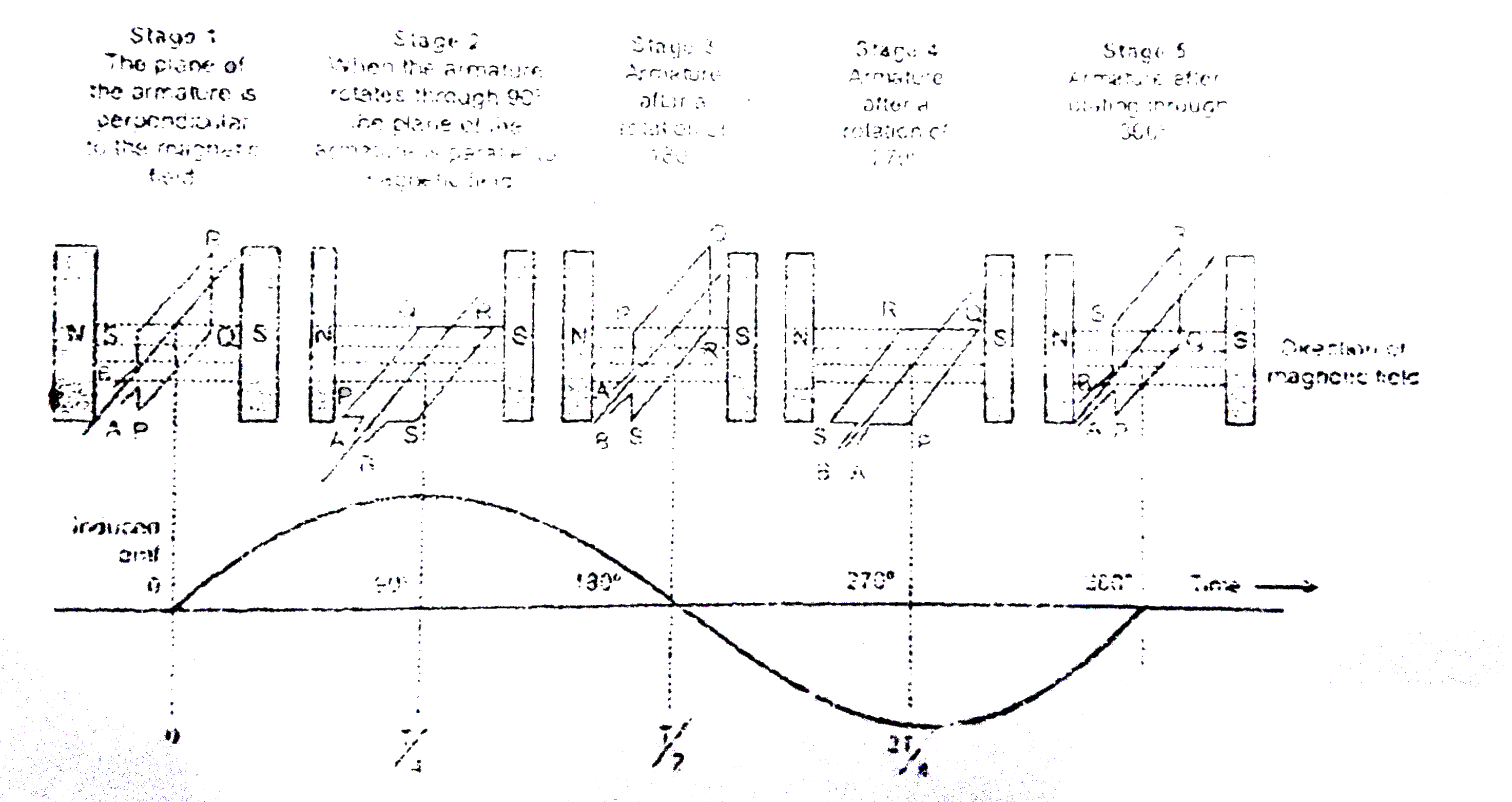
|
|
| 31. |
A cylindrical magnetic having a length of 7 cm and diameter 4 cm has a uniform magnetization of 6xx10^3 A//m Calculate the dipole moment. |
|
Answer» |
|
| 32. |
Use Bohr's model of hydrogen atom to obtain the relationship between the angular momentum and t magnetic moment of the revolving electron. |
|
Answer» Solution :When an electron revolves around the nucleus in an HYDROGEN atom, an equivalent current `I= (ev)/(2pir)` is set up and the magnetic moment associated with the CIRCULATING current is equivalent to `vecmu_(l)=I.A=(ev)/(2pir)xxpir^(2)=(evr)/(2)` However, as PER Bohr.s quantum condition, the angular momentum of the revolving electron is an integer multiple of `(h)/(2pi) i.e` `|vecl |= mvr = (nh)/(2pi)` Comparing (i) and (II) we find that Comparing (i) and (ti), we find that `|vecmu_(l)|= (e)/(2M).|vecl|` |
|
| 33. |
The relation R in the set {1,2,3} given by R = {(1,2),(2,1),(1,1)} is- |
|
Answer» SYMMETRIC and TRANSITIVE, but not REFLEXIVE |
|
| 34. |
There is a point object at a height h above the surface of water in a tank. If the bottom of the tank acts as a plane mirror where will be the image formed? If an observer looks from air at the surface of water normally, calculate the distance of the image from that surface of water of the tank formed by the mirror-like bottom surface of the tank. Refractive index of water =(4)/(3). |
|
Answer» Solution :Q is a POINT source. For refraction in water the apparent position of Q is Q. [Fig. 2.57]. `"So", "" MU = ("apparent HEIGHT")/("real height") = (PQ.)/(PQ)` `= (PQ.)/(h)` `or, "" PO. = mu^(h) = (4)/(3)h` Therefore the distance of Q. from the bottom of the tank `= d + (4)/(3)h` So the image of Q. will be formed at a distance of `(d + (4)/(3)h)`from the bottom of the tank. The distance of the image from the surface of water ` = d + d(4)/(3)h = 2d + (4)/(3)h` If the apparent distance of the image from the surface of water the EYE of an observe in air medium is x then, `(4)/(3) = (2d + (4)/(3)h)/(x)` `or, "" x = (4)/(3) (2d + (4)/(3)h) = (3)/(2)d + h` 
|
|
| 35. |
(a) Explain the processes of nuclear fission and nuclear fusion by using the plot of binding energy per nucleon (BE/A) versus the mass number A. (b) A radioactive isotope has a half-life of 10 years. How long will it take for the activity to reduce to 3.125%? |
|
Answer» Solution : (b) Here `T_(1/2) = 10 `years. Let after n half LIVES the activity of radioactive isotope is reduced to 3.125%. Then as per RELATION `R_(n) = R_(0)(1/2)^(n)`, we have `R_(n)/(0)=3.125/100=(1/2)^(n) implies n=5` `therefore` Time `t =nT_(1/2) =5 xx 10 years = 50 `years |
|
| 36. |
Why do birds fly off a high tension wire when current is switched on ? |
| Answer» Solution :When HIGH tension CURRENT is SWITCHED on, INDUCED currents are set up in the body system is being CONDUCTED in the nervous and circulatory systems | |
| 37. |
The refractive indices of crown glass prism of C,D and F lines are 1.527, 1.530 and 1.535 respectively. Find the dispersive power of the crown glass prism. |
|
Answer» 0.01509 |
|
| 38. |
Referring to the previous Illustration, if the stone reaches the ground after 1 2 scoond from same initial height of release, find the (a) speed of the balloon af the time of releasing the stone, (b) total distance covered by the stone till it reaches The ground level, c) The average speed and (d) average velocity of the stone for the total time of its flight, one from the bottom and the other from the top. |
|
Answer» SOLUTION :(a) 4.8 = `-v_(0)t+(1)/(2)GT^(2)` PUTTING t= 2 sec, We obtain `2V_(0)=20-4.8=15.2m//s` `rArrv_(0)=7.6m//sec`. (b)`d=4.8+2xx(V_(0)^(2))/(2g)=4.8+(V_(0)^(2))/(G)`where `v_(0)=7.6m//sec`. (c)(d)`vecU=(d)/(t)`,put the values of d and t = 2 sec.`vecv=(s)/(t)`put s=4.8 and2 sec. to obtain `vecv = 2.4 m//s` |
|
| 39. |
Cell arises from pre-exixting cell was stated by- |
|
Answer» Haeckel |
|
| 40. |
Explain how the image is formed by thin convex lens and derive -1/u+1/v=(n_(21)-1)[(1)/(R_1)+(1)/(R_2)] |
|
Answer» SOLUTION :Figure shows the GEOMETRY of image formation by a double convex lens. The image formation can be seen in terms of two steps. The first refracting surface forms the image `I_1`, of the OBJECT O figure (b).  The image `I_1`, acts as a virtual object for the second surface that forms the image at I figure (c).  Thus, the image formed by thin lens is shown in figure (a).  For refraction at interface ABC, `therefore (n_1)/(OB)+(n_2)/(BI_1)=(n_2-n_1)/(BC_1)` ... (1) A similar procedure applied to the interface ADC gives, `therefore-(n_2)/(DI_1)+(n_2)/(DI)=(n_2-n_1)/(DC_1)` ... (2)(Refractive index of medium on right side of ADC is n, while on its left it is `n_2`). For a thin lens, `BI_1`, = `DI_1`. Adding equations (1) and (2), `(n_1)/(OB)+(n_1)/(DI)=(n_2-n_1)[(1)/(BC_1)+(1)/(DC_2)]` Suppose the object is at infinity i.e. OB `rarr infty` and DI = f. `therefore (n_1)/(infty)+(n_2)/(f)=(n_2-n_1)[(1)/(BC_1)+(1)/(DC_2)]` `therefore (n_1)/(f)=(n_2-n_1)[(1)/(R_1)-(1)/(R_2)]` `[ because BC_1=R_1" and "DC_2=-R_2]` Now dividing by `n_1` on both SIDES `(1)/(infty)=0` `therefore 1/f=(n_2/n_1-1)[(1)/(R_1)-(1)/(R_2)]` `therefore 1/f=(n_(21)-1)[(1)/(R_1)-(1)/(R_2)](because n_(21)=(n_2)/(n_1))` ... (3) equation (3) is known as the lens maker.s formula. It is useful to design lenses of desired focal length using surfaces of SUITABLE radii of curvature. Note that the formula is true for a concave lens also. In that case R, is negative, R, positive and therefore f is negative. |
|
| 41. |
The circuit shown in figure has two identical capacitors one of which carries a charge Q and the other is having no charge. Switch S is closed. Find the maximum value of current in the circuit if self inductance of the loop is L and each capacitance C. Neglect resistance of the loop. |
|
Answer» |
|
| 42. |
The refracting angle of a prism is A and refractive index of the material of the prism is cot(A/2).The angle of minimum deviation is : |
|
Answer» `180^@-3A` `cot""A/2=(sin((deltam+A)/(2)))/(sin""A/2)` `(cos""A/2)/(sin""A/2)=(sin((deltam+A)/(2)))/(sin""A/2)` `cos""A/2=sin((deltam+A)/(2))` `THEREFORE sin(90^@-A/2)=sin((deltam+A)/(2))` `therefore 90^@-A/2=(deltam+A)/(2)` `therefore180^@-A=deltam+A` `therefore180^@-2A=deltam``thereforedeltam=180^@-2A` |
|
| 43. |
4 cells of identical emf E and internal resistance r, are connected in series to a variable resistor. The following graph shows the variation of termical voltage of the combination with the current output. Fig. MTP 1.2. (a) What is the emf of each cell used? (b) For what current from the cells, does maximum power dissipation occur in the circuit? (c) Calculate the internal resistance of each cell. |
| Answer» SOLUTION :(a) 1.4V (b) 1A (c) `0.7 Omega`. [See HINT Q. 80, PAGE 2//95]` | |
| 44. |
The heat producted by 100 W heater in 2 mintues is equal to |
|
Answer» 10.5 kJ |
|
| 45. |
Resistances P,Q,R,S of values 2,3,2,4 form a wheat stone bridge the resistance to be connected to S to have the bridge balanced is |
|
Answer» `1OMEGA` series |
|
| 46. |
A car is travelling at 36 kmph on a road. If mu=0.5 between the tyres and the road, the minimum turning radius of the car is (g=10 ms^(-2)) |
| Answer» Answer :A | |
| 47. |
The minimum distance of distinct vision for a person is1m . What eye defect does suffer from ? |
|
Answer» |
|
| 48. |
Explain by drawing a line spectra diagram of the transition between energy levels in an atom. |
|
Answer» Solution :The formula for the wavelength of light emitted from a transition between different ATOMIC states. `(1)/(lambda_(if))~~R[(1)/(n_(f)^(2))-(1)/(n_(i)^(2))] and n_(f) lt n_(i)` If `n_(f)=1 and n_(i) =2,3,4...`then the wave number of Lyman series line `alpha, beta, gamma, delta`..... resprectively obtained. If `n_(f)=2 and n_(i)= 3,4,5`... then wave number of Balmer series line `alpha, beta, gamma, delta,`.... respectively obtained. If `n_(f)=3 and n_(i)= 4,5,6`... then wave number of Balmer series line `alpha, beta, gamma, delta, `..... respectively obtain If `n_(f)=5 and n_(i)= 6,7,8`... then wave number of pfund series lineed. `alpha, beta, gamma, delta`.,.... respectively obtained. The spectral line from all the different TRANSITIONS of the electron in hydrogen atom is SHOWN in figure below.  To remember the short of this series : LAY BAPA BE FUND means LA = For Lyman `n_(f) = 1` BA = For Balmer `n_(f) = 2` PA = For Paschen `n_(f) =3` BE = For Brackett `n_(f) = 4` FUND = For Pfund `n_(f)=5` |
|
| 49. |
A self-induced wmf in a solenoid of inductance L changes in time asvarepsilon=varepsilon_0e^(-kz). Assuming the charge is finite.find the total charge that passes a point in the wire of the solenoid. |
|
Answer» `varepsilon_0/(Lk^2)` |
|