

Saved Bookmarks
This section includes 7 InterviewSolutions, each offering curated multiple-choice questions to sharpen your Current Affairs knowledge and support exam preparation. Choose a topic below to get started.
| 1. |
A positively charged ball hang a silk thread. We put a positive test charge q_(0) at a point and measure F//q_(0), then it can be predicted that the electric field strength E. |
|
Answer» `GT F//q_(0)` |
|
| 2. |
The forbidden energy gap of a semiconductor is 1.1eV.What does it mean? |
| Answer» SOLUTION :It MEANS that,for an electron to MOVE from valance band to the conduction band REQUIRES an ENERGY of 1.1eV. | |
| 3. |
When ac is passing through a resistor, what is the instantaneous power? |
|
Answer» <P> SOLUTION :`P = I^2 R = Ri_m^2sin^2 OMEGA t` |
|
| 4. |
The dimensional formula for stefan's constant 's' is |
|
Answer» `M^(1)L^(0)T^(-3)K^(-4)` |
|
| 5. |
The resolving power of a microscope is |
|
Answer» Solution :The diagram related to the calculation of resolution of microscope. A microscope is used to see the details of the OBJECT under OBSERVATION. The ability of microscope depends not only in magnifying the object but also in resolving two points on the object separated by a small distance `d_(min)` Smaller the value of ` d_(min)` better will be the resolving power of the microscope. The radius of central MAXIMA us, `r_(0) = (1.22 lambdav)/(a)` In the place of focal lenghtf we have the image distance v. If the difference between the two points on the object to be resolved is `d_(min)` , then the magnicifation m is, `m = (r_(0))/(d_(min))` `d_(min)=(r_(0))/(am)=(1.22lambdau)/(a) [thereforem=v//u]` `d_(min)=(1.22lambdaf)/(a)[thereforeuapproxf]` On the object side, `2 tan beta approx = 2 sin beta = (a)/(f) "" THEREFORE [a = f 2sin beta]` `d_(min) = (1.22lambda)/(2sin beta)` The further reduce the value of `d_(min)` the OPTICAL pathof the light is increased by immersing the objective of the microscope in the a bath containing oil of refractive index n. 
|
|
| 7. |
Two weights w, and w, are attached to the ends of a string which passes over a frictionless pulley. If the pulley is placed in a lift rising up with an acceleration equal to that of gravity i.e. '8', the tension in the string : |
|
Answer» `(4w_(1)w_(2))/(w_(1)+w_(2))` When the PULLEY is accelerated upward with acceleration g then each of the weight is doubled as W.= m (g +a) = 2 mg = 2W `:.T=(2(2W_(1))+(2W_(2)))/(2W_(1)+2W_(2))=(4W_(1)W_(2))/(W_(1)+W_(2))` HENCE correct choice is (a) |
|
| 8. |
The amplitude of the electric field of a plane electro- magnetic wave in air is 6.0 xx 10^(-4) Vm^(-1). The amplitude of the magnetic field will be: |
|
Answer» `1.8 xx 10^(5) T` |
|
| 9. |
The optical properties of a medium are governed by the ralative permittivity (epsilon_(r )) and relative permittivity (mu_(r )). The refractive index is defined as sqrrt(mu_(r ) epsilon_(r )) = n. For ordinary material epsilon_(r ) gt 0 and mu_( r) gt 0 and the positive sign is taken for thesquare root. In 1964, a Russian scientist V. Veselago postulated the existence of material with epsilon_( r) lt 0 and mu_( r) lt 0. Since then such 'metamaterials' have been produced in the laboratories and their optical properties studied. For such material n = - sqrt(mu_( r) epsilon_(r )). As light enters a medium of such refractive index the phase travel away from the direction of propagation. (i) According to the description above show that if rays of light eneter such a medium from aie (refractive index = 1) at an angle theta in 2nd quadrant, then the refracted beam is in the 3rd quardrant. (ii) Prove that Snell's law halds for such a medium. |
|
Answer» SOLUTION :Suppose the given postulate is true. In that event, two parallel rays entering such a medium from air (refractive index `= 1`) at an angle `theta_(i)` in 2nd QUADRANT, will be refracted in 3rd quadrant as shwon in Fig.  Let `AB` represent the incident wavefront and `DE` represent the refracted wavefront. All points on a wavefront must be in same phase and in turn, must have the same optical path LENGTH. `:. -sqrt(in_( r) mu_(r )) AE = BC - sqrt(in_( r) mu_(r ))CDorBC = sqrt(in_( r) mu_(r )) (CD - AE)` If `BC gt 0`, then `CD gt AE`, which is obvious from Fig. Hence the postulate is RESONABLE. However, if the light proceeded in the sense it does for ordinary material, (going from 2nd quadrant to 4th quadrant) as shown in Fig. then proceeding as above, `-sqrt(in_(r ) mu_(r))AE = BC - sqrt(in_(r ) mu_(r )) CD or BC = sqrt(in_(r) mu_(r ))(CD - AE)` As `AE gt CD`, therfore, `BC lt 0` which is not possible. Hence the given postulate is correct. (ii) In Fig. `BC = AC sin theta_(i) and CD - AE= AC sin theta_( r)` As`BC = sqrt(in_(r ) mu_(r)) (CD - AE)` `:. AC sin theta_(i) = sqrt(in_(r ) mu_(r )) AC sin theta_(r )` or`(sin theta_(i))/(sin theta_( r)) = sqrt(in_( r)/(mu_(r )) = n`, which proves Snell's law. |
|
| 10. |
The plane of a circular coil is at right angles to the magnetic meridian. If the number of turns in the coil equals 2, radius of the coil equals 0.078 m and current 2.8 A, then calculate the net magnetic field at the centre for clockwise and anticlockwise currents. Given : B_(u)=4 times 10^(-5)T. |
|
Answer» Solution :Magnetic field at the cenre `=(mu_(0)/(4pi))((2pini)/r)tesla` i.e., `""B_(C)=((10^(-7))(2 times 3.142 times 2 times 2.8))/(0.078)` `""B_(C)=4.51 times 10^(-5)T.` Case (i) : For ANTI clockwise current `""B_(R)=B+B_(H)` `""B_(R)=(4.51+4) times 10^(-5)T=8.51 times 10^(-5)T` Case (ii) : For clockwise current `""B_(R)=B-B_(H)` `""=(4.51-4)times 10^(-5)` `""=0.51 times 10^(-5)T` 
|
|
| 11. |
Four point charges are labeled charge 1, charge 2, charge 3, and charge 4. it is known that charge 1 attracts charge 2. charge 2 repels charge 3, and charge 3 attracts charge 4. which of the following must be true? |
|
Answer» Charge 1 attracts charge 4 `{:(1,2):}` Next, since Charge 2 repels charge 3, charge 3 is in the same CAMP as charge 2 `{:(1,2),(,3):}` And, finally, since charge 3 attracts charge 4, these charges are in opposite camps, giving us `{:(1,2),(4,3):}` We now SEE that only (D) |
|
| 12. |
A parallel plate capacitor in series with a resistance of 100 Omega, an inductor of 20 mH and and AC voltage source of variable frequency shows resonance at a frequency of (1250)/(pi)Hz. If this capacitor is charged by a DC voltage source to a voltage 25 V, what amount of charge will be stored in each plate of the capacitor ? |
|
Answer» `0.2 mu C` `rArr 4PI^(2)upsilon_(r )^(2)=(1)/(LC)rArr C=(1)/(4pi^(2)upsilon_(r )^(2)L)` `rArr C=(pi^(2))/(4pi^(2)xx(1250)^(2)xx20xx10^(-3))=8XX10^(-6)F` Now, the capacitor is charged by a voltage source of 25 V, charge stored = Q = CV `=8xx10^(-6)xx25=200xx10^(-6)=0.2xx10^(-3)C` `therefore Q=0.2 mC` |
|
| 13. |
Air bubble in water behaves as |
|
Answer» some TIMES conacave, SOMETIMES CONVEX lens |
|
| 14. |
The neutral region formed at P-n junction due to recombination of electrons and holes is |
|
Answer» FERMI LAYER |
|
| 15. |
A step down transformer increases the input current 4 A to 24 A at the secondary. If the number of turns in the primary coil is 330, the number of turns in the secondary coil is |
|
Answer» a. 60 |
|
| 16. |
The critical angle for a certain wavelength of light is glass is 40^(@). Calculate the polarising angle and the angle of refraction in glass corresponding to it. |
|
Answer» |
|
| 17. |
The temperature co-efficient of resistance of a wire is 0.00125 °C^-1. At 300K its resistance is 1 ohm. The resistance of the wire will be 2 ohm at which temperature? |
|
Answer» 154 K |
|
| 18. |
On flowing current in a conducting wire the magnetic field produces around it.‛ It is a law of |
|
Answer» Lenz |
|
| 19. |
If the electric flux entering and leaving an enclosed surface respectively is phi_(1) and phi_(2), then electric charge inside the surface will be |
|
Answer» `(phi_(2)-phi_(1))epsi_(0)` |
|
| 20. |
An automobile traveling at 80.0 km//h has tyres of 70.0 cm diameter. (a) What is the angular speed of the tires about their axles? (b) If the car is brought to a stop uniformly in 30.0 complete turns of the tyres (without skidding), what is the magnitude of the angular accelera tion of the wheels? (c) How far does the car move during the braking? |
| Answer» Solution :(a) `omega_(0)= 63.4rad//s`,(B) `omega^(2)= 10.7rad//s` , (C) 66.0m | |
| 21. |
If p.d. across a capacitor is doubled b. halved, by what factor does the energy stored change in each case? |
|
Answer» Solution :`E=1/2 CV^(2)` a. `triangleE=(1/2 C(2V)^(2))/(1/2 CV^(2)) =4"TIMES"` b. `triangleE=(1/2 C(V/2)^2)/(1/2 CV^(2))=1/4` |
|
| 22. |
Two long parallel wires carrying currents 2.5A and I amp in the same direction (directed into plane) are held at P and Q respectively as shown. The points P and Q are located at 5 m and 2m respectively from a collinear point R. An electron moving with a velocity of 4 xx 10^5 m/s along positive x axis experiences a force of 3.2 xx 10^(-20)N at the point 'R'. The value of I is |
| Answer» ANSWER :A | |
| 23. |
The capacities of three capacitors are in ratio 1:2:3. Their equivalent capacity when connected in parallel is (60)/11 muFmore than that when they are connected in series. The individual capacitors are of capacities in muF. |
|
Answer» `4,6,7` |
|
| 24. |
What are the uses of nuclear reactor ? |
|
Answer» Solution :Nuclear reactor is a system in which the nuclear fission takes place in a self-SUSTAINED controlled manner and the energy produced is used either for research purpose or for power generation. The main parts of a nuclear reactor are fuel, moderator and control rods. In addition to this, there is a cooling system which is connected with power generation set up. Fuel : (i) The fuel is fissionable material, usually uranium or plutonium. Naturally occurring uranium contains only 0.7% of `""_(92)^(235)U` and 99.3% are only `""_(92)^(238)U`. So the `""_(92)^(238)U` must be enriched such that it contains at least 2 to 4% of `""_(92)^(235)U`. (ii) A neutron source is required to initiate the chain reaction for the first time. A mixture of beryllium with plutonium or polonium is used as the neutron source. (iii) During fission of `""_(92)^(235)U`, only fast neutrons are emitted but the probability of initiating fission by it in another nucleus is very low. (iv) Slow neutrons are preferred for sustained nuclear reactions. Moderators : (i) The moderator is a material used to convert fast neutrons into slow neutrons. Usually the moderators are chosed in such a way that it must be very light nucleus having mass comparable to that of neutrons. (ii) Hence, these light nuclei undergo collision with fast neutrons and the speed of the neutron is reduced (Note that a billiard ball striking a stationary billiard ball of equal mass would itself be stopped but the same billiard ball bounces off almost with same speed when it strikes a heavier mass. (iii) This is the REASON for USING lighter nuclei as moderators). Most of the reactors use water, heavy water `(D_(2)O)` and graphice as moderators. (iv) The blocks of uranium stacked TOGETHER with blocks of GRAPHITE (the moderator) to form a large pile. 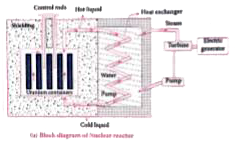 Control rods : (i) The control rods are used to adjust the reaction rate. (ii) During each fission, on an average 2.5 neutrons are emitted and in order to have the controlled chain reactions, only one neutron is allowed to cause another fission and the remaining neutrons are absorbed by the control rods. (iii) Cadmium or boron acts as control rod material and these rods are inserted into the uranium blocks. (iv) Depending on the insertion depth ofcontrol rod into the uranium, the average number of neutrons produced per fission is set to be equal to one or greater than one. (v) If the average number of neutrons produced per fission is equal to one, then reactor is said to be in critical state. (vi) If it is greater than one, then reactor is said to be in super-critical and it may explode sooner. Shielding : For a protection against harmful radiations, the nuclear reactor is surrounded by a concrete wall of thickness of about 2 to 2.5 m. 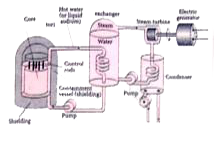 Cooling system : (i) The cooling system removes the heat generated in the reactor core. (ii) Ordinary water, heavy water and liquid sodium are used as coolant since they have very high specific heat capacity and have large boiling point under high pressure. (iii) This coolant passes through the fuel block and carries away the heat to the steam generator through heat exchanger. (iv) The steam runs the turbines which produces electricity in power reactors. |
|
| 25. |
Find the resulting amplitude and phase of the vibrations s=Acosomegat+(A)/(2)cos(omegat+(pi)/(2))+(A)/(4)cos(omegat+pi)+(A)/(8)cos(omegat+(3pi)/(2)) |
|
Answer» `B=sqrt((A-(A)/(4))^(2)+(A/(1)-(A)/(8))^(2)),tanvarphi=((A//4)-(A//8))/(A-(A//4))=(1)/(2)` 
|
|
| 26. |
A conducting loop is held in a magneitc field such that the field is oriented perpendicular to the area of the loop as shown in the figure A any instant, magnetic flux density over the entire area has the same value but it varies with time as shown in the figure B odot observer vec(B) (positive direction of field ) Match the following . |
|
Answer» |
|
| 27. |
A conducting loop is held in a magneitc field such that the field is oriented perpendicular to the area of the loop as shown in the figure A any instant, magnetic flux density over the entire area has the same value but it varies with time as shown in the figure B odot observer vec(B) (positive direction of field ) Match the following . |
|
Answer» <P>`{:(P,Q,R,S),(2,3,1,4):}` |
|
| 28. |
Draw electric field lines of simple charge distribution. |
|
Answer» Solution :The picture of field lines was invented by Faraday to develop an way to visualizing ELECTRIC FIELDS around charged CONFIGURATIONS. Faraday called them lines of force. Figures show the field lines around some simple charge configurations. As mentioned earlier, the field lines are in 3-dimensional space, though the figure shows them only in a plane. 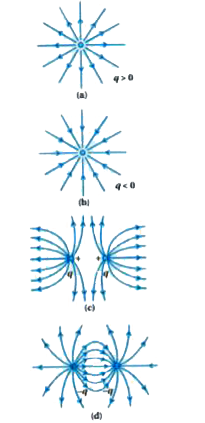 Electric field lines for positive charge are shown in figure (a). Electric field lines for negative charge are shown in figure (B). Electric field lines for dipole are shown in figure (c). For information : (a) Electric field lines for two negative charges :  (b) Electric field lines for uniform electric fields.  (c) Electric field lines on metallic sphere in uniform electric field : 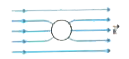 (d) Electric field lines for DIELECTRIC slab in uniform electric field : 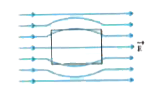 |
|
| 29. |
We want to rotate the direction of polarization of a beam of polarized through 90^(@) by sending the beam through one or more polarizing sheets . (a) What is the minimum number of sheets required ? (b) What is the minimum number of sheets required if the transmitted intensity is to be more than 65% of the original intensity ? |
| Answer» SOLUTION :(a) 2 SHEETS (B) 6 sheets | |
| 30. |
A 2.00-H indductor carries a steady current of 0.500A. When the switch in the circuit is opened,the current is effectively zero after 10.0ms. What is the average induced emf in the inductor during this time interval? |
|
Answer» 100V |
|
| 31. |
A motor car needs an engine of 3000 watts to keep up moving with a constant velocity of10m// s on horizontal road. The force of friction between the car tyres and the ground is |
|
Answer» <P>`300"DYNE"` |
|
| 32. |
In the arrangement shown in Fig itis possible to measure(by meansof a balance) theforce withwhich a paramagneticball of volumeV = 41 mm^(3) is attratedto a pole of theelectromagnet M.The magnetic induction at the axisof thepoleshoe dependson theheightx as B = B_(0) exp (-ax^(2)), where B_(0) = 1.50 T, a = 100 m^(-2). Find: (a) at what heightx_(m) the ball experiences the maximumattraction, (b) the magnetic suspeptibilityof the paranagneticif the maximumattraction forceequalsF_(max) = 160 muN. |
|
Answer» Solution :The force is QUESTION is `vec(F) = (vec(P_(m)) . vec(grad)) vec(B) = (chi BV)/(mu mu_(0)) (dB)/(DX)` since `B` is essentially in the X-direction So, `F_(x) = (chi V)/(2 mu_(0)) (dB^(2))/(dx) = (chi B_(0)^(2) V)/(2 mu_(0)) (d)/(dx) (e^(-2 ax^(2))) = -4 ax e^(-2ax^(2)) (chi B_(0)^(2))/(2 mu_(0)) V` This is maximum when is derivative vanishes i.e., `16 a^(2) x^(2) - 4a = 0`, or, `x_(m) = (1)/(SQRT(4a))` The maximum force is, `F_(max) = 4a (1)/(sqrt(4a)) e^(-1//2) (chi B_(0)^(2) V)/(2 mu_(0)) = (chi B_(0)^(2) V)/(mu_(0)) sqrt((a)/(e))` So, `chi = (mu_(0) F_(max) sqrt((e)/(a)))//V B_(0)^(2) = 3.6xx10^(-4)` |
|
| 33. |
Which material is used for the meter bridge wire and why ? |
|
Answer» Solution :Manganin/Constantan/Nichrome This material has a LOW temperature (any ONE) of coefficient of resistance/ HIGH resistivity. |
|
| 34. |
For sky wave propagation of 10 MHz signal. What should be the minimum electron density in the ionosphere |
|
Answer» `10^(12)//m^(3)` |
|
| 35. |
In heavy stable nuclei, neutron number is more than proton number. It is because |
|
Answer» NEUTRONS are heavier than proton. |
|
| 36. |
The area of the coil in a moving coil galvanometer is 16 cm^2 and has 20 turns. The magnetic induction is 0.2 T ad the couple per unit twist of the suspend wire is 10^(-6) Nm per degree. If the deflection is 45^@ calculate the current passing through it. |
|
Answer» SOLUTION :Given, `A = 16 cm^2 = 16 xx 10^(-4)m^2` `B = 0.2 T, N = 20, C = 10^(-6) N`m/degree ` theta = 45^@` From `C theta = BiAN` `= i (C theta)/(BAN)= (10^(-6) xx 45)/(0.2 xx 16 xx 10^(-4) xx 20) = 7 xx 10^(-3) A.` |
|
| 37. |
for what distance is ray optics os good approximation when the aperture is 4 mm and the wavelength of light is 400 nm ? |
|
Answer» 24 m |
|
| 38. |
If magnetic monopoles existed, which of the four Maxwell's equation be modified. |
| Answer» SOLUTION :(i) `ointvecB.vecds = (Q)/epsilon_0` (II) `ointvecE.vecdl = 0` | |
| 39. |
Two coils A and B are placed in a circuit. When current changes by 8 Amps in the coil A, the magnetic flux change of 1.6 weber occurs in B. Then what is the mutual inductance of the coil? |
|
Answer» SOLUTION :`phi_s = MdI_p` `THEREFORE M = phi_s/dI_p= 1.6/8 = 0.2H` |
|
| 40. |
A signal wave of frequency 12kHz is modulated with a carrier wave of frequency 2.51 MKz. The upper and lower side band frequency are respectively |
|
Answer» 2512 KHZ and 2508 kHz |
|
| 41. |
The magnetic potential due to short bar magnetic dipole at an axial point 20 cm from the centre of dipole is 10^-5 Wb/m. Its magnetic moment is : |
|
Answer» 1 `Am^2` |
|
| 42. |
The angle of initial phase is called |
|
Answer» epoch |
|
| 43. |
A small sphere of radius r_(1)and charge q_(1)is enclosed by a spherical shell of radius rand charge q_(2)Show that if q_(1)is positive, charge will necessarily flow from the sphere to the shell (when the two are connected by a wire) no matter what the charge q_(2)on the shell is. |
| Answer» Solution :Hint: By Gauss’s LAW, field between the SPHERE and the shell is determined by `q_(1)` alone. HENCE, potential difference between the sphere and the shell is INDEPENDENT of `q_(2)`. If `q_(1)`is POSITIVE, this potential difference is always positive. | |
| 44. |
The total energy of an electron in the first excited state of the hydrogen atom is about –3.4 eV. (a) What is the kinetic energy of the electron in this state? (b) What is the potential energy of the electron in this state? (c) Which of the answers above would change if the choice of the zero of potential energy is changed? |
|
Answer» Solution :According to hypothesis of Bohr model. `mvr=(nh)/(2pi)` and centripetal force = coulomb force. `(mv^(2))/(r)=(e^(2))/(4p epsi_(0)r^(2)) [ :.` For H, Z=1] `:.(1)/(2) mv^(2)= (e^(2))/(8 pi epsi_(0)r)` `:.k=(e^(2))/(8 pi epsi_(0)r)` `:. K=(e^(2))/(8 pi epsi_(0)r )""...(1)` and potential energy , `U=-(e-e)/(4pi epsi_(0)r)=(-e^(2))/(4pi epsi_(0)r) ""...(2)` `:.U=-((e^(2))/(8 pi epsi_(0)r))=-2K""...(3) ` and E=K+U `=K+(-2k)` `:.E=-K ""..(4)` E = -3.4 eV depend on the conventional CHOICE in which the potential energy is ZERO at infinite distance. `E=-k` `:.-(3.4)=-K` `:.K=3.4eV` |
|
| 45. |
A truck is moving due north at 30 m/s runs west and travels in the same speed, then the change in velocity is |
|
Answer» `60 m/s` North west |
|
| 46. |
A galvanometer having a resistance of 50Omega , gives a full scale deflection for a current if 0.05 A. The length in metre if a resistance wire of area of cross- section 2.97 xx10^-2cm^2 that can be used to convert the gaivanometer into an ammeter which can read a maximum of 5 A current is (specific resistance of the wire =5xx10^-7Omega-m) |
|
Answer» |
|
| 47. |
An electric dipole is kept fixed at a location. A positive point charge is brought near the dipole. What will be the maximum number of null points by placing point charge at appropriate location with respect to electric dipole? |
|
Answer» |
|
| 48. |
Two identical metallic sphere's having unequal opposite charges are placed at a distance 0.9 m apart in air. After bringing them in contact with each other they are again placed at the same distance apart. Now the force of repulsion between them is 0.025 N. calculate the final charges on each of them. |
|
Answer» SOLUTION :As two metallic spheres are idential, after bringing them in contact charges on both will be same i.e., `q_1 =q_2 =q` (say ).As R= 0.9 m and F = 0.025 N. Hence from the relation ` F= ( 1)/( 4pi in _0).(q_1 q_2)/(r^(2)) =(1)/(4pi in _0).(q^(2)) /(r^(2))`, we have ` ""q= sqrt ( 4 pi in _0. F . r^(2)) = sqrt ((0.025xx ( 0.9)^(2))//( 9xx 10 ^(9))) = 15 mu C .` |
|
| 49. |
Two similar thin equi-convex lenses, of focal length f each, are kept coaxially in contact with each other such that the focal length of the combination is F_1, when the space between the two lenses is filled with glycerin (which has the same refractive index (mu = 1.5) as that of glass) then the equivalent focal length is F_2. The ratio F_1 :F_2 will be : |
|
Answer» `3:4` `THEREFORE F_1=f/2` and `F_2=f` GIVEN `therefore(F_1)/(F_2)=1/2` |
|