Saved Bookmarks
This section includes 7 InterviewSolutions, each offering curated multiple-choice questions to sharpen your Current Affairs knowledge and support exam preparation. Choose a topic below to get started.
| 1. |
Choose the correct alternative: (a) Alloys of metals usually have (greater/less) resistivity than that of their constituent metals. (b) Alloys usually have much (lower/higher) temperature coefficients of resistance than pure metals. (c ) The resisitivity of the alloy manganin is nearly independent of/increases rapidly with increase of temperature. (d) The resistivity of a typical insulator (e.g., amber) is greater than that ofa metal by a factor of the order of (10 ^(22) //10 ^(23)). |
| Answer» SOLUTION :INDEPENDENT of TEMPERATURE | |
| 2. |
If a constant force acts on a particle, its acceleration will |
|
Answer» remain CONSTANT |
|
| 3. |
Fig. shows two identical parallel plate capacitors connected to a battery with the switch .S. closed. The switch is now opened and the free space between the plates of the capacitors is filled with a dielectric of K = 3. Find the ratio of the total electrostatic energy stored in both the capacitors before and after the introduction of the slab. |
|
Answer» `2:3` |
|
| 4. |
Define work function for a given metallic surface. |
| Answer» Solution :The minimum amount of ENERGY required to just eject an electron from a GIVEN METAL surface is called the work FUNCTION for that metal surface. | |
| 5. |
Let there be n resistors R_(1)... R_(n)with R_(max)= max (R_(1) ...R_(n) ) and R_("min") = " min " (R_(1) ... R_(n) ) . Show that when they are connected in parallel, the resultant resistance R_(p) = R_("min")and when they are connected in series, the resultant resistance R_(s) gt R_("max") . Interpret the result physically. |
Answer» Solution :Let some minimum value of resistance be `R_(" min")`  Let `R_("max") and R_("min")` be maximum and minimum resistance. For PARALLEL connection, `(1)/(R_(p)) = (1)/(R_(1)) + (1)/(R_(2)) + .... + (1)/(R_("min")) + ... + (1)/(R_(n))` By multiplying by `R_("min") ` on both side, `(R_("min"))/(R_(P)) = (R_("min"))/(R_(1)) + (R_("min"))/(R_(2))+ ..... + (R_("min"))/(R_(n))` `(R_("min"))/(R_(P)) gt ` 1 (Right side value is more than 1) `therefore(R_(p))/(R_("min")) lt 1 ` `therefore R_(p) lt R_("min")`  Series connection : From `R_(1), R_(2), ...., R_(n)R_("max") ` be maximum value, For series connection, `R_(S) = R_(1) + R_(2) + .... + R_("max") +.... + R_(n)` `R_(s) = R_("max") + (R_(1) +.... + R_(n))` `R_(s) gt R_("max")` ( Value of summation of resistance other than`R_("max") ` is POSITIVE.  For parallel connection : From FIGURE (a) `R_("min")` resistance is minimum resistance for loop given in figure (b). But in figure (b) there are (n- 1) loop so additional resistor (n - 1) . HENCE. current obtained in figure (b) is larger that current obtained in figure (a). `therefore ` Equivalent resistance of figure (b) will be LESS than `R_("min")` `therefore R_(p) lt R_("min")` For series connection : In figure (c) provide maximum resistance `R_("max")` Thus, current in figure (d) will be less than current in figure (c). thus, equivalent resistance of figure (d) `ltR_("max") therefore R_(S) gt R_("max")` 
|
|
| 6. |
If I_(r ) is reflected current and I_(0) is the incident current of a transmission line, then value of K_(r ) is : |
|
Answer» `K_(r )=(I_(r ))/(I_(0))` |
|
| 7. |
In the depletion layer, the electric field created |
|
Answer» is from n-side to p-side |
|
| 8. |
A plane glass plate is placed over a various coloured letters ( violet , green , yellow , red ) . The letter which appears to raised more is |
|
Answer» Red `THEREFORE SN` is more for that colour, for which n is more. Among the given COLOURS n is more for violet. Therefore it appears to be raised more. |
|
| 9. |
Two plates of a charged capacitor are connected to each through a resistance and a switch which is kept open initially. The switch is closed at t= 0. If q is charge on capacitor and I is the current in the circuit at time t then the curves that correctly represent the variation of the change and current with time are: |
|
Answer»
CHARGE as a function of TIME : `q= q_(0) e^(-t//tau)` Electric current as a function of time `i= i_(0) e^(-t//tau)` |
|
| 10. |
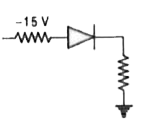
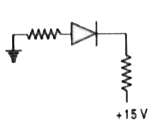
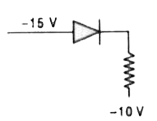
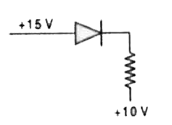
A ray of light travels from a medium of refractive index n into air. If the angle of incidence at the plane surface of separation is theta. And the correspoonding angle of deviation is delta, the variation deltawith theta is shown correctly in the figure. |
|
Answer»
|
|
| 11. |
The boolean expression of NOR gate is……. |
|
Answer» `y=overline(A)` `THEREFORE y=overline(A+B)` |
|
| 12. |
Consider the following statement A and B and identify the correct answer A) In the phenomenon of double refraction ordinary ray obeys Snell.s law where as extraordinary ray does not obey Snell.s law B) Velocity of extra-ordinary ray in the negative crystal is greater than for ordinary ray in the same crystal. |
|
Answer» A is FALSE but B is true |
|
| 13. |
A horizontal uniform glass tube of 100 cm length, sealed at both ends contains 10 cm mercury column in the middle. The temperature and pressure of air on either side of mercury column are respectively 31°C and 76 cm of mercury. If the air column at one end is kept at 0^@C and the other end at 273^@C, the pressure of air which is at 0^@C is (in cm of Hg) |
|
Answer» <P>76 `(76xx45)/((273+31)) =(P_(2)xxl)/(273+0) =(P_(3)(90-l))/(273 + 273)` `(P_(2)xxl)/273 =(P_(3)(90-l))/546` [`because` Mercury COUMN is at REST, `P_(2) = P_(3)`] `therefore l=30cm` `(76xx45)/304 =(P_(2)xx30)/273` `therefore P_(2) = 102.4` |
|
| 14. |
Name the part of electromagnetic spectrum which is suitable for (i) radar systems used in aircraft navigation. (ii) treatment of cancer tumours. |
| Answer» SOLUTION :(i) MICROWAVES (II) `GAMMA-`RAYS. | |
| 15. |
When a point light source of power W emitting monochromatic light of wavelength lamda is kept at a distance alpha from a photo-sensitive surface of work function phi and area S, we will have |
|
Answer» number of photons STRIKING the surface per unit time as `(WlamdaS)/(4)pihca^2` The maximum energy of emitted photoelectrons is `E_(max)=hc-phi=(hc)/(lamda)-phi=(1)/(lamda)(hc-lamdaphi)` The stopping potential is given by `eV_S=E_(max)` Hence, `V_S=(E_(max))/(e)=(1)/(elamda)(hc-lamdaphi)` Hence, choice (c ) is incorrect. For photoemission to be possible, we have `hcgephi`. Hence, `(hc)/(lamda)gephi` or `lamdale(hc)/(phi)` Thus, the permitted range of values of `lamda` is `0lelamdale(hc)/(phi)` Hence, the correct choices are (a), (b), (d) |
|
| 16. |
The amplitude of the magnetic field part of a harmonic electromagnetic wave in vacuum is B_(0)=510nT. What is the amplitude of the electric field part of the wave? |
|
Answer» Solution :As `B_(0)=510nT=510xx10^(-9)T` `THEREFORE""E_(0)=B_(0).c=510xx10^(-9)xx3xx10^(8)=153NC^(-1)`. |
|
| 17. |
Elinstein was awarded Nobel Prize in 1921 for his work on photoelecric effect. Write down Einstein's photo electric equation and explain the the symbols. |
| Answer» SOLUTION :`hV=hV_0+1/2mv^2` | |
| 18. |
Two small identical electric dipoles AB and CD, each of dioplemomentp are kept at an angleof 120^(@) as shown in Figure. What is the resultant dipolemoment of this combination ? If this system is subjectedto electricfield vec((E)) directed along + X direction, what will be the magnitude and direction of the torque actingon this ? |
|
Answer» SOLUTION :In FIG. two dipolemoments `p_(1)` alongBA and `p_(2)` along DC ACT at an angleof `120^(@)`. The resultant dipole moment is along OR `P_(R) = sqrt(p_(1)^(2) +p_(2)^(2) + 2p_(1) p_(2) cos 120^(@))` `= sqrt(p^(2) + p^(2) + 2pp (- (1)/(2))) = p` As `/_AQR = 60^(@)`, therefore, `/_XQR = theta = 90^(@) - 60^(@) = 30^(@)` `tau = pE sin theta = pE sin 30^(@) = pE//2` The direction of torque is perpendicular to `VEC(p) and vec(E) , i..e.,` perpendicular to planeof paper and outwards, Fig. 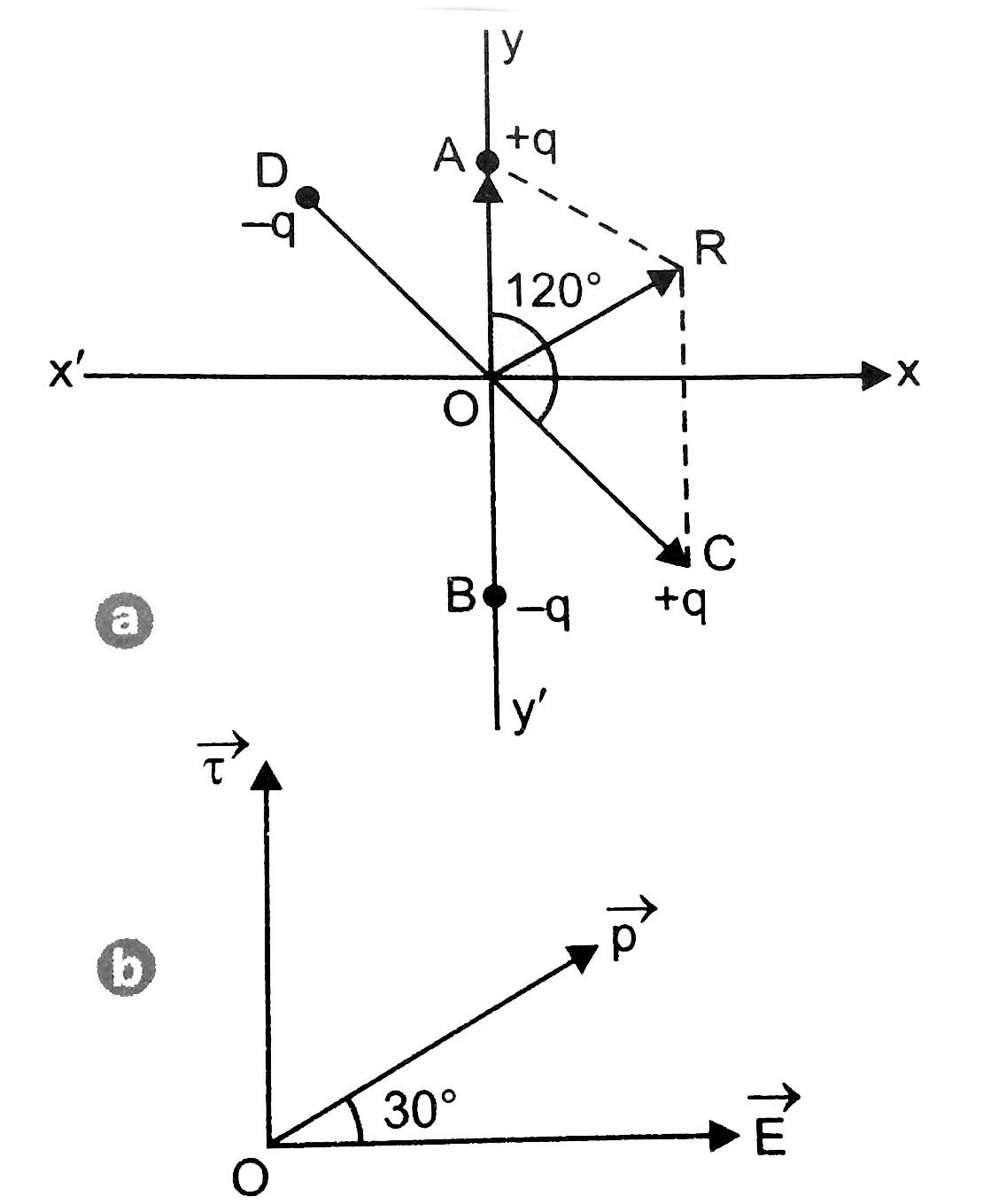
|
|
| 19. |
For concave mirror, image obtained at d_2 from mirror for object at d_1 . The focal length of mirror will be ...... |
|
Answer» `f=SQRT(d_1d_2)` `f=(UV)/(u+v)` `f=((f+d_1)(f+d_2))/(f+d_1+f+d_2)` `THEREFORE f^2+fd_1+f^2+fd_2=f^2+fd_2+fd_1+d_1d_2` `therefore f^2=d_1d_2` `therefore f=sqrt(d_1d_2)` |
|
| 20. |
We have ""_(19)^(39)K and ""_(17)^(37)Cl a. What are these nuclides ? ""b. How do they differ? |
|
Answer» Solution :a. They are ISOTONES. b. May have the same NUMBER of neutron but DIFFER in their ATOMIC number and atomic MASS. |
|
| 21. |
A diverging meniscus lens of radii of curvatures 25 cm and 50 cm has a refractive index 1.5. Itsfocal length is (in cm) |
| Answer» Answer :B | |
| 22. |
The vallue of ripple factor for full wave rectifier is |
|
Answer» Solution :RIPPLE factor for FULL wave rectifier = 0.482. EXPRESSED in `%` it is `48.2%` |
|
| 23. |
Two charge conducting spheres of radii a and b are connected to each other by a wire. What is the ratio of electric field at the surfaces of the two spheres ? |
|
Answer» SOLUTION :When two conducting spheres are connected to each other by a wire, transfer of charge will take place until the two spheres ATTAIN same potential. i.e., `V_(1) = V_(2) ` or, `E_(1) a = E_(2) B ` `:. ( E_(1))/( E_(2)) = ( b)/( a) ` |
|
| 24. |
At T(k), copper (atomic mass=635 u) has fcc unit cell structure with edge length of x A. What is the approximate density of Cu in g cm^-3 at that temperature? (N_A=6.0 times 10^23 mol^-1) |
|
Answer» `42.3/x^3` FCC unit cell is present, Z=4 Edge length = `x A` ATOMIC weight =`63.5 G mol^-1` `becauseDensity , d=(Z times at OMIC weight )/(a^3 times N_A)` where, a= edge length ` d=(Z times at omic weight )/(x^3times6.023 times10^23 times(10^-8)^3)` `=(4 times63.5)/(x^3 times6.023 times10^23 times10^-24)` `d=423.0/x^3` Hence, option (c ) is correct. |
|
| 25. |
(A):The Instantaneous velocity does not depend on instantaneous position vector. (R ):The instantaneous velocity and average velocity of a particle are always same. |
|
Answer» |
|
| 27. |
""_4^9Be + ""_2^4He to ""_6^12C + P + Q a. What are 'P' and 'Q'? "" b. What are the specialities of P ? |
|
Answer» Solution :a. P - neutron `(""_0^1n)` Q - energy b. i. A free neutron is unstable. ii. EXCEPT hydrogen, it is present in the nucleus of all ELEMENTS. III. Being a chargeless PARTICLES, it is underflected by electric and magnetic fields. iv. ENERGISED neutron has high penetrating power. |
|
| 28. |
Name two factors on which mutual inductance of a pair of coils depends. |
|
Answer» |
|
| 29. |
A uniform magnetic field exists in vertical downward direction in a room. If an electron is moving in horizontal direction, it gets deflected in circular path with constant speed. Its direction is : |
|
Answer» CLOCKWISE in VERTICAL plane |
|
| 30. |
A parallel plate capacitor made of circular plates each of radius 10.0 cm has a capacitance200muF. The capacitor is connected to a 200V a.c. supply with an angular frequency of 200rads^-1. (a) What is the r.m.s. value of the conduction current? (b) Is the conduction current equal to displacement current? (c) Peak value of displacement current. (d) Determine the amplitude of magnetic field at a point 2.0 cm from the axis between the plates. |
|
Answer» Solution :Here, `R=10cm=0.1m`, `C=200pF=200xx10^-12F=2xx10^-10F,` `E_(rms)=200V, omega=200rads^-1,` `r=2.0xx10^-2m`. (a) `I_(rms)=(E_(rms))/(1//omegaC)=omegaCE_(rms)` `=8xx10^-6A=8muA` (B) Yes, because `I_D=I` (c) `I_0=sqrt2I_(rms)=sqrt2xx8xx10^-6` `=11.312xx10^-6 A` (d) Consider a loop of radius r between two circular plates of parallel plate capacitor placed coaxially with them. The area of this loop `A'=pir^2`. By symmetry, the magnetic field `vecB` is equal in magnitude and is tangentially to the circle at every point, In this case, only a part of displacement current `I_D` will CROSS the loop of area A'. Therefore, the current passing through the area A'. Therefore, the current passing through the area A' `I'=(I_D)/(piR^2)xxpir^2=(I_D)/(R^2)r^2` Using Ampere's Maxwell law we have, `oint vecB.vec(DL)=mu_0xx`(total current through the area A') or `2pirB=mu_0(I_0)/(R^2)r^2` or `B=(mu_0I_0r)/(2piR^2)=(4pixx10^-7xx11.312xx10^-6 xx2xx10^-2)/(2pi(0.1)^2)` `=4.525xx10^-12T` |
|
| 31. |
A galvanometer of resistane G can measure 1 A current. If a shunt S is used to convert it into an ammeter to measure 10 Acurrent . The ratio ofG/Sis |
|
Answer» ` 1/9` I = 10 A Fromfigure, `I_(g)G = ( I - I_(g))S ` ` G/S = (I-I_(g))/(I_(g))` Substitutingthe GIVENVALUES, we GET ` G/S= (10 A -1 A)/( 1 A) = 9/1 ` 
|
|
| 32. |
When electrons drift in a metal from lower to higher potential, does it mean that all the free electrons of the metal are moving in the same direction ? |
| Answer» Solution :No even THOUGH, OVERALL motion is from higher to POTENTIAL, INDIVIDUAL in their motion randomness PRESENT. | |
| 33. |
What is dielectric strength ? |
| Answer» SOLUTION :Themazimumelectricfieldthe dielectriccan withstandbeforeit BREAKDOWNS is calleddielectricstrength . | |
| 34. |
In a series D.C. circuit has core of a reactance of 8Omega and a resistance of 6Omega. The effective resistance of the circuit will be ….. |
|
Answer» `24/7Omega` |
|
| 35. |
If the platesof a charged capacitor be suddenlyconnectedto eachother by a wire, what will happen ? |
| Answer» SOLUTION :The capacitorwill be dischargedimmediately. | |
| 36. |
.^(90)Sr decays to .^(90)Y by beta decay with a half-life of 28 years. .^(90)Y decaysby beta-to .^(90)Zr with a half-life of 64h. A pure sample of .^(90)Sr is allowed to decay. What is the valued of (N_(Sr))/(N_(y)) after (a) 1h (b) 10 years ? |
|
Answer» Solution :`N_(sr)=N_(Sr)^(0)R^((-lambda_(sr)t))` ....(1) `N_(y)=(lambda_(sr)N_(sr)^(0))/(lambda_(y)-lambda_(sr))[E^((lambda_(sr)t))-e^((-lambda_yt))]`.......(2) Dividing the two EQUATIONS `(N_(y))/(N_(sr))(lambda_(sr))/(lambda_(y)-lambda_(sr))[1-e^((-lambdat))(lambda_(sr)-lambda_(y))t]` `lambda_(sr)=0.693//(28xx365xx24)=2.825xx10^(-6)h^(-1)` `lambda_(y)=0.693//64=0.0108 h^(-1)` (a) For `t=1h` and using the VALUES for the decay constant `N_(sr)//N_(y)=3.56xx10^(5)` (b) For `t=10 "year", N_(sr)//N_(y)=3823` |
|
| 37. |
Interference fringes were produced by Young’s double slit method, the wavelength of light used being 6000 A The separation between the two slits is 2 mm. The distance between the slits and screen is 10 cm. When a transparent plate of thickness 0.5 mm is placed over one of the slits, the fringe pattern is displaced by 5mm. Find the refractive index of the material of the plate |
|
Answer» |
|
| 38. |
Why are the connections between the resistors in a meter bridge made of thick copper strips ? |
| Answer» Solution :This is to ensure that the connections do not CONTRIBUTE any EXTRA, UNKNOWN, resistances in the circuit. | |
| 39. |
The angular velocities of three bodies in simple harmonic motion are omega_(1),.omega_(2),omega_(3) with their respective amplitudes as A_(1),A_(2),A_(3). If all the three bodies have the same mass and velocity, then : |
|
Answer» `A_(1)omega_(1)=A_(2)omega_(2)=A_(3)omega_(3)` Since velocity is same `:.""A_(1)omega_(1)=A_(2)omega_(2)=A_(3)omega_(3)` Correct choice is (a). |
|
| 40. |
What happens to the drift velocity (v_(d)) of electrons and to the resistance (R), if the length of a conductor is doubled (keeping potential difference unchanged)? |
|
Answer» Solution :Drift velocity of free electron is given by `v_(d)=(EE)/(m)TAU` where `E=("Pot. Diff.")/("LENGTH")=(V)/(l)` So `v_(d)=(eV)/(ml)tau` i.e. `v_(d)prop(1)/(l)`(if `(eVtau)/(m)` is constant). It means if l is doubled keeping pot. diff. unchanged), the drift velocity will become half of the ORIGINAL value. we know, resistance `Rpropl` (length of the conductor) therefore, the resistance of the conductor becomes double of the original value when length of the conductor is doubled. |
|
| 41. |
Three rods A, B and C of the same length and same cross-sectional area are joined as shown. Their thermal conductivities are in the ratio 1:2:3/2. If the open ends of A and C are at 200^@C and 18^@C, respectively, then the temperature at the junction of A at steady state is |
| Answer» Answer :C | |
| 42. |
The properties of x -rays as put forwarded by Rontgen in his pioneering paper on the topic are as follos: X-rays posses a very strong pentrative power it can penetrate wood upto 3cm and and aluminium foil upto 15mm . If the hand if the hand is held between the discharge tube and the screen the dark shadow of the of the bones os visible within the slightly dark shadow of thehand" photographc plates and film "show themselves susceptible to x- rays " Hence , photography provided a valuable method of studying theeffect of x-rays xrays neither reflected nor reflected refracted (so far as Rontgen could discover ). Hence , " X - rays as cannot be concerted by lenses" X- rays discharge electrified bodies , whether the electrification is positive or negative . X-rays are generated when the cathode rays of the discharge tube strike any solid body .A heavier element , such as plantium , however is much more efficient as a generator of X - rays than a lighter element , such as aluminium . Most of Rontgen 's observation stood the test of time, though some of them needed to be modified later. ,brgt Now today we know if electronare accelerated through a potential difference V, then maximum energy of emitted photon could be E_(max)=eV, (hc)/(lambda_(min))=(hc)/(eV) lambda_(min) is also called cut off wavelength . since electron may loose very small energy in a given collision, the upper value of lambd eill approach infinity . when X-rays is produced in X-ray tube , two types of X-rays spectra and line are observed: continousspectra and line spectra. A continous spectra is produced by bremsstrahlung, the electromagnetic radiation produced when free electron are accelerated during collision with ions. A line spectrum result when an electra having sufficient energy collides with a heavy atom, and an electr in an inner energy level is ejected from the atom . An electra from an outer energy level then fills the vacant inner energy level, resulting in emission of an X-ray photon. The electron knocks out an inner shell electron of the atom with which it collides . Let us take an hypothetical case of a target atom whose K- shell electron has been knocked out as shown. this will create a vacancy in K-shell . sensing this vacancy an electron from a higher energy state may make a trasition to thsi vacant state. when such a transition take placce the differeceof energy is converted into photon of electromagnetic radiation, which is called charactertistic X-rays . Now depending upon the shell from which an electron make a trasition to K -shell we may have different lines in the K series of Xrays e.g. if electron from L shell jumps to K shell we have K_(alpha), if electron from M shell jumps to K shell we have K_(beta) X -rays and so . on . Monseley conducted many experiment on characteristic X-rays , the finding of whcih played an inportant role in . developing the concept opf atomic number . Moseley's observation can be expressed as sqrtv=a(Z-b) where a and b are constants. Z is the atomic number of target atom n is the frequency .In intensity V//s wavelength graph, which of the following process is reponsible for the intensity of peaks p_(1) and p_(2)? |
|
Answer» Bremsstrahlung |
|
| 43. |
The properties of x -rays as put forwarded by Rontgen in his pioneering paper on the topic are as follos: X-rays posses a very strong pentrative power it can penetrate wood upto 3cm and and aluminium foil upto 15mm . If the hand if the hand is held between the discharge tube and the screen the dark shadow of the of the bones os visible within the slightly dark shadow of thehand" photographc plates and film "show themselves susceptible to x- rays " Hence , photography provided a valuable method of studying theeffect of x-rays xrays neither reflected nor reflected refracted (so far as Rontgen could discover ). Hence , " X - rays as cannot be concerted by lenses" X- rays discharge electrified bodies , whether the electrification is positive or negative . X-rays are generated when the cathode rays of the discharge tube strike any solid body .A heavier element , such as plantium , however is much more efficient as a generator of X - rays than a lighter element , such as aluminium . Most of Rontgen 's observation stood the test of time, though some of them needed to be modified later. ,brgt Now today we know if electronare accelerated through a potential difference V, then maximum energy of emitted photon could be E_(max)=eV, (hc)/(lambda_(min))=(hc)/(eV) lambda_(min) is also called cut off wavelength . since electron may loose very small energy in a given collision, the upper value of lambd eill approach infinity . when X-rays is produced in X-ray tube , two types of X-rays spectra and line are observed: continousspectra and line spectra. A continous spectra is produced by bremsstrahlung, the electromagnetic radiation produced when free electron are accelerated during collision with ions. A line spectrum result when an electra having sufficient energy collides with a heavy atom, and an electr in an inner energy level is ejected from the atom . An electra from an outer energy level then fills the vacant inner energy level, resulting in emission of an X-ray photon. The electron knocks out an inner shell electron of the atom with which it collides . Let us take an hypothetical case of a target atom whose K- shell electron has been knocked out as shown. this will create a vacancy in K-shell . sensing this vacancy an electron from a higher energy state may make a trasition to thsi vacant state. when such a transition take placce the differeceof energy is converted into photon of electromagnetic radiation, which is called charactertistic X-rays . Now depending upon the shell from which an electron make a trasition to K -shell we may have different lines in the K series of Xrays e.g. if electron from L shell jumps to K shell we have K_(alpha), if electron from M shell jumps to K shell we have K_(beta) X -rays and so . on . Monseley conducted many experiment on characteristic X-rays , the finding of whcih played an inportant role in . developing the concept opf atomic number . Moseley's observation can be expressed as sqrtv=a(Z-b) where a and b are constants. Z is the atomic number of target atom n is the frequency . |
|
Answer» ` (##NAR_PHY_XII_V05_C02_E01_312_O01.png" width="30%"> |
|
| 44. |
The specific heat of carbon is 0.12 cal/gm _^@^C. It's molar specific heat will be |
|
Answer» 0.1 cal/mole `_^@^C` |
|
| 45. |
In which of the following cases the diode is forward biased ? |
|
Answer» <P> |
|
| 46. |
A given coin has a mass of 3.0 grams Calculate the nuclear energy that would be required to separate all the neutrons and protons from each other .Assume that the coin is entirely made of ._29Cu^63 atoms of mass =62.92960 u. Given Avogadro number = 6.023xx10^23, mass of proton m_p = 1.00727u and mass of neutron m_n=1.00866 u. |
|
Answer» SOLUTION :Given : - No of atoms in a 3 gram COIN `=(6.023xx10^23xx3)/63` `=2.868xx10^22` Each atom of copper containing 29 protons and 34 neutrons . `therefore`Mass defect `Deltam=[Zm_p +(A -Z)m_n ]-M` `Deltam=[29xx1.00727+(63-29)1.00867]-62.98960` `Deltam=0.57601`u Total mass deject for all the atoms `=E xx Deltam` `=0.57601xx2.868xx10^22` `=1.652xx10^22` u 1u=931 MEV Nuclear energy required= `1.6252xx10^22xx931=1.528xx10^22` MeV |
|
| 47. |
A capacitor is to be designed to operate, with constant capacitance, even when temperature varies.The distance between plates is adjusted by spacer to compensate temperature effect. Let alpha_(1) and alpha_(2)be the coefficient of thermal expansion of plate and spacer respectively. Find the ratio of alpha_2/alpha_1 .So that no change in capacitance of capacitor with change in temperature. |
|
Answer» |
|
| 48. |
A particle of mass 6 kg moves accordings to the law x=0.2 t^2-0.02 t^3. Find the work done by the force in first 4 sec. |
|
Answer» 2.6428 J |
|
| 49. |
A mass 'm' moves with a velocity '' and collides inelastically with another identical mass. After collision the Ist mass moves with velocity in a direction perpen-dicular to the initial direction of motion Find the speed of the 2nd mass after collision : |
|
Answer» V COD `o=(mv)/(sqrt3)-mv_1sin theta` `:. V_1=(2)/(sqrt3)v` 
|
|
| 50. |
What is photoelectric effect ? |
| Answer» Solution :The EJECTION of ELECTRONS from a metal plate when illuminated by light or any other electromagnetic radiation of SUITABLE WAVELENGTH (or frequency) is CALLED photoelectric effect. | |