Saved Bookmarks
This section includes 7 InterviewSolutions, each offering curated multiple-choice questions to sharpen your Current Affairs knowledge and support exam preparation. Choose a topic below to get started.
| 1. |
यदि आपतन कोण का मान 72 डिग्री हो तो परावर्तन कोण के अर्द्धक का मान कितना होगा ? |
|
Answer» 72 |
|
| 2. |
Which statement ios not correct :- |
|
Answer» INDUCTANCE is not possible without resistance |
|
| 3. |
there in no current part of this circuit for time t lt o. Switch S is closed at t = 0. The current through the inductor after a long time will be |
|
Answer» zero So in initially, `V_(A) - V_(B) = ((6)/(1 + 5)) xx 1 = 1 V` (i) `V_(A) - V_(C) = ((6)/(2 + 4)) xx 2 = 2 V` (ii) from (i) and (ii), `V_(B) - V_(C) = 2 - 1 = 1 V` `rArr V_(B) - V_(C) = L(di)/(dt)` `rArr 1 = 0.1 (di)/(dt) rArr (di)/(dt) = 10 As^(-1)` Current through `6 W` resistor will remain constant because it is independently connected to `6 V`. After a LONG TIME, inductor will BEHAVE like a simple wire. `1 OMEGA` and `2 Omega` are in PARALLEL, their equivalent is `(2)/(3) Omega` `5 Omega` and `4 Omega` are in parallel, their equivalent is `(20)/(9) Omega`. `V_(1) = ((2)/(3) xx6)/((2)/(3) + (20)/(9)) = (18)/(13) V,V_(2) = V - V_(1) = 6 - (18)/(13) = (60)/(13)V` `I_(1) = (V_(1))/(2) = (18)/(13 xx 2) = (9)/(13)A, I_(2) = (V_(2))/(4) = (60)/(13 xx 4) = (15)/(13) A` Current through inductor: `I = I_(2) - I_(1) = (15)/(13) - (9)/(13) = (6)/(13)A` 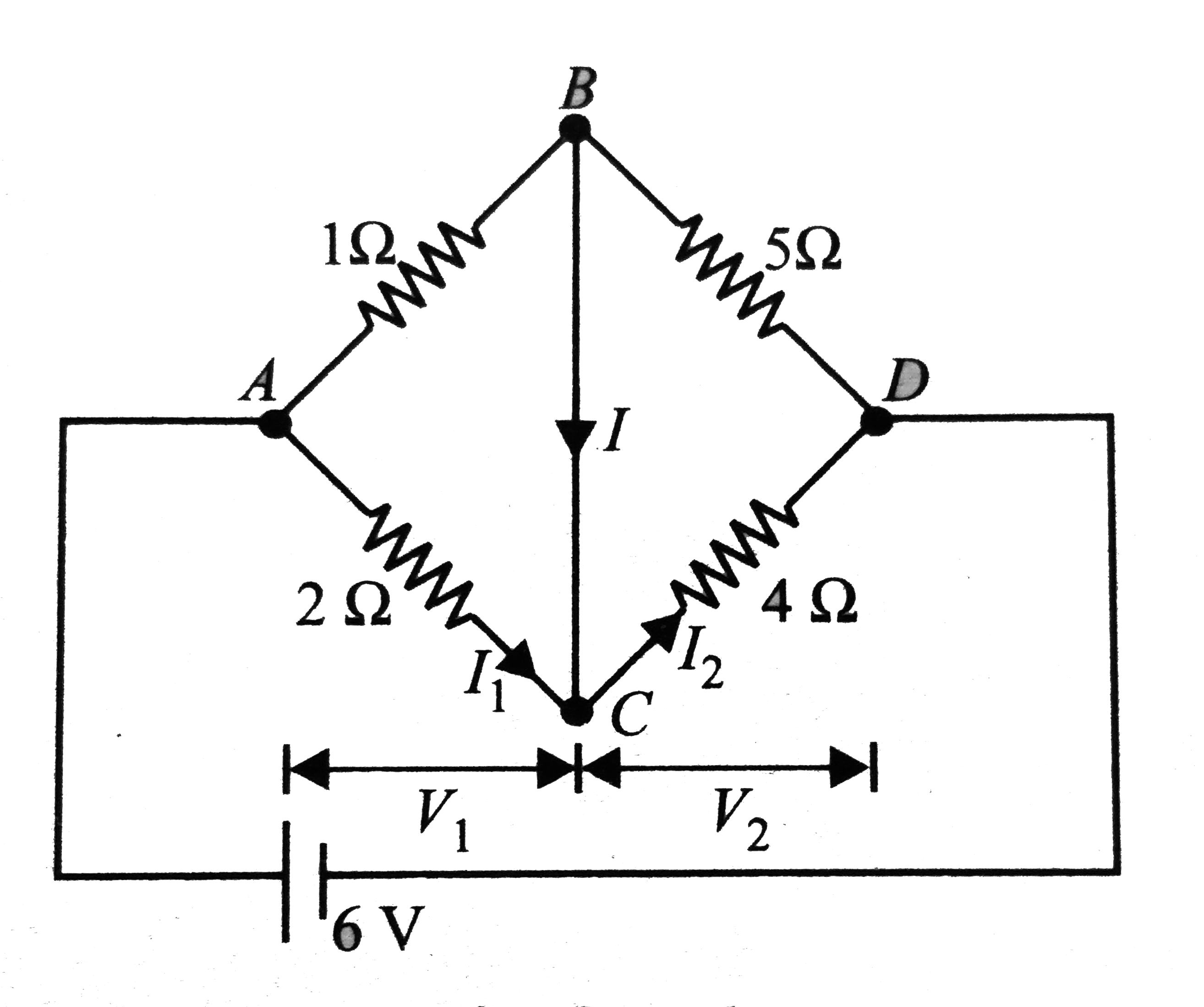
|
|
| 4. |
Figure shows a long cylindrical container with ideal gas in two chambers. Lower chamber is filled with one mole of a mono atomic gas, while upper chamber has one mole of a diatomic gas. The gases initially are at temperature 300K, the container walls as well as pistons are conducting. Both the pistons are identical with mass 'M' and area 'A' such that (Mg)/A=P_(0) (atmosphere pressure). Assuming the ideal gas constant to be R, answer the following questions: The upper piston is pulled up slowly by 16 cm and held there. the displacementof the lower piston till it reaches new equilibrium state is: |
|
Answer» Solution :`P_("LOWER")-P_("upper")=P_(0)` `implies(3P_(0)xx(8))/((8+x))-(2P_(0)xx12)/((28-x))=P_(0)` `impliesx=4cm` |
|
| 5. |
Figure shows a long cylindrical container with ideal gas in two chambers. Lower chamber is filled with one mole of a mono atomic gas, while upper chamber has one mole of a diatomic gas. The gases initially are at temperature 300K, the container walls as well as pistons are conducting. Both the pistons are identical with mass 'M' and area 'A' such that (Mg)/A=P_(0) (atmosphere pressure). Assuming the ideal gas constant to be R, answer the following questions: Total work done by the ideal gases in this process is |
|
Answer» `300Rln(3)` `=300R[LN(24/12)+ln(12/8)]=300Rln(3)` |
|
| 6. |
A parallel plate capacitor connected to a cell gets fully charged. After disconnecting the cell a thin sheet of mica is placed between the plates of the capacitor What happens to its : a) Charge , b) Capacitance |
| Answer» SOLUTION :a) CHARGE REMAINS CONSTANT , B) Charge remains constant | |
| 7. |
Match the following: ("Gravitational potential energy" (U=0, "at the reference level"))/g (in J-s^(2)//m) of the body (shown in column-1) with respect to the reference level (shown in column-2) where g is gravitation acceleration. |
|
Answer» <P>(I)(i)(S) |
|
| 8. |
A parallel plate capacitor of capacitance C is charged to a potential V by a battery . Without disconnecting the battery , the distance between the plates is tripled and a dielectric medium of dielectric constant 10 is introduced between the plates of the capacitor . Explain giving reasons , how will the following be affected : energy density of the capacitor . |
|
Answer» Solution :Initially capacitance of given parallel capacitor, `C = (in_(0) A)/(d)` and it has been charged to a potential DIFFERENCE V . HENCE charge on capacitor Q = CV and electric field between the plates of capacitor E `= (V)/(d)` and so the ENERGY density `u = 1/2 in_(0) E^2` As per question the new distance between the plate `d. = 3d` and a dielectric medium of dielectric constant K = 10 is introduced between the plates of capacitor . Moreover , as battery remains connected , the potential difference V remains unchanged . New electric field between the plates of capacitor , E. = `(V)/(KD.) = (V)/(10 xx 3d) = (E)/(30)` `therefore` New energy density u. `= (1)/(2) in_(0) E.^(2) = (1)/(2) in_(0) [(E)/(30)]^(2) = (1)/(90) xx (1)/(2) in_(0) , E^(2) = (u)/(90)` |
|
| 9. |
When you have learned to integrate, calculate the change in entropy in the course of an arbitrary quasi-static process. |
|
Answer» `S_2 - S_1 = m/M int_(T_1)^(T_2) C_(mV) (dT)/T + (dT)/T + m/M R ln (V_2)/(V_1)` For a SMALL temperature range the ISOCHORIC heat CAPACITY may be assumed to be a constant. In this case `S_2 - S_1= m/M (C_(mV) ln (T_2)/(T_1) + R ln (V_2)/(V_1))` |
|
| 10. |
In the arrangement shown in figure, the string has mass of 5 kg. How much time will it take for a transeverse distubance produced at the floor to reach the pulley A? Take g = 10 m//s^(2). |
|
Answer» |
|
| 11. |
A parallel plate capacitor of capacitance C is charged to a potential V by a battery . Without disconnecting the battery , the distance between the plates is tripled and a dielectric medium of dielectric constant 10 is introduced between the plates of the capacitor . Explain giving reasons , how will the following be affected : charge on the capacitor |
|
Answer» Solution :Initially capacitance of given parallel capacitor, `C = (in_(0) A)/(d)` and it has been charged to a potential difference V . Hence charge on capacitor Q = CV and electric field between the plates of capacitor E `= (V)/(d)` and so the energy DENSITY `u = 1/2 in_(0) E^2` As per question the new distance between the plate `d. = 3d` and a DIELECTRIC medium of dielectric constant K = 10 is introduced between the plates of capacitor . Moreover , as battery remains connected , the potential difference V remains UNCHANGED . New charge on the capacitor `Q. = C. V = `(10)/(3) C V = (10)/(3) Q` |
|
| 12. |
The property of the electric line of force (a) The tangent to the line of force at any point is parallel to the direction of .E. at that point (b) No two lines of force intersect each other |
|
Answer» both .a & b. |
|
| 13. |
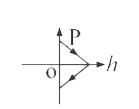
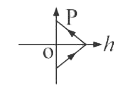
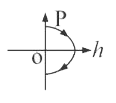
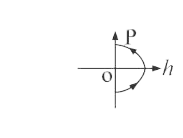
A ball is thrown vertically up (taken as + z-axis) from the ground. The correct momentum-height (p-h) diagram is: |
|
Answer»
Clearly it is parabolic functions. STARTING from ground momentum first decreases and then becomes zero at highest position. THEREFORE it increases in –ve direction. HENCE `3^(rd)` option is correct. |
|
| 14. |
Two circuits (a) and (b) have charged capacitors of capacitance C. 2C and 3C with open switches. Charges on each of the capacitor are as shown in the figures. On closing the switches |
|
Answer» No charge FLOWS in (a) but charge flows from L to R in (B) |
|
| 15. |
Under minimum deviation condition in a prism, if a ray is incident at an angle of 30^@. The angle between the emergent ray and the second refracting surface of the prism is |
|
Answer» `0^(@)` |
|
| 16. |
Three long straight parallel wires are kept as shown in the fig. The wire (3) carries a current I. (i) The direction of flow of current I in wire (3) is such that the net force on wire (1) due to the other two wires, becomes zero. What will be the direction of current I in the two cases ? Also obtain the relation between the magnitude of currents I_1, I_2 and I_3. |
|
Answer» Solution :(i) Since net force per unit length on wire (1) due to other two wires is zero, the direction of `I_2 and I_3` must be mutually opposite and then `|vec(F_(12))| = |vec(F_(13))|` `:. (mu_0 I_1I_2)/(2 pi d) = (mu_0 l_1 I)/(2 pi (2d)) implies I = 2I_(2)` (II) When direction of I of reversed then net force per unit length on wire (2) due to other two wires becomes zero. HENCE, now `vec(F_21) + vec(F_23) = 0` `:. |vecF_(21)| = |vecF_(23)| implies (mu_0 I_1 I_2)/(2 pi d) = (mu_0 I_2I)/(2 pi d) implies I_2 = I` |
|
| 17. |
An early model for an atom considered it to have a positively charged point nucleus of charge Ze, surrounded by a uniform density of negative charge up to a radius R. The atom as a whole is neutral. For this model, what is the electric field at a distance r from the nucleus ? |
|
Answer» Solution :The charge distributionfor this model of the atom is asthe total chargein the uniform sperical of charge z e + negative HARGE is neutral this immedialtely gives us the negative charge density p since we must have `(4piR^(3))/(3) p= 0-Ze` to fin d the electricfieldE(r ) at apointP whichis a distance r awayfrom the nucleuswe usegausslawits direction is alongtheradius VECTOR rfrom the origin to the pointthe obvious gaussian surface is a spherical surface centredto the POINT P the obviousgaussian surfaceis a spherical surfacecentred at the nucleus we consider twosituation namely `rgtR` and `rlt R` (i) `r gt R`the electricflux `Phi`enclosedbythe spherical surface is `Phi =E(r )xx4 PI r^(2)` where E(r )is the magnitude of the electricfieldat r this is because the field at any pointon the sphericaland has the same magnitude at all points on the surface i.e `q=Ze+(4pir^(3))/(3) P` substituting for the charge density p obtained earlier we haveM (II)`r gt R`in this case the totalenclosed by the gaussiansperical surface is zerosince the atom is neutral thus from gauss law at r =R both cases given the same result E =0 |
|
| 18. |
A current carrying wire is in the shape of a semicircle of radius R and has current I. M is midpoint of the arc and point P lies on extension of MC at a distance 2R from M. Find the magnetic field due to circular arc at point P. |
|
Answer» |
|
| 19. |
What kind of ferromagnetic material is used for coating magnetic tapes in a cassette player, or for building 'memory stores in a modern computer? |
| Answer» SOLUTION :(d) Ferrites (ceremic OXIDES of iron) are USED for COATING of magnetic tapes. They are MAGNETICALLY ferromagnetic and electrically insulators. | |
| 20. |
For what kinetic energy of a neutron will the associated de-Broglie wavelength be 1.40xx10^(-10)m? |
|
Answer» Solution :`lambda=1.40xx10^(-10)m`, `H=6.63xx10^(-34) Js` `m=1.67xx10^(-27)`kg (a) de-Broglie wavelength of neutron, `lambda=(h)/(sqrt(2mK))` `therefore K=(h^(2))/(2mlambda^(2))` `=((6.63xx10^(-34))^(2))/(2xx1.67xx10^(-27)XX(1.4xx10^(-10))^(2))` `therefore K=6.686xx10^(-21)`J `=(6.686xx10^(-21))/(1.6xx10^(-19))eV` `therefore K=4.174xx10^(-2)eV` (b)Average kinetic energy of neutron Here `k_(B)=1.38xx10^(-23)Jmol^(-1)K^(-1)` T=300 K `K=(3)/(2)K_(B)T` `therefore K=(3)/(2)xx1.38xx10^(-23)xx300` `therefore K=621xx10^(-23)J` `therefore` de-Broglie wavelength, `lambda=(h)/(sqrt(2mK))` `therefore lambda=(6.63xx10^(-34))/(sqrt(2xx1.67xx10^(-27)xx621xx10^(-23)))` `therefore lambda=(6.63xx10^(-34))/(45.54xx10^(-25))` `therefore lambda=0.14558xx10^(-9)m` `therefore lambda~~0.146` nm |
|
| 21. |
Which one of the following is INCORRECT statement in the transmission of electromagnetic waves |
|
Answer» GROUND wave propagation is for high frequency transmission |
|
| 22. |
The mean path length of alpha-particles in air under standard conditions is defined by the formula R=0.98 xx 10^(-27) V_(0)^(3) cm, where V_(0)(cm//s) is the initial velocity of an alpha-particle. Using this formula, final for an alpha-particle with initial kinetic energy 7.0 MeV. (a) Its mean path length. (b) The average number of ion pairs formed by the given alpha-particle over the whole path R as well as over its first half. Assuming the ion pair formation energy to be equal to 34 eV. |
|
Answer» |
|
| 23. |
Excitation energy of hydrogen atom is 13.6eV. Match the following . |
|
Answer» a-r b-pc-s d-q |
|
| 24. |
A car is traveling in a straight line along a highway at a constant speed of 80 miles per hour for 10 seconds. Find its acceleration. |
| Answer» SOLUTION :SINCE the car is traveling at a constant VELOCITY, its ACCELERATION is zero. If there's no change in velocity, then there's no acceleration. | |
| 25. |
In the above problem, find the ratio of wavelengths of wave |
|
Answer» `M/(M+m)` |
|
| 26. |
A coil of 150 turns, each of area 50 cm^(2), is rotating in a magnetic field of 0.15 T with a constant frequency of 20 rotations per second about an axis in the plane of the coil and normal to the field. Calculate the peak emf, rms emf and the instantaneous emf induced in the coil. |
|
Answer» SOLUTION :Data: `N=150, A=50 cm^(2) = 50 xx 10^(-4) m^(2) = 0.005 m^(2), f=20 reps, B=0.15 T` `omega=2pif= 2pi xx 20 = 40pi` rad/s (i) The peak emf is `E_(0) = omega NAB = (40 xx 3.142) (150)(0.005)(0.15)` `=14.14`V (ii) The rms emf is `E_(0)/sqrt(2) = 14.14/(1.414 )= 10V` (iii) The instantaneous value fo the induced emf is `E=E_(0)sin omegat = 14.14 sin (40 pit)V` |
|
| 28. |
What are the advantages of the null-point method in a Wheatstone bridge ? What additional measurements would be required to calculte R_("unknown ")by any onther method ? |
|
Answer» Solution :In Wheatstone BRIDGE advantage of null point method is that there is no change in position of null point due to resistance of galvanometer. Hence, there is no need to determine current in resistance or internal resistance of galvanometer. This method is easy and comfortable for OBSERVER. In an another method to determine unknown resistance Kirchhoff.s laws are USED For these precise current measurement is to be done through all branches of resistors, galvanometer and internal resistance of galvanometer. Note : Necessary and required condition for BALANCE of Wheatstone bridge, `(P)/(Q) = (R)/(S)` where P and Q is ratio of LENGTH, R is unknown resistor and S is known resistor. |
|
| 29. |
At what angle should a ray of light be incident on the face of a prism of refracting angle 60^(@) so that it just suffers total internal reflection at the other face? The refractive index of the material of the prism is 1.524. |
|
Answer» Solution :If the REFRACTED RAY in the PRISM is incident on the SECOND face at the critical angle i c , the angle of refraction r at the first face is `(60^(@)-i_(c))`. Now, `i_(c) = sin^(-1) (1//1.524) ~= 41^(@)` Therefore, `r = 19^(@) sin i = 0.4962, i ~= 30^(@)` |
|
| 30. |
Explain in detail the four fundamental forces. |
|
Answer» Solution :Gravitational, electromagnetic, strong and WEAK forces are called fundamental forces of nature. (i) Gravitational force between two masses and it is UNIVERSAL in nature. Our planets are bound to the sun through gravitation force of the sun. Eg. : We are in the Earth because of Earth.s gravitational attravtion on our body. (ii) Electromagnetic force and it plays major role in most of our day-to-day events. Eg. : We are standing on the surface of the earth because of the electromagnetic force between atoms of the surface of the earth with atoms in our foot. (iii) Strong force fundamental force of nature called the weak force. Eg. : The atoms in our body are stable because of strong nuclear force. (iv) Weak force fundamental force of nature called the weak force. This weak force is even shorter in range than nuclear force. This force plays an important role in beta decay and energy production of stars. During the fusion of hydrogen into helium in sun, neutrinos and enormous radiations are produced through weak force. Eg. : The lives of SPECIES in the earth depend on the solar energy from the sun and it is due to weak force which plays VITAL role during nuclear fusion reactions going on in the core of the sun. |
|
| 31. |
(a) Calculate the disintegration energy when stationary ""_(92)^(232)"U" nucleus decays to thorium ""_(90)^(228)"Th" with the emission of alpha particle. The atomic masses are of ""_(92)^(232)"U" = 232.037156 u , ""_(90)^(228)"Th" = 228.028741 u and""_(2)^(4)"He" = 4.002603 u (b) Calculate kinetic energies of ""_(90)^(228)"Th" and alpha- particle and their ratio. |
|
Answer» Solution :(a) The difference in masses `Delta m = (m_(U) - m_(Th) - m_(alpha))` ` = (232.037156 - 228.028741 -4.002603)u` The mass LOST in this decay = `0.005812 u ` Since `1u = 931`MeV, the energy Q released is `Q = (0.005812 u) xx (931 MeV/u) = 5.14 MeV` This disintegration energy Q appears as the kinetic energy of `alpha` particle and the daughter nucleus.In any decay, the total linear momentum must be conserved. Total linear momentum of the parent nucleus = total linear momentum of the daughter nucelus + `alpha` particle. Since before decay, the uranium nucleus is at rest,its momentum is ZERO. By applying conservation of momentum, we get `0 = m_(Th) vec(v)_(Th) + m_(a) vec(v)a` `m_(a) vec(v)_(a) = - m_(Th) vec (v)_(Th)` It implies that the alpha particle and daughter nucleus move inopposite directions.In magnitude `m_(alpha)v_(alpha) = m_(Th) v_(Th)` The VELOCITY of `alpha` particle `v_(a) = (m_(Th))/(m_(a)) V_(Th)` Now that `(m_(Th))/(m_(a)) gt 1`, so `v_(alpha) gt v_(Th)`. The ratio of the kinetic energy of `alpha` particle to the daughter nucleus. `(K.E_(alpha))/(K.E_(Th)) = (1/2 m_(alpha)v_(alpha)^(2))/(1/2 m_(Th)v_(Th)^(2)` By substituting, the value of `v_(a)` into the above equation, we get `(K.E_(alpha))/(K.E_(Th)) = (m_(Th))/(m_(alpha)) = (228.02871)/(4.002603) = 57 ` The kinetic energy of `alpha` particle is 57 times greater than the kinetic energy of thedaughter nucleus `(""_(90)^(228)"Th")`. The disintegration energy Q = total kinetyic energy of PRODUCTS `K.E_(alpha) + K.E_(Th) = 5.41 MeV` `57 K.E_(Th) + K.E_(Th) = 5.41 MeV` `K.E_(Th) = (5.41)/(58) MeV = 0.093 meV` `K.E_(alpha) = 57 K.E_(Th) = 57 xx 0.093 = 5.301 MeV` In fact, `98 %` of total kinetic energy is taken by the `alpha` particle. |
|
| 32. |
Prove laws of reflection using Huygens' principal. (OR) Prooffor laws of reflection using Huygens'Principal: |
Answer» Solution : (i) Consider a parallel beam of light is incident on a refracting plane surface XY such as a glass surface as shown in Figure.  (ii) The incident wavefront AB is in rarer medium (1) and the refracted wavefront A'B' is in denser medium (2). (iii) These wavefronts are perpendicular to the incident rays L, M and refracted rays L',M' respectively. (iv) By the time the point A of the incident wavefront touches the refracting surface, the point B is yet to travel a distance BB' to touch the refracting surface at B. (v) When the point B falls on the refracting surface at B', the point A would have reached A' in the other medium. This is applicable to all the points on the wavefront. Thus, the refracted wavefront AB emanates as a plane wavefront.(vi) The two normals N and N' are CONSIDERED at the points where the rays L and M fall on the refracting surface. (vii) As refraction happens from rarer medium (1) to denser medium (2), the speed of light is `v_1` and `v_2` before and after refraction and `v_1` is greater than `v_2 (v_1 gt v_2)`. But, the time TAKEN t for the ray to travel from B to B' is the same as the time taken for the ray to travel from A to A' ` t = (BB')/(v_1) = ("AA"')/(v_2) " or " (BB')/("AA"') = v_1/v_2` (i) The incident rays, the refracted rays and the normal are in the same plane. (ii) ANGLE of incidence, `i= angleNAL = 90^@ - angleNAB = angle BAB'` Angle of refraction, ` r = angleN'B'M' = 90^@ - angleN'B'A' = angleA'B'A` For the two right angle triangles `Delta`ABB' and `Delta`B' A' A, `(sin i)/(sin r) = ((BB')/(AB'))/(("AA"')/(AB')) = (BB')/("AA"') = v_1/v_2 = ((c)/(v_2))/((c)/(v_1))` (viii) Here, c is speed of light in vacuum. Theratio `c/v` is the constant, called refractive index of the medium. The refractive index of medium (1).is, `(c)/(v_1)= n_1` and that of medium (2) is, `(c)/(v_2) = n_2` ` (sin i)/(sin r) = (n_2)/(n_1)` In product form, `n_1 sin i = n_2 sin r ` Hence, the laws of refraction are PROVED. (ix) In the laws of refraction can also be proved for wavefront travelling from denser to rarer medium. (x) Light travels with greater speed in rarer medium and lesser speed in denser medium. Hence, the WAVELENGTH of the light is longer in rarer medium and shorter in denser medium. `(lamda_1)/(lamda_2) = n_2/n_1` |
|
| 33. |
In the given circuit diagram. V_(B)=0.6V a) Calculate the current i in the circuit. b) Find the current (I) if the diode is reversed. |
|
Answer» Solution :(a)`I=(E-V_(B))/(R )=(6-6.0)/(270)` `I=20mA` (b)`i=0` since diode is REVERSE biased (OPEN circuited). |
|
| 34. |
In Rutherford experiment, for head-on collision of alphaparticles with a gold nucleus, the impact parameter is |
|
Answer» of the order `10^(-10)`m |
|
| 35. |
Using logarithmic tables, evaluate: (5.67)/(0.304xx45.42) |
|
Answer» Solution :Let `X=(5.67)/(0.304xx45.42)implieslogx=log5.67-log0.304-log45.42` `=0.7536-bar(1).4829-1.6573=bar(1).6134` IMPLIES anti `logbar(1).6134=0.4106` |
|
| 36. |
A p-n photodiode is made of a material with a band gap of 2.0 eV. The minimum frequency of the radiation that can be absorbed by the material is nearly. |
|
Answer» `20 XX 10^(14)` Hz |
|
| 37. |
Assertion (A) : A p-type semiconductor has a large number of holes yet it is electrically neutral. Reason (R) : A p-type semiconductor is obtained by doping an intrinsic semiconductor with a trivalent impurity. |
| Answer» SOLUTION :Both ASSERTION and reason are TRUE but reason does not EXPLAIN the cause of assertion. | |
| 38. |
The family is big and is constantly |
|
Answer» Growing |
|
| 39. |
Explain the following giving reasons: (a) When monochromatic light is incident on a surface separating two media, the reflected and refracted light both have the same frequency as the incident frequency. Explain why. (b) When light travels from a rarer to a denser medium, the speed decreases. does the reduction in speed imply a reduction in the energy carried bythe light wave ? (c) In the wave picture of light, intensity of light is determined by the square of the amplitude of the wave, what determines the intensity of light in the photon pisture of light ? |
|
Answer» Solution :(a) Refraction and refraction both arise through interaction of INCIDENT light with the atomic constituents of matter. Atoms may be considered as oscillators which vibrate with frequency of light. The frequency of light emitted by a charged oscillator equals its frequency of oscillation. therefore, the frequency of both reflected as well as refracted light equals the frequency of incident light. (B) No. Reduction in speed of light has no connection with energy carried by light wave. energy carried by a wave DEPENDS only on its amplitude. (C) As per photon pixture of light intensity of light is determined by the NUMBER of photons of a given frequency crossing per unit area per unit time. |
|
| 41. |
Consider the D - T reaction (deuterium - tritium fusion) ._(1)^(2)H+ ._(1)^(3)H to ._(2)^(4)He + n Calculate the energy released in MeV in this reaction from the data : m(._(1)^(2)H)=2.014102 u m(._(1)^(3)H)=3.016049 u |
|
Answer» SOLUTION :`A=[m(""_(1)^(2)H)+m(""_(1)^(3)H)-m(""_(2)^(4)He)-m(n)]c^(2)=17.59MeV` (b) K.E. REQUIRED to overcome COULOMB repulsion = 480.0 keV `480.0 KeV=7.68xx10^(-14)J=3kT` therefore `T=(7.68xx10^(-14))/(3xx1.381xx10^(-23))""("as "k=1.381xx10^(-23)JK^(-1))` `=1.85xx10^(9)K"(required temperature)"` |
|
| 42. |
In problem 40, if I is reversed in direction, then V_(B)-V_(A) equals |
|
Answer» `5 V` 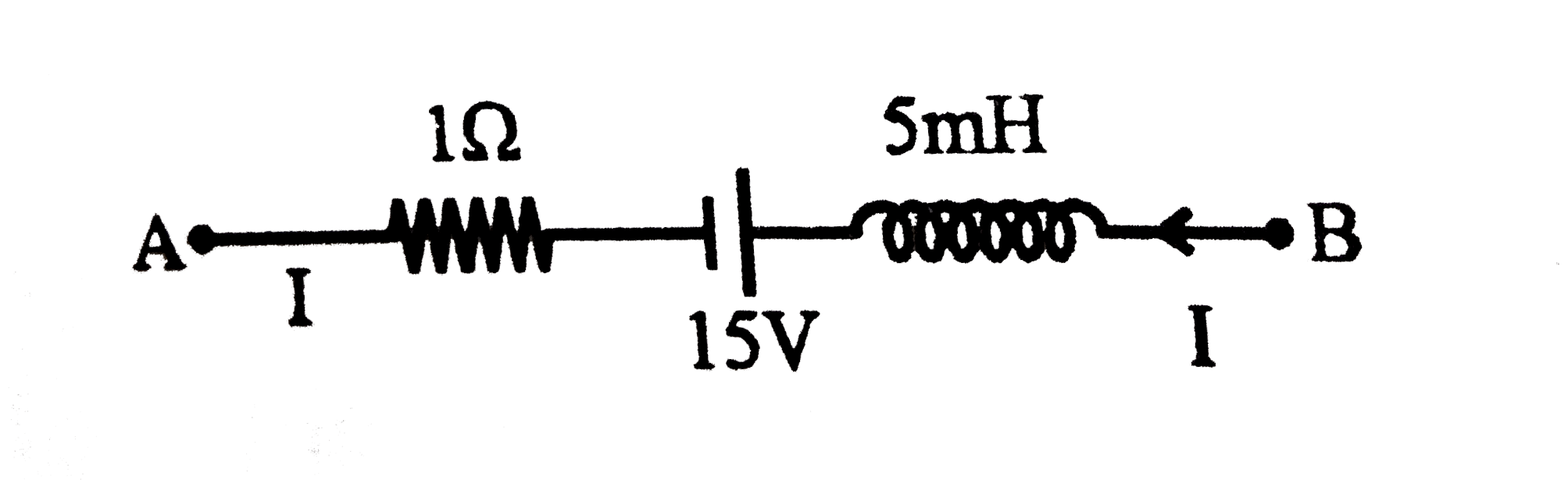 `V_(B)-V_(A)=IR+15+L(dI)/(dt)` `=5xx1+15+5xx10^(-13)XX(-10^(-3))=15` VOLT |
|
| 43. |
A circular coil 'A' has a radius R and the current flowing through it is I. Another circular coil 'B' has a radius 2R and if 2I is the current flowing through it, then the magnetic fields at the centre of the circular coil are in the ratio of |
|
Answer» `4:1` |
|
| 44. |
For right-angled prism, ray-1 is the incident ri and ray-2 is the emergent ray as shown in the figure. Refractive index of the prism is ......... |
|
Answer» `(1)/(sqrt2)` `therefore`At point D, angle of INCIDENCE formed with perpendicular MN on surface AB is EQUAL to CRITICAL angle C = `45^@` `n=(1)/(sinC)=(1)/(SIN45^@)=(1)/(0.7071)=1.414=sqrt2` It is clear from the figure that ray experience: total internal reflection at points D and E. A these points value of angle of incidence is `45^@` `therefore45^@ gt C` (critical angle) `implies sin 45^@ gt sin Cimplies (1)/(sqrt2) gt 1/n implies n ge sqrt2` Out of given option for `n ge sqrt2,n=sqrt2` |
|
| 45. |
The magnitude of magnetic field at a distance 'r' from a long straight wire carrying a current I is given by B = …………………… . |
| Answer» SOLUTION :`(mu_0 I)/(2 PI R)` | |
| 46. |
What is the base resistance R_(B) in the circuit as shown in figure , if beta_(d.c.) = 90, V_(BE) = 0.7 V, V_(CE) =4V? |
|
Answer» `29 K OMEGA` `I_(c)(5xx10^(-3))/(2) rArr2.5 xx 10^(-3)` `beta=90 (I_(C))/(I_(B))` `I_(beta)=(2.5 xx10^(-3))/(90)` `V_(BE)=-I_(B)R_(B) +3` `0.7 + (2.5 xx 10^(-3))/(50) R_(B) =3` `R_(B)=(2.3xx90)/(2.5xx10^(-3))` `=(2.3 xx 10^(-3))/(25) xx 10^(4)` `rArr (2070)/(25) xx 10^(3)rArr 82 K Omega` |
|
| 47. |
A small conducting loop of radius r & resistance R is pulled with velocity v perpendicular to long straight current carrying conductor carrying a current i. If the power dissipated (P ) in the loop is constant find the variation of the velocity of the loop with the displacement x. |
|
Answer» |
|
| 48. |
A closed triangular box is kept in an electric field of magnitude E= 2 xx10^(3)NC^(-1) as shown in the figure . Calculate the electric flux through the (a) vetical rectangular surface (b) slanted surface and (c ) entire surface. |
|
Answer» Solution :Electric field of magnitude `E=2xx10^(1)NC^(-1)` (a) Vertical rectangular surface : Rectangular area `A= 5xx10^(-2)xx15xx10^(-2)` `A= 75 xx10^(-24) m^(2)` `theta = 180^(@) implies COS 180^(@)=-1` Electric flux `Phi_(v.s)=EA "cos"theta` `=2xx10^(3)xx75xx10^(-4)xx"cos"180^(@)` `=-150xx10^(-1)` `Phi_(v.s) =-15Nm^(2)C^(-1)` (b) Stanted surface : `cos theta = cos 60^(@) = 0.5 ` `SIN theta = sin^30^(@) = (Opposite )/(hyp)` `hyp = (5xx10^(-2))/(0.5) ` hyp =0.1 m Area of slanted surface `A_(2) = (0.1 xx15xx10^(-2))` `A_(2)= 0.015 M^(2)` 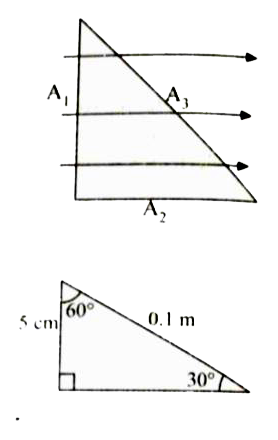 Electric flux `Phi_(v.s) = EA cos theta ` `=2xx10^(3)xx0.015xxcos 60^(@)` `= 2xx10^(3)xx0.015xx0.5 ` `=0.015 x10^(3)` `Phi_(v.s)= 15 Nm^(2)C^(-1)` HORIZONTAL surface `theta= 90^(@), cos90^(@)= 0` Electric flux `Phi_(H.S)= E. A_(3) Cos90^(@)=0` (c ) ENTIRE surface : `Phi_("Total" )= Phi_(V.S)+ Phi_(s.s) + Phi_(H.S)=-15+ 15 +0` `Phi_("Total ")=0` |
|
| 49. |
Photon of frequency v has a momentum associated with it. If c is the velocity of light, the momentum is |
|
Answer» `(HV)/(c)` |
|