

Saved Bookmarks
This section includes 7 InterviewSolutions, each offering curated multiple-choice questions to sharpen your Current Affairs knowledge and support exam preparation. Choose a topic below to get started.
| 1. |
A receiver in a communication system must have |
| Answer» Answer :D | |
| 2. |
(A) : In L-C-R series AC circuit X_(L) = X_(C) = R at a given frequeny. When frequency is doubled, the impedance of the circuit is (sqrt(13))/(2)R (R): At resonance frequency, X_(L) = X_(C). |
|
Answer» Both 'A' and 'R' are true and 'R' is the CORRECT EXPLANATION of 'A'. |
|
| 3. |
A sphere is placed on two similar cubes as shown. All surfaces are smooth. When velocity of sphere is 10ms^(-1) vertical down then find magnitude of velocity of the block B with respect to block C. |
|
Answer» `10sqrt(3) ms^(-1)` `(10sqrt(3))/(2)=V_(B)(1)/(2)` `V_(B)=10sqrt(3)` |
|
| 4. |
How does Ampere-Maxwell law explain the flow of current through a capacitor when it is being charged by a battery? Write the expression for the displacement current in terms of the rate of change of electric flux. |
|
Answer» Solution :Consider charging of a parallel plate capacitor by a time-varying current iw Let us find the magnetic field at a point P in a region outside the capacitor. For this we consider a plane circular loop of RADIUS r whose plane is perpendicular to the direction of the current carrying wire and which is centred symmetrically with respect to the wire [Fig]. Using symmetry condition and applying Ampere.s circuital law, we have `B(2pir)=mu_(0)i_((t))"....(i)"` However, if we consider a different surface, having the same boundary [either as shown in Fig. or Fir. and apply Ampere.s circuital law as before, we find `B(2pir)=mu_(0)(0)=0"....(ii)"` It is because nocurrent passes through the surface of Figs. and 8.04. It CAUSES a CONTRADICTION because we get a finite value of magnetic field B by doing calculation in one way and zero value of B by doing calculation in another way. To remove this contradiction Maxwell introduced the concept of displacement current  `i_(D)=in_(0)(dphi_(E))/(dt),` where `(dphi_(E))/(dt)` is the RATE of change of electric flux between the plates of given capacitor. Now, the Ampere - Maxwell.s circuital law is expressed as `oint vecB.vecdl=mu_(0)[i_((t))+i_(D)]` Thus, Ampere - Maxwell law successfully explains the flow the current through a capacitor when it is being charged (or discharged) by a battery. |
|
| 5. |
The refractive index of a material of prism of refracting angle 45^(@) is 1.6 for a certain monochromatic ray. What should be the minimum angle of incidence of this ray on this prism so that so internal reflection takes place as the ray comes out of the prism ? |
|
Answer» `10.1^(@)` |
|
| 6. |
A glass slab having refractive index n and thickness d is placed on the paper on table. A dot (drop) of dink is made on paper below glass slab. At how much height will the dot be found if it is observed from the upper side of slab? |
|
Answer» `(N-1)d/n` `=h_0-(h_0)/(n)[because (h_i)/(h_0)=1/n therefore h_i=(h_0)/(n)]` `=(nd-d)/(n)` (here `h_0`=d) `therefore` SHIFTING in dot `= (n-1)d/n` |
|
| 7. |
Which of the following equation reprsents a wave ? |
|
Answer» `y =a sin omegat ` |
|
| 8. |
A long straight conductor carrying a current of 4 A is in parallel to another conductor of length 5 cm and carrying a current 9 A. They are separated by a distance of 10 cm. Calculate (a) B due to first conductor at second conductor (b) The force on the short conductor. |
| Answer» SOLUTION :`8 xx 10^(-6)T (b)s 36 xx 10^(-7) N` | |
| 9. |
Assertion : An alternating current does not show any magnetic effect. Reason : Alternating current does not vary with time. |
|
Answer» If both assertion ans reason are true ans reaason is the correct EXPLANATION of assertion. |
|
| 10. |
The emf of the batteries E, F, G and H are 2 V, 1 V, 3 V and 1 V respectively. Their internal resistance are respectively 2 Omega, 1 Omega,3 Omega and 1 Omegarespectively. Calculate potential difference between B and D. |
|
Answer» Solution :Circuit with internal resistances of batteries is as under. Currents on different PATHS are shown in figure. Near point D according to Kirchoff.s first LAW, I = `I_(1) + I_(2) ""` .... (1) For loop DBAD using Kirchoff.s second law, `2I_(1) - 2 (I - I_(1))- (I - I_(1))= -2 + 1 ` `THEREFORE 2I_(1) - 2I+ 2I_(1) - I + I_(1) = - 1` `therefore 5I_(1) -3I = -1""` ... (2)  For loop D-C-B-D using Kirchoff.s second law, `therefore- 3I - I - 2I_(1) = - 3 + 1 ` `therefore - 4I- 4I_(1) = - 2 ` ` therefore 2 I + I_(1) = 1"" ` .... (3) Multiplying equ. (2) by 2 and equ. (3) by 3 and eliminating l , ` therefore 10I_(1) - 6I = -2 ` `6I + 3I_(1) = 3 ` `therefore 13 I_(1) = 1 rArr I_(1) = (1)/(13) `A p.d. between points B and D=` V_(BD) = 2I_(1)` ` therefore V_(BD) = (2)/(13) `V |
|
| 11. |
In the above question , the intensity of the wave reachinga point P far away on the + x axis from each of the four sources is almost the same , and equal to I_(0) , Then |
|
Answer» If `d = lambda//4` the intensity at P is `4I_(0)` |
|
| 12. |
A thin plano -convex lens acts like a concave mirror of focal length 0.2 m when silvered from its plane surface. The refractive index of the material of the lens is 1.5. The radius of curvature of the convex surface of the less will be |
|
Answer» 0.4 m |
|
| 13. |
बहुपद x^2 - 4x + 1 के शुन्यकों का योग है- |
|
Answer» 1 |
|
| 14. |
The work done in carrying a charge 'a' once round a circle of radius 'a' with a charge Q at its centre is |
| Answer» | |
| 15. |
Two particles move toward each other with velocities v_1=0.50c and v_2=0.75c relative to a laboratory frame of reference. Find: (a) the approach velocity of the particles in the laboratory frame of reference, (b) their relative velocity. |
|
Answer» Solution :(a) By DEFINITION the velocity of approach is `v_(approach)=(dx_1)/(dt)-(dx_2)/(dt)=v_1-(-v_2)=v_1+v_2` in the reference frame K. (B) The relative velocity is obtained by the transformation law `v_r=(v_1-(-v_2))/(1-(v_1(-v_2))/(c^2))=(v_1+v_2)/(1+(v_1v_2)/(c^2))` |
|
| 16. |
In the hysteresis cycle, the value of magnetic intensity H needed to make the magnetisation of sample zero is called |
| Answer» Solution :coercive force | |
| 17. |
Electromagnetic waves possess |
|
Answer» only ENERGY, not MOMENTUM |
|
| 18. |
The momentum of a photon of an electron-magnetic radiation is 6.6xx10^(-29)kgms^(-1). If h=6.6xx10^(-34) js and c=3xx10^(8) m/sthe frequency of the radiation is |
|
Answer» `3xx10^(12)Hz` `v=(PC)/(h)=(6.6xx10^(-29)xx3xx10^(8))/(6.6xx10^(-34))` `=3xx10^(13)Hz` |
|
| 19. |
A fringe width of a certaininterference pattern is beta=0.002 cm. What is the distance of 5^(th) dark fringe from centre ? |
|
Answer» `1 xx 10^(-2) CM` For `5^(th)` dark FRINGE, n = 4 `x_(5) = (9)/(2) beta = (9)/(2) xx 2 xx 10^(-3)` `= 9 xx 10^(-3) cm` |
|
| 20. |
An interference pattern is formed on a screen by shining a planar wave on a double-slit arrangement. If we cover one slit with a glass plate, the phases of the two emerging waves will be different because the wavelength is shorter in glass than in air. If the phase difference is 180^(@), how is the interference pattern altered? |
|
Answer» The pattern vanishes |
|
| 21. |
I Young.s double slit experiment a mica plate of thickness .t. and refractive .mu. is introduced in one of the interfering beams. Then the central fringe will be displaced through (d= distance between the slits, D= distance between the slits and the screen) |
|
Answer» `DT"/"D(MU-1)` |
|
| 22. |
What are the factors affecting surface tension? |
|
Answer» SOLUTION :1 Surface TENSION DECREASES with temprature. 2 If the liquid surface is contaminated by some other substances, surface tension decreases. 3 If any organic substance REMAINS dissolved in a liquid. Surface tension increases but decreases, if substance dissolved are organic. 4 Surface tension of a liquid depends on the nature of media in CONTACT with it.s surface. |
|
| 23. |
Compare the radii of the nuclei of""_(13)Al^(27) and ""_(Te)^(125). |
|
Answer» SOLUTION :`A_(1) = 27 , A_(2) =125` The radius of a nucleus , `R= R_(0)A^(1//3)` `IMPLIES R prop A^(1//3)implies(R_1)/R_2 = ((A_1)/(A_2))^(1//3) = ((27)/(125))^(1//3)=3/5` |
|
| 24. |
Assertion : If a charged particle is moving on a circular path in a perpendicular magnetic field, the momentum of the particle is not changing,. Reason : Velocity of the particle in not changing in the magnetic field. |
|
Answer» If both ASSERTION and REASON are TRUE and the reason is the CORRECTEXPLANATION of the assertion. |
|
| 25. |
To what height troposphere extends and is for? |
| Answer» SOLUTION :WEATHER PHENOMENON | |
| 26. |
A wire is replaced by another wire of same length and material but twice the diameterwhat will be the effect on the increase in it's length under a given load ? |
| Answer» Solution :INCREASE in length will be reduced to ONE FOURTH. | |
| 27. |
The current gain of a transistor in common base and common-emitter configurations called alphaandbetaare related as |
|
Answer» ` ALPHA = ( BETA ) /( 1 + beta )` |
|
| 28. |
A capcacitor of capacitance 10muF is connected to an AC source and an AC ammeter . If the source voltage varies as V=50sqrt2 sin 100t, the reading of the ammeter is |
|
Answer» `50mA` Comparing with `V=V_(0)sinomegat` `V_(0)=50sqrt""2V,omega=100` `therefore V_(rms)=(V_(0))/(SQRT(2))=(50sqrt(2))/(sqrt(2))=50V` `X_(C)=(1)/(omegaC)=(1)/(100xx10xx10^(-6))=10^(3)=1000OMEGA` `therefore I_(rms)=(V_(rms))/(X_(C))=(50)/(1000)=50mA` = Ammeter reading |
|
| 29. |
A body of mass 'm' has its position x at a time t given by x = 3t^(3//2) + 2t - 1//2. The instantaneous force acting is proportional to : |
|
Answer» `t^(3//2)` |
|
| 30. |
A wire is replaced by another wire of same length and material but twice the diameter what will be the effect on the maximum load which it can bear ? |
| Answer» Solution :Maximum BEARABLE LOAD BECOMES FOUR times. | |
| 31. |
For a CE-transistor amplifier Fig.the audio signal voltage across thecollector resistance of 1.0kOmega is 1.0V. Suppose the current amplification factor of the transistor is 100, what should be the value of R_(B) in series with V_(BB) =0.6V. Also calculate the voltage drop across the collector resistance. |
|
Answer» Solution :Here, `V_(0)=1.0V`, `I_(c)=V_(0)/R_C=1.0/1000=1.0xx10^(-3)A=1.0 mA` Signal current through the base, `I_B=I_c/beta=(1.0mA)/100=0.010 mA` Now the base current has to be INCREASED to be, `I_B^(')=10I_B=10xx0.01=0.10mA` As, `V_(BB)=V_(BE)+I_B^(')R_B` `:. R_(B)=(V_(BB)-V_(BE))/I_B^(')=((1.0-0.6)V)/(0.10xx10^(-3)A)` `=4XX10^(3)Omega=4kOmega` DC collector current, `I_C^(')=betaxxI_B^(') =100xx0.10= 10mA` Voltage drop across the collector RESISTANCE `I_C^(')= (10xx10^(-3)A)xx(1000Omega)=10V` |
|
| 32. |
In a photoelectric cell, the wavelength of incident light is changed from 4000Å to 3600Å. The change in stopping potential will be: |
|
Answer» Solution :`eV_(S)=HV-phi_(0)` `eV_(s)=hv.- phi_(0)` `:.e(V_(s)-V_(s))=H(v.-v)` `:.V_(s).-V_(s)=(h)/(c)(v.-v)=0.35V` |
|
| 33. |
Two point charges of magnitude + q and - q are placed at (-(d)/(2),0,0) and ((d)/(2),0,0) . respectively. Find the equation of the equipotential surface where the potential is zero. |
Answer» Solution :Let the REQUIRED plane lies at a distance x from the origin as shown in figure. 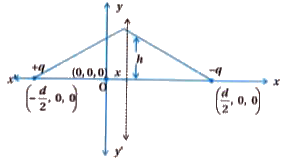 POTENTIAL at POINT P `(kp)/([(x+(d)/(2))^(2)+H^(2)]^(1//20))-(kq)/([(x-(d)/(2))^(2)+h^(2)]^(1//2))=0` `:. (1)/([(x+(d)/(2))^(2)+h^(2)]^(1//2))=(1)/([(x-(d)/(2))^(2)+h^(2)]^(1//2))` `:. (x+(d)/(2))^(2)+h^(2)=(x+(d)/(2))^(2)+h^(2)` `:. x^(2)-xd+(d^(2))/(4)=x^(2)+xd+(d^(2))/(4)` `:. 0 =2xd` `:. x=0` It is the required equation of the potential for EQUIPOTENTIAL surface at x = 0 means yz plane. |
|
| 34. |
It is difficult to perform electrostatic experiment on a humid day. Why? |
| Answer» SOLUTION :On humid daya air conduct electricity to a CERTAIN extent and it is DIFFICULT for an object to HOLD charge for longer DURATION | |
| 35. |
Define the terms of focal plane of the mirror. |
| Answer» SOLUTION :A PLANE DRAWN NORMAL to the principal axis and containing the principal focus of the mirror or lens is CALLED the focal plane. | |
| 36. |
(A) : A nonconducting ring having charge q uniformly distributed is rotated about an axis passing through its center and perpendicular to its plane. This ring is placed on smooth x-y plane. This ring can be stopped by a uniform magnattic field applied along x or y axis depending on sense of rotation. (R) : The magnetic torque is expresed as barMbarB . |
|
Answer» Both 'A' and 'R' are TRUE and 'R' is the CORRECT EXPLANATION of 'A'. |
|
| 37. |
A 250muA meter has 50 divisions and it needs 250 mV for full scale deflection. How will you convert it to read (i) 05 mA/division and (ii) 0.5 V/division? |
|
Answer» |
|
| 39. |
Let us consider simple microscope of a concave lens of power -10D and a convex lens of power +30D in contact. If the image is formed at infinity, what is the magnifying power of the microscope ? Consider distance of the distinct vision as 25cm. |
| Answer» | |
| 40. |
What is tangent law ? Discuss in detail. |
Answer» Solution :Tangent LAW :  (i) A MAGNETIC needle suspended, at a point where there are two crossed magnetic frelds acting at RIGHT angles to each other, will come to rest in the direction of the resultant of the two fields. (ii) `B_(1) " and " B_(2)` are two uniform magnetic fields acting at right angles to each other. (iii) A magnetic needle placed in these two fields will be subjected to two torques tending to ritatethe MAGNET in opposite directions. (iv) The torque `tau_(1)` due to the two equal and opposite parallel forces `mB_(1)" and " mB_(1)` tend to set the magnet parallel to B 1. Similarly the torque `tau_(2)` due to the two equal and opposite parallel forces `mB_(2)" and " mB_(2)`tends to set the magnet parallel to`B_(2)`. In a position where the torques balance each other, the magnet comes to rest. Now the magnet makes an angle `theta ` with `B_(2)`as shown in the Fig. The deflecting torque due to the forces, `mB_(1)" and " mB_(1)` `tau_(1) = mB_(1) xx NA` ` = mB_(1) xx NS cos theta ` ` = mB_(1) xx 2l cos theta ` ` = 2l mB_(1) cos theta ` ` :. "" tau_(1) = MB_(1) cos theta` Similarly the restoring torque due to the forces `mB_(2)" and "mB_(2)` `tau_(2) = mB_(2) xx SA` ` = mB_(2) xx 2l SIN theta ` ` = 2lm xx B_(2) sin theta` ` tau_(2) = MB_(2) sin theta ` At equillibrium , `tau_(1) = tau_(2)` ` :. "" MB_(1) cos theta= MB_(2) sin theta ` ` :. "" B_(1) = B_(2) tan theta ` This is called Tangent law Invariably , in the applications of tangent law,the restoring magnetic field `B_(2)` is the horizontal component of Earth's magnetic field `B_(h) `. |
|
| 41. |
The focal length of objective and eyelens of a astronomical telescope are respectively 20 cm and 5 cm. Final image is formed at least distance of distinct vision. The magnifying power will be |
|
Answer» `-4.8` |
|
| 42. |
Large band width for higher data is achieved by usibng |
|
Answer» high FREQUENCY CARRIER wave |
|
| 43. |
Which of the following is false for interference of light ? |
|
Answer» Coherence of the source is an essential condition for interference. |
|
| 44. |
(i) State law of Malus. (ii) Draw a graph showing the variation of intensity (I) of polarised light transmitted by an analyser with angle (theta) between polariser and analyser. (iii) What is the value of refractive index of a medium of polarising angle 60^(@) ? |
|
Answer» <P> Solution :(i) The intensity of polarised light transmitted through an analyser varies as the square of cosine of angle between plane of transmission of analyser and the plane of polariser. If `I_(0)` be the intensity of plane polarised light, then the intensity I. of the light emerging from the analyser is given by`I_(0)=Icos^(2)theta`. it is known as Malus.s law. (II) The graph showing the VARIATION of intensity I of polarised light transmitted by an analyser with angle q between polariser and analyser is shown in figure. (iii) `therefore`Polarising angle `i_(p)=60^(@)`. `therefore`Refractive index of the MEDIUM n=tan`i_(p)=tan60^(@)=SQRT3.` |
|
| 45. |
Electrical resistance of certain materials, known as superconductors, changes abruptly from a nonzero value to zero as there is lowered below a critical temperature T_(C)(0). An interseting property of supercoductors is that their critical temperature becomes smaller than T_(C)(0) if they are placed in a magnetic field , i.e., the critical temperature T_(C) (B) on B si shown in the figure. A superconductor has T_(C) (0)=100K. When a magnetic field of 7.5 Tesla is applied , its T_(C) decreases to 75 . For this material onecan definitely say that when : |
|
Answer» B=5 Tesla, `T_(C)(B)=80K` |
|
| 46. |
Assertion : When two charged spheres are connected to each other by a thin conducting wire, charge flow bigger sphere to smaller sphere, if initial charges on them are same. Reason : Electrostatic potential energy will be lost in redistribution of charges. |
|
Answer» If both ASSERTION and REASON are TRUE and Reason is the correct EXPLANATION of Assertion. |
|
| 47. |
A light bulb and an open coil inductor are connected to an ac source through a key as shown infigure. The switch is closed and after sometime, an iron rod is inserted into the interior of the inductor. The glow of the light bulb (a) increases, (b) decreases, (c) is unchanged, as the iron rod is inserted. Give your answer with reasons. |
| Answer» SOLUTION :As the IRON ROD is inserted, the magnetic field inside the coil magnetizes the iron increasing the magnetic field inside it. Hence, the inductance of the coil increases. Consequently, the inductive reactance of the coil increases. As a result, a LARGER fraction of the applied ac voltage appears across the inductor, leaving LESS voltage across the bulb. Therefore, the glow of the light bulb decreases. | |
| 48. |
(A) : gamma -radiation emission occurs after alpha and beta decay (R): Energy levels occur in nucleus. |
|
Answer» Both .A. and .R. are TRUE and .R. is the correct EXPLANATION of .A. |
|
| 49. |
A charge 'Q'is placed at each comer of a cube of side a. The potential at the centre of the cube is : |
|
Answer» `(8Q)/(piepsilon_0a)` |
|
| 50. |
Determine the furrent drawn from a 12 V suly with internal resistacne 0.5Omegaby the infinite network shown in Each rsistor has 1Omega resistance. |
Answer» SOLUTION :  Here no. of identical UNITS on the left side of line CD and line PQ are same and so equivalent resistance of given infinite LADDER between points P and Q as well as between points C and D must be same . Let it be x . thus , `R_(PQ) = R_(CD) ` = x ... (1) Now, let us remove part on the left side of line CD and let us replace it by equivalent resistance x.  Now, equivalent resistance between points P and Q in above figure is, `R_(PQ) = 1 + ((x xx 1)/(x + 1) ) + 1 ` `therefore x =2 + (x)/(x +1) `[ from equation (1)] `thereforex (x + 1) = 2 x (x + 1) + x ` `thereforex^(2) + x = 2x + 2 + x ` ` therefore x^(2) - 2x - 2 = 0 ""` .... (2) Comparing above equation with`ax^(2) + bx + c = 0 ` we get a = 1, b = - 2, c = -2 Now,`Delta = b^(2)- 4ac ` = `(-2)^(2) - 4 (1) (-2)` = 4 + 8 `Delta = 12 = 4 xx 3"" rArr sqrt(Delta ) = 2 sqrt(3)` Solution of equation (2) will be, ` x = (- b pm sqrt(Delta ))/( 2 a ) = - ((-2) pm 2 sqrt(3))/(2(1))` ` therefore x = (2 + 2 sqrt(3))/(2 )"" (because x gt 0 )` `therefore x =(2(1 + sqrt(3)))/(2 ) = 1"" sqrt(3) = 1 + 1.732 ` `therefore ` x =2.732 `Omega ""` .... (3) Now, as per the statement above resistance is connected across a battery (12 V, 0.5 `Omega` ) and so , For adjoining loop, `I = (epsilon)/(x +r)` `therefore I = (12)/(2.732 + 0.5) ` ` therefore I = (12)/( 3.232)` `therefore I = 3.713 ` A 
|
|