

Saved Bookmarks
This section includes 7 InterviewSolutions, each offering curated multiple-choice questions to sharpen your Current Affairs knowledge and support exam preparation. Choose a topic below to get started.
| 1. |
Which depolarizers are used to neutralizes hydrogen layer in cells |
|
Answer» Potassium DICHROMATE |
|
| 2. |
A square surface of side L metres is in the plane of the paper. A uniform electric field vec(E) (volt/m), also in the plane of the paper, is limited only to lower half of the square surface. The electric flux in SI units associated with the surface is |
| Answer» Answer :D | |
| 3. |
In a metere bridge, the balance length from left end (standard resistance of 1 Omega is in theright gap) is found to be 20cm the length of Resistance in left gap is (1)/(2)m and radiusis 2mm its specific resistance is |
|
Answer» `PI XX 10^(-6) ohm-m` |
|
| 4. |
A uniform wire (Y=2xx10^11 N//m^2)is subjected to a longitudinal tensile stress of 5xx10^(7) N//m^2. If the overall volume change in the wire is 0.02% the fractional decrease in its radius is 5kxx10^(-6)Find the value of k |
|
Answer» Solution :STRAIN=`(DELTAL)/l = "stress"/Y=(5xx10^7)/(2XX10^11)=2.5xx10^(-4)` Volume V=Al `DeltaV=Adeltal+l DeltaA` `(DeltaV)/V =(Deltal)/l =(DeltaA)/A` `rArr 2xx10^(-4)=2.5xx10^(-4)+(DeltaA)/A` `rArr (DeltaA)/A=0.5xx10^(-4)` `therefore (DeltaA)/A=(2Deltar)/r` `|(DELTAR)/r|=1/2|(DeltaA)/A|=1/2xx0.5xx10^(-4)=0.25xx10^(-4)` k=5 |
|
| 5. |
A transistor - oscillator using a resonant circuit with an inductor L (of negligible resistance) and a capacitor C in series produce oscillations of frequency f. If L is doubled and C is changed to 4C, the frequency will be |
|
Answer» f/2 or,`(f_(1))/(f_(2))=((L_(2)C_(2))/(L_(1)C_(1)))^(1//2)=((2L XX 4C)/(L xx C))^(1//2)=(8)^(1//2)` `therefore (f_(1))/(f_(2))=2sqrt(2) RARR f_(2)=(f_(1))/(2sqrt(2))` or, `f_(2)=(f)/(2sqrt(2)).(because f_(1)=f)` |
|
| 6. |
The conduction current is same as displacement current when source is |
|
Answer» AC only |
|
| 7. |
...... no. of electrons have charge equal to 1 coulomb. |
|
Answer» `6.25 xx 10^19` `THEREFORE N = Q/e = (1C)/(1.6 xx 10^(-19)C) = 6.25 xx 10^(18)` electrons. |
|
| 8. |
Light gets __ into different colors on passing through a triangular prism. |
| Answer» SOLUTION :DISPERSED | |
| 9. |
Using the equation of power for an ideal transformer, prove (I_(p))/( I_(s)) = ( V_(s))/( V_(p)) = ( N_(s))/( N_(p)) |
|
Answer» Solution :If the transformer is an ideal one, its efficiency is 100% so no energy losses. The POWER input is equal to the power output and since. p = IV `:. `In put power = Output power `I_(p) V_(p) = I_(s) V_(s) `…(1) Some energy is always lose, since a well designed transformer may have an efficiency of more than 95%. For an ideal transformer, `(V_(s))/(V_(p)) = ( N_(s))/( N_(p)) `...(2) Where `V_(s)` and `V_(p)` voltage across secondary and primary coil respectively and `N_(s)` and `N_(p)` are the number of turns in secondary coil and primary coil respectively. From equation (1) and (2), `(I_(p))/( I_(s)) = (V_(s))/(V_(p)) = ( N_(s))/( N_(p))`...(3) Hence, I and V both OSCILLATE with the same frequency as the ac source equation (3) also gives the ratio of the amplitude or rms value of corresponding quantities. |
|
| 10. |
Assuming that the charge of an electron is 1.6 x 10^-19 C. The number of electrons passing through a section of wire per second, when the wire carries a current of 1A is |
|
Answer» `0.625 X 10^19` |
|
| 11. |
What is isobar? Give an example. |
|
Answer» Solution :Isobars are the atoms of different elements having the same number A, but different atomic number Z. For example `""_(16)^(40)"S", ""_(17)^(40)"CI", ""_(18)^(40)"Ar", ""_(19)^(40)"K" and ""_(20)^(40)"Ca"` are isobars having same mass number 40 and different atomic number. |
|
| 12. |
Which of the following statements about dipole moment is not true? |
|
Answer» The dimensions of dipole moment is [L T A]. |
|
| 13. |
What is the number of atoms in an elementary cell of a closely packed hexagonal lattice? |
Answer» 
|
|
| 14. |
Obtain the equation fot resolving of optical instrument. |
|
Answer» Solution :The effect of diffraction has an adverse impact in the image formation by the OPTICAL instruments such as microscope and telescope. For a single rectangular slit, the half angle `theta` subtended by the spread of central maximum (or position of firs minimum) is given by the relation. `a sin theta = lambda` Similar to a rectangular slit, when a circular aperture or opening (like a lens or the iris of our eye) forms an image of a point object, the formed will not be a point but a diffraction pattern of CONCENTRIC circles that becomes fainter while moving away from the center. These are known as Airy.s discs. The circle of central maximum has the half angular spread given by the EQUATION, `a sin theta = 1.22 lambda` Here, the numerical value 1.22 comes for central maximum formed by circular aperutres. This involves higher level mathematics which is avoided in this discussion. `a sintheta = .22 lambda`  For small angles, `sin theta approx theta` `a theta = 1.22 lambda` Rewriting further, `theta=(1.22lambda)/(a)and(r_(0))/(f)=(1.22lambda)/(a)` `r_(0)=(1.22lambdaf)/(a)` When two point sources close to each another form image on the screen, the diffraction pattern of one point source can overlap with another and blurred image. To obtain a good image of the two sources, the two point sources MUST be resolved i.e. the point sources must be imaged in such a way that their images are sufficiently for apart that their diffraction pattern do not overlap, According to Rayleigh.s criterison, for two point objects to be just resolved, the minimum of one coincides with the first minimum of the other and vice versa. Such an image is said to be just resolvedimage of the object. The Rayleigh.s criterion is said to be limit of resolution. According to Rayliegh.s criterionthe two point sources are said to be just resolved when the distance between the two maxima is at least `r_(o)`. The angular resolution has a unit in radian (rad) and it is given by the EQUAITON, `theta = (1.22 lambda)/(a)` itshows that the frist order diffraction angle must be as small as possible for greater resolution. This further shows that for better resolution, the wavelenght of light used must be as small as possible and the size of the aperture of the instrument used must be as large as possible. The equation (4) is used to calculate spacial resolution. The inverse of resolution is called resolving power. This implies, smaller the resolution, greater is the resolving power of the instrument. The ability of an optical instrument to separate or distinguish small or closely adjecent objects through the image formation is said to be resolving of the instrument. |
|
| 15. |
A block of mass M slides along the sides of bowl as shown in the figure. The walls of the bowl are frictionless and the base has coefficient of friction 0.1, and length 0.5m. The block is released from the point A which is 0.2 m high as shown in figure. Then the block comes to rest |
|
Answer» SOLUTION :From law of conservation of energy mgh `=1/2 mv^(2)` `THEREFORE v^(2) =2(0.2)G = 0.4 g` `therefore 1/2 m(0.4)g = 0.1 (m)(g) (0.5) + mgh_(1), therefore h_(1) = 0.15 m` SIMILARLY when it reaches to P again it rises to 0.1 m. And then comes to Q and rises to 0.5 m. and then finally comes to REST at P. 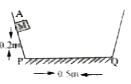
|
|
| 16. |
Electromagnetic waves are produced by: |
|
Answer» an ACCELERATING charge |
|
| 17. |
What will be the total flux through the faces of the cube as in figure with side of length a if a charge q is placed at ? (a) A: a corner of the cube. (b) B : midpoint of an edge of the cube. (c) C: centre of a face of the cube. (d) D : midpoint of B and C. |
|
Answer» Solution :(a) Cube has 8 corners. Charge on each corner: `=q/(8 XX 1) = q/8` `THEREFORE` ELECTRIC flux at A. `phi = q/(8epsilon_(0))` (b) If the charge q is placed at B, middle point of an edge of the cube, it is being shared equally by 4 cubes. Flux through each cube, `phi = phi^(.)/4 = q/(4epsilon_(0))` (c) If the charge q is placed at C, the centre of a face of the cube, it is being shared equally by 2 cubes. `therefore`Flux through each cube, `phi = phi^(.)/epsilon_(0) = q/(2epsilon_(0))` (d) Finally, if charge q is placed at D, the MIDPOINT of B and C, it is being shared equally by 2 cubes. `therefore`Flux through each cube, `phi = phi^(.)/epsilon_(0) = q/(2epsilon_(0))` |
|
| 18. |
(A ): Magnitude of electric force acting on a proton and an electron, moving in a uniform electric field is same, where as acceleration of electron is 1836 times that of a proton. (R ): Electron is lighter than proton. |
|
Answer» Both .A. and .R. are true and .R. is the CORRECT explanation of .A. |
|
| 19. |
If the audio signal is transmitted directly into space, the length of transmitting antenna required will be : |
|
Answer» EXTREMELY small |
|
| 20. |
During adiabatic change, specific heat is |
|
Answer» ZERO |
|
| 21. |
(a) State Lens law. Give one example to illustrate this law. '' The Lenz's law is a consequence of the principle of conversation of energy .' Justify this statement. (b) Deduce an expression for the mutual inductance of two long coaxial solenoids but having different radil and different radil and different number of turns. |
|
Answer» Solution :(a)Lenz's law:It states that the direction of induced current or `emf` in a circuit is always such that it opposes the cause which produces it. It gives the direction of current or `emf` induced in a circuit. Lenz's law is in accordance with the principles of conservation of energy.In electromagnetic induction, the electrical energy (in the form of induced current or induced `e.m.f`) is obtained at the EXPENSE of mechanical energy. (b)Coefficient of mutual induction:The coefficient of mutual induction or mutual inductance of two COILS is numerically equal to the amount of magnetic flux linked with one coil when unit current flows through the neighbouring coil. It is denoted by `M`.Its `SI` unit is weber/ampere. Mutual inductance of two long coaxial solenoids:Consider the following fig.Which shows two long coaxial solenoids each of length `l` let the radius of the inner solenoid `S_(1)` be `r_(1)` and the number of turns per unit length be `n_(1)` The corresponding quantities for the outer solenoid `S_(2)` are `r_(2)` and `n_(2)` respectively. Let `N_(1)` and `N_(2)`, be the total number of turns of coils `S_(1)` and `S_(2)` respectively. `N_(1)phi_(1)=M_(12)I_(2)` ..(1) where `M_(12)` is called the mutual inductanceof solenoid `S_(1)` with respect to solenoid `S_(2)`.The magnetic field due to the current `I_(2)` in `S_(2)` is `mu_(0)n_(2)l_(2)`.The resulting flux LINKAGE with coil `S_(1)` is `N_(1)phi_(1)=(n_(1)l)(pir^(2))(mu_(0)n_(2)I_(2))=mu_(0)n_(1)n_(2)pir_(1)^(2)lI_(2)`..(2) where `n_(1)l` is the total number of turns in solenoid `S_(1)` From eq.(1) and (2) we get `M_(12)I_(2)=mu_(0)n_(1)n_(2)pir_(1)^(2)lI_(2)` or `M_(12)=mu_(0)n_(1)n_(2)pir_(1)^(2)l`...(3) Now consider the reverse case a current `I_(1)` is passed through the solenoid `S_(1)` and the flux linkage with coil `S_(2)` is `N_(2)phi_(2)=M_(21)I_(1)` ..(4) Where `M_(21)`,is called the mutual inductance of solenoid `S_(2)` with respect to solenoid `S_(1)`.The flux due to the current `I_(1)` in `S_(1)` can be assumed to be confined only inside `S_(1)`, SINCE the solenoids are very long.Thus, flux linkage with solenoid `S_(2)` is `N_(2)phi_(2)=(n_(2)l)(pir_(1)^(2))(mu_(0)nl_(1)^(2))`...(5) Where `n_(2)l` is the total number of turns of `S_(2)`. From eq.(4) and (5), we get `M_(21)=mu_(0)n_(1)n_(2)pir_(1)^(2)l`...(6) From eq (3) and (4), we get `M_(12)=M_(21)=M`(say) Therefore `M=mu_(0)n_(1)n_(2)pir^(2)l` 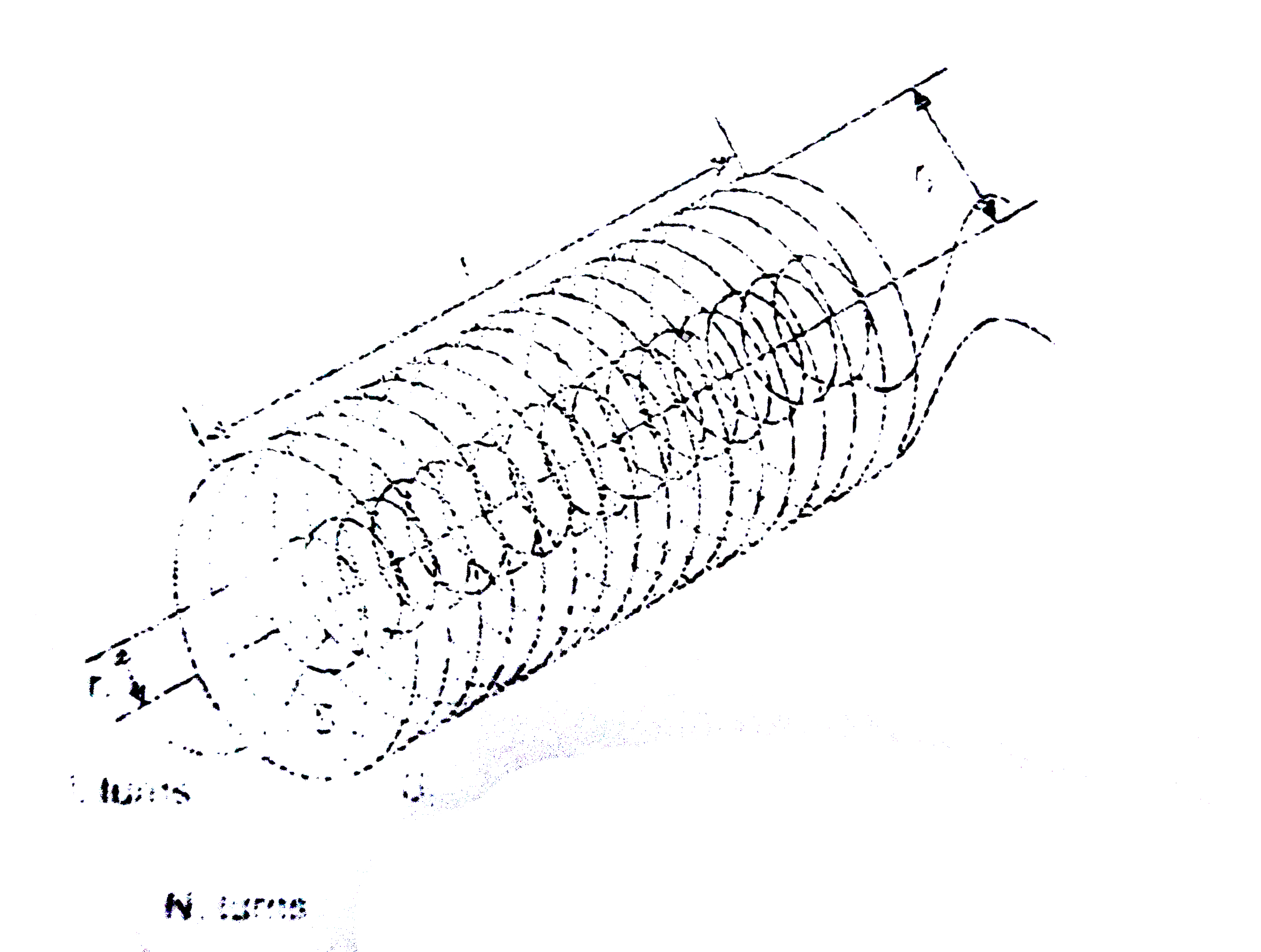
|
|
| 22. |
In an equilateral prism if incident angle is 45 then minimum deviation is…… |
|
Answer» Solution :`i+e=A + delta` But when `i=e IMPLIES delta=delta_m` `therefore 2i=A+delta_m` `therefore delta_m=2i-A=2 times 45^@-60^@=30^@` |
|
| 23. |
A 50 muF capacitor is connected to an ac sourceV = 220 sin50t where V is in volt and t is in second. The rms current is |
|
Answer» 0.55 A `V=V_0` sin `omegat` , we get `V_0` =220 V and `omega=50 "RAD s"^(-1)` `therefore` The capacitive REACTANCE is `X_C=1/(omegaC)=1/((50 "rad s"^(-1))(50xx10^(-6) C))=10^4 /25 Omega` `therefore` The rms CURRENT is `I_(rms)=V_(rms)/X_C=(V_0/sqrt2)/X_C(because V_(rms)=V_0/sqrt2)` `= (220/sqrt2V)/(10^4/25 Omega)=(220xx25)/(10^4 XX sqrt2)A = 0.55/sqrt2`A |
|
| 24. |
The puppy survived because |
|
Answer» NEHRU NURSED her with care |
|
| 25. |
The charges given to a hollow sphere of radius 10 cm is 10 n C . Electric field at a point situated at a distance of 4 cm from its centre is |
| Answer» Answer :D | |
| 26. |
The SI units of magentic permeability are |
|
Answer» `WB A^-1m` |
|
| 27. |
sin270^(@) is equal to- |
|
Answer» -1 |
|
| 28. |
The inherent property of all matter is |
|
Answer» PARAMAGNETISM |
|
| 29. |
The process of producing a new stable nucleus from the other stable nucleus is called |
|
Answer» NUCLEAR reaction |
|
| 30. |
A frictionless piston-cylinder based enclosure contains some amount of gas at a pressure of 400 kPa. Then heat is transferred to the gas at constant pressure in a quasi-static process. The piston moves up slowly through a height of 10 cm. If the piston has a cross-sectional area of 0.3 m^(2), the work done by the gas in this process is |
|
Answer» <P>`6 KJ` `W = P Delta V = P Delta (lA) = 400 kPa XX 10 xx 10^(-2) xx 0.3` `= 400 xx 10^(3) xx 10 xx 10^(-2) xx 0.3 = 12 kJ` |
|
| 31. |
Radii of curyature of a converging lens are in the ratio 1 : 2, Its focal length is 6 cm and refractive index is 1.5. Then its radii of curvature are …. Respectively. |
|
Answer» 9 cm and 18 cm Let `R_(1) = R and R_(2) = 2R` We know the focal length of converging lens By USING relation `(1)/(f) = (mu - 1) [(1)/(R_(1)) + (1)/(R_(2))]` Substituting all the values, we get `R = 4.5 cm` `therefore R_(1) = 4.5 cm and R_(2) = 2 xx 4.5 = 9 cm` |
|
| 32. |
A ball of mass 100 g is moving with a velocity of 10 ms^(-1). On being hit with bat rebounds with a velocity of 10 ms^(-1). The force of the ball by the bat acts for 0.01 s, then the force exerted on the ball by the bat is |
|
Answer» 50 N FORCE`=(m(v_(1)-v_(2)))/(Delta t)` `=(0.1[10+10])/0.01 = 200 N` |
|
| 33. |
The atmosphere above the height of 80 km is called |
|
Answer» stratosphere |
|
| 34. |
Demonstrate that in the reference frame rotating with a constant angular velocity omega about a stationary axis a body of mass m experiences the resultant (a) centrifugal force of inertia F_(cf)=momega^2R_C, where R_C is the radius vector of the body's centre of inertia relative to the rotation axis, (b) Coriolis force F_(cor)=2m[v_C^'omega], where v_C^' is the velocity of the body's centre of inertia in the rotating reference frame. |
|
Answer» Solution :For a point mass of mass `dm`, looked at from C rotating frame, the equation is `dmoverset(RARR')w=vecf+dmomega^2overset(rarr')r+2dm(OVERSET(rarr')vxxvecomega)` where `overset(rarr')r`=radius vector in the rotating frame with respect to rotation axis and `overset(rarr')v`=VELOCITY in the same frame. The total centrifugal FORCE is CLEARLY `vecF_(cf)=sumdmomega^2overset(rarr')r=momega^2vecR_c` `vecR_c` is the radius vector of the C.M. of the body with respect to rotation axis, also `vecF_(cor)=2moverset(rarr')v_cxxvecomega` where we have used the definitions `mvecR_c=sum dmoverset(rarr')r` and `moverset(rarr')c=sumdmoverset(rarr')v` |
|
| 35. |
In a surface tension experiment with a capillary tube water rises upto 0· 1 m. If the same experiment is repeated on an artificial satellite, which is revolving around the earth, water will rise in the capillary tube upto a height of : |
|
Answer» 0.1 m THUS the correct chioce is (d). |
|
| 36. |
The initial pressure and volume of a given mass of an ideal gas("with " C_(p)/C_(v) = gamma), taken in a cylinder fitted with a piston are P_(0) " and " V_(0)respectively. At this stage the gas has the same temperature as that of the surrounding medium which is T_(0). It is adiabatically compressed to a volume equal to V_(0)/2.Subsequently the gas is allowed to come to thermal equilibrium with the surroundings. What is the heat released to the surroundings? |
|
Answer» `0` `T_(0) V_(0)^(gamma -1) = T (V_(0)/2)^(gamma -1)` `rArr T (V_(0)^(gamma -1))/2^(gamma -1) = T_(0)V_(0)^(gamma -1) rArr T = T_(0) 2 ^(gamma -1) ` ....(i) Assuming that the piston will remain fixed after compression . WORK done in adiabatic compression , `W = N C_(v) Delta T ` ` = n R/((gamma -1)) (T_(0) -T) ` ` = n R/((gamma -1)) (T_(0) - T_(0) 2^(gamma -1)) ` (USING (i)) ` = (nRT_(0))/((gamma -1)) (1 - 2^(gamma -1)) = (P_(0) V_(0))/((gamma -1)) (1 - 2^(gamma -1))` Now , in case of adiabatic compression , `W lt0`, thus work done is negative. ` :. `HEAT released , `Delta Q = - W = (P_(0)V_(0))/((gamma -1)) (2^(gamma -1) -1) ` |
|
| 37. |
A string of mass m and length l is hanging from ceiling as shown in the Fig. Wave in string move upward. v_A and v_(B)are the spec at A and B respectively Then v_(B) is: |
|
Answer» `SQRT(3)v_(A)` |
|
| 38. |
A potential difference of 220 V is maintained across a 12000 ohm rheostat AB. The voltmeter V has a resistance of 6000 ohm and point C is at one fourth of the distance from A to B. What is the reading in the voltmeter? |
|
Answer» Solution :As in CASE of linear rheostat `RpropL,(R_(AC))/(R_(AB))=(AC)/(AB)` Here, as `R_(AB)=12000Omega` and `AC=1/4AB` So, `R_(AC)=12000xx1/4=3000Omega` Now as the resistance `R_(AC) ( = 3000 OMEGA)` is in parallel with VOLTMETER of resistance of `6000Omega`. So the effective resistance between points A and C will be `R_(AC).=(3000xx6000)/((3000+6000))=2000Omega` Now as `R_(BC)=(R_(AB)-R_(AC))` `=12000-3000)=9000Omega` is in SERIES with `R_(AC). (= 2000Omega)` and in series potential divides in proportion to resistance, potential difference ACROSS AC, i.e., voltmeter reading will be, `V_(AC)=(R_(AC).V_(AB))/((R_(BC)+R_(AC).))=(2000)/((9000+2000))xx220=40V` 
|
|
| 39. |
Show that in the free oscillations of an LC circuit, the sum of energies stored in the capacitor and the inductor is constant in time. |
|
Answer» Solution :SUPPOSE at time `t=0`, a capacitor with charge `q_(0)` is connected to an inductor ( without any magnetic field inside it) and the circuit is MADE closed. Now, capacitor starts getting discharged through an inductor. If charge on capacitor is q at time t then, `q = _(0 ) cos ( OMEGA t ) `...(1) ( Where` omega =` angular frequency of LC oscillations `= ( 1)/( sqrt( LC ))` )..(2) Energy in the electric field between the plates of a capacitor at time t will be. `U_(E ) = ( 1)/(2)(q^(2))/( C )` `:. U_(E ) = ( 1)/(2) (q_(0)^(2)cos^(2) ( omegat))/( C ) `....(3) Now, current through an inductor at time t is, `i = ( dq)/( dt)` `= ( d)/( dt) { q_(0) cos ( omega t )}` `= q_(0) { - sin ( omega t )} omegat` `:. i = - q_(0) omega sin ( omega t )`....(4) Energy in the magnetic field inside an indcutor at time t will be, `U _(B) = ( 1)/(2) Li^(2)` `:. U_(B ) = ( 1)/(2) Lq_(0)^(2) omega^(2) ( omega t )` [ From equation (4) ] `:. U_(B) = (1)/(2) Lq_(0)^(2) xx (1)/( LC)sin^(2) ( omegat )` `:. U_(B )= (1)/(2) ( q_(0)^(2))/( C ) sin^(2) ( omega t ) `...(5) TOTAL energy stored in capacitor and in an inductor at time t will be , `U_(E ) + U_(B ) = (1)/(2) ( q_(0)^(2))/( C ) { cos ^(2) ( omega t ) |+ sin^(2) ( omega t) }` `:. U_(E )+ U_(B ) = ( 1)/(2) (q_(0)^(2))/( C )` ...(6) `:. U_(E ) + U_(B )`= constant `( :. q_(0)` and C are constants ) |
|
| 40. |
In a p-n junction diode the thickness of depletion layer is 2 xx 10^(-6) m and barrier potential is 0.3 V. The intensity of the electric field at the junction is : |
|
Answer» <P>`0.6 XX 10^(-6) Vm^(-1) ` from n to p SIDE |
|
| 41. |
Speed of electromagnetic waves in vacuum, |
|
Answer» depends on type of source. |
|
| 42. |
An infinitely long wire with linear charge density+lambdais bent and the two parts are inclined at angle 30^@ as shown in fig, the electric field at point P is : |
|
Answer» `(lambda)/(4 pi in_0 d) [ (1 + sqrt(3))hati + hatj]` `E_1 = (lambda)/(4 pi in_0 ((sqrt(3)d)/(2))) (COS 60^@ + cos 0^@) = (sqrt(3) d)/(4 pi in_0 d)` `:. VEC(E ) = (E_1 + E_2 cos 30^@ + E_2 cos 60^@) hati + (E_1^. + E_2^1 sin 60^@ - E_2 sin 30^@) hati`  `= ((lambda)/(4pi in_0 d) + (sqrt(3)lambda)/(8pi in_0 d) + (sqrt(3) lambda)/(8 pi in_0 d)) hati + ((lambda)/(4pi in_0 d) + (sqrt(3))/(8pi in_0 d) - (sqrt(3))/(8pi in_0 d)) hatj` `= (lambda)/(4 pi in_0 d)[(1 + sqrt(3) hati + 2hatj]` |
|
| 43. |
The circuit in Fig. shows two cells connected in opposition toeach other. Cell epsi_1, is of emf 6 V and internal resistance 2Omega and the cell epsi_2is of emf 4 V and internal resistance 8 Omega. Find the potential difference between the points A and B. |
|
Answer» Solution :Since two cells are connected in opposition, hence net emf `EPSI = epsi_1 - epsi_2 = 6-4 = 2 V `and total resistance `r = r_1 + r_2 = 2 + 8 = 10 Omega` ` therefore` Circuit current`I = epsi/r = 2/10 = 0.2 A` ` therefore ` Potential difference between the POINTS A and `B = |V_A-V_B | = epsi_2 + r_2I = 4 + 8 xx 0.2 = 5.6 V` Of course point B is at higher potential than the point A. |
|
| 44. |
Which part of electromagnetic spectrum has the largest penetrating power ? |
| Answer» SOLUTION :GAMMA RAYS. | |
| 45. |
How many electrons constitute current of one ampere? |
|
Answer» `6.25 X 10^9` |
|
| 46. |
A body of mass 0.1 kgperforming linear SHM experiences a restoring force of 1 N when its displacement from the mean position is 5 cm. Find (i) the force constant (ii) the period of SHM (iii) the acceleration of the body, when its displacement from the mean position is 1 cm./ |
|
Answer» Solution :DATA : , m= 0.1 kg , F=1 , N x =5 `xx 10^(-2) m, x_(1) = 10^(-2) `m (i) F= kx The force constant= ` K = F/x = 1/(5xx 10^(-2)) = 20 ` N/m (ii) The period of the motion ` T = 2 pi sqrt(m/k) =2pi sqrt(0.1/20) = (2pi)/(10sqrt2) = (6.284)/(14.14)` = 0.4444 s The magnitude of the acceleration . LTBR. ` a = omega^(2) x= ((2pi)/T)^(2) x= (4pi(10^(-2)))/(4pi^(2)//200) = 2m//s^(2)` |
|
| 47. |
Light waves of wavelength , lambda propagate in a medium . If M and N are two points on the wave front and they are separated by a distance lambda//4,the phase difference between them will be ( in radian ) |
|
Answer» `pi//2` |
|
| 48. |
Check that the ratio ke^(2)/G m_(e )m_(p)is dimensionaless look up a table of physical constant and determinethe value of this ratio whatdoes the ratio signify |
| Answer» Solution :`2.4xx10^(39)` this is the ratio of ELECTRIC FORCE to thegravitational forcebetween an electronand a PROTON | |
| 49. |
Draw a ray diagram to show the working of a compound microscope . Deduce an expression for the total magnification when the final is formed at the near point . In a compound microscope, an object is place at a distance of 1.5cm from the objective of focal length 1.25cm. If the eye piece has a focal length of 5cm and the final image is formed atthe near point, estimate the magnifying power of the microscope. |
Answer» Solution :Labelled Ray DIAGRAM `:` 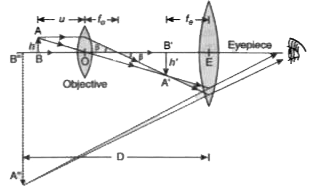 Expression for total magnification `:` Magnification due to the objective , `m_(0) = ( h.)/( h ) = ( L)/( f_(0))` Magnification `m_(E )`, due to eyepiece , ( when the final image is formed at the NEAR point ) `m_(e ) = ( 1+ ( D)/( f_(e )))` Total magnification, `m= m_(0) m_(e ) = ( L)/( f_(0)) ( 1+ (D )/( f_(e)))` Estimation of magnifying POWER `:` Given `:` `u_(0) = - 1.5 cm, f_(0) = 1.25 cm`, we have `(1)/( f_(0)) = ( 1)/( v_(0)) - ( 1)/( u _(0))` `(1)/(1.25) = ( 1)/( v_(0)) - ( 1)/( - 1.5) rArr v_(0) = 7.5 cm` `m= (v_(0))/( u_(0)) ( 1 + ( D)/( f_(e)))` `= ( 7.5 )/( - 1.5 ) ( 1+ ( 25)/( 5)) rArr m = - 30` |
|
| 50. |
In an interial reference from K thereis onlyelectric fieldof strengthE = a (xl + y)//x^(2) + y^(2)), where a isa constant, i findj are unit vectorsof thex and yaxes. Find themagtneticinduction B' in the frameK'movingrelative to the freameK with a consantnon-relativisticvelocityv = vkl k is the unitvectorof the z-axis. The z' axisis assumedto coinculewith thez-axis. Whatis the shapeof the magneticinduction B' ? |
|
Answer» Solution :In `K,vec(E) = a (vec(r))/(r^(2)), vec(r) = (X HAT(i) + y hat(j))` In `K', vec(B') = (vec(v) XX vec(E))/(c^(2)) = (a vec(r) xx vec(v))/(c^(2) r^(2))` The magnetic lines are circular. |
|