Saved Bookmarks
This section includes 7 InterviewSolutions, each offering curated multiple-choice questions to sharpen your Current Affairs knowledge and support exam preparation. Choose a topic below to get started.
| 1. |
In a half-wave rectifier, the load current flows for |
|
Answer» the complete cycle of the inpui SIGNAL |
|
| 3. |
A compound microscope has an objective of focal length 2 cm ahd eye piece of focal length 5 cm. The distance between two lenses is 25 cm. If final image is at 25 cm from the eye - piece, find the magnifying power of the microscope : |
|
Answer» 56.5 `(1)/(-25) - (1)/(-u_(e))=(1)/(5) or u_(e)=(25)/(6)` `L = v_(0) + u_(e) or 25 = v_(0) + (25)/(6)` or `v_(0) = (125)/(6) cm` For objective `(1)/(((125)/(6)))-(1)/(-u_(0))=(1)/(2)oru_(0)=(250)/(113)cm` `THEREFORE M=(v_(0))/(u_(0))[1+(D)/(f_(e))]=((125)/(6))/((259)/(113))[1+(25)/(5)]` |
|
| 4. |
CH_(3)-CH_(2)-CH_(2)-C-=N "","" CH_(3)-underset(CN)underset(|)CH-CH_(3) (A)""(B) Relation between (A) and (B) is - |
|
Answer» CHAIN isomer In chain isomerism the LENGTH of C- chain is change |
|
| 5. |
(A) Consider circuit How much energy is absorted by electrons from the initial state of no currentto the state of draft velocity? (b) Electrons give up energy at the rate of Rt^(2) per second in the thermal energy What time state would one assoclate energy with energy in problem (a) ? n = no of electron /volume = 10^(29)//m^(3) length of ciruit = 10 cm cross section A = (1 mm)^(2) |
|
Answer» Solution :(a) current `I = (V)/(R) = (6V)/(6 Omega) = 1A`, driff VELOCITY `v_(d) = (I)/(nA e) = (1)/(10^(29) xx (10^(-4)) xx (1.6 xx 10^(-19)) = (1)/(1.6) xx 10^(-4) m//s` No of electron in the wire `= nAI` KE of all the electron `= (1)/(2) m_(e) u_(d)^(2) xx nAI = (1)/(2) xx (9.1 xx 10^(-31)) xx ((1)/(16) xx 10^(-4))^(2) xx 10^(29) xx(10^(-4)) xx 10^(-1)` `= 2 xx 10^(-17) J` (b) power loss`= I^(2) xx 6 = 6 J//s` All the `KE` of electron would be LOST in time `= (2 xx 10^(-17)J)/(6 J//s) = 0.33 xx10^(-17) s ~~ 10^(-17) s` |
|
| 6. |
जरायुज (viviparous) जन्तु है: |
|
Answer» पक्षी |
|
| 7. |
In a YDSE, a total of 241 fringe can be seen on the screen. The set up is completely immersed in water. What will be the number of fringes now seen on the screen? |
|
Answer» Solution :The total number of fringes is given by `(2D)/(lambda)+1` assuming `(2d)/(lambda)` to be an integer. `THEREFORE (2d)/(lambda)+1= 241 implies (2d)/(lambda)= 240 implies (2d)/(lambda)= 240` Now, let `lambda^(1)` be the changed WAVELENGTH when the YDSE set up is submerged in water. Then the total number of fringes will be `(2d)/(lambda)+1= (2 d mu)/(lambda)+1= 240(4/3)+1` `(therefore mu" for water "= 4"/"3)= 321`. |
|
| 8. |
Four charges are arranged at the comers of a square ABCD of side d, as shown in Fig. a. Find the work required to put together this arrangement b. A charge q_(0) is brought to the centre E of the square, the four charges being held fixed at its corners. How much extra work is needed to do this?n |
|
Answer» Solution :Since the work done depends on the final arrangement of the charges, and not on how they are put togeth calculate work needed for one way of putting the charges at A, B, C and D. Suppose, first the charge +q is brought to A, and then the charges -q, +q, and -q are brought to B, C and D, respectively. The total work needled oan be caloulated in STEPS: i. Work needed to bring charge +q to A when no charge is present ELSEWHERE, this is zero. i. Work nooded to bring - q to B when + q is at A. This is given by (charge at B) `xx` (eleectrostatic potential at B due to charge +q at A) `=-q xx q/(4pi epsi_(0) d)=-(q^(2))/(4pi epsi_(0)d)` iii. Work needed to bring charge +q to C when +q is at A and - is at B. This is given by `"(charge at C) "xx` (potential at C due to charges at A and B) `=+q ((+q)/(4pi epsi_(0)dsqrt2) +(-q)/(4pi epsi_(0) d))= (-q^(2))/(4pi epsi_(0)d) (1-1/sqrt2)` iv. Work needed to bring -q to D when +q at A, - q at B, and + q at C. This is given by (charge at D) `xx` (potential at D due to charges at A, B and C) `=-q ((+q)/(4pi epsi_(0)d) +(-q)/(4pi epsi_(0) dsqrt2) +(q)/(4pi epsi_(0) d))=(-q^(2))/(4pi epsi_(0) d) (2-1/sqrt2)` Add the work done in steps (i), (II), (iii) and (iv). The total work required is `=(-q^(2))/(4pi epsi_(0) d) {(0)+(1)(1-1/sqrt2) +(2-1/sqrt2)}=(-q^(2))/(4pi epsi_(0) d) (4-sqrt2)` The work done depends only on the arrangement of the charges, and not how they are assembled. By definition, this is the total electrostatic energy of the charges. b. The extra work NECESSARY to bring a charge `q_(0)` to the point E when the four charges are at A, B, C and D is `q_(0) xx`(electrostatic potential at E due to the charges at A, B, C and D). The electrostatic potential at E is clearly zero since potential due to A and C is cancelled by that due to B and D. Hence no work is required to bring any charge to point E. |
|
| 9. |
Match the following: |
|
Answer» |
|
| 10. |
In Photo electric effect, What happens when the negative potential is increased? |
| Answer» SOLUTION :PHOTOELECTRIC CURRENT DECREASES. | |
| 11. |
Two monochromatic beam A and B of equal intensity I,hit a screen.The number of photons hitting the screen by beam A is twice that by beam B.Then what inference can you make about their frequencies? |
|
Answer» SOLUTION :Intensity of light is given by, `I=(E_(N))/(At)=(NHF)/(At)` (Where A=area of given screen) `therefore I=m.hf` where n.=`(n)/(At)`=no. of photon INCIDENT of unit unit area of screen per unit TIME `therefore n.f=(I)/(h)`=constant(`because` Here I is constant) `therefore n._(A)f_(A)=n._(B)f_(B)` (As per the statement) `therefore f_(A)=(f_(B))/(2)` `implies` Frequency of beam A would be half of frequency of beam B. |
|
| 12. |
A telescope has an objective of focal length 1.44m and an eye piece of focal length 0.06m. What is the separation between the objectives and the eye piece? |
| Answer» SOLUTION :`L=f_0 + f_e= 1.44 + 0.06 = 1.5 m` | |
| 13. |
The diagram shows combination of three cuboidal spaces (1),(2) and (3). Space 1 and 3 contain electric field E as shown while space 2 has magnetic field B. A particle of charge q and mass m is projected as shown with velocity V_(0) cos theta(i) + V_(0) sin theta hat(j). Find the value of E, so that his particle enters the magnetic field parallel to the x-axis and just passes through point P along the electric field at that point. Find its speed at P and also the ratio L/R (Neglect the effect of gravity) |
|
Answer» |
|
| 14. |
In the previous question if the mass of the wire is measured as 0.53kg and length of the wire is measured by an mm scale and is found to be 50.0cm find the density of the wire in correct significant . |
| Answer» SOLUTION :`rho=(m)/(((PID^(2))/(4))l)=((0.53xx10^(3))xx4)/((3.14)(1.70xx10^(-3))^(2)(50xx10^(-2)))g//m^(3)=4.7xx10^(8)(2S.F.)` . | |
| 15. |
Give Oersted's observation. |
Answer» Solution :1. As shown in figure, conducting wire is connected with battery.  2. Magnetic needle is kept nearby conducting wire which is stable in North-South direction. 3. As key is CLOSED, current in a straight wire caused deflection in a nearby magnetic compass needle and alignment of the needle is tangential of an imaginary circle which has the straight wire as its centre and has its plane perpendicular to the wire. This situation is depicted in figure (a). Here the needle is sufficiently CLOSE to the wire so that the Earth.s magnetic FIELD MAY be ignored. REVERSING the direction of the current reverses the orientation of the needle which is depicted in figure (b). 4. The deflection increases on increasing the current or bringing the needle closer to the wire. 5. Moving charges or currents produced a magnetic field in the surrounding space. |
|
| 16. |
Using Huygen's wave theoryof light , derive Snell's law of refraction. |
Answer» Solution :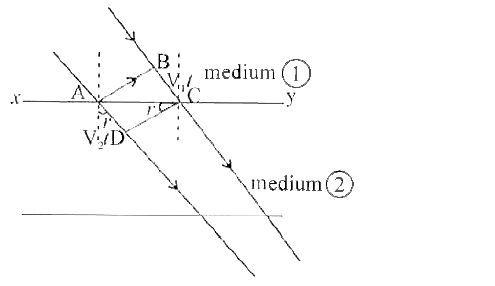 Let xy represent the surface separating medium(1) and medium (2) as shown in the figure. Let `v_1` and `v_2` REPRESENTTHE speed of light inmediums (1) and (2) respectively. A plane wave front incident on the interface xy at angle i. Let t be the time taken by the wavefront to travelthe distance BC. thenBC=`v_it`. The secondarywave from A will travel a distance `V_2t` in medium 2 , in the same time period.Draw an arc in medium 2. Then AD=`V_2t` and the TANGENT from C touches the arc at D . CD is the tangential surfacetouching all the spheres of refractedsecondary wavelets , and hence CD is the refracted wave front. `angle(BAC)=i` and `angle(DCA)=r` From triangle BAC, sin i = `(BC)/(AC)` From triangle DCA, sin r =`(AD)/(AC)` `(sin i)/(sin r) =(BC//cancel(AC))/(AD//cancel(AC))` `=(BC)/(AD)` SUBSTITUTING values of BC and AD , `therefore (sin i)/(sin r) =(V_1 cancelt)/(V_2 cancelt)=V_1/V_2 to ` (1) Now, R.I of the first medium `V_1=c//n_1` Similarly for the SECOND medium `V_2=c//n_2` Substituting in eqn.(1) , we get `(sin i)/(sin r) =(cancelc//n_1)/(cancelc//n_2)=(1//n_1)/(1//n_2)=n_2/n_1` `therefore (sin i)/(sin r)=n_1/n_2` This is the snell.s law of refraction. |
|
| 17. |
What was the 'Subsistence Crisis' which occurred frequently in France? |
|
Answer» An extreme SITUATION endangering the BASIC MEANS of livelihood |
|
| 18. |
A proton and an alpha particle have same kinetic energy. Their de-Broglie wavelengths are in the ratio_____. |
| Answer» Solution :`lamda_(p):lamda_(alpha)=2:1` [As PER relation `lamda=(H)/(sqrt(2mK))`, for same value of KINETIC ENERGY `lamdaprop(1)/(sqrt(m))`.]. | |
| 19. |
When a loop of wire is dipped in a wetting liquid and is taken out. A liquid film is formed and loop of light inextensible thread is gently put on the liquid film. A hole is pricked inside the loop of thred. Due to property of suface tension , free surface of the liquid tries to minimize its surface are and hence are of the hole will be maximized. In the above description , loop wire is square of side 4 units ,liquid is soap and length of loop of thread is 15 units. If of the suface tension of soap is 'S' what is the tension inh the thread ? |
|
Answer» `(S)/(4-pi)`UNITS |
|
| 20. |
When a loop of wire is dipped in a wetting liquid and is taken out. A liquid film is formed and loop of light inextensible thread is gently put on the liquid film. A hole is pricked inside the loop of thred. Due to property of suface tension , free surface of the liquid tries to minimize its surface are and hence are of the hole will be maximized. In the above desciption. loop wire is square of side 4 units. If lenght of thread is 15 units what is the final suface area for soap film on one side of wire frame? (Neglect the frication everywhere) |
|
Answer» `0.289 " UNITS "^2` |
|
| 21. |
Which phenomenon supports that matter has a wavel nature ? |
|
Answer» ELECTRON MOMENTUM |
|
| 22. |
In the above question, if Q' is removed then which option is correct : |
|
Answer»
|
|
| 23. |
A source emitting light of wavelengths 480nm and 600 nm is usedin a double slit interference experiment . The seperation between the slits is 0.25 mm and the interference is observed on a screen placed at 150 cm from the slits. Findthe linear separation between the first maximum (next to the central maximum ) corresponding to the two wavelengths . |
|
Answer» `0.36` MM |
|
| 24. |
Figure 25-27 displays a 16.0 V battery and 3 uncharged capacitors of capacitances C_1=4.00 mu F, C_2=6.00 mu F and C_3=3.00 mu F The switch is thrown to the left side until capacitor 1 is fully charged. Then the switch is thrown to the right. What is the final charge on (a) capacitor 1, (b) capacitor 2 and (c ) capacitor 3? |
| Answer» SOLUTION :`a) 42.7 mu C b) 21.3 mu C c) 4.4 mu J d)5.0 TIMES 10^5 V//m e) 1.1 J//m^3` | |
| 26. |
What is rectifier ? Explain the use of p-n junction diode as a full wave rectifier. |
|
Answer» Solution :Rectification. Rectification is the process of converting alternating voltage/current into direct voltage/current. A device used for this purpose is called rectifier and this phenomenon is called rectification. Principle. It is BASED on the principle that a p-n junction diode CONDUCTS when it is FORWARD biased and does not CONDUCT when it is reverse biased. Construction. The apparatus for rectification consists of two diodes `D_(1)` and `D_(2)` connected to two ends of the secondary of a step down transformer. Output is taken out from mid point of the secondary and common point N of two diodes. OUPUT is taken out from ends of the load R.  Working. During the positive half of input `AC,D_(1)` is forward biased and `D_(2)` reverse biased. Hence the current flows through the upper circuit as shown. During negative half, lower portion `(D_(2))` is forward biased and upper `(D_(1))` is reverse biased. Thus during each half, we get the current either from `D_(1)` or from `D_(2)`. The output voltage is unidirectional having ripple contents. Ripple factor of a rectifier `=("r.m.s of a.c.component")/("value of d.c. component")` To smoothen the output electric filters are used. The electric filters are combination of inductors are capacitors. Some of the useful filters are L-filter and `pi`-filter. |
|
| 27. |
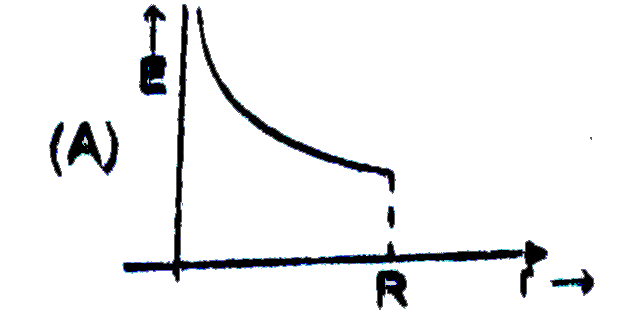
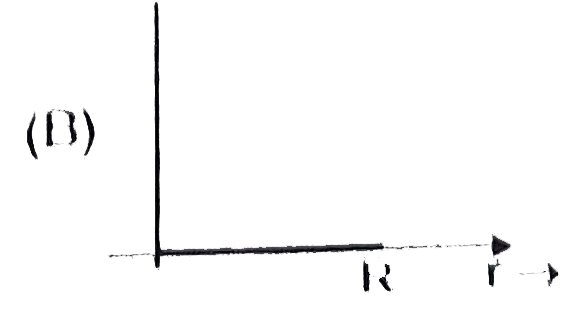
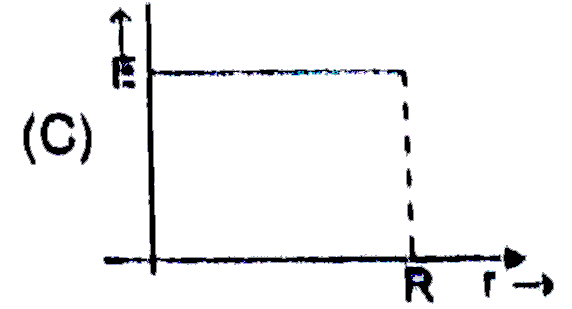
A body is moving in a straight line under the influence of a surce of constant power which supplies its energy continuously. Which of the above graphs shown between displacement 's' and time 'shows the true relation for its motion ? |
|
Answer»
impliesFS=Pt or `FS prop t` …(i) Now `1/2at^2=S` `IMPLIES a prop (S)/(t^2)` Since F=ma `implies F prop implies F prop (S)/(t^2)` `:.` (i) GIVES `(S)/(t^2).S prop t` `implies S^2 prop t^3implies S prop t^(3/2)` THUS DISPLACEMENT `prop (t)^(3/4)` |
|
| 28. |
A stationary wave is given by y = 5 sin (pi x)/(3) cos 40 pi twhere x and y are in cm and t is in seconds What is the distance between two successive nodes |
|
Answer» 0.01m |
|
| 29. |
A particle in a circular path of radius r,it's angular momtntum is L. The centripetal force acting on the particle is |
|
Answer» `(L^3)/(mr^3)` |
|
| 30. |
A stationary wave is given by y = 5 sin (pi x)/(3) cos 40 pi twhere x and y are in cm and t is in seconds What is the velocity of a particle of the string at the position x = 1.5 cm when t = 9/8 s |
| Answer» Answer :A | |
| 31. |
Four rods are joined together to form a structure like alphabet M as showm in the figure.AB=a, AE=a, BX=CX=a//2Mass per unit length of the rod is lambda. The letter made of four rods is rotated about point C by 90^(@). Total shift in the position of centre of mass will be : |
|
Answer» `(a)/(4)[2+sqrt(2)]` |
|
| 32. |
Caught by surprise near a supernova, you race away from the explosion in your spaceship, hoping to outrun the high-speed material ejected toward you. Your Lorentz factor gamma relative to the inertial reference frame of the local stars is 22.4. How long does that trip take according to you (in your reference frame)? |
|
Answer» Solution :KEY IDEAS 1. We now want the time interval measured in a different REFERENCE frame- namely, yours. Thus, we need to TRANSFORM the data given in the reference frame of the stars to your frame. 2. The given path length of `9.00xx10^(16)`m, measured in the reference the two ends of the path are at rest in that frame. As observed from your reference frame, the stars. reference frame and those two ends of the path race past you at a relative speed of `v~~c`. 3. You measure a CONTRACTED length `L_(0)//gamma` for the path, not the proper length `L_(0)`. Calculations: We can now rewrite Eq. 36-19 as (time interval relative to you) `=("distance relative to you")/(c )=(L_(0)//gamma)/(c )`. Substituting known data, we find (time interval relative to you)`=((9.00xx10^(16)m)//22.4)/(299 792 458 m//s)` `=1.340xx10^(7)s=0.425y`. In part (a) we found that the flight takes 9.51 y in the reference frame of the stars. However, here we find that it takes only 0.425 y in your frame, due to the relative motion and the resulting contracted lengthof the path. |
|
| 33. |
Caught by surprise near a supernova, you race away from the explosion in your spaceship, hoping to outrun the high-speed material ejected toward you. Your Lorentz factor gamma relative to the inertial reference frame of the local stars is 22.4. To reach a safe distance, you figure you need to cover 9.00xx10^(16)m as measured in the reference frame of the local stars. How long will the flight take, as measured in that frame? |
|
Answer» Solution :KEY IDEAS From Chapter 2, for constant speed, we know that speed `=("distance")/("time interval")"" `(36-19) Form Fig. 36-8, we see that because your Lorentz factor `gamma` relative to the stars is 22.4 (large), your relative speed v is almostc - so close that we can APPROXIMATE it as c. Then for speed `v~~c`, we must be careful that the distance and the time interval in Eq. 36-19 are measured in the same reference frame. Calculations: The given distance `(9.00xx10^(16)m)` for the LENGTH of your travel path is measured in the reference frame of the stars, and the requested time interval `DELTAT` is to be measured in that same frame. Thus, we can write (time interval relative to stars)`=("distance relative to stars")/(c )`. Then substituting the given distance, we find that (time interval relative to stars) `=(9.00xx10^(16)m)/(299 792 458m//s)` `=3.00xx10^(8)s=9.51y`. |
|
| 34. |
A stationary wave is given by y = 5 sin (pi x)/(3) cos 40 pi twhere x and y are in cm and t is in seconds What are the amplitude and velocity of the component waves whose superposition can give this vibration |
|
Answer» `2.5 cm, 1.2 MS^(-1)` |
|
| 35. |
An n-type semiconductors has 4 xx 10^(-3)m width, 25 xx 10^(-5)m thickness and 6 xx 10^(-2) m length. 4.8 mA current is flowing through it. Here voltage is applied parallel to the length of the semiconductor. Calculate the current density. The density of the free electron is equal to 10^(22) m^(-3) .What will be the time taken by the electron across the length of the semiconductor ? |
Answer» Solution :l = 6 `xx 10^(-2) m , b = 4 xx 10^(-3 ) m`  h = 25 ` xx 10^(-5) ` m I = `4.8 xx 10^(-3) ` A n= `10^(22) (1)/(m^(3))` J = ? , t = ? Voltage is applied parallel to length, so area is obtained by taking product of breaths and thickness. Area of cross section of conductor, `thereforeA = b xx h ` ` = 4 xx 10^(-3) xx 25 xx 10^(-5)` ` A = 10^(-6) m^(2) ` Current density j = `(I)/(A) = (4.8 xx 10^(-3))/(10^(-6))` `therefore J = 4.8 xx 10^(3) (A)/(m^(2))` Now, I = nAve.... (1) But, suppose time TAKEN by electron to cover distance l is t s., `therefore v = (I)/(t) "" `.... (2) ` therefore I = nA [ (l)/(t) ] e""` [ from equ. (1) and (2) ] ` therefore t = ("nAle")/(l)` ` therefore t = (10^(22) xx 10^(-6) xx 6 xx 10^(-2)xx 1.6 xx 10^(-19))/( 4.8 xx 10^(-3))` `therefore t = 2 xx 10^(-2) ` s |
|
| 36. |
A cylindrical capacitor consists of _____ coaxial cylindrical shells separated by a dielectric between them. |
|
Answer» |
|
| 37. |
Represent EM waves propagating along the x-axis in which electric and magnetic fields are along y-axis and z-axis respectively |
Answer» SOLUTION :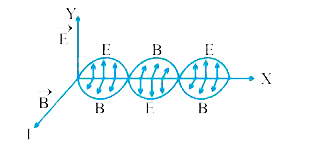
|
|
| 38. |
When light of wavelength 2200 Å falls on Cu, photo electrons are emitted from it. Find (i) the threshold wavelength and (ii) the stopping potential. Given : the work function for Cu is phi_(0) = 4.7 eV. |
|
Answer» Solution :(i) The threshold wavelength is given by `lambda_(0) = (hc)/(phi_(0)) = (6.626 xx 10^(-43) xx 3 xx 10^(8))/(4.7 xx 1.6 xx 10^(-19)) = 2643 Å` (II) ENERGY of the photon of wavelength 2200 `Å` is `E = (hc)/(lambda) = (6.626 xx 10^(-34) xx 3 xx 10^(8))/(2200 xx 10^(-10))` `= 9.035 xx 10^(-19)` J = 5.65 eV We know that kinetic energy of fastest photo ELECTRON is `K_(MAX) = h upsilon - phi_(0) = 5.65 - 4.7 = 0.95 eV` From equation, `K_(max) = eV_(0)` `V_(0) = (K_(max))/(e) = (0.95 xx 1.6 xx 10^(-19))/(1.6 xx 10^(-19))` Therefore, stopping potential = 0.95 V |
|
| 39. |
Show that in problem 3 the potential of the second conductor of the second capacitor is Q//3C. |
|
Answer» |
|
| 40. |
A particle of mass m is projected with a velocity v making an angle of 45° with the horizontal. The magnitude of the angular momentum of the projectile about the point of projection, when the particle is at its maximum height h, is |
|
Answer» zero Height of a projectile= h  `thereforeh=(V^(2)sin^(2)theta)/(2g)=(v^(2)xxsin^(2)45^(@))/(2g)=(v^(2))/(4g)` ….(i) At maximum height, the velocity of projectile `vcostheta=vcos45^(@)=v/(sqrt2)` `therefore` Momentum at highest point `=(mv)/(sqrt2)` `therefore` Moment of momentum about point O`=(mv)/(sqrt2)xxh` `therefore` Angular momentum about O =`(mvh)/(sqrt2)` `thereforeL=(mvh)/(sqrt2)` ...(II) Put h from (i) in (ii), we get, `L=(mv)/(sqrt2)XX((v^(2))/(4g))=(mv^(3))/(4sqrt2g)` ...(iii) From (i), eliminate v in (iii) Angular momentum `=(mv^(3))/(4sqrt2g)=(mxx(4gh)^(3//2))/(4sqrt2g)` or `L=msqrt(2gh^(3))` ...(iv) Options (b, d) REPRESENT the ANSWERS. |
|
| 41. |
A horizontal ray is incident on a right-angled prism with prism angle of 4o. If the refractive index of material of the prism is 1.5, angle of emergence is .......... . Use the given figure. |
|
Answer» SOLUTION :`i=0,A=4^@,mu=1.5,e=?` For SMALL angle of PRISM `delta=A(mu-1)=4(1.5-1)=2` Now,`i+e=A+delta impliesi=A+delta+e` `=4+2+0=6^@` |
|
| 42. |
A machine gun of mass 15 kg fires 30g bullets at the rate of 5 bullets per second with a velocity of 500 m/s. What force in newton's must be applied to the gun to hold in position ? |
|
Answer» 60 N |
|
| 43. |
A thin prism of angle 5^(@) is placed at a distance of 10 cm from the object. What is distance of image from the object ? |
|
Answer» 0.25 cm  DISTANCE of image from the OBJECT is `OI = OE XX D = u xx (mu - 1) A` `therefore OI = 10 (1.5 - 1) xx (pi xx 5)/(180^(@)) = 0.43cm` |
|
| 44. |
A proton and an a-particle have the same de-Broglie wavelength. Determine the ratio of their speeds. |
| Answer» SOLUTION :. | |
| 45. |
A circular coil is made from a wire of length 2m. Its radius is 4/pi cm. When a current of 1A passes through it, it’s magnetic moment is |
|
Answer» `PIAM^(2)` |
|
| 46. |
Suppose the circuit inhas a resistance of 15 W. Obtain the average power transferred to each element of the circuit, and the total power absorbed. |
|
Answer» Solution :We known that, `I_(rms) = ( V_(rms))/(|Z|)` `= (V_(rms))/( sqrt( R^(2) + ( X_(L ) - X_(C))^(2)))` `= ( V_(rms))/( sqrt( R^(2) +( 2pi fL - ( 1)/( 2pi fC))^(2)))` `= ( 230)/(sqrt( (15)^(2) + ( 2 XX 3.14 xx 50 xx 80 xx 10^(-3) - ( 1)/( 2 xx 3.14 xx 50 xx 60 xx 10^(-6)))^(2)))` `:. I_(rms) = 7.256A` (i) Average power transferred to resistor, `P _(R ) = I_(rms)^(2) R ` `= ( 7.256)^(2) ( 15)` `= 789.7 W` (Watt) (ii) Average power transferred to an inductor, `P_(L) = 0 ``( :. phi = ( pi )/(2) rad )` (iii) Average power transferred to a capacitor, `P_(C )= 0( :. phi= - (pi)/(2) rad)` `rArr` Total power absorbed (or consumed ) by the circuit, `P = P_(R ) + P_(L) + P_(C 0` `= P_(R ) + 0+0` `= P_(R 0` `= 789.7 W` |
|
| 47. |
Demonstrate that the binding energy of a nucleus with mass number A and charge Z can be found from Eq.(6.6b). |
|
Answer» Solution :From the BASIC formula `E_(b)=Z_(mH)+(A-Z)m_(n)-M` We define `Delta_(H)=m_(H)-1 am U` `Delta_(n)=m_(n)-1 am u` `Delta=M-A am u` Then clearly `E_(b)=Zdelta_(H)+(A-Z)Delta_(n)-Delta` |
|
| 48. |
Why are alkali metal most suited for photoelectric emission? |
| Answer» Solution :The work FUNCTION of alkali metal is QUITE LOW and also its threshold energyis ALMOST equal to that of photons of visible light. For this reason alkali METALS are most suited for photoelectric emission. | |
| 49. |
An AM wave is given by v=15[1+0.5sin1256t]sin(5.26xx10^(5)t). The modulating frequency is |
|
Answer» `2.0` KHZ |
|