Saved Bookmarks
This section includes 7 InterviewSolutions, each offering curated multiple-choice questions to sharpen your Current Affairs knowledge and support exam preparation. Choose a topic below to get started.
| 1. |
A transverse wave is represented by the equation y = y_(0) sin" " (2pi)/(lambda)(vt - x). For what value of lambda is the maximumparticle velocity equal to two times the wave velocity ? |
|
Answer» `lambda = y_(0)` /2 `(DY)/(dt)= y_(0) COS" " (2pi)/(lambda) (vt - x) [ (2pi)/(lambda) . V ]` For `(dy)/(dt ) ` to be maximum , cos `(2pi)/(lambda)` (vt - x) = 1. `therefore ((dy)/(dt))_("max") = y_(0) . (2pi)/(lambda) .v ` since `v_(max) = 2v rArr y_(0) . (2pi)/(lambda). v = 2 v ` `rArr "" lambda = pi y_(0) ` |
|
| 2. |
In a cylindrical metallic vessel some water is taken and is put on a burner. The bottom surface area of the vessel is 2.5 xx 10^(-3)m^(2)and thickness 10^(-3)m. The thermal conductivity of the metal of vessel is 50 W//m^(@)C. When water boils, it is observed that 100 gm water is vaporized per minute. Calculate the temperature of the bottom surface of the vessel. Given that the latent heat of vaporization of water is 2.26 xx 10^(6)J//kg. |
|
Answer» |
|
| 3. |
When oversetto(dB) is maxm and when it is minimum ? |
| Answer» SOLUTION :`theta=90^@,theta=0^@` | |
| 4. |
The flux linked per each turn of coil of 5xx 10^3 turns changes from 0.4 xx 10^(-3) Wb to 0.6 xx 10^(-3) Wb in 0.2 sec. If the total resistance of circuit including the coil is 20 Omega , find the change induced charge in coil. |
|
Answer» 0.01 m C `phi_1=0.4xx10^(-3)` Wb `phi_2=0.6xx10^(-3)` Wb `R=20 Omega` `RARR` Induced emf in coil `Q=(N(phi_2-phi_1))/R` `=(5xx10^3xx(0.6xx10^(-3)-0.4xx10^(-3)))/20` `=(5xx10^(-3)xx2xx10^(-3))/20` `therefore` Q=0.05 C |
|
| 5. |
Light of wavelength 6000 overset(@)A is used to obtain interference fringe of width 6 mm in a young's double slit experiment. Calculate the wavelength of light required to obtain fringe of width 4 mm if the distance between the screen and slits is reduced to half of its initial value. |
|
Answer» SOLUTION :`beta=(lambdaD)/d` `beta_1=(lambda_1D_1)/d beta_2=(lambda_2D_2)/d` `beta_1/beta_2=(lambda_1D_1)/(lambda_2D_2)` Substitution and simplification : Arriving upto `lambda^2` = 8000 Å Given, `lambda=6800xx10^(-10)m = 6xx10^(-7)` m `lambda.`=? `beta=6xx10^(-3)m , beta.=4xx10^(-3)m` D.=D/2 `rArr` fringe width , `beta=(lambdaD)/d` Hence, `(beta.)/beta=(lambda.D.)/d xx d/(lambdaD)` i.e., `(beta.)/beta=(lambda.D.)/d xx d/(lambdaD)` `therefore beta.=(lambda.beta)/(2lambda)` or `lambda.=(2lambdabeta.)/beta` i.e., `lambda.=(2xx6xx10^(-7)xx4xx10^(-3))/(6xx10^(-3))` i.e., `lambda=8xx10^(-7)` m or `lambda.`=800 Å Thewavelength required to produce FRINGES of width 4 mm is 8000 Å. |
|
| 6. |
For which position of the object magnification of convex lens is -1 (minus one) ? |
| Answer» SOLUTION :TWICE or DOUBLE the FOCAL LENGTH from lens. | |
| 7. |
An electron emitted by a heated cathode and accelerated through a potential difference of 2.0 Kv, enters a region with uniform magnetic field of 0.15 T. Determine the trajectory of the electron if the field (a) is transverse to its initial velocity , (b) makes an angle of 30^@ with the intial velocity . |
|
Answer» SOLUTION :v=2.0 kV `= 2.0 xx 10^3 v, B = 0.15 T` `KE = eV = 1/2 mv^2 "" THEREFORE v = sqrt(2eV)/(m)` `v= sqrt(2xx 1.6 xx 10^(-19) xx 2 xx 10^3)/(9 xx10^(-31)) = sqrt((2 xx 1.6 xx 2 xx 10^(15))= 8/3 xx 10^7 ms^(-1)` `(mv^2)/(Bq)=(9 xx 10^(-31) xx 8 xx 10^7)/(3 xx 0.15 xx 1.6 xx 10^(-19)) = 1 ` mm (TRANSVERSE) b . r=0.5 mm inclined through `30^@` with B . Here v `sin theta` component is `_|_ = 2.3 xx 10^7 ms^(-1)` |
|
| 8. |
The current in coil of self inductance 5 mH changes from 2.5 A to 2.0 A is 0.01 second. Calculate the value of self induced e.m.f. |
|
Answer» Solution :`E=-L*(dI)/(dt) or |E|=L*(dI)/(dt)` CALCULATION of SELF INDUCED e.f.m. `E=|E|=0.25V` Detailed Answer: Inductance of the coil `L=5xx10^(-3)H` Initial current in the coil `=2.5A` FINAL current in the coil `=2.0A` Change in current `dI=2.0-2.5=-0.5A` Time taken for the change, `dt=0.01` `E=-L(dI)/(dt)=(-5xx10^(-3)(-0.5))/(0.01)=0.25V` |
|
| 9. |
In question number 45, what will be the electric field at centre O, if the charge from one of the corners (say A) is removed? |
|
Answer» `q/(4piepsilon_(0)R^(2))` ALONG OA |
|
| 10. |
Distinguish between conductors, insulators and semiconductors on the basis of band theory. |
Answer» Solution : OR CONDUCTORS: In conductors, valence band and conduction BANDS are overlapped. Semiconductors : Semiconductors, the valence band and conduction bands are separated by small ENERGY gap. INSULATORS: In insulators, the valence band and conduction bands are separated by LARGE energy gap |
|
| 11. |
In the above question the radiation force on the mirror will be |
|
Answer» `6.4xx10^(-7)N` |
|
| 12. |
Match the List-I with List-II (O is the point object shown in diagram) |
|
Answer» `{:(P,Q,R,S),(3,1,4,2):}` 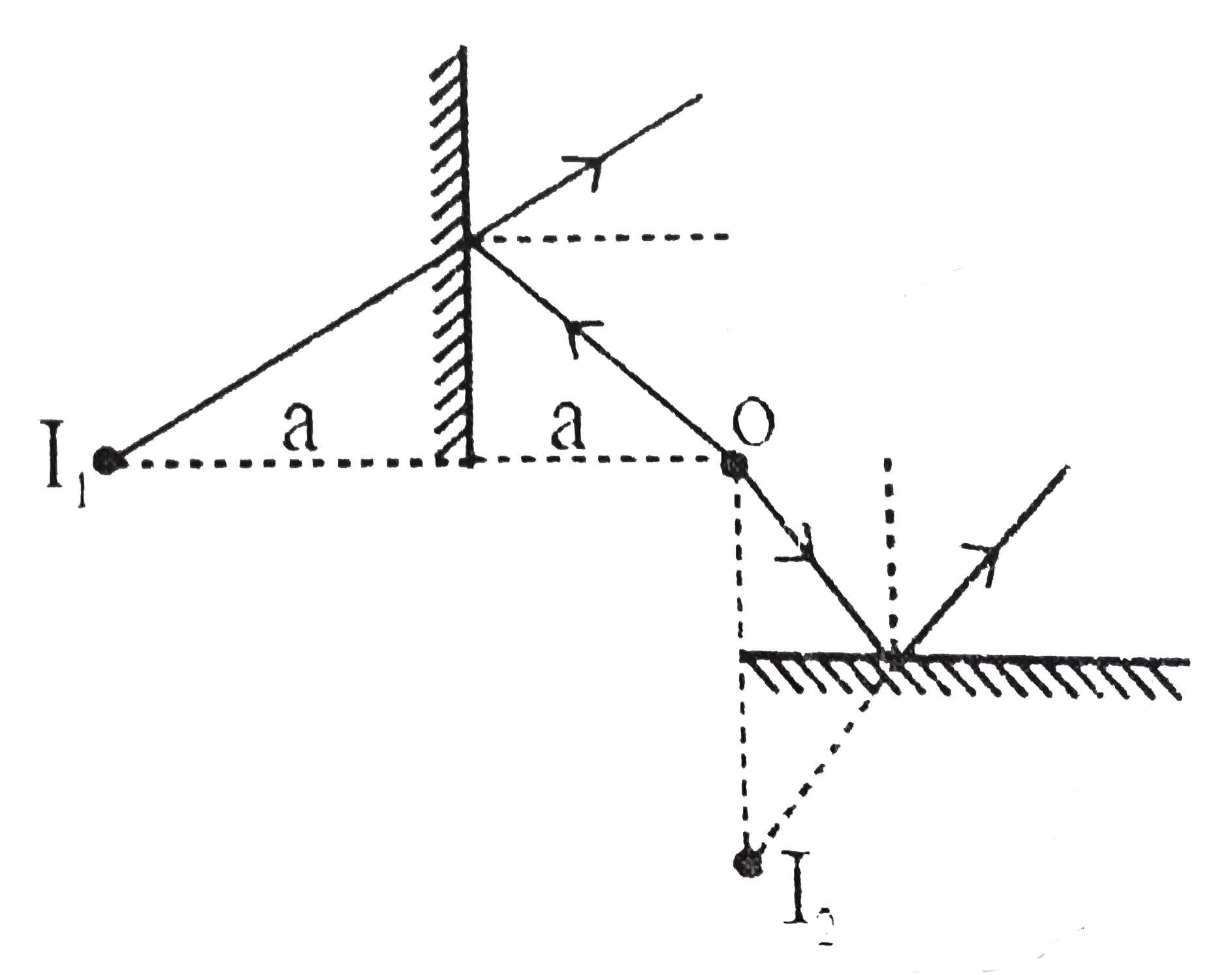 (Q) Let angle of incidence is `theta` Velocity of object `v_(0)=0` velocity of mirror `v_(m) =-v_(i)` velocity of object w.r.t. mirror `v_(om)=v_(o)-v_(m)=+vi` `v_(IM) = v_(I)-v_(m)` or `v_(I) =v_(IM)+v_(m)` `V_(IM) = -vcos2theta HAT(i) - vsin 2thet hat(j)` `v_(I)=(-vcos2theta-v)hat(i)-v sin 2theta hat(j)` `theta =30^(0),v =sqrt(3)m//s` `|v_(I)|=3 m//s` (R) Let angle of incidence is `theta` `r_(I)=(-xcos2theta)hat(i)+(-x sin 2 theta)hat(j)` `(d)/(dt)(r_(I))=V_(I),(d theta)/(dt)=omega` `v_(1)=[-x xx(-SIN2 theta)xx2.(d theta)/(dt)hat(i)]-x.cos2 theta xx2.(d theta)/(dt)hat(j)` `V_(I)=2omegax sin 2 theta hat(i) - 2 omega x cos 2 theta hat(j) ` Put the values. `|V_(I)|=2m//s` (S) Let angle of incidence is `theta` Position vector of image `=r_(I)=(-x cos 2theta hat(i))+(-x sin 2 theta)hat(j)` `(d)/(dt)(r_(I))=v_(I),(DX)/(dt)=v, (d theta)/(dt)=omega` `(d)/(dt)(r_(I))=[(-dx)/(dt). cos2 theta-x(-sin2 theta).2(d theta)/(dt)]hat(i)` `+[((-dx)/(dt))sin 2 theta-x.cos2 theta xx2.(d theta)/(dt)]hat(j)` `V_(I)=[-Vcos2 theta+2omegax sin 2 theta]hat(i)+[-V sin 2 theta-2omega x cos 2 theta]hat(j)` Put the values of `theta, omega` & v `|V_(I)|=a=(31)/(9)cm//s` |
|
| 13. |
An air conditioner connected to a 125 V rms ac line is equivalent to a 9.20 Omega resistance and a 4.70 Omegainductive reactance in series. Calculate (a) the impedance of the air conditioner and (b) the average rate at which energy is supplied to the appliance. |
|
Answer» |
|
| 15. |
An interference is observed due to two coherent sources S_1placed at origin and S_2placed at (0,3lamda,0). Here lamdais the wavelength of the sources. A detector Dis moved along the positive X-axis. Find x-coordinates (excluding x = 0 and x = oo) where maximum intensity is observed. |
|
Answer» <P> Solution :At x = 0, path difference is `3lamda` . Hence, third order maxima will be obtained. At x = `oo` , path difference is zero. Hence, zero order maxima is obtained. In between, first and second order maximas will be obtained. First order maxima: ` S_1P - S_1P = LAMDA " or "sqrt(x^2 + 9 lamda^2) - x = lamda ` or`sqrt(x^2 + 9 lamda^2) = x +lamda`Squaring both SIDES, we get `x^2 = 9lamdaa^2 = x^2 + lamda^2 + 2x lamda`SOLVING this, we get `x = 4 lamda` Second order maxima: `S_2 P - S_1 P = 2 lamda` or`sqrt(x^2 + 9 lamda^2) - x = 2 lamda " or" sqrt(x^2 + 9 lamda^2) = (x + 2 lamda)` Squaring both sides, we get ` x^2 + 9 lamda^2 =x^2 +4 lamda^2 + 4X lamda` Solving, we get` x = 5/4 lamda = 1.25 lamda` Hence, the desired x coordinates are, `x = 1.25 lamda` and x = `4 lamda` |
|
| 16. |
Four charges are arranged at the corners of the square PQRS of side a as shown in the figure . (a) Find the work required to assemble these charges in the given configuration . (b) Suppose a charge q is brought to the center of the square by keeping the four charges fixed at the corners how much extra work is required for this ? |
|
Answer» SOLUTION :(a) The work done to arrange the charges in the corners of the square is independent of the way they are arranged . We can FOLLOW any order. (i) First the charge +q is brought to the corner P . This requires no work since no charge is already present `W_(p)` = 0 (ii) Work required to bring the charge `-q` to the corner Q `=(-q)xx` potential at a point Q due to `+q` located at a point P . `W_(Q)=-qxx(1)/(4piepsilon_(0))(q)/(q)=-(1)/(4piepsilon_(0)) (q^(2))/(a)` (iii) Work required tpo bring the charge +q to the corner R q`xx` potential at the point R due to charges at the point P and Q . `W_(r)=qxx(1)/(4piepsilon_(0))(-(q)/(a)+(q)/(sqrt(2a)))=(1)/(4piepsilon_(0))(q^(2))/(a)(-1+(1)/(sqrt(2)))` (iv) Work required to bring the fourth charge -q at the position S = q`xx` potential at the point S due the all the three charges at the three charges at the point P,Q and R . `W_(s)=-qxx(1)/(4piepsilon_(0))((q)/(a)+(q)/(a)-(q)/(sqrt(a)))=-(1)/(4piepsilon)(q)/(a)(2-(1)/(sqrt(2)))` (b) Work required to bring the charge q to the center of the square =q `xx` potential at the center point O due to tall the four charges in the four corners . The potential created by the two +q charges are canceled by the potential created by the -q charges which are located in the opposite corners . Therefore the NET electric potential at the center O due to all the charges in the corners is zero . Hence no work no work is required to bring any charge to the point O . Physically this implies that if any charge q when brought close to O then it moves to the point O without any external force. |
|
| 17. |
Consider a tightly wound 200 turn coil of radius 20 cm, carrying a current of 1A. What is the magnitude of the magnetic field at the centre of the coil ? |
|
Answer»
`B=(mu_(0)id)/(2piR^(2)),dleRandB=(mu_(0)i)/(2pid),dgtR` |
|
| 18. |
Assuming air (M = 29 kg/mole) to be composed mainly of oxygen and nitrogen, find the percentage composition of these gases in the atmosphere. |
|
Answer» Solution :Using Dalton.s law one can EASILY obtain the equation`m/M = (m_1)/(M_t) - (m_2)/(M_2)`On the other hand, the mass of a gas is the sum of the MASSES of its COMPONENTS: `m = m_1 + m_2`. Putting `x = m_1//m_2, y = m_2//m_1` we obtain a system of TWO equations: `1/M = x/(M_1) + y/(M_2) , 1 = x + y` Solving this system we find the percentage composition of the gases. |
|
| 19. |
The photoelectric threshold wavelength for silver is lamda_(0). The energy of the electron ejected from the surface of silver by an incident wavelength lamda(lamdaltlamda_(0)) will be |
|
Answer» `hc(lamda_(0)-lamda)` |
|
| 20. |
Thehalf life of a radioactive substance is 20s, the time taken for the sample to decay by 7//8^(th) of its initial value is |
|
Answer» 20 s `=(1/2)^3=1/8` `therefore ` Time TAKEN for the sample to DECAY by `(1-1//8)^(th)` or `7^(th)/8` of initial value. `=3T_(1//2)=3xx20`=60 s |
|
| 21. |
At Curie point, a ferromagnetic material becomes ............ . |
|
Answer» |
|
| 22. |
The total energy (E) of the electron is an orbit of radius r in hydrogen atom is |
|
Answer» `e^2/(8πepsilon_0r)` |
|
| 23. |
a. When monochromatic light is incident on a surface separating two media, the reflected and refracted light both have the same frequency as the incident frequency. Explain why. b. When light travels from a rarer to a denser medium, the speed decreases. Does the reduction in speed imply a reduction in energy carried by the light wave? c. In the wave picture of light, intensity of light is determined by the square of the amplitude of the wave. What determine the intensity of light in the photon picture of light? |
|
Answer» Solution :a. Reflection and refraction arise through interacion of incident light with the atomic conistituents of matter. ATOMS may be viewed as OSCILLATORS,which take up the frequency of the external agency (light) CAUSING forced osicllations.The frequency of light EMITTED by acharged oscillator equals its frequency of oscillation. Thus, the frequency of scattered light equals the frequency of incident light. b.No. Energy carried by a wave depends onthe amplitude of the wave, not on the speed of wave propagation. c.For a given frequency, intensity of light in the photon is determined by the number of PHOTONS crossing a unit are a per unit time. |
|
| 24. |
A ring of mass m free to slide on a fixed smooth horizontal rod is attached to a particle of mass M kg by a inextensible string of length l. Initially, both M and m are at rest and the string is vertical. A horizontal velocity v_(0) is imparted to the particle. The maximum height up to which block will rise w.r.t its initial position is (M = 2m) |
|
Answer» `(v_(0)^(2))/(2G)` |
|
| 25. |
An astronomical telescope of ten - fold ungular magnification has a length of 44 cm. The focal length of the objective is |
| Answer» Answer :2 | |
| 26. |
Ram is preparing for IIT JEE. He sets on to tackle a typical problem in mechanics. He sees that the wedge is kept on a smooth ground and it's inclined surface is also smooth. A block is projected on it as shown. Both the block and wedge have equal mass. Can you help him find the answer to following three question? How does the path of block look like as seen from ground. |
|
Answer»
|
|
| 27. |
Ram is preparing for IIT JEE. He sets on to tackle a typical problem in mechanics. He sees that the wedge is kept on a smooth ground and it's inclined surface is also smooth. A block is projected on it as shown. Both the block and wedge have equal mass. Can you help him find the answer to following three question? He sets on to find the maximum height attained by the block, assuming the block does not fall off to the other side. Which of the following equation is correct. |
|
Answer» `mgh=1/2mv_(0)^(2)` (by conservation of energy) where H is maximum HEIGHT of the block. |
|
| 28. |
Ram is preparing for IIT JEE. He sets on to tackle a typical problem in mechanics. He sees that the wedge is kept on a smooth ground and it's inclined surface is also smooth. A block is projected on it as shown. Both the block and wedge have equal mass. Can you help him find the answer to following three question? What is the radius of curvature of it's path at the highest point? |
|
Answer» 0 |
|
| 29. |
The charges and coordinates of two charged particles held fixed in an xy plane are q_(1) = +3.0 mu C, x_(1) = 3.5 cm, y_(1) = 0.50 cm, and q_(2) = -4.0 mu C, x_(2) =-2.0 cm, y_(2) = 1.5 cm. Find the (a) magnitudeand (b) direction of the electrostatic force on particle 1 due to particle 2. At what (c ) x and (d) y coordinates should a third particle of charge q_(3) = +6.0 mu C be placed such that the net electrostatic force on particle 1 due to particles 2 and 3 is zero ? |
| Answer» Solution :(a) 35N, (b) `170^(@)`, (C ) +10 cm, (d) -0.69 cm | |
| 30. |
Explan the apparent height of stars. |
| Answer» SOLUTION :Air is optically denser than vaccum. When stars at vaccum are viewed from the SURFACE of earth, stars appear to be further away, i.e., the apparent HEIGHT of stars is greater than the actual height. | |
| 31. |
Waves from two different sources overlap a particular point. The amplitude and frequency of the two waves are same.The ratio of the intensity when the two waves arrive in phase to that when they arrive 90^(@) out of phase is : |
|
Answer» `1 : 1` `therefore I_(1) = 4a^(2)` When phase difference is `90^(@)`, resultant amplitude ` = [a^(2) + a^(2)]^(1/2) = sqrt 2a` `therefore I_(2) = 2a^(2)` `RIGHTARROW (I_(1))/(I_(2)) = (4a^(2))/(2a^(2)) = 2/1` |
|
| 32. |
How many number of turns of nichrome wire of specific resistance 10^(-6)Omegam and diameter 2mm that should be wound on a cylinder of diameter 5cm to obtain a resistance of ? |
|
Answer» Solution :If R is the radius of the CYLINDER r is the radius of the wire and N is the number of turns `"then"R.=(rhol)/(A)""THEREFORE""R.=(rho(2piR)N)/(pir^(2))` `40=(10^(-6)(2xx2.5xx10^(-2)xxN))/(1XX10^(-6)) therefore N=800` |
|
| 33. |
A thin metal plate is inserted half way between the plates of a parallel plate capacitor of capacitance C in such a way that it is parallel to the two plates. The capacitance now becomes : |
|
Answer» C |
|
| 34. |
If the potential energy of a harmonic oscillator in its resting position is 500ergand total energy is 1500 erg when the amplitude is 5 cm whatis the force constant if its mass is 200 gm ? |
|
Answer» 40 dyne/CM `2000=k xx25` `k=80("DYNES.")/("cm")` CORRECT choice is ( c ). |
|
| 35. |
(A): Electric and gravitational fields are acting along same line. When proton and alpha-particle are projected up vertically along that line, the time of flight is less for proton. (R ): In the given electric field acceleration of a charged particle is directly proportional to specific charge |
|
Answer» Both .A. and .R. are TRUE and .R. is the CORRECT explanation of .A. |
|
| 36. |
The voltage between the plates of a parallel plate capacitor of capacitance 1.0 mu F is changing at the rate of 5 V s^(-1). What is the displacement current in the capacitance ? |
| Answer» SOLUTION :`5mu A` | |
| 37. |
According to Bohr model, energy of electron in n^(th) orbit is ...... Z = atomic number. |
|
Answer» `E_(n)prop(n^(2))/(Z^(2))` `E_(n)=(mZ^(2)e^(4))/(8in_(0)^(2)h^(2)n^(2)),(me^(4))/(8in_(0)^(2)h^(2))=` CONSTANT |
|
| 38. |
The conductivity of semi conductors like Si or Ge |
|
Answer» Increases when it is doped with tetravalent IMPURITY |
|
| 39. |
वैद्युत क्षेत्र vecE में vecP आघूर्ण वाले द्विध्रुव पर लगने वाला बल-आघूर्ण है: |
|
Answer» `vecP.vecE` |
|
| 40. |
A small ball of mass 100 g is attached to a light and inextensible string of length 50 cm. The string is tied to a support O and the mass m released from point A which is a' a horizontal distance of 30cm from the support. Calculate the speed of the ball is its lowest point of the trajectory. |
|
Answer» Solution :`mgxx0.4=(1)/(2)MV^(2)` `V=2sqrt(2)m//s` (from conservation of mechanical energy just before the string BECOMES taut during the APPLICATION of impulse, VELOCITY along perpendicular to the string remain same. So after impulse velocity of the ball equal to `(6sqrt(2))/(5)m//s` again from conservation of mechanical energy `(1)/(2)m((6sqrt(2))/(5))^(2)+mg(0.1)=(1)/(2)mv_(f)^(2)` Now velocity at the bottommost point `v_("final")=2.2m//s` |
|
| 41. |
At a frequency omega_(0) the reactance of a certain capacitor equals that of a certain inductor. If frequency is changed to 2omega_(0). The ratio of reactance of the inductor to that of the capacitor is |
|
Answer» `4:1` |
|
| 42. |
Wavelength of an electron accelerated through a potential difference of 1 volt is |
| Answer» Answer :A | |
| 43. |
It is required to convert a galvanometer with a sensitivity of 3.0 xx 10^(-4) A per scale division into a multimeter: a voltmeter for voltages of 10 V, 100 V and 1000 V and an ammeter for currents of 100 mA and 5 A. Draw the circuit diagram and calculate the resistor block. The scale comprises 50 divisions. |
Answer» 
|
|
| 44. |
Consider a p-n junction as a capacitor, formed with p and n - materials acting as thin metal electrodes and depletion layer width acting as separation between them. Basing on this, assume that a n-p-n transistor is working as an amplifier in CE configuration. If C_1and C_2 are the baseemitter and collector-emitter junction capacities then |
|
Answer» `C_1 gtC_2 ` |
|
| 45. |
A disc is rotating with angular speed CD. If a child sits on it, what is conserved |
|
Answer» linear MOMENTUM [`because` angular momentum = moment of inertia `xx` angular velocity] |
|
| 46. |
A gun of mass M fires a bullet of mass m with a velocity v relative to the gun. The average force required to bring the gun to rest in 0.5 sec. is |
|
Answer» `(2 M MV)/(M + m)` |
|
| 47. |
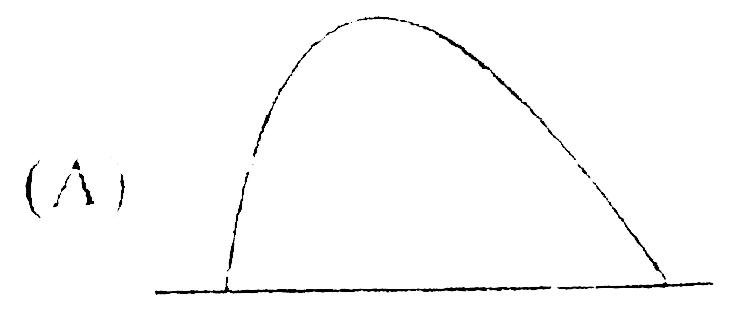
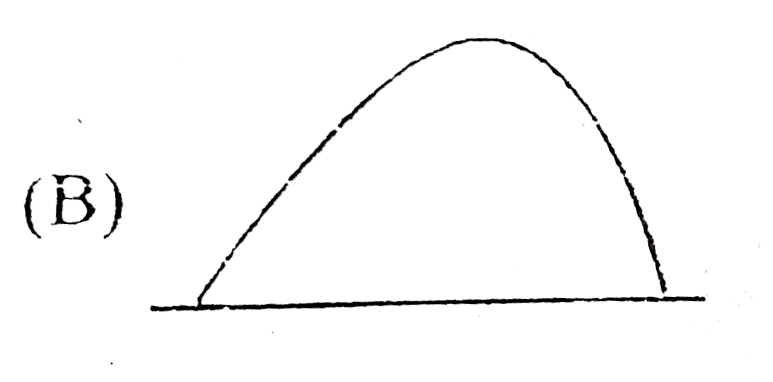
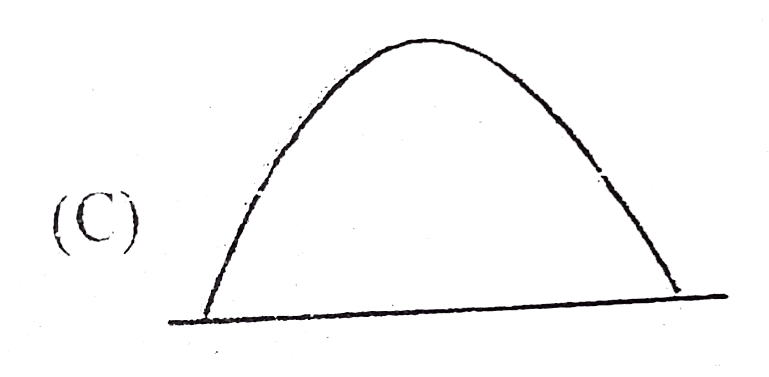
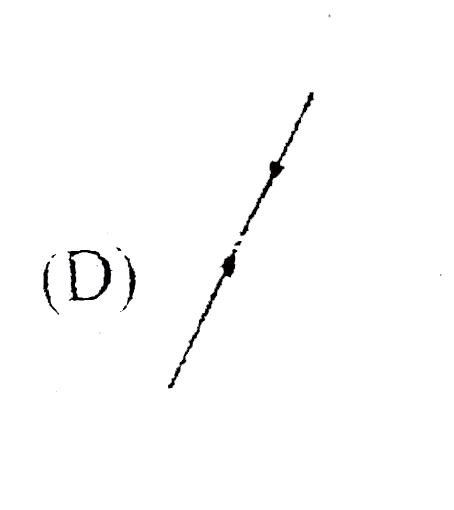
Which of the following figures represents the variation of particle momentum and associated de-Broglie wavelength |
|
Answer»
|
|
| 48. |
In an a.c. circuit containing an inductor of zero resistance, the emf of the applied A.C. voltage leads the current by ……… |
| Answer» Solution :In an A.C. circuit CONTAINING only an inductor emf is ahead by `90^@`phase then the CURRENT. | |
| 49. |
Three identical spheres reach of mass m are placed touching each other on the horizontal surface. what is the position of C.M, of the system? |
|
Answer» R, 2r |
|
| 50. |
The box of a pinhole camera, of length L, has a hole of radius a. It is assumed that when the hole is illuminated by a parallel beam of light of wavelength lambda. The spread of the spot (obtained on the opposite wall of the camera) is the sum of its geometrical spread and the spread due to diffraction. The spot would then have its minimum size (say b_("min")) when : |
|
Answer» `a = (LAMBDA^2)/L and b_("min") = ((2lambda^2)/(L))` `theta = lambda/a` As the beam travels a distance L, it spreads over a linear width, `x = (L lambda)/a` Diameter of the spot , `B = 2A + (2L lambda)/a "" ....(i)` The minimum size of the spot, `(DB)/(da) = 0 "".....(ii)` `1 - (L lambda)/(a^2) = 0` `implies a = sqrt(lambda L)"".....(iii)` Substituting a from equation (iii) in (i) `B = 2 sqrt(lambda L) = (2 L lambda)/(sqrt(lambda L))` `B_("min") = 2 sqrt(lambda L) + 2sqrt(lambda L) = 4sqrt(lambda L)` The radius of the spot, `b_("min") = 1/2(4 sqrt(lambda L)) = sqrt(4 lambda L)` 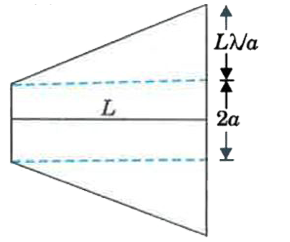
|
|