

Saved Bookmarks
This section includes 7 InterviewSolutions, each offering curated multiple-choice questions to sharpen your Current Affairs knowledge and support exam preparation. Choose a topic below to get started.
| 1. |
Depict the equipotential surfaces for a system of two identicalpositive point charges placed a distance 'd' apart. |
Answer» SOLUTION :Equipotential SURFACES for a system of TWO identical positive point charges (say `q_("each")`) PLACED a distance d apart are shown in Fig.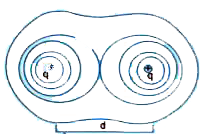
|
|
| 2. |
A coil of self inductance 50 henry is joined to the terminals of a battery of emf 2 volts through a resistance of 10 ohm and a steady current is flowing through the circuit. If the battery is now disconnected, the time in which the current will decay to 1/e of steady value is |
|
Answer» 500s |
|
| 3. |
Consider a block symmetrically attached to two identical massless springs by means of strings passing over light frictionless pulleys as shown. In the equilibrium position extension in the springs is x_(0). Find the time period of small vertically oscillations of the blocks. |
| Answer» SOLUTION :`2PI SQRT((x_(0))/(g COS theta))` | |
| 4. |
Find the potential function V (x,y) of an electrostatic field vec(E)=2axy hat(i)+a(x^(2)-y^(2))hat(j) where a is a constant. |
|
Answer» `v_(0) + AX^(2)y - (AY^(3))/(3)` |
|
| 5. |
The length of the antenna a) limits the frequency of EM waves to be radiated b) makes the users to opt for Higher frequency transmission c) is insignificant during transmission. |
|
Answer» a & B are TRUE |
|
| 6. |
A car moving at a velocity of 17 ms^(-1)towards an approaching bus that blows a horn at a frequency of 640 Hz on a straight track. The frequency of this horn appears to be 680 Hz to the car driver. If the velocity of sound in air is 340 ms^(-1) , then the velocity of the approaching bus is |
|
Answer» `2ms^(-1)` Here, `v. = 600 Hz, v= 640 Hz` `v = 340 ms^(-1)` and `v_(0) = 17 ms^(-1)` `v_(s) = 4MS^(-1)` |
|
| 7. |
(a) (i) Two independent monochromatic sources of light cannot produced a sustained interference pattern'. Give reason. (ii) Light waves each of amplitude ''a'' and frequency ''w'', emanating from two coherent light sources superpose at a point. If the displacements due to these waves is given byy_(3)=a cos omega t and y_(2)=a cos(omega t+phi) where phi is the phase difference between the two, obtain the expression for the resultant intensity at the point. (b) In Young's double slit experiment, using monochromatic light of wavelength lambda, the intensity of light at a point on the screen where path difference is lambda, is K units. Find out the intensity of light at a point where path difference is lambda//3. |
|
Answer» Solution : The resultant displacement will be GIVEN by `y=y_1+y_2` `=a cos omega t + a cos (omega t+phi)` `=a[cos omegat +acos (omegat+phi)]` `=2acos (phi//12)cos (omegat+phi12)` The AMPLITUDE of the resultant displacement is `2A cos (phi//12)` The INTENSITY of light is directly proportional to the square of amplitude of the wave. The resultant, intensity will be given by `I=4a^2` or `a^2=I/4` |
|
| 8. |
The circuit shown in thefigure contains two diodeseach with a forwardresistance of 50 ohm andwith infinite backwardresistance. If the battery voltage is 6 V, the current through the 100 ohm resistance (in ampere) is |
|
Answer» zero `THEREFORE I=6/(50+150+100)=6/300`=0.02 A CURRENT through 100 `Omega` resistance = 0.02 A |
|
| 9. |
When current is passed through the conductor, the compass needle deflects. Why? |
| Answer» Solution : The compass needle is now SUBJECTED to earth.s MAGNETIC field and the magnetic field of the STRAIGHT conductor. | |
| 10. |
A star which can be seen with naked eye fro Earth has intensity 1.6xx10^(-9)Wm^(-2) on Earth.If the corresponding wavelength is 560 nm,and the radius of the lens of human eye is 2.5xx10^(-3)m,the number of photons entering in our eye in 1s is……. |
|
Answer» Solution :`I=1.6x10^(-9)(W)/(m^(2))` `lambda=560 nm=5.6xx10^(-7)m` `r=2.5xx10^(-3)m` t=1s,N=? `I=(E )/(At)=(P)/(A)` `therefore P=IA=I(pir^(2))` `therefore P=(nhc)/(lambda)` `therefore n=(plambda)/(hc)` `=(3.14xx10^(-15)xx5.6xx10^(-7))/(6.62xx10^(-34)xx3xx10^(8))` `therefore n=8.85xx10^(4)~~9xx10^(4)` |
|
| 11. |
(i) How emission spectrum are produced ? |
| Answer» SOLUTION :(i) INCANDESCENT SOLID, LIQUID or GAS. | |
| 12. |
Fig. 9.02(a) and (b), show refraction of a ray in air incident at 60^(@) with the normal to a glass - air and water - air interface, respectively. Predict the angle of refraction in glass when the angle of incidence in water is 45^(@) with the normal to a water - glass interface [Fig. 9.02(c)]. |
|
Answer» Solution :From fig (a) `n_(ga) =(sin 60^(@))/(sin 35^(@)) =0.8660/0.5736 = 1.51` and from fig (b) : `n_(WA) = (sin 60^(@))/(sin 47^(@)) = 0.8660/0.6561 = 1.32` `THEREFORE n_(GW) = n_(ga)/n_(wa) = 1.51/1.32 = 1.144` Now, in fig. ( c) if angle of REFRACTION be r, then `(sin 45^(@))/(sin r) = n_(gw) = 1.144 rArr sin r =(sin 45^(@))/(1.144) = 0.7071/1.144 = 0.6181` and `r = sin^(-1) (0.6181) = 38^(@)` |
|
| 13. |
(a) The blusih colour predominates in clear sky . (b) Voilet colour is seen at the bottom of the spectrum when white light is dispersed by a prism. State resons to explain these observations. |
|
Answer» SOLUTION :(a) Blue colour of sky is due to scattering of sunligh. As blue colour has a SHORTER wavelength than. (B) When a white light is dispersed by a prism, the violet colour DEVIATES through MAXIMUM angle. Hence, it is seen at the bottom of the spectrum. |
|
| 14. |
An aeroplane, with wingspan 60 m, is flying horizonally due north at 900 km/h at a location where the vertical component of the Earth's magnetic field is 20 mu T. The potential difference developed between its wing-tips is |
|
Answer» 0.03 V `=(20xx10^(-6))(60)(250)=3xx10^(5)xx10^(-6)V` `(because 900 km//h)=900xx(5)/(18)=250 m//s).` |
|
| 15. |
In a double-slit experiment the angular width of a fringe is found to be 0.2^(@) on a screen placed 1 m away. The wavelength of light used is 600 nm. What will be the angular width of the fringe if the entire experimental apparatus is immersed in water? Take refractive index of water to be 4/3. |
|
Answer» `0.27^(@)` |
|
| 16. |
A high tension (HT) supply of, say, 6 kV must have a very large internal resistance.Why? |
|
Answer» Solution :Because I =`(EPSILON)/(R + r)` (Where emf `epsilon` is very LARGE for high tension SUPPLY) In case of short circuit, R = 0 and so value of I will be more than current CAPACITY of given circuit which may cause damage. Hence, in this case value of I can be kept smaller than current capacity by keeping large internal resistance. . |
|
| 17. |
A thin rod of 5 cm length is kept along the axis of a concave mirror of 10 cm focal length such that its image is real and magnified and one end touches the rod. Its magnification will be |
|
Answer» 1 |
|
| 18. |
If 10% of a radioactive material decays in 5 days, then amount of original material left after 20 days is approximately : |
|
Answer» 0.6 After 15 days, 10% of 81% decayed then 72.9% left. After 20 days 10% of 72.9% decayed then 65% left. |
|
| 19. |
A 35 mm film is to be projected on a 20 m wide screen situated at a distance of 40 m from the filmprojector. Calculate the distance of the film from the projection lens and focal length of projection lens. |
| Answer» SOLUTION :` U = 7 CM, f~~7 cm` | |
| 20. |
Define the binding energy of a nucleus. |
| Answer» SOLUTION :Amount of energy NEEDED to split up a nucleus into its individual NUCLEONS is called its binding energy. | |
| 21. |
A graph of acceleration versus time of a particle starting from rest at t =0 is shown. The speed of the particle at t=14 second is |
|
Answer» `2 ms^(-1)` `v= (1)/(2) (12+6)4 -(1)/(2)xx2xx2=36-2 = 34 ms^(-1)` Since initial velocity is zero and the GAIN in velocity is `34 ms^(1)`. Therefore, the velocity at 14 second is 34 `ms^(-1).` |
|
| 22. |
The binding energy per nucleon is maximum in case of : |
|
Answer» `_2He^4` |
|
| 23. |
N-type semiconductor is doped with_____impurity in n-type and p-type with_____impurity. |
|
Answer» |
|
| 24. |
Two coherent sources S_(1) and S_(2) are kept on the edges of a step as shown in the figure. An infinitely long screen is placed on the right side of sources and lies at along y-z plane. Calculate total no. of maximas observed on the screen. PS_(1)=8lambda and PS_(2)=6lambda. Where lambda is wavelength of light used. (There is no reflection from steps) |
Answer» SOLUTION :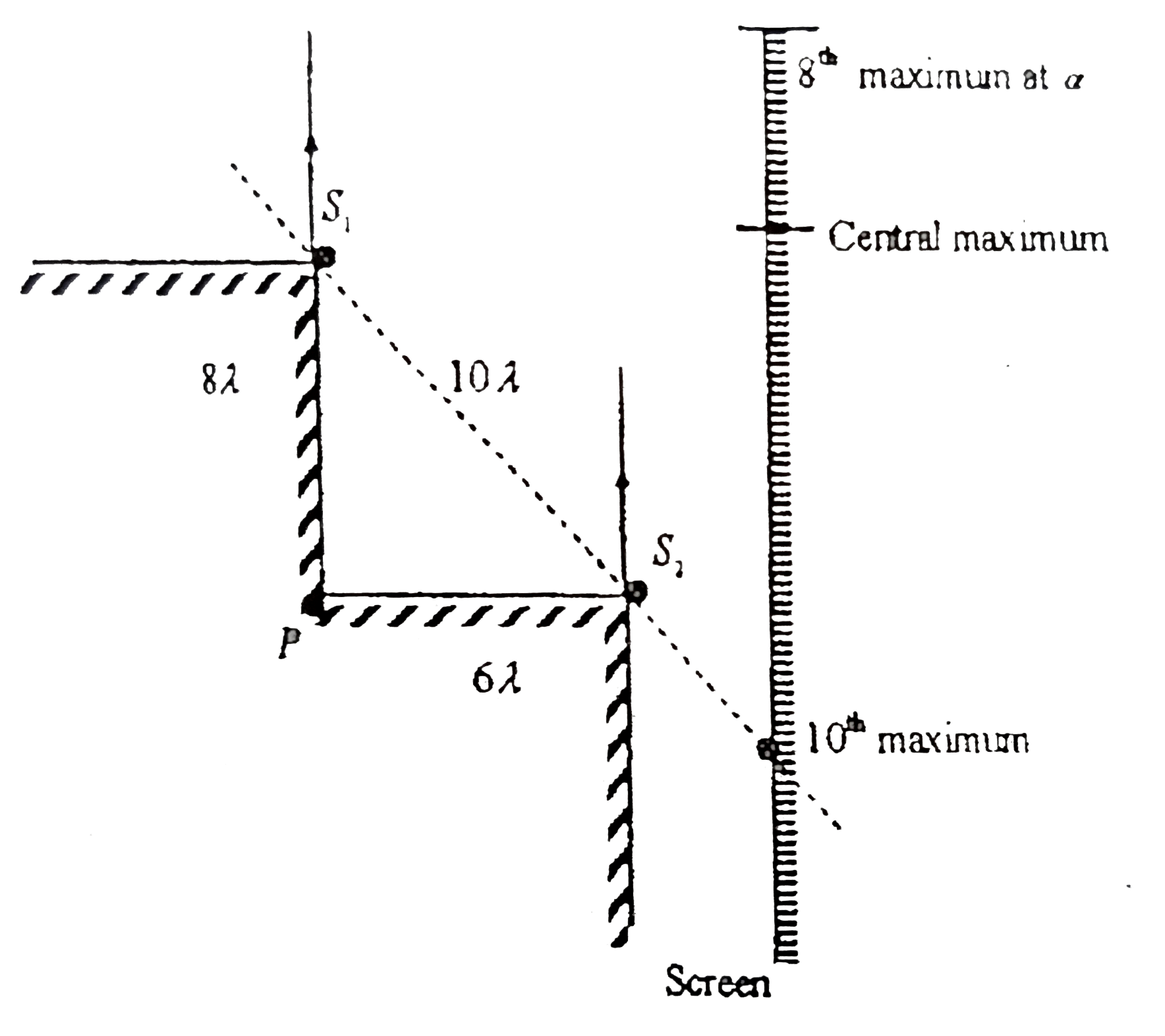
|
|
| 25. |
Using the Hund rules,find the basic terms atom whose paratially filled subshell contains (a) three p electrons, (b) four p electrons. |
|
Answer» Solution :(a) when the partially filled shell contains three `p` electrons, the total spin `S` must equal `S=(1)/(2) or (3)/(2)`. The state `S=(3)/(2)` has maximum spin and is totally symmetric under exchange of spin labels. By Pauli's exclusion principle this implies that the angular part of the wave function a `p` electron is vector of `vec(r)_(1)` the total wavefunction of three `p` electrons is the totally antisymmetric combination of `vev(r )_(1),vec(r )_(2)`, and `vec(r )_(3)`. The only such combination is `vec(r )_(1).(vec(r )_(2)xxvec(r )_(3))=|(x_(1),x_(2),x_(3)),(y_(1),y_(2),y_(3)),(Ƶ_(1),Ƶ_(2),Ƶ_(3))|` This combination is a SCALAR and hence has `L = 0`. The spectral term of the ground state is then `.^(4)S_(3/2)` since `J = (3)/(2)` (b) We can think of four `P` electrons as consisting of a FULL `p` shell with two `p` holes. The state of maximum spin `S` is then `S = 1`. By Pauli's principle the orbital angular momentum part must be antisymmertic and can only have the form `vec(r )_(1)xxvec(r )_(2)` where `vec(r )_(1),vec(r )_(2)` are the coordinates of holes. Four `p` electrons can have `S = 0,1,2` but the `S = 2` state is totally symmetric. The corresponding angular wavefunction must be toatlly atisymmetric. But this is imposible: there is no quantity which is antisymetric in four vectors. Thus the maximum ALLOWED `S is S=1`. We can CONSTRUCT such a state by coupling the spins of electrons 1& 2 to S=1 and of electrons 3 & 4 to S=1 and then coupling the resultant spin states to `S=1`. Such a state is symmetric undr the exchange of spin of 1& 2nd 3 and `4` but antisymmetric under the simultaneous exchange of (1,2) & (3,4). the CONJUGATE angular wavelength must be antisymmetric under the exchange of `(1,2)` and under the exchange of `(1,2)` and `(3,4)`. (This is beacuse two exchange of electrons are involved.) The required angular wavefunction then has the from `(vec(r )_(1))xx(vec(r )_(3)xxvec(r )_(4))` and is a vector, `L=1`. Thus, using also the fact that the shell is more than half full, we find the spectral term `.^(3)P_(2)` `(J=L+S)`. |
|
| 26. |
When a battery is connected to the resistance of 10 Omega the current in the circuit is 0.12 A . The same battery gives 0.07A current with 20 Omega Calculate e.m.f and internal resistance of the battery. |
|
Answer» SOLUTION :We know that E= IR + IR `I_1 r+ I_1 R_1 = I_2 r + I_2 R_2` `impliesI_1 r - R_2 r = I_2 R_2 - I_1 R_1` `r(I_1 - I_2) = I_2 R_2 - I_1 R_1` `impliesr= (I_2 R_2 - I_1 R_1)/(I_1 - I_2)` `r= (0.07xx20- 0.12xx10)/(0.12-0.07)` `=(1.4-12)/(0.05)` `=(0.2)/(0.05) = 4 Omega` INTERNAL resistance `r= 4 Omega` e.m.f `E= I_1 r_1 + I_1 R_1` `0.12xx4 + 0.12xx10= 0.48+1.2` `E= 1.68 ` volt |
|
| 27. |
Consider following statement (A) Work done by pseudo force in non-inertial frame itself cannot be positive (B) Net work done by static friction on the system (consisting surfaces I contact) is always zero (C) Net work done by Kinetic friction on the system (consisting surfaces in contact) may be positive (D) Work done by kinetic friction on a body may be positive Select correct alternative :- |
| Answer» Answer :A | |
| 28. |
A thin wire AC shaped as a semi-circle of diameter d rotates with a constant angular frequency (omega) in a uniform magnetic field of indcution vec(B). The vector vec(omega) is parallel to vec(B) and the rotation axis XY passes through the end A of the wire and is perpendicular to the diameter AC (see Fig.). vec(B) is directed left to right in the plane of the paper. The value of the line intergral I=int vec(E)* d vec(r) taken along the wire form the point A to the point C will be (omega Bd^(2))/(?). What interger should be inserted in place of question mark. |
|
Answer» Hence flux linked=`phi_(B)=B(1/2(AC)^(2)theta)` where `theta` is the angle traced in time t. By Faraday's law, the induced emf `E=oint vec(E)*dvec(L)` But we also have , `oint E*dl = e =-(d phi_(B))/(dt)` `oint E*dr = -(d)/(dt) (1/2 (d)^(2)theta)B` `=-1/2 d^(2)B((d theta)/(dt))=-(B)/(2) omega d^(2)` But we desire only the `int_(C )^(A) E*dr` which will be `1/2` or `oint E*dr`. Hence `oint_(C)^(A) E*dr = -(B)/(2) omega d^(2)`. |
|
| 29. |
Pick the odd one out of the following |
|
Answer» ev |
|
| 30. |
A ray of light of intensity I is incident on a parallel glass slab at a point A as shown.It undergoes partial reflection and refraction. At each reflection 25% of incident energy is reflected. The rays AB and A' B'undergo interference. The ratio I_(max)/I_(min) is : |
|
Answer» ` 4 : 1` LIGHT TRANSMITTED along `AC = (3I)/(4)` then REFLECTED along `CA. = (1)/(4) xx (3I)/(4)= (3I)/(16)` Reflected at A. = `1/4 xx (3I)/(16) = (3I)/(64)` `therefore` Intensity of light transmitted along A.B. is `I_(2) = (3I)/(16) -(3I)/(64) =(9I)/(64)` `therefore (I_(1))/(I_(2)) = (a^(2))/(b^(2)) = (I)/(4) xx (64)/(9I) = (16)/(9)` `therefore (a^(2))/(b^(2)) = (16)/(9)`, so (a)/(b) = 4/3 `(I_(max))/(I_(min)) = ((a + b)^(2))/((a- b)^(2)) = ((4 + 3)/(4 -3))^(2) = (49)/(1)` |
|
| 31. |
In Young's double-slit experiment, light of wavelength 400 nm is used to produce bright fringes of width 0.6 mm at a distance of 2 m. if whole apparatus is immersed in water of refractive index 4/3, then fringe width will be |
|
Answer» 0.6 mm |
|
| 32. |
STATEMENT-1: In the figure shown, the y-component of velocity of m is (u_(1) cos theta_(1)+u_(2)cos theta_(2)) when the string is being pulled with speed u_(1) and u_(2) as shown in the figure. STATEMENT-2: According to parallelogram law of vector addition the sum of two independent vectors is given by the diagonal of the parallelogram if the two vectors are represented by the adjacent sides of the parallelogram. |
|
Answer» Statement-1 is TRUE, Statement-2 is True, Statement-2 is a CORRECT EXPLANATION for statement-1. |
|
| 33. |
Give some important uses of photo-cells. |
|
Answer» Solution :Photo CELLS have many applications, especially as switches and sensors. Automatic lights that TURN on when it gets dark USE photocells, as well as street lights that switch on and off according to whether it is night or day. Photo cells are used for REPRODUCTION of sound in MOTION pictures and are used as timers to measure the speeds of athletes during a race. |
|
| 34. |
In which of the following decay, the element does not change |
| Answer» Answer :D | |
| 35. |
Two point charges +q and -2qare placed at the vertices B and C of an equilateral triangle ABC of side 'a' as shown in Obtain the expression for The magnitude , (b) The direction of the resultant electric field at the vertex A due to these two charges. (c) |
|
Answer» Solution :As shown in electric field at vertex A DUE to charge +q placed at vertex B is ` ""E_B =(1)/( 4 pi in _0) . (q)/( a^(2)) ` along BA and electrical field at vertex A due to CHARGES -2q placed at vertex C is ` "" E_C =(1)/( 4 pi in _0)(2q)/( a^(2)) ` along AC Obviously ` oversetto (E_B) and oversetto (E_C) ` are inclined at an angle ` THETA = 120^(@)` from the another . Hence Magnitude of net electric field at A `"" E= sqrt( E_B^(2) + E_C^(2)+2E_BE_C cos 120 ^(@))= sqrt(E_B^(2) +E_C^(2)-E_B E_C ) ` ` rArr ""E= ( 1)/( 4 pi in _0).(sqrt3q)/( a^(2)) ` (b) If the net electric field `oversetto E ` is directed at angle `beta ` from the direction AC, then ` tan beta = ( E_Bsin 120^(@) )/(E_C+ E_B cos 120 ^(@)) =(E_B.(SQRT3//2))/(E_C-(E_B//2))=(E_B.(sqrt3//2))/(2E_B-(E_B//2))` `rArr "" tan beta = (1)/(sqrt3) or beta= tan ^(-1)((1)/(sqrt3)) =30^(@) `  `<br> <img src=)
|
|
| 36. |
A male voice after modulation-transmission sounds like that of a female to the receiver. The problem is due to |
|
Answer» poor selection of modulation index (SELECTED `0ltmlt1`) |
|
| 37. |
A wheel , starting from rest, turns, through 360 radwith a constant angular acceleration of 5 rad/s^(2). (i) what is its final angular velocity ? (ii) How much time elapseswhile it turns through the 360 radians ? |
|
Answer» Solution :DATA : ` omega_(0) = 0 , THETA = 360 rad, prop = 5 " rad/s"^(2)` (i) ` omega^(2) omega_(0)^(2) + 2proptheta = 2 proptheta"" (thereforeomega_(0)=0)` (ii) ` theta = omega_(o) t + 1/2prop t^(2)( thereforeomega_(0) =0) ` ` t^(2) = (2theta)/prop = (2(360))/5 = 144 ` The requiredtime interval, t =12 s |
|
| 38. |
Name two conditions when ohm's law fails? |
|
Answer» Solution :(i) Ohm.s law is not APPLICATION for circuit containing diode, transitor etc. (ii) it is not application for the non-linear NETWORK. It non-linear network. The RESISTANCE, capacitance, INDUCTANCE and frequency etc changes with FINE. |
|
| 39. |
For an amplifier in C.E. configuration for load 1kOmega (h_(fe)=50) and (h_("cc")=25xx10^(-6)) , the current gain is : |
|
Answer» `-48.78` `A_i=(h_(fe))/(1+h_(CE)R_L)` Here , `h_(fe)=50` `h_(ce)=25xx10^(-6)` `R_L=10000Omega` `:. A_i=50/(1+25xx10^(-6)xx10^3)` `=50/(1+0.25)=50/(1.025)=48.78(-ve)` |
|
| 40. |
When charge is given to a body |
|
Answer» more CHARGE accumulates at REGIONS of small curvature |
|
| 41. |
Match the frequency band with the type of use Frequency Band Type of use {:("(a) LF","(e) Radio Broad casting"),("(b) HF","(f) Marine and navigational aid"),("(c) VHF","(g) Satellite communication"),("(d) SHF ", "(h) TV Broad casting"):} |
|
Answer» a-e,b-f,C-h,d-g |
|
| 42. |
To a fish under water, viewing obliquely a fisherman standing on the bank of a lake, the man looks |
|
Answer» TALLER than what he ACTUALLY is |
|
| 43. |
In the figure shown the radius of curvature of the left & right surface of the concave lens are 10cm & 15 cm respectively. The radius of curvature of the mirror is 15 cm .equivalentfocal length of the combination is |
|
Answer» the SYSTEM behaves like a convex mirror of focal LENGTH `18 cm` |
|
| 44. |
A gas (gamma=1.5) undergoes a cycle of adiabatic, isobaric and isochoric processes in an order. If the volume of the gas is doubled in the adiabatic process then the efficiency of the cycle is approximately, |
|
Answer» `18%` In isochoric process, `(p_(A))/T_(A)=p_(B)/T_(B)` 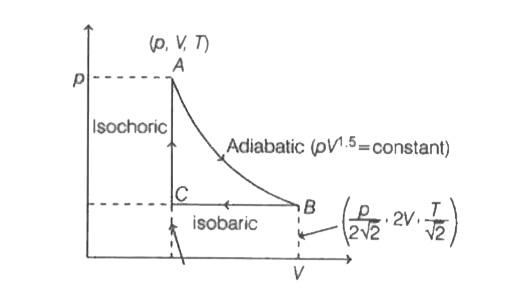 As work done in ADIABATIC process, `W=(nR(T_(1)-T_(2)))/(y-1)=(R(T-T/sqrt(2)))/((1.5-1)) ""("Taking, " n=1)` `V_(2)=2V_(1)` `rArr ""T_(2)=T_(1)/sqrt(2) " or "T_(2)=T/sqrt(2)` `W_(t)=RT 2(1-1/sqrt(2))=0.58 ""(because r=i " Given ")` Work done in isobaric process, `""W_(2)=pDeltaV=nRDeltaT` `rArr W=nR(T/(2sqrt(2))-T/sqrt(2))=-RT(1/sqrt(2)-1/(2sqrt(2)))=-0.35` Now, heat given to system `Q_(1)=nC_(p)DeltaT=7/2R(1/sqrt(2)-1/(2sqrt(2)))=-1.23 J` Negative, `Q_(1)` shows that heat is given to the system. Efficiency of the CYCLE, `""eta="net work done"/"heat input"=(W_(1)+W_(2))/Q_(1)` `""=(0.58-0.35)/1.23` `rArr ""eta=0.23/1.23 TIMES 100 =18.6%=18%` Hence, the efficiency of cycle is 18%. |
|
| 45. |
What should be the height 'h' to which a cylinderical vessel be filled by an isotropic liquid so that the force on its sides is equal to the force acting on its botom ? (r = radius) : |
|
Answer» h=r Correct CHOICE is (a). |
|
| 46. |
Drift speed v_dof electrons in a conductor varies with the strength of electric field E as per therelation : |
|
Answer» `v_d PROP E` |
|
| 47. |
A coil, of areas A, carrying a steady current I, has a magnetic moment, vecm, associated with it. Write the relation, between vecm, I am A in vector form. |
| Answer» SOLUTION :`vecm=Ivecm` | |
| 48. |
What is the shortest wavelength present in the Paschen series of spectral lines ? |
|
Answer» Solution :Spectral LINES of Paschen series are given by the RELATION `(1)/(lambda) = R [(1)/(3^(2)) - (1)/(n^(2))]` For SHORTEST wavelength `n = oo` and we know that `R=1.097 xx 10^(7) m^(-1)` `therefore ""(1)/(lambda_("mix")) = 1.097 xx 10^(7) xx[(1)/(3) - (1)/(oo)] = 1.097 xx 10^(7) [(1)/(9)]` `rArr"" lambda_("mix") = (9)/(1.097 xx 10^(7)) = 8.20 xx 10^(-7) = 820nm` |
|
| 49. |
In a hot wire ammeter the deflection angle theta of the pointer is related with the current I as |
|
Answer» `I alphatheta^2` |
|
| 50. |
Two 2Omega resistances are connected in parallel in the circuit X and in series in circuit Y. The batteries in the two circuits are identical and have zero internal resistance. Assume that the energy transferred to resistor A in circuit X within a certain time is W. The energy transferred to resistor B in circuit Y in the same time will be |
|
Answer» `(1)/(4)W` In a circuit Y, both resistance are in series. Therefore, `V_(B)+V_(B)'=V or V_(B)=V//2` In a circuit Y, power supplied to `B=((V//2)^(2))/(2)=(V^(2))/(8)=(W)/(4)` |
|