Saved Bookmarks
This section includes 7 InterviewSolutions, each offering curated multiple-choice questions to sharpen your Current Affairs knowledge and support exam preparation. Choose a topic below to get started.
| 1. |
A progressive wave moves with a velocity of 36m/ s in a medium with a frequency of 200Hz. The phase difference between two particles seperated by a distance of 1 cm is |
|
Answer» `40^(@)` |
|
| 2. |
Two cars leave one after the other and travel with an acceleration of 0.4 ms. Two minutes after the departure of the first car, the distance between them becomes 1.90 km. The time interval between their departures is : |
|
Answer» 50 s Time =120 sec. Then `1900=(1)/(2)xx0.4[(120)^(2)-(120-t)^(2)]` or `(1900)/(0.2)=(240-t) t` or 9500=`240t-t^(2)` or `t^(2)-240t+9500=0` or `t^(2)-240t+9500=0` or `t^(2)-190t-50t+9500=0` or t(t-190)-50(t-190)=0 or (t-50)(t-190)=0 t=50 s 190 s Rejecting t=190 s, we get t=50 s |
|
| 3. |
The de-Broglie wavelength of an electron, an alpha-particle and a proton are lambda_(e), lambda_(a), lambda_(p). Which is wrong from the following? |
|
Answer» <P>`lambda_(e) GT lambda_(p)` |
|
| 4. |
_92U^235 and _92U238differ as : |
|
Answer» `_92U^238` has 3 NEUTRONS more |
|
| 5. |
Using the definition of the group velocity u, derive Rayleigh's fromula (5.5d). Demonstrate that in the vicinity of lambda = lambda' the velocity u is equal to the segment upsilon' cut by the tangent of the curve upsilon(lambda) at the point lambda' (Fig.) |
|
Answer» Solution :By definition `u = (d omega)/(DK) = (d)/(dk) (vk)` as `omega = vk = V+ k(dv)/(dk)` Now `k = (2pi)/(lambda)` so `dk =- (2pi)/(lambda^(2)) d lambda` Thus `u = v - lambda (dv)/(d lambda)`. Its INTERPRETATION is the FOLLOWING: `((dv)/(d lambda))_(lambda-lambda')` is the slope of the `v - lambda` curve at `lambda = lambda'`. Thus as is obvious from the DIAGRAM `v' = v(lambda') - lambda' ((dv)/(d lambda))_(lambda= lambda')` is the group velocity for `lambda = lambda'` 
|
|
| 6. |
Matchthe following{:("PART - A ","PART - B "),("A) achromatic light","d)"(lambda D)/(d)),("b)monochromatic two successive bright bands ","e) distance between light "),("c) fringe width","f) distance between two successive dark bands "),(,"g) central fringe is always bright"),(,"h) central fringe is always achromatic"):} |
|
Answer» `a to gb to e, f, g, C to e, f, g` |
|
| 7. |
When kinetic energy of proton is equal to energy of photon then ratio of de-Broglie wavelength of proton and photon is proportional to ….. |
|
Answer» <P>E Where E is ENERGY of photon For ptoyon `lambda_(p)=(h)/(sqrt(2mK))` here m and K are MASS and kinetic energy of proton , `therefore (lambda_(p))/(lambda_(p))=(E )/(c )sqrt(2mK) propE^((1)/(2))[because E=K]` |
|
| 8. |
The mass of a muon is 207 times the electron mass, the average lifetime of muons at rest is 2.20 mus. In a certain experiment, muons moving through a laboratory are measured to have an average lifetime of 6.90 mus. For the moving muons, what are (a) beta, (b) K, and (c ) p (in MeV/c)? |
|
Answer» |
|
| 9. |
A two wire transmission line has a capacitance of 20 Pf//m and a characteristic impedance of 50 Omega Determine the impedance of an infinitely long section of such cable. |
| Answer» Solution :The CHARACTERISTIC impedance of a TRANSMISSION line is the impedance that an infinite length of line would present to a power supply at the input end of the line. THUS, `Z_(oo) = Z_(0) = 50OMEGA` | |
| 10. |
A two wire transmission line has a capacitance of 20 Pf//m and a characteristic impedance of 50 Omega What is the inductance per metre of this cable ? |
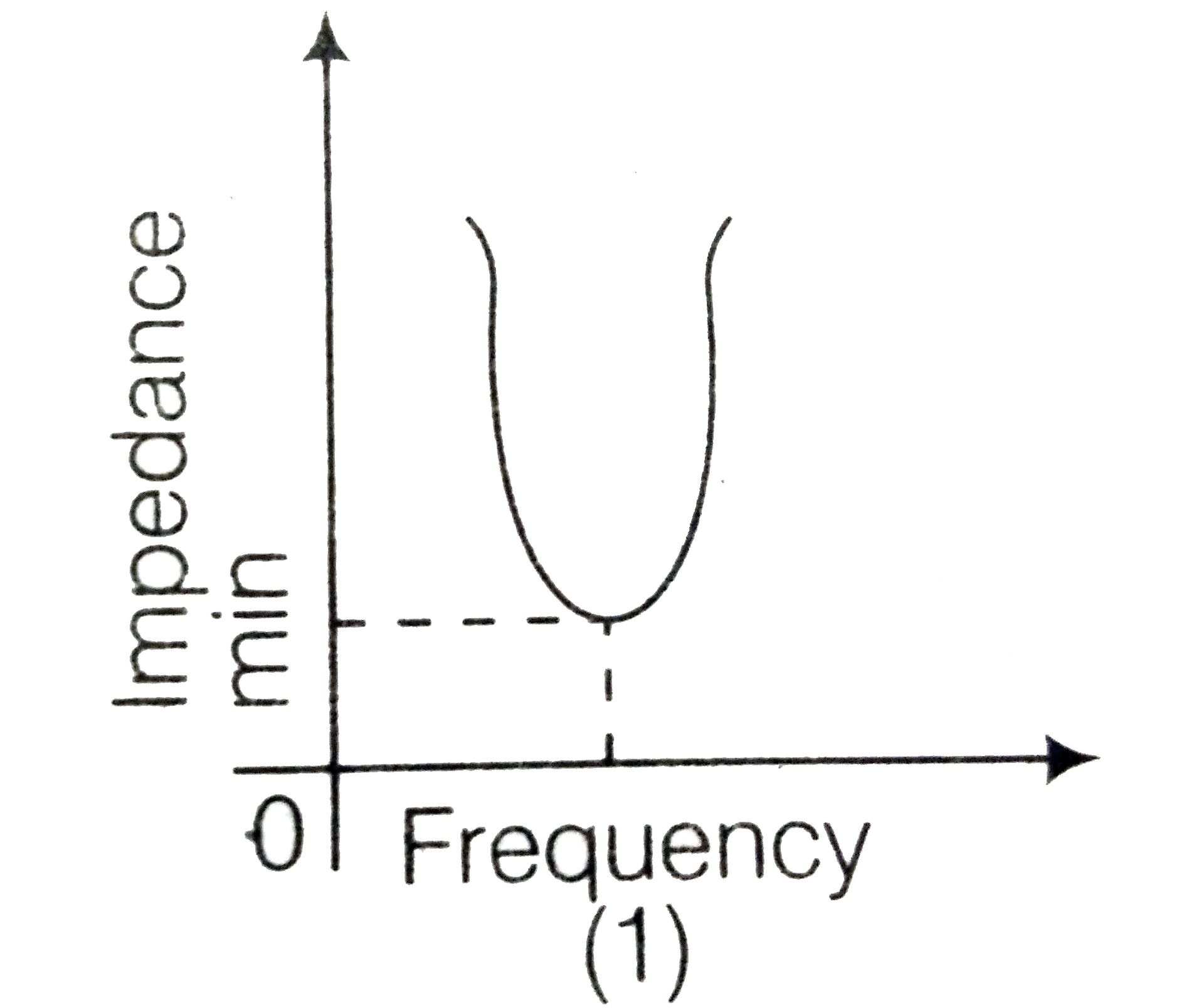
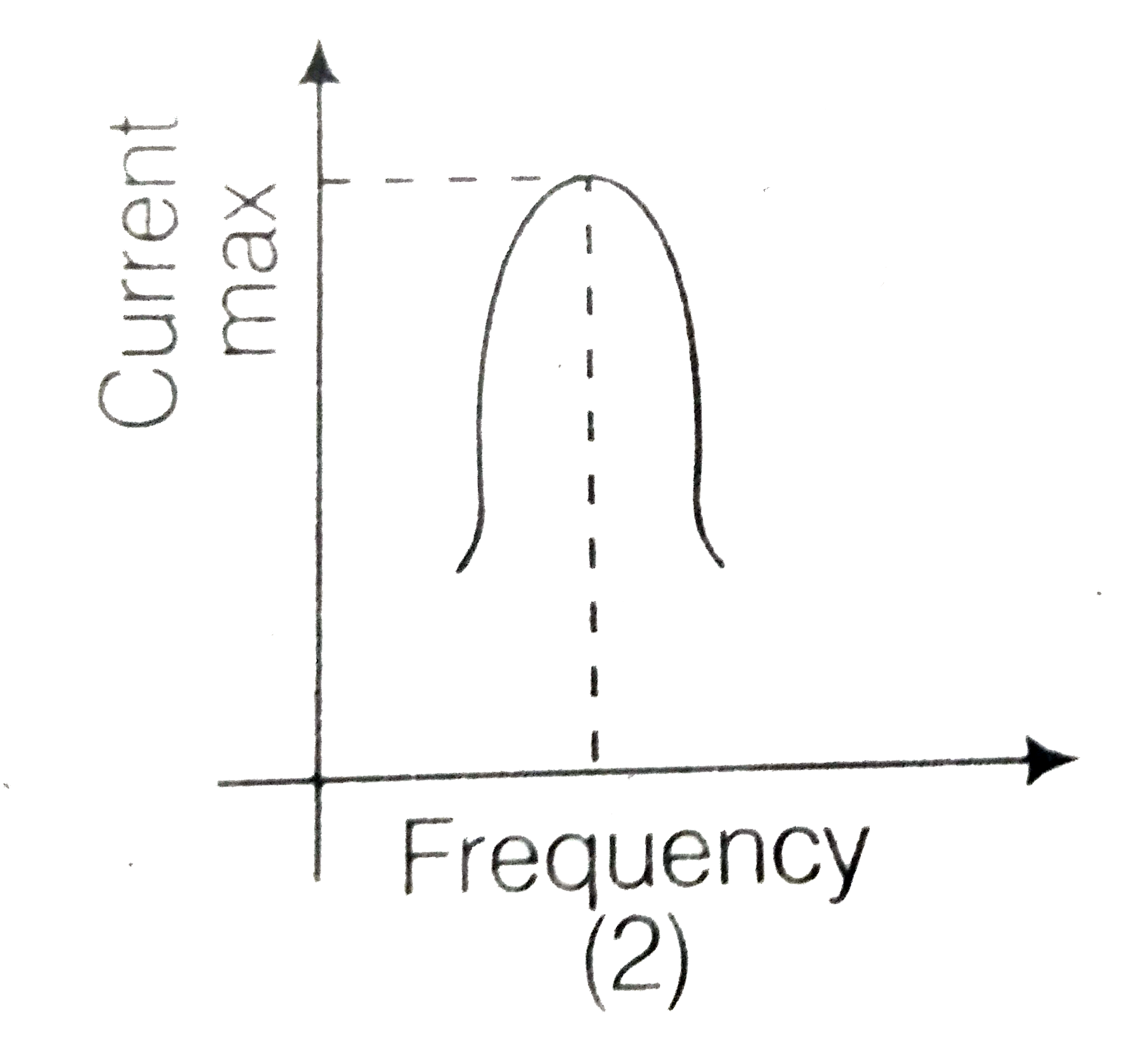
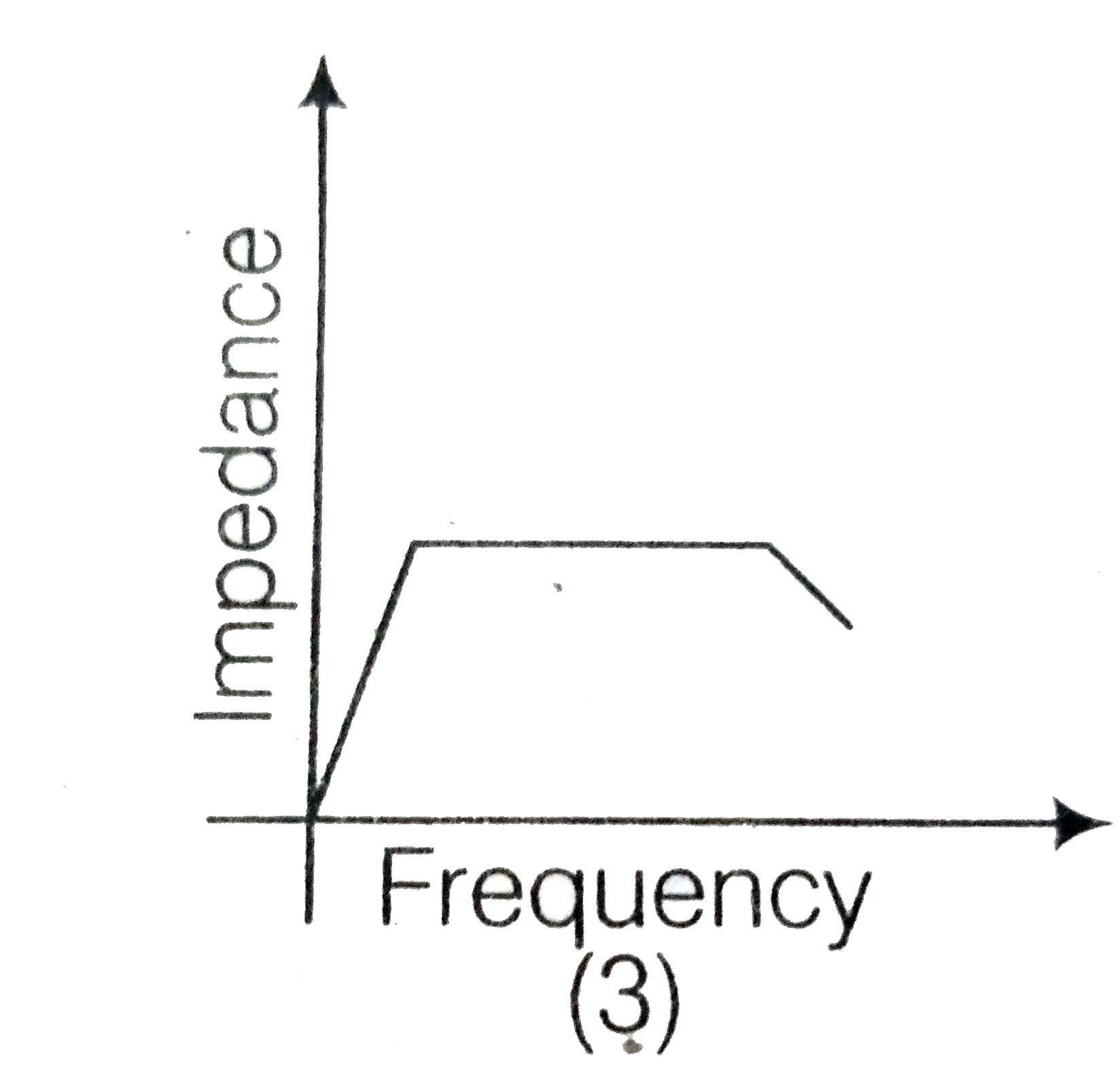
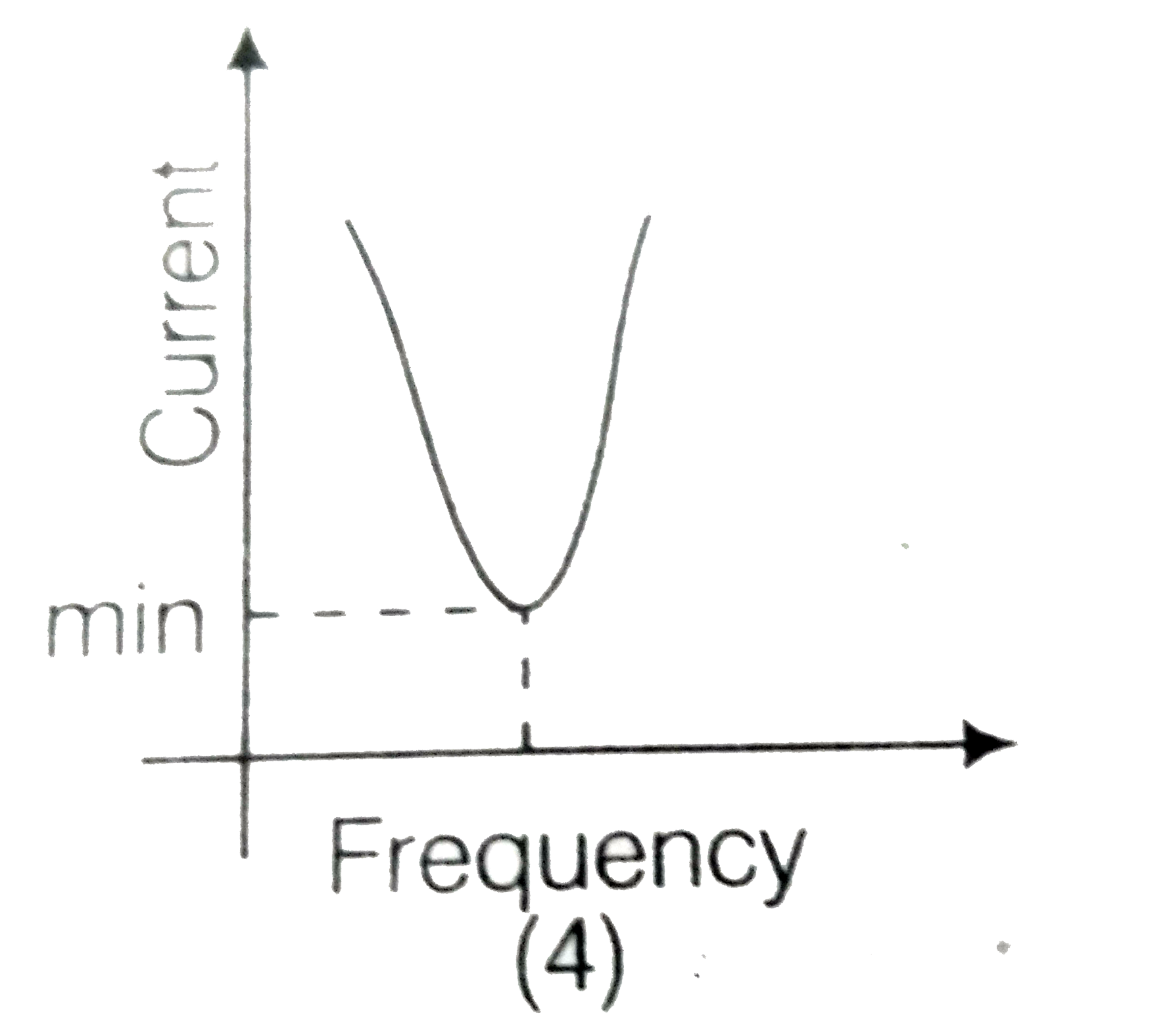
| Answer» Solution :The CHARACTERISTIC impedance. `Z=sqrt(L//C)=L = (Z^(2))(C)= (50)^(2) (20xx10^(-12))H = 0.05H.` | |
| 11. |
Two sinusoidal waves y_1, (x, t) and y_2(x, t) have the same wavelength and travel together in the same direction along a string. Their amplitudes are y_(m1)= 4.0 mm and y_(m2)= 3.0 mm, and their phase constants are 0 and pi//3 rad, respectively. What are the amplitude y_(m)', and phase constant of the resultant wave? Write the resultant wave in the form of Eq. 16-63. |
|
Answer» Solution :(1) The two waves have a number of properties in commom: Because they travel ALONG the same string, they must have the same speed v as set by the tension and incar density of the string according to Eq: 16.29 With the name WAVELENGTH, `lambda` they have the same angular wave numbe `k (=2pi//lambda)`. Also, because they have the same wave number k and speed y, they must have the same angular frequency `omega (=kv).` (2) The waves (call them waves 1 and 2) can be represented by phasors rotating at the same angular speed `omega` about an origin. Because the phase constant for wave `omega` is greater than that for wave 2 is greater than that for wave 1 by `pi//3`, PHASOR 2 must lag phasor 1 by `pi//3` rad in their clockwise rotation, as shown in Fig. 16-24a. The resultant wave due to the interference of waves 1 and 2 can then be represented by a phasor that is the vector sum of phasors 1 and 2. Calculations : To simplify the vector summation, we drew phasors 1 and 2 in Fig 16-24 a at the instant when phasor 1 lies along the horizontal axis. We then drew laging phasor 2 at positive angle `pi//3` rad. In Fig 16-24b we shifted phasor 2 so TAIL is at the 1. Then 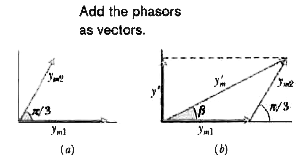 we can draw the phasor `y_(m).` of the resultant wave from the tail of phasor 1 to the head of phasor 2. The phase constant B is the angle phasor `y_m.` makes with phasor 1. To find values for `y_m. and beta`, we can sum phasors 1 and 2 as vectors on a vector-capable calculator. However, here we shall sum them by components. (They are called horizontal and vertical components, because the SYMBOLS x and y are already used for the waves themselves.) For the horizontal components we have `y_(mh).=y_(m1) cos 0 +y_(m2) cos pi//3` `=4.0 mm+(3.0 mm) cos pi//3)=5.50mm` For the vertical components we have `y_(mv).=y_(m1) cos 0+y_(m//2) sin pi//3` `=0 +(3.0 mm) sin pi//3=2.60mm`, Thus, the resultant wave has an amplitude of `y_(m).=sqrt((5.50mm)^(2) +(2.60 mm)^(2))` =6.1 mm and a phase constant of `bet=tan^(-1) (2.60 mm)/(5.50 mm)=0.44 rad` From Fig. 16-24b, phase constant `beta` is a positive angle relative to phasor 1. Thus, the resultant wave lags wave 1 in their travel by phase constant `beta=+0.44` rad. From Eq. 16 -63, we can write the resultant wave `y. (x,t) =(6.1 mm) sin (kx-omega t+0.44 rad).` |
|
| 12. |
Sketch the output Y from a OR gate having inputs X and Y as per the following conditions: |
Answer» SOLUTION :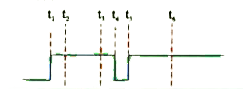
|
|
| 13. |
A particle of mass m (starting at rest) moves vertically upwards from the surface of earth under an external force overset(to)(F) which varies with height z as overset(to)(F)= (2- alpha z) m overset(to)(g) where alpha is a positive constant. If H is the maximum height to which particle rises. Then |
|
Answer» `H=(1)/(alpha)` `therefore (mvdv)/(dz) = (1- alpha z) mg rArr (v^2)/(2) = ( z- (alpha z^(2))/( 2) )g` From maximum height, `v=0` `rArr z=H= (2)/( alpha) rArr (H)/(2) = (1)/( alpha)` So, velocity at height `(H)/(2) , v= sqrt(2 (z - ( alpha z^(2) )/( 2) )g)= sqrt(2 ( (1)/(alpha) - (1)/( 2 alpha) ) g) = sqrt((g)/(alpha))` `therefore` Work done by force F, W `= int_(0)^(1// alpha) (2 -alphaz )` mg dz `= mg [2Z - (alpha z^(2) )/( 2) ]_(0)^(1//alpha) = mg [(2)/(alpha)- (1)/( 2 alpha) ]= (3 mg)/( 2alpha).` |
|
| 14. |
20 Capacitors each of capacity IF are joined in series. The capacity of combination is : |
|
Answer» 20 F |
|
| 15. |
Two nearby sources are said to be just resolved if the central maximum of one coincides with the first minima of the other. This condition is given by : |
|
Answer» Fresnel |
|
| 16. |
A card sheet divided into squares each of size 1 mm^(2) is being viewed at a distance of 9 cm through a magnifying glass (a converging lens of focal length 9 cm) held close to the eye. (a) What is the magnification produced by the lens? How much is the area of each square in the virtual image? (b) What is the angular magnification (magnifying power) of the lens? (c) Is the magnification in (a) equal to the magnifying power in (b)? Explain. |
|
Answer» Solution :`(1)/(v)+(1)/(9)=(1)/(10)` i.e., `v=-90cm`. Magnitude of MAGNIFICATION `= 90//9 = 10`. Each square in the virtual image has an area `10 xx 10 xx 1 mm^(2) = 100 mm^(2) = 1 CM^(2)` (b) Magnifying POWER `= 25//9 = 2.8` (c) No, magnification of an image by a lens and angular magnification (or magnifying power) of an optical instrument are two separate things. The latter is the ratio of the angular size of the object (which is equal to the angular size of the image even if the image is MAGNIFIED) to the angular size of the object if placed at the near point (25 cm). Thus, magnification magnitude is `|(v//u)|` and magnifying power is `(25// |u|)`. Only when the image is located at the near point `|v| = 25 cm,` are the two quantities equal. |
|
| 17. |
A cricket ball of mass 0-5 kg strikes a bat normally with a velocity of 30 ms^(-1) and rebounds with a velocity of 20 ms^(-1) in the opposite direction. The impulse of the force exerted by the ball on the bat is : |
|
Answer» `0.5 Ns` `= m(upsilon +upsilon’) = 0.5 (30 + 20) = 25 Ns` HENCE CORRECT choice is (b) |
|
| 18. |
An alpha-particle is in electric field of 15 xx 10^4 V/m So, the force experienced by it is......N. |
|
Answer» (A) `4.8 xx 10^(-12)` `=(2e)E`(`THEREFORE` For `ALPHA`-PARTICLE, q=2e) `=2 xx 1.6 xx 10^(-19) xx 15 xx 10^(4) (therefore e=1.6 xx 10^(-19)C)` `=4.8 xx 10^(-14)` N |
|
| 19. |
A carbon film resistor has colour code Green Black Violet Gold. The value of the resistor is |
|
Answer» `50 M Omega` |
|
| 20. |
A monkey of mass m clings to a rope over a fixed pulley. The opposite ends of the rope is tide to a weight of mass M lying on a horizontal plate neglecting friction, find the acceleration of both bodies relative to the plate and tension of the rope in the following cases: i) the monkey does not move with respect to rope. ii) the monkey moves upwards with respect to rope with acceleration beta . iii) the monkey moves downwards with respect to the rope with acceleration beta. |
|
Answer» Solution :i) If the monkey is at rest on the rope, then acceleration of both mass M and monkey are same, equal to a (say) If T is tension in the rope, then the equation of MOTION of monkey is ` mg-T=ma_1`..........(1) and equation of motion of MASSM is `T = Ma_1` ........... (2) Adding (1) and (2) `mg =(M+m)a_1` ` :. a_1 = (m)/(M+m) g ` ......... (3) ii) When monkey moves upward with acceleration `beta`, the reaction m `beta` acts downward, therefore equations of motion now take the FORM (`a_2` is acceleration of mass, M relative to PLATE) ` mg + m beta - T = ma_2` ( for monkey ) ............. (4) ` T= Ma_2 ` ( for mass M) ............. (5) Adding , we get , `mg + m beta = ( M+ m)a_2` `:. a_2 =(m (g + beta))/( M + m)` ` :.` The acceleration of mass relative to PLANE ` a_2 = ( m ( g + beta))/( M + m)` ............ (6) and acceleration of monkey M relative to plate `a_2 = a_2 - beta = (m (g + beta))/( M + m) - beta = ( m(g + beta ) - beta ( M + m))/( M+ m) = (mg + m beta - M beta - m beta)/( M + m) = ( Mg - M beta)/( M + m)` iii) When monkey moves downward with acceleration `beta`, the reaction `(R= mbeta)` acts upward, therefore the equations of motion take the form (`a_3` is acceleration of block relative to plate) `mg - m beta -T = ma_3` .......... (8) `T = Ma_3 ` ............ (9) Adding we get ` mg - m beta = (M + m) a_3` ` :. a_3 =( m (g - beta))/(M+ m)` and acceleration of monkey relative to plate ` a_3^1 = a_3 + beta = (m ( g -beta))/( M +m) + beta = (mg - m beta + M beta + m beta )/( M + m)` `:. a_3^(1) = (mg + M beta )/( M + m)` |
|
| 21. |
A spherical black body with a radius of 12 cm radiates 450 W power at 500 K. If the radius were halved and the temperature double, the power radiated in watt would be |
|
Answer» a)225 |
|
| 22. |
Three charges +4q .Q and +q are placed along a straight line of length 'a'at points 0, ( a)/(2)and a respectively . Find the relation between Q and q in order to make the net force on q to be zero For the net force q to be zero. |
|
Answer» SOLUTION :` F_(CA) +F_(CB) =0` ie. ` (1)/( 4pi in _0) (Q.2Q)/( a^(2) +(1)/( 4pi in -0))(qQ)/((a)/(2)^(2)) =0 `2q +4Q =0 therefore Q= (-q)/( 2) ` ` (##JYT_AJP_AIO_PHY_XII_C01_SLV_009_S01.png" width="80%"> |
|
| 23. |
In a certain arrangement, a proton does not get deflected while passing through a magnetic field region. Under what condition is it possible? |
| Answer» Solution :When INITIAL velocity of the PROTON is in the same (or opposite) direction as that of magneitc FIELD. | |
| 24. |
Whatis theIUPAC namefor thefollowingcompound ? Hoverset(O)overset(||)(C)-O-overset(O)overset(||)(C)H |
|
Answer» PROPANOIC anhydride 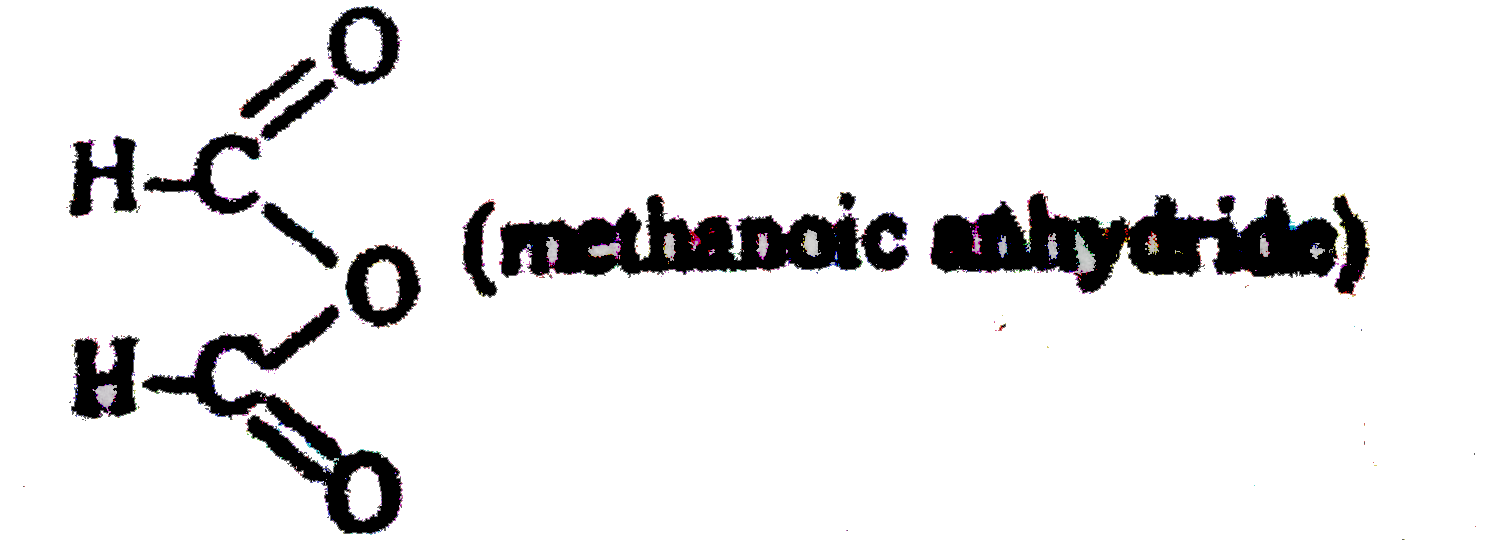
|
|
| 25. |
There is a narrow beam of negative pions with kinetic energy T equal to the rest energy of these particles. Find the ratio of fluxes at the sections of the beam separated by a distance l=20 m. The proper mean lifetime of these poins is tau_(0)=25.5ns. |
|
Answer» Solution :Here `eta=(T)/(mc^(2))=1` so the life time of the PION in the laboratory frame is `eta=(1+eta)tau_(0)=2tau_(0)` The law of RADIOACTIVE decay implies that the flux DECREASE by the factor. `(J)/(J_(0))=e^(-t//tau)=e^(-l//vt)=e^(-l//ctau_(0))sqrt(eta(2+eta))` `=exp(-(m c l)/(tau_(0)sqrt(T(T+2mc^(2)))))=0.221` |
|
| 26. |
Assertion (A) : Rutherford visualised the nuclear model of an atom. Reason (R) : Rutherford's atom model fails to explain the stability of the atom. |
|
Answer» If both ASSERTION and reason are TRUE and the reason is the CORRECT EXPLANATION of the assertion. |
|
| 27. |
A galvanometer of resistance 50 ohm shows full scale deflection when 1.5 mA current flows. how can you convert it into (a). Voltmeter that reads 1 volt at full scale deflection(b) Ammeter that reads 30 mA at full scale deflection . |
| Answer» SOLUTION :a. 617.7 `OMEGA` in SERIES , B. 2.63 `omega` in PARALLEL | |
| 28. |
Digital signals (i)do not provide a continuous set of values, (ii)represent values as a discrete steps, (iii) can utilise only binary system, and (iv)can utillise decimal as well as binary systems Which of the above statements are ture? |
|
Answer» (i) and (II) only |
|
| 29. |
To emit a free electron from a metal surface a minimum amount of energy must be supplied.This energy is called____ |
| Answer» SOLUTION :WORK FUNCTION | |
| 30. |
The plates of a parallel plate capacitor have an area of 90 cm^2 each and are separated by 2.5 mm. The capacitor is charged by connecting it to a 400 V supply. (a) How much electrostatic energy is stored by the capacitor? (b) View this energy as stored in the electrostatic field between the plates, and obtain the energy per unit volume u. Hence arrive at a relation between u and the magnitude of electric field E between the plates. |
|
Answer» SOLUTION :(a) `2.55 xx 10^(-6)` J (b) `u = 0.113 J m^(-3), u = (1//2) epsilon_(0) E^(2)` |
|
| 31. |
Assertion: In Millikan's experiment for the determination of charge on an electron, oil drops of any size can be used. Reason : Millikan's experiment determine the charge on electron, by simply measuring the terminal velocity |
|
Answer» If both ASSERTION and REASON are true and the reason is the correct EXPLANATION of the assert ion. |
|
| 32. |
The electric field at a point on equatorial line of a dipole and direction of the dipole moment |
|
Answer» will be parallel |
|
| 33. |
What is wattless current ? |
| Answer» Solution : Wattless CURRENT is that which does not DISSIPATE power 21 OT although there is a FLOW of current in the CIRCUIT. | |
| 34. |
When electrons bombard a molybdenum target, they produce both continuous and characteristic x rays as shown in fig. In that figure the kinetic energy of the incident electrons is 35.0 keV, (a) what is the value of lambda_(min), and (b) do the wavelengths of the K_(alpha) and K_(beta) lines increase, decrease, or remain the same? |
| Answer» SOLUTION :(a) 22.5 PM, (B) REMAIN the same | |
| 35. |
निम्नलिखित में किसके द्वारा एक बिन्दु - स्त्रोत से समांतर किरणपुंज मिल सकता है? |
|
Answer» अवतल दर्पण |
|
| 36. |
What happened when the British officer came to Pratibandhpuram? |
|
Answer» He DENIED him to hunt tigers |
|
| 37. |
The power factor of a series LCR circuit at resonance will be |
|
Answer» 1 |
|
| 38. |
The thermonuclear reaction of hydrogen inside the stars is taking place by a cycle of operations. The particular element which acts as a catalyst is : |
|
Answer» Nitrogen |
|
| 39. |
Using Gauss' law deduce the expression for the electric field due to a uniformly charged spericalconducting shell of radius R at apoint (i) outside and (ii) inside the shell. Plot a graph showing variation of electric field as a function of r gt R and r lt R. (r being the distance from the centre of the shell) |
|
Answer» <P> Solution :Electric field due to a uniformly charged thin spherical shell -(i) When point P lies Outside the Spherical Shell - Suppose that we have to calculate electric field at the point P at a distance `r(r gt R)` from its centre. Draw the Gaussian surface through point P so as to enclose the charged spherical shell of radius r and centre O. Let `VEC(E)` be the electric field at point P. Then, the electric flux through area element `vec(ds)` is given by, `d PHI = vec(E).vec(ds)` Since `vec(ds)` is also along normal to the surface, `d phi = Eds` `therefore` Total electric flux through the Gaussian surface is given by, `phi = oint Eds = E underset(s)oint ds` Now, `oint ds = 4 pi r^(2)` `therefore""phi = E xx 4 pi r^(2)""...(i)` Since the charge enclosed by the Gaussian surface is q, according to Gauss theorem, `phi=(q)/(epsilon_(0))""...(ii)` From equations (i) and (ii), we get `E xx 4 pi r^(2)=(q)/(epsilon_(0))` `E=(1)/(4 pi epsilon_(0)).(q)/(r^(2))""("for r" gt R)` 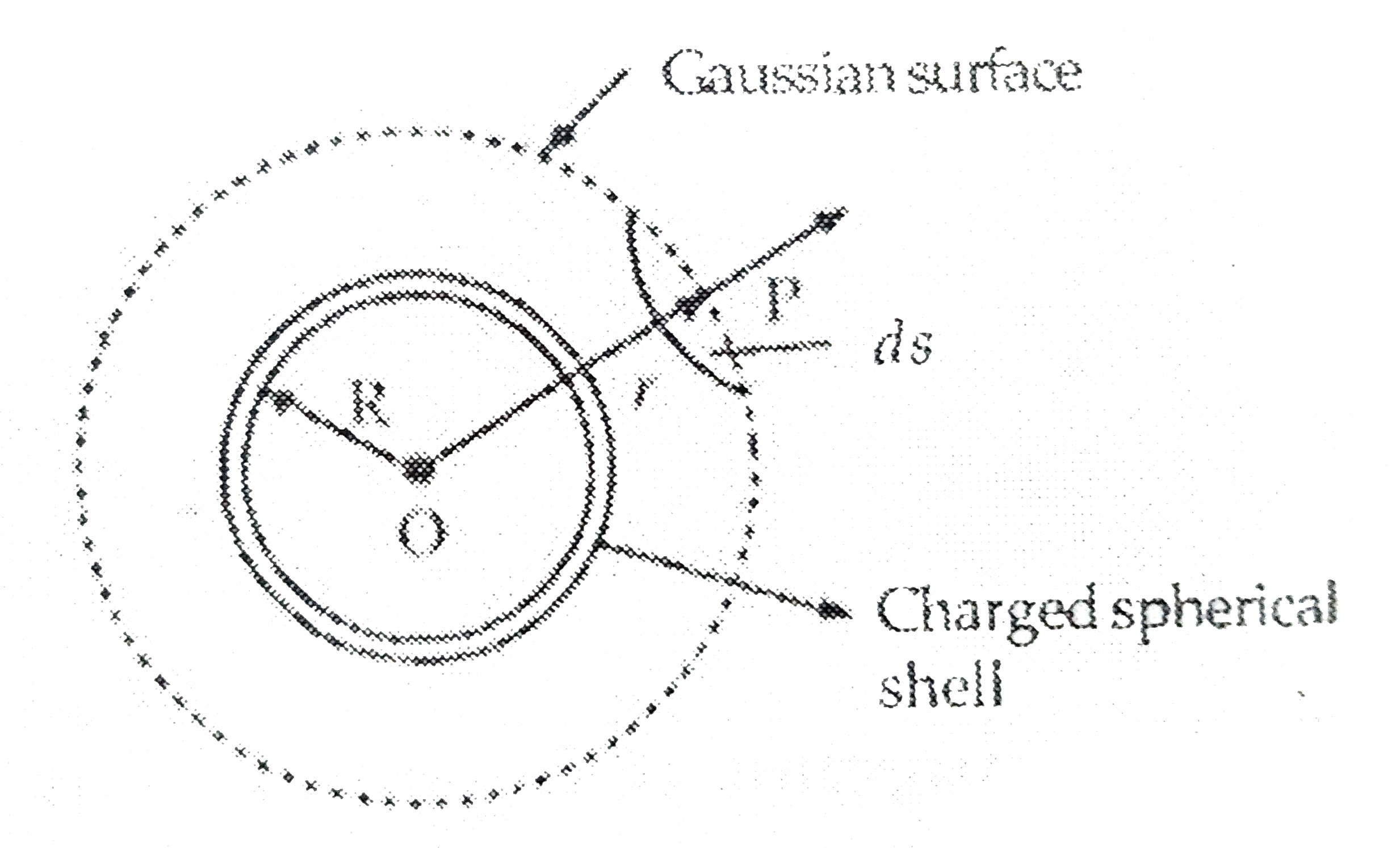 (ii) When point P lies inside the spherical shell : In such a case the Gaussian surface encloses no charge According to Gauss Law, `E xx 4 pi r^(2) = 0` i.e., `""E=0 (r LT R)` Graph showing the variation of electric field as a function of r. 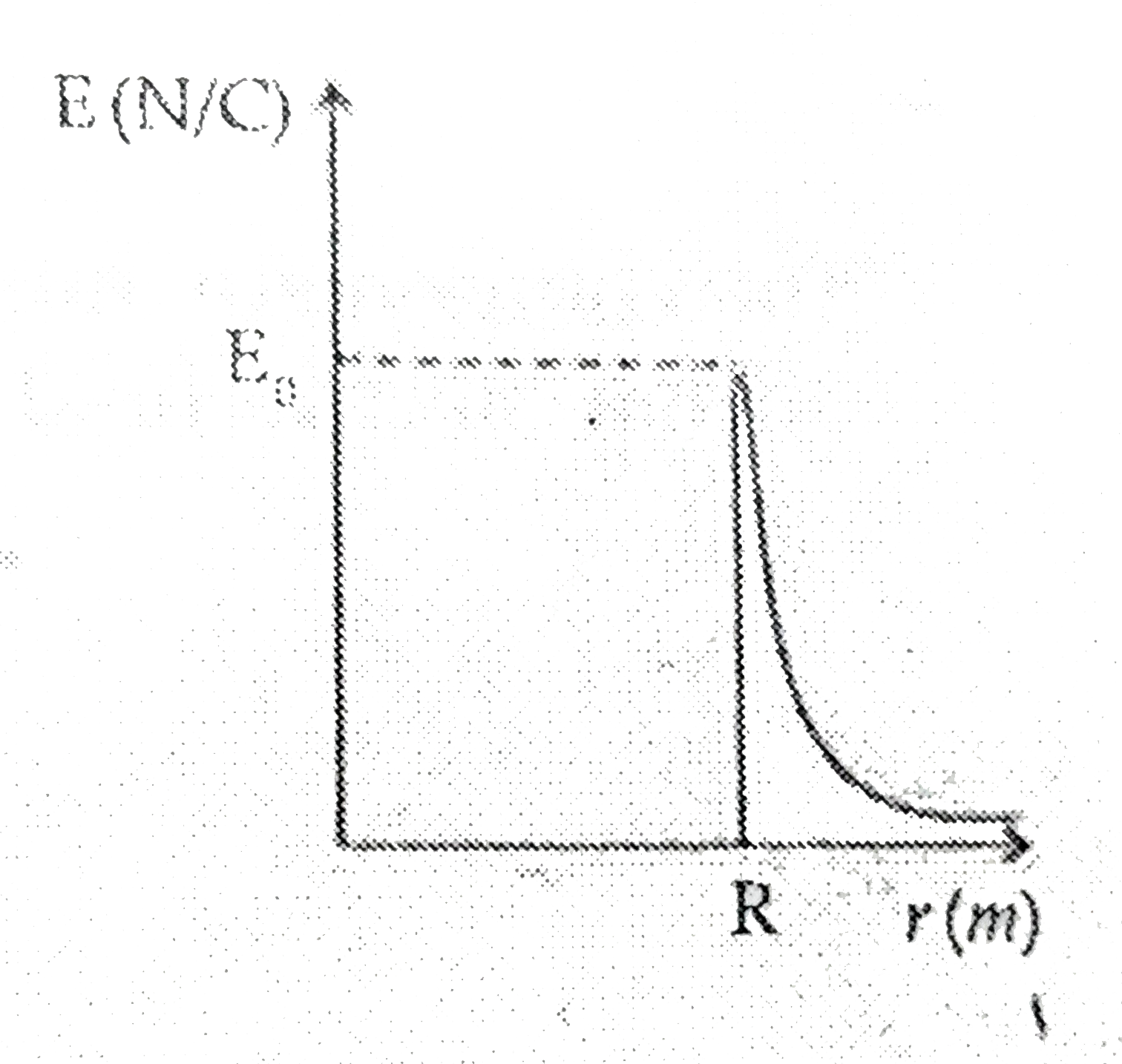
|
|
| 40. |
Statement 1: Heat supplied to a gas is process is 100 J and work done by the gas in the same process is 120 J, then pressure of he gas in the process should increase. because Statement2: Work done by the gas is greater than the heat supplied to the gas. Hence, internal energy of the gas should decrease. |
|
Answer» Statement -1 is TRUE, Statement -2, is true, Statement-2 is a CORRECT EXPLANATION for statement-1. |
|
| 41. |
अंतः केंद्रित इकाई कोशिका में केंद्र पर उपस्थित गोले का योगदान होता है |
|
Answer» 0.5 |
|
| 42. |
The count rate of a radioactive sample was 1600 count/s at t=0 and 100 counts at t=8 s . Select the correct alternatives |
|
Answer» its count rate was `400 count/s` at t = 2s |
|
| 43. |
If a light of wavelength 4950 A^@is viewed as a continuous flow of photons, what is the energy of each photon in eV? Given h = 6.6 xx 10^(-34) Js, C=3 xx 10^8 ms^(-1)? |
|
Answer» SOLUTION :Here `lambda = 4950 A^@ = 4950 xx 10^-10 m` Energy of each photon `E= (HC)/lambda = (6.6 xx 10^-34 xx 3 xx 10^8)/(4950 xx 10^-10) = 4.0 xx 10^-19` `= (4.0 xx 10^-19)/(1.6 xx 10^-19) = e V = 2.5 e V |
|
| 44. |
निम्नलिखित में से कोनसी दविआधारी संक्रियाओं के लिए तत्सम अस्तित्व नहीं होगा |
|
Answer» योगफल |
|
| 45. |
Assuming human pupil to have a radius of 0.25 cm and a comfortable viewing distance of 25 cm, the minimum seperation between two objects that human eye can resolve at 500 nm wavelength is |
| Answer» Answer :B | |
| 46. |
In AND operation if Y is output and A and B are inputs the truth table is : |
|
Answer» 0,0,1,0 |
|
| 47. |
State two logic functions in which the output is "low" when both inputs are "low" |
| Answer» SOLUTION :OR , XOR | |
| 48. |
Out of thefollowinggraphs,which graphs shows thecorrect relation (graphicalrepesentation) forLCparallelresonantcircuit ? |
|
Answer»
This is correctlydepicatedin the graph (4). |
|
| 49. |
Hydrogen atom excites energy level from n = 3 to ground state. Number of spectrum lines according to Bohr, is ...... |
| Answer» Solution :NUMBER of LINES `=(N(n-1))/(2)=(3(3-1))/(2)=3` | |
| 50. |
Consider two small balls carrying equal and opposite charges. If one is secured and other is related it can do work W_(1) against the repulsive force (as it moves away). If before the second ball is released, they are connected by a conductor for some time, the second ball can do work W_(2) while moving away. The heat liberated in the conductor when the balls are connected, the energy at the expense ofwhich heat is liberated and mechanical work changed is |
|
Answer» `((q_(1)+q_(2))^(2))/4(1/R-1/L)` |
|