

Saved Bookmarks
This section includes 7 InterviewSolutions, each offering curated multiple-choice questions to sharpen your Current Affairs knowledge and support exam preparation. Choose a topic below to get started.
| 1. |
A helicopter is moving in upward direction with speed of 10 m/s. If the length of the helicopter is 10 m and the horizontal component of magnetic field of earth is 1.5 xx 10^(-3) "Wb"/ m^2 then the induced emf produced across the foremost (nose) and end part (tail) of the helicopter will be ____ |
|
Answer» 0.15 V `=1.5xx10^(-3)xx10xx10xx"sin"pi/2` `therefore epsilon` =0.15V |
|
| 2. |
Give the expression for the instantaneous energy stored in a capacitor along with the meaning of the symbols used. |
|
Answer» SOLUTION :`U_(E)=(1)/(2)(q_(0)^(2))/(C)cos^(2)(omegat)` where, C - electrical capacitance, `omegat`- phase angle and `U_(E)` - electrical ENERGY stored in the DIELECTRIC medium between the plates. |
|
| 3. |
What is polarisation of light ? What is its most important significance ? |
|
Answer» SOLUTION :Polarisation. The phenomenon of restricting the waves in oscillations to PARTICULAR plane is called polarisation. A wave having oscillation in all possible DIRECTIONS is said to be unpolarised. When all the oscillations get confined along one direction, the wave is called plane polarised. Significance. Polarisation is possible only in TRANSVERSE wave motion, so polarisation of light means that light is transverse in nature. |
|
| 4. |
Mention any one type of electron emission. |
|
Answer» Solution :1. THERMIONIC emisson 2. FIELD emission 3. Photo-electric emission |
|
| 5. |
An alpha- particle and a proton are accelerated from rest by a potential difference of 100 V. After this, their de Broglie wavelengths are and lamda_(a) and lamda_(p) respectively. The ratio (lamda_(p))/(lamda_(a) to the nearest integer, is ............... |
|
Answer» 1 `:.(lambda_(p))/(lambda_(a))= sqrt((m_(a)E_(a))/(m_(p)E_(p)))= sqrt((4xx2E)/(E))=2 sqrt(2)~~3` `:.E_(p)=EV and E_(prop)= 2eV` |
|
| 6. |
The unit of permitivity of free space epsilon_(0) is |
|
Answer» COULOMB/newton-METER |
|
| 7. |
We cannot use a D.C. Voltmeter to measure an alternating voltage because : |
|
Answer» the alternating voltage is virtual |
|
| 8. |
y_1 = 8 sin (omegat - kw) and y_2 = 6 sin(omegat + kx) are twowaves travelling in a string of area of cross-sections and density rho. These two waves are superimposed to produce a standing wave. Find the total amount of energy crossing through a node per second. |
| Answer» SOLUTION :`(2 RHO omega^2s)/K` | |
| 9. |
y_1 = 8 sin (omegat - kw) and y_2 = 6 sin(omegat + kx) are twowaves travelling in a string of area of cross-sections and density rho. These two waves are superimposed to produce a standing wave. Find the energy of the standing wave between two consecutive nodes. |
| Answer» SOLUTION :`(50 PI RHO omega^2 s)/K` | |
| 10. |
Two parallel resistanceless rails are connected by an inductor or inductance L at one end as shown in figure. A magnetic field B exists in the space which is perpendicular to the plane of the rails. Now a conductor of length l and mass m is placed transverse on the rail and given an impulse J towards the rightward direction. Then select the corrent option(s). |
|
Answer» velocity of the CONDUCTOR is half of the initial velocity after a displacement of the conductor `d=sqrt((3J^(2)L)/(4B^(2)l^(2)m))` `rArr int di=(Bl)/(L)int vdt rArr t rArr i=(Bl)/(L)x ""`….(i) `F=ma rArr -iBl=mv (dv)/(DX)` `rArr -(B^(2)l^(2)x)/(L)=mv(dv)/(dx)rArr - (B^(2)l^(2))/(mL)int_(0)^(d)xdx=int_(v_(0))^(v_(0)//2)vdv` `rArr -(B^(2)l^(2)d^(2))/(2mL)=(-3v_(0)^(2))/(8)[v_(0)=(J)/(m)] rArr d=sqrt((3J^(2)L)/(4B^(2)l^(2)m))` Putx = d in (i),`i=(Bl)/(L)sqrt(3J^(2)L)/(4B^(2)l^(2)m)=sqrt((3J^(2))/(4Lm))` |
|
| 11. |
Polaroid sheets are often used for making sun glasses. This is because polaroid glass. |
|
Answer» (a) cut off glare |
|
| 12. |
An alternating current source of frequency 100 Hz is joined to a series combination of a resistance, a capacitance and a coil in series. The potential difference across the coil, the resistance and the capacitor is 46, 40 and 8 volt respectively. What is the electromotive force of alternating current source in volt ? |
|
Answer» 94 `V_L=46, V_R=8, V_C=40` `=8^2+(46-40)^2` `=8^2+6^2` =64+36 `V^2`= 100 `THEREFORE` V=10 V |
|
| 13. |
A photon collides with a stationary hydrogen atom in ground state inelastically. Enorgyof the colliding photon is 10.2 eV. Almost instantaneously. Another photon collidos with same hydrogen atom inelastically with an energy of 15 eV. What will be observed by the detector ? |
|
Answer» two PHOTONS of ENERGY 10.2 eV |
|
| 14. |
The plates of a parallel plate capacitor have an area of 90 cm^(2) each and are separated by 2.5mm. The capacitor is charged by connecting it to a 400V supply. a. How much electrostatic energy is stored by the capacitor? b. View this energy as stored in hte electrostatic field between the plates, and obtain the energy per unit volume u. Hence arrive at a relation between u and the magnitude of electric field E between the plates. |
|
Answer» SOLUTION :`90 cm^(2)= 90 xx 10^(-4) m^(2)` `d=2.5mm =2.5 xx 10^(-3)m` V=400V a. Energy, `E=1/2CV^(2)=1/2 xx (8.85 xx 10^(-12) xx 90 xx 10^(-4))/(2.5 xx 10^(-3)) xx 400 xx 400` `=(8.85 xx 10^(-8) xx 9 xx 8)/(2.5)=(88.5 xx 72 xx 10^(-8) xx 4)/(100)=2.55 xx 10^(-6)J` b. `u=(1/2 CV^(2))/(A xx d)=1/2 xx (epsi_(0)A xx V^(2))/(d xx Ad)=1/2epsi_(0) E^(2)` |
|
| 16. |
When a surface is irradiated with a light of wavelength 4950 Å, a photocurrent appears which vanishes if a retarding potential greater that 0.6 V is applied across the phototube. When a different source of light is used, it is found that the critical retarding potential is changed to 1.1 V. Change in two stopping potentials is |
|
Answer» Not observed |
|
| 17. |
The nutritive cells found in seminiferous tubules are |
|
Answer» LEYDIG's cells |
|
| 18. |
When did the author's parents leave him with his grandmother? |
|
Answer» When he was a kid |
|
| 19. |
In a potentiometer arrangement, a cell of emf 1.25 V gives a balance point at 30.0 cm lengththe wire. If the cell is replaced by anotherand the balance point shifts to 60.0 cm, what the emf of the second cell ? |
|
Answer» SOLUTION :In case of potentiometer ratio of two EMFS is, `(epsilon_(1))/(epsilon_(2)) = (l_(1))/(l_(2))` `therefore (1.25)/(epsilon_(2)) = (35)/(63)` `therefore epsilon_(2) = 1.25 XX (63)/(35)` ` therefore epsilon_(2) = 2.25 ` V |
|
| 20. |
There is a fixed positive charge Q at O and A and B are points equidistant from O. A positive charge + q is taken slowly by an external agent from A to B along the line AC and the along the line CB. |
|
Answer» The TOAL work DONE on the charge is zero |
|
| 21. |
Describe the coil and barmagnet experiment to demonstrate the phenomenon of electromagnetic induction. |
Answer» Solution : Figure consits of a cylindrical coil C made up ofseveral turns of insulated copper wire connected in series to a sensitive galvanometer G. A strong bar magnet NS with its north pole pointing towards the coil is moved up and down. The following inferences were made by FARADAY. (i) Whenever there is a relative motion between the coil and the magnet, the galvanometer shown deflection INDICATING the flow of INDUCED current. (ii) The deflection is momentary. It lasts so LONG as there is relative motion between the coil and the magnet. (III) The direction of the flow of current changes if the magnet is moved towards and withdrawn from it. (iv) The deflection is more when the magnet is moved faster, and less when the magnet is moved slowly. (v) However, on reversing the magnet (i.e.,) south pole pointing towards the coil, same results are obtained, but currentflows in the opposite direction. |
|
| 22. |
A student is standing at a distance of 50 metre from the bus. As soon as the bus begins its motion with an acceleration of 1m//s^(2), the student starts running towards the bus with a uniform velocity u. assuming the motion to be along a straight road, the minimum value of u. so that the student is able to catch the bus is |
|
Answer» `12 m//s^(-1)` `u=0, a=1 ms^(-2)` `v^(2)-0=2xx1xx50=100` `:. V=10 ms^(-1)` Hence to catch the bus the student should RUN at least with uniform VELOCITY of `10 ms^(-1)` |
|
| 23. |
In one A.C. generator, brushes connected with slip rings become positive and negative alternatively at the regular interval of 10 ms. Then angular frequency of this A.C. voltage would be ………. |
|
Answer» 50 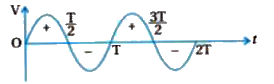 We can SEE that polarity of A.C. voltage changesat every half cycle i.e. at the end of every `T/2` time interval, which is given 10 MS in the STATEMENT. Hence, `T/2`=10 ms `therefore` T=20 ms = `20xx10^(-3)` s `therefore (2pi)/omega=20xx10^(-3) (because omega=(2pi)/T)` `therefore omega=(2pi)/(20xx10^(-3))` `therefore omega=100pi "rad"/s` |
|
| 24. |
Which of the following is used in optical fibres? |
|
Answer» TOTAL internal REFLECTION |
|
| 25. |
A triangular current carrying loop is placed in the X-Y plane with its vertices at P(0,(asqrt(3))/2),Q(-a/2,0) and R(a/2,0). The loop carries a current l in the direction PtoQtoRtoP. Let the point S have the coordinates (0,(asqrt(3))/2) Choose the correct option(s): |
|
Answer» The magnetic FIELD at S due to the side PQ is in the –Z direction The PERPENDICULAR distance of S from PQ, `r_(PQ)=(asqrt(3))/2` So field due ot PQ `B_(PQ)=(mu_(0)I)/(4pir_(PQ))(sin 120^(@)+sin (-30^(@)))=(mu_(0)I)/(4pia)(1-1/(sqrt(3)))` Field at S due to side RP is also in the +Z direction and has the same magnitude due to SYMMETRY. Now, field at S due to side QR is in the –Z direction. The perpendicular distance of S from QR, `r_(QR)=(asqrt(3))/2` So field due to QR` B_(QR)=(mu_(0)I)/(4pir_(QR))(sin 30^(@)+sin 30^(@))=(mu_(0)I)/(2sqrt(3)pia)` Net field at S `vecB_("net")=vecB_(PQ)+vecB_(QR)+veB_(RP)=[(mu_(0)I)/(2pia)(2/(sqrt(3))-1)](-hatk)` |
|
| 26. |
An electron revolves in a circle of radius 0.4A^(0) ith a speed of 106 ms^(-1) in a hydrogen atom. The magnetic field produced at the centre of the orbit due to motion of the electron, in tesla, is [mu_(0)=4pixx10^(-7)H//m] |
|
Answer» 0.1 |
|
| 27. |
(a) Work function of aluminium is 4.2 eV. If two photons each of energy 2.5 eV are incident on its surface. Will the emission of electrons take place ? Justify your answer. (b) Name the radiation of the electromagnetic spectrum which is used for taking photographs of the sky during night annd foggy condition. give their frequency range. |
|
Answer» Solution :(a) There will be no EMISSION of electron from aluminium, having a work function of 4.2 eV, when two photons, each of energy 2.5 eV, are incident onit. It is because as per Einstein.s quantum condition only one SINGLE photon cann interact with ann electron present in the photoelectric SURFACE. thus, emission of electron is possible only when a single photon of energy 4.2 eV or more in incident on aluminium. (b) Infra red rays are used for taking photographs of the sky during night and foggy conditions. their FREQUENCY varies from `10^(11) Hz` to `10^(14)Hz`. |
|
| 28. |
In pure crystal of silicon at 300 K temperature having number of atom n_(i)=10^(16)m^(-3). If 10^(21) atoms of phosphorus added per m^(3) then number of holes created will be …… /m^(3). |
|
Answer» `10^(21)` `n_(i)^(2)=n_(E )n_(N)` `therefore n_(n)=(n_(i)^(2))/(n_(e ))=((10^(16))^(2))/(10^(21))=10^(11)m^(-3)` |
|
| 29. |
Two wires are made up of same material. Ratio of their masses is 1 : 2 and ratio of their lengths is 2 : 1 . So ratio of their resistances is.... . |
|
Answer» `1: 4` `R= (RHO l)/(A) rArr R = (rho l^(2))/(V)"" [ because Al = V] ` `R = (rho l^(2))/((m)/(d)) ( because " VOLUME" = ("mass")/("density"))` Material is same, so `rho` and d are constant. `therefore R PROP (l^(2))/(m)` `therefore (R_(1))/(R_(2)) = ((l_(1))/(l_(2)))^(2) xx ((m_(2))/(m_(1))) ` = ` (2)^(2)xx (2)` `= 4 xx 2 = 8` `therefore R_(1) : R_(2) = 8 : 1 ` |
|
| 30. |
A fixedmass of gas (gamma=1.4) at 1 atmosphericpressureis compressed under adiabatic condition to 5 atmospheres and then allowedto expandisothermally to its original volume. The final pressure is |
|
Answer» 5 ATMOSPHERES |
|
| 31. |
A man fixes outside his house one evening a two metre high insulating slab carrying on itstop a large aluminium sheet of area 1 m^2. Will he get an electric shock if he touches the metal sheet next morning? |
| Answer» Solution :Yes, the steady discharging current in the ATMOSPHERE CHARGES up the aluminium sheet gradually and raises its VOLTAGE to an extent depending on the capacitance of the capacitor (formed by the sheet, slab and the ground). As a RESULT, the man will get a shock. | |
| 32. |
Consider Fraunhoffer diffraction pattern obtained with a single slit at normal incidence.At the angular paosition of first diffraction minimum, the phase difference between the wavelets from the opposite edges of the slit is |
Answer» Solution :To have the FIRST minimum, the PATH difference between the waves from A and B = BD = `a/2, sin theta = (lambda)/(2)`.The path difference between the waves from A and C at the same point should be `lambda` or phasedifference is `2pi` 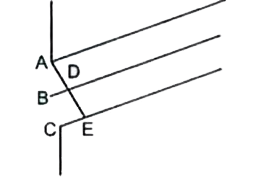
|
|
| 33. |
The forcebetween two short bar magnets with magnetic moments M_(1) and M_(2)whose centres are r metre apartis 8.0 Nthen force between then is reduced to |
|
Answer» Solution :`F=(mu_(0))/(4pi).(6M_(1)M_(2))/(r^(4))` `therefore F=(F)/(16)=8/16=0.5 N` |
|
| 34. |
Explain how value of unknown resistor can be obtained by using meter bridge. |
|
Answer» Solution :In one gap of meter bridge unknown resistor R and in second gas resistance S from resistance box is connected. Jockey key is SLIDED (moved) on wire AC. `rArr` ASSUME that when jockey key is on position D, galvanometer shows zero deflection. `rArr` Let length from A to D is l. `rArr` Resistance of AD wire = `R_(cm)` lwhere `R_(cm)`is resistance of wire per unit length (1 cm). `therefore ` Resistance of DC wire = `R_(cm) ` (100 - l) `rArr` Wire AB, BC, DA and CD form Wheatstone bridge, where, AB = R, BC = S, DA = `R_(cm)` l CD = `R_(cm) (100 - l) ` From principle of Wheatstone bridge for balancing of Wheatstone bridge, ` (AB)/(BC) = (DA)/(CD)` `therefore (R)/(S) = (R_(cm)l)/(R_(cm) (100 - l))` `therefore (R)/(S) = (l)/(100 -l)` `rArr` Unknown resistance can be obtained by using equation R= `S (l)/(100 - l)`. `rArr` For different value of S, value of unknown resistance R can be obtained by taking average value error can be eliminated. `rArr` To eliminate end correction. position of resistance R and resistance S from box can be interchanged and null point can be obtainedand error can be reduced. `rArr` For balancing bridge, null point should be at 50 cm (between 40 cm and 60 cm) and percentage error can be minimized. `rArr` From value of resistance obtained by meter bridge temperature of unknown resistance can be obtained. `rArr` By using meter bridge value of SMALL resistance can be known. |
|
| 35. |
Give difference between Ammeter and Voltmeter. |
Answer» SOLUTION :
|
|
| 36. |
Define current? |
| Answer» Solution :CURRENT is defined as a net charge Q PASSES through any cross SECTION of a CONDUCTOR in time t then, `I=(Q)/(t)`. | |
| 37. |
A current I flows in an infinitely long wire with cross section in the form of a semicircular ring of radius R. The magnitude of magnetic induction along its axis is |
|
Answer» `(mu_0 I )/( 2 PI^2 R)` |
|
| 38. |
In an experiment with post office box, the ratio arms are 1000:10. If the value of third resistance is 870Omega, find the unknown resistance. |
|
Answer» |
|
| 39. |
A biconcave lens made of a transparent material of refractive index 1.25 is immersed in water of refractive index 1.33. Will the lens behave as a converging or a diverging lens ? Give reason. |
| Answer» Solution :The LENS will now BEHAVE as a CONVERGING lens because its new refractive INDEX w.r.t. water is LESS than one. | |
| 40. |
The angle of polarisation on a certain crystal is 55^(@)C. The reflected light is completely polarised. Find the refractive index of the crystal andangle of refraction. |
|
Answer» SOLUTION :Refractive INDEX, `n=tan theta_(p)=tan 55^(@)=1.428` `r +theta_(P)=90"" :. R-90-theta_(P)=90-55=35^(@)` |
|
| 41. |
In forward bias the width of potential barrier in a p-n diode |
|
Answer» REMAIN constant |
|
| 42. |
A person in a train moving at a speed3 xx 10 ^(7 ) m s ^(-1) sleeps at 10 .00 p.m. by his watch and gets up at 4.00 a.m. How long did he sleep according to the clocks at the stations? |
|
Answer» Solution :The time interval MEASURED by the watch is the proper time interval because the events , 'sleeping ' and 'getting up' , are recorded by the single clock (the watch). The clocks at the stations represent the ground frame and in this frame he sleeps at one place and GETS up at another place. THUS, the time interval measured by the station clocks is improper time interval and is more than the proper time interval. The duration of his sleep in the ground frame is ` delta t' = gammaDelta t = ( Delta t / (sqrt 1 - v^(2) / c^(2))) = (6 h/ (sqrt 1 -(3 xx 10 ^(7 m s ^(-1 )/ 3 xx 10 ^(8 m s ^(-1 ) )^(2))))` `= 6 h (sqrt 100 / 99 ) = 6 hours 1.8 minutes`. The speed of the train in this example is hypothetical. A typical FAST train TODAY runs at about` 300 km h ^(-1) .` Repeatthe exercise with such a train . |
|
| 43. |
Asseration: The direction of induced e.m.f. is always such as to oppose the change that causes it. Reason: The direction of induced e.m.f. is given by Lenz's Law. |
|
Answer»
|
|
| 44. |
Heat H produced when mechanical work W is done, they are related by |
|
Answer» `H = W/J` |
|
| 45. |
Monomer related to Nylon 26 is |
| Answer» Solution :"Glycine+Armino carproic acid rarr Nylon-26" | |
| 46. |
Use Lenz's law to determine the direction of induced current in the situations described by the following figures. a. A wire of irregular shape turning into a circular shape, b. A circular loop being deformed into a narrow straight wire. |
|
Answer» SOLUTION :a. By RIGHT HAND thumb rule, the current direction is ALONG adcba. b. Here current direction is opposite to that in along a.d.c.b.a. |
|
| 47. |
A doped semiconductor is |
|
Answer» POSITIVELY charged |
|
| 48. |
Current gain in common-base configuration in less than 1, because : |
|
Answer» <P>`I_(E) LT I_(p)` |
|
| 49. |
Choose the current relation between transistor parametersalphaand beta |
| Answer» SOLUTION :`beta=alpha/(1-alpha)` | |
| 50. |
Three identical dipoles with charges q and -q, and separation A between the charges, are placed at the corners of an equilateral triangle of side D as shown in (Fig. 3.123). Find the interaction energy of the system (a lt lt d). . |
|
Answer» <P> 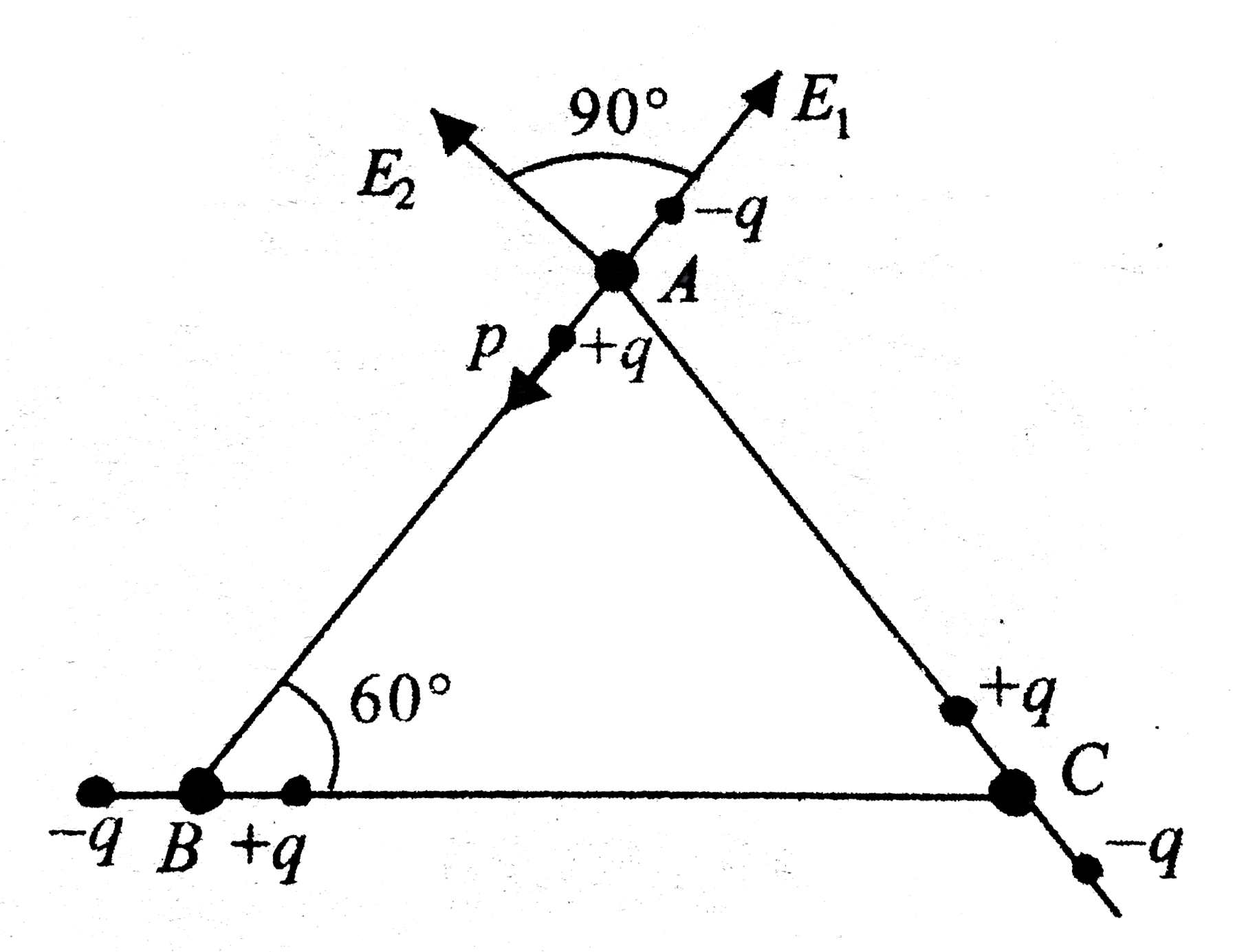 . . Electric field `E_1` due to DIPOLE at `B` is `E_1 = (k 2 p cos 60^(@) )/(d^3)` and `E_2 = (k SIN 60^(@))/(d^3)` Potential energy between `A and B` is `- vec p . vec E = - vec p.(vec E_1 + vec E_2) = - vec p. vec E_1` , `(because vec p _|_ vec E_2)` or `-p E_1 cos 180^(@) = p E_1 = (k 2 p^2 cos 60^(@))/(d^3) = (q^2 a^2)/(4 pi epsilon_0 d^3)` Net energy of system is `3 q^2 a^2 // 4 pi epsilon_0 d^3`. |
|