Saved Bookmarks
This section includes 7 InterviewSolutions, each offering curated multiple-choice questions to sharpen your Current Affairs knowledge and support exam preparation. Choose a topic below to get started.
| 1. |
What is speed of electromagnectic wave ? |
| Answer» SOLUTION :`C=1/(SQRT(mu_0epsilon_0) =3xx10^8 m/sec` in EMPTY. SPACE where `epsilon_0`=PERMITTIVITY of empty. | |
| 2. |
A combination is formed by keeping a convex lens in contact with a concave lens. If both have same focal length of value 25 cm, then power of combination is ...... D. |
|
Answer» Solution :`1/f=(1)/(f_1)+(1)/(f_2)=(1)/(25)-(1)/(25)` `1/f=0` `therefore` Power P=`1/f=0` `therefore P=0` |
|
| 3. |
Two coaxial solenoids of different radii carry current I in the same direction. Let F_(1) be the magnetic force on the inner solenoid due to the outer one and F_(2) be the magnetic force on the outer solenoid due to the inner one. Then |
|
Answer» `F_(1)` is radily OUTWARDS and `F_(2)=0` |
|
| 4. |
Lencho wrote a Letter to God and said that |
|
Answer» He and His family will GO hungry |
|
| 5. |
Find the proper length of a rod if in the laboratory frame of reference its velocity is v=c//2, the length l=1.00m, and the angle between the rod and its direction of motion is theta=45^@. |
|
Answer» Solution :In the rest frame, the COORDINATES of the ENDS of the rod in terms of proper length `l_0` `A:(0,0,0) B: (l_0costheta_0, l_0sintheta_0, 0)` at time t. In the LABORATORY frame the coordinates at time `t'` are `A: (vt^', 0, 0), B: (l_0costheta_0srqt(1-beta^2)+vt', l_0sintheta_0,0)` THEREFORE we can write, `locstheta_0=l_0costheta_0sqrt(1-beta^2)` and `lsintheta=l_0sintheta_0` HENCE `l_0^2=(l^2)((cos^2theta+(1-beta^2)sin^2theta)/(1-beta^2))` or, `=sqrt((1-beta^2sin^2theta)/(1-beta^2))` 
|
|
| 6. |
Whichof the following statements (s) is (are) correct? |
|
Answer» The rest MASS of a stable NUCLEUS is less than the sum of the rest masses of its separated nucleons |
|
| 7. |
In Young's double slit experiment the distance between slits is 2 xx 10^(-3)m, the distance between screen and slits is 200 cm. When the light of wave length 5000 A^(@) is used, then the fringe width on the screen will be |
|
Answer» 2mm |
|
| 8. |
All of the following statements are correct except (for real object): |
|
Answer» the magnification produced by a convex mirror is always less than or equal to one |
|
| 9. |
Explain, using suitable digrams, the formation of standingwaves in a closed pipe.How may this be used to determine the frequency of a source of sound ? |
|
Answer» Solution :Formation of standing waves in a closed pipe `:` (1) In closed pipe one and the other end is open.So antinode is formed atopen end and antinode is formedat closed end. (2) The possible HARMONICS in vibrating air column in a closedpipe `v = (( 2n+a)upsilon)/(4l)`where v = 0,1,2,3,....... (3) In first normalmode of vibrating aircolumn in a closed pipe , `v_(1) =(v)/(4l)` [ first harmonic ( or )fundamental frequency ] (4)In a second normal mode of vibrating air column in a closed pipe, `v_(3) = ( 3v)/( 4l) ` [ Third harmonic (or) first overtone ] (5) In thrid normal mode ofvibrating air column in a closed pipe, `v_(5)=( 5v)/(4l) ` [ FIfth harmonic( or ) second overtone ] 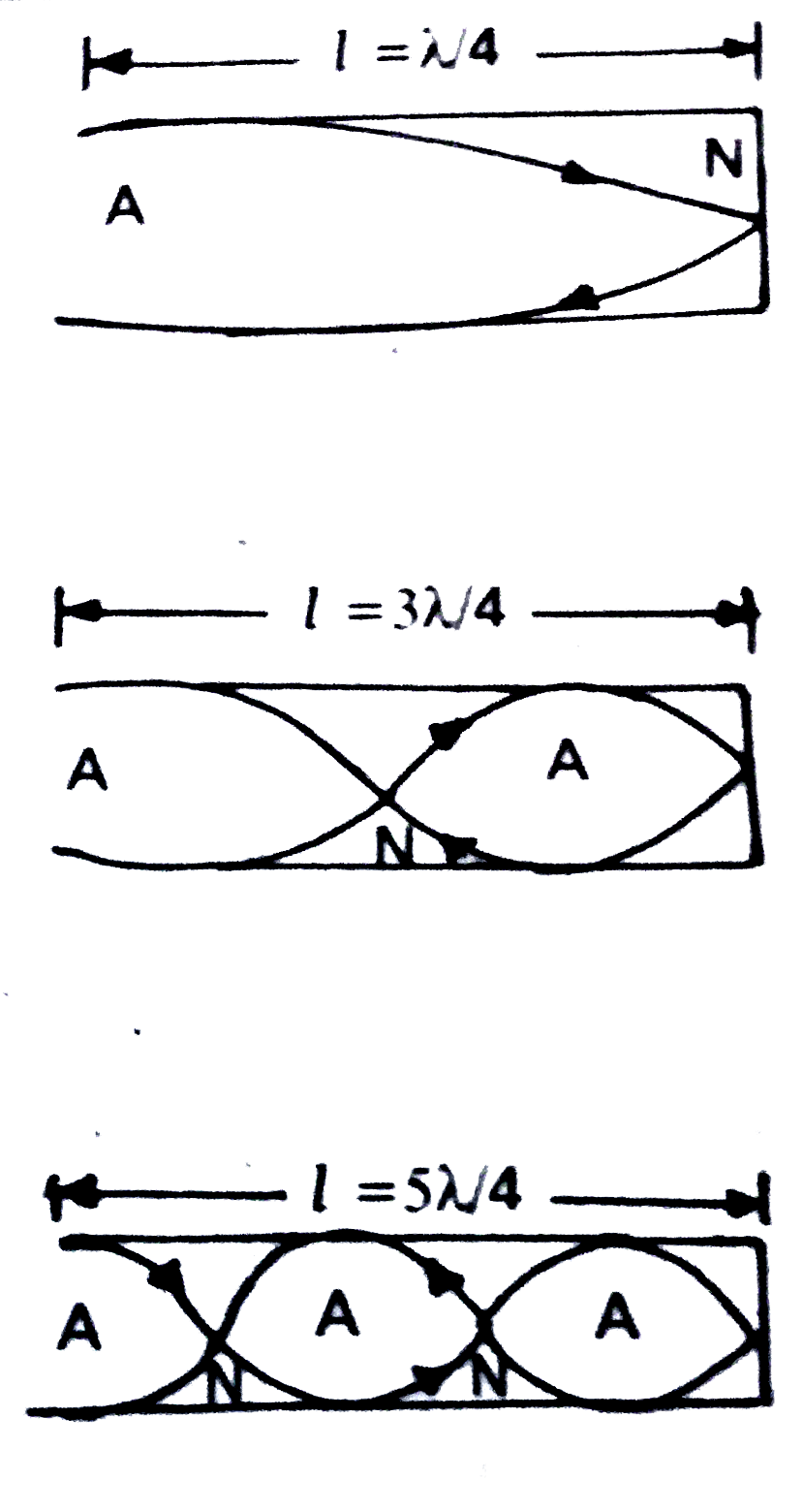 Determination of frequency of a SOURCE of sound `:` (1) The vibrating fork ofunknown frequency (v) is placed above theopen end of the tube. 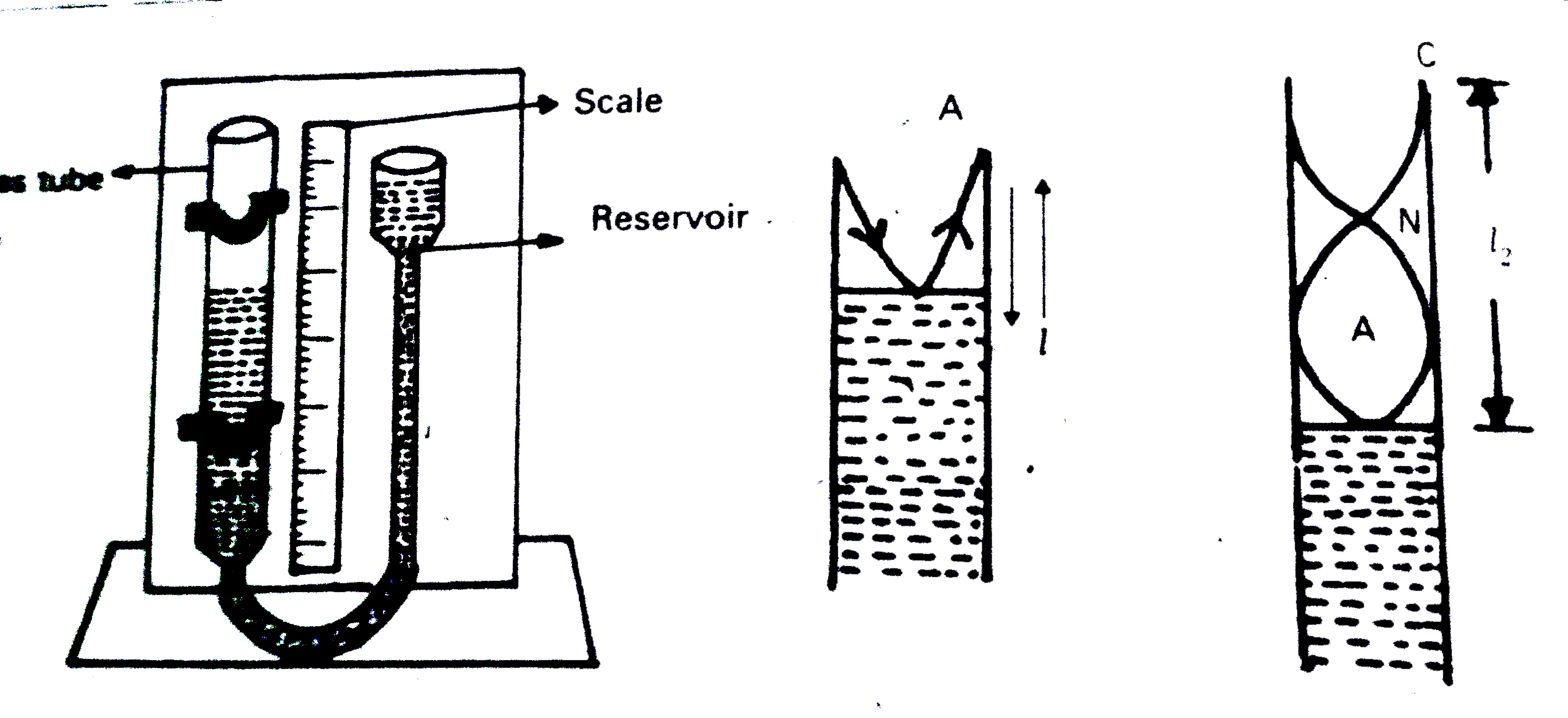 (2) Reservoir is slowly lowered, until a large booming sound is heard.Measure 1st resonating air column length `l_(1)`. (3) Further lower the reservoir, untl second timer a large booming sound s heard. Measure`2^(nd)` resonating air column length `l_(2)`. (4) VELOCITY of a waveat `0^(@) C `is `v =331m//s`. (5) By KNOWING `v, l_(1)` and `l_(2)` we can find unknown frequency of a tunning fork using `v=(v)/(2 ( l_(2) - l_(1)))` |
|
| 10. |
Force vec(F) acting on a test charge q_(0) in a uniform electric field vec(E) is |
|
Answer» `VEC(F) = q_(0) vec(E)` |
|
| 11. |
(A):If a particle is thrown upward then distance travelled in last second of upwardjourney is independent of the velocity of projection. (R ):The slope of tangent to path always measure the magnitude of velocity at that point |
|
Answer» |
|
| 12. |
A 220 V input is supplied to a transformer . The output circuit draws a current of 2.0 ampere at the current drawn by the primary winding of the transformer is |
|
Answer» 2.5 ampere. `ETA= (V_(s)I_(s))/(V_(P)I_(P))xx100%` `80= (440xx2)/(220xxI_(P))xx100` `I_(P)=5A` |
|
| 13. |
Which of the following is not irrational? |
|
Answer» `(2-sqrt3)2` |
|
| 14. |
A piece of metal floats on mercury. The coefficients of volume expansion of the metal and mercury are gamma_1 and gamma_2 respectively. If the temperatures of both mercury and the metal are increased by an amount DeltaT, the fraction of the volume of the metal submerged in mercury changes by the factor............ |
|
Answer» `(1+gamma_(2)DELTAT)/(1+gamma_(1)DeltaT)` |
|
| 15. |
How is a wave front different from a ray? Draw the geometrical shape of the wavefronts when. light diverges from a point source, |
| Answer» Solution :A wavefront is a surface obtained by joining all points vibrating in the same phase.A RAY is a line DRAWN PERPENDICULAR to the wavefront in the DIRECTION of PROPAGATION of light.(i) Spherical | |
| 16. |
A steam of similar negatively charged particles enters an electrical field normal to the elctric lines of force with a velocity of 3xx10^(7)m//s . The electric intensity is 100m , the electrons beam is deflected by 2mm . Then the specific charge value of inC kg ^(-1) is |
|
Answer» `2xx10^(10)` |
|
| 17. |
Derive mirror equation. |
Answer» Solution :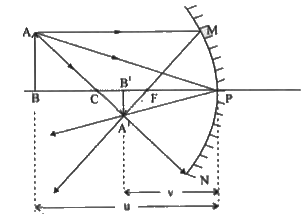 MPN is a concave mirror of radius of curvature 2f and focal length f. AB represents an extended object and A.B. its image. For objects beyond C, the image is real and inverted and is formed in b/w F and C. The image will be diminished. Let u be the object distance from P and v be the image distance from P. Sign convention : (1) All distances aremeasured from the POLE of the mirror. (2) Distances measured from P and to the opposite direction of incident light are taken as negative. Let .M. be very close to P. Then the arc lengthMP = perpendicular length PM. Considerright angled triangles A.B.F and MPF `(A^(1)B^(1))/(MP)=(B^(1)F)/(FP)`, SINCE `MP=AB, (A^(1)B^(1))/(AB)=(B^(1)F)/(FP)""`...........(1) where,`B^(1)F=B^(1)P-FP=v-f "" `.........(2) Consider two other SIMILER rightangled triangles ABP and `A^(1)B^(1)P`. `(A^(1)B^(1))/(AB) = (B^(1)P)/(BP) = (-v)/(-u) "" ` .........(3) comparing (1) and (3) since`PF=-f, B^(1)P=-v`, be sign conventions we get, i.e., `(B^(1)F)/(FP)= (B^(1)P)/(BP)` i.e., `(v-f)/(f)= (v)/(u)` i.e., `(v)/(f)-1=(v)/(u) "" divide v` on both sides, we get`(1)/(f)-(1)/(v)=(1)/(u)` Hence, `(1)/(f)=(1)/(u)+(1)/(v)` This is known as the mirror formula. Note : Magnification,`m=(v)/(u). ""` By sign convention `h_(0)` is +ve, and for read image `h_(i)` is -ve. hence, `m=(-h_(i))/(h_(o))=(v)/(u)` or`m=(-v)/(u)` |
|
| 18. |
Molten lead of mass m = 5.0 g at a temperature t_2 = 327^@C (the melting temperature of lead) was poured into a calorimeter packed with a large amount of ice at a temperature t_1 = 0 ^@C. Find the entropy increment of the system lead-ice by the moment the thermal equilibrium is reached. The specific latent heat of melting of lead is equal to q = 22.5 J//g and its specific heat capacity is equal to c = 0.125 J//(g.K). |
|
Answer» Solution :`DELTA S = -(m q_1)/(T_2) - MC 1n (T_2)/(T_1) + (M q_(ICE))/(T_1)` where `M q_(ice) = m(q_2 + c(T_2 - T_1)` =`mq_2 ((1)/(T_1) -(1)/(T_2)) + mc ((T_2)/(T_1) - 1 -(T_2)/(T_1))` =`0.2245 + 0.2564 ~~ 0.48 J//K`. |
|
| 19. |
A screen is at a distance of 2m from a narrow slit illuminated with light of 600 nm . The first minimum lies 5mm on either side of the centralmaximum . The width of slit is |
|
Answer» `0.024` MM |
|
| 20. |
A ray of white light is incident on a spherical water drop whose center is C as shown below. When observed fromthe opposite side, the emergent light – |
|
Answer» Will be WHITE and will emerge WITHOUT deviating |
|
| 21. |
एक पुष्प के परागकणों का उसी पादप के दूसरे पुष्प के वर्तिकाग्र तक का स्थानांतरण कहलाता है |
|
Answer» स्वयुग्मन |
|
| 22. |
In India electricity is supplied for domestic use at 220 V. It is supplied at 110 V in USA. If the resistance of a 60 W bulb for use in india is R, the resistance of a 60 W bulb for use in USA will be |
| Answer» ANSWER :C | |
| 23. |
A rotating, rigid body makes one complete revolution in 2s. What is its average angular velocity? |
|
Answer» Solution :One complete REVOLUTION is EQUAL to an angular displacement of `2pi` RADIANS, so the body's average angular VELOCITY is `overline(omega)=(Deltatheta)/(Deltat)=(2pi" rad")/(2s)=pi` rad/s |
|
| 24. |
A potential difference of 30V is applied between the ends of a conductor of length 100 m and resistance 0.5Omega . The conductor has a uniform cross-section. Find the total linear momentum of free electrons. |
|
Answer» `60A, 3.4xx10^(-8)kg//s` |
|
| 25. |
Assertion: When a charged capacitor is connected to an pure inductor then current in the inductor varies sinusoidal. Reason: Total energy of the circuit remains constant. |
|
Answer» If both assertion and REASON are correct and reason is correct EXPLANATION of the assertion |
|
| 26. |
Newton's law of cooling is valid for |
|
Answer» LAW TEMPERATURE |
|
| 27. |
(A):If a particle is thrown upward then distance travelled in last second of upward journey is independent of the velocity of projection. (R ):A vertically projected body covers a distance of 4.9 m in the last second of its upward journey. |
|
Answer» |
|
| 28. |
Magnetic field at the centre of circular loop of radius R is B. Magnetic moment of this coilwould be _______ |
|
Answer» `(BR^(3))/(2pimu_(0))` `thereforeI=(2BR)/mu_(0)` `rArr` Now `mu_(0)=IA=(2BR)/mu_(0)xxpiR^(2)" "thereforemu=(2piBR^(3))/mu_(0)` |
|
| 29. |
Two blocks A and B of same masses are resting in equilibrium on an inclined plane having inclination with horizontal =alpha(gt0). The blocks are touching and exerting no zero normal force on each other with block B higher than A. Coeffcient of static friction of A with incline =1.2 adn of B=0.8. If motons not imminent |
|
Answer» `alphagt30^(@)` `f_(A)=mg SIN alpha +N` `f_(B)=mg sin alpha-N` To SHOW `N!=0` `f_(b_("max"))=0.8mgcosalpha` `=N=mg[sinalpha-0.8cosalpha]` `N=mg sec alpha [tan alpha-0.8]` `N=mgsec alpha [tan alpha-0.8]` For `alpha gt tan^(-1) (0.8)` `f_(A)gt f_(B)` for `alpha ge tan^(-1)(0.8)f_(A)=f_(B)` 
|
|
| 30. |
Name the physical whose SI unit is Wb m^(-2). Is it a scalar or vector quantity ? |
| Answer» Solution :Magnetic FIELD `VECB` (or magnetic flux density `vecB`) . It is a vector QUANTITY. | |
| 31. |
a. What is the principle used in optical fibres ? b.Explain briefly the working principle. c. What are the uses of optical fibres ? |
|
Answer» Solution :a. Total internal reflection b. Optical fibres work on the principle of total internal reflection. A FIBRE consists of large number of very long fine quality glass or quartz ( of higher refractive index. ) they are coated with a thin layer of material of lower refractive index. When light is incidentat a small angle on one end, it is refracted into the fibre and falls on the SURFACE of coating . Until the angle of incidence remains greater than criticl angle of fibre, it is completed again and again. Then it emerges out through the other end even if the fibre is bent. c. Uses i. Used as .light pipe. in medical and optical diagnosis. ii.Used in optical SIGNAL transmission. III. Used to carry telephone, television and computer signals as pulses of light. iv used for transmission nad receiving electrcial signals which have been converted into light. 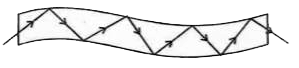
|
|
| 32. |
A particle moves along a straight line OX. At a time (in second) the distance x (in metre) of the particle from "O' is given by : x=40+12t-t^(3) How long particle travels before coming to rest ? |
|
Answer» 16 m `v=(dx)/(DT)=12-3t^(2)` For `v=0,3t^(2)`=12 or `t=2s` `:.x=40+12xx2-(2)^(3)` 64-8=56 m. |
|
| 33. |
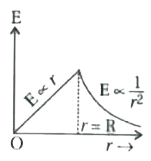
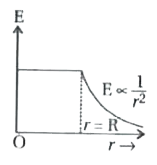
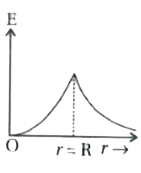
Which of the following is the graph of electric field versus distance r from the centre of charged spherical shell ? R is the radius of tr sphere shell, 'O' is centre of shell |
|
Answer»
|
|
| 34. |
20Omegaresistance is connected to V = 220sin (100pit) voltage source. Time taken by current to reduce from maximum value to its rms value is ..... |
|
Answer» 0.2 s `THEREFORE I=I_0 sin (100 pit)` Here, `delta=0` `therefore I_0/sqrt2=I_0 sin (100pit)` `1/sqrt2=sin (100pit)` `therefore 100pit = pi/4` `therefore t=1/400`=0.0025 `therefore t=2.5xx10^(-3)` s |
|
| 35. |
Two antinodes are formed at distance 4cm successively. What will be the wavelength |
|
Answer» 8cm |
|
| 36. |
The maximum particle velocity is 3 times the wave velocity of a progressive wave. If the amplitude of the particle is "a". The phase difference between the two particles seperated by a distance of 'x' is |
|
Answer» `X/a` |
|
| 37. |
Find the angular separation between the consecutive bright fringes in a Young's double slit experiment with blue-green light of wavelength 500 nm. The separation between the slit is 2.0 xx 10^(-3) m. |
|
Answer» `0.14^(@)` |
|
| 38. |
Find the tension needed to produce stationary waves with 4 loops in a string 1m long and 0.5 gram in weight, fixed to a tuning fork of frequency 200Hz, when the prongs of the fork are vibrating perpendicular to the string. |
|
Answer» 5N |
|
| 39. |
A tuningfork 'A' produces 6 beats per second with another fork 'B'. On loading 'B' with a little wax, it produces 5 beats per second with 'A'. If the frequency of 'A'is 256 Hz find the frequency of 'B?. |
|
Answer» Solution :Let the FREQUENCIES of the forks be `n_(A) and n_(B)` RESPECTIVELY. They produce 6 beat, per second. `:.n_(A)=n_(B)=6 or n_(B)-n_(A)=6` The frequency of .B. decreases on loading i.e. `n_(B) lt n_(B)` The beat frequency after loading is 5. `:.n_(A)-n_(B)=5 or :. n_(B)-n_(A)=5` If originally `n_(A)-n_(B)=6` is correct, then `n_(A)-n_(B) gt 6` But it is not so. The beat frequency did not increase `:.` Originally `n_(B)-n_(A)=6` is correct `n_(B)=n_(A)+6256+6=262 HZ` |
|
| 40. |
The initial mass of a rocket is 30 tons, the initial acceleration is 3g. The rocket has four nozzles each of 20 cm diameter. The remaining data are the same as in the previous problem. Find the initial fuel consumption (together with the oxidant), the density and the pressure of the gas ejected from the nozzle. |
|
Answer» The density of the gas is found from the continuity equation: `RHO = mu/(Su) = (16 mg)/(pi D^2 u^2)` The pressure is found from the Mendeleev-Clapeyron equation. |
|
| 41. |
Two points p and Q lie on either side of an axis XY as shown. It is desired to produce an image of p at Q using a spherical mirror, with XY as the optic axis. The mirror must be |
|
Answer» Converging and POSITIONED to the left of p |
|
| 42. |
Demonstrate that the quantity E^2-p^2c^2 for a particle is an invariant, i.e. it has the same magnitude in all inertial reference frames. What is the magnitude of this invariant? |
|
Answer» Solution :As before `E=m_0c^3(dt)/(DS)`, `p_x=m_0c(DX)/(ds)`. Similarly `p_y=m_0c(dy)/(ds)`, `p_z=m_0c(DZ)/(ds)` Then `E^2-c^2p^2=E^2-c^2(p_x^2+p_y^2+p_x^2)` `=m_0^2c^4((c^2dt^2-dx^2-dy^2-dz^2))/(ds^2)=m_0^2c^4` is invariant |
|
| 43. |
Assertion : For communication antennae length should be comparable to lambda (iota ~ lambda) Reason : It leads to maximum power |
|
Answer» If both ASSERTION and reason are TRUE and reason is the correct explanation of assertion. |
|
| 44. |
Laser light of wavelength 640 nm incident on a pair of slits produces an interference pattern in which the bright fringes are separated by 7.2 mm. calculated the wavelength of another source of light which produces interference fringes separated by 8.1 mm using same arrangement. Also find the minimum value of the order (n) of bright fringes of shorter wavelength which coincides with that of the longer wavelength. |
|
Answer» Solution :Here `lamda_(1)=640nm,beta_(1)=7.2mm,and beta_(2)=8.1mm` For same arrangement, `(beta_(2))/(beta_(1))=(lamda_(2))/(lamda_(1))implieslamda_(2)=(beta_(2)lamda_(1))/(beta_(1))=(8.1xx640)/(7.2)=720nm` Let n bright FRINGES of shorter wavelength `(lamda_(1)=640nm)` coincide with (n-1) bright fringes of longer wavelength `(lamda_(2)=720nm)`, then `nlamda_(1)=(n-1)lamda_(2)`. `impliesn=(lamda_(2))/((lamda_(2)-lamda_(1)))=(720)/(720-640)=9`. |
|
| 45. |
In a Young's double slit interference experiment the fringe pattern is observed on a screen placed at a distance D from the slits. The slits are separated by a distance d and are illuminated by monochromatic light of wavelength lambda. Find the distance from the central point where the intensity falls to (a) half the maximum, (b) one fourth of the maximum. |
|
Answer» `(D LAMBDA)/(4D), (D lambda)/(3D)` |
|
| 46. |
What will be the change in mass of object if it is charged by rubbing ? |
|
Answer» doesn't change |
|
| 47. |
Which of the following is the correct prefix with the word "conductor" |
|
Answer» Semiconductor |
|
| 48. |
An object and a convex lens are approaching each other with speeds 3cm^(-1) and 1cm^(-1)along the principal axis as shown focal length of lens is 10 cm. If the speed of image relative to ground frame of reference is 5x. Then find x. |
|
Answer» |
|
| 49. |
A parallel - plate capacitor containing a dielectric slab is connected to a cell. The slab is then taken out of the capacitor slowly. Disregard the forces of gravity and friction. For this process, which of the following statements is incorrect? |
|
Answer» The external agent pulling the slab out will have to PERFORM some WORK. |
|