

Saved Bookmarks
This section includes 7 InterviewSolutions, each offering curated multiple-choice questions to sharpen your Current Affairs knowledge and support exam preparation. Choose a topic below to get started.
| 1. |
Three identical large metal plates each of area S are at distance d and 2d from each other as shown. Metal plate A is uncharged, while metal plates B and C have charges + Q and - Q respectively. Metal plates A and C are connected by a conducting wire through a switch K. How much electrostatic energy is lost when the switch is closed ? |
|
Answer» |
|
| 2. |
A very long staright conductor and an isoceles triangular conductor lie in a plane and separated from each other as shown in the figure. Given a=10cm, b=20cm and h=10cm (a) Find their coefficeint of mutual induction. (b)If current in the staright wire is increasing at a rate of 2A//s , find the direction and magnitude of current in the triangular wire. [Diameter of the wire crosss-section d=1 mm, resistivity of the wire, rho=1.8xx10^(-8)Omega-m] |
|
Answer» Solution :`(a)` Assuming a small strip at a distance `X` from the apex. `dA=(b)/(h)XDX` Let `I` be the current folowing in the straight wire, then magnetic field at the location of the strip is `B=(mu_(0)I)/(2pi(a+x))` `dphi=BdA=(mu_(0)IB)/(2pih)((xdx)/(a+x))` `phi=(mu_(0)Ib)/(2pih)int_(0)^(h)[1-(a)/(a+x)]DX` `phi=(mu_(0)Ib)/(2pih)=[h-a ln|(a+h)/(a)|]` The COEFFICENT of mutual induction is given by `M=(phi)/(I)=(mu_(0)b)/(2pih)[h-aln|(a+h)/(a)|]` Here, `b=20cm`, `h=10cm`, `mu_(0)=4pixx10^(-7)H//m` `M=((4pixx10^(-7))(0.2))/(2pi(0.1))[0.1-0.1ln|(10+10)/(10)|]=1.22xx10^(-8)H` `(b)` According to Faraday's law `E_("ind")=-M(di)/(dt)` since, `(di)/(dt)=2A//s` `:. (E_("ind")=(1.22xx10^(-8))(2)=2.44xx10^(-8)` volt. Resistance of the triangular conductor is `R=rho(1)/(A)` here, `rhp=1.8xx10^(-8)Omega-m`, `1=10sqrt(2)+20+10sqrt(2)=20(sqrt(2)+1)cm=0.48cm` `A=(pi)/(4)(10^(-3))^(2)=10^(-6)(pi)/(4)m^(2)` `:. R=(1.8xx10^(-8))((0.48))/((3.14))xx(4)/(10^(-6))=1.1xx10^(-2)Omega` `I=(E_("ind"))/(R )=(2.44xx10^(-8))/(1.1xx10^(-2))=2.2muA` The direction of the current is anticlockwise by Lenz Law. 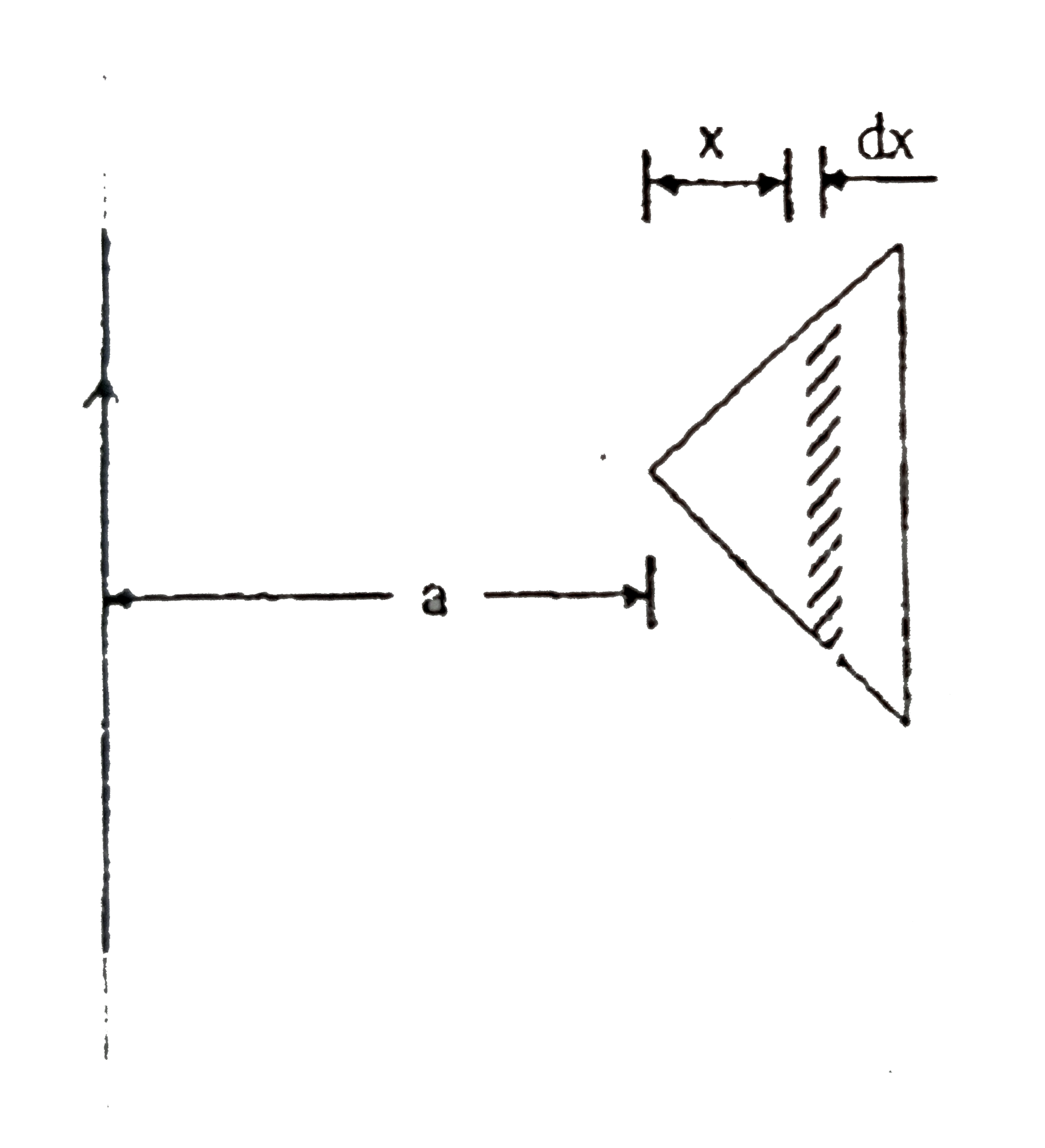
|
|
| 3. |
Vacuoles that helps in expulsion of water is known as |
|
Answer» SAP vacuoles |
|
| 4. |
A spherical bob of mass m and radius R is attached to a fixed point by means of a massless rigid rod whose length from the point of support up to the centre of bob is l. Find the period of small oscillation. |
|
Answer» Solution :`l (d^(2) THETA)/(dt^(2)) = -mg l SIN theta ~= -mgl theta` where `l = (2)/(5) mR^(2) + m l^(2)` `=m ((2)/(5) R^(2) + l^(2))` `:. (d^(2) theta)/(dt^(2)) = (- mg l theta)/(m((2)/(5) R^(2) + l^(2)))` `rArr T = 2pi sqrt((5L^(2) + 2R^(2))/(5gl))` 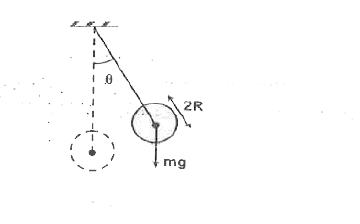
|
|
| 5. |
For an electron in the second orbit of Bohr's hydrogen atom, the moment of linear momentum is ...... |
|
Answer» `(2h)/(pi)` Now n = 2 in second orbit of linear momentum `=(h)/(pi)` |
|
| 6. |
A point charge q is located at a very small distanceform the center of a very large square on the line perpendicularto the square passing through its center Determine the approximate electric flux through the square due to the point charge. |
| Answer» SOLUTION :`q//2epsilon_(0)` | |
| 7. |
The temperature at which a black body radiates at the rate of 5.67"W cm"^(-2) is (sigma=5.67xx10^(-8)S.I.): |
|
Answer» 100 K Now `E=sigmaT^(4)""RARR""T=((E)/(sigma))^(1//4)` `T=((5*67xx10^(4))/(5*67xx10^(-8)))^(1//4)=1000K`. THUS correct choice is (c ). |
|
| 8. |
The number of electrons for 1 coulomb of charge is |
|
Answer» `a) 6.25xx10^18` |
|
| 9. |
Four persons K, L, M and N are initially at four corners of square of side a. Each person now moves with a velocity V in such a way that K moves directly towardsL, L directlytowards M, M directlytowards N and N directly towards K. The four persons will meet after a time : |
|
Answer» `(a)/(V)` |
|
| 10. |
A particle in simple harmonic motion is described by the displacement functionx(t) = A cos(omegat +theta).If the initial (t = 0) position of the particle is 1 cm, its initial velocity is it cm/s, and its angular speed is pi radian per second then its amplitude is |
|
Answer» 1 cm At t=0, I = A cos `(0 + theta) = A cos theta` `rArr cos theta =1/A`...........(i) Velocity of PARTICLE `=(DX)/(dt) =-AOMEGA. Sin(omegat + phi)` `pi =-A.pi sin theta rArr sin theta =1/A`............... (ii) By SQUARING and adding equation (i) and (ii) we get `cos^(2) theta + sin^(2) theta =1/A^(2) + 1/A^(2) =2/A^(2)` `therefore A^(2) =2` or `A = sqrt(2) cm` |
|
| 11. |
A coin placed on a rotating turn table just slips if it is placed at a distance of 4cm from the centre. If the angular velocity of turn table is doubled, it will just slip at a distance of |
| Answer» ANSWER :A | |
| 12. |
An object of height 2.5 cm is placed perpendicularly on the principal axis of a concave mirror of focal length f at a distance of (3)/(4)f. What will be the nature of the image of the object and its height? |
|
Answer» Solution :For concave mirror, the FOCAL length `f` is actually - f, using the proper sign. Also, u = `-(3)/(4)f.` So the relation `(1)/(v) + (1)/(u) = (1)/(f)` gives, `(1)/(v) + (-(4)/(3f)) = (1)/(-f) or, (1)/(v) = (4)/(3f) - (1)/(f) = (1)/(3f)` or, v = 3f The positive sign of v means that the image is formed on the OPPOSITE side, so it is a virtual image. MAGNIFICATION = `-(v)/(u) = (3f)/(-(3f//4)) = 4 ` `therefore` Image height `= 4 xx 2.5 = 10 `cm |
|
| 13. |
Draw energy band diagrams of n-type and p-type semiconductors at temperature T > O K. Mark the donor and acceptor energy levels with their energies. |
Answer» SOLUTION :`{:("Energybandsof "," ENERGY BANDS of "),("n-typeat T> 0"," p-typeat T> 0"):}` 
|
|
| 14. |
(A): In our houses when we start switching on different light buttons main current increases. (R): The connections are in parallel. |
|
Answer» Both 'A' and 'R' are TRUE and 'R' is the CORRECT explanation of 'A' |
|
| 15. |
A ray of light passes from vacumm into a medium of refractive index n. If the angle of incidence is found to be twice the angle of refraction, then the angle of incidence is : |
|
Answer» `2 sin^-1(N/2)` |
|
| 16. |
The order of size of nucleus and Bohr's radius of an atom respectively are : |
|
Answer» `10^(-14) m, 10^(-10)m` |
|
| 17. |
What we call to the transfer of information or message from saurce. |
| Answer» SOLUTION :COMMUNICATION | |
| 18. |
A bullet moving with velocity upsilon stops suddenly after hitting the target and whole of its mass m melts. If s is the specific heat, L the latent heat and its initial temp. is 25^(@)C and melting point. is 475^(@)C, then the velocity upsilon is given by: |
|
Answer» mL =ms `(475-25)+(1)/(2) mv^(2)//J` HEAT produced `Q=(W)/(J) (mv^(2))/(2J)` Heat required to melt the bullet `Q^(1)=ms Delta T+mL` `Q_(1)=ms (475-25)+mL` `therefore Q_(1)=Q` `ms (475-25) mL =(mv^(2))/(2J)` Hence, correct CHOICE is (b). |
|
| 19. |
State Coulomb's law in electrostatics and explainit in the case of the case of free space. |
|
Answer» Solution :The electrostatic force of attraction or REPULSION between two point charges `q_1` and `q_2`separated by a distance r is directly proportional to the PRODUCTOF the magnitudeof the chargesand inverselyproportional to the square of the distance between them. `F alpha (q_1q_2)/r^2` `F=k(q_1q_2)/r^2` Where k=Constant=`1/(4piepsilon_0)` Where `epsilon_0`is CALLED permittivity of free space. 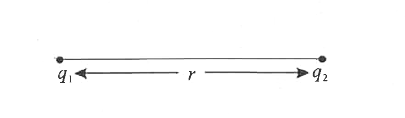
|
|
| 20. |
Why diamond dazzles ? |
| Answer» SOLUTION :It is due to total internal reflection.Diamond has refractive index of 24 and a CRITICAL angle of `24.5^@`. Thus light ENTERING a diamond suffers total internal reflection at NEARLY all surfaces. Hence,it dazzles. | |
| 21. |
The main lesson of this sample problem is this: It isperfectly all right to choose an easy path instead of a hard path. Figure 8-22a shows a 2.0 kg block of slippery cheese that slides along a frictionless track from point a to point b. The cheese travels through a total distance of 2.0 m along the track, and a net vertical distance of 0.80 m . How much work is done on the cheese by the gravitational force during the slide ? |
|
Answer» Solution :KEY IDEAS (1) We cannot calculate the work by using Eq. 8-12 `(W_(g)= mgd cos phi)`. The reason is that the angle `phi` between the directions of the gravitational force `vec(F)_(g)` and the displacement `vec(d)` VARIES along the trackin an unknown way. (Even if we did know the shape of the track and could calculate `phi` along it, the calculation could be very DIFFICULT. ) (2) Because `vec(F)_(g)` is a conservation force, we can find the work by choosing some other path beween a and b - one that makes the calculation easy. Calculations:Let us choose the dashed path in Fig. 8-22b, it consists of two straight segments. Along the horizontal segment, the angle `phi` is a constant `90^(@)`. Even though we do not know the displacement along that horizontal segment, Eq. 8-12 tells us that the work `W_(h)` done there is `W_(h)=mgd cos 90^(@)=0`. Along the vertical segment, the displacement d is 0.80 m and , with `vec(F)_(g)` and `vec(d)` both downward, the angle `phi` is  Figure 8-22 (a) A block of cheese slides along a frictionless track from POINT a to point b. (b) Finding the work done on the cheese by the gravitational force is easier along the dashed path than along the actualpath taken by the cheese, the result is the same for both paths. a constant `0^(@)`. Thus, Eq.8-12 GIVES us, for the work `W_(b)` done along the vertical part of the dashed path, `W_(v) = mgd cos 90^(@)`. ` = (2.0kg) (9.8 m//s^(2))(0.80 m)(1)` `=15.7` J. The total work done on the cheese by `vec(F)_(g)` as the cheese moves from point a to point b along the dashed path is then `W=W_(h)+W_(v)=0+15.7 J ~~ 16 J`. This is also the work done as the cheese slides along the track from a to b. |
|
| 22. |
When lights of different colours move through water, they must have different |
|
Answer» wavelengths |
|
| 23. |
A golfer standing on the ground hits a ball with a velocity of 52 m/s at an angle theta above the horizontal if tan theta=(5)/(12) find the time for which the ball is at least 75m above the ground? (g=10 m//s^(2)) |
|
Answer» Solution :`v_(y)= sqrt(u_(y)^(2)-2gy) ` `=sqrt(52xx52xx(5xx5)/(13xx13)-2xx10xx15)= sqrt(16xx25-300)=10` `Delta =(2u_(y))/(10)=(2XX10)/(10)=2s` 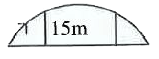
|
|
| 24. |
A particle of mass 'm' and charge 'q' moves with a constant velocity 'v' along the positive x-direction. It enters a region containing a uniform magnetic field B directed along the negative Z-direction, extending from x = a to x=b. The minimum value of 'v' required, so that the particle can just enter the region x > b is |
|
Answer» `(qbB)/(m )` |
|
| 25. |
एक बिंदु आवेश के कारण 3 मीटर की दुरी पर विद्युत क्षेत्र 500 न्यूटन/कूलॉम है। आवेश का परिमाण होगा - |
|
Answer» 2.5µC |
|
| 26. |
For protecting a sensitive equipment from the external magnetic field, it should be |
|
Answer» placed inside an aluminium can |
|
| 28. |
(A ): A charge is lying at the centre of the line joining two similar charges each which are fixed. The system will be in equilibrium if that charge is one fourth of the similar charges. (R ): For charge to be in equilibrium, sum of the forces on charge due to rest of the two charges must be zero. |
|
Answer» Both .A. and .R. are TRUE and .R. is the correct EXPLANATION of .A. |
|
| 29. |
In total internal reflection when the angle of incidence is equal to the critical angle for the pair of media in contant, what will be angle of refraction ? |
|
Answer» `90^@` 
|
|
| 30. |
If the circuit is connected to a high frequency supply (240 V, 10 kHz). Hence, explain the statement that at very high frequency, an inductor in a circuit nearly amounts to an open circuit. How does an inductor behave in a dc circuit after the steady state? |
|
Answer» Solution :(a) `I_(0)=1.1xx10^(-2)A` (B) `tan PHI=100pi, phi` is close to `pi//2`. `I_(0)` is much smaller than the low frequency caseshowing thereby that at high frequencies, L nearly amounts to an open circuit. In a dc circuit (after steady state) `omega=0`, so here L acts LIKE a PURE conductor. |
|
| 31. |
Figure 9.34 shows an equiconvex lens (of refractive index 1.50) in contact with a liquid layer on top of a plane mirror. A small needle with its tip on the principal axis is moved along the axis until its inverted image is found at the position of the needle. The distance of the needle from the lens is measured to be 45.0cm. The liquid is removed and the experiment is repeated. The new distance is measured to be 30.0cm. What is the refractive index of the liquid? |
| Answer» SOLUTION :`n=1.33` | |
| 32. |
Two bodies of masses m and 2m are moving along positive x and y axes respectively with equal speed 4 ms^-1. They collide at origin and stick together. The final velocity of combined mass is |
|
Answer» `(4hati+8hatj) ms^-1` |
|
| 33. |
In the figure shown, parallel beam of light is incident on the plane of the slits of a Young's double slit experiment. Light incident on the slit S_(1) passes through a medium of variable refractive index mu = 1 + ax (where 'x' is the distance from the plane os lits as shown), upto a distance 'l' before falling on S_(1). Rest of the space is filled with air. If at 'O' a minima is formed, then the minimum value of the positive constant a (in terms of l and wavelength 'lambda' in ) is : |
|
Answer» `(lambda)/(L)` |
|
| 34. |
An object is placed at 15 cm from a convex lens of focal length 10 cm. Where should another convex mirror of radius 12 cm placed such that image will coincide with object |
| Answer» ANSWER :A | |
| 36. |
A TV tower has a height of 75m. What is the maximum area upto which this TV communication can be possible ? |
|
Answer» 1509 KM |
|
| 37. |
Flash spectrum confirms a/an |
|
Answer» TOTAL solareclipse |
|
| 38. |
A 10 mu F capacitor and 20 mu F capacitor are connected in series across 200 V supply line. The charged capacitors are then disconnected from the line and reconnected with their positive plates together and negative plates together and no external voltage is applied. What is the potential difference across each capacitor? |
| Answer» Answer :A | |
| 39. |
The change in the value of g at a height 'h' above the surface of earth is the same as at a depth 'd' below the surface of earth. When both d and h are much smaller than the radius of earth, then which one of the following is correct? |
|
Answer» `d=(h)/(2)` `g.=g(1-(2h)/(R )) rArr Delta g_(1)=(2h)/(R ).g` At DEPTH d below the surface of earth `g.=g(1-(d)/(R )) rArr Delta g_(2)=(d)/(R ).g` since `Deltag_(1)=Delta g_(2) rArr d=2h`. So the correct CHOICE is (c ). |
|
| 40. |
Calculate the degeneracy temperature for the electron gas in aluminium, in sodium and in copper. |
|
Answer» |
|
| 41. |
The refractive index of an anisotropic medium varies as mu=mu_(0)sqrt((x+1)) , where 0lexlea. A ray of light is incident at the origin just along y-axis (shown in figure). Find the equation of ray in the medium . |
|
Answer» Solution :`mu=mu_(0)SQRT(x+1)` at `x=0rarrmu=mu_(0)` `musintheta=` constant `mu_(0) SIN90^@=mu_(0)sqrt(x+1)sintheta` `sintheta=(1)/(sqrt(x+1))` `rArr costheta=sqrt((x)/(x+1)` `(dy)/(DX)=tantheta` `rArr (dy)/(dx)=(sintheta)/(costheta)=(1)/(sqrt(x))` `:.intdy=int(1)/(sqrt(x))dx` or `y=2sqrt(x)` 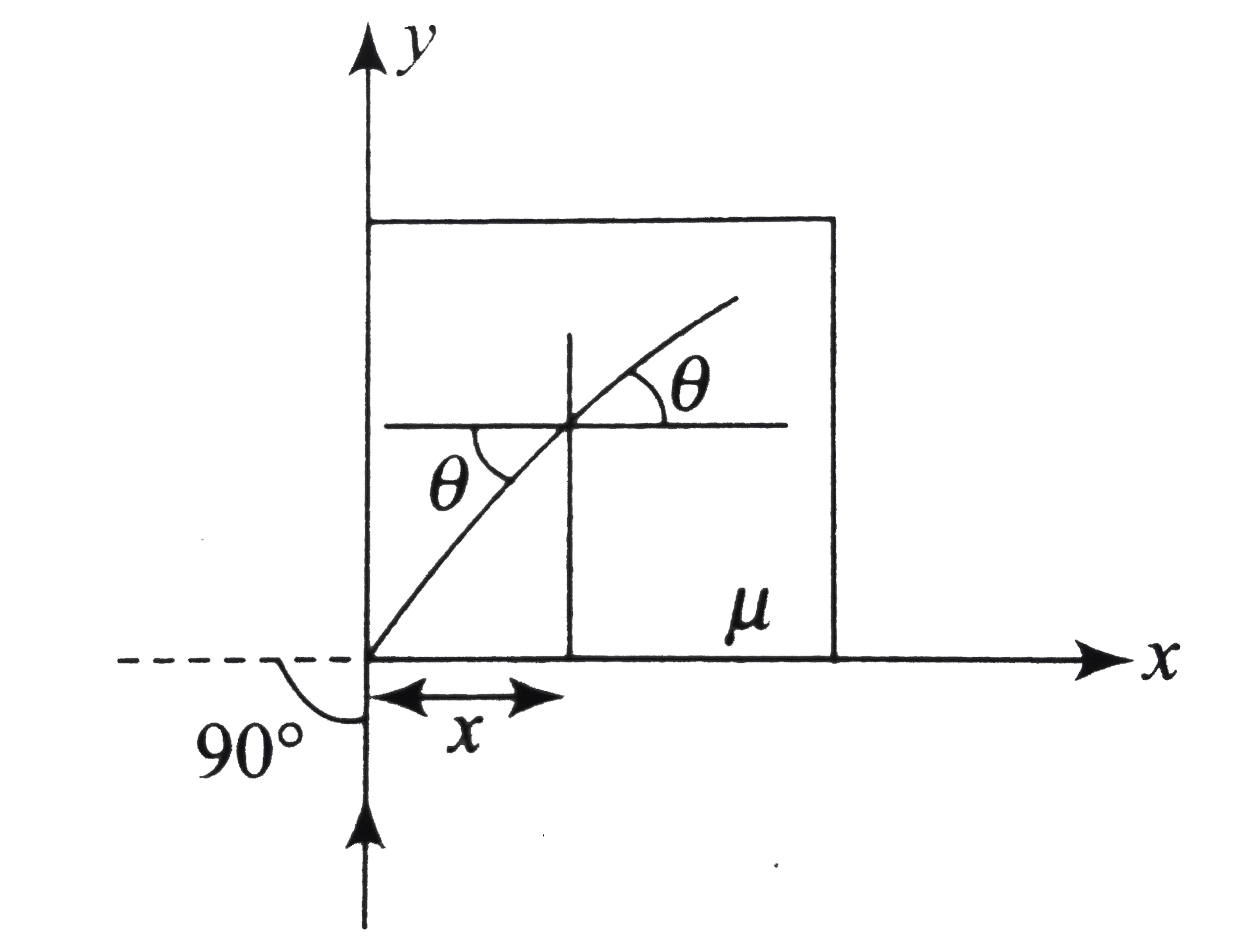
|
|
| 42. |
What is a period of revolution of earth satellite ? Ignore the height of satellite above the surface of earth. Given : The value of gravitational acceleration g= 10 m s^(-2) Radius of earta R_(E)= 6400 km. Take pi=3.14. |
|
Answer» 85 minutes `T = 5024s = 83.73` MIN |
|
| 43. |
A particle of mass mis acted upon by a force F given by the empirical law F + R/(t^2) v (t).If this law is to be tested experimentally by observing the motion starting from rest, the best way is to plot: |
|
Answer» LOG `UPSILON` (t) GIVEN `1/t` |
|
| 44. |
Answer the following questions regarding earth's magnetism Name the three independent quantities conventionally used to specify earth's magnetic field . |
| Answer» SOLUTION :(i) ANGLE of dip , (ii) Angle of DECLINATION , (III) Horizontal component of earth's MAGNETIC field . | |
| 45. |
The dimensional formula for latent heat will be |
|
Answer» `M^0L^2T^-2` |
|
| 46. |
A bomb of mass 16 kg at rest explodes into two pieces of masses 4 kg and 12 kg. The velocity of the 12 kg mass is 4 ms^(-1). The kinetic energy of the other mass is : |
|
Answer» 144 J `16xx0=4v_1+12xx4` `v_1=-12m//s` `:.` K.E. =`1/2m_1v_1^2=1/2xx4(-12)^2=288J`. |
|
| 47. |
A 0.50 gm ball carries a charge of magnitude 10mu C. It is suspended by a string in a downward electric field of intensity 300N/C. If the charge on the ball is positive, then the tension in the string is (g = 10 ms^(-2)) |
| Answer» Answer :B | |
| 48. |
Which of the following are correct about spherical mirrors |
|
Answer» concave mirror FORMS virtual IMAGE of real object some TIMES |
|
| 49. |
Copper is _____ |
| Answer» SOLUTION :DIAMAGNETIC | |