

Saved Bookmarks
This section includes 7 InterviewSolutions, each offering curated multiple-choice questions to sharpen your Current Affairs knowledge and support exam preparation. Choose a topic below to get started.
| 1. |
A pendulum is formed by pivotting a long thin rod of length L and mass m about a point P on the rod which is a distance d above the centre of the rod as shown. As d changes from L/2 to zero |
|
Answer» TIME PERIOD increases continuously |
|
| 2. |
The refiracting angle of a prism is A and the refractive index of the material of the prism is cot(A/2). The angle of minimum deviation of the prism is . |
|
Answer» `PI + 2A` |
|
| 3. |
How far must one stand from a 5 mW point sound source if the intensity is at the hearing threshold? Assume the sound waves travel to the listener without being disturbed. |
|
Answer» 500m |
|
| 4. |
The frequency of a tuning fork A is 5% greater than that of a standard fork K. The frequency of another fork B is 3% less than that of K. When A and B are vibrated simultaneously 4 beats per second are heard. Find the frequencies of A and B. |
|
Answer» 52.5 HZ, 48.5 Hz |
|
| 5. |
How rational system is helpful? |
| Answer» Solution :A system of UNIT is which all the physical quantities, which are qualitatively similar, are EXPRESSED in one unit is CALLED a rational system. In SI, all types of energy is expressed in joule. Therefore, SI is said to be a rational system of units. | |
| 6. |
A concave mirror has a radius of curvature of 24 cm. How far is an object from the mirror, if an image is formed that is (i) virtual and 3.0 times the size of the object, (ii) real and 3.0 times the size of the object and (iii) real and 1//3 the size of the object? |
|
Answer» Solution :Given,R=-24 cm Hence,`f=R/2=-12 cm` (i) image is virtual and three TIMES larger. Hence, u is negative and v is positive. Simultaneousely, `abs(v)=3abs(u)`. So let, u=-x then, v=+3x Substituting in the mirror formula `1/v+1/u=1/f`, we have `1/(3x)-1/x=1/(-12)` `therefore` x=8 cm Therefore, object distance is 8 cm. (II) Image is REAL and three times larger. Hence, u and v both are negative and `abs(v)=3(u)`. So let, u=-x then,v=-3x Substituting in mirror formula, we have `1/(-3x)-1/x=-1/12or x=16 cm` `therefore` Object distance should be 16 cm. (iii) Image is real and `1/3`rd the size of object. Hence both u and v are negative and `abs(v)=abs(u)/3`. So let, u=-x then, `v=-x/3` Substituting in the mirror formula, we have `-3/x-1/x=-1/12` x=48 cm `therefore` Object distance should be 48 cm. |
|
| 7. |
In a triode value for a grid voltage V_g=-1.2V , the phase current I_p and plate voltage V_p are given I_p=(-5+0.1 V_0),I_p in mA and V_p in volt . When grid voltage is changed to - 3.2 V at constant plate voltage of 150 V , a plate current of 5 mA is observed , then Tran conductance inductance g_m is |
|
Answer» `1.5 xx10^3 ohm^(-1)` As `V_p=150 V_p=150 V, i_p=(-5.0+0.1xx150)=10^(-2)A` with `Vg = -3.2 V and V_p = 150 V` `i_p = 5xx10^(-3)A` `:. G_m` (transconductance ) = `((5-10))/((3.2)-(-1.2))` `= 2.5 xx10^(-3) ohm^(-1)` |
|
| 8. |
A particle of unit mass is projected with velocity u at an inclination alpha above the horizon in a medium whose resistance is k times the velocity. Its direction will again make an angle alpha with the horizon after a time |
|
Answer» `1/k "log" {1- (2ku)/g "SIN" alpha}` |
|
| 9. |
A thin equiconvex lens of glass of refractive side of3/2 and of focal length 0.3 m is sealed into anopening at end of a tank filled with water (p=4/3). on the opposite side of the lens a mirror is placed inside the tank with the tank wall perpendicular to the sense axis as shown in figure The separation between the lens and mirror is 0.8 m. A small object is placed outside the tank is front of the lens, at a distance of 0.9 m from the lens along its axis. Find the position (relative to the lens) of the image of the object formed by the system. |
|
Answer» |
|
| 10. |
In a triode value for a grid voltage V_g=-1.2V , the phase current I_p and plate voltage V_p are given I_p=(-5+0.1 V_0),I_p in mA and V_p in volt . When grid voltage is changed to - 3.2 V at constant plate voltage of 150 V , a plate current of 5 mA is observed , then Voltage amplification for 20 kOmega load in plate circuit is |
|
Answer» 5.5 `= (25xx20xx10^3)/((10xx10^3+20xx10^(3)))=50/3` i.e, `A_v=16.67` |
|
| 11. |
In a triode value for a grid voltage V_g=-1.2V , the phase current I_p and plate voltage V_p are given I_p=(-5+0.1 V_0),I_p in mA and V_p in volt . When grid voltage is changed to - 3.2 V at constant plate voltage of 150 V , a plate current of 5 mA is observed , then Amplification factor mu is |
|
Answer» 25 `MU= R XX G ` `= 10 ^4 xx2.5xx10^(-3) = 25` |
|
| 12. |
In a triode value for a grid voltage V_g=-1.2V , the phase current I_p and plate voltage V_p are given I_p=(-5+0.1 V_0),I_p in mA and V_p in volt . When grid voltage is changed to - 3.2 V at constant plate voltage of 150 V , a plate current of 5 mA is observed , then Plate resistance R_p is |
|
Answer» `10^2 Omega` then `((Deltai_p)/(Deltai_p))=0.1xx10^(-3)AV^(-1)` then PLATE RESISTANCE `((Deltai_p)/(Deltai_p))=1/(0.1xx10^(-3))=10^(4)Omega` |
|
| 13. |
The ionisation potential for ...... nucleus will be minimum. |
|
Answer» `""_(7)N^(14)` Here for given nuclei, radius of `C_(s)` is highest hence at the outermost orbit, the electron are most distant from the nucleus therefore, the binding energy of such electrons is lowest. As a result, to emit electron that is energy of IONISATION is lowest so ionisation potential is minimum. |
|
| 14. |
The density of a solid at normal pressure is p. When the solid is subjected to an excess pressure P_(1), the density changes top'. If the bulk modulus of the solid is k, then the ratio (p')/p is |
|
Answer» `1+p/k` `thereforedp=(-m)/(V^(2))DV` `therefore(dp)/P=(-dV)/V` Substituting this VALUE in bulk MODULUS, K`=(-P)/(dV//V)` `K=(-P)/((-dp)/p)=(PP)/(dp)` with increase in pressure, the density increases `thereforedp=p.-p` `thereforeK=(Pp)/(p.-p)` `therefore(p.-p)/p=p/K` `(p.)/p=(1+p)/K` so correct choice is (a). |
|
| 15. |
In a common emitter transistor amplifier the audio signal voltage across the collector is 3 V. The resistance of collector is 3 kOmega. If current gain is 100 and the base resistance is 2 kOmega, the voltage and power gain of the amlifier is : |
|
Answer» 200 and 1000 |
|
| 16. |
If two plane mirrors are inclined at an angle of 120^@to each other, how many images of an object are formed? |
| Answer» SOLUTION :2, if OBJECT on the bisector of MIRRORS, otherwise 3 | |
| 17. |
If two plane mirrors are inclined at an angle of 120^@to each other, how many images of an object are seen? |
| Answer» SOLUTION :any of 1,2 or 3 depending on the POSITION of OBSERVER and OBJECT] | |
| 18. |
A biconvex lens is cut in such a way that its equal two halves are (i) XOX. and (ii) YOY.axis respectively. If the focal length of original lens is fi f. is focal length in case (i) and fi in case (ii), then which of the following is true ? |
|
Answer» f.=2f,f..=2f  `1/f=(mu-1)((1)/(R_1)-(1)/(R_2))` In this CASE, `R_1` and `R_2` doesn.t CHANGE. Hence, focal LENGTH of both is f. `therefore f.=f`  which is combination of two lenses of same focal length. `therefore 1/f=(1)/(f_1)+(1)/(f_2)`where `f_1=f_2=f..` `therefore 1/f=(1)/(f..)+(1)/(f..)=(2)/(f..)` `thereforef..=2f` |
|
| 19. |
Removal of non metallic element is |
|
Answer» Reduction |
|
| 20. |
Assertion. A charge q is placed on a hieght h//4 above the centre of a square of side b. The flux associatedwith the square is independent of side length. Reason. Gauss's law is independent fo size of the Gaussian surface. |
|
Answer» both, Assertion and Reason are true and the Reason is correctexplanation of the Assertion. `phi_(E) = oint_(S) = vec(E) . d Vec(s) = (1)/(in_(0))` `XX` charge enclosed by the surface 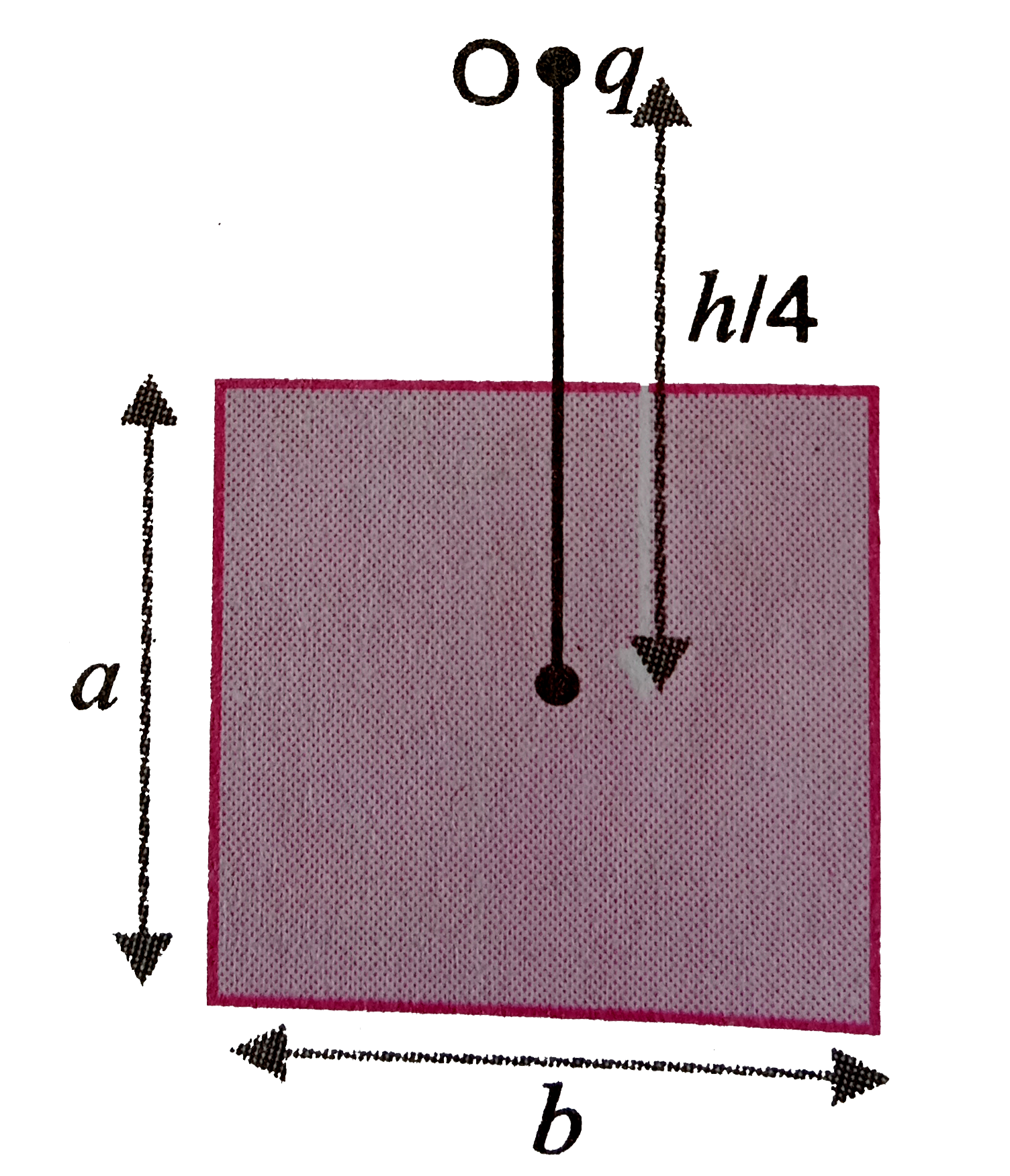 If a charge `q` isplaced at the centre `O` at the CUBE then electric flux through all the six faces of the cube is `= (q)/(in_(0))` Electric flux through one face `= (1)/(6) (q)/(in_(0))` which is independat of side length `b`. |
|
| 21. |
The dimensional formula of mu_(0) in_(0) is …….. |
|
Answer» `M^(0)L^(-2)T^(2)` `therefore [mu_(0)in_(0)]=[C^(-2)]` `= [M^(0)L^(1)T^(-1)]^(-2)=M^(0)L^(-2)T^(2)` |
|
| 22. |
Find the equivalent resistance of the network as shown in Fig 27.48 between points a andb |
|
Answer» |
|
| 23. |
What is the function of 'receiver 'in communication system ? Draw the block diagramof AM-receiver . |
Answer» SOLUTION :A receiveris a DEVICEWHICH DETECTS , demodulatesand amplifiesthe RECEIVED MESSAGE. 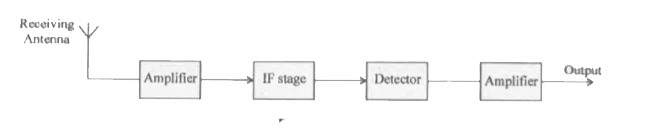
|
|
| 24. |
Why is that the terminal potential difference is always less than the e.m.f. of a cell? |
|
Answer» Solution :During charging of the CELL the terminal VOLTAGE is more than the EMF of the cell. emf = T.V. - IR or `T.V. GT emf` |
|
| 25. |
Electric field of one plane progresive electromagnetic wave is E_(Z)=100 cos (6xx10^(8)t + 4x)Vm^(-1). Then refreactive index of medium pf propagation would be ….. |
|
Answer» `1.5` `omega =6xx10^(8)` rad/s k = 4 rad/s Required refractive index, `mu=(c )/(V)=(c )/(omega//k)=(ck)/(omega)=(3xx10^(8)xx4)/(6xx10^(8))=2` |
|
| 26. |
Verify this result for the simple configuration of two charges of the same magnitude and sign placed a certain distance apart. |
Answer» Solution :The middle POINT of the line joining two like charges is a NULL point. If we displace a TEST charge slightly along the line, the restoring FORCE try to bring the test charge back to the centre. If we displace the test charge normal to the line, the net force on the test charge takes it further away from the null point. Hence, the equilibrium is not stable. 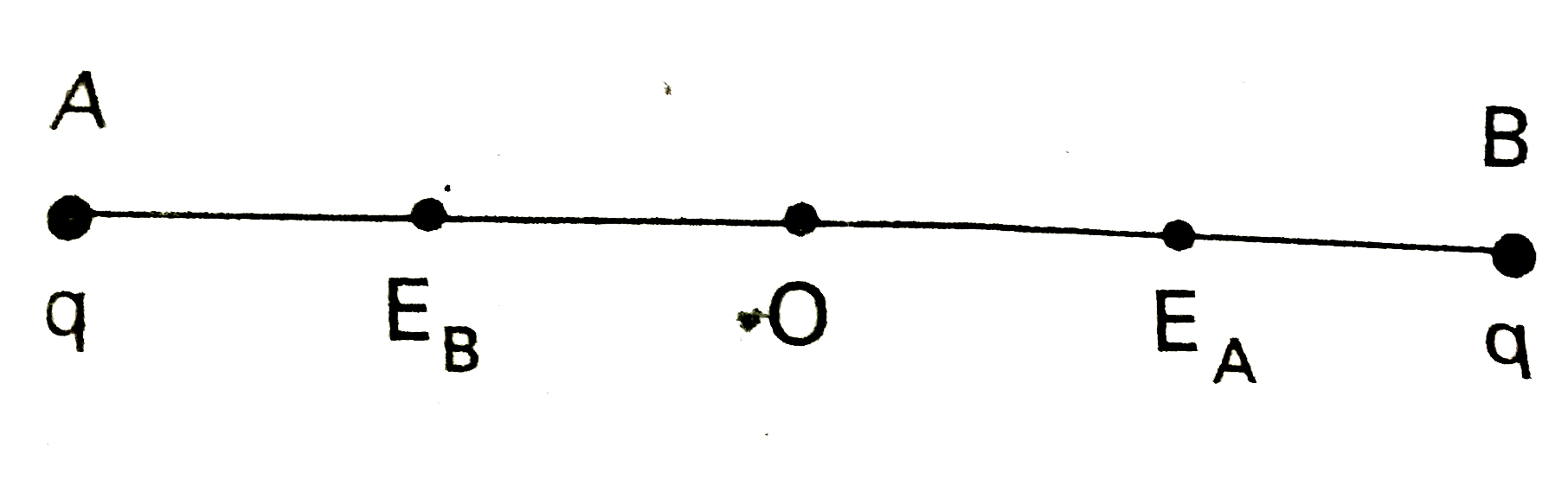
|
|
| 27. |
Lencho seeks help from Almighty. |
|
Answer» 1May be True |
|
| 28. |
The voltage of an A.C. source varies with time according to the equation V = 100 sin 100pit cos100pit, where t is in second and V is in volt, then ....... |
|
Answer» the peak voltage of the source is 100 V =50 (2 sin 100 `PI`t cos 100 `pit`) =50 sin (200`pi`t) comparing this eqn. with `V=V_m sin omegat` `therefore V_m`=50 V, `omega=200pi` rad/s , f=100 Hz. |
|
| 29. |
A circular coil of radius R carries a curretn. Find an expression for the magnetic field due to this coil at its centre. Also find the direction of field. |
|
Answer» Solution :Consider a circular loop of radius R carrying a current I in clockwise direction. The loop may be considered to be divided into a LARGE number of current elements. Consider one such current element of length dl as shown in fig. Magnetic field at the centre POINT O of the loop due to this element, as per Bio-Sarvart.s law is `DB = (mu_0)/(4pi) cdot (I dl sin 90^(@))/(R^2) = (mu_0)/(4 pi) cdot (I dl)/(R^2) "[ Here " = THETA = 90^(@)]` The total magnetic field due to current loop `B = (mu_0)/(4 pi) cdot (I)/(R^2) sum dl = (mu_0 I)/(4 pi R^2) cdot (2 pi R) = (mu_0 I)/(2 R)[ :. sum dl = 2 pi R]` If instead of a single loop we have a circular coil of N turns, then `B = (mu_0 N I)/(2 R)` The magnetic field is directed perpendicular to the plane of paper directed inward. 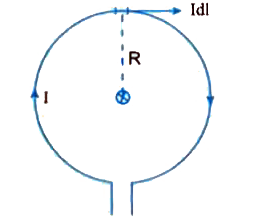
|
|
| 30. |
The initial pressure of neon is 2.0 xx 10^5 Pa, the initial volume is 0.4 m^2. The gas expanded adiabatically so that its volume increased three times. Find the final pressure. Compare with the pressure that would result from an expansion at constant temperature. In which process does the gas perform more work upon expansion? |
|
Answer» |
|
| 31. |
Deduce the expression for the torque vectau when unit vector hatn is at an angle thetawith the field. |
Answer» Solution :In the general case , the unit normal vector `hatn` and magnetic field `vecB` is with an angle `theta` as shown in FIGURE.  (a) The forceon section in PQ ` vec l = a hatj " and " vecB = B hat i` `vecF_("PQ") = vec(Il) xx vecB = I a B ( hatj xx hati )= - I a B hat k ` SINCE , the unit vector normal to the plane `hatn` is along the direction of `hat k`. (b ) The force on section QR `vecl = b cos (pi/2 - theta) ĭ sin (pi/2 - theta) k̆ " and " vecB = B ĭ ` `vecF_("QR") = vec(Il) xx vecB = - IbB (pi/2 - theta) hat j ` `vecF_("QR") = - IbB cos theta hat j ` (c) The force on section RS `vecl = a hatj " and " vecB= B hat i ` ` vecF_("RS") = vec(Il) xx vecB = I a B ( hatj xx hati) = - IaB hat k ` Since , the unit vector normal to the plane is along the direction of ` - hat k` . (d) The force on section SP `vecl = b cos ( pi/2 - theta ) hati + sin ( pi/2 + theta ) hatk " and " vecB = B hat i` ` vecF_("SP")= vec(Il) xx vecB = IbB sin (pi/2 + theta ) hat j` ` vecF_("SP") = - IbB cos theta hatj` The net force on the rectangular loop is `vecF_("net") = vecF_("PQ") + vecF_("QR") + vecF_("RS") + vecF_("SP") ` `vecF_("net") = IaB hatk - IbB cos theta hatj - IaB hatk + IB B cos theta hatj vecF_("net") = vec0` Hence, the net force on the rectangular loop in this configuration is also zero. Notice that the force on section QR and SP are not zero here. But, they have equal and opposite effects, but we assume that the loop to be rigid, so no deformation. So, no torque produced by these tow sections. Even though the forces PQ and RS also are equal and opposite, they not collinear. So these two forces constitute a couple as shown in Figure (a) . Hence the net torque produced by these two forces about the axis of the rectangular loop is given by `vec tau_("net") = baBI sin theta hatk = ABI sin theta hat k` From the Figure (c )  `vec(OA) = b/2 cos (pi/2 - theta) ( - hat i) + b/2 sin ( pi/2 - theta) ( - hat k ) ` ` = b/2 ( - sin theta hati + cos theta hatk) ` `vec(OB) = b/2 cos ( pi/2 - theta ) ( hat i) + b/2 sin ( pi/2 - theta ) ( - hat k) ` ` = b/2 ( - sin theta hati + cos theta hatk) ` `vec(OA) xx vecF_("PQ") = { b/2 ( -sin theta hati + cos theta hatk)} xx { Ia Bhatk}` ` = 1/2 IabB sin theta hatj ` `vec(OB) xx vecF_("RS") = { b/2 ( sin theta hati + cos theta hatk)} xx { - I aB hatk}` ` = 1/2 IabB sin theta hatj` The net torque `vectau_("net") = I ABB sin theta hatj` .....(1) Note that the net torque is in the positive y direction which tends to ROTATE the loop in clockwise direction about the y axis. If the current is passed in the other way `(P to S to R to Q to P)` , then total torque will point in the negative y direction which tends to rotate the loop in anticlockwise direction about y axis . Another important point is to note that the torque is less in this case compared to earlier case(where the `hat n` is perpendicular to the magnetic field `vecB`) . It is becasue the perpendicular distanceis reduced between the forces `vecF_("PQ") " and " vecF_("RS") ` in this case. The equation (1) can also be rewritten in terms of magnetic dipole moment `vecp_(m) = I vecA = I ab hatn vectau_("net") = vecp xx vecB` |
|
| 32. |
Select and write the corrcet answer : The capillary rise for a wetting liquid in a capillary tube is |
|
Answer» `h = (2T)/(r RHO gcos THETA)` |
|
| 33. |
Two charged particles of charge +2q and +q have masses m and2m respectively. Then are kept in uniform electric field allowed to move for the same time. Find the ratio of their kinetic energies. |
|
Answer» `1:8` Let `m_(1)=m, m_(2)=2m` Force on particles, `F_(1)=ma_(1)=2QE` `implies F_(2)=2ma_(2)=qE` `a_(1)=(2qE)/m` and `a_(2)=(qE)/(2m)` FINAL velocities of the particle `v_(1)=u_(1)=a_(1)t` `implies v_(1)=(2qE)/m timpliesv_(2)=(qE)/(2m)t` Let `K=` KINETIC energy `K_(1)=1/2m ((qE)/(2m))^(2)t^(2)implies(K_(1))/(K_(2))=16/1` |
|
| 34. |
Two charges 5 xx 10^(-8)C and -3 xx 10^(-8)C are located 16 cm apart. At what point(s) on the line joining the two charges is the electric potential zero ? Take the potential at the infinity to be zero. |
|
Answer» <P> SOLUTION :On the line there are two locations where potential BECOMES ZERO.For `P, (5 xx 10^(-8))/(x)=(3 xx 10^(-8))/((16-x))` `5(16-x) =3x, 80x-5x=3x` `8x=80 therefore x=10cm` For `Q, (5 xx 10^(-8))/((16+y))=(3 xx 10^(-8))/(y)` 5y=38+3y 2y=48 y=24 CM i.e, at (16+24)=40 cm from A. 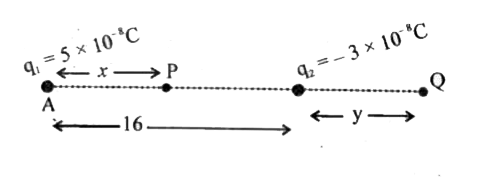
|
|
| 35. |
What do you mean by electric flux ? Is it a vector or scalar ? |
| Answer» Solution :Electric flux is associated with electric field. The electric flux through a surface held inside an electric field represents the TOTAL number of electric LINES of force crossing the surface in a direction normal to the surface. it is a SCALAR QUANTITY and it.s UNITY is `Nm^2C^(-1)`. | |
| 36. |
The X and Y component of a force F acting at 30° to X-axis are respectively |
|
Answer» `F/SQRT(2),F` `F_(y)=Fsin30^@=Fxx1/2=F/2` |
|
| 37. |
The binding energies per nucleon are 5.3 MeV, 6.2 MeV and 7.4 MeV for the nuclei with mass numbers 3,4 and 5 respectively. If one nucleus of mass number 3 combines with one nucleus of mass number 5 to give two nuclei of mass number 4, then |
|
Answer» 0.3 MEV of ENERGY ABSORBED |
|
| 38. |
Magnetic permeability is maximum for |
|
Answer» DIAMAGNETIC substances |
|
| 39. |
A heavy uniform chain lies on horizontal table top. If the coeficient of friction 0.25, then the maximum friction of length of the chain that can hang over on edge of the table is |
| Answer» ANSWER :A | |
| 40. |
Three identical, each of emf 2 V and internal resistance 0.2 Omega are connected in series to an external resistor of 7.4 Omega. Calculate the current in the circuit. |
|
Answer» |
|
| 41. |
A long wire is bent into the shape shown in the figure. Without cross-contact at P. Determine the magnitude and direction of B at the center of the circular portion of radius R when a current I flows as indicated. |
|
Answer» |
|
| 42. |
Each questioncontains statementsgivenin two columnswhichhave to be matched . Statement (A,B,C,D) in column I haveto be matchedstatements(p,q,r,s) in columnII. Capillary rise and shape of droplets on a platedue to surface tension are shown in column - II . Matchthe following |
| Answer» SOLUTION :`(A) to (p) (B) to (q,R,s)( C) to (p,s) (D) to (q,r)` | |
| 43. |
Each questioncontains statementsgivenin two columnswhichhave to be matched . Statement (A,B,C,D) in column I haveto be matchedstatements(p,q,r,s) in columnII. Capillary rise and shape of droplets on a platedue to surface tension are shown in column - II . Matchthe following |
|
Answer» |
|
| 44. |
In a Young's double slit experiment, two slits act as cherent sources of waves of equal amplitude A and wavelength lambda. In another experiment with the same arrangement the two slits are made to act as incoherent sources of waves of same amplitude and wvaelenght. If the intensity at the middle point of the screen in the first case is I_(1) and in the second case is I_(2) then the ratio (I_(1))/(I_(2)) is : |
|
Answer» Solution :For COHERENT SOURCES : `I_(1) = 4I_(0)` For coherent sources `I_(2) = 2I_(0)` `(I_(1))/(I_(2)) = (2)/(1)` |
|
| 45. |
The binding energies per nucleon for a deuteron and an alpha - particle are x_(1) and x_(2) respectively. What will be the energy Q released in the reaction, ""_(1)H^(2)+""_(1)H^(2) to ""_(2)He^(4)+Q |
|
Answer» `4(x_(1)+x_(2))` |
|
| 46. |
An angular magnification (magnifying power) of 30X is desired using an objective of focal length 1.25cm and an eyepiece of focal length 5cm. How will you set up the compound microscope? |
|
Answer» Solution :Assume MICROSCOPE in normal use i.E., image at 25 cm. Angular magnification of the eye-piece `=(25)/(5)+1=5` Magnification of the objective `=(30)/(6)=5` `(1)/(5u_(o))-(1)/(u_(o))=(1)/(1.25)` which gives `u_(0) = -1.5 cm, v_(0) = 7.5 cm. |u_(e)|= (25//6) cm = 4.17 cm`. The SEPARATION between the objective and the eye-piece should be `(7.5 + 4.17) cm = 11.67 cm`. Further the object should be placed 1.5 cm from the objective to obtain the desired magnification. |
|
| 47. |
(A): Magnetic Resonance Imaging (MRI) is useful diagnostic tool for producing images of various parts of human body. (R) : Proton of various tissues of human body play a role in MRI. |
|
Answer» Both .A. and .R. are TRUE and .R. is the CORRECT EXPLANATION of .A. |
|
| 48. |
Assume that a neutron breaks into a proton and an electron. The energy released during this process is : (Mass of neutron=1.6725xx10^(-27) kg , Mass of proton = 1.6725 xx 10^(-27) kg , Mass of electron = 9 xx 10^(-31) kg) |
|
Answer» `-0.51` MEV |
|
| 49. |
Two concave mirrors each of focal length 'f' are placed infront of each other co=axially at a distance of 4d in a medium of refractive index n_(0). A plane galss slab of refractive index 'n' & thickness 'd' is placed at a distance of 'd' from M_(1).A point object O is placed at a distace of 'd' from M_(2) as shown in the figure. Consider first reflection by M_(2), then refraction on slab and then reflection by M_(1). Determine the distance of this iamge after reflection from M_(1) |
|
Answer» `rArr v_(1)=((-d)(-f))/(-d+f)=(DF)/(f-d)` {`u_(1),v_(1)` coordinates of object `&` image resp. `w.r.t.` pole `S` and POSITIVE axis as `x`} and `v_(2)=v_(1)-d(v_(1)-d(1-(n_(0))/(n))=(dt)/(f-d)-d(1-(n)/(n_(0)))` [`v_(2)` is coordinate of image after refraction by the slab considering origin at `S` and positive direction as `x` axis] and `u_(3)=-(v_(2)+4d) rArr v_(3)=|(u_(3)(-f))/(u_(3)-(-f))|` [`u_(3)=` coordinate of `v_(2)` considering origin at `S'` and positive direction as `x'.v_(3)=` coordinates of image of `u_(3)`, origin at `S'` and positive direction as `x'`] `|((v_(2)+4d)f)/(-v_(2)-4d+_f)| rArr "distance" |((df)/(f-d)-d(1-(n_(0)/(n))+4d)f)/((df)/(d-f)+d(1-(n_(0))/(n))-4d+f)|` 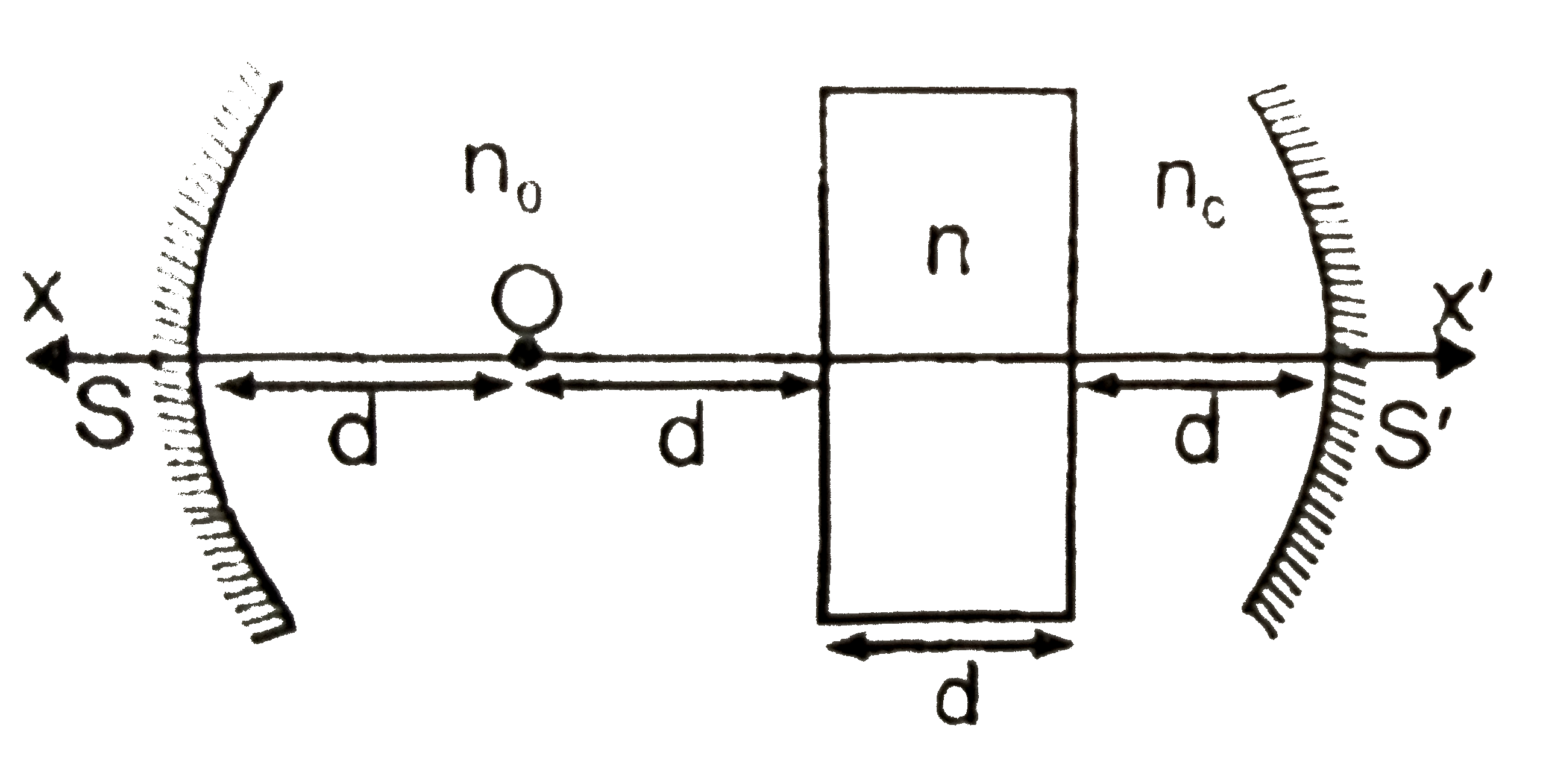
|
|
| 50. |
A beam of light passing from one transparent medium to another obliquely,undergoes an abrupt change in direction.This bending of two media is called ? |
| Answer» SOLUTION :REFRACTION | |