

Saved Bookmarks
This section includes 7 InterviewSolutions, each offering curated multiple-choice questions to sharpen your Current Affairs knowledge and support exam preparation. Choose a topic below to get started.
| 1. |
A girl is sitting near the open window of a train that is moving at a velocity of 10.00 m/s to the east. The girl's uncle stands near the tracks and watches the train move away. The locomotive whistle emits sound at frequency 520.0 Hz. The air is still. (a) What frequency does the uncle hear? (b) What frequency does the girl hear? A wind begins to blow from the east at 10.00 m/s. ( c) What frequency does the uncle now hear? (d) What frequency does the girl now hear? |
| Answer» SOLUTION :(a) 505.3Hz , (B) 520Hz, ( C) 505.7 HZ , (d) 520 Hz | |
| 2. |
The electrons in hydrogen atoms are raised from ground state to third excited state. The number of emission lines will be |
|
Answer» 10 |
|
| 3. |
Three equal resistors connected across, a source of emf together dissipate 10 watt of power. What will be the power dissipated in watt if the same resistors are connected in parallel across the same source of emf |
|
Answer» `(10)/(3)` Suppose each has RESISTANCE R `therefore` TOTAL resistance in SERIES `R_(1) = 3 R `, Total resistance in parallel `R_(2) = (R)/(3) ` Now P = `(V^(2))/(R)` , Where V= constant `therefore P prop (1)/(R)` `therefore (P_(2))/(P_(I)) = (R_(1))/(R_(2)) = (3R)/((R)/(3)) = 9 ` `therefore P_(2) = 9 xx 10 = 90 ` V |
|
| 4. |
In a U-tube experiment, a colmn AB of water is balanced by a column CD of paraffin. The relative density of paraffinn is : |
|
Answer» `(H(2))/(h_(1))` |
|
| 5. |
A surveyer is using a magnetic compas 3m below a power line in which there is a steady current of 75 A . What is the magnetic field t this point due to the power line ? |
| Answer» SOLUTION :`5 MU T` | |
| 6. |
When the modified galvanometer of exercise 26 is connected across the terminals of a battery, it shows a current of 4A. The current drops to 1A when a resistance of 1.5Omega is connected in series with the modified galvanometer. Find the emf and the internal resistance of the battery. |
|
Answer» |
|
| 7. |
There is one cylindrical vessel whose height and diameter are both equal to D. An observer's eye is placed in such a manner that bottom edge of the vessel is just visible to eye. There is a point P at the bottom of container at a distance x from the centre of container as shown in the figure. Up to what height the liquid of refractive index mu should be poured in the vessel so that point P is visible to the eye? |
Answer» Solution :From the FIGURE GIVEN below we can understand that he need to put liquid up to a height so that after REFRACTION from liquid up to a height sothat after refraction from liquid light ray from POINT P is refracted along the line of vision . Line of vision of eye is at `45^(@)` because we know that height and diameter of vessel both are equal to D . LET h be the height of liquid poured. 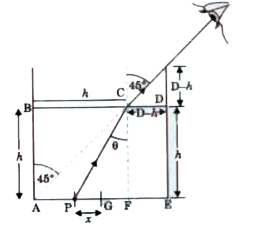 We can see in the figure that the angle of incidence of light ray from point P is equal to `theta`. Let us apply Snell.s law at point C in the diagram . `mu sin theta = sin 45^(@)` `sin theta = (1)/(mu sqrt2)"" ... (i)` Further from the figure we can write the following : PF = PE - FE `implies PF = (D//2 + x) - (D - h)` `impliesPF = x + h - D//2 ... (ii)` Further from the figure we can write the following : `tan theta = (PF)/(CF)` `implies tan theta = (x + h - (D)/(2))/(h) "" ... (iii)` Now from equation (i) we can write the following : `tan theta = (1)/(sqrt(2 mu^(2) - 1)) "" ... (iv)` From equation (iii) and (iv) we can write the following : From equation (iii) and (iv) we can write the following : `(x + h- D/2)/(h) = (1)/(sqrt(2mu^(2) - 1))` `implies "" (2x + 2h - D)/(2h) = (1)/(sqrt(2mu^(2) - 1))` `implies (2x - D) (sqrt(2 mu^(2) - 1)) + 2h (sqrt(2mu^(2) - 1)) = 2h` `implies (2x - D) (sqrt(2mu^(2) - 1)) = 2h (1- sqrt(2mu^(2) - 1))` `impliesh = ((2x - D) (sqrt(2mu^(2) - 1)))/(2 (1 -sqrt(2mu^(2) - 1)))` |
|
| 8. |
A galvanometer with a coil of resistance 120 ohm shows full-scale deflection for a current of 2.5 mA. How will you convert the galvanometer into an ammeter of range 0 to 7.5A? Determine the net resistance of the ammeter. When the ammeter is put in a circuit, does it read slightly less or more than the actual current in the original circuit? Justify your answer |
|
Answer» Solution :`R_(6) = 120 omega , I_(g) =2.5 m A = 0.0025A, I = 7.5 A` `R_(s)=(I_s)/(I-I_g)xx R_s = (0.0025)/(7.5 -0.0025) xx 120 =0.04 Omega` By connecting a shunt of 0.04 `Omega` across the given galvanometer, we GET an ammeter of range 0 to 7.5 A. NET resitance of the ammeter `=(120 xx 0.04)/(120 +0.04)= 0.03998 Omega` When an ammeter is put in circuit, it reads slightly less than the actual current. An ammeter has a small RESISTANCE. When it is CONNECTED in the circuit, it decrease the current by a small amount. |
|
| 9. |
Four boys are standing at the four comers of a square ABCD of length of sideal. They simultaneously start running such that runs towards B, B runs towards C, C runs towards D and D runs towards A each with velocity . They will meet at after time given by : |
|
Answer» `(sqrt(2)a)/(v)` Net displacementis `A_(0)=(1)/(2)AC` `A_(0)=(1)/(2)sqrt(a^(2)+a^(2))=(1)/(2)sqrt(2a)=(a)/(sqrt(2))` 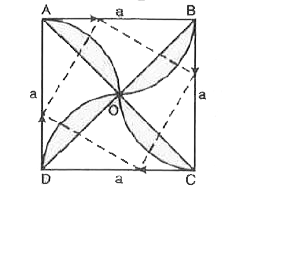 Component of velcoity v along AO is `=v cos 45^(@) =(V)/(sqrt(2))` `:. `Time TAKEN` =("displacement")/("VELOCITY")=((a)/sqrt(2))/((v)/(sqrt(2)))=(a)/(v)` |
|
| 10. |
S.T an LC oscillator executes SHM and hence obtain an expression for the angular frequency of oscillation. |
|
Answer» Solution :Applying KVL we get, `v_(c)-L(di)/(dt)=0` i.e, `(q)/(C)-L(di)/(dt)=0` `therefore i=-(dq)/(dt),(di)/(dt)=(-d^(2)q)/(dt)` `therefore (q)/(C)+L(d^(2)q)/(dt^(2))=0` or `(d^(2)q)/(dt^(2))+(1)/(LC)q=0` which is similar to `(d^(2)X)/(dt^(2))+omega_(o)^(2)x=0` `therefore omega_(0)^(2)=(1)/(LC)` i.e., `omega_(0)-(1)/(sqrt(LC))andq=q_(m)cos(omega_(0)t+phi)` 
|
|
| 11. |
A copper connector of massm, starting from rest, slides down two conducting bars set at angle alpha to the horizontal, due to gravity (see figure). At the top the bars are interconnected trhough a resistance R. The separation between the bars is equal to l. The system is located in uniform magnetic field of induction B, perpendicular to the plane in which the connectr slides. The resistance of the bars the connector and the sliding contacts, as well as the self inductance of the loop, are assumed to be negligible. The coefficient of friction between the connector and the bars is equal to (1)/(2) and alpha (a) Find the steady-state velocity of the connector. (b) How will your answer differ if the magnetic field was in opposite direction. |
|
Answer» |
|
| 12. |
If an object's speed is changing, which of the quantities could remain constant? |
|
Answer» Displacement |
|
| 13. |
In a potentiometer experiment when a battery of e.m.f. 2 V is included in the secondary circuit, the balance point is 500 cm. Find the balancing length of the same end when a cadimum cell of e.m.f. 1.018V is connected to the secondary circuit. |
|
Answer» Solution :`E prop L,(E_(1))/(E_(2))=(l_(1))/(l_(2))` `l_(2)=(E_(2))/(E_(1))xxl_(1)=(1.018)/(2)xx500=254.5cm`. |
|
| 14. |
Two coherent point sources S_(1) and S_(2) vibrating in phase emit light of wavelength lambda.The separation between the sources is 2 lambda.The smallest distance from S_(2) on a line passing through S_(2) and perpendicular to S_(1)S_(2) where a minimum intensity occurs is : |
|
Answer» `(7 lambda)/(12)` `S_(1)P -S_(2)P = (3lambda)/(2)`....(1) 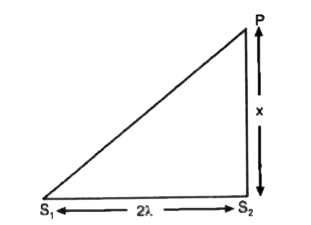 or `sqrt(4LAMBDA^(2) + x^(2)) - x = (3 lambda)/(2)` Then `x = (7lambda)/(12)` |
|
| 15. |
Wavelength of infrared waves is ….. |
| Answer» Answer :B | |
| 16. |
The figure shown is part of the circuit at steady state The current following from 3Omega resistor is : |
|
Answer» 2A |
|
| 17. |
The basic elements of communicationg system are _____, _____ and _____. |
| Answer» SOLUTION :TRANSMITTER, CHANNEL and RECEIVER | |
| 18. |
Deutrium was discovered in 1932 by Harold Urey by measuring the small change in wavelength for a particular transition in ""^(1)H and ""^(2)H. This is because, the wavelength of transition depend to a certain extent on the nuclear mass. If nuclear motion is taken into account then the electrons and nucleus revolve around their common centre of mass. Such a system is equivalent to a single particle with a reduced mass u, revolving around the nucleus at a distance equal to the electron-nucleus separation. Here mu=m_(e)M//(m_(e)+M) where M is the nuclear mass and m_(e) is the electronic mass. Estimate the percentage difference in wavelength for the 1st line of the Lyman series in ""^(1)H and ""^(2)H. (Mass of ""^(1)H nucleus is 1.6725 xx 10^(-27) kg, Mass of ""^(2)H nucleus is 3.3374 xx 10^(-27) kg Mass of electron =9.709xx10^(-31)kg) |
|
Answer» Solution :For HYDROGEN and DEUTERIUM atoms, according to formula `lambda_(d)=(1-(m_(e))/(M))(1+(m_(e))/(2M))_lambda_(h)` `:. lambda_(d)=(1-(9.109xx10^(-31))/(1.6725xx10^(-27)))(1+(9.109xx10^(-31))/(3.3374xx10^(-27)))(1218)` `:. Lambda_(d)=(1-5.446xx10^(-4))(1+2.7294xx10^(-4))(1218)` `:. lambda_(d)=(1-0.005446)(1+0.0002729)(1218)` :. lambda_(d)=(0.9994554) (1.0002729)(1218)` :. lambda_(d)=1217.6688Å` A For first line of Lyman SERIES of deuterium atom, percentage decrease in its wavelength (RELATIVE to corresponding wavelength for hydrogen atom) `=(Delta lambda)/(lambda_(h))xx100%` `(lambda_(h)-lambda_(d))/(lambda_(h))xx100%` `=((1218-1217.6688)/(1218))xx100%` `=(0.3312)/(1218)xx100%` `2.719xx10^(-2)%` `=0.02719%` |
|
| 19. |
Ina meter bridge, the balancinglength from leftend ( standardresistanceof oneohm is in therightgap ) is foundto be 20 cm . The valueof the unknowresistanceis . |
|
Answer» `0.25 Omega` |
|
| 20. |
A charge is placed at centre of circular face of cylinder of radius .r. nad length .r. flux through remaining curved surface is (other than opposite circular face) |
|
Answer» `(Q)/(2epsilon_(0))-(q)/(2epsilon_(0))[1-(1)/(sqrt(2))]` |
|
| 21. |
A convex lens of focal length 30 cm and a concave lens of 10 cm focal length are placed so as to have the same axis. If a parallel beam of light falling on convex lens leaves concave lens as a parallel beam, then the distance between two lenses will be |
|
Answer» 40 cm |
|
| 22. |
The displacement of A particle at x = 0 of a stretched string carrying a wave in the positive x-direciion is given by f(t) = Ae^(-t^(2)) . The wave speed is V. Write equation of the wave. |
|
Answer» `F(x,t) = AE^((-t+x)^(2)` |
|
| 24. |
A negatively charged particle is situated on a straight line joining two other stationary particles each having charge + q. The direction of the motion of the negatively charged particle will depend on |
|
Answer» the MAGNITUDE of charge |
|
| 25. |
When an object in rarer medium is viewed from denser medium, then that object seems to be ..... |
|
Answer» SHIFTED up  `(h_i)/(h_0)=(n_(("denser")))/(n_("(rarer)"))=n/1` `THEREFORE n=(h_i)/(h_0)` Here, `h_i LT h_0` APPARENT height `lt` REAL height `therefore` Object seems to be shifted down. |
|
| 26. |
Consider an assembly of three conducting concentric spherical shells of radii a,b and c as shown in figure. Find the capacitance of the assembly between the points A and B. |
|
Answer» `(4piin_0ac)/(c+a)` |
|
| 27. |
In a double slit experiment, the slit separation is 0.2 cm and the slit to screen distance is 100cm. Find the positions of the third order minima, if wavelength of the source is 500 nm. |
| Answer» SOLUTION :`PM 0.0625cm` | |
| 28. |
A uniform rope of length 12 m and mass 6 kg hangs vertically from a rigid support. A block of mass 2 kg is attached to the free end of the rope. A transverse pulse of wavelength 0.06 m is produced at the lower end of the rope. What is the wavelength of the pulse when it reaches the top of the rope ? |
|
Answer» Solution :As the ROPE has a mass and a mass is ALSO SUSPENDED from the lower end, the tension in the rope will be different at different points. Now as `v = sqrt((T//m))` or `v_T/v_B =sqrt(T_T/T_B) = sqrt(((6 =2)g)/(2g) ) = 2(or) [(f_r lambda_T)/(f_blambda_B)] =2` `[asv = f lambda]` Here ` f_T =f_B` as frequency is the characteristic of the source PRODUCING the waves. So `lambda_T =2 lambda_B = 2 XX 0.06 = 0.12 m` 
|
|
| 29. |
Let A=i A costheta+ j A sintheta ( is a vector. Another vectorB is which is normal to vecA can be expressed as |
|
Answer» `i B costheta- J B sintheta` |
|
| 30. |
Using Binomial approximation find the value of (99)^(12) |
|
Answer» 9.97 |
|
| 31. |
Statement-1: For zero value of R in circuit power transfer in external resistance will be maximum. Statement-2: Since R_(1)gtr in the given circuit, So, power transfer in external resistance will be maximum when R=0, |
|
Answer» Statement-1 is TRUE,Statement-2 is True, Statement-2 is a CORRECT EXPLANATION for Statement-1 |
|
| 32. |
A mass sliding down an inclined plane and reaches the bottom with velocity v. If the same mass is in the form of a disc and rolls down the same inclined plane, what is its velocity at the bottom ? |
|
Answer» v TOTAL K.E. of disc = `(1)/(2)mv_(d)^(2)+(1)/(2)((1)/(2)mr^(2))OMEGA^(2)` `=(3)/(4)mv_(d)^(2)` `THEREFORE (3)/(4)mv_(d)^(2)=(1)/(2)mv^(2)` or `v_(d)=sqrt((2)/(3))v` |
|
| 33. |
Diameter of plano - convex lens is 6 cm and thickness at the centre is 3 mm. If speed of light in material of lens is 2 xx 10^(8) m//s, the focal length of the lens is : |
|
Answer» Solution :(b) `R^(2) = d^(2) + (R - t)^(2)` `R^(2) - d^(2) = R^(2) {1-(t)/(R)}^(2)` `1 - (d^(2))/(R^(2)) = 1-(2t)/(R )` `R=((3)^(2))/(2xx(0.3))=(90)/(6) = 15 cm` `(1)/(F) = (mu-1)[(1)/(R_(1))-(1)/(R_(2))]` `(1)/(f) = ((3)/(2) - 1) ((1)/(15))` 
|
|
| 34. |
A poing source of light at the surface of a sphere causes a paralel beam of light to emerge from the opposite surface of the sphere. The refractive index of the material of the sphere is |
|
Answer» 1.5 |
|
| 35. |
Calculate the least value of the angular separation of two stars which can be resolved by a telescope of 200 cm aperture. If the aperture of the human eye be 2mm and if the focal length of the eyepiece be 1 inch, what must be the minimum focal length of the objective if full resolving power of the telescope is to be utilized. Take lambda = 5500 A^(0). |
|
Answer» `6.7xx 10^(-7)RAD, 500` INCHES |
|
| 36. |
A sample of diatomic gas with y=1.5 is compressed from a volume of 1600 cc to 400 cc adiabatically. The initial pressure of gas was 1.5xx10^5 Pa.Find the final pressure and work done by the gas in the process. |
|
Answer» SOLUTION :We know in an adiabatic process, pressure and volume of gas of its different sates are related as `P_1V_1^gamma=P_2V_2^gamma` or `P_2=(V_1/V_2)^(gamma).P_1` `=(1600/400)^(1.5)xx1.5xx10^5` `=(4)^(1.5)xx1.5xx10^5` `=1.2xx10^6` PA For an adiabatic process work DONE by a gas is given as `W=(P_1V_1-P_2V_2)/(gamma_1)` `=(1.5xx10^5xx1600xx10^(-6)-1.2xx10^6xx400xx10^(-6))/(1.5-1)` `=(240-480)/0.5`=-480 J Here work done by gas comes out a NEGATIVE value thus we can state that as gas is being compressed , work is done on the gas and so work done by gas is -480 J. |
|
| 37. |
What is difference between viscosity and friction? |
| Answer» Solution :Force of friction acts on the SURFACE of SOLIDS while force of VISCOSITY acts on LAYERS of liquid. | |
| 38. |
Resistance of a wire is ROmega. It is stretched uniformly till Its length becomes four times. It's resistivity will ....... . |
|
Answer» be doubled `Resistivity of wire DEPENDS on type of material. Resistivity of wire of same material is constant. |
|
| 39. |
In the circuit as shown, V_(A) - V_(B) = V. The resistance of each wire AB, AC, etc are shown in the figure. Find the current in AC. |
|
Answer» `2V//3R` , (##BMS_V03_CA2_E01_095_S02.png) , (##BMS_V03_CA2_E01_095_S04##), (##BMS_V03_CA2_E01_095_S05.png) `V = I R_(eq)` Hence, current through RESISTANCE is `V//6R`. |
|
| 40. |
Define the term wave front. State Huygen's principles. Consider a plane wave front incident on a thin convex lens. Draw a proper diagram to show how the incident wave front traverses through the lens and after refraction focuses on the focal point of the lens, giving the shapeof the emergent wave front. |
|
Answer» SOLUTION :A wave front is a locus of all the PARTICLES which are vibrating in the same phase. `(i)` A SOURCE sends waves in all possible directions. `(ii)` Each point of a wave front acts as a source of secondary wavelets. The envelope of all wavelets at a given instant gives the position of a new wavelets. 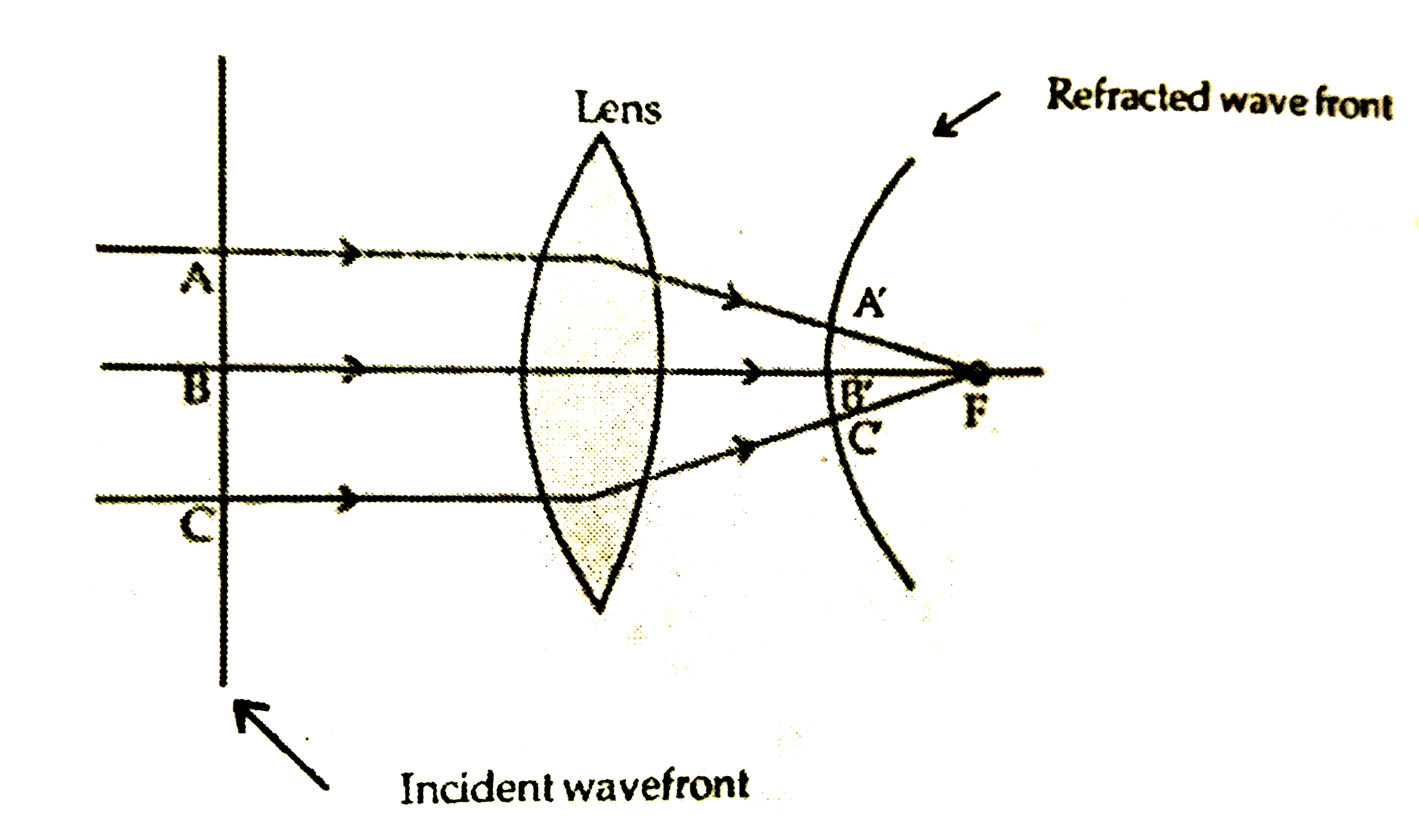
|
|
| 41. |
The electric intensity E, current density j and conductivity sigma are related as : |
|
Answer» `j=sigmaE` |
|
| 42. |
A system has two charges q_(A)=2.5 xx 10^(-7)C and q_(B)=-2.5 xx 10^(-6)Clocated at paint A: 0, 0, -15 cm) and B: (0, 0, +15 cm), respectively. What are the total charge and electric dipole moment of the system? |
|
Answer» SOLUTION :TOTAL charge =Zero `p=q(2l) =2.5 xx 10^(-7) xx 30 xx 10^(-2)=7.5 xx 10^(-8)" Cm ALONG z AXIS"`. |
|
| 43. |
At the moment t=0 a stationary particle of mass m experiences a time-dependent force F=at(tau-t), whera a is a constant vector, tau is the time during which the given force acts. Find: (a) the momentum of the particle when the action of the force discontinued: (b) the distance covered by the particle while the force acted. |
|
Answer» Solution :From the equation of the GIVEN time dependence force `vecF=vecat(pi-t)` at `t=pi`, the force vanishes, (a) Thus `Deltavecp=vecp=underset(0)overset(tau)int vecFdt` or, `vecp=underset(0)overset(tau)int vecat(tau-t)DT(vecatau^3)/(6)` but `vecp=mvecv` so `vecv=(vecatau^3)/(6m)` (b) Again from the equation `vecF=mvecw` `vecat(tau-t)=m(dvecv)/(dt)` or, `VECA(ttau-t^2)dt=mdvecv` Integrating within the limits for `vecv(t)`, `underset(0)overset(t)int veca(t tau-t^2)dt=m underset(0)overset(vecv)intdvecv` or, `vecv=(veca)/(m)((taut^2)/(2)-(t^3)/(3))=(vecat^2)/(m)(tau/2-t/3)` Thus `v=(at^2)/(m)(tau/2-t/3)` for `tletau` Hence distance covered during the time interval `t=tau`, `s=underset(0)overset(tau)int v dt` `=underset(0)overset(tau)(at^2)/(m)(tau/2-t/3)dt=a/m(tau^4)/(12)` |
|
| 44. |
A Gaussian surface S encloses two charges q_(1)= q and q_(2) = -qthe field at p is where vecE_(1), vecE_(2)and vecE_(3)are the field contributed by q_(1),q_(2)and q_(3)at P respectively. |
|
Answer» `vecE_(1)+vecE_(2)` |
|
| 45. |
Is Ohm’s law obeyed in semiconductors or not ? |
| Answer» SOLUTION :The Ohm’s law obeyed only for LOW electric FIELD (less than `10^6V//m`). Above this field the current becomes ALMOST independent of a APPLIED field. | |
| 46. |
If there is a change of angular momentum from 1 J to 4 J in 4sec., then the torque is |
|
Answer» `3//4` J |
|
| 47. |
Out of glass (rod) and silk (cloth), work function of glass is |
|
Answer» smaller |
|
| 48. |
Apple falls from a tree due to gravity. State which is greater in magnitude-force exerted by earth on the apple or force exerted by apple on the earth. |
| Answer» Solution :The GRAVITATIONAL force between the earth and the apple is `F=(GMm)/R^2` ACCELERATIONOF the earth towards the apple`a=^F//_M=(GMm)/(R^2xxM)=(Gm)/R^2=(6.67xx10^(-11)xx0.25)/((6.4xx10^6)^2)THEREFORE g=4xx10^(-25)m//s^2` | |
| 49. |
If current passing through both the capacitors is zero , then charges on capacitor C_(1)&C_(2) will be respectively(##ALN_EC_PH_1_P2_E01_003_Q01.png" width="80%"> |
|
Answer» 0,0 |
|
| 50. |
The refractive indices of water and glass w.r.t. air are 1.3 and 1.5 respecitvely. What will be the refractive index if glass with respect to water? |
|
Answer» 1.3/1.5 |
|