Saved Bookmarks
This section includes 7 InterviewSolutions, each offering curated multiple-choice questions to sharpen your Current Affairs knowledge and support exam preparation. Choose a topic below to get started.
| 1. |
If F_(p-p) , F_(p-n),F_(n-n)F F are nuclear forces given two protons, a proton and a neutron, two neutrons respectively inside a nucleus, then |
|
Answer» <P>`F_(p-p)LT F_(p-n) lt F_(n-n) ` |
|
| 2. |
What is a conduction band ? |
| Answer» Solution :The LOWEST unfilled ENERGY band lying just above the valence band is CALLED as CONDUCTION band. | |
| 3. |
Assertion : A string wave traveling towards a free end changes its direction of motion but phase Reason : When string wave reaches the free end there is no medium present in front of it.remains constant after reflection. |
|
Answer» If both ASSERTION and REASON are TRUE and reason is the CORRECT EXPLANATION of assertion. |
|
| 4. |
Two field lines can never crosses each other because , |
|
Answer» field LINES are CLOSED curves |
|
| 5. |
Half lives of two isotopes X and Y of a material are known to be 2xx10^(9) years and 4xx10^(9)years respectively. If a planet forms with equal number of these isotopes, estimate the current age of the planet, given that currently the material has 20% of X and 80% of Y by number |
|
Answer» `2XX10^(9)` YEARS |
|
| 6. |
A balanced wheatstone bridge is shown the values of currents i_1 and i_2 are |
|
Answer» 0.9A,0.6A |
|
| 7. |
यदि बहुपद p(x) = x^2 - 2x + 5 के शून्यक alpha,beta हो तो alpha^3 +beta^3 का मान होगा- |
|
Answer» 22 |
|
| 8. |
The dimension formula for angular momentum is |
|
Answer» `ML^2T^-1` |
|
| 9. |
The potential difference between points A and B is |
|
Answer» 10 v |
|
| 10. |
A concave lens of glass, refractive index 1.5, has both surface of same radius of curvature R. On immersion in a medium of refractive index 1.75, it will have as a |
|
Answer» CONVERGENT LENS of focal length 3.5R. |
|
| 11. |
For scattering by an 'inverse square' field (such as that produced by a charged culeus in Rutherfor's model ), the relation between impact parmeter b and the scattering angle thetais given by : b = (Ze^(2) cot theta//2)/(4 pi epsilon_(0)((1)/(2) mv^(2))) (a)What is the scattering angle for b = 0 ? (b) For a given impact parameter b, does the angle of deflection increase or decrease with increase in energy ? (c) What is the impact parameter at which the scattering angle is 90^(@) for Z = 79 and initial energy equal to 10 MeV? energy? What is the impact parameter at which the scattering angle is 90^(@) for Z = 79 and initial energy equal to 10 MeV? (d) Why is it that the mass of the nucleus does not enter the formula above but its charge does ? (e) For a given energy of the projectile does the scattering anlgle increase or decrease with decrease in impact parameter ? |
|
Answer» Solution :Given relation: b = `(Ze^(2) cot theta //2)/(4 pi epsilon_(0) ((1)/(2) mv^(2)))` `0 = (Ze^(2) cot theta //2)/(4 pi epsilon_(0)((1)/(2) mv^(2))) " or " cot (theta)/(2)= 0 cot (theta)/(2) = 0 therefore (theta)/(2) = 90^(@) " or " theta = 180^(@)` Thus the scattering angle is `180^(@)` when IMPACT parameter is zero. (b) For given b, `(Ze^(2) cot theta //2)/(4 pi epsilon_(0) ((1)/(2) mv^(2))) ` = constant As the energy `(mv^(2) //2)` increases, the value of cot `theta`/2 increases. Therefore, the value of scattering angle `theta` decreases as expected. (c ) `theta = 90^(@) `, Z = 79, e = ` 1.6 xx 10^(-19)` C now E = `(1)/(2)mv^(2)= 10 ` Me V `10 xx 10^(6) xx 1.6 xx 10^(-19) J = 1.6 xx 10^(-12) J ` `thereforeb = (9 xx 10^(9) xx 79 xx (1.6 xx 10^(-19))^(2) cot 45^(@))/(1.6 xx 10^(-12)) = 1.1 xx 10^(-14)` m (d) the scattering of `alpha`-particles takes place due to charge on the nucleus. If Z = 0 , `theta = 0^(@)` (from the given formula). Mass of nucleus does not APPEAR in the EXPRESSION for b because the recoil of the nucleus is being IGNORED i.e., the nucleus is assumed to be at rest during its interaction with the `alpha`-particle. (e) For a given energy `(mv^(2)//2)` of the projectile, the decrease in the value of impact parameter means a decrease in the value of cot`theta`/2 and hence an increase in the value of scattering angle `theta`. |
|
| 12. |
A straight horizontal conducing rod of lenght 0.45 m and mass 60 g is suspend by two vetical wires at its ends. A current of 5.0 A is set up in the rod through the wires. a. What magnetic field should be set up normal to the conductor in order that the tension in the wires is zero ? b. What will be the total tension in the wires if the direction of current is reversed keeping the magnetic field same as before ? (Ignore the mass of the wires.) g= 9.8 ms^(-2) |
|
Answer» Solution :l= 0.5 m and mass m = 60 G , I - 5 A a. BIL = MG `therefore B= (60 xx 10^(-3) xx 9.8 xx 100)/(5 xx 0.45) = 261.6 = 0.26 I` b. `2 mg = 2 xx 60 xx 10^(-2) xx 9.8 = 117.6 = 1.176 N` |
|
| 13. |
In a photoelectric setup, a point source of light of power 3.2xx10^(-3) W emits monoenergetic photons of energy 5.0 eV. The source is located at a distance of 0.8 m from the center of a stationary metallic sphere of work function 3.0 eV and of radius 8.0xx10^(-3)m. The efficiency of photoelectron emission is 1 for every 10^(6) incident photons. Assume that the sphere is isolated and initially neutral and that photoelectrons are instantaneously swept away after emission. Q. Calculate the number of photoelectrons emiited per second . |
|
Answer» `10^(3)` 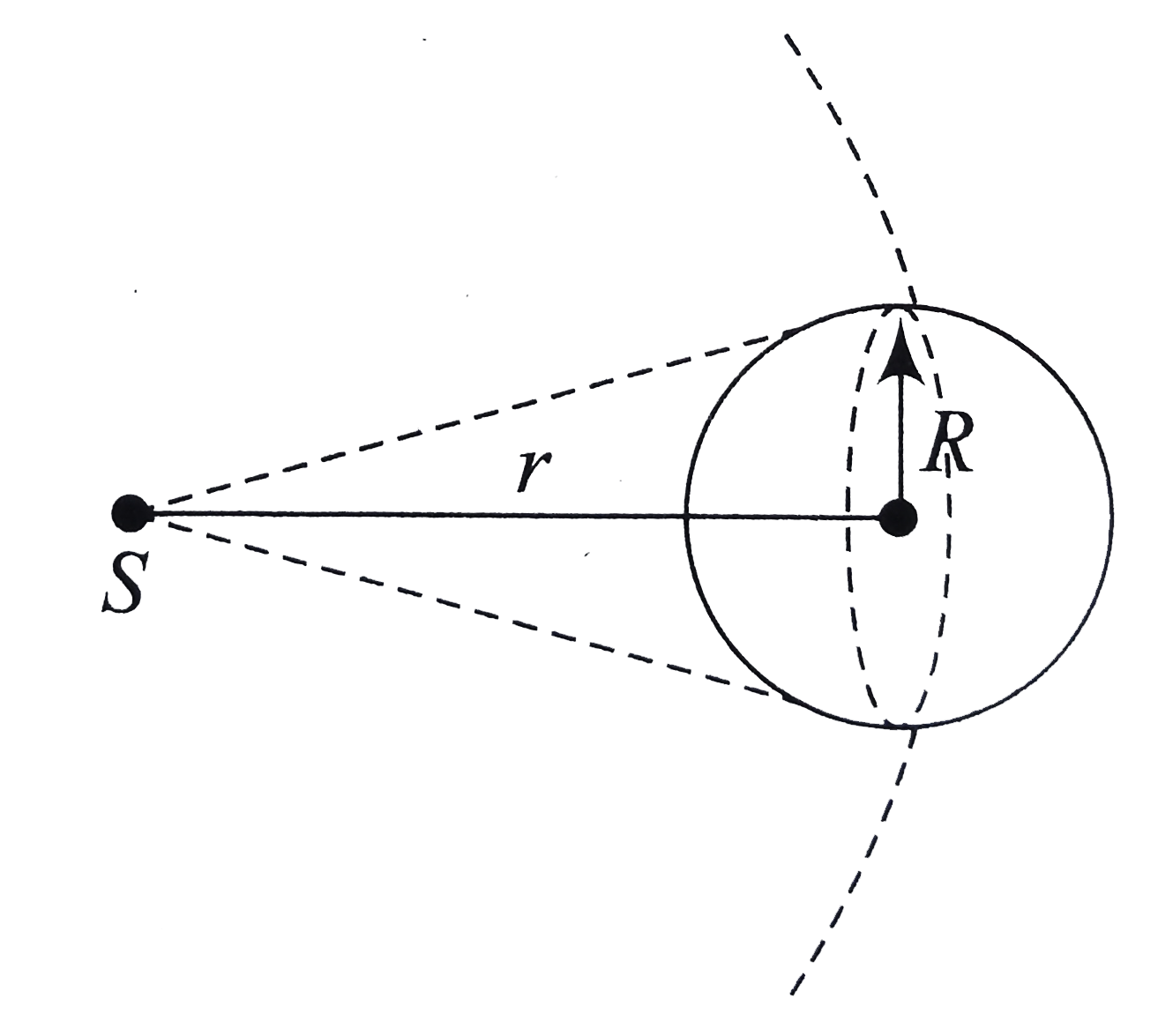 If P is the power of point source of light, the intensity at a distance r is `I=(P)/(4pir^2)` The energy intercepted by themetallic sphere is `E=` intensity `xx` projected area of sphere `=(P)/(4pir^2)xxpiR^2` If e is the energy of the single PHOTON and `eta` the efficiency of the photon to liberate an electron, the number of ejected electrons is `eta(PR^2)/(4r^2R)=((10^(-6))(3.2xx10^(-3))(8XX10^(-3))^2)/(4xx(0.8)xx(5xx1.6xx10^(-19)))` `=10^(5)` electron `s^(-1)` The emission of electrons from a metallic sphere leaves it POSITIVELY charged. As the potential of the charged sphere begins to rise, it attracts emitted electron. The emission of electrons will stop when the kinetic energy of the electrons if neutralised by the retarding potential of the sphere. So, we have `eV=(KE_(max)` `V=((KE_(max))/(e))` From Einstein's photoelectric equation, `KE_(max)=hv-phi=(5-3)=2 eV` The potential of a charged sphere is `V=(1)/(4piepsi_0)(q)/(R)=(1)/(4piepsi_0)((n e)/(R))` `(1)/(4piepsi_0)((n e)/(R))=2` `n=(4piepsi_(0)2R)/(e)` `(2xx8xx10^(-3))/(9xx10^(9)xx1.6xx10^(-19))=1.11xx10^(7)` The photoelectric EFFECT will stop when `1.11xx10^(7)` electrons have been emitted. The time taken by it to emit `1.11xx10^(7)` electrons, `t=(1.11xx10^(7))/(10^(5))=111 s=1.85` min |
|
| 14. |
Infinite number of straight wires each carrying current I areequally placed as shown in the figure. Adjacent wires have current in opposite direction. Find net magnetic field at point P? |
|
Answer» Solution :`B_("net") = (mu_0I)/(4pi) (sin 30^@ + sin 30^@) hatk[1/d - 1/(2d)+ 1/(3D)-(1)/(4D).......+oo]` (where d = a COS 30 `=(sqrt(3a))/(2))` `therefore B_("net")= (mu_0I)/(2sqrt(3pia))hatk[1 - (1)/(2) + (1)/(3)-(1)/(4) + .....oo]` ` = (mu_0I)/(sqrt(3)PIA) "ln" 2 hatk = (mu_0I)/(4pi) = ("ln"4)/(sqrt(3)a)hatk` |
|
| 15. |
A projectile of mass m, charge Z., initial speed v and impact parameter b is scattered by a heavy nucleus of charge Z. Use angular momentum and energy conservation to obtain a formula connecting the minimum distance (s) of the projectile form the nucleus to these parameters. Show that for b = 0, s reduces to the closest distance of approach r_(0). |
|
Answer» Solution :Fig. shows the conditions of the problem. Charge on the nucleus = Ze Charge on the projectile = Z.E  At infinity, the angular momentum of projectile about the nucleus = mvb When the projectile is at the minimum DISTANCE s from the nucleus, its velocity vector v. is normal to the radius vector (drawn from the centre of the nucleus). `:.` Angular momentum of the projectile about the nucleus = mv.s From the law of conservation of angular momentum, we have, mvb = mv.s or `v.=(vb)/(s)""_______(i)` When the projectile is infinitely away from the nucleus, it has only KINETIC energy (`because` P.E = 0) given by, `E_(k)=(1)/(2)mv^(2)` When the projectile is at minimum distance s from the nucleus, it has both kinetic and potential energies given by, `E_(k)=(1)/(2)mv.^(2)` and `E._(p)=(1)/(4pi epsilon_(0)).("ZZ".e^(2))/(s)` From the law of conservation of energy, we have, `E_(k)+E_(p)=E_(k)` or `(1)/(2)mv.^(2)+(1)/(4pi epsilon_(0)).("ZZ".e^(2))/(s)=(1)/(2)mv^(2)` PUTTING v. = vb/s from eq. (i), we get, `(1)/(2)m(v^(2)b^(2))/(s^(2))+(1)/(4pi epsilon_(0)).("ZZ".e^(2))/(s)=(1)/(2)mv^(2)` Dividing both sides by `mv^(2)//2`, we get, `(b^(2))/(s^(2))+(1)/(4pi epsilon_(0)).("ZZ".e^(2))/(s(mv^(2)//2))=1` or `s^(2)=b^(2)+(1)/(4pi epsilon_(0)).("ZZ".e^(2)s)/(mv^(2)//2)` This is the required formula. For a head-on collision, b = 0. `:. s^(2)=(1)/(4pi epsilon_(0)).("ZZ".e^(2)s)/(mv^(2)//2):.s=(1)/(4pi epsilon_(0)).("ZZ".e^(2)s)/(mv^(2)//2)` which is the distance of closest approach |
|
| 16. |
The force exerted by a spring when it's displaced by x from its natural length is given by the equation F(x)=-kx, where k is a positive constant. What is the work done by a spring as it pushes out from x=-x_(2) to x=-x_(1) (where x_(2) gt x_(1))? |
Answer» Solution :We sketch the GRAPH of F(X)=-kx and calculate the area under the graph from `x=-x_(2)` to `x=-x_(1)`.  Here, the REGION is a TRAPEZOID with area `A=(1)/(2)("base"_(1)+"base"_(2))xx"HEIGHT"`, so `W=A=(1)/(2)(kx_(2)+kx_(1))(x_(2)-x_(1))` `=(1)/(2)k(x_(2)+x_(1))(x_(2)-x_(1))` `=(1)/(2)k(x_(2)^(2)-x_(1)^(2))`. |
|
| 17. |
The decay constant of a radioactive sample is 0.01 s^(-1). Its half-life period is |
|
Answer» 693 s |
|
| 18. |
An isolated charged capacitor may gradually discharge as charge leaks from one plate to the other through the intermediate material, as if it were discharging through an external resistor. (a) What is the resistance of such an external resistor if a 2.00 muF capacitor's potential difference decreases to 60.0% of its initial value of 50.0 V in 2.40 d? (b) What is the corresponding loss of potential energy in that time interval? (c) At the end of that interval, at what rate is the capacitor losing potential energy? |
|
Answer» |
|
| 19. |
A ball of sqrt(3) xx 10^(-2) kg hits a hard surface at 45^(@)to normal with speed 4sqrt(2)m/s and rebounds with8//sqrt(3) m//s ' s, at 60^(@) angle. If ball remains in contact for 0.1 sec, what force does it exert ? |
Answer» Solution : During rebounce, horizontal component of momentum (parallel to SURFACE) does not change but vertical component (normal to surface) changes by, 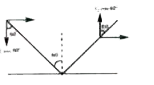 `Deltap = mv_(2) cos THETA-(-mv_(1)cos 45^(@))` `=m(8//sqrt(3))1//2 + m(4sqrt(2))1//sqrt(2) = m((4//sqrt(3))+4)` `=sqrt(3) XX 10^(2)((4sqrt(3)) + 4) = (4+4sqrt(3)) xx 10^(-2) = 10.92 xx 10^(-2) N -s` `therefore F =(Deltap)/(Deltat) = (10.92 xx 10^(-2))/0.1 = 10.92 xx 10, N`, normal to surface. |
|
| 20. |
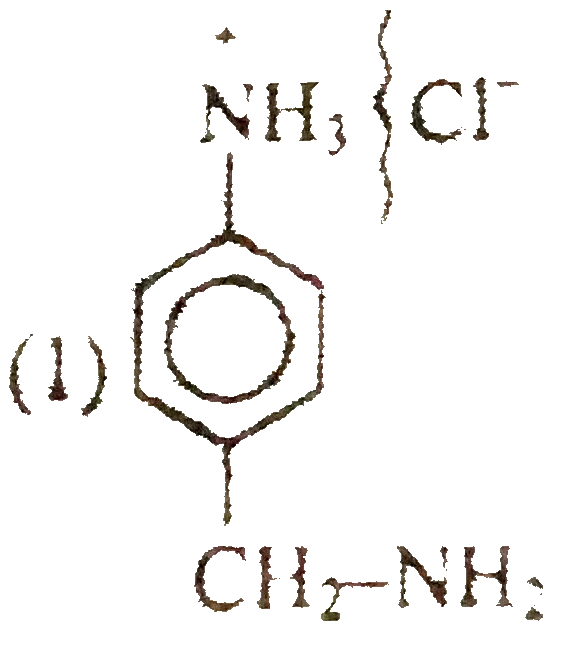
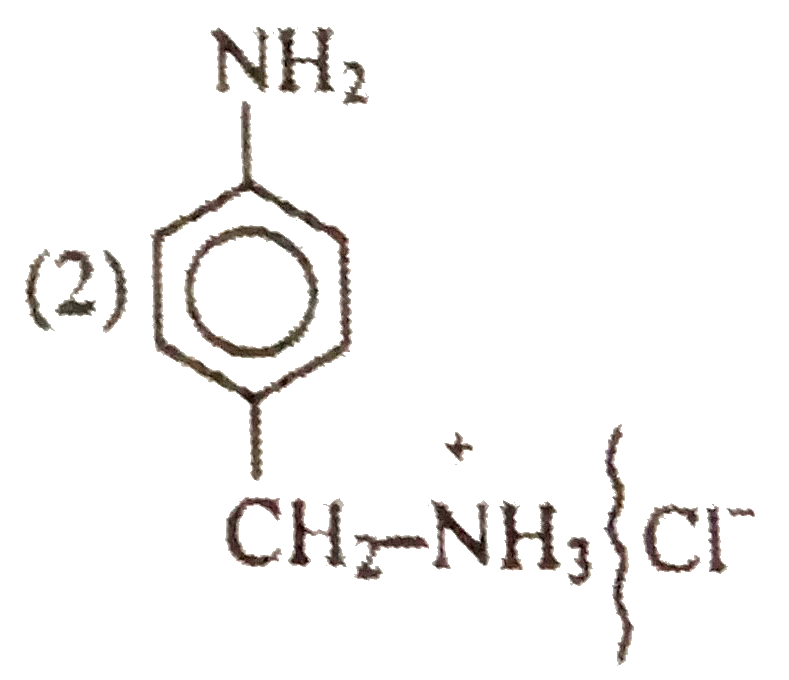
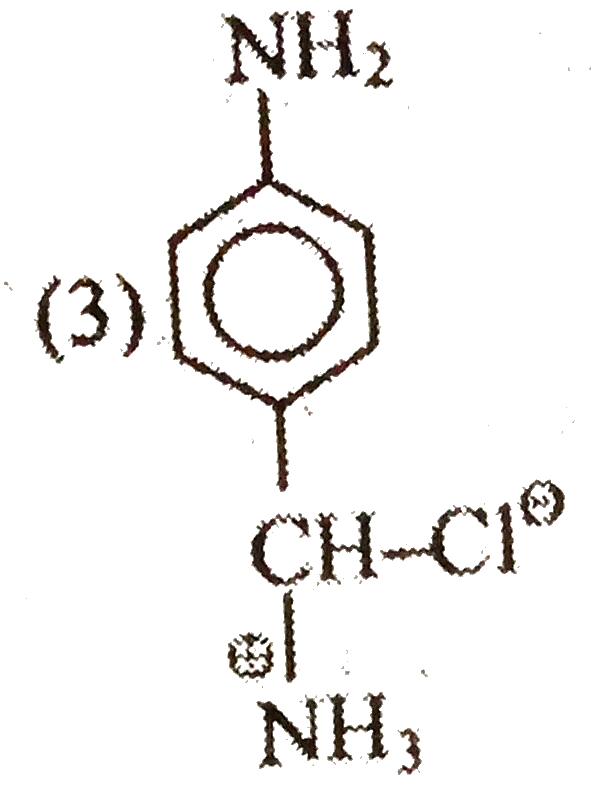
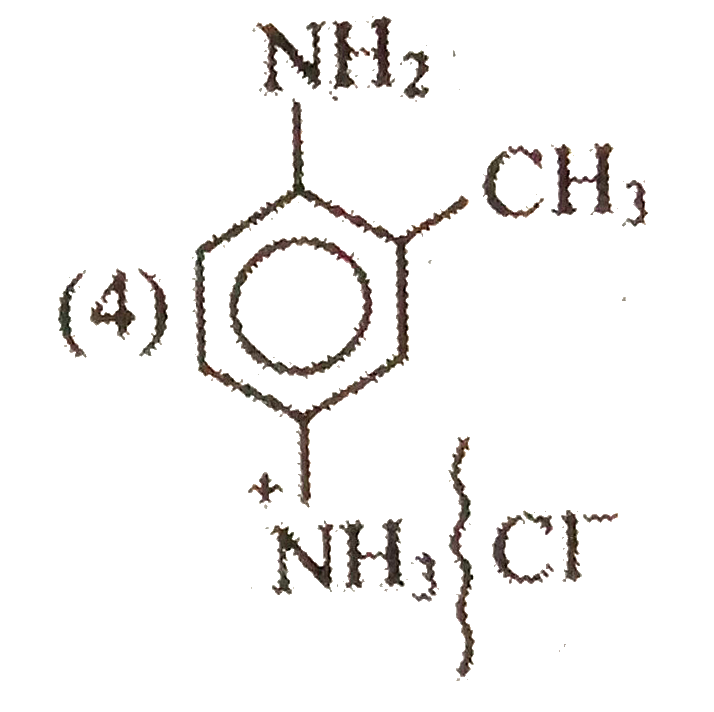
Product formed in above reactionis - |
|
Answer»
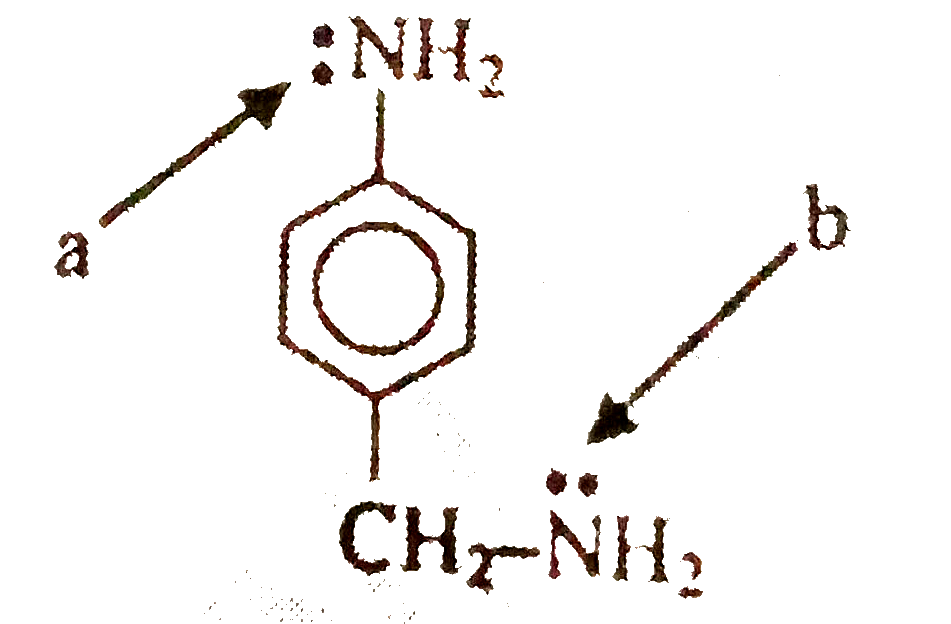 Lone PAIR of (a) delocalized with benzene ring but (b) is not so (b) is morebasic than (a). HENCE, `HCL` is REACT easily in site `(b)`. |
|
| 21. |
Find the resistance of the wire figure shown in Fig. 26.2a. The wire is uniform, made of aluminium of 0.4 mm diameter. The length of the side of the square is 20 cm. |
Answer» 
|
|
| 22. |
An ionized gas contains both +ve and -ve ions which are initially at rest. The gas is subjected to vecE toward positive x-axis, magnetic field along +ve z axis. Then.find the direction of deflection of a) +vecharged ions b) -ve charged ions |
|
Answer» Solution :`vecF=q(vecvxxvecB)` In case of +ve charged ions, direction of `vecF=+(hatixxhatk)` (`VECV` direction is same as `VECE`)=`-HATJ` i.e +ve charged ions deflect towards -ve y-axis in case of -ve charged ions direction of `vecF` `=-(-hatixxhatk)` (`becausevecV` direction is OPP to `vecE`) =`-hatj` i.e -ve charged ions ALSO deflect towards -ve y-axis |
|
| 23. |
A foot ball is kicked of with an inirial speed of 19.6 m/sec at a projection angle 45^(@) . A receiver on the goal line 67.4 m away in the direction of the kick starts running to meet the ball at that in stant. What must his speed be if he is to catch the ball before it hits the ground? |
|
Answer» Solution :`R=(u^(2)sin 2theta)/g =((19.6)^(2) xx sin 90)/(9.8)` or R=39.2 METRE. Man must run 67.4 m -39.2 m = 28.2 m in the time taken by the ball to come to ground. Time taken by the ball. `t=(2u sin THETA)/g =(2 xx 19.6 xx sin 45^(@))/9.8 =4/sqrt(2)` `t=2sqrt(2) =2 xx 1.41 = 2.87`SEC Velocity of man `=(28.2 m)/(2.82 "sec") =10`m/sec. |
|
| 24. |
What are permanent magnets ? Give the ways for preparing them. |
|
Answer» Solution :SUBSTANCE which at room temperature RETAIN their ferromagnetic property for a long period of time are called permanent magnets. One can hold an IRON ROD in the north-south direction and hammer it repeatedly. (This method is shown in figure).  One can also hold a iron rod and stroke it with one end of a bar magnet a large number of times, always in the same sense to make a permanent magnet. An EFFICIENT way to make a permanent magnet is to place a ferromagnetic rod in a solenoid and pass a current. The magnetic field of the solenoid magnetises the rod. |
|
| 25. |
A Source of frequency 10 KHz, when vibrated over the mouth of a closed organ pipe is in unison at 300K. The beats produced when temperature rises by IK is |
| Answer» ANSWER :C | |
| 26. |
The undefined nuclear region of prokaryotes are also known as |
|
Answer» nucleus |
|
| 27. |
What is the meaning of a.m.u. (atomic mass unit) ? |
|
Answer» |
|
| 28. |
In a single slit diffraction pattern, how does the angular width of central maxima change when slit width is decreased |
|
Answer» Solution :Angular WIDTH of CENTRAL maxima `theta=beta_0/D=(2lamda)/d` If d `to` decreases Angular width increases |
|
| 29. |
A rod of negligible dimensions carrying a charge q falls into a conducting loop of resistance R and radius a through a height h. The current flowing through the loop will be |
|
Answer» Zero |
|
| 30. |
A galvanometer with a coil of resistance 120 ohm shows full scale full scale deflection for a current of 2.5 mA. How will you convert the galvonometer into an ammeter of range 0 to 7.5 A ? Determine the net resistance of the ammeter. When an ammeter is put in a circuit, does it read slightly less or more than the actual current in the original circuit ? Justify your answer. |
|
Answer» Solution :Here `R_G = 120 Omega, I_g = 2.5 mA = 2.5 xx 10^(-3) A and I = 7.5 A` `:.` Shunt resistance NEEDED to converted galvanometer into AMMETER `r_s = (I_g)/(I - I_g) cdot R_G = (2.5 xx 10^(-3) xx 120)/(7.5 - 2.5 xx 10^(-3)) = 0.04 Omega` `:.` Net resistance of the ammeter `R = (G r_S)/(G + r_S) = (120 xx 0.04)/(120 + 0.04) = 0.04 Omega` when an ammeter is put in an electric CIRCUIT, it reads slightly less becase net resistance of the circuit slightly rises due to resistance of ammeter being included in series. CONSEQUENTLY, the current slightly decreases. |
|
| 31. |
In Ques. 131, if the pulse lasts for 10^(-7) sec, calculate average power of the laser during the pulse : |
|
Answer» `235.5xx10^(6)W` `=7.85xx10^(19)xx3xx10^(-19)` `=23.55 J` `:. "Power of laser"=("total energy")/("time")` `=(23.55)/(10^(-7))=23.55 xx10^(7)` WATT `=235xx10^(6)W` |
|
| 32. |
How much copper will be deposited from a vitriol solution in 3 minutes, if the current through the electrolyte changes in accordance with the law i=6-0.03t? All quantities are expressed in the SI system. |
|
Answer» `q=underset(0)overset(180)intidt` (check this). Then the MASS of copper may be FOUND from Faraday.s law |
|
| 33. |
For most stable position of magnetic dipole in a uniform magnetic field the value of potential energy should be ....... |
|
Answer» `-MB` `U= - overset(to)(m) .overset(to)(B) = - m B cos theta` it becomes steady when `theta = 0^@` , `therefore U= -mB ""[because cos 0^(@) =1]` |
|
| 34. |
A particle is confined to a one-dimensional trap by infinite potential energy walls. Of the following states, designed by the quantum number n, for which one is the probability density greatest near the center of the well? |
|
Answer» n=2 |
|
| 35. |
Write the condition of destructive interference in terms of phase difference. |
|
Answer» phase DIFFERENCE `=2N PI` |
|
| 36. |
An average induced e.m.f. of 2V appears in a coil when the current in it is changed from 10A in one direction to 10A in opposite direction in 0.5sec. What is the self inductance of the coil? |
|
Answer» SOLUTION :`E = L(dI)/DT = L(20/0.5) = 40L ` `therefore L = 2/20 = 1/20 = 0.05H = 50mH`. |
|
| 37. |
Assertion (A) : Neutrons penetrate matter more readily than protons . Reason (R) : Neutrons are slightly more massive than protons . |
| Answer» SOLUTION :Neutrons penetrate matter more readily than PROTONS because these are uncharged particles and do not easily interact with nuclei. | |
| 38. |
The energy transfered to the battery of an invertor from the electric line is given by U=E.q where q = charge transfered. If A is the ammeter reading during transfer for a small time Deltat, then the dimensions of e.m.f. E of the battery are : |
|
Answer» `ML^(2)T^(-3)A^(-1)` `:.e.m.f.E=(U)/(q)` `E=(ML^(2)T^(-2))/(AT^(1))` `[ML^(2)T^(-3)A^(-1)]` `:. (a)` is the CORRECT choice. |
|
| 39. |
When liquid medicine of density p is to be put in the eye, it is done with the help of a dropper. As the bulb on the top of the dropper is pressed, a drop forms at the opening of the dropper. We wish to estimate the size of the drop. We first assume that the drop formed at the opening is spherical because that requires a minimum increase in its surface energy. To determine the size, we calculate the net vertical force due to the surface tension T when the radius of the drop is R. When this force becomes smaller than the weight of the drop, the drop gets detached from the dropper. If the radius of the opening of the dropper is r, the vertical force due to the surface tension on the drop of radius R (assuming r |
|
Answer» `2pirT`  `=2pirT.r/R=(2pir^(2)T)/R` So CORRECT choice is (C). |
|
| 40. |
What time does it take for the current in a circuit made up of a coil and a resistor to reach 0.9 of its stationary value? |
|
Answer» Taking the logarithms, we obtain `-t/tau LOG e=log 0,1, -t/tau 0.434=-1` HENCE `t=2.3tau`. |
|
| 41. |
A straight wire carrying a current of 12 A is bent into a semicircular arc of radius 2.0 cm as shown in figure (a). Consider the magnetic field vecB at the centre of the arc. (a) What is the magnetic field due to the straight segments ? (b) In what way the contribution to vecB from the semicircle differs from that of a circular loop and in what way does it resemble ? ( c) Would your answer be different if the wire were bent into a semicircular arc of the same radius but in the opposite way as shown in figure (b) ? |
|
Answer» Solution :(a) DL and r for each element of the straight segments are parallel. Therefore, dl × r = 0. Straight segments do not contribute to |B|. (b) For all segments of the SEMICIRCULAR arc, dl × r are all parallel to each other (into the plane of the paper). All such contributions add up in magnitude. HENCE direction of B for a semicircular arc is GIVEN by the right-hand rule and magnitude is half that of a circular loop. THUS B is `1.9 x× 10^(-4)`T normal to the plane of the paper going into it. (c ) Same magnitude of B but opposite in direction to that in (b). |
|
| 42. |
When liquid medicine of density p is to be put in the eye, it is done with the help of a dropper. As the bulb on the top of the dropper is pressed, a drop forms at the opening of the dropper. We wish to estimate the size of the drop. We first assume that the drop formed at the opening is spherical because that requires a minimum increase in its surface energy. To determine the size, we calculate the net vertical force due to the surface tension T when the radius of the drop is R. When this force becomes smaller than the weight of the drop, the drop gets detached from the dropper. If r = 5 xx 10^(-4) m p = 10^(3) kgm^(-3), g = 10 ms^(-2), T = 0.11 Nm^(-1), the radius of the drop when it detaches from the dropper is approximately : |
|
Answer» `1.4xx10^(-3)m` `R^(4)=(3R^(2)T)/(2pg)=4.125xx10^(-12)` `rArrR~~1.4xx10^(-3)m` So Correct CHOICE is (a). |
|
| 43. |
When liquid medicine of density p is to be put in the eye, it is done with the help of a dropper. As the bulb on the top of the dropper is pressed, a drop forms at the opening of the dropper. We wish to estimate the size of the drop. We first assume that the drop formed at the opening is spherical because that requires a minimum increase in its surface energy. To determine the size, we calculate the net vertical force due to the surface tension T when the radius of the drop is R. When this force becomes smaller than the weight of the drop, the drop gets detached from the dropper. After the drop detaches, its surface energy is : |
|
Answer» `1.4xx10^(-6)J` So, correct CHOICE is (b). |
|
| 44. |
Obtain the relation between electric field and electric potential . |
Answer» Solution :As shown in figure consider wo closely space equipotential surfaces A and B with potential values V and V + `deltaV` where `deltaV` is the change in V in the direction of the electric field `vecE` . 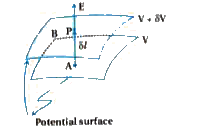 Let P be a point on the surface B.`deltal`is the perpendicular distance of the surface A from P. Suppose that a UNIT positive charge is moved along the perpendicular from the surface B to the surface A against the electric field. The work done in this process is `|vecE|deltal`. But work done , `W=V_(A)-V_(B)` `:.|vecE|deltal=V-(V+deltaV)` `:.|vecE|deltal=-deltaV` `:. |vecE|=-(deltaV)/(deltal)` `:. |vecE|=|(deltaV)/(deltal)|` `:. E=(V)/(l)` Hence NEGATIVE value of potential gradient is equal to the magnitude of electric field. `(deltaV)/(deltal)` is known as potential gradient . Its unit is `Vm^(-1)` . From this there are two important conclusions are as below. (1) Electric field is the direction in which the potential decreases steepest. (2) The magnitude of electric field is given by the change in the magnitude of potential per unit displacement NORMAL to the equipotential surface at the point. |
|
| 45. |
If R is the radius of earth and g is acceleration due to gravity on the surface of the earth, then binding energy of the satellite of mass m at the height h above earth's surface is · (r is orbital radius of satellite) |
|
Answer» `(mgR^2)/R` |
|
| 46. |
Why are vehicles provided with wheels and- ball bearing ? |
| Answer» Solution :The is due to the FACT that the ROLLING friction is MUCH SMALLER than the sliding friction. | |
| 47. |
Define farad. Give the expression for energy stored in a capacitor of capacitance C charged to a potential V. |
|
Answer» SOLUTION : Capacitance of CAPACITOR is SAID to be one farad if charge of 1 COULOMB is required to raise the potential by 1 volt. `U = 1/2 CV^2` |
|
| 48. |
At which place magnetic dip angle is maximum ? |
|
Answer» (A) on MAGNETIC north pole and magnetic SOUTH pole |
|
| 49. |
Nonmetric version : (a) How long does a 2.0 xx 10^(5) Btu// h water heater take to raise the temperature of 65 gal of water from 70^(@)F to 100^(@)F ? Metric version : (b) How long does a 59 kW water heater take to raise the temperature of 246L of water from 21^(@) to 38^(@)C ? |
|
Answer» |
|