Saved Bookmarks
This section includes 7 InterviewSolutions, each offering curated multiple-choice questions to sharpen your Current Affairs knowledge and support exam preparation. Choose a topic below to get started.
| 1. |
An observer is moving with a constant speed of 20m/s on a circular track of radius 50m. A source kept at centre of track emits a sound of frequency 200 Hz. Then the frequency received by the observer is x xx 10^2 Hz, what is value of x. (V= 340m/s) |
|
Answer» |
|
| 2. |
Two charge 5xx10^(-8)Cand -3xx10^(-8) Care located 16 cm apart. At what point(s) on the line joining the two charges is the electric potential zero ? Take the potential at infinity to be zero. |
|
Answer» Solution :Here are two possibilities. First possibillty : Let charge `q_(1) = 5xx10^(-8) ` C and `q_(2) =-3XX10^(-8) ` C are placed at point A and B respectively. AB = 0.16 m 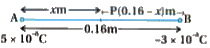 Let electric potential at point P is zero `:.` Electric potential at Point P `V = V_(1) +V_(2)` `O=(kq_(1))/(x) +(kq_(2))/(0.16-x)` `O = (5xx10^(-8))/(x) -(3xx10^(-8))/(0.16-x) [ because ` Dividing by k] `:. (3xx10^(-8))/(0.16-x)=(5xx10^(-8))/(x)` `:. (3)/(0.16-x) =(5)/(x)` `:. 3x=0.8 -5x` `:. 8x=0.8` `:. x = 0.1 `m `:. ` It is zero from 0.1 m away from `5xx10^(-8) ` C or It is zero from 0.06 m away from `-3 xx10^(-8) C ` Second possibillity : 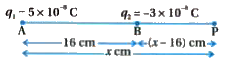 `V= V_(1) + V_(2)` `:. 0 =(kq_(1))/(x) (kq_(2))/(x-16)` `:. (q_(1))/(x) = (q_(2))/(x-16)` `:. (5)/(x XX 10^(-2))= (3)/((x-16)xx10^(-2))` `:. (5)/(x) =(3)/(x-16)` `:. 5x-80=3x` `:. 2x=80 ` `:. x = 40 cm` `:.` 40 cm away from `q_(1)` cahrge or 24 cm away from `q_(2)` charge. |
|
| 3. |
Two identical thin rings, each of radius 10 cm carrying charges 10 C and 5 C are coaxially placed at a distance 10 cm apart. The work done in moving a charge q from the centre of the first ring to that of the second is |
|
Answer» a. `(Q)/((sqrt2+1)/sqrt2)` |
|
| 4. |
A charge 'q' moving along the X-axis with a velociyt vecv (fig) is subjected to a uniform magnetic field vecB acting along the Z-axis as it crosses the origin O. (i) Trace its trajectory. (ii) Does the charge gain kinetic energy as it enters the magnetic field? Justify your answer. |
Answer» SOLUTION :The trajectory is a circualr path in X - Y plane as shown in fig. 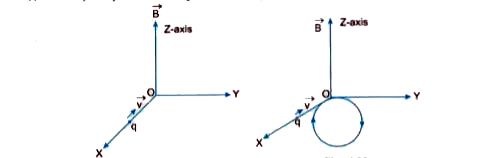 (ii) The charge does not gain kinetic energy as it enters as it enters the magnetic field `vecB`. Force `VECF ( = q vecv XX vecB)` due to magnetic field is in a perpendicular DIRECTION and changes only the direction of motion of charge. There is no change in magnitude of velocity of charge and HENCE no change in its kinetic energy. |
|
| 5. |
Ozone layer absorbs |
|
Answer» VISIBLE ligh |
|
| 6. |
Light moves in a straight line. Because ...... |
|
Answer» its velocity is very high. |
|
| 7. |
Three identical cells of emf 2 V and internal resistances 0.20 Omega are connected in series. The combination is further connected to an external resistor of 6Omega . Calculate the current through 6 Omega resistor. |
| Answer» SOLUTION :`(10)/(11)A` | |
| 8. |
What is the direction of the electric field at the surface of a charged conductor having charge density sigma |
| Answer» Solution :Electric field at the SURFACE of a charged conductor, whose surface charge density is NEGATIVE (`sigma`<0), is acting normal to the surface and is directed inwards. | |
| 9. |
The kinetic energy of the electron in an orbit of radius r in hydrogen atom is proportional ...... |
|
Answer» `(e^(2))/(2r)` `(mv^(2))/(r)=(k(ze)(e))/(r^(2))` `:.(1)/(2)mv^(2)=(KE^(2))/(2r)[:.z=1]` Kinetic energy of electron in atom `H_(2)=(ke^(2))/(2r)` Note: There is an error in the statement of self LEARNING which is here corrected |
|
| 10. |
The dimensional formula for the coefficient of thermal conductivitywill be |
|
Answer» `MLT^-3K^-1` |
|
| 11. |
Alternative bright and bark fringes appear in Young.s double slit experiment due to the pheno-menon of |
|
Answer» polarisation |
|
| 12. |
How many electrons will have a charge of one coulomb ? |
|
Answer» `6.25 XX 10^(18)` |
|
| 13. |
If e/m of electron is 1.76xx10^(11)Ckg^(-11) and the stopping potential is 0.71 V, then the maximum velocity of the photoelectron is |
|
Answer» a. 150 km `s^(-1)` |
|
| 14. |
Four similar prisms of angle of prism are arranged. Which of the following arrangements give no netangular deviation ? |
|
Answer»
|
|
| 15. |
Two blocks 'A' and 'B' having masses m_(A) and m_(a), respectively are connectd by an arrangement shown in the figure. Calculate the downward acceleration of the block B. Assume the pulleys tobe massless. Under what condition will block A have downward acceleration? |
|
Answer» SOLUTION :According to Newton `2^(nd)` Law `m_(B)g-T=m_(B)a_(B)""("From FBD of " m_(B))"" ...1` `2T-m_(A)g=m_(A)a_(A)""("From FBD of "m_(A))""...2` Constraint relation `a_(B) = 2a_(A)=a""...3` Solving EQUATION 1, 2 & 3 `a_(B)=a=(2g(2m_(B)-m_(A)))/((4m_(B)+m_(A))), a_(A)= (a)/(2)=(g(2m_(B)-m_(A)))/((4m_(B)+m_(A)))`. Block A will have downward motion if `a_(A) lt 0 rArr (2m_(B)-m_(A)) lt 0` `rArr m_(A) gt 2m_(B)` |
|
| 16. |
In telescope, focal length of objective is kept more as ... |
|
Answer» diameter of LENS BECOMES larger so DIFFRACTION becomes less. |
|
| 17. |
A material has Poisson ratio 0.5. If a rod of the material has a longitudinal strain 2 xx 10^(-3), the percentage change in volume is : |
|
Answer» 0.6 In this case `(Deltal)/l=2xx10^(-3)` and `sigma=0.5` `THEREFORE=(Deltar)/r=sigmaxx(Deltal)/l` `=2xx10^(-3)xx0.5=10^(-3)` Let V be the initial volume and `(V + Delta V)` be the FINAL volume, then `V=pir^(2)l` `V+DeltaV=pi(r-Deltar)^(2)(l+Deltal)` `thereforeDeltaV=pir^(2)Deltal-2pirlDeltar` (Subtracting and simplifying) `(DeltaV)/V=(Deltal0)/l-(2Deltar)/r` `=2xx10^(-3)-2xx10^(-3)`=Zero |
|
| 18. |
Statement I. If ice at the poles melts then the durationof day will shorten. Statement II. When ice flows from poles towards equator then moment of inertia decreases. This increases the frequencyof rotation of earth. |
|
Answer» STATEMENT-I is TRUE, Statement-II is true and Statement-II is correct explanation for Statement-I. So correct CHOICE is d. |
|
| 19. |
O is the centre of an equilateral triangle ABC. F_(1), F_(2) and F_(3) are three forces acting along the sides AB, BC and AC as shown in the figure. What should be the magnitude of F_(3), so that the total torque about O is |
|
Answer» `(F_(1)+F_(2))` `=F_(1)x+F_(2)x-F_(3)x=0` or `F_(1)+F_(2)=F_(3)` |
|
| 20. |
Assertion : Cyclotron does not accelerate electron. Reason : Mass of the electron is very small |
|
Answer» If both assertion and reason are true and reason is the correct EXPLANATION of assertion. Explanation : Cyclotron is suitable for accelerating HEAVY particles like protons, x-particles. ,etc. and not for ELECTRON because of LOW mass. |
|
| 21. |
A car is moving in a circular path with a uniform speed. Find the magnitude of change in its velocity when the car rotates through an angle theta |
|
Answer» Solution :Change in velocity `VEC(Deltav)= vec v= vec v- vec u` The magnitude of change in velocity `DELTA v= sqrt(v^(2)+u^(2)-2 UV cos theta)` As the speed is uniform `=|vecv|=|vecu|=v` `:. Deltav=2v SIN ((theta)/(2))` |
|
| 22. |
Two metal plates having a potential difference of 800 V are 0.02 m apart horizontally. A particle of mass 1.96 xx 10^(-15) kg is suspended in equilibrium between the plates. If e is the elementary charge, the charge on the particle is |
|
Answer» Solution :For steady position weight = ELECTRIC force `therefore mg = QE` `therefore mg = "NE"E` `therefore "ne" = (mg)/E = (mgd)/V [therefore E =V/d]` `=(1.96 xx 10^(-15) xx 9.8 xx 0.02)/800 = 0.00048 xx 10^(-15)` `therefore Q = 3 xx 1.6 xx 10^(-19)` `therefore Q = 3e(therefore 1.6 xx 10^(-19) C =e)` |
|
| 23. |
The wavelength of radiation emitted by a body depends upon : |
|
Answer» the TEMPEARTURE of its SURFACE `lamda_(m)*T=` Constant Correct choice is (a). |
|
| 24. |
In an experiment the values of refractive index of glass were found to be 1.54, 1.53, 1.44,1.54, 1.56, 1.45. The relative error andpercentage error are |
|
Answer» `0.04 , 4%` |
|
| 25. |
(A) : The centre of sensitivity of our eyes coincides with the centre of the wavelength distribution of the Sun. (R) : Humans have evoled with visions most sensitive to the strongest wavelengths from the Sun. |
|
Answer» Both 'A' and 'R' are TRUE and 'R' is the CORRECT EXPLANATION of 'A'. |
|
| 26. |
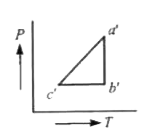
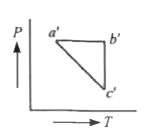
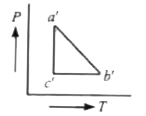
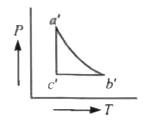
One mole of an ideal gas undergoes a cyclic process abca, as shown in figure. If ab is isothermal process, then which of the following is correct P - T diagram for the cyclic process ? |
|
Answer»
|
|
| 27. |
The dimensions of a brick wall of a living room are: thickness 40 cm, width 5 m and height 2.8 m. A temperature of 20^(@)C is maintained inside the room, the temperature outside being -15^(@)C. How much heat is lost through this wall in 24 hours? |
|
Answer» |
|
| 28. |
A car batteryisof12V. Eightdrycellsof1.5 Vconnectedin seriesalsogive12V, butsuchacombination is not usedtostart acar. Why ? |
| Answer» Solution :Drycell usedin SERIESWILL havehighresistance`(= 10 OMEGA ) `andhenceprovidelow current,whilea carbatteryhas LOW INTERNALRESISTANCE(`0.1 Omega ` )andhencegiveshighcurrentforthesameemf,needed to startthecar. | |
| 29. |
A bar magnet of magnetic moment 2.5 Am^(2) is free to rotate about a vertical axis through its centre. The magnet is released from the east - west direction. Find the kinetic energy of the magnet as it aligns itself in the north - South direction (B_H = 0.3x10^(-4)T). |
| Answer» SOLUTION :`75 MU J` | |
| 30. |
A force(7 hat i + 6 hat k )newton makes a body move on a rough plane with a velocity of (3 hat j + 4 hat k)m/s. calculater power in watt. |
|
Answer» 15 |
|
| 31. |
A piston is performing S.H.M, in the vertical direction with a frequency of 0.5 Hz. A block of 10 kg is placed on the piston. The maximum amplitude of the system such that the block remains in contact with the piston is |
|
Answer» 1.5 m `(2pi XX 0.5)^(2) xx` A = 10 `:. A = (10)/(2pixx0.5)^(2)` = 1 m |
|
| 32. |
In the circuit shown in fig. (a), final the value of R_(C). |
|
Answer» Solution :Consider the fig. (b) to solbe this question. `I_(E) = I_(C) + I_(B) " and " I_(C) = beta I_(B)`.....(i) `I_(C) R_(C) + V_(CE) + I_(E) R_(E) = V_(C C)` .....(ii) `RI_(B) + V_(BE) + I_(E) R_(E) = V_(C C)`....(iii) `I_(E) ~~ I_(C) = beta I_(B)` 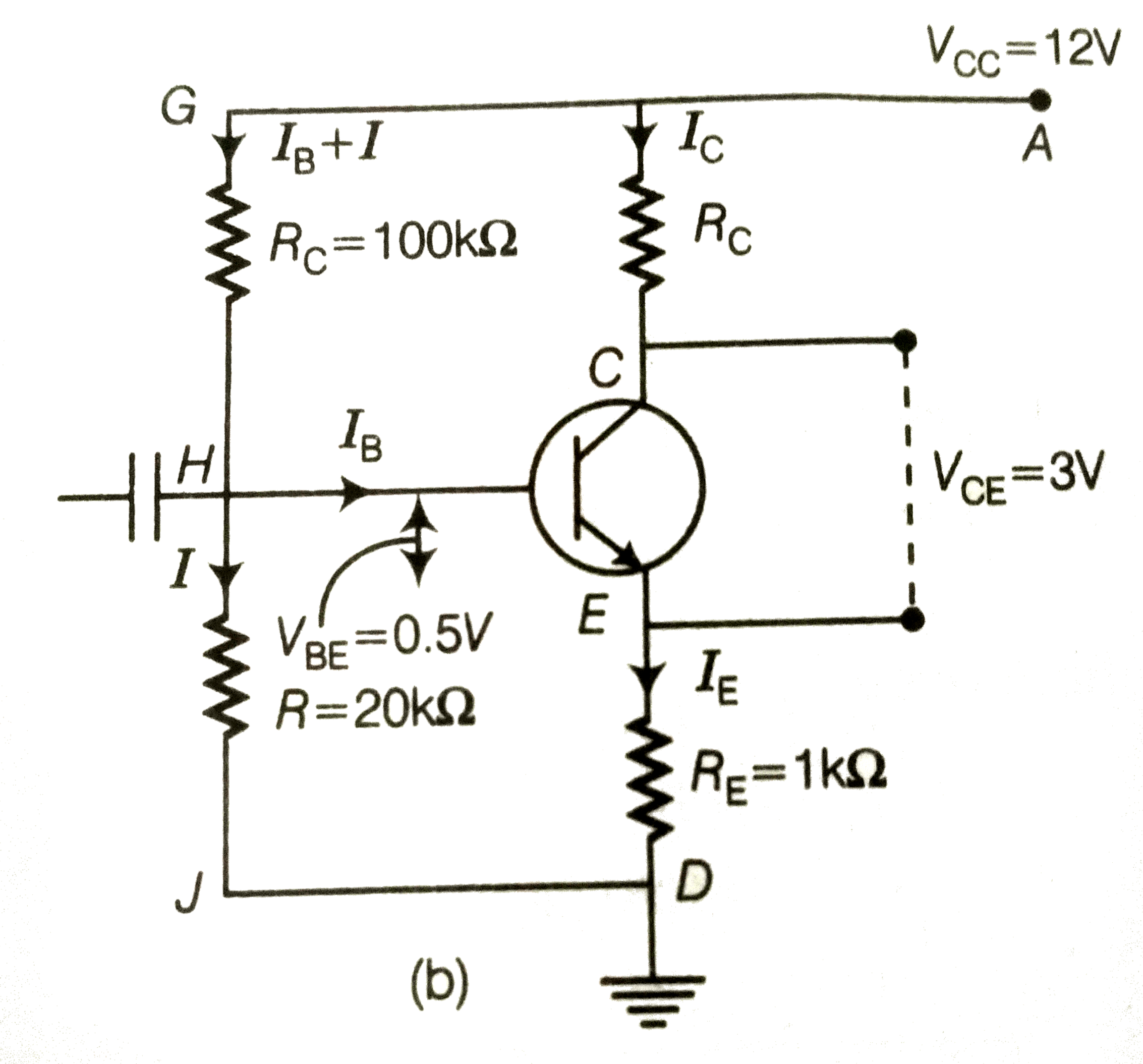 From Eq. (iii), `(R + beta R_(E)) I_(B) = V_(C C) - V_(BE)` `rArr I_(B) = (V_(C C) - V_(BE))/(R + beta. R_(E))` `= (12 - 0.5)/(80 + 1.2 xx 100) = (11.5)/(200) mA` From Eq. (ii), `(R_(C) + R_(E)) = (V_(CE) - V_(BE))/(I_(C)) = (V_(C C) - V_(CE))/(beta I_(B)) "" ( :. I_(C) = beta I_(B))` `(R_(C) + R_(E)) = (2)/(11.5) (12 - 3) k OMEGA = 1.56 k Omega` `R_(C)+ R_(E) = 1.56` `R_(C) = 1.56 - 1 = 0.56 k Omega` |
|
| 33. |
A cylindrical conductor has a resistance R. When the conductor is at a temperature (T) above its surrounding temperature (T_0), the ratio of thermal power dissipated by the conductor to its excess temperature (DeltaT = T – T_(0)) above surrounding is a known constant k. The conductor is connected to a cell of emf V. Initially, the conductor was at room temperature T_(0). Mass and specific heat capacity of the conductor are m and s respectively. (i) find the time (t) dependence of the temperature (T) of the conductor after it is connected to the cell. Assume no change in resistance due to temperature. (ii) find the temperature of the conductor after a long time. |
|
Answer» (II) `T=T_(0)+(V^(2))/(kR)` |
|
| 34. |
In a betatron the magnetic flux across an equilibrium orbit of radiusr = 20 cmvaries duringa timeintervalDelta t = 1.0 ms at practicallyconstantratefrom zeroto B = 0.40 T. Find the energy acquiredby theelectron per revolution. |
|
Answer» SOLUTION :From the betatron condition, `(1)/(2) (d)/(dt) lt B gt = (dB)/(dt) (r_(0)) = (B)/(Delta t)` Thus, `(d)/(dt) lt B gt = (2B)/(Delta t)` and `(d PHI)/(dt)=PI r^(2) (d lt B gt)/(dt) = (2pi r^(2) B)/(Delta t)` So, energy increment per revolution is, `e (d Phi)/(dt) = (2pi r^(2) eB)/(Delta t)` |
|
| 35. |
Keeping the source frequency equal to the resonating frequency of the series LCR circuit, if the three elements, L, C and R are arranged in parallel, show that the total current in the parallel LCR circuit is minimum at this frequency. Obtain the current rms value in each branch of the circuit for the elements and source specified in Exercisefor this frequency. |
|
Answer» Solution :Effective impedance of the parallel LCR circuit is given by `=(1)/(Z)=sqrt((1)/(R^(2))+(omegaC-(1)/(OMEGAL))^(2))` which is minimum at `omega=omega_(0)=(1)/(sqrt(LC))` Therefore, |Z| is maximum at `omega = omega_(0)` , and the total current amplitude is minimum. In R branch, `I_("RMS")=5.75A` In L branch, `L_("Lrms")=0.92A` In C branch, `I_("Crms")=0.92A` Note: total current `I_("rms") = 5.75 A` , since the currents in L and C branch are `180^(@)` out of phase and add to zero at EVERY INSTANT of the cycle. |
|
| 36. |
Two wires A and B are of lengths 40 cm and 30 cm. A is bent into a circle of radius r and B into an arc of radius r. A current i_(1) is passed through A and i_(2) through B. To have the same magnetic induction at the centre, the ratio of i_(1) : i_(2) is |
|
Answer» `3:4` |
|
| 37. |
A uniform sphere of mass 20kg and radius 10cm is placed on a rough horizontal surface . The coefficient of friction between the sphere and the surface is 0.5.If a force of magnitude 14.14 N is applied on the sphere at an angle of45^(@) with horizontal as shown in the figure, calculate (a) frictional force (b) acceleration of the sphere (c ) angular acceleration of the sphere |
|
Answer» |
|
| 38. |
Reflective intensity of material is equal to the tangent of porzing angle, it is called |
|
Answer» Brewster.s LAW |
|
| 39. |
The wires which connect the battery of an automobile to its starting motor carry a current of 300 A (for a short time). What is the force per unit length between the wiresif they are 70 cm long and 1.5 cm apart? Is the force attractive or repulsive? |
| Answer» Solution :`1.2 N m^(-1)` , repulsive. Note, obtaining TOTAL force on the wire as `1.2 x× 0.7 = 0.84 N` , is only APPROXIMATELY correct because the formula `F = (mu_0)/(2pi r) I_1 I_2`for force per UNIT LENGTH is strictly valid for infinitely LONG conductors. | |
| 40. |
A square loop of side a is placed in the same plane as a long straight wire carrying a current i. The centre of the loop is at a distance r from the wire where r > > a. The loop is moved away from the wire with a constant velocity v. The induced e.m.f. in the loop is |
|
Answer» Solution :Magnetic field by the straight WIRE of current i ata DISTANCE r is B =`(mu_0 i)/(2pi r)` flux associated with the LOOP is `phi = BA = (mu_0 i)/(2pi r) a^2` ` therefore e = (-dphi)/(dt) = (-mu_0 )/(2pi) ia^2 (d)/(dt) (1/r) = (-mu_0)/(2pi) ia^2 = ((-1)/(r^2)) (dr)/(dt)` Hence the induced emf in the loop is `e = (mu_0)/(2pi) i (a^2)/(r^2) v ( because (dr)/(dt) = v)` |
|
| 41. |
An electron completes 25 rotations in 1 seconds on circular path, then amount or electric charge passing through any point in circular path in 10 seconds is .... . |
|
Answer» `4 xx 10^(20)` C Q= fet `= 25 xx 1.6 xx 10^(-19) xx 10` = ` 4 xfx 10^(-17)` C |
|
| 42. |
n' small drops of same size are charged to a potential V. The drops caolesce to form a bigger drop. Calculate the potential of the bigger drop. |
|
Answer» |
|
| 43. |
A body takes 10 minutes to cool from 60^(@)C to 50^(@)C. The temperature of surroundings is constant at 25^(@)C. Then, the temperature of the body after next 10 minutes will be approximately |
|
Answer» `48^(@)C` |
|
| 44. |
Orientedwith transmission make an angle of 60^(@) .The percentage of light that passes through the pattern is |
|
Answer» 0.5 |
|
| 45. |
If a toroid uses bismuth for its core, will the field in the core be (slightly) greater or (slightly) less than when the core is empty? |
| Answer» Solution :(C) Since bismuth is diamagnetic, MAGNETISATION is obtained OPPOSITE to magnetising field. HENCE, resultant magnetic field obtained in a toroid FILLED with bismuth will be less than that in empty toroid. | |
| 46. |
A body moves for a total of nine seconds starting from rest with uniform acceleration and then with uniform retardation, which is twice the value of acceleration and then stops. The duration of uniform acceleration is: |
|
Answer» 3 s For FIRST part `v=0+at_(1)` or `t_1=(v)/(a)` For SECOND part `0=v-2at_(2)` or `t_(2)=(v)/(2a)` Total time t=9 s=`t_1 +t_2 =(v)/(a)+(v)/(2a)` `9=(2v+v)/(2a)=(3)/(2)(v)/(a)` `(v)/(a)=6` Now `t_1=(v)/(a)=6s` |
|
| 47. |
c. the virtual image produced by a convex mirror is always diminished in size andis located between the focus and the pole. |
|
Answer» Solution :c.m = `(f)/(f - u) .` for a convex MIRROR, f is POSITIVE and u NEGATIVE . `therefore (f - u) gt ` f i.e., m `lt ` 1 Hence the IMAGE is DIMINISHED. |
|
| 48. |
Name the type of lensused to correct (i) Myopia (ii) Hypermietropia |
| Answer» Solution :Concave LENS of SUITABLE FOCAL LENGTH. | |
| 49. |
Derive lens maker's formula for a biconvex lens. |
|
Answer» Solution :Consider a point object O situated on the principal axis of a biconvex lens, whose TWO surfaces have radii of curvature `R_(1) and R_(2)`, respectively. As shown in figure due to refractionat 1st surface of lens an image I. is formed for the object O. If OC = u, CI. = V., then using the refraction formula at a single spherical surface, we have `(n_(2))/(v.)-(n_(1))/(u)=(n_(2)-n_(1))/(R_(1)) "" ...(i)` The image I. behaves as a virtual object for refraction at the second surface of the lens and the final real image is formed at I. Thus, for second surface applying refraction formula, we have `(n_(1))/(v)-(n_(2))/(v.)=(n_(1)-n_(2))/(R_(2))=(n_(2)-n_(1))/((-R_(2)))"" ...(ii)`  Adding (i) and (ii), we have `(n_(1))/(v)-(n_(1))/(u)= (n_(2)-n_(1))((1)/(R_(1))-(1)/(R_(2)))` or `(1)/(v)-(1)/(u)=((n_(2))/(n_(1))-1)((1)/(R_(1))-(1)/(R_(2)))` `=(n_(21)-1)((1)/(R_(1))-(1)/(R_(2)))` If `u=oo`, then by definition `v=F` and, hence, `(1)/(f)-(1)/(oo)=(n_(21)-1) ((1)/(R_(1))-(1)/(R_(2))) rArr (1)/(f)=(n_(21)-1)((1)/(R_(1))-(1)/(R_(2)))` This relation is known as lens maker.s formula. |
|
| 50. |
How many AM broadcast stations can be accommodated in a 100 kHz bandwidth if the highest modulating frequency of carrier is 5 kHz ? |
|
Answer» SOLUTION :Any station being modulated by a 5 kHz signal will produce an upper side FREQUENCY 5 kHz above its carrier and a lower side frequency 5 kHz below its carrier THEREBY REQUIRING a bandwidth of 10 kHz. Thus, Number of stations accommodated `("Total banwidth")/("Band width per station")=(100)/(10)=10` |
|