

Saved Bookmarks
This section includes 7 InterviewSolutions, each offering curated multiple-choice questions to sharpen your Current Affairs knowledge and support exam preparation. Choose a topic below to get started.
| 1. |
Which of the following is diamagetic ? |
|
Answer» ALUMINIUM |
|
| 2. |
Light takes time t_1 to travel a distance x_1 in vacuum and the same light takes time t_2 to travel adistance x_2 in a medium. The critical angle for that medium is |
|
Answer» `SIN ((x_2 t_2)/(x_1 t_1))` |
|
| 3. |
Mention some striking resemblances in the geometrical description of resistances, capacitance and inductance. |
| Answer» SOLUTION :R = `rho(l/A), C=sum(A/d), L=(N^(-2)muA)/l` (i) In each case, there is an INVOLVEMENT in the PHYSICAL property of the medium. These are resistivity `pi`for resistance, permittivity `sum` for capacitance and permeability `mu` for inductance. | |
| 4. |
An atom in the state with quantum numbers L=2,S=1 is located in a weak magnetic field. Find its magnetic moment if the least possibel angle between the angular momentum and the field direction is known to be equal to 30^(@). |
|
Answer» Solution :The angular between the angular MOMENTUM vector and field DIRECTION is the LEAST when the angular mommentum vector and the field direction is the least when the angular mommentum projection is maximum i.e., `j ħ` Thus `j ħ=sqrt(J(J+1)) ħ cos 30^(@)` or `sqrt((J)/(J+1))=(sqrt(3))/(2)` Hence `J=3` Then `g=1+(3xx4+1xx2-2xx3)/(2xx3xx4)=1+(8)/(24)=(4)/(3)` and `mu=(4)/(3)sqrt(3xx4)mu_(B)=(8)/(sqrt(3))mu_(B)`. |
|
| 5. |
(A) : Capacitor serves as a block for D.C. and offers an easy path to A.C. (R) : Capacitive reactance is inversely proportional to frequency. |
|
Answer» Both 'A' and 'R' are true and 'R' is the CORRECT EXPLANATION of 'A'. |
|
| 6. |
What do you understand when it is stated that the potential difference is 3V ? |
| Answer» Solution :p.d = 3V means, workdone on 1C to MOVE between the TWO POINTS is 3J. | |
| 7. |
Define magnetic flux |
| Answer» Solution :Total number of magnetic lines of FORCE passing through a given AREA (area being normal to the magnetic line of force) is known as magnetic FLUX. | |
| 8. |
If the frequency of an a.c. circuit consisting of an inductance coil is increased, the current gets increased. |
|
Answer» |
|
| 9. |
if rod is rotated about an axis passing through its mid-point , the potential difference between the ends of rod is |
|
Answer» `(BomegaL^(2))/(4)` 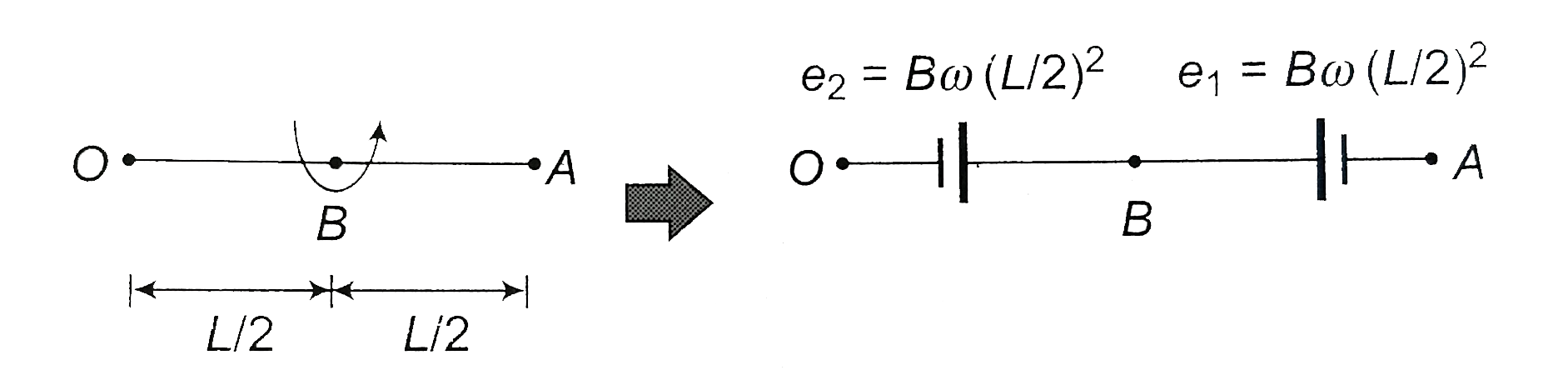
|
|
| 10. |
What is the degree of cubic polynomial |
|
Answer» 2 |
|
| 11. |
A concave mirror of radius of curvature 1 m is placed at the bottom in a reservoir of water. When the sun is situated directly over the head, the mirror forms an image of the sun. If the depth of water is (i) 80 cm and (ii) 40 cm , calculate the image distance from the mirror. ["Given", mu_(w) = (4)/(3)] |
|
Answer» SOLUTION :The SUN acts as an object situated at infinity. So its image will be formed by the concave mirror at its focus i.e. `(100)/(2) = 50CM` above the mirror. When the depth of water in the reservoir is 80 cm the image is formed at a distance of 50 cm inside water from the mirror. But when the depth of water is 40 cm the image will be formed in AIR. LIGHT rays will be refracted while passing from water to air. So, the refracted rays will converge at O. and an image will be formed at O. [Fig. 259]. Displacement of the image `= OO. = t(1- (1)/(mu)) = 10(1-(3)/(4))` `= 10 xx (1)/(4) = 2.5cm` `therefore "" "distance of image from the mirror"` `= PO. = 50 - 2.5 = 47.5 cm` 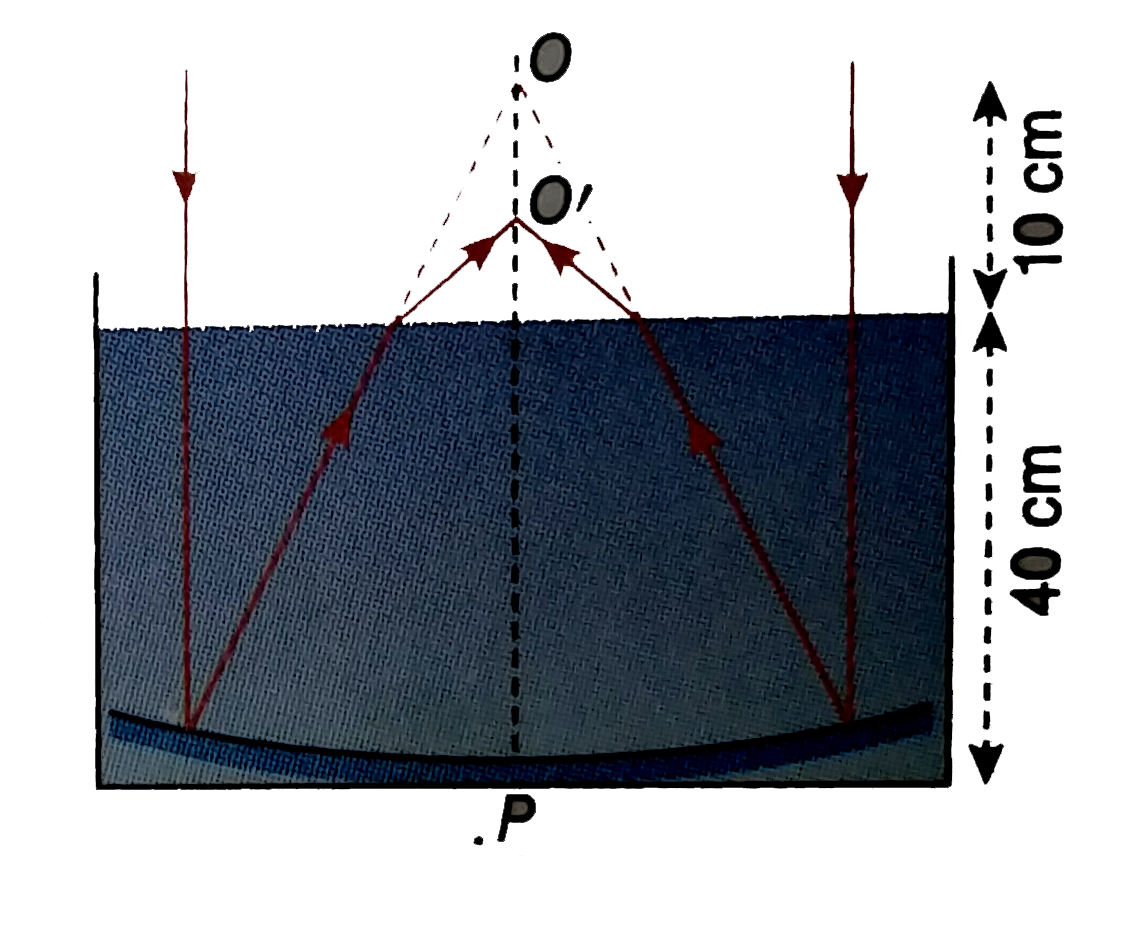
|
|
| 12. |
What will happen to the image if one half of the objective lens is covered with a black paper ? |
| Answer» Solution :The size of the image unchanged if one half of the objective lens is covered with blackpaper . Only brightness of the image will DECREASE to some extent. Here, the half of the objective lens takes part in the FORMATION of the image . So the COMPLETE image is FORMED . The brightness of the image will be reduced to half as the amount of refracted light is reduced to half . | |
| 13. |
The magnetic flux threading a coil changes from 12 xx 10^(-3) Wb " to " 6 xx 10^(-3) Wb "in " 0.01 sec. Calculate the induced emf. |
|
Answer» |
|
| 14. |
In an electron microscope, the electron beam is associated through a large potential difference in a device called "_____________" |
|
Answer» ACCELERATOR |
|
| 15. |
Keeping the velocity of projection constant, the angle of projection is increased from 0° to 90°. Then the horizontal range of the projectile |
|
Answer» GOES on INCREASING up to 90° |
|
| 16. |
In the circuit shown in fig. the switch is kept closed in position 1 for a long time. At time t = 0 the switch is moved to position 2. Write the dependence of voltage (V_C) across the capacitor as a function of time (t). Take V_(C) to be positive when plate a is positive. Given: R_(1) = 20 Omega, R_(2) = 60 Omega, R_(3) = 400 kOmega, V_(1) = 40 V, V_(2)= 90 V and C = 0.5 mu F. |
|
Answer» |
|
| 17. |
In an interference pattern the path difference between waves starting from S_(1) and S_(2) and reaching at P is 1.5 microns i.e. S_(2)P - S_(1)P = 1.5 microns. If the wavelength of light used be 6000 Å, then the point P is : |
|
Answer» II ND Max. `= (1.5 xx 10^(-6))/(6 xx 10^(-7)) lambda` ....(i) 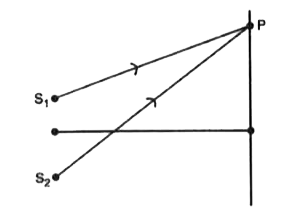 In terms of `lambda`, `= 2.5 lambda = (2N -1) lambda/2`...(ii) `therefore n = 3`. |
|
| 18. |
Two bodies start moving in the same straight line at the same instant of time from the same origin. The first body moves with a constant velocity of 40 m/s, and the second starts from rest with a constant acceleration of 4 "m/s"^2. Find the time that elapses before the second catches the first body. Find also the greatest distance between then prior to it and the time at which this occurs. |
|
Answer» SOLUTION :When the SECOND body cathces the first ,the distance travelled by eachis the same. `therefore 40t=(1)/(2)(4)t^(2)` or t=20 S Now ,the distance s between the two bodies at any time t is `s=ut-(1)/(2)at^(2)` for s to be maximum, `(ds)/(DT)=0` or u-at =0 or `t=(u)/(a)=(40)/(4)=10S` maximum DIstance `=40xx10-(1)/(2)xx4xx(10)^(2)=400-200=200m` |
|
| 19. |
What happens to the light from a bulb if the distance from the bulb is doubled? As a laser beam travels across the length of a room, its intensity essentially remains constant. What geomatrical characterstic of LASER beam is responsible for the constant intensity which is missing in the case of light from the bulb? |
|
Answer» Solution :INTENSITY of LIGHT is reduced to one fourth because the light beam spreads as it approaches into a SPHERICAL region of area `4pir^2`,i.e., `Iprop1//r^2`. But laser beam dose not spread, HENCE its intensity remains constant. Laser beam is is unidirectional, monochromatic and coherent light, whereas the light from a bulb does not POSSESS the above properties. |
|
| 20. |
Two electrons are moving with the same speed, v One electron enters at different instants , the quantity produced second time was twic of that produced first time. If now their present acitivies are A_(1) and A_(2) respectively then their age difference equals |
|
Answer» `lambda_(1)=lambda_(2)` |
|
| 21. |
In a magnetic field of 0.08 T, area of a coil changes from 101 cm^2 to 99cm^2 without changing the resistance which is 5 Omega. The amount of charge that flows during this period is |
|
Answer» `2.5 xx 10^(-6)`C `rArr(8xx10^-2xx10^-4)/5rArr1.6xx10^-6` |
|
| 22. |
A glass sphere of diameter 50 cm and mu=1,5 has a small air bubble. Looking from outside the diameter, the bubble appears to be at a distance 10 cm from the surface. Find the apparent position of the bubble when it is viewed from the diametrically opposite position. |
|
Answer» REAL image, at the pole of 2ND FACE |
|
| 23. |
Which of the following is most reactive |
|
Answer» Potassium |
|
| 24. |
The electron in a hydrogen atom makes a transition from an excited state to thegroundstate . Which of thefollowingstateementsis ture ? |
|
Answer» Itskineticenergyincrease and its POTENTIAL and totalenergies decreases. |
|
| 25. |
Magnitude of emf produced in a coil, when magnet is inserted in the coil does not depend upon ___ no of turns in the coil |
|
Answer» no of TURNS in the coil |
|
| 26. |
Coulombian force between two charges …………. |
|
Answer» is ALWAYS attractive. |
|
| 27. |
Explain the working of a single-phase AC generator with necessary diagram. |
Answer» Solution :In a single phase AC generator, the armautre conductors are CONNECTED in series so as to form a single circuit which generates a single-phase alternating emf and hence it is called single-phase alternator.  i. The simplified version of a AC generator is discussed here. Consider a stator core consisting of 2 slots in which 2 armature conductors PQ and RS are mounted to form single-turn rectangular loop PQRS as shown in field windings which can be magnetized by means of DC source. ii. Working : The loop PQRS is stationary and is perpendicular to the plane of the paper. When field windings are excited, magnetic field is produced around it. The directionof magnetic field passing through the armature core is shown in Figure. Let the field magnet be rotated in clockwise direction by the prime mover. The axis of rotation is perpendicular to the plane of the paper. iii. Assume that intial POSITION of the field magnet is horizontal. At that instant, the direction magnetic field is perpendicular to the plane of the loop PQRS. The induced emf is ZERO (Refer case (iii) of section 4.4). This is represented by origin O in the graph between induced emf and time angle. iv When field magnet rotates through `90^(@)`, magnetic field become maximum. parallel tdo PQRS. The induced emf across PQ and RS would become maximum. Since they are connected in series, emf are added up and the direction of total induced emf is given by Fleming's right hand rule.  v. Car has to be taken while applying this rule, the thumb indicates the direction of the motion of the conductor with respect to field. For clockwise rotating poles, the conductor appears to be rotating anti-clockwise. Hence, thumb should point to the LEFT. The direction of the induced emf is at right angles to the plane of the paper. For PQ, it is downwards and for RS upwards. Therefore, the current flows along PQRS. The point A in the graph represents this maximum emf. iv. For the rotation of `180^(@)` from the initial position, the field is again perpedicular to PQRS and the induced emf becomes zero. This is represented by point B. v. The field magnet becomes again parallel to PQRS for `270^(@)` rotation of field magnet. The induced emf is maximum but the direction is reversed. Thus the current flows along SRQP. This represented by point C. vi. On completion of `360^(@)` the induced emf becomes zero and is represented by te point D. From the graph, it is clear that emf induced in PQRS is alternating in nature. vii. Therefore, when field magnet completes one rotation, induced emf in PQRS finishes one cycle. For this construction, the frequency of the induced emf depends on the speed at which the field magnet rotates. |
|
| 28. |
Above is the graph of current induced in a coil of resistance 10 Omega , because of change of magnetic flux, versus time. Then change of magnetic flux is …….. Wb. |
|
Answer» 8 `therefore Deltaphi=QR` `therefore Deltaphi=ItR "" [because Q=It]` `therefore DeltaQ` = (Area ENCLOSED under I `to` t graph ) (resistance) `therefore Deltaphi=1/2xx4xx0.1xx10` `therefore Deltaphi`=2 WB |
|
| 29. |
90% of a radioactive sample is left undisintegrated after time I has elapsed, what percentage of initial sample will decay in a total time 2t: |
|
Answer» 0.38 If decay fraction is f in time `TAU`, it will be `f^(2)` in time `2TAU`. Material decays to `9/10` in time `tau`. In time `2tau`, it will decay to `f^(2)` `=(81)/(100)` of ORIGINAL fraction remaining =19% |
|
| 30. |
Like a series resonance L.C.R circuit, a parallel resonance circuit also: |
|
Answer» offers MINIMU impedance |
|
| 31. |
निम्नलिखित मे से कौन सी संख्या एक अपरिमेय संख्या है |
|
Answer» 0.23 |
|
| 32. |
A parallel plate capacitor of capacity 5 mu F and plate separation 6cm is connected to a IV battery and is charged. A dielectric of dielectric constant 4 and thickness 4 cm introduced into the capacitor. The additional charge that flows into the capacitor from the battery is |
|
Answer» `2 MU C ` |
|
| 33. |
A small aperture is illuminated with a parallel beam of lambda= 628 nm. The emergent beam has an angular divergence of 2^0. The size of the aperture is |
|
Answer» `9 MU m` |
|
| 34. |
A unform magnetic field of 3000 G is established along the positive z-direction. A rectangular loop of sides 10 cm and 5 cm carries a current of 12 A . What is the torque on the loop in the different cases shown in the fig ? What is the force on each case? Which case corresponds to stable equilibrium ? |
|
Answer» Solution :Here `B = 3000 G = 3000 xx 10^(-4) T = 0.3 T`, length of loop `l = 10 cm, 0.1 m, ` breadth of loop b = 5 cm = 0.05 m and current `I = 12 A` (a) Torque on the loop, `tau = B I A sin theta = B I l b sin theta "" [ :. A = lb ]` `= 0.3 xx 12 xx 0.1 xx 0.05 xx sin 90^@ [ :. vecA` is pointing along x-axis] `= 1.8 xx 10^(-2) N m` The torque ACTS along - y direction . Force will ACT on the sides of the loop which are perpendicular to the magnetic field i.e., on the sides of the lenght, b each. Therefore, force on these two sides = `B I b = 0.3 xx 12 xx 0.05= 0.18 N ` (along x-axis) As two forces are equal and opposite hence net force on the loop is zero. (b) Torque on the loop, `tau = B I l b sin theta` `= 0.3 xx 12 xx 0.10 xx 0.05 xx sin 90^@ = 1.8 xx 10^(-2) N m` The force will act with equal magnitude on the sides which are perpendicular to hte magnetic field (on the sides of length l each). Hence Force on each of these two sides `= B I l= 0.3 xx 12 xx 0.10 = 0.3 N` (along x - axis) As two forces are equal in magntiude but mutually opposite in DIRECTIONS, hence net force on the loop is zero. (c) Torque on the loop and forces on the sides are equal to the answers given in (a) but the direction of forces is along y - axis. Net force is even now zero. (d) Torque on the loop and force forces on the sides are equal in magnitude as those in case (a). However, now the force is in a direction `60^@` to the y-axis. (e) and (f) , There is no side parallel to hte magnetic field around which loop can rotate, the torque is zero. Net force on the loop is zero. Case (e) represents stable equilibrium because `tau = 0, F = 0` and the area vector `vecA` is a parallel to hte magentic field `vecB`. However , case (f) represents unstable equilibrium because the area vector `vecA` is antiparallel to the magnetic field `vecB` when the current flows through the loop. |
|
| 35. |
find the emf (epsi_(0)) and internal resistance (r_(0)) if a battery which is equivalent to a parallel combination of two batteries of emfs epsi_(1) and epsi_(2) and internal resistances r_(1) and r_(2) respectively, with polarities as shown in figure. |
|
Answer» |
|
| 36. |
The magnetic moment of a dip needle is 0.5Am^(2) and it is set at a place where dip is 60^(@) . A weight of 0.05g placed 4 cm from the axle cause the needle to hum the horizontal position Calculate the value of the horizontal and vertical components of the earth's field |
|
Answer» |
|
| 37. |
The stopping potential in an experiment on photoelectric effect is 1.5 V. what is the maximum kinetic energy of the photoelectrons emitted ? |
| Answer» SOLUTION :As stopping potential `V_(0)=1.5V`, hence MAXIMUM kinetic enerrgy of the photoelectrons EMITTED `K_(MAX)=1.5eV`. | |
| 38. |
A glass sphere of diameter 50 cm and mu=1.5 has a small air bubble. Looking from outside the diameter, the bubble appears to be at a distance 10 cm the surface. Find the apparent position of the bubble when it is viewed from the diametrically opposite position. |
|
Answer» real IMAGE, at the POLE of 2 nd face |
|
| 39. |
The refractive index of a material of a plane-concave lens is 5//3 the radius of curvature is 0.3m. The focal length of the lens in air is |
|
Answer» `-0.45m` where `R_(2)=OO,R_(1)=0.3m` `:. 1/f=(5/3-4)(1/0.3-1/(oo))` `implies1/f=2/3xx1/0.3` or `f=0.45m` |
|
| 40. |
Which phenomena shows both particle and wave nature of electromagnetic waves and electron? |
|
Answer» ELECTRON REFLECTED from METAL surface |
|
| 41. |
A parallel beam of white light is reflected from a thin wedge shaped film. The colour of the fringe at the edge of the wedge will be |
|
Answer» white For maxima, `X=(lamdal(m+1/2))/(2hn),m=0,1,2,...` For minima, `x=(lamdalm)/(2hn),m=0,1,2,....` At the edge of the wedge, x = 0 This CORRESPONDS to a MINIMUM at m = 0. Hence, at edge, black fringe will form. 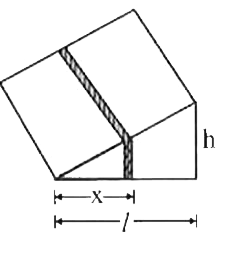
|
|
| 42. |
The natural vibration frequency of a hydrogen molecule is 1.26xx10^(14) Hz. Find the zero-point energy of the vibrations of the molecule. Can the vibrational degrees of freedom in the molecule be excited at 600 K? |
|
Answer» `T_("vib")=2hv//3k=4xx10^(3)K` This does not agree with experiment, since the lines of the vibrational spectrum of hydrogen molecules are observed at lower temperatures. This is because of the Maxwellian molecular speed distribution (see 25.2), which shows that a gas contains molecules whose speeds are far in EXCESS of the average. For instance, about 2% of the molecules have speeds three TIMES greater than the average. The energy of such molecules is more than 9 times the average kinetic energy. |
|
| 43. |
An electric current can be induced in a coil by changing the magnetic flux through the coil.which of the following galvanometer shows larger deflection when the tapping key is pressed suddenly |
| Answer» SOLUTION :The GALVANOMETER in FIGURE b SHOWS larger DEFLECTION. | |
| 44. |
Avector has x component of -25.0 units and y component of 40.0 units find the magnitude and direction of the vector: |
|
Answer» SOLUTION :CONSIDER a vector `vecA=A_(s)hati+A_(y) hatj` ` :. vecA=-25 hati+40 hati` `|vecA|= SQRT(A_(x)^(2)+A_(y)^(2))= sqrt((-25.0)^(2)+(40.0)^(2))` and `tan ALPHA=(A_(y))/(A_(x))=(40.0)/(-25.0)=1.6` `:. alpha= taun^(-1)(-1.6)=-58.0^(0)` with -ve x axis. This is in clock wise direction). This is equivalent to `(122^(@))` in anticlockwise direction with the x-axis. |
|
| 45. |
The current flowing through 10 Omega resistor in the circuit shown in the figure is |
|
Answer» 50 mA |
|
| 46. |
A small charged ball is in state of equilibrium at a height h above a large horizontal uniformly charged dielectric plate having surface charge density of sigma C//m^2. (a) Find the acceleration of the ball if a disc of radius r (ltlt h) is removed from the plate directly underneath the ball. (b) Find the terminal speed (V_0) acquired by the falling ball. Assume that mass of the ball is m, its radius is x and coefficient of viscosity of air is eta. Neglect buoyancy and assume that the ball acquires terminal speed within a short distance of its fall. |
|
Answer» (B). `V_(0)=(MGR^(2))/(12 pi ETA xh^(2))` |
|
| 47. |
Two forces, each numerically equal to 5 N, are acting as shown in the figure. Then the resultant is |
|
Answer» 2.5 N Resultant FORCE is `|vecR|= sqrt(|vecA|^(2)+|vecB|^(2)+2xx|vecA||vecB|"cos"theta)` `=sqrt((5)^(2)+(5)^(2)+2xx(5)xx(5)xx(-(1)/(2)))=5N` |
|
| 48. |
(A) : A cyclicst always bends inwards while negotiating a horizontal curve.(R ) : By bending, cyclist lowers his centre of gravity. |
|
Answer» Both (A) and (R ) are TRUE and (R ) is the CORRECT EXPLANATION of (A) |
|
| 49. |
A 600pF capacitor is charged by a 200V supply. It is then disconnected from the supply and is connected to another unchanged 600pF capacitor. How much electrostatic energy is lost in the process. |
|
Answer» Solution :Here `C_(1) 600pE ,C_(2) = 600 pF, V_(1)=200 V , V_(2) = 0` V From GIVEN formula `:.` Loss in electrostatic ENERGY `DeltaU = (C_(1)C_(2)(V_(1)-V_(2))^2)/(2(C_(1)+C_(2)))` `=(600xx10^(-12)xx600xx10^(-12)(200-0))/(2(600xx10^(12)600xx10^(-12)))` `=(36xx10^(-20)xx200)/(2xx1200xx10^(-12))` `= 6xx10^(-6)` J Loss in energy. |
|