

Saved Bookmarks
This section includes 7 InterviewSolutions, each offering curated multiple-choice questions to sharpen your Current Affairs knowledge and support exam preparation. Choose a topic below to get started.
| 1. |
There is small circular coil which is suspended through a wire of length l to a rigid support. Initially, thread is kept vertical and uniform magnetic field B is applied perpendicular to the plane of circular coil. Coil is slightly displaced through an angle theta_(0) and released in such a manner that while oscillating plane of the coil always remains along the thread and it does not rotate about it. Calculate emf induced in the coil as a function of time assuming t = 0 at some instant when thread is vertical. |
|
Answer» Solution :Initially when thread is vertical then angle between magnetic field and area vector of coil is zero. When thread makes an angle `theta` with the vertical then angle between magnetic field and area vector of coil also becomes `theta`. Hence magnetic flux linked with the coil can be WRITTEN as follows: `phi=BA COS theta` We can apply Faraday.s law to get emf induced in the coil as follows: `epsilon=-(dphi)/(dt)=BA sin theta (dphi)/(dt)` Here angle `theta` is given to be very SMALL. Hence we use `sin theta approx theta` to rewrite the above relation as follows: `epsilon=BAtheta(dtheta)/(dt)` We know that coil PERFORMS SHM. And the angle the thread makes with the vertical can be written as follows: `theta= theta_(0) sin omegat` where `omega=sqrt((g)/(l))` On differentiating equation (ii) we get the following: `(dtheta)/(dt)=theta_(0) omega cos omegat` ...(iii) Substituting from equation (ii) and (iii) in equation (i) we get the following: `epsilon=BA(theta_(0)sin omegat)(theta_(0) omega cos omegat)` `implies epsilon =BA omega theta_(0)^(2)sin omegat cos omegat` `implies epsilon=(1)/(2)BA omega theta_(0)^(2) sin2omegat` |
|
| 2. |
Starting from the expression for theenergy W= 1/2 LI^(2), stored in a solenoid of self-inductance L to build up the current I, obtain the expression for the magnetic energy in terms of the magnetic field B, area A and lengthl of the solenoid having n number of turns per unit length. Hence show that the energy density is given by B^(2)//2mu_(0). |
|
Answer» Solution :GIVEN, Energy `W=1/2 LI^(2)` A SOLENOID having magnetic field B. Area A & length l and having N numbersof turns PER unit length. Self inductance of the solenoid : `L= mu_(0)n^(2)lA` `B=mu_(0)n I` `:. W=1/2 mu_(0)n^(2)LAI^(2)` `:.B^(2)=mu_(0)^(2)n^(2)I^(2)` `V=AL` (volume) `rArr W=(1)/(2mu_(0)) mu_(0)n^(2)lAI^(2)` `rArr W=(1)/(2 mu_(0))B^(2)V` Energy density `=W/V = (B^(2))/(2mu_(0))` |
|
| 3. |
(A): All the intrinsic semiconductors are insulators at absolute zero (R): All electrons are tightly bound at absolute zero. |
|
Answer» Both 'A' and 'R' are true and 'R' is the CORRECT EXPLANATION of 'A' |
|
| 4. |
In the given table, column I shows the different types of decays in nuclear fission, collumn II show the change in the element which undergoes decay and Column III shows properties of different types of decays. What are the characteristics of the below nuclear equation? ""_(z)^(A)X (mother nucleus) ""_(Z+1)^(A)Y (daughter nucleus)+""_(-1)^(0)e |
|
Answer» (III)(II)(J) |
|
| 5. |
Two coherent sources of wavelength 6 . 2 xx 10^(-7)m produce interference . The path difference corresponding to 10^(th)order maximum will be ? |
|
Answer» `6. 2 XX 10^(-6) m` For `10^(TH)`order maximum `Delta x = 10 xx 6 . 2 xx 10 ^(-7) = 6 . 2 xx 10^(-6)` m |
|
| 6. |
कुंजी. एक वर्गिकी सहायता साधन है जो जीवों को पहचानने के लिये प्रयुक्त होती है। कुंजी का प्रत्येक कथन कहलाताहै : |
|
Answer» युग्मित |
|
| 7. |
जैविक शब्दावलि में, समान जीवों का समूह जो आपस में प्रजनन कर प्रजननयोग्य वंशज उत्पन्न करने में समर्थ हैं, कहलाता है - |
|
Answer» जाति |
|
| 8. |
A magnifying lens is of shorter focal length. Why? |
| Answer» Solution :The magnification of marying lens is, `m=1+D/f_e`. To get HIGH magnification, the focal LENGTH of lens USED should be SMALL. | |
| 9. |
For the displacement vector veca = (3.0m) hati + (4.0m) hatj and vecb = ( 5.0m) hati + (-2.0m) hatj, give veca + vecb in (a) unit-vector notation, and as (b) a magnitude and (c ) angle (relative to hati). Now give veca - vecb in (d) unit-vector natation, and as (e) a magnitude and (f) an angle. |
| Answer» Solution :`(a) (8.0m)HATI + (2. 0 m) hatj, (B) 8.2 m, (c ) 14 ^(@) , (d) (2. 0 m) hati - (6.0 m) hatj , (e) - (6.0 m) hatj, (e) 6.3 m, (F) - 72 ^(@)` | |
| 10. |
In the given table, column I shows the different types of decays in nuclear fission, collumn II show the change in the element which undergoes decay and Column III shows properties of different types of decays. What are the characteristics of the below nuclear equation? ""_(Z)^(A)X(mother nucleus) to""_(Z-2)^(A-4)Y(daughter nucleus) +""_(2)^(4)He |
|
Answer» (I)(ii)(J) |
|
| 11. |
Sketch the output Y from a NAND gate havinginputs A and B given below : |
|
Answer» Solution :For `TLE t_(1), A = 1 ,B=1 ,` Hence Y = 0 For`t_(1)` to `t_(2), A =0,B = 0, ` Hence Y = 1 For`t_(2) ` to `t_(3), A =0, B = 1 , ` Hence Y = 1 For `t_(3) ` to `t_(4), A= 1 , B= 0 , ` Hence Y= 1 For `t_(4) `to `t_(5), A= 1, B= 1 , ` Hence Y = 0 For `t_(5)` to `t_(6), A = 0 , B= 0 , `Hence`Y = 1 ` For `t gt t_(6), A =0 , B = 1 , ` Hence Y=1 
|
|
| 12. |
If the wavelength of the first line of the Balmer series of hydrogen is 6561 A, the wavelength of the second line of the series should be. |
|
Answer» `13122 Å` and `(1)/(lambda_(2)) = R [(1)/((2)^(2)) - (1)/((4)^(2))] = (3)/(16)R""…..(II)` `RARR ""(lambda_(2))/(6561 Å) = (5)/(36) xx (16)/(3) = (20)/(27) = or lambda_(2) = (20)/(27) xx 6561 = 4860 Å` |
|
| 13. |
In the Young.s double slit experiment, the intensity of light at a point on the screen where the path difference is lambda is K, (lambda being the wave length of light used). The intensity at a point where the path difference is lambda"/"4, will be |
| Answer» Answer :C | |
| 14. |
A fish looking up through the wave sees the outside world contained in a circular horizon. If the refractive index of water is (4)/(3) and the fish is 12 cm below the surface, the radius of this circle in cm is |
|
Answer» `36sqrt5` `therefore""sini_(c)=(3)/(4)=(h)/(sqrt(R^(2)+h^(2)))=(12)/(sqrt(r^(2)+144)) rArr r=(36)/(sqrt7)cm` 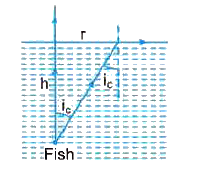
|
|
| 15. |
A transverse wave propagating along x-axis is represented by y(x,t) = 8.0 sin(0.5 pi - 4pit - pi//4) where x is in metres and t is in seconds. The speed of the wave is |
|
Answer» 8 m/s Compare with a standard wave equation, `y =asin((2pix)/lambda -(2pit)/T + PHI)` we GET, `(2pi)/lambda = 0.5 pi` or `lambda =(2pi)/(0.5 pi) = 4M` and `(2pi)/T = 4pi` or `T =(2pi)/(4pi) = 1/2 s` `therefore v = 1//T =2 Hz` Wave velocity, `v= lambda v = 4 xx2 = 8 m//s` |
|
| 16. |
The potential difference between the terminals of a battery of e.m.f 6.0V and internal resistance 1Omega drops to 5.8V when connected across an external resistor. Find the resistance of the external resistor. |
| Answer» SOLUTION :`29 OMEGA` | |
| 17. |
In the question number 7, the rate of change of potential difference between the plates is |
|
Answer» `2.41xx10^(9)VS^(-1)` Also q = CV or `(dq)/(DT)=Cxx(dV)/(dt)"i.eI"=C(dV)/(dt)or(dV)/(dt)=(I)/(C)=(0.15)/(80xx10^(-12))` or `(dV)/(dt)=(I)/(C)=(0.15)/(80xx10^(-12))=1.87xx10^(9)"V s"^(-1)` |
|
| 18. |
Figure represents the graph of photo current l versus applied voltage (V). The minimum energy of emitted photoelectrons is |
|
Answer» 2 eV |
|
| 19. |
For scattering by an 'inverse square field' (such as that produced by a charged nucleus in Rutherford's model) the relation between impact parameter b and the scattering anglethetais given byb (Ze^2 cot (theta/2))/(4 pi epsi_0 ((mv^2)/(2))) a. What is the scattering angle for b =0? b. For a given impact parameter h, does the angle of deflection increase or decrease with increasing energy? c .What is the impact parameter at which the scattering angle is 90^@ for Z = 79 and initial energy of 10 MeV? d. Why is it that the mass of the nucleus does not enter the formula above but the charge does? e. For a given energy of the projectile, does the scattering angle increase or decrease with decrease in impact parameter? |
|
Answer» Solution :a.For b = 0, we get cot ` theta /2` = 0. It means` theta /2 = 90^@ `or 0= `180^@ ` b. Increase in b means increase in cot.`theta /2` i.E., decrease in `theta `. c. USING `b =(Ze^2 cot "" theta /2)/( 4pi epsi_0E )`, we get b= `1.1 xx 10^(-14)` m d. Scattering occurs because of field due to the CHARGE on nucleus. If Z=0, then `theta `=0. As recoilof nucleousis notconsider, domassofnueleousunimportant butin case RECOIL is not ignored, then small change in the relation is required. e. Decrease in b means decrease in cot `theta /2`i.e., increase in scattering angle `theta`. |
|
| 20. |
The velocity of light in vacuum can be changed by changing : |
|
Answer» frequency |
|
| 21. |
Assertion: Surface tension is the property of only liquids. Reason: Only liquids have free surface in fluids. |
|
Answer» If both ASSERTION & Reason are TRUE & the Reason is a correct EXPLANATION of the Assertion. |
|
| 22. |
In an A.C. circuit, a resistance of R Omega connected in series with an inductance If phase angle between voltage and current 45^@. Then what will be the value of inducti reactance ? |
|
Answer» `R/4` `THEREFORE (omegaL)/R=1` `therefore omegaL=R` `therefore X_L=R` |
|
| 23. |
A plane electromagnetic wave travels in vacuum along z - direction. What can you say about the directions of its electric and magnetic field vectors ? If the frequency of the wave is 30 MHz, what is its wavelength ? |
|
Answer» Solution :Here `vec(E )` MUST be along + X axis and `vec(B)` must be along + Y axis, so that direction of `vec(E )xx vec(B)=` direction of `hat(i)xx hat(J)=` direction of `hat(k)=` direction of + Z axis = direction of propagation of electromagnetic wave. In both of above cases, `vec(E )` and `vec(B)` will OSCILLATE perpendicular to each other in XY - plane, perpendicular to direction of propagation of electromagnetic wave. Since given electromagnetic wave propagates in vacuum, its speed would be equal to c. Now, according to formula, `c=v lambda` `therefore lambda = (c )/(v)=(3xx10^(8))/(30xx10^(6))=10m` |
|
| 24. |
An electron of a stationary hydrogen atom passes from the fifth energy level to the fundamental state. What velocity did the atom acquire as the result of photon emission? What is the recoil energy? |
|
Answer» `epsi=hv(1+(hv)/(2Mc^(2)))` Solving this quadratic equation, we obtain the expression for the energy of the photon: `hv=(2epsi)/(1+sqrt(1+2epsi//Mc^(2)))` Since the transition energy in a hydrogen atom is below 13.6 eV, and its rest energy is 1 GeV, it follows that `2epsi//Mc^(2)~~10^(-8)`, and so this term in the denominator may be left out without APPRECIABLE LOSS in accuracy. Since, according to the statement of the problem, the transition is from the fifth to the first level, it follows that `epsi=hcR(1/1^(2)-1/5^(2))=24/25hcR` Hence `hv=(24hcR)/25`, the recoil energy is `D=(24^(2)h^(2)R^(2))/(2xx25^(2)M)`, the velocity of the atom is v = `(24hR)/(25M)`. |
|
| 25. |
The energy of X-rays photon is 3.3 ×x 10^(-16) J. Its frequency is : |
|
Answer» `2 xx 10^(19) Hz` `v=E // h=5 xx 10^(17)` Hz. |
|
| 26. |
A transparent cube of 15 cm edge contains a small air bubble. Its apparent depth when viewed through one face is 6 cm and when viewed through the opposite face is 4 cm. The refractive index of the material of the cube is |
|
Answer» `2.0` `therefore" Refractive index n"=(15)/(10)=1.5` |
|
| 27. |
a) For the telescope described in Exercise 34 (a), what is the separation between the objective lens and the eyepiece ? |
|
Answer» SOLUTION :(a) `f_(O)+f_(e)=145cm` (b) Angled subtended by the TOWER `=(100//3000)=(1//30)`rad Angled subtended by the image produced by the OBJECTIVE `=(h)/(f_(O))=(h)/(140)` Equating the two, `h=4.7cm`. (c) Magnification (magnitude) of the eye-piece = 6. Height of the final image (magnitude) = 28 cm. |
|
| 28. |
Arrange the intensities of the transmitted light in their increasing order of magnitudes when they are passed through a system of two polarisers (A) When incident light is unpolarised and of intensity I and the angle between the polarisers is 30^(@) (B) When incident light is polarised of intensity 2 I and the angle between the polarisers is 45^(@) (C ) When polarised light of intensity 4I is incident and the angle between the polarisers is 90^(@). (D) When incident light is unpolarised and of intensity 3I and the angle between the polarisers is 30^(@) |
| Answer» Answer :D | |
| 29. |
In a stationary wave all the particles of the medium |
|
Answer» CROSS the mean position with DIFFERENT VELOCITIES at the same instant |
|
| 30. |
Draw the output waveform of a full wave rectifier. |
Answer» SOLUTION :
|
|
| 31. |
Maximum speed of electron emitted from metal surface is 5xx10^(6 )ms^(-1) .If specifi charge of electron is 1.8xx10^(11) ckg^(-1),then value of stopping potential will be….. |
|
Answer» 2V `V_(0)=(mv_(max)^(2))/(2E)` `(v_(max)^(2))/(2(e//m))` `((5XX10^(6))^(2))/(2xx1.8xx10^(11))` `=6.95V~~7.0V` |
|
| 32. |
A particle has an initial velocity 3hati+4hatj and an acceleration of 0.4hati +0.3hatj. Its speed after 10s is |
| Answer» Answer :B | |
| 33. |
How displacement current I_D is the related to rate of change of electric flux ? |
| Answer» SOLUTION :I_D=epsilan_0 | |
| 34. |
The increase in temperature of a cathode in electronic tube by DeltaT= 1.0K from the valueT= 2000K results in the increase of sturation current by eta=1.4%. Find the work function of the electron for the material of the cathode. |
|
Answer» Solution :From Richardson's eqaution `I= aT^(2)e^(-A//KT)` where `A` is the work function in `eV`. When `T` increases by `DELTAT, I` incereses to `(1+eta)I`. Then `1+eta=((T+DeltaT)/(T))^(2)e^(-(A)/(kT)((T)/(T+DeltaT))-1)-(1+(DeltaT)/(T))^(2)e^(+(A)/(kT).(DeltaT)/(T+DeltaT))` Expanding and neglecting higher powers of `(DeltaT)/(T)` we get `eta=2(Delta T)/(T)+(A)/(kT^(2))Delta T` THUS `A=kT((ETAT)/(DeltaT)-2)` Substituting we get `A= 4.48eV` |
|
| 35. |
Two concentric circular coils, one of small radius r, and the other of large radius r_2,such that r_1 lt lt r_2 ,are placed co-axially with centres coinciding. Obtain the mutual inductance of the arrangement. |
|
Answer» Solution : Let a current `I_2 `flow through the outer circular coil The field at the centre of the coil is `B_2 = mu_0 I_2// 2r_2` . SINCE the other co-axially placed coil has a very small radius, B may be considered constant over its cross-sectional AREA, Hence. `phi_1 = pi r_1^2 B_2 = (mu_0 pi r_1^2)/(2r_2) I_2 = M_12 I_2 ` thus  mutual inductance of solenoid `S_1` with respect to `S_2` `M_12 = (mu_0 pi r_1^2)/(2r_2) ......(i) " but" M_12 = M_21 = (mu_0 pi r_1^2)/(2r_2)` Note that we calculated `M_12`from an approximate value of `phi_1` ,assuming the magnetic field `B_2` to be uniform over the area `pi r_1^2`. However we can accept this value because `r_1 lt lt r_2` ? It would have been difficult to calculate the flux through the BIGGER coil of the non-uniform field due to the current in the SMALLER coil and hence the mutual inductance `M_12` The equality `M_12 = M_21`is HELPFUL. Note also that mutual inductance depends solely on the geometry. |
|
| 36. |
The redistribution of ____ of hight due to superposition of waves is called interference. |
| Answer» SOLUTION :INTENSITY | |
| 37. |
The ratio of the largest to shortest wavelengths in Balmer series of hydrogen spectra is : |
|
Answer» `(25)/(9)` |
|
| 38. |
The poet describes earth's clouds as: |
|
Answer» Deathly-gray |
|
| 39. |
Deduce an expression for the electric field E due to a dipole of length '2a' at a point distant 'r' from the centre of the dipole on the axial line. (b) Draw a graph of E versus r forr gt gt a. © |
Answer» Solution :E-r GRAPH for ` r gt gt a `shown in figure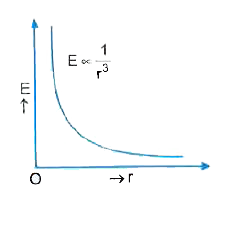 The positions of stable and UNSTABLE equilibrium have represented in in Both positions , TORQUE acting on the dipole is ZERO. The positions of stable and UNSTABLE equilibrium have represented in in Both positions , TORQUE acting on the dipole is ZERO.
|
|
| 40. |
Rank the following radiations according to their associated energies, greatest first. (1) yellow light from a sodium lamp (2) gamma ray emitted by a radioactive nucleus (3) radio wave emitted by the antenna (4) microwave beam emitted by radar |
|
Answer» (2), (1), (4), (3) |
|
| 41. |
The acceleration of a charged particle in a uniform electric field is |
|
Answer» PROPORTIONAL to its charge only |
|
| 42. |
In the given table, column I shows the different types of decays in nuclear fission, collumn II show the change in the element which undergoes decay and Column III shows properties of different types of decays. What are the characteristics of the below nuclear equation? ""_(Z)^(A)X* (mother nucleus)to""_(Z)^(A)Y (daughter nucleus ) +hf |
|
Answer» (III) (IV)(L) |
|
| 43. |
The equation of an alternating emf is volt. Find V= 120sin(100pit)cos(100pit) Volt the peak value of its emf and its frequency. |
| Answer» Answer :D | |
| 44. |
A point source emitting alpha particles is placed at a distance of 1 m from a counter which records any alpha particle falling on its 1 cm^(2)window. If the source contains 6.0 xx 10^(16)active nuclei and the counter records a rate of 50000 counts/second, find the decay constant. Assume that the source emits alpha particles uniformly in all directions and the alpha particles fall nearly normally on the window |
|
Answer» |
|
| 45. |
To produce a magnetic field of pi tesla at the centre of circular loop of diameter 1 m, the current flowing through loop is : |
|
Answer» `5xx10^(6)A` |
|
| 46. |
In a Young's double slit experiment, the interference fringes are obtained on a screen 0.75 m apart. The third dark band is at a distance of 5.5 mm from the central fringe (a) Determine the wavelength of light used if the two slits are 0.15 mm apart. (b) What will be the wavelength of light used if the entire apparatus is immersed in a liquid of refractive index 4//3 ? |
|
Answer» |
|
| 47. |
What is nuclear notation ? |
| Answer» Solution :To DESIGNATE a given nucleus, we NEED to give only A and Z.A nucleus is given by a SPECIAL symbol which TAKES the from `_ZX^A`, where X is CHEMICAL symbol of the element A= mass number andZ is atomic number. | |
| 48. |
Careful measurement of the electric field at the surface of a black box indicates that the net outward flux through the surface of the box is 8.0 xx 10^3 Nm^2//C. (a) What is the net charge inside the box ? (b) If the net outward flux through the surface of the box were zero, could you conclude that there were no charges inside the box ? Why or Why not ? |
|
Answer» Solution :(a) According to Gauss.s law, net electric flux PASSING through any closed surface, enclosiri net charge q in vacuum (or free space) is, `phi = q/epsilon_(0)` `therefore q = phiepsilon_(0)` `= 8 xx 10^(3) xx 8.85 xx 10^(-12)` `therefore q = 7.08 xx 10^(-8)` C (b) Again, `phi^(.) = q^(.)/epsilon_(0)` Here, `phi. = 0 rArr q. =0` GIVEN box MIGHT contain EQUAL amount o unlike CHARGES whose net charge is zerc Thus, when q. = 0, it is not necessary that i does not contain any charge. |
|
| 49. |
Path difference between two waves superposing at one point is 132, so interference at that point will be ...... and ...... order. |
|
Answer» constructive `13^(th)` `:.` So at this POINT constructive interference of `13^(th)` order will be formed. |
|
| 50. |
Two cells each emf e but of internal resistance r_1 and r_2 are connected in series through and external resistance R. IF the potential difference across the first cell is zero while current flows the value of R in terms of r_1 and r_2 is |
|
Answer» `R=r_1+r_2` `thereforeI=(2E)/(r_1+r_2+R)` Again, POTENTIAL DIFFERENCE =E-1 As the potential across the first cell is zero, when current flows through it `therefore 0=e-(2e)/(r_1+r_2+R)timesr_1thereforeR=r_1-r_2` |
|