

Saved Bookmarks
This section includes 7 InterviewSolutions, each offering curated multiple-choice questions to sharpen your Current Affairs knowledge and support exam preparation. Choose a topic below to get started.
| 1. |
Why are Si and GaAs preferred materials for solar cells ? |
|
Answer» Solution :The solar radiation spectrum received by us is shown in figure . The MAXIMA is near 1.5 eV . For photo- excitation , `h upsilon gt E_(g)` . HENCE semiconductor with band gap `~ 1.5 eV` or lower is likely to give better solar conversion efficiency . Silicon has `E_(g) ~ 1.1 eV` while for GaAs it is `-1.53` eV . In fact , GaA is better (in spite of its higher band gap ) than Si because of its relatively higher absorption coefficient . if we choose materials like CdS or CdSe `(E_(g) ~ 2.4` eV) , we can use only the high energy component of the solar energy for photo-conversion and a significant part of energy will be of no use . We do not use material like PbS (`E_(g) ~ 0.4 eV`) which satisfies the condition `hupsilon gt E_(g)` of `upsilon`maxima CORRESPONDING to the solar radiation spectra . If we do so , most of the solar radiation will be ABSORBED on the top-layer of solar cell and will not reach in or near the depletion region . For effective electron-hole SEPARATION . due to the junction field , we want the photo-generation to occur in the junction region only. 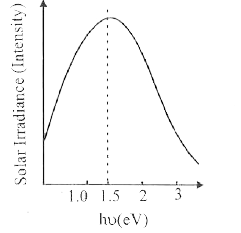
|
|
| 2. |
How phase difference and path difference are related ? |
|
Answer» Solution :Phase difference = `2pi/lambda` (PATH difference) `PHI = 2pi/lambda` X |
|
| 3. |
The axes of the polariser and analyser are inclined to each other at 60^(@) .If the amplitude of polarisedlight emergent through anyalyser is A. The amplitude of unpolarised light incident on polariser is |
|
Answer» `A/2` |
|
| 4. |
Two identical, small, charged spheres, each having a mass of 4.0xx10^(-2)kg hang in equilibrium as shown in Fig. 22-10a. The length of each string is 1.5m and the angle theta is 37.0^(@).Find the magnitude of the charge on each sphere. |
|
Answer» Solution :KEY IDEA From Fig. 22-10a, we can see that the two spheres exert repulsive FORCES on each other. If they are held close to each other and released, they will move outward from the center and settle into the configuration in Fig. 22-10a after the damped oscillations due to air resistance have vanished. The key phrase "in equilibrium" helps us to classify this as an equilibrium PROBLEM, which we approach as we did equilibrium problems in the chapter on Newton.s Laws in (Volume 1) with the added feature that one of the forces on a sphere is an electric force. We analyze this problem by drawing the free-body diagram for the left-hand sphere in Fig. 22-10b. The sphere is in equilibrium under the application of forces T from the string, the electric force `F_(e )` from the other sphere, and the gravitational force mg. Calculations: Because the sphere is in equilibrium, the forces in the horizontal and vertical directions must separatelyadd up to zero. `sum F_(x)=T sin theta-F_(e ) "" (22-11)` `sum F_(y)=T cos theta-mg "" (22-12)` Frow Eq. 22-12, we see that `T=mg//cos theta`, thus, T can be eliminated from Eq. 22-11 if we make this substitution.This gives a value for the magnitude of the electric force `F_(e ): ` `F_(e )=mg tan theta =(4xx10^(-2)kg) (10 m//s^(2)) tan 37^(@)=0.3N`. Considering the geometry of the triangle in Fig. 22-10a, we see that `sin theta=alpha//L`. Therefore, `a=L sin theta=(1.5m)sin37^(@)=0.9m` The separation of the spheres is `2a=1.8m`. From Coulomb.s law (Eq. 22-10), the magnitude of the electricfroce is `F_(e )=k_(e ) (|q|^(2))/(r^(2))` where r = 2a = 1.8m and |q| is the magnitude of the charge on each sphere. This equation can be solved for `|q|^(2)` to give `|q|^(2)=(F_(3)r^(2))/(k_(e ))=(0.3xx(1.8)^(2))/(9xx10^(9)Nm^(2)//C^(2))=1.08xx10^(-10)C^(2)` `|q|=6sqrt(3)muC` |
|
| 5. |
A charged particle having a positive charge q approaches a grounded metallic spheres of raidus R with a constant small speed v as shown in figure. In this situation |
|
Answer» as the charge draws nearer to the surface of the sphere , a current flows into the ground. `(1)/(4piepsilon_(0))(Q)/(R)+(1)/(4piepsilon_(0))(q)/((R_(0)-vt))=0` where `R_(0)` is the initial distance of the charged particle. `Q=(Rq)/(R_(0)-vt)` or `(dQ)/(dt)=i=(Rqv)/((R_(0)-vt)^(2))` |
|
| 6. |
Which light when falls on a metal will emit photoelectons ? |
|
Answer» uv radiation |
|
| 7. |
Bainbridge's mass spectrometer separates ion having the same velocity. The ions, after enteering through slits, S_(1) and S_(2), pass through a velocity selector composed of an electric field pproduced by the charged plates P and P' abd a magnetic field vecB perpendicular to electric field and the ion path.Thew ions that then passs undeviated through the crossed vecE1 and vecB fields enter into a region where a secondmagnetic field vecB exists, where they are made to follow circular path. A photographic plate ( or a modern detector) registors their arrival. If r is the radius of the circular orbit , then specific charge (q)/(m) of ion is |
|
Answer» `(E)/(RBB')` |
|
| 8. |
The power of transmitter 19 kW. The power of the Carrier wave is, if the amplitude of modulated wave is 10 V and that of Carrier is 30 V, |
|
Answer» 18kW |
|
| 9. |
A person looking at a person wearing a shirt with a pattern comprising vertical and hoziontal lines is able to see the vertical lines more distinclty than the horizontal ones. What is this defect due to ? How is such a defect of vision corrected? |
| Answer» Solution :Astigmatism. This defect is removed by USING CYLINDRICAL LENS with vertical AXIS. | |
| 10. |
What is meant by magnetic induction ? |
|
Answer» Solution :The magnetic induction (TOTAL magnetic FIELD ) insidethe specimem `vec(B)` is equal to the SUM of the magnetic field `vec(B_(0))` produced in VACUUM due to the magentising field and the magnetic field `vec(B_(m))` due to the induced magnetisation of the substance. `vec(B) = vec(B_(0)) + vec(B_(m)) = mu_(0) vec(H) + mu_(0) vec(I) = mu_(0) (vec(H) + vec(I)) = mu_(0) (vec(H) + vec(I))` |
|
| 12. |
Light rays travel from liquid (refractive index=2) to air. (a) What is the maximum angle of deviation ? (b) What is the angle of incidence corresponding to this maximum angle of deviation? (c ) At what angle (s) of incidence can the angle of deviation be 30^(@) ? |
|
Answer» |
|
| 13. |
A source of sound of frequency 500Hz produces wave in a medium of wave length 0.1m. In what time, the waves will travel a distance of 300m ? |
|
Answer» SOLUTION :`v = nlamda` `therefore s/t = n LAMDA` `therefore t = s/(nlamda) = 300/(500 XX .1) = 6` Secs |
|
| 14. |
The focal length of the lens of refractive index (mu = 1.5) in air is 10 cm. If air is replaced by water of mu = (4)/(3) , its focal length is |
| Answer» Answer :C | |
| 15. |
In an Young's experiment, the distances between two slits and that between slits and the screen are 0.05 cm and I m respectively. Find the distance between 3^(rd)bright and 5^(th) dark fringes. Take the wavelength of light equal to 5000Å |
|
Answer» Solution :Here, d = 0.05 CM, D = 100 cm, `lamda=5000Å=5xx10^(-5)cm`, `x._(5)-x_(3)=?` n = 5 (dark) and n = 3 (bright) For `n^(th)` bright fringe, `(x_(n)d)/(D)=nlamda` TAKING n=3 `(x_(3)d)/(D)=3lamda` `:.x_(3)=(3lamdaD)/(d)""....(1)` For `n^(th)` dark fringe, `(x._(n)d)/(D)=(2n-1)(lamda)/(2)` Taking n=5 `(x._(n)d)/(D)=(9lamda)/(2)` `:.x._(5)=(9lamdaD)/(2D)""....(2)` Now, `x._(5)-x_(3)=(9lamdaD)/(2d)-(3lamdaD)/(d)=(3lamdaD)/(2d)` `=(3xx5xx10^(-5)xx100)/(2xx0.05)` `:.x._(5)-x_(3)=15xx10^(-2)cm=1.5mm` |
|
| 16. |
An hydrogen atom in its ground state absorbs 10.2 eV of energy. The orbital angular momentum is increased by…….js. |
|
Answer» `1.05 TIMES 10^-34` `10.2=13.6-13.6/n^2` `therefore 13.6/n^2=13.6-10.2` `therefore 13.6/n^2=3.4` `therefore n^2=13.6/3.4` `therefore n^2=4` `therefore n=2` Angular MOMENTUM `=(nh)/(2pi)` `=((1)times6.625 times 10^-34)/(2 times 3.14)` `=1.0549 times 10^-34` `approx 1.05 times 10^-34 Js` |
|
| 17. |
The temperature of a gas contained in a closed vessel of constant volume increases by 1^(@)C when the pressure of the gas is increased by 1%. The initial temperature of the gas is: |
|
Answer» <P>100 K `therefore (dp)/(p) xx100 =(DT)/(T)xx100` `1=(1)/(T) xx100` `rArr T=100 K` So, correct choice is (a). |
|
| 18. |
What will be the motion of the conductor of the previous problem, if a resistor of resistance R is connected into the circuit instead of the capacitor? Neglect the resistance of the conductors. |
|
Answer» After a certain moment of time the acceleration becomes ZERO and the conductor CONTINUES to fall uniformly at a constant speed (compare with PROBLEM 5.13). |
|
| 19. |
Consider the transistor shown in figure, its terminals are marked as 1, 2 and 3 using multimeter one try to identify the base of transistor he proceed in the way as follows Experiment 1: He touches the common lead of the mulimeter to 2 then on touching other lead of miltimeter of 1 he hasn't got any becp(indication of conduction)but when connected to 3got the beep Experiment II : He connects the common lead of multimeter to 1 and other lead to 2 and 3 turn by turn then in this case he got beep for both connections. From this we conclude that |
| Answer» Answer :A | |
| 20. |
In an oscillating LC circuit, L = 25.0 mH and C = 2.89 muF. At time t=0 the current is 9.20 mA, the charge on the capacitor is 3.80 muC and the capacitor is charging. What are (a) the total energy in the circuit, (b) the maximum charge on the capacitor, and (c) the maximum current? (d) If the charge on the capacitor is given by q= cos(omega t+ phi), what is the phase angle phi? (e) Suppose the data are the same, except that the capacitor is discharging at t= 0. What then is phi ? |
|
Answer» |
|
| 21. |
The threshold wavelength of Na element is 6800 Å.Its work function is ……….xx10^(-19)J.(h=6.625xx10^(-34)Js,C=3xx10^(8)ms^(-1)) |
|
Answer» 2.9 `THEREFORE phi=(hc)/(lambda_(0))=(6.625xx10^(-34)xx3xx10^(8))/(68xx10^(-8))` `=0.2922xx10^(-18)=2.922xx10^(-19)J` |
|
| 22. |
Find magnetic field at O due to the current carrying conductor as shown in the figure. |
| Answer» SOLUTION :`|B_0| = (mu_0i)/(4) i/r SQRT(1/(pi^2) + 1/4)` | |
| 23. |
Answer the following questions: (a) Are the following equations of nuclear reactions balanced in the sense of a chemical equation e.g. 2H_2+O_2=2H_2O? If not, in what sense are they balanced on both sides?for example : 6C^(12)+._6C^(12) to._10Ne^(20)+._2He^4 (b) If both the number of protons and number of neutrons are conserved in each nuclear reaction, in what way is mass converted into energy of vice-versa in a nuclear reaction? (c) A general impression exists that mass energy interconversion take place only in nuclear reactions and never in chemical reactions. This is strictly speaking incorrect. Explain |
|
Answer» Solution :(a) A chemical reaction SIMPLY changes the original combination of atoms. Therefore, a chemical equation is balanced in the sense that the number of atoms of each element is the same on both sides of the equation. In a nuclear reaction, elements may be transmitted, both are conserved separately in a nuclear reaction. At very high ENERGIES, even this is not valid. At such energies, total charge is conserved and total baryon number is conserved. In the given EXAMPLE, neutron number and proton number are conserved separately. (b) As neutron number and proton number are conserved in a nuclear reaction, the total rest mass of NEUTRONS and protons is the same on either side of nuclear on the nuclear reaction. But the total B.E. of nuclei on the left side need not be the same as that on the right side. The difference in the binding energies on two sides appears as energy released or absorbed in the nuclear reaction. As B.E. contributes to mass, we say that the difference in total mass of nuclei on the two sides gets converted into energy or vice-versa. It is in this sense that a nuclear reaction is an example of mass-energy interconversion. (c) In principle, a chemical reaction is similar to a nuclear reaction, form the point of view of mass energy interconversion. The energy released of absorbed in a chemical binding energies of atoms and molecules on the two sides of a chemical reaction. As chemical binding energy is also due to mass defect, we can say that difference in the total mass of atoms or molecules on the two sides of chemical reaction gets converted into energy or vice-versa However, the mass defects involved in a chemical reaction are almost a million times smaller than those in a nuclear reaction. That is why we have the impression that mass energy interconversion does not take place in a chemical reaction, though the impression is INCORRECT. |
|
| 24. |
What do you mean by 'flaming building'? |
|
Answer» BURNING building |
|
| 25. |
Water rises in a capillary tube upto a height h so that the upward force due to surface tension is balanced by the force due to the weight of the water column. If this force is 75xx10^-5N and surface tension of water is 6xx10^-2N/m. Then what is the inner circumference of the capillarity? |
|
Answer» Solution :UPWARD force DUE to ST = WEIGHT of the lifted liquid `therefore T = F/l `therefore` upward force `F = T xx L = T xx 2pir` `therefore T xx 2pir = mg` INNER circumference of the capillary = `2pir = (mg)/T = (90 xx 10^-5)/(6 xx 10^-2)` [`because 1N = 10^5` dyne] `15 xx 10^-3 = 1.5 xx 10^-2 m` |
|
| 26. |
Can a convex mirror ever form a real image of a real object? |
|
Answer» |
|
| 27. |
Answer questionon the basis of yourunderstanding of the following paragraph and the related studied concepts. A Charges placed at a point in space produces an electric field everywhere in the surrounding. When another charge is borught in the field of first charge, it experiencesa force . The electric field at a point is space due to given charges is defind as the forcethat a unit positive charges would experience if placed at that point. It we consider a system of charges q_1, q-2,q_3 ..... with position vectors oversetto (r_1 ) , oversetto (r_2) , oversetto (r_3) ..... relative to some origin O, then electric field at a point in space due to the system of charges is determined by finding the vector sum of fields due to all individual charges of the charges system. We have a charges configuration as shownhere. Without actual calculations guess the value of net electric field at a point O, the centre of the square ABCD , Give reasonfor your answer.(##U_LIK_SP_PHY_XII_C01_E03_004_Q01.png" width="80%"> |
| Answer» Solution :Net FIELD at pointO will be zero because AO =BO =CO =DO and so field of `q_1 ` will be just BALANCED by field due to `q_3` and field of `q_2`will be justbalanced by field due to `q_4` | |
| 28. |
Answer questionon the basis of yourunderstanding of the following paragraph and the related studied concepts. A Charges placed at a point in space produces an electric field everywhere in the surrounding. When another charge is borught in the field of first charge, it experiencesa force . The electric field at a point is space due to given charges is defind as the forcethat a unit positive charges would experience if placed at that point. It we consider a system of charges q_1, q-2,q_3 ..... with position vectors oversetto (r_1 ) , oversetto (r_2) , oversetto (r_3) ..... relative to some origin O, then electric field at a point in space due to the system of charges is determined by finding the vector sum of fields due to all individual charges of the charges system. What will be the electric field at O if q_1is interchanged withq_2and q_3interchanged withq_4?(##U_LIK_SP_PHY_XII_C01_E03_005_Q01.png" width="80%"> |
| Answer» Solution :Evennow net field at O will be ZERO because even now electric fields DUE to diagonally OPPOSITE CHARGES are exactly equal in magnitude but opposite in direction and thus balance each other. | |
| 29. |
Answer questionon the basis of yourunderstanding of the following paragraph and the related studied concepts. A Charges placed at a point in space produces an electric field everywhere in the surrounding. When another charge is borught in the field of first charge, it experiencesa force . The electric field at a point is space due to given charges is defind as the forcethat a unit positive charges would experience if placed at that point. It we consider a system of charges q_1, q-2,q_3 ..... with position vectors oversetto (r_1 ) , oversetto (r_2) , oversetto (r_3) ..... relative to some origin O, then electric field at a point in space due to the system of charges is determined by finding the vector sum of fields due to all individual charges of the charges system. A charges q=-2 mu Cis placed at a point O. Find the electric field at a point P situated at a distance 0.5 m from O along positive direction of x-axis.(##U_LIK_SP_PHY_XII_C01_E03_002_Q01.png" width="80%"> |
|
Answer» SOLUTION :ELECTRIC field at P, E= force experienced by a UNIT positive charged PLACED at p `=(1)/( 4pi in _0) .(q)/(r^(2)) =((9xx 10^(9))xx ( -2xx 10 ^(-6))/( (0.5)^(2))=-7.2 xx 10 ^(4)NC^(-1) ` |
|
| 30. |
Answer questionon the basis of yourunderstanding of the following paragraph and the related studied concepts. A Charges placed at a point in space produces an electric field everywhere in the surrounding. When another charge is borught in the field of first charge, it experiencesa force . The electric field at a point is space due to given charges is defind as the forcethat a unit positive charges would experience if placed at that point. It we consider a system of charges q_1, q-2,q_3 ..... with position vectors oversetto (r_1 ) , oversetto (r_2) , oversetto (r_3) ..... relative to some origin O, then electric field at a point in space due to the system of charges is determined by finding the vector sum of fields due to all individual charges of the charges system. What is the direction of electric field ? |
| Answer» SOLUTION :The FIELD is ALONG the directionPO i.e.Along -x-direction. | |
| 31. |
Answer questionon the basis of yourunderstanding of the following paragraph and the related studied concepts. A Charges placed at a point in space produces an electric field everywhere in the surrounding. When another charge is borught in the field of first charge, it experiencesa force . The electric field at a point is space due to given charges is defind as the forcethat a unit positive charges would experience if placed at that point. It we consider a system of charges q_1, q-2,q_3 ..... with position vectors oversetto (r_1 ) , oversetto (r_2) , oversetto (r_3) ..... relative to some origin O, then electric field at a point in space due to the system of charges is determined by finding the vector sum of fields due to all individual charges of the charges system. State the SI unit of electric field. |
| Answer» SOLUTION :SI units of electric field is `NC^(-1)` and it is ALSO expressed as `Vm^(-1) ` | |
| 32. |
n number of identical equilateralprisms are kept in contact as shown in figure. If deviation through a single prism is delta. Then, (n,m are integers) |
|
Answer» if `N=2m,` deviation through n prisms is zero 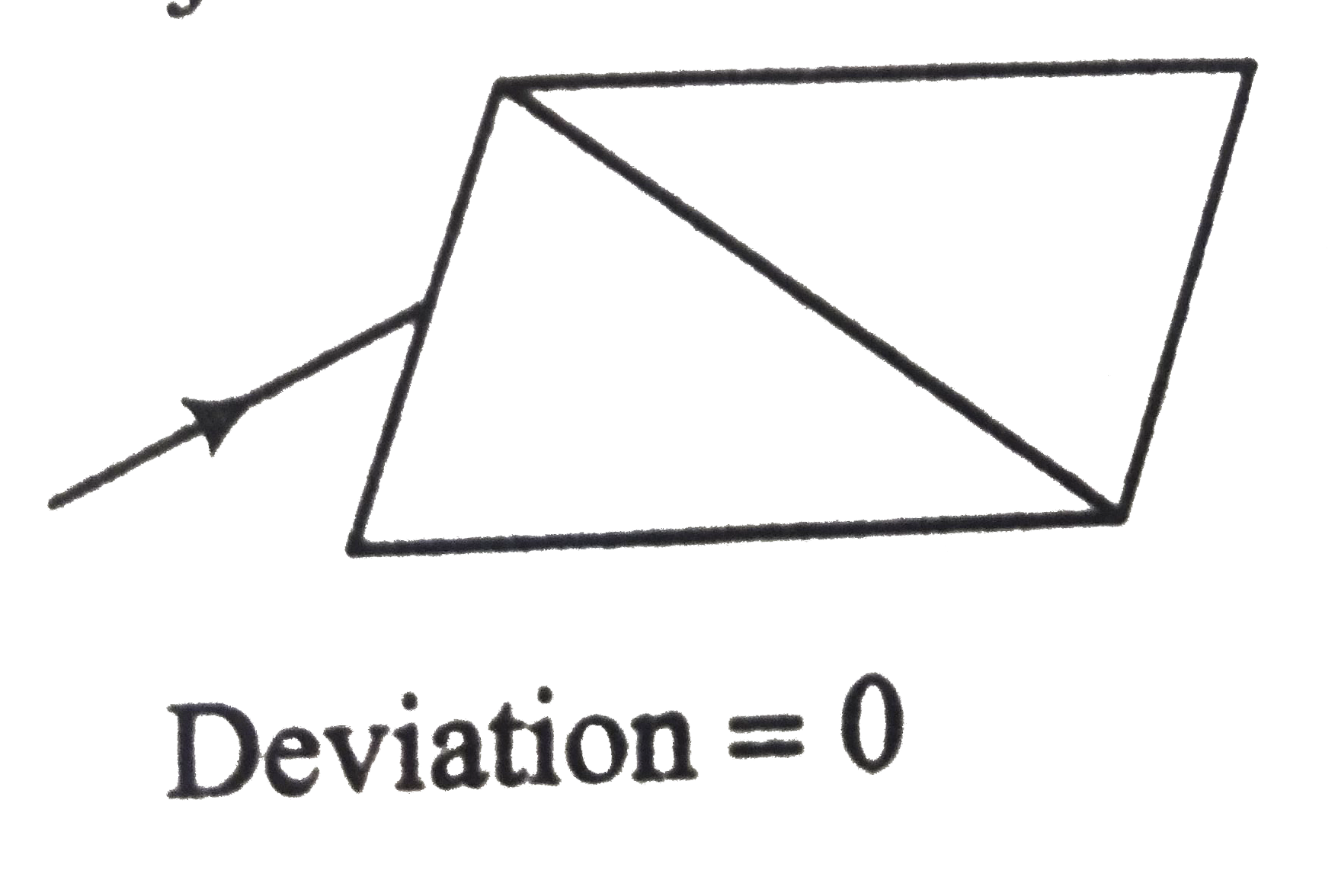 `:. Deviation=0` For `n=2m+1,` it is just like an identical prism of LARGER size. 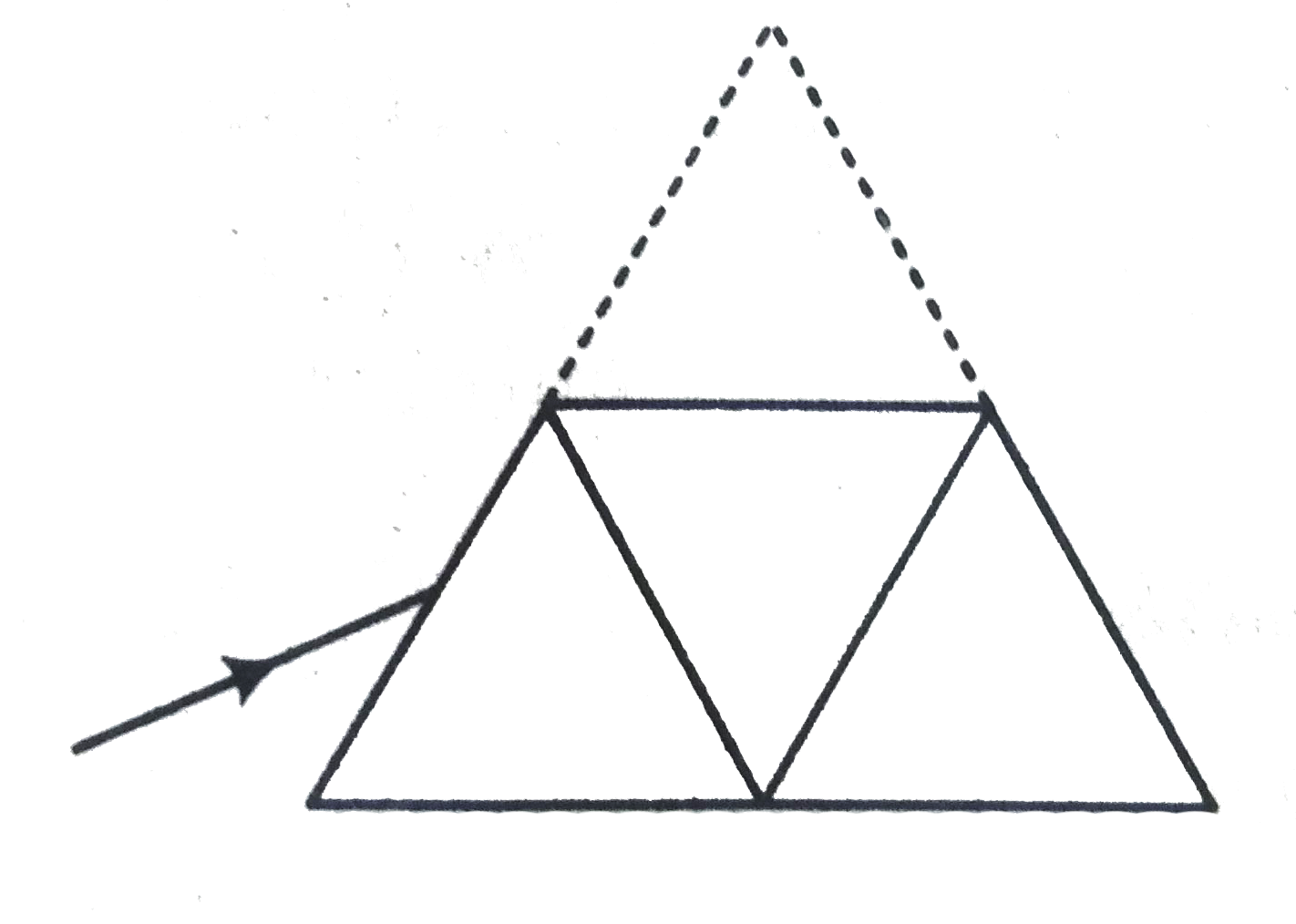
|
|
| 33. |
The wavelength of light in the visible region is about 390 nm for violet colour, about 550 nm (average wavelength ) for yellow - green colour and about760 nm for red colour .(a ) What are the energies of photons in (ev) at the (i) violet end, (ii) average wavelength , yellow - green colour , and (ii) red end of the visible spectrum ? (Take h = 6.63 xx 10^(-34) Js and 1 eV=1.6 xx 10^(-19) J ) , |
|
Answer» Solution :(a) Eneergy of the incident photon, `E=hv=hc//lambda` `E=(6.63xx10^(-34)Js)(3xx10^(8)m//s)//lambda` `=(1.989xx10^(-25)Jm)/(lambda)` (i) For violet LIGHT, `lambda_(1)=390nm" (lower wavelength end)"` `"Incident photon energy, "E_(1)=(1.989xx10^(-25)Jm)/(390xx10^(-9)m)` `=5.10xx10^(-19)J` `=(5.10xx10^(-19)J)/(1.6xx10^(-19)J//eV)` `=3.19eV` (II) For YELLOW - green light, `lambda_(2)=550nm"(average wavelength)"` `"Incident photon energy, "E_(2)=(1.989xx10^(-25)Jm)/(550xx10^(-9)m)` `=3.62xx10^(-19)J=2.26ev` (iii) For red light, `lambda_(3)=760nm"(higher wavelength end)"` `"Incident photon energy, "E_(3)=(1.989xx10^(-25)Jm)/(760xx10^(-9)m)` `=2.62xx10^(-19)J=1.64ev` (B) For a photoelectric device to operate, we require incident light energy E to be equal to or greater than the work function `phi_(0)` of the material. Thus, the photoelectric device will operate with violet light (with E = 3.19 ev) photosensitive material `Na ("with "phi_(0) = 2.75 eV), K ("with "phi_(0) = 2.30 eV) and Cs ("with "phi_(0) = 2.14 eV)`. It will also operate with yellow-green light `("with E "= 2.26 eV)" for Cs "("with "phi_(0) = 2.14 eV)` only. HOWEVER, it will not operate with red light (with E = 1.64 eV) for any of these photosensitive materials. |
|
| 34. |
A string will break under a load of 5 kg. To the one end of such a 2m long string a mass of 1kg is attached. The maximum rpm in the horizontal plane so that the string does not break is (g = 10 ms^(-2)) |
|
Answer» 28.66 |
|
| 35. |
Answer question on the basis of your understanding of the following paragraph and the related studied concepts. Eletric field around a single charges or a charges configuration can be pictorially mapped by drawing electric field lines in space. An electric field line is, in general, a curve drawn in such a way that the tangent to it at each point is in the direction of the net. field point. An arrow on the curve is obviously necessary to specify the direction of electric field from the two possible directions indicated by a tangent to the curve. A field line is a space curve i.e., a curve in three dimensions. Electric field lines may be taken to be continous curve without any breaks. Relative density (i.e. closeness)of the field lines at different points indicate the relative strength of electric field at those points. The field lines crowd where the field is strong and are spaced apart where it is weak. In the field drawn in at what points is the electric field strongest? |
| Answer» Solution :Electric field is strongest NEARTHE two charges of DIPOLE because field LINES are concentrated there. | |
| 36. |
Answer question on the basis of your understanding of the following paragraph and the related studied concepts. Eletric field around a single charges or a charges configuration can be pictorially mapped by drawing electric field lines in space. An electric field line is, in general, a curve drawn in such a way that the tangent to it at each point is in the direction of the net. field point. An arrow on the curve is obviously necessary to specify the direction of electric field from the two possible directions indicated by a tangent to the curve. A field line is a space curve i.e., a curve in three dimensions. Electric field lines may be taken to be continous curve without any breaks. Relative density (i.e. closeness)of the field lines at different points indicate the relative strength of electric field at those points. The field lines crowd where the field is strong and are spaced apart where it is weak. Can electrostatic field lines fromclosed loops?Why |
| Answer» Solution :Electrostaticfield lines cannot FORM CLOSED loops because electrostatic field is a CONSERVATIVE field. | |
| 37. |
Answer question on the basis of your understanding of the following paragraph and the related studied concepts. Eletric field around a single charges or a charges configuration can be pictorially mapped by drawing electric field lines in space. An electric field line is, in general, a curve drawn in such a way that the tangent to it at each point is in the direction of the net. field point. An arrow on the curve is obviously necessary to specify the direction of electric field from the two possible directions indicated by a tangent to the curve. A field line is a space curve i.e., a curve in three dimensions. Electric field lines may be taken to be continous curve without any breaks. Relative density (i.e. closeness)of the field lines at different points indicate the relative strength of electric field at those points. The field lines crowd where the field is strong and are spaced apart where it is weak. A solid metallic sphere is placed in a uniform electric field. The electricfieldlines around the sphere followthe path(s) shown in the figure as: (##U_LIK_SP_PHY_XII_C01_E03_010_Q01.png" width="80%"> |
|
Answer» 1 |
|
| 38. |
Answer question on the basis of your understanding of the following paragraph and the related studied concepts. Eletric field around a single charges or a charges configuration can be pictorially mapped by drawing electric field lines in space. An electric field line is, in general, a curve drawn in such a way that the tangent to it at each point is in the direction of the net. field point. An arrow on the curve is obviously necessary to specify the direction of electric field from the two possible directions indicated by a tangent to the curve. A field line is a space curve i.e., a curve in three dimensions. Electric field lines may be taken to be continous curve without any breaks. Relative density (i.e. closeness)of the field lines at different points indicate the relative strength of electric field at those points. The field lines crowd where the field is strong and are spaced apart where it is weak. What is an electric field line? |
| Answer» Solution :An ELECTRICFIELD LINE is a curve drawn in an electric field, TANGENT to which at anypointgives the direction of electricfield. | |
| 39. |
Answer question on the basis of your understanding of the following paragraph and the related studied concepts. Eletric field around a single charges or a charges configuration can be pictorially mapped by drawing electric field lines in space. An electric field line is, in general, a curve drawn in such a way that the tangent to it at each point is in the direction of the net. field point. An arrow on the curve is obviously necessary to specify the direction of electric field from the two possible directions indicated by a tangent to the curve. A field line is a space curve i.e., a curve in three dimensions. Electric field lines may be taken to be continous curve without any breaks. Relative density (i.e. closeness)of the field lines at different points indicate the relative strength of electric field at those points. The field lines crowd where the field is strong and are spaced apart where it is weak. Draw electric field lines due to an electric dipole and mark their directions. |
|
Answer» Solution :The electricfield LINES have been drawn here and their directions have been MARKED by the arrow HEADS. ` (##U_LIK_SP_PHY_XII_C01_E03_007_S01.png" width="80%"> |
|
| 40. |
What is half wave and full wave rectifier ? |
| Answer» SOLUTION :It’s when HALF of a.c. input and full of ARC. supply are rectified respectively. | |
| 41. |
A light bulb is rated at 100W for a 220 V supply. Findthe rms current through the bulb. |
|
Answer» SOLUTION : Also we have `P = V_("rms") I_("rms") cos PHI ` For purely resistive CIRCUIT `phi = 0^(@)`andso, `P = V_(rms) I_(rms)` `:. I_(rms) = (P)/( V_(rms)) = ( 100)/( 220) = 0.4545A` |
|
| 42. |
When a ray of light is incident on the surface of a glass slab at 60^@ , it is found that the reflected ray is completely plane polarised. What is the velocity of light in glass ? |
|
Answer» `SQRT3 XX 10^8 m/s` |
|
| 43. |
What is significance of negative energy in a orbit ? |
| Answer» SOLUTION :This SIGNIFIES that the ELECTRON is BOUND to the NUCLEUS. | |
| 44. |
(i) A giant refracting telescope at an observatory has an objective lens of focal length 15 m . If an eyepiece of focal length 1.0 cm is used, what is angular magnification of the telescope ? (ii) If this telescope is used to view the moon, what is the diameter of the image of the moon formed by the objective lens ? the diameter of the moon is 3.48xx10^(6)m, and the radius of lunar orbit is 3.8xx10^(8) m. |
| Answer» | |
| 45. |
A closed organ pipe is vibrating in fundamental frequency. There are two points A and B in the organ pipe as shown, at a distance AB = L/n. Ratio of maximum pressure variation at point A to point B is 2//sqrt(3)find value of n. |
| Answer» Answer :A | |
| 46. |
1muC charge is placed on each vertex of a regular hexagon. Side of hexagon is 1 m, then electric field at its centre is....... |
|
Answer» `5/6 XX 10^(-6)k` `E =(kQ)/r^(2) = k xx (1 xx 10^(-6))/(1)^(2)` `therefore E =10^(-6) K` |
|
| 47. |
When white light passes through prism, which colour of light will experience minimum deviation ? |
| Answer» SOLUTION :Deviation`PROP(1)/("Wavelength")` and `lambda_R gt lambda` are remaining COLOURS | |
| 48. |
Show mathematically that the electric field strength due to a short electric dipole at a distance 'r' along its axis is twice that at the same distance along its equatorial axis. |
|
Answer» Solution :Field on the axial, `vecE_("axial")- (2 vecp)/(4pi epsi_(0) R^(3))` Field on the equatorial line, `vecE_("equilatorial")=(-vecp)/(4pi pi_(0) r^(3))` HENCE `|E_("axial")|=2 XX |E_("equilaterial")|` |
|
| 49. |
The maximum number of photons emitted when electron jumps from an energy level n=4 to n=1 is: |
|
Answer» 1 |
|
| 50. |
Three particles are projected in the air with the minimum possible speeds, such that the first goes from A to B, the second goes from B to C and the third goes from C to A. Points A and C are at the same horizontal level. The two inclines make the same angle alpha with the horizontal, as shown. The relation among the projection speeds of the three particles is |
|
Answer» `u_(3)=u_(1)+u_(2)` |
|