

Saved Bookmarks
This section includes 7 InterviewSolutions, each offering curated multiple-choice questions to sharpen your Current Affairs knowledge and support exam preparation. Choose a topic below to get started.
| 1. |
The maximum kinetic energy of photoelectrons emitted from a surface, when photons of energy 6.0 eV fall on it, is 4.0 eV. The stopping potential is |
|
Answer» 2V |
|
| 2. |
Number of atoms in Simple cubic Unit cell |
|
Answer» 1 |
|
| 3. |
A deuteron (""_(1)^(2)Hz) and an alpha particle (""_(2)^(4)He) are accelerated by applying same potential difference. Ratio of their de-Broglie wavelength will be_____. |
|
Answer» |
|
| 4. |
How much positiveand negative chargeis therein acup of water |
| Answer» Solution :LET us assume that the mass of one cup of water is 250 g the MOLECULAR mass of water is 18 g thus one MOLEOF water is 18 g therefore the number ofmolecules in onecup of wateris `(250//18)xx6.02 xx10^(23)`each molecule of water containstwo hydrogen atoms and one oxygentotal negative charge has the same magnitude it is EQUAL to `(250//18)xx6.02 xx10xx1.6 xx10^(-10^(-19) C=1.34 xx10^(7)C` | |
| 5. |
A hollow sphere of radius R is coinciding with any diameter of the sphere. Then its radius of gyration is |
|
Answer» `SQRT(3/2)R` |
|
| 6. |
A particle is dropped from a height H. the deBroglie wavelength of the particle as a function of height is proportional to |
|
Answer» H |
|
| 7. |
A soap bubble of radius R = 1 cm is charged with the maximum charge for which breakdown of air on its surface does not occur. Calculate the electrostatic pressure on the surface of the bubble. It is know that dielectric breakdown of air takes place when electric field becomes larger then E_(0)=3xx10^(6)W//m |
|
Answer» |
|
| 8. |
Colours appear on a thin soap film and on soab bubbles due to the phenomenon of |
|
Answer» Interference |
|
| 9. |
The electrostatic force on a small sphere of charge 0.4 muCdue to another small sphere of charge -0.8 uC in air is 0.2 N. (a) What is the distance between the two spheres ? (b) What is the force on the second sphere due to the first ? |
|
Answer» Solution :(a) Coulombian force between two point as charges is, `F = k(q_(1)q_(2))/r^(2)` `therefore -0.2= 9 xx 10^(9)xx (0.4 xx 10^(-6))(-0.8 xx 10^(-6))/r^(2)` (Here, F is attractive and so its value is taken as negative) `therefore r^(2) = (9 xx 10^(9))(4 xx 10^(-7))(8 xx 10^(-7))/(2 xx 10^(-1))` `therefore r^(2) = 144 xx 10^(-4) m^(2)` `therefore r= 12 xx 10^(-2) m = 0.12 m` (b) Here Coulombian force on second sphere due to first sphere is also 0.2 N and attractive in nature because ELECTRIC force is two body force which is always exerted mutually with equal magnitude and opposite directions. |
|
| 10. |
In a Young's double slit experiment, the separation between the two slits is d and the wavelength of the light is lambda.The intensity of light falling on slit 1 is four times the intensity of light falling on slit 2.Choose the correct choice(s). |
|
Answer» If `d = lambda`, the screen will contain only one maximum. If `lambda lt d lt 2 lambda`, then the maximum path difference will be less than `2 lambda`. So there will be two more maximum on screen in ADDITION to the central maximum. Intensity of the dark fringes becomes zero whenintensititesat the two SLITS are equal.Initial intensity atboth the slits are unequal so there will somebrightnessat dark finge.Hence when intensity of both slits is made same the intensity at dark fringe on screen will decrease to zero. The alternative (c) and (d) are not correct. |
|
| 11. |
Give the physical meaning of binding energy per nucleon. |
| Answer» Solution :The average binding energy per NUCLEON is the energy REQUIRED to separate SINGLE nucleon from the particular nucleus. | |
| 12. |
In a semiconductor a) there are no free electrons at OK b) there are no free electrons at any temperate c) the number of free electrons increases with temperature d) the number of free electrons is less than that in a conductor |
|
Answer» Only a and B are CORRECT |
|
| 13. |
In capacitor bridge, a voltage V_0is applied and the variable capacitor C_1has been adjusted till voltmeter shown zero reading. If C_(1)=8.9 muF, C_(2)=18muFat balance point, then C_x is |
|
Answer» `5.4 MUF` |
|
| 14. |
A thin equiconvex lens is made of glass of refractive index 1.5 and its focal length in air is 0.2 m. If it acts as a concave lens of 0.5 m focal length when dipped in a liquid, the velocity of light in the liquid is |
|
Answer» `1.2 XX 10^8 MS^(-1)` |
|
| 15. |
Two coaxial solenoids are made by winding thin insulated wire over a pipe of cross-section area A = 10cm^2 and length l = 20 cm. If one of the solenoids has 300 turns and the other 400 turns, their mutual inductance is ....... [mu_0=4pixx10^(-7) "TmA"^(-1)] |
|
Answer» `2.4pixx10^(-4)` H `M=(mu_0 N_1N_2A)/l` `=(4pixx10^(-7)xx300xx400xx10xx10^(-4))/0.2` `=24000000 PI xx 10^(-11)` `THEREFORE M=2.4 pixx10^(-4)` H |
|
| 16. |
A raindrop of radius r falls from a certain height h above the ground. The work done by the gravitational force is proportional to : |
|
Answer» `r^4` `[because mass=volumexxdensity]` `:. W PROP r^3` |
|
| 17. |
Terminal voltage of battery of 1.25 V and emf of battery" 1.5V ,so internal resistance of battery is ...... Omega. |
|
Answer» 2 V = E - Ir `= E -(Er)/(R + r) = (ER+ Er - Er)/(R + r)` `therefore V =(ER)/(V) ` `therefore R + r = (ER)/(V)` `therefore r = (ER)/(V) - R` ` = (1.5 xx 10^(4))/(1.25) - 10^(4)` = ` 1.2 xx 10^(4) - 10^(4)= 0.2 xx 10^(4)` `therefore r = 2000 OMEGA` |
|
| 18. |
To prepare a print the time taken is 5 sec due to lamp of 60 watt at 0.25 m distance. If the distance is increased to 40 cm then what is the time taken to prepare the similar print |
|
Answer» `3.1 SEC` |
|
| 19. |
Ploughing along the contour lines to decelerate the flow of water down the slopes is called: |
|
Answer» STRIP cropping |
|
| 20. |
A thermal neutron strikes U_(92)^(235) nucleus to produce fission. The nuclear reaction is as given below : n_(0)^(1) + U_(92)^(235) to Ba_(56)^(141) + Kr_(36)^(92) +3n_(0)^(1) + E Calculate the energy released in MeV. Hence calculate the total energy released in the fission of 1 Kg of U_(92)^(235). Given mass of U_(92)^(235) = 235.043933 amu Mass of neutron n_(0)^(1) =1.008665 amu Mass of Ba_(56)^(141)=140.917700 amu Mass of Kr_(36)^(92)=91.895400 amu |
|
Answer» Solution :Mass of the REACTANTS `=235.043933+1.008665` `=236.052598` Mass of the PRODUCT `=140.917700 +91.895400+3(1.008665)` `=235.839095` Energy E `= Delta m XX 931 "MeV"` `=198.77` MeV 235 grams contain `6.0233 xx 10^(23)` atoms of `U^(235)` 1000 gram contains N number of atoms `N=(6.0233 xx 10^(23) xx 1000)/( 235)` `=2.5629 xx 10^(24)` atoms Total energy released `=198.77 xx 2.5629 xx 10^(24)` `=509.43 xx 10^(24)` MeV or `E=8.15 xx 10^(13)` J |
|
| 21. |
The maximum wavelength required to release photo electrons from the surface of photosensitive material what we call ? |
| Answer» SOLUTION :THRESHOLD WAVELENGTH | |
| 22. |
Two identical particles A & B of mass m=2kg is connected at the end of the spring (K=50N//m) and placed on a smooth horizontal surface. Now, force F=10N and 2F are applied on the particles in opposite direction as shown in figure. Initially spring is in natural length. Simultaneously particle A receives an impulse towards B which impats speed v_(0) to it, find v_(0) in m/s for which length of elongation is two times the length of compression in the spring during subsequent motion? |
|
Answer» `v_(0)^(2)=(4xx9F^(2))/(KM)` `v_(0)=6m//s` |
|
| 23. |
Choose the correct alternative from the clues given at the end of the each statement: A classical atom based on .......... is doomed to collapse. (Thomson’s model/ Rutherford’s model.) |
| Answer» SOLUTION :RUTHERFORD’s MODEL | |
| 24. |
What is meant by light year ? |
| Answer» Solution :It is distance travelled by LIGHT, in VACCUM in ONE YEAR 1 `ly=9.467xx10^15m` | |
| 25. |
The radius of the circular conducting loop shown in figure is R. Magnetic field is decreasing at a constant rate alpha. Resistance per unit length of the loop is rho. then current in wire AB is (AB is one of the diameter) |
|
Answer» `(Ralpha)/(2RHO)` from `A` to `B` |
|
| 26. |
(A):A body can have acceleration even if its velocity is zero at a given instant of time. (R ):A body can is momentarily at rest when it reverses its direction of motion . |
|
Answer» |
|
| 27. |
State and explain Faraday's law of electromagnetic induction. |
|
Answer» Solution :On the basis of his EXPERIMENTAL study, Faraday gave a LAW of electromagnetic induction, which has following two parts: (i) Whenever the amount of magnetic flux linked with a circuit (or a coil) changes (either increases or DECREASES), an emf is induced in the circuit. The induced emf lasts so long as the change in magnetic flux CONTINUES. It indicates that the real cause of electromagnetic induction is the change in magnetic flux linked with a circuit with time. (ii) The magnitude of induced emf in a circuit is equal to the rate of change of magnetic flux linked with the circuit. Mathematically, Induced emf `varepsilon = - (dphi_(B))/dt.` Here - ve sign has been incorporated because induced emf always opposes the change in magnetic flux. If `phi_(i)` be the initial VALUE of magnetic flux linked with a circuit and or be the final value of flux after time, then the average value of induced emf `varepsilon = -(phi_(f)-phi_(1))/t= (phi_(f)-phi_(i))/t`. |
|
| 28. |
The magnetic flux near the axis inside a current-carrying air-core solenoid is pi/3 xx 10^(-6) Wb. What is its magnetic moment if the length of the solenoid is 60 cm? [Assume the length to be large compared with the cross section of the solenoid] |
|
Answer» Solution :The magnetic INDUCTION near the AXIS, and well inside, of an air-core solenoid is `B=(Phi_(m)/A) = mu_(0)(N/L)I`, where N is the number of turns. Therefore, its magnetic moment, `M=NIA = (Phi_(m)L)/(mu_(0)) = ((pi/3 xx 10^(-6)) xx 0.6)/(4pi xx 10^(-7)) = 0.5 A-m^(2)` |
|
| 29. |
In the given circuit, the current through 2 Omega resistor is |
|
Answer» `0.45 A` 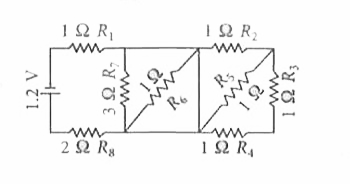 Now, `R_(2),R_(5)` and R' are in parallel, So, `1/(R’’) = 1/(R_(2)) + 1/(R_(5)) + 1/(R’) = 1/1 + 1/1 + 1/2 = 5/2 rArr R’’ = 2/5 Omega` Now, `R_(7), R_(8)` and R’’ are in parallel, So `1/(R’’’) = 1/3 + 1/1 +5/2 rArr` R’’’ `6/(23) Omega` Now, `R_(1),R_(8)` and R’’’ are in series. So, EQUIVALENT resistance, `R=1 + 6/(23) + 2 = (75)/(23) Omega` `:.` Current through `2Omega` resistor is, `I = V/R = (1.2xx23)/(75) = 0.36` A |
|
| 30. |
Two satellites orbit the Earth in circular orbits, each travelling at a constant speed. The radius of satellite A's orbit is R, and the radius of satellite B's orbit is 3R. Both satellites have the same mass. How does F_(A), the centripetal force on satellite A, compare with F_(B), the centripetal force on satellite B? |
|
Answer» `F_(A)=9F_(B)` |
|
| 31. |
Defineinput resistance, output resistance and current amplification of a transistor. |
|
Answer» SOLUTION :Input RESISTANCE : It is the ratio of change in base-emitter voltage and the CORRESPONDING change in base current at constant collector-emitter voltage. i.e., `R_"in"=((DeltaV_(BE))/(DeltaI_B))` at constant `V_(CE)` Output resistance : It is the ratio of the change in collector-emitter voltage to the corresponding change in collector current at a constant base current. i.e., `R_"out"=((DeltaV_(CE))/(DeltaI_C))` at constant `I_B` Current amplification : It is the ratio of change in collector current and the change in base current at constant collector -emitter voltage when the transistor is in ACTIVE state `beta_(ac)=((DeltaI_C)/(DeltaI_b))` at constant `V_(CE)` |
|
| 32. |
Abhishek and Deepak have two samples of magnetic materials X and Y. Experimentally they determine the following properties of the samples. Considering this, choose best choice |
|
Answer» X and Y both for electromagnets |
|
| 33. |
The de Broglie wavelength of the electron in the hydrogen atom is proportional to [n is the principal quantum number] |
|
Answer» n |
|
| 34. |
A uniform circular loop of radius a and resistance R is pulled at a constant velocity v out of a region of a uniform plane of the loop and the velocity are both perpendicular to B. Then the electrical power in the circular loop at the instant when the arc (of the circular loop) outside the region of magnetic field subtends an angle (pi)/(3) at the centre of the loop is |
|
Answer» `(B^(2)a^(2)v^(2))/(R)` |
|
| 35. |
A small resistor (say a lamp) is usually put in parallel to the current carrying coil of an electromagnet. What purpose does it serve? |
| Answer» Solution :When the current in the electromagnet is switched of the flux CHANGES from a large value to ZERO. This produces a high induced emf when the induces current passes across the switch, spark are produced. To avoid this, a SMALL RESISTANCE is CONNECTED in parallel and this provides a conducting path for the induced voltage thereby spark is avoided. | |
| 36. |
Two infinitely long parallel wires carry equal current I flowing in the same direction. The magnetic field exactly half way between the wires is |
|
Answer» `(mu_0I)/(2R)` |
|
| 37. |
In a certain oscillating LC circuit, the total energy is converted from electrical energy in the capacitor to magnetic energy in the inductor in 2.50 mus. What are (a) the period of oscillation and (b) the frequency of oscillation? (c) How long after the magnetic energy is a maximum will it be a maximum again? (d) In one full cycle, how many times will the electrical energy be maximum? |
|
Answer» |
|
| 38. |
A circular loop has radius R and a current I flows through it. Another circular loop has radius 2R and a current 2I flows through it. Ratio of the magnetic fields at their centres is |
|
Answer» `(1)/(4)` |
|
| 39. |
Find the frequency of light which ejects electrons from a metal surface stopped by a retarding potential of 3.3 V. if photoelectric emission begins in this metal at a frequency of 8xx10^(14)Hz, calculate the work function (in eV) for this metal. |
|
Answer» SOLUTION :Here stopping potential `V_(0)=3.3V` and threshold frequency `v_(0)=8xx10^(14)Hz` `THEREFORE` Work function `phi_(0)=(hv_(0))/(e)eV=(6.63xx10^(-34)xx8xx10^(14))/(1.6xx10^(-19))eV=3.315eV` If frequency of INCIDENT light be V, then `(hv)/(e)=[phi_(0)+V_(0)]eV` `implies v=[(phi_(0)+V_(0))/(h)]*e=((3.315xx3.3)xx1.6xx10^(-19))/(6.63xx10^(-34))=1.58xx10^(15)Hz`. |
|
| 40. |
A beam of light is incident on a glass slab (mu=1.54) in a direction as shown in the figure. The reflected light is analysed by a polaroid prims. On rotating the polaroid (tan57^(@)=1.54) |
|
Answer» a. the INTENSITY REMAINS unchanged |
|
| 41. |
The doping of minute quantity of antimony to a silicon crystal makes it ……… |
|
Answer» a good insulator. ANTIMONY is a PENTAVALENT (donar) so n-type semiconductor will FORM. |
|
| 42. |
Rain, pouring down at an angle a with the vertical has a speed of 10 m/s. A girl runs against the rain with a speed of 8 m/s and sees that the rain makes an angle beta with the vertical, then relation between alpha and beta is |
|
Answer» `TAN beta = (8 + 10 sin alpha)/(10 COS alpha)` |
|
| 43. |
To which part of the electromagnetic spectrum does a wave of frequency 5 xx 10^(11) Hz belong? |
| Answer» SOLUTION :MICROWAVE | |
| 44. |
In following meter bridge, when 12 Omega resistance is connected parallel to S null point is obtained at 50 cm from point A. Find value of S. |
| Answer» SOLUTION :`R = 4 OMEGA , S = 6 Omega` | |
| 45. |
Figure. 6.10 shows heat capacity of a crystal vs temperatue in terms of the Debye theory. Here C_(cl) is classical heat capacity Theta is the Debye temperature. Using this plot, find: (a0 The Debye temperature for silver if at a temperature T= 65K its molar heat capacity is equal to 15J (mol.K), (b) the molar heat capacity of aluminum at T= 80K if at T= 250K it is equal to 22.4J(mol.K) (c )the maximum vibration frequency for copper whose heat capacity at T= 125K differs form the classical value by 25%. |
|
Answer» Solution :(a) By Dulong and Petit's LAW, the classical heat capacity is `3R= 24.94J//K`- mol e. THUS `(C )/(C_(cl))= 0.6014` From the graph we see that this value of `(C )/(C_(cl))` corresponds to `(T)/(Theta)= 0.29` Hence `Theta=(65)/(0.29)~~ 224K` (b) `22.4J` mole - K corresponds to `(22.4)/(3xx8.314)=0.898`. From the graph this corresponds to `(T)/(Theta)~~ 0.65`. This gives `Theta= (250)/(0.65)~~ 385K` Then `80K` corresponds to `(T)/(Theta)= 0.208` The corresponding value of `(c )/(C_(cl))` is `0.42`. Hence `C= 10.5J//mol e-K` (c ) We calculate `Theta` from the datum that `(C )/(C_(cl))= 0.75 at T= 125K`. The `x`-coordinate corresponding to `0.75` is `0.40`. Hence `Theta=(125)/(0.4)= 3125K` Now `kTheta= ħ omega_(max)` So `omega_(max)= 4.09xx10^(13) rad//sec` |
|
| 46. |
The neutron is a particle with zero charge still it has a non-zero magnetic moment with z-component 9.66 xx 10^(-27) A-m^(2). This can be explained by the internal structure of the neutron. The evidence indicates that a neutron is composed of three fundamental particles calleed quarks : an "up" (u) quark, of charge + (2e)/(3), and two "down" (d) quarks, each of change - (e)/(3). The combinations of the three quarks prodcues a net charge of (2e)/(3) - e/3 - e/3 = 0. If the quarks are in motion they can produce a non-zero magnetic moment. As a very simple model, suppose the u quark moves in a counter clockwise circular path and the d quarks move in a clockwise circular path, all of the radius r and all with the same speed v see figure. Determine the magnitude of the magnetic moment due of the circular u quark :- |
|
Answer» `(EVR)/(3pir)` |
|
| 47. |
The neutron is a particle with zero charge still it has a non-zero magnetic moment with z-component 9.66 xx 10^(-27) A-m^(2). This can be explained by the internal structure of the neutron. The evidence indicates that a neutron is composed of three fundamental particles calleed quarks : an "up" (u) quark, of charge + (2e)/(3), and two "down" (d) quarks, each of change - (e)/(3). The combinations of the three quarks prodcues a net charge of (2e)/(3) - e/3 - e/3 = 0. If the quarks are in motion they can produce a non-zero magnetic moment. As a very simple model, suppose the u quark moves in a counter clockwise circular path and the d quarks move in a clockwise circular path, all of the radius r and all with the same speed v see figure. Determine the magnitude of the three-quark system :- |
|
Answer» `(EVR)/(3pir)` |
|
| 48. |
The neutron is a particle with zero charge still it has a non-zero magnetic moment with z-component 9.66 xx 10^(-27) A-m^(2). This can be explained by the internal structure of the neutron. The evidence indicates that a neutron is composed of three fundamental particles calleed quarks : an "up" (u) quark, of charge + (2e)/(3), and two "down" (d) quarks, each of change - (e)/(3). The combinations of the three quarks prodcues a net charge of (2e)/(3) - e/3 - e/3 = 0. If the quarks are in motion they can produce a non-zero magnetic moment. As a very simple model, suppose the u quark moves in a counter clockwise circular path and the d quarks move in a clockwise circular path, all of the radius r and all with the same speed v see figure. If all Quarks start moving in the same direction then what will be the magnetic moment of the neutron :- |
|
Answer» `(evr)/(3pir)` |
|
| 49. |
In a Lloyd's experiment , the path difference between the direct and reflected beam of light for the 8th maxima fringe was observed to be 0.23 mm . Find the wavelength of light used . |
|
Answer» |
|