Saved Bookmarks
This section includes 7 InterviewSolutions, each offering curated multiple-choice questions to sharpen your Current Affairs knowledge and support exam preparation. Choose a topic below to get started.
| 1. |
Paragraph : A particle vibrates in S.H.M. along a straight line. Its velocity is 4 cm/s when its displacement is 3 cm and velocity is 3 cm/s when displacement is 4 cm. The amplitude of SHM is : |
|
Answer» 5 cm `=5` cm Correct choice is ( c ). |
|
| 2. |
In a LCR circuit, the plot of I_("max") versus ω is shown in figure. Find the bandwith ? |
|
Answer» Solution :`I_("RMS") = (I_("max"))/(SQRT2) = (1)/(sqrt2)= 0.7` At from DIAGRAM `omega_1 = 0.8` rad/s `omega_2 = 1.2` rad/s `Delta w = 1.2 - 0.8 =0.4` rad/s |
|
| 3. |
As situation shown in figure the maximum value of rate of energy stored in the capacitor after the switch is closed. |
|
Answer» `(xi^(2))/(2R)` |
|
| 4. |
A series LCR circuit is connected to a 220 V ac source of variable frequency . The inductance of the coil is 5 H, capacitance of the capacitor is 5muF and resistance is 40 Omega . At resonance , calculate the inductive reactance. |
|
Answer» SOLUTION :INDUCTIVE REACTANCE `XL=2pisqrtL=2xx3.142xx31.81xx5` XL=999.4`OMEGA` |
|
| 5. |
A thin metallic spherical shell of radius Rcarriesa charge Q on its surface. A point charge(Q)/(2)is placed at its centre C and another charge +2Q is placed outside the shell at point A at a distance x from the centre (x gt R) Find the force on the charge at the centre of the shell and at the point A Find the electric flux through the shell. |
|
Answer» Solution :The force on the charge `(Q)/(2) ` placed at the centre of shell is zero because electric FIELD point C , inside the shell is zero. For the PURPOSE of electric force on charge 2Q placed at point A. the charge Q PRESENT on spherical shell may be considered to be ` therefore `Force at point A, `F_A=(1)/(4piin _0).((3Q//2)(2Q))/(x^(2)) =(1)/(4piin _0) .(3Q^(2))/(2) ` (b) Electric flux through the shell `phi_in =(1)/(in_0) `(charged enclosed )`=(1)/(in_0) .(3Q)/(2) =(3Q)/(2in_0) ` ` (##U_LIK_SP_PHY_XII_C01_E09_025_S01.png" width="80%"> |
|
| 6. |
Obtain the expression for the electric field at a point on the equatorial plane of an electric dipole. |
|
Answer» Solution :Consider an electric dipole CONSISTING of two point charges +q and -q separated by a small distance 2a. We have to find the electric FIELD intensity at p on the equatorial line of the dipole when `thetap=r`. `E_1` is electric field intensity at P due to charge +q is , `|E_1|=1/(4piepsilon_0)q/(AP^2)` where `AP^2=a^2+r^2` `|E_1|=1/(4piepsilon_0)q/(a^2+r^2)` The magnitudeof the electric field intensity at P due to charge -q is `|E_2|=1/(4piepsilon_0)q/(a^2+r^2)` The direction of `vecE_1` is away from the charge +q and the direction of `vecE_2` is towards the eachother charge -q as shown `vecE_1` and `vecE_2` can be RESOLVED into two components . The components normal to the dipole axis cancel away . The components along the dipole axis add up. `therefore vecE_1=(E_1 cos theta + E_2 cos theta )-hatP` Here the direction of `vecE` is opposite to the dipole monent P `therefore -hatP` is a unit vector . `vecE=(E_1+E_2)cos theta -hatP "" because |E_1|=|E_2|` `vecE=(1/(4piepsilon_0) q/((a^2+r^2)) + 1/(4piepsilon_0)q/((a^2+r^2))) cos theta -hatP` From the figure , cos `theta =1/((a^2+r^2)^(1//2))-hatP` `vecE=1/(4piepsilon_0)q/(a^2+r^2)[1+1]a/((a^2+r^2)^(1//2))-hatP` `=2 1/(4piepsilon_0)(qa)/((a^2+r^2)^(3//2))-hatP "" because P=qxx2a` `=1/(4piepsilon_0)P/((a^2+r^2)^(3//2))-hatP` `vecE=1/(4piepsilon_0)vecP/((a^2+r^2)^(3//2)) "" because hatP=vecP/P` a < << r So, a can be neglected . `vecE=1/(4piepsilon_0). vecP/((r^2)^(3//2))-vecP/P` `vecE=-1/(4piepsilon_0)vecP/r^3` 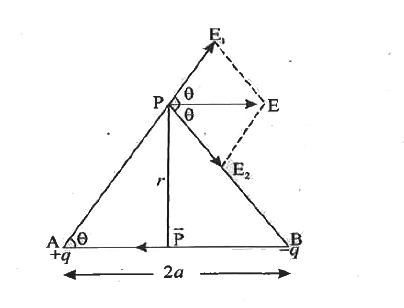
|
|
| 7. |
LiCl is ........in colour with excess Li vapours |
|
Answer» pink |
|
| 8. |
Obtain an expression for angular frequency of LC oscillations ? |
|
Answer» Solution :i. The mechanical energy of the spring-mass system is given by `E=(1)/(2)mv^(2)+(1)/(2)kx^(2)` ii. The energy E remains constant for varying values of x and v. Differentiating E with respect to time, we get `(dE)/(dt)=(1)/(2)m(2v(dv)/(dt))+(1)/(2)k(2X(dx)/(dt))=0` `orm(d^(2)x)/(dt^(2))+kx=0` since `(dx)/(dt)=vand(dv)/(dt)=(d^(2)x)/(dt^(2))""...(1)` iii. This is the differential equation of the OSCILLATION of the spring-mass system. The general solution of equation (1) is of the form `x(t)=X_(m)cos(omegat+phi)` iv. where `X_(m)` is the maximum value of x (t), `omega` the angular frequency and `phi` the phase constant. Similarly, the electronmagnetic energy of the LC system is given by `U=(1)/(2)Li^(2)+(1)/(2)((1)/(C))q^(2)=" constant "` Differentiating U with respect to time, we get `U=(1)/(2)(2i(di)/(dt))+(1)/(2C)(2i(dq)/(dt))=0` `orL(d^(2)q)/(dt^(2))+(1)/(C)q=0""...(2)` since `i=(dq)/(dt)and(di)/(dt)=(d^(2)q)/(dt^(2))` v. The general solution of eqution (2) is of the form `q(t)=Q_(m)cos(omegat+phi)""(3)` where `Q_(m) is the maximum value of q (t), `omega` the angular frequency and `phi` the phase constant. Current in the LC circuit The current flowing in the LC circuit is obtained by differentiating q (t) with respect to time. `i(t)=(dq)/(dt)=(d)/(dt)[Q_(m)cos(omegat+phi)]` `=-Q_(m)omegasin(omegat+phi)""" since "I_(m)=Q_(m)omega` or `i(t)=-I_(m)sin(omegat+phi)""...(4)` The equation (4) clearly shows that current VARIES as a function of time t. In fact, it is a sinusoidally varying alternating current with angular frequency `omega.` Angular frequency of LC oscillations By differentiating equation (3) twice, we get `(d^(2)q)/(dt)=-Q_(m)omega^(2)cos(omegat+phi)""...(5)` SUBSTITUTING equations (3) and (5) in equation (2), we obtain `L[-Q_(m)omega^(2)cos(omegat+phi)+(1)/(C)Q_(m)cos(omegat+phi)=0` Rearranging the terms, the angular frequency of LC oscillations is given by `omega=(1)/(sqrt(LC))` This equation is the same as that obtained from qualitative analogy. |
|
| 9. |
Which of the following compound have 1^(@),2^(@), 3^(@) and 4^(@)C present in given compounds- |
|
Answer» `(CH_(3))_(3)`C 
|
|
| 10. |
A black body is at 727^(@)C. It emits energy at a rate which is proportinal to : |
|
Answer» `(1000)^(4)` `EpropT^(4)`, where T is absolute temperature of BLACK BODY. `Eprop(727+273)^(4)` `rArrEprop(1000)^(4)` Correct CHOICE is (a). |
|
| 11. |
Write any two drawbacks of the Rutherford model of an atom. |
| Answer» SOLUTION :Rutherford.s model of ATOM COULD not explain the stability of an atom.Bohr.s model of atom could explain the stability of an atom. ACCORDING to Bohr, electron can revolve only in stationary ORBITS. | |
| 12. |
A series LCR circuit is connected to a 220 V ac source of variable frequency . The inductance of the coil is 5 H, capacitance of the capacitor is 5muF and resistance is 40 Omega . At resonance , calculate The resonant frequency . |
|
Answer» Solution :GIVEN: V=220V L=5H `C=5HF=5xx10^(-6)F` `R=40Omega` At RESONANCE XL =XC `V_0=1/(2pisqrt(LC))=1/(2xx3.142sqrt(5xx5xx10^(-6)))` `=1/(2xx3.142sqrt(5xx5xx10^(-6)))=1/(6.2884xx5xx10^(-3))` `=1/(31.42xx10^(-3))=0.0318xx10^3` `V_0`=31.81 Hz |
|
| 13. |
In a S.H.M. when displacement is one third of the amplitude, what fraction of the total energy is potential ? |
|
Answer» 0 |
|
| 14. |
A series LCR circuit is connected to a 220 V ac source of variable frequency . The inductance of the coil is 5 H, capacitance of the capacitor is 5muF and resistance is 40 Omega . At resonance , calculate current in the circuit . |
|
Answer» SOLUTION :`I=V/Z` at RESONANCE Z=R= `40Omega` `I=(22cancel0)/(4cancel0)`=5.5A I=5.5 A |
|
| 15. |
A biconvex lens of focal length 15cm is in front of a plane mirror. The distance between the lens and the mirror is 10cm. A small object is kept at distance of 30cm from the lens. The final image is |
|
Answer» VIRTUAL and at a distance of 16 cm from the mirror 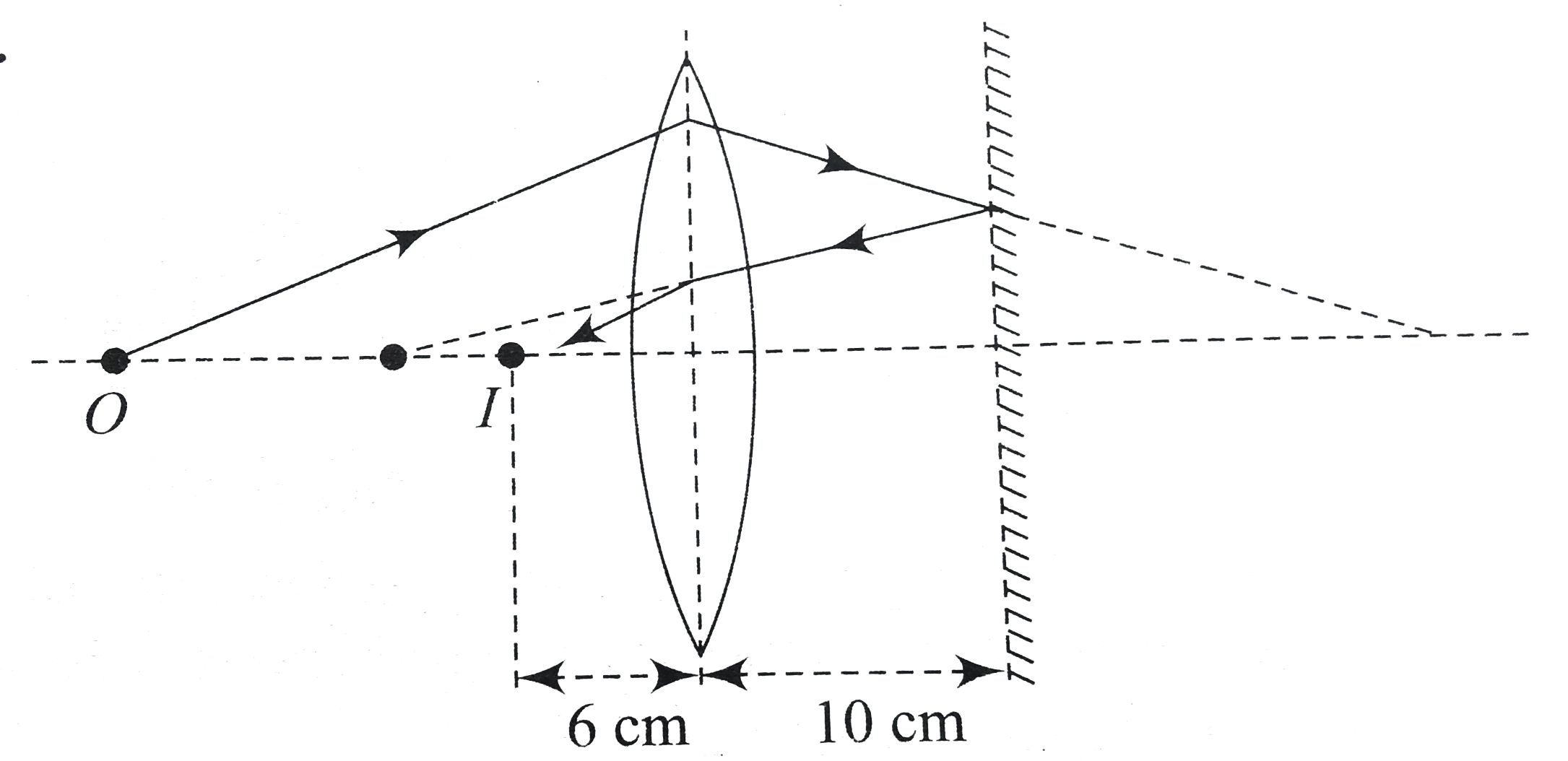
|
|
| 16. |
A laser beam is used for locating distant objects because |
|
Answer» it is monochromatic |
|
| 17. |
निम्नलिखित में से जल प्रदूषित होने का सही कारण क्या है? |
|
Answer» घरेलू और औद्योगिक अपशिष्ट |
|
| 18. |
पृथ्वी का संपूर्ण जलीय भाग इनमें से क्या कहलाता है |
|
Answer» वायुमंडल |
|
| 19. |
A particlesstarts from rest and has an acceleration of2m//s^(2)for 10 sec. After that , it travels for 30 sec with constant speed and then undergoes a retardation of4m//s^(2) and comes back to rest.The total distance covered by the particle is |
|
Answer» Solution :Here, `U = 0, a = 2 ms^(–2), t = 10 s" USING "v = u +" at "= 0 +2 xx 10 = 20" ms"^(–1)` For next `t = 30 s, v = 20" ms"^(–1)` and finally the particle comes to rest in next 5S. `because" "v=u + at" or "0=20-4t" or "t=5s` Now, distance = AREA of the TRAPEZIUM OABC `=(1)/(2) xx (30+45) xx20 =750 m` 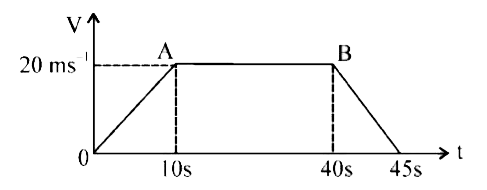
|
|
| 20. |
भौम जल स्तर के गिरने का इनमें से कारण है? |
|
Answer» सिंचाई के साधनों का विकास |
|
| 21. |
Find the potential difference V_(a)-V_(b) between the points (1) and (2) shown in each part of Fig. |
|
Answer» Solution :(a) We first distribute the charges on DIFFERENT capacitors and branches keeping in mind Kirchhoff's junction rule .We can START from any battery. In this case, We start from battery `epsilon_(1)`. Let battery `epsilon_(1)` supply a charge `q` The charge on the left plate of capacitor `C_(1)` wil be `q` as this plate is receiving the charge. Now charge `q` reches junction `b` where it is divided into two Paths. Let charge `x` go to capacitor `C_(3)`, then the remaining charge `q-x` will go to capacitor `C_(2)`. In juncation `a`, we can verify Kirchoeff's juncation rule, i.e., the incoming charge is equal to the outgoing charge. Now we write the loop equations. For loop `1` `2 - (q)/(2) - (x)/(C) = 0` For loops `2` `2 + (x)/(C) - ((q-x))/(2) = 0` (i) or `2 + (x)/(C) - (q)/(2) + (x)/(2) = 0` ......(ii) From `(i)` and `(ii)` `(2x)/(C) + (x)/(2) = 0` or `x ((2)/(C) + (1)/(2)) = 0` or `x = 0`(since `(2)/(C) + (1)/(2) ne 0`) No charge will go to the capacitor connected across `(1)-(2)`. A there is no charge in the capacitor connected across `(1)` and `(2)`, the potential difference across `(1)` and `(2)` should be zero. 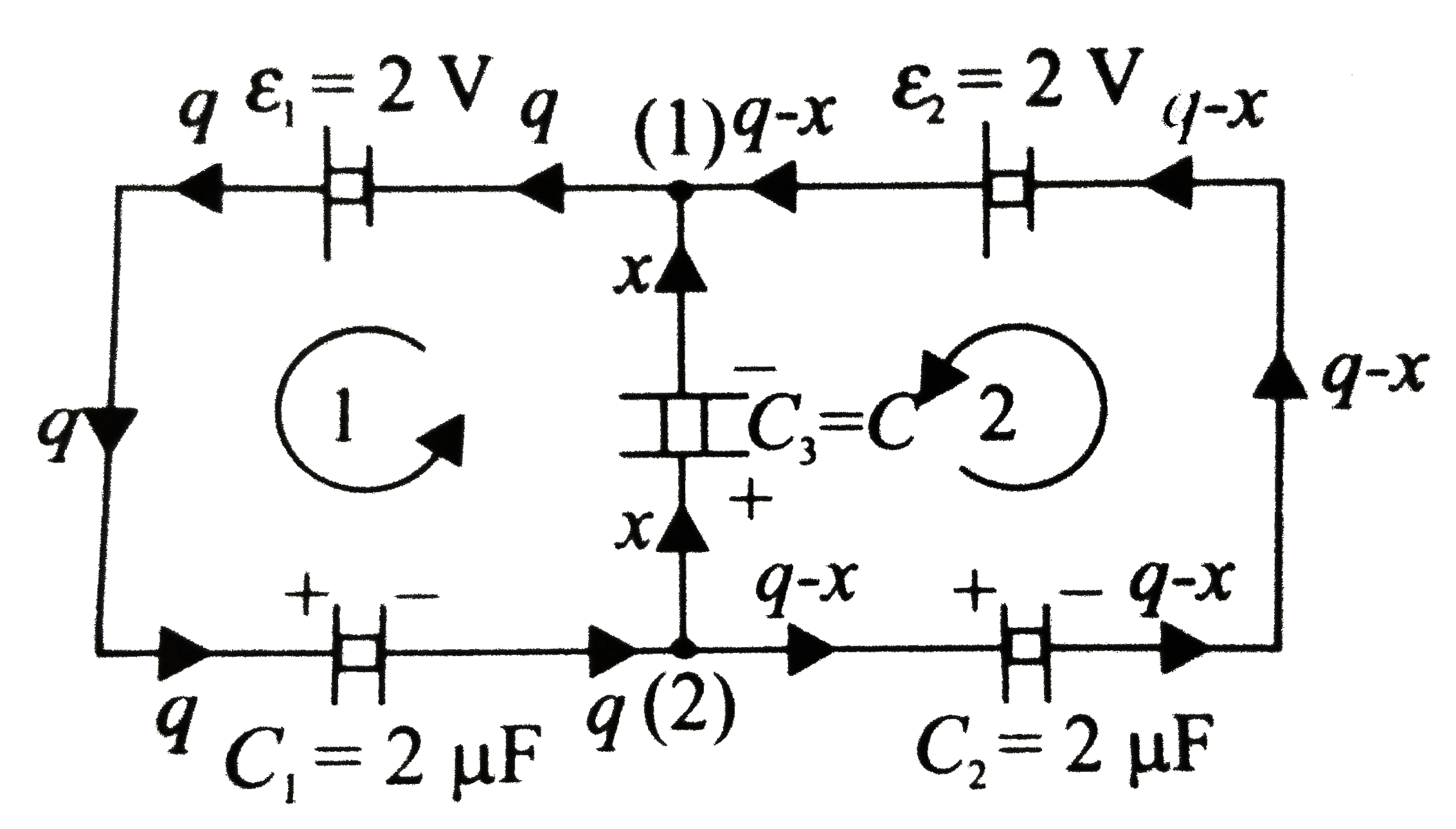 (b) In this case also, we will first distribute the charges. Let us start from the `24 V` battery. Let this battery supply a charge `q`, which is divided into two paths after reaching juncation `(2)`. Let `x` charge MOVE toward the `2 MUF` capacitor, then the reminaning charge `q - x` will move toward the `4 muF` capacitor, as per Kirchhoff's juncation rule. Now we write the loop equations. In the upper closed loop `+6+((q-x))/(4)-(x)/(2)-12=0` or `(q)/(4)-x=6`....(i) In the lower closed loop `12+(x)/(2)+(q)/(1)-24=0` or `q + (x)/(2) = 12`.....(ii) From `(i)` and `(ii)`, `x = (-8)/(3) mu C` Moving from `(1)` to `(2)` through middle path `V_(a) + 12 - (8//3)/(2) = V_(b)` or `V_(a) - V_(b) = (4)/(3) - 12 = (-32)/(3) V` |
|
| 22. |
Color of Bromine Gas |
|
Answer» Brown |
|
| 23. |
A person of mass 70 kg jump from a 3.0m height |
|
Answer» Impulse on the main by ground will be `539N-s` |
|
| 24. |
Statement - I : Water kept in an open vessel will evaporate quickly on the surface of moon. Statement - II : The temperature at the surface of moon is much higher than boiling point of water. |
|
Answer» STATEMENT - I is TRUE, Statement - II is true and Statement - I is correct EXPLANATION for Statement - II. So correct CHOICE is (C ). |
|
| 25. |
Answer the question regarding earth's magnetism: The angle of dip at a location in southern India is about 18^@. Would you expect a greater or smaller dip angle in Britain? |
|
Answer» Solution :(B) As compared to southern PART of India,Britain is closer to magnetic north pole of Earth and so dip angle at Britain is more. (Please remember that as we MOVE from magnetic EQUATOR to magnetic poles of Earth, dip angle (also called inclination) goes on increasing from 0° to 90°). (NOTE: Dip angle at Britain is about `70^@` ) |
|
| 26. |
In a mixture of nitrogen and helium kept at room temperature. As compared to a helium molecule nitrogen molecule hits the wall |
|
Answer» with GREATER AVERAGE speed `M_(N_(2))gtM_(He)` |
|
| 27. |
Steel is preferred for making permanent magnets whereas soft iron is preferred for making electromagnets. Explain. |
| Answer» SOLUTION :Steel is preferred for MAKING permanent MAGNETS on account of its high permeability and high coercivity. Soft IRON is preferred for making ELECTROMAGNETS on account of low retentivity, low coercivity and low hysteresis loss. | |
| 28. |
The potential gradients on the potentiometer wire are V_(1) and V_(2) with an ideal cell and a real cell of same emf in the primary circuit then |
|
Answer» `V_(1)=V_(2)` |
|
| 29. |
When a magnetic compass needle is carried nearbyto a straight wire carrying current, then I. the straight wire cause a noticeable deflection in the compass needle. II. the alignment of the needle is tangential to an imaginary circle with straight wire as its centre and has a plane perpendicular to the wire |
|
Answer» (I) is correct |
|
| 30. |
An air bubble is inside water. The refractive index of water is 4//3. Atthe what distance from the air bubble should a point object be placed so as to form a real image at the same distance from the bubble? |
| Answer» Answer :D | |
| 31. |
A constant current of 3 A flows through a resistor. The rms value of the current in the resistance is : |
|
Answer» `3sqrt2A` |
|
| 32. |
Two semiconductor materials X and Y, shown in the given, are made by dopinggermanium crystal with indium and arsenic respectively. The two are joined end to end and connected to a battery as shown. (i) Will the junction be forward biased or reverse biased ? (i) Sketch a V-I graph for this arrangement. |
|
Answer» Solution :(i) The semiconduct or material X is behaving as p-type, because here the dopant indium is trivalent. Material Y behaves as n-type because there the dopant ARSENIC is PENTAVALENT. As p-side of junction has been connected to POSITIVE terminal of battery, the junction is FORWARD biased. (i) V-Igraph is shown in 
|
|
| 33. |
A rod of mass 'm' and length 'l' is hinged at point 'P ' and rod can rotate about higne point 'P' in vertical plane. Other end of rod is connected through a block by a string which is passed through pulley of mass 'm' and radius 'R' and there is no slipping between the pulley and the string as shown in figure. At t=0, system is released . Find the hinge reaction at P at t=0. |
|
Answer» `(2)/(11)mg` |
|
| 34. |
The equation of a wave is y = 4sin{pi/2 (2t + x/8)}, where y, x are in cm and time in seconds. The phase difference between two position of the same particle which are occupied at time interval of 0.4 s is x pi xx 10^(-1), what is the value of x ? |
|
Answer» |
|
| 35. |
What is Kirchhoff's loop rule. |
|
Answer» Solution :Junction. It isapont where two or more conductors are connected to source and current gets distributed at the point. Loop. Loop is a CLOSED path of an electric circuit. 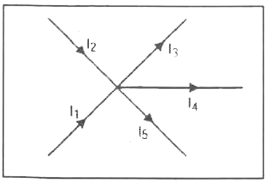 Kirchhoff.s First Law of Junction Rule. It states that the algebraic sum of currents meeting at a point is zero. This law is also called Kirchhoff.s current law. To explain this law, consider a number of wires connected at a point P. currents `i_(1),i_(2),i_(3),i_(4)` and `i_(5)` flow through these wires in the directions as shown in the figure. Sign conventions (i) The currents approaching the point P be taken as positive. (ii) Current flowing away from it be taken as negative. According to Kirchhoff.s first law, `i_(1)+i_(2)-i_(3)-i_(4)-i_(5)=0` or `sumi=0` The most evident conclusion of this law is that the current entering a point must be the same as that LEAVING. hence there cannot be any accumulation for current at any point in a conductor. Kirchhoff.s Second Law or Loop Rule It states that in a closed electric circuit, the algebraic sum of e.m.f.s is equal to the algebraic sum of the product of the resistances and the currents flowing through them. this law may be called Kirchhoff.s voltage Law. 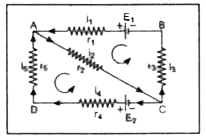 Sign Convenstions Select any point on the loop and traverse the loop once in any direction clockwise or anticlockwise. (i) If the direction of flow of current in a resistance is the same as that of traversing the loop, the product of the resistance and the current flowing through it is taken as positive and vice-versa. (ii) While traversing the loop, if -ve pole of a cell is encountered first then its e.m.f. is taken as +ve, otherwise negative. The resistance of a conductor has no sign. the sign of the product of the current the resistance will, therefore, be decided by the sign of electric current. Considering circuit ABCA, we have `E_(1)=i_(1)r_(1)+i_(2)r_(2)+i_(3)r_(3)` In circuit ABCDA, we have `E_(1)-E_(2)=i_(1)r_(1)-i_(5)r_(5)-i_(4)r_(4)+i_(3)r_(3)` CONDITIONS of balanced wheatstone bridge Wheatstone bridge consists of four resistors, P,Q,R and S, the last one is unknown. The DISTRIBUTION of the current is as shown in the figure. Applying Kirchhoff.s law to circuit 1 i.e., ABDA, we have `0=i_(1)P+i_(G)G-(i-i_(1))R` When bridge is balanced `i_(g)=0` `therefore 0=i_(1)P(i-i_(1))R` When bridge is balanced, `i_(g)=0` `therefore 0=i_(1)P(i-i_(1))R` or `i_(1)P=(i-i_(1))R` . . . (i) Applying Kirchhoff.s law to second circuit i.e., BCDB, we have `0=(i_(1)-i_(g))Q-(i-i_(1)+i_(g))S-i_(g)G` For balanced bridge, `i_(g)=0` `therefore 0=i_(1)Q-(i-i_(1))S` or `i_(1)Q=(i-i_(1))S`. . (ii) 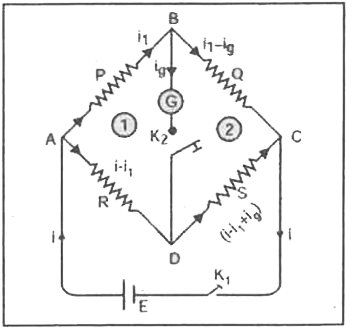 Dividing (i) by (ii), we have `(i_(1)P)/(i_(1)Q)=((i-i_(1))R)/((i-i_(1))S)` `P/Q=R/S` This is the principle of Wheatstone.s bridge. |
|
| 36. |
Nickel shows ferromagnetic property at room temperature. If the temperature is increased beryond Curie temperatue,then it will show |
|
Answer» ANTIFERROMAGNETISM |
|
| 37. |
Discuss the biasing polarities in an NPN and PNP transistors. |
|
Answer» <P> Solution :In a PNP TRANSISTOR, base and COLLECTOR will be naegative with respect to emitter indicated by the middle letter N whereas base and collector will be positive in an NPN transistor [ indicated by the middle letter P ] |
|
| 38. |
(a) With the help pf a ray diagram , show how a concavemirror is used to obtain an erect and magnified image of an object .(b)Using the ray diagram below , obtain the mirror formula and the expression for linear magnification. |
Answer» Solution :(a)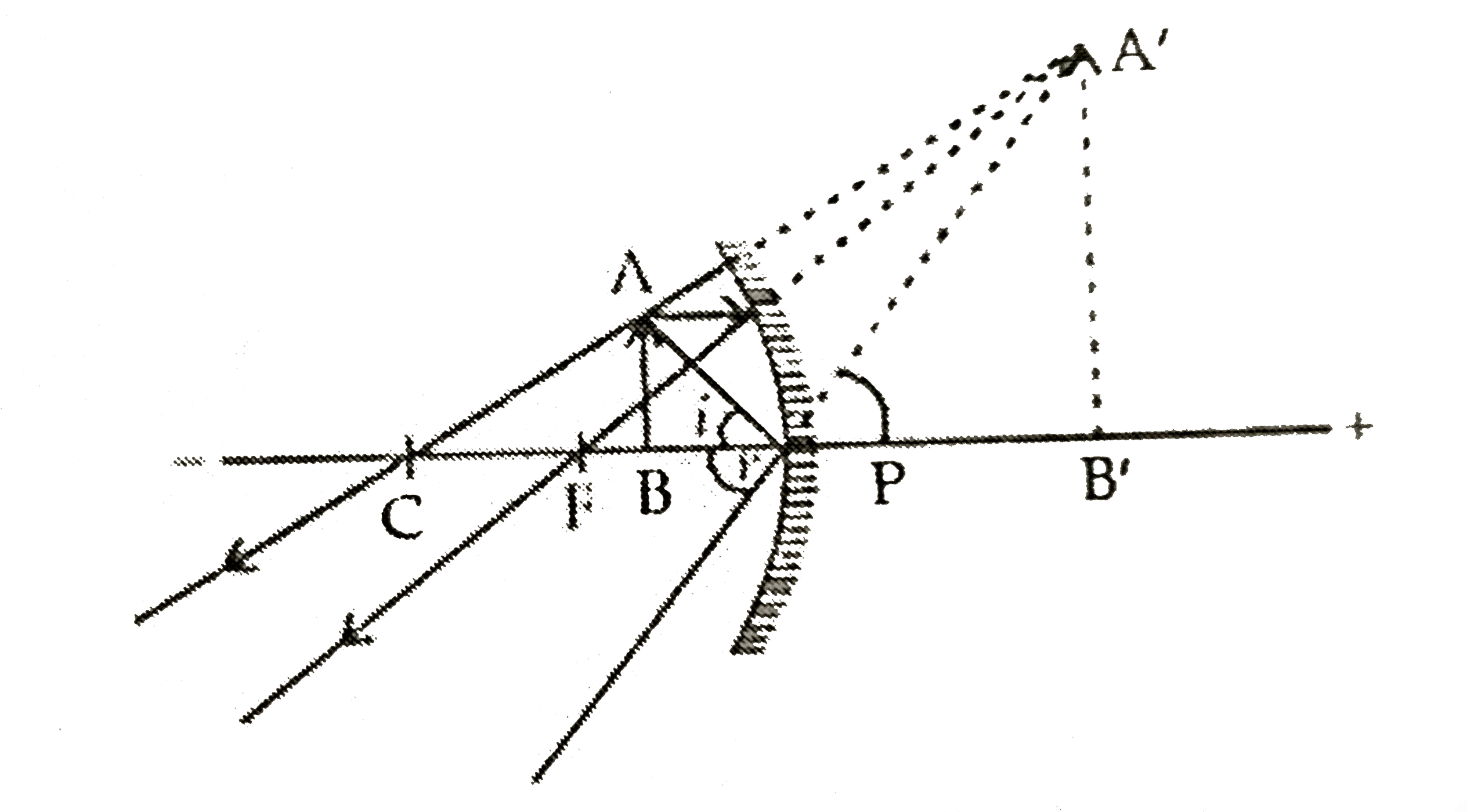 (b)`DELTAA'B'P~DeltaABP`(by A Asimilarity) So ,`(A'B')/(AB)=(B'P)/(BP)=(+V)/(-U)` . . . (i) `DeltaA'B'C~DeltaABC`(by A A similarity) So ,`(A'B')/(AB)=(CB')/(CB)=(CP+PB')/(CP-BP)=(-2f+v)/(-2f-(-u))` . . . (ii) From equation (i)and (ii), `(+v)/(-u)=(-2f+v)/(-2f+u)` `v(-2f+u)=-(-2f+v)` `-2vf+4v=+2uf-uv` `2uv=2uf+2vf` Dividing by 2uvf, `(1)/(f)=(1)/(v)+(1)/(u)` From equation (i) , `(A'B')/(AB)=(-v)/(u)` So,`(h_("i"))/(h_(0))=(-v)/(u)` So,`m=(h_("i"))/(h_(0))=(-v)/(u)` |
|
| 39. |
If for a transistor, beta=49then the value of alpha is |
|
Answer» 1 |
|
| 40. |
Dimesional formula of self-inductance is |
|
Answer» `[MLT^(-2) A^(-2)]` |
|
| 41. |
In the above question, the potential of point A is |
| Answer» Solution :`V_(A)-0=(2Q)/4=3 V`. | |
| 42. |
In radioactive chain reaction shown, initially at t = 0, only No molecules of .A. are present. At some time I = I, number of molecules of A, B, C, D and E are N_(1),N_(2),N_(3),N_(4) and N_(5) respectively. Then the activity of .B. at this time is |
|
Answer» `lamda_(1)N_(1)+lamda_(4)N_(4)-lamda_(5)N_(2)-lamda_(3)N_(2)` |
|
| 43. |
A closed organ pipe of radius r_(1)and an open organ pipe of radius r_2 and having same length .L. resonate when excited.with a given tunning fork. Closed organ pipe resonates in its fundamental mode where as open organ pipe resonates in its first overtone, then |
|
Answer» `r_(2) - r_(1) = L` |
|
| 44. |
For ...... light, focal length of convex lens is maximum. |
|
Answer» blue |
|
| 45. |
For several practical applications the so-called "differential" magnetic permeability mu'=1/mu_(0) (d B)/(d H) the usual magnetic permeability mu-B//mu_(0)H is the parameter of interest. Here (d B)/(d H) is the derivative of the field induction with respect to the field intensity, i.e. the slope of the graph in Fig. 29.9a. For the purpose of practical calcula- tions one can assume mu'=(1)/mu_(0) (triangle B)/(triangle H)" where "triangleB and triangleH are chosen so small that the respective segment of the graph may be regarded as a straight line. Find the approximate values of the differential magnetic permeability for the same values of the magnetic field strength as in Problem 29.9. |
|
Answer» |
|
| 46. |
The size of the Nano robots is reduced to ____level to perform a task in very small space. |
|
Answer» Macroscopic |
|
| 47. |
In deriving the single slit diffraction pattern, it was stated that the intensity is zero at angles of nlambda//a. Justify this by suitably dividing the slit to bring out the cancellation. |
|
Answer» Solution :When a slit of width d is DIVIDED into n no. of smaller identical slits then width of each smaller slit will be, `d.=(d)/(n)""....(1)` Now, angle of diffraction for FIRST order MINIMUM is, `theta=(lamda)/(d.)` `=(lamda)/(d//n)` [From equation (1)] `:.theta=(nlamda)/(d)` At above angle of diffraction, we get zero intensity due to each smaller slit and so due to ENTIRE single big slit also we get zero intensity. |
|
| 48. |
The least distance from the central maxima where the fringes due to both wavelength coincide is |
|
Answer» `3.02 mm` Now fringe width `beta = (n lambda D)/(d)` `therefore (n lambda_(1)D)/(d) = (n + 1)lambda_(2).D/d` then `nlambda_(1) = (n + 1) lambda_(2)` ` nxx 6500 XX 10^(-8) = (n + 1) 5200 xx 10^(-8)` Then `n = 4` for `lambda_(1)` `x_(4) = (4lambdaD)/(d) = 1.56 mm` |
|
| 49. |
During the propagation of electromagnetic waves in a medium : |
|
Answer» (A)ELECTRIC ENERGY density is EQUAL to the magnetic energy density. `therefore (rho_(E ))/(rho_(B))=in_(0)mu_(0)(E_(rms)^(2))/(B_(rms)^(2))` `therefore (rho_(E ))/(rho_(B))=(1)/(c^(2))XX c^(2)"" [because in_(0) mu_(0)=(1)/(c^(2)), (E_(rms))/(B_(rms))=c]` = 1 `therefore rho_(E )=rho_(B)` |
|
| 50. |
A conductor of length L is connected across d.c. source of emf epsi . If the conductor is replaced byanother of the same material and area of cross-section but of length = 5 L, by what factor will the drift velocity change ? |
| Answer» SOLUTION :DRIFT velocity becomes 1/5th of its previous VALUE because of reduction in value of ELECTRIC field `epsi` . | |