

Saved Bookmarks
This section includes 7 InterviewSolutions, each offering curated multiple-choice questions to sharpen your Current Affairs knowledge and support exam preparation. Choose a topic below to get started.
| 1. |
Which light is partially polarised when light is incident on a transparent medium at the polarising angle ? |
|
Answer» INCIDENT light |
|
| 2. |
What did Gafur give to Banshi as a mortgage? |
|
Answer» BRASS plate |
|
| 3. |
Derive expresion for capacitance of a parallel plate capacitor and explain the combination of capacitors in series. Or. Write expression for three capacitors in series and parallel combinations. |
|
Answer» Solution :Capacitors in Series. Capacitors are said to be connected in series when charge proceeds from one point to the other through a single path. If figure `C_(1),C_(2), . . ,C_(n)` etc, are connected in series. Let CAHRGE +q be given to the left plate of `C_(1)`, a charge-q is induced on inner side of right plate of `C_(1) and +q` on the outer side of this plate. charge thus flows from left to rightl. let `V_(1),V_(2),. . .V_(n)` be the potential differences between two sides of `C_(1),C_(2), . . ,C_(n)` respectively V be the total P.D. across all the plates. 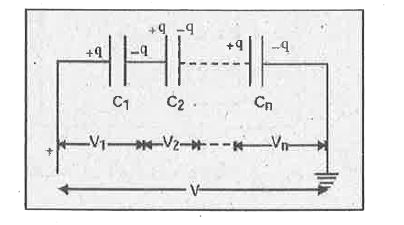 `therefore V_(1)=(q)/(C_(1)),V_(2)=(q)/(C_(2)), . . .,V_(n)=(q)/(C_(n)) and V=(q)/(C_(s))` where `C_(s)` is the resultant CAPACITANCE of the arrangement in series. Now `V=V_(1)+V_(2)+ . .+V_(n)` or `(q)/(C_(s))=(q)/(C_(1))+(q)/(C_(2))+ . .+(q)/(C_(n))` or `(1)/(C_(s))=(1)/(C_(1))+(1)/(C_(2))+ . .. +(1)/(C_(n))` NOTE: if we have two capacitors of capacitance `C_(1) and C_(2)`, then `(1)/(C_(s))=(1)/(C_(1))+(1)/(C_(2))` Capacitors in parallel. capacitors are said to be connected in parallel if the .positively charged. plates of all the capacitors are connected together at a point A while the .earthed. plates are connected together at another point B. the point B is also connected to earth while the source of charge is connected between the points A and B (fig). 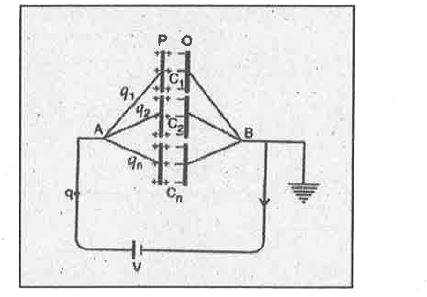 Capacitors having capacities `C_(1),C_(2), ... ,C_(n)`, draw charges `q_(1),q_(2), . . . ,q_(n)` in ACCORDANCE with their capacities. if q is the total charge drawn from the source, then `q=q_(1)+q_(2)+ . . .+q_(n)`. . (1) Since all the capacitors are connected between two COMMON points A and B therefore, the potential difference across each of them is the same i.e. V. this is also the potential difference across the two terminals of the source of charge. When `q_(1)=C_(1)V`, `q_(2)=C_(2)V`, . . . . . . . .. . . . . . . . `q_(n)=C_(n)V`. If `.C_(p).` is the capacity of the combination, then `V=(q)/(C)` or `q=CV` Putting the values of `q,q_(1),q_(2), . ..,q_(n)` in Eq. (i), we get `CV=C_(1)V+C_(2)V+ . . .+C_(n)V` or `C_(p)=C_(1)+C_(2)+ ... . +C_(n)` Note. For three capacitors, we shall use only three capacitors `C_(1),C_(2) and C_(3)`, then `(1)/(C_(s))=(1)/(C_(1))+(1)/(C_(2))+(1)/(C_(3))` and `C_(p)=C_(1)+C_(2)+C_(3)`. |
|
| 4. |
In the Fig. 6.22 given below, a bar magnet moving towards the right or left induces an emf in the coils (i) and (ii). Find, giving reason, the directions of the induced currents through the resistors AB and CD when the magnet is moving (a) towards the right and (b) towards the left. |
|
Answer» SOLUTION :(a) When the MAGNET NS is moving towards the right, in accordance with Lenz.s law INDUCED CURRENT in resistor AB flows from A to B and in resistor CD current flows from D to C. (b) When the magnet NS is moving towards the left, induced current in resistor AB flows, in accordance with Lenz.s law, from B to A and in resistor CD current flows from C to D. |
|
| 5. |
For a plane convex lens for which mu = 1.5 has radius of curvature of 10 cm. It is silvered on its plane surface. Find the focal length after silvering. |
|
Answer» 10 cm |
|
| 6. |
How we should live ? |
|
Answer» Happily |
|
| 7. |
Computethe current in the wire if a charge of 120 C is flowing through a copper wire in 1 minute. |
| Answer» SOLUTION :The CURRENT (rate of flow of CHARGE) in the wire is `I=(Q)/(t)=(120)/(60)=2A` | |
| 8. |
A cone of base radius R and height h is located in a uniform electric field vec(E) parallel ot its base. The electric flux entering the cone is : |
| Answer» ANSWER :D | |
| 9. |
The expression for the capacity of the capacitor formed by compound dielectric placed between the plates of a parallel plate capacitor as shown in figure, will be (area of plate = A) |
|
Answer» `(epsi_(0)A)/(((d_(1))/(K_(1)) + (d_(2))/(K_(2)) + (d_(3))/(K_(3))))` |
|
| 10. |
Define critical angle. Write two conditions for total internal reflection. |
|
Answer» SOLUTION :Critical angle : It is the angle of incidence in the denser medium for ,which the angle of refraction is `90^(@)`. Condition for TIR The ray of LIGHT must travel from denser to rarer medium The angle of incidence must be GREATER than the critical angle. |
|
| 11. |
A bat flies at a steady speed of 4 m s^(-1) emitting 90 kHz sound waves and is flying towards a wall. It detects a reflected signal at a frequency (Take speed of sound = 340 m s^(-1) ) |
|
Answer» 90.1 KHZ velocity of sound, v = 340 m `s^(-1)` Frequency emitted by the bat, `upsilon` = 90 kHz As source (bat) is moving towards the wall, the apparent frequency of sound striking the wall is `upsilon.=upsilon[v/(v-v_s)]`....(i) On REFLECTION , wall ACTS as source and bat is the observer `therefore upsilon..=upsilon.[(v+v_o)/v]=upsilon[(v+v_o)/(v-v_s)]` [USING (i)] `=90[(340+4)/(340-4)]=(90xx344)/336`=92.1 kHz |
|
| 12. |
Two charge each of 1 coulomb are at a distance 1 km apart, the force between them is : |
|
Answer» `9 XX 10^3N` |
|
| 13. |
Express the relations between the pressure and the temperature and between the volume and the temperature in an adiabatic process. |
|
Answer» The work of ADIABATIC compression of a GAS is `W_(ad)= (p_2V_2 - p_1V_1)//(gamma - 1) = 1.87 xx 10^(6) J` The work of isothermic compression of a gas is `W_(isot) = 2.3 p_1V_1 "log" (V_1//V_2) = 1.11 xx 10^6 J`. |
|
| 14. |
The capacitance of a parallel plate condenser is : |
|
Answer» `C=(Kvarepsilon_0d)/A` |
|
| 15. |
In the magnetic meridian of a certain place, the horizontal component of the earth's magnetic field is 0.26G and the dip angle is 60^(@). What is the magnetic field of the earth at this location? |
|
Answer» Solution :It is given that `H_(E)=0.26G`. From Fig 5.11 we have `cos 60^@=(H_(E))/(B_(E))` `B_(E)=(H_(E))/(cos 60^(@))` `=(0.26)/((1//2))=0.52 G` |
|
| 16. |
ABC is an equilateral triangle. Charged of +q are placed at each corner. The electric field at O will be(##U_LIK_SP_PHY_XII_C01_E04_006_Q01.png" width="80%"> |
|
Answer» ` (1)/( 4pi in _0) .(q)/(r^(2))` |
|
| 17. |
Equal currents are passing through two very long and straight parallel wires in the same direction. They will _______ . |
|
Answer» REPEL each other |
|
| 18. |
Consider a system of two equal points charges, each Q = 8 muC, which are fixedat points (2m, 0 ) and (-2m, 0). Another charge mu is held at a point (0,0.1m) on the y-axis. Mass of the charge mu is 91 mg . At t= 0 , mu is released from rest and it is observed to oscillate along y-axis in a simple harmonic manner. It is also observed that at t = 0 , the force experienced by it is9 xx 10^(-3)N. Charge q is |
|
Answer» `-8muC` `F=(1)/(4piepsilon_(0))(Qq)/(Y^(2)+a^(2))` 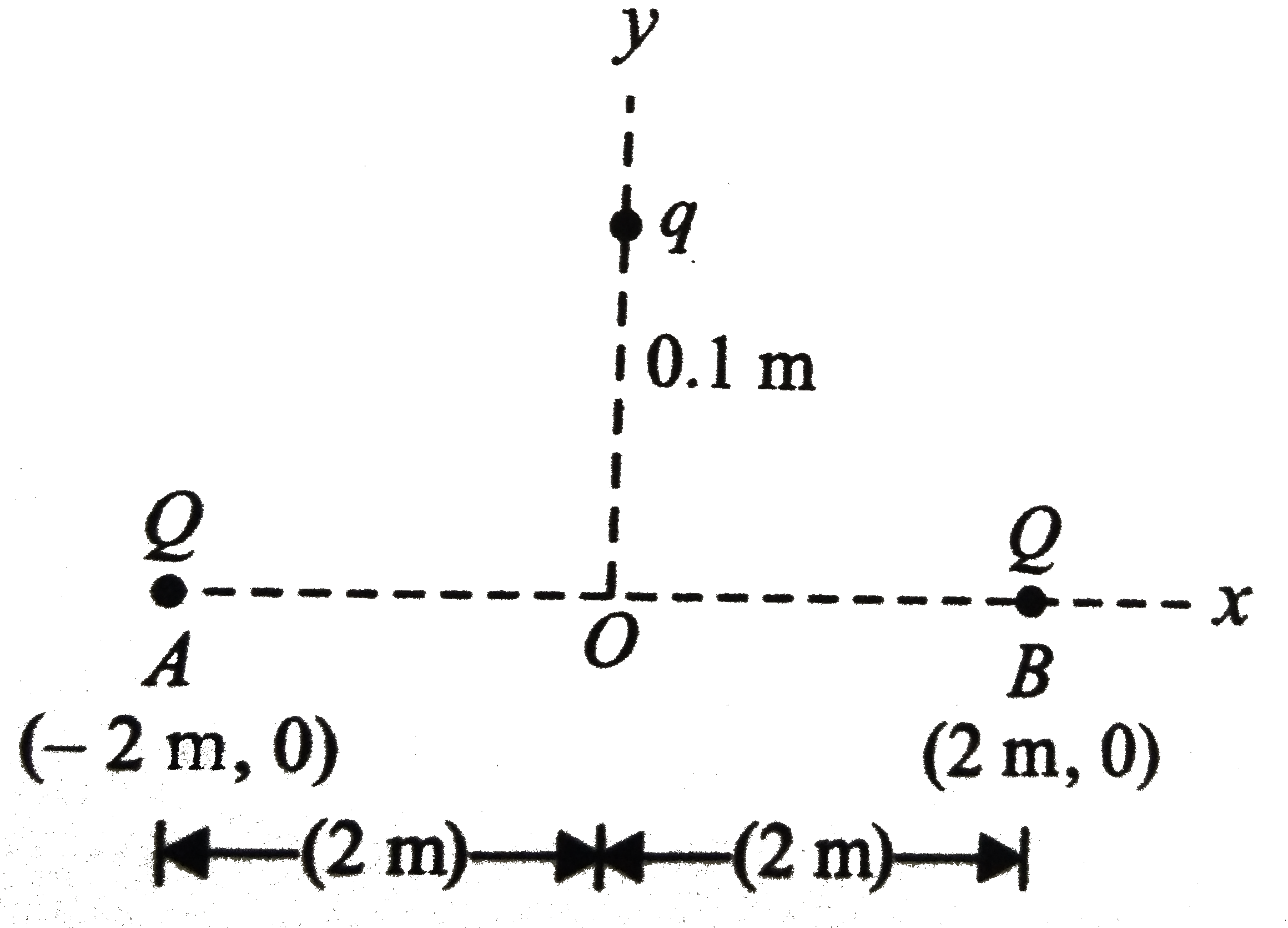 Force applied by `Q` at `A` on `q` can be resolved into rectangular components: `F omegas theta` and `F sin theta`. Similarly, force applied by `Q` at `B` on `q` can be resolved into components: `F cos theta` and `F sin theta. F sin theta` components of the two forces BALANCE each other so that the net force on `q` is `2F cos theta` toward `O`. Therefore, net force on q. `F_(n)=2(1)/(4piepsilon_(0))(Qq)/(y^(2)+a^(2))costheta` `F_(n)=(1)/(4piepsilon_(0))(2Qq)/(y^(2)+a^(2))(y)/((y^(2)+a^(2))^(1//2))=(1)/(4piepsilon_(0))(2Qqy)/((y^(2)+a^(2))^(3//2))`..(i) for `y lt lt a` net force on q, `F_(n)=(1)/(4piepsilon_(0))(2Qqy)/(a^(3))` ..(ii) Here `Q=8muC=8xx10^(-6)C` At `t=0`, q is at `y=0.1` m obviously `ylta(=2m)` since the motion is simple harmonic we can use the approximation `ylt le a` so initially i.e, at `y=0` m force on q is `9xx10^(-3)` N Units Eq. (i) we get or `9xx10^(-3)=(9xx10^(9))(2(8xx10^(-6))q(0.1))/((2)^(3))` or `q=5xx10^(-6)C=5muC` this, in fact, is the magnitude of q. We know that q, as explained earlier is a negative charge hence `q=-5muC` So correct option is (c). At `t=0` q is released at a piont 0.1 m from O on y-axis as it oscillates its other extreme position will be 0.1 m from O on the netative y-axis assuming undamped simple harmonic motion. Hence amplitude of oscillation is 0.1 m or 10 cm so correct option is (a). from fig we get `F_(n)=(1)/(4piepsilon_(0))(2Qqy)/(a^(3))=ky` ltbr where `k=(1)/(4piepsilon_(0))(2Qq)/(a^(3))` Thus, `F_(n)propy` we also know that `F_(n)` always acts towards O (mean position) time period of resulting SHM will be `T=2pisqrt(m//k)` of frequency is `(1)/(2pi)sqrt(k//m)` `f=(1)/(2pi)sqrt((1)/(4piepsilon_(0))(2Qq)/(ma^(3)))` `=(1)/((2xx3.14))sqrt((9xx10^(9))((2)(8xx10^(-6))(5xx10^(-6)))/((91xx10^(-6))(2)^(3)))=5` `[m=91mg=91xx10^(-6)kg]` thus the correct option is (c). In SHM, equation of displacement from mean position can be expressed as `y=asin(omegat+phi)` here `a=0.1mu,omega=2pif=2pixx5=10pi`, `y=0.1sin(10pit+phi)` but at `t=0,y=0.1` Hence `0.1=0.1sinphi` or `sinphi=1` or `phi=(pi)/(2),y=0.1sin(10pit+pi//2)` thus the correct option is (b). 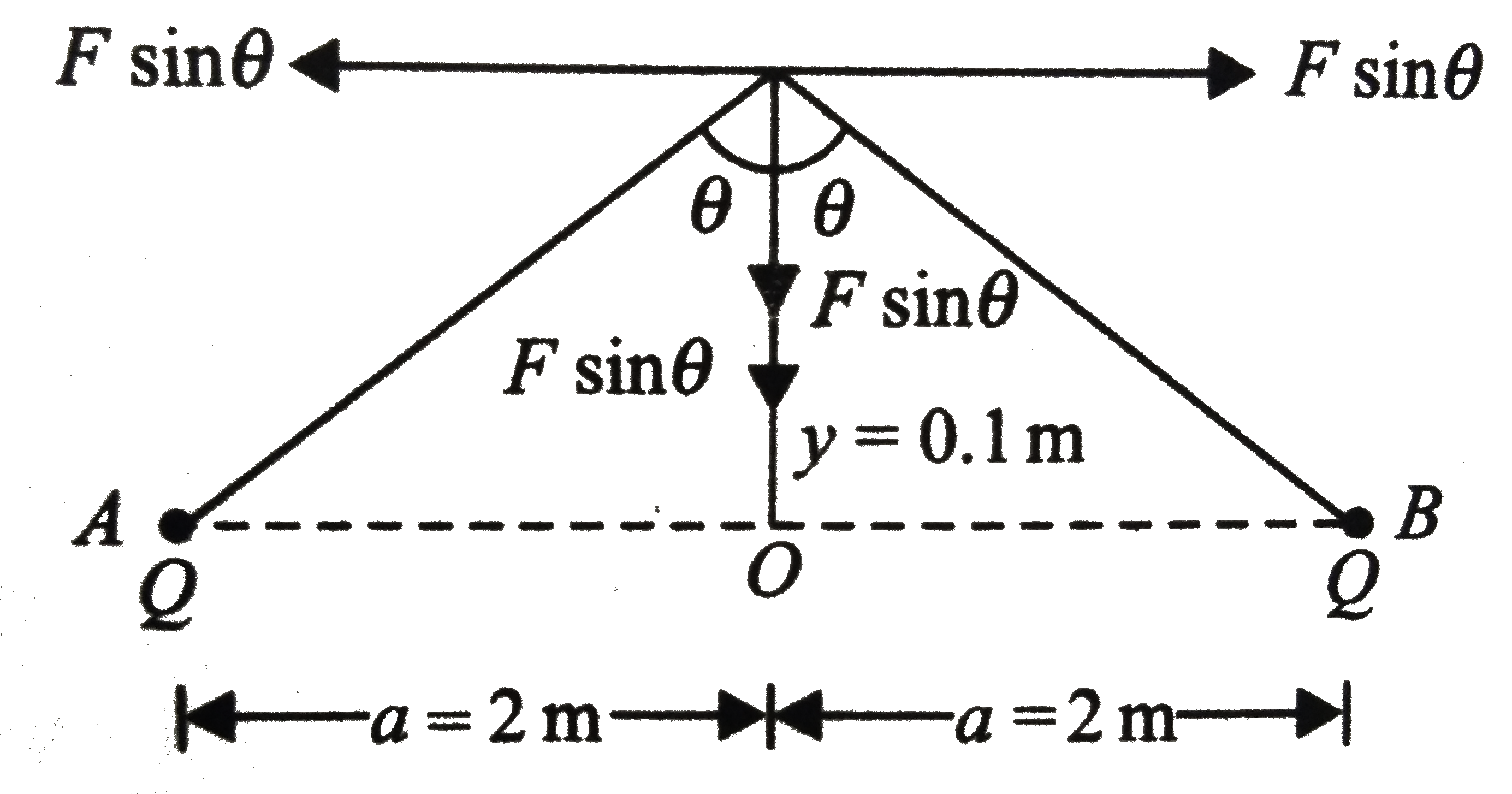
|
|
| 19. |
Consider a system of two equal points charges, each Q = 8 muC, which are fixedat points (2m, 0 ) and (-2m, 0). Another charge mu is held at a point (0,0.1m) on the y-axis. Mass of the charge mu is 91 mg . At t= 0 , mu is released from rest and it is observed to oscillate along y-axis in a simple harmonic manner. It is also observed that at t = 0 , the force experienced by it is9 xx 10^(-3)N. Amplitude of motion is |
|
Answer» `10 cm` `F=(1)/(4piepsilon_(0))(Qq)/(Y^(2)+a^(2))` Force applied by `Q` at `A` on `q` can be resolved into rectangular components: `F omegas theta` and `F sin theta`. Similarly, force applied by `Q` at `B` on `q` can be resolved into components: `F cos theta` and `F sin theta. F sin theta` components of the two forces balance each other so that the net force on `q` is `2F cos theta` toward `O`. Therefore, net force on q. `F_(N)=2(1)/(4piepsilon_(0))(Qq)/(y^(2)+a^(2))costheta` `F_(n)=(1)/(4piepsilon_(0))(2Qq)/(y^(2)+a^(2))(y)/((y^(2)+a^(2))^(1//2))=(1)/(4piepsilon_(0))(2Qqy)/((y^(2)+a^(2))^(3//2))`..(i) for `y lt lt a` net force on q, `F_(n)=(1)/(4piepsilon_(0))(2Qqy)/(a^(3))` ..(ii) Here `Q=8muC=8xx10^(-6)C` At `t=0`, q is at `y=0.1` m obviously `ylta(=2m)` since the motion is simple harmonic we can use the approximation `ylt le a` so initially i.e, at `y=0` m force on q is `9xx10^(-3)` N UNITS Eq. (i) we get or `9xx10^(-3)=(9xx10^(9))(2(8xx10^(-6))q(0.1))/((2)^(3))` or `q=5xx10^(-6)C=5muC` this, in fact, is the magnitude of q. We know that q, as explained earlier is a negative charge hence `q=-5muC` So correct option is (c). At `t=0` q is released at a piont 0.1 m from O on y-axis as it oscillates its other extreme position will be 0.1 m from O on the netative y-axis assuming undamped simple harmonic motion. Hence amplitude of oscillation is 0.1 m or 10 cm so correct option is (a). from fig we get `F_(n)=(1)/(4piepsilon_(0))(2Qqy)/(a^(3))=ky` ltbr where `k=(1)/(4piepsilon_(0))(2Qq)/(a^(3))` Thus, `F_(n)propy` we also know that `F_(n)` always acts towards O (mean position) time period of resulting SHM will be `T=2pisqrt(m//k)` of frequency is `(1)/(2pi)sqrt(k//m)` `f=(1)/(2pi)sqrt((1)/(4piepsilon_(0))(2Qq)/(ma^(3)))` `=(1)/((2xx3.14))sqrt((9xx10^(9))((2)(8xx10^(-6))(5xx10^(-6)))/((91xx10^(-6))(2)^(3)))=5` `[m=91mg=91xx10^(-6)kg]` thus the correct option is (c). In SHM, EQUATION of displacement from mean position can be expressed as `y=asin(omegat+phi)` here `a=0.1mu,omega=2pif=2pixx5=10pi`, `y=0.1sin(10pit+phi)` but at `t=0,y=0.1` Hence `0.1=0.1sinphi` or `sinphi=1` or `phi=(pi)/(2),y=0.1sin(10pit+pi//2)` thus the correct option is (b). 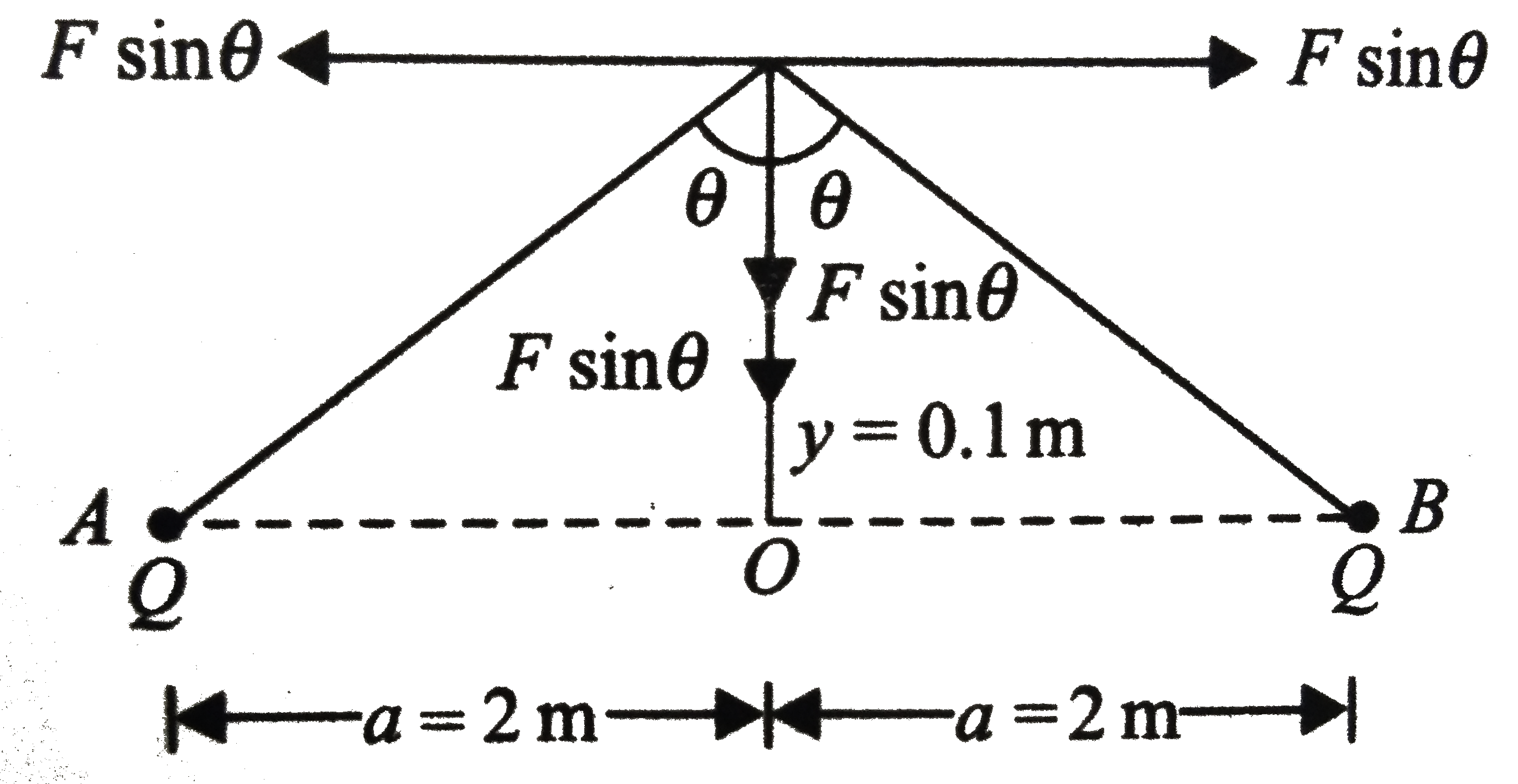
|
|
| 20. |
Consider a system of two equal points charges, each Q = 8 muC, which are fixedat points (2m, 0 ) and (-2m, 0). Another charge mu is held at a point (0,0.1m) on the y-axis. Mass of the charge mu is 91 mg . At t= 0 , mu is released from rest and it is observed to oscillate along y-axis in a simple harmonic manner. It is also observed that at t = 0 , the force experienced by it is9 xx 10^(-3)N. Frequency of oscillation is |
|
Answer» 8 `F=(1)/(4piepsilon_(0))(Qq)/(Y^(2)+a^(2))` Force applied by `Q` at `A` on `q` can be resolved into rectangular components: `F omegas theta` and `F SIN theta`. Similarly, force applied by `Q` at `B` on `q` can be resolved into components: `F cos theta` and `F sin theta. F sin theta` components of the two forces balance each other so that the net force on `q` is `2F cos theta` toward `O`. Therefore, net force on q. `F_(n)=2(1)/(4piepsilon_(0))(Qq)/(y^(2)+a^(2))costheta` `F_(n)=(1)/(4piepsilon_(0))(2Qq)/(y^(2)+a^(2))(y)/((y^(2)+a^(2))^(1//2))=(1)/(4piepsilon_(0))(2Qqy)/((y^(2)+a^(2))^(3//2))`..(i) for `y lt lt a` net force on q, `F_(n)=(1)/(4piepsilon_(0))(2Qqy)/(a^(3))` ..(ii) Here `Q=8muC=8xx10^(-6)C` At `t=0`, q is at `y=0.1` m obviously `ylta(=2m)` since the motion is simple harmonic we can use the approximation `ylt le a` so initially i.e, at `y=0` m force on q is `9xx10^(-3)` N Units Eq. (i) we get or `9xx10^(-3)=(9xx10^(9))(2(8xx10^(-6))q(0.1))/((2)^(3))` or `q=5xx10^(-6)C=5muC` this, in fact, is the magnitude of q. We know that q, as explained earlier is a negative charge hence `q=-5muC` So correct option is (c). At `t=0` q is released at a piont 0.1 m from O on y-axis as it oscillates its other extreme position will be 0.1 m from O on the netative y-axis assuming undamped simple harmonic motion. Hence amplitude of oscillation is 0.1 m or 10 cm so correct option is (a). from fig we get `F_(n)=(1)/(4piepsilon_(0))(2Qqy)/(a^(3))=ky` ltbr where `k=(1)/(4piepsilon_(0))(2Qq)/(a^(3))` Thus, `F_(n)propy` we also know that `F_(n)` always acts towards O (mean position) time period of resulting SHM will be `T=2pisqrt(m//k)` of frequency is `(1)/(2pi)sqrt(k//m)` `f=(1)/(2pi)sqrt((1)/(4piepsilon_(0))(2Qq)/(ma^(3)))` `=(1)/((2xx3.14))sqrt((9xx10^(9))((2)(8xx10^(-6))(5xx10^(-6)))/((91xx10^(-6))(2)^(3)))=5` `[m=91mg=91xx10^(-6)kg]` thus the correct option is (c). In SHM, equation of displacement from mean position can be expressed as `y=asin(omegat+phi)` here `a=0.1mu,omega=2pif=2pixx5=10pi`, `y=0.1sin(10pit+phi)` but at `t=0,y=0.1` Hence `0.1=0.1sinphi` or `sinphi=1` or `phi=(pi)/(2),y=0.1sin(10pit+pi//2)` thus the correct option is (b). 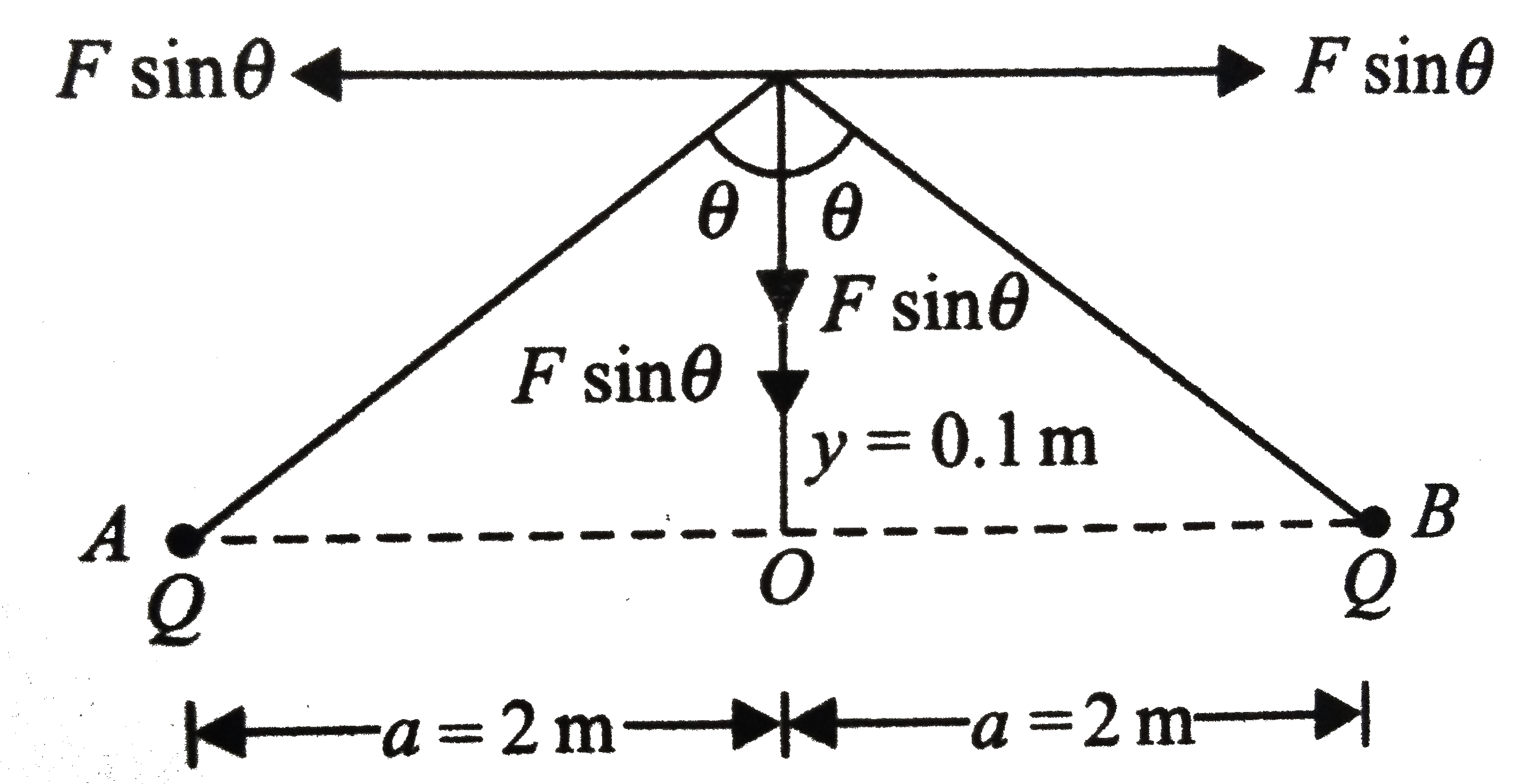
|
|
| 21. |
Consider a system of two equal points charges, each Q = 8 muC, which are fixedat points (2m, 0 ) and (-2m, 0). Another charge mu is held at a point (0,0.1m) on the y-axis. Mass of the charge mu is 91 mg . At t= 0 , mu is released from rest and it is observed to oscillate along y-axis in a simple harmonic manner. It is also observed that at t = 0 , the force experienced by it is9 xx 10^(-3)N. Equation of SHM (displacement from mean position) can be expressed as |
|
Answer» `y = 0.1 sin (10pit)` `F=(1)/(4piepsilon_(0))(Qq)/(Y^(2)+a^(2))` Force applied by `Q` at `A` on `q` can be resolved into rectangular components: `F omegas theta` and `F sin theta`. Similarly, force applied by `Q` at `B` on `q` can be resolved into components: `F cos theta` and `F sin theta. F sin theta` components of the two forces balance each other so that the net force on `q` is `2F cos theta` toward `O`. Therefore, net force on q. `F_(n)=2(1)/(4piepsilon_(0))(Qq)/(y^(2)+a^(2))costheta` `F_(n)=(1)/(4piepsilon_(0))(2Qq)/(y^(2)+a^(2))(y)/((y^(2)+a^(2))^(1//2))=(1)/(4piepsilon_(0))(2Qqy)/((y^(2)+a^(2))^(3//2))`..(i) for `y lt lt a` net force on q, `F_(n)=(1)/(4piepsilon_(0))(2Qqy)/(a^(3))` ..(ii) Here `Q=8muC=8xx10^(-6)C` At `t=0`, q is at `y=0.1` m obviously `ylta(=2M)` since the motion is simple HARMONIC we can use the approximation `ylt le a` so INITIALLY i.e, at `y=0` m force on q is `9xx10^(-3)` N Units Eq. (i) we get or `9xx10^(-3)=(9xx10^(9))(2(8xx10^(-6))q(0.1))/((2)^(3))` or `q=5xx10^(-6)C=5muC` this, in fact, is the magnitude of q. We know that q, as explained earlier is a negative charge hence `q=-5muC` So correct option is (c). At `t=0` q is released at a piont 0.1 m from O on y-axis as it oscillates its other extreme position will be 0.1 m from O on the netative y-axis assuming undamped simple harmonic motion. Hence amplitude of oscillation is 0.1 m or 10 cm so correct option is (a). from fig we get `F_(n)=(1)/(4piepsilon_(0))(2Qqy)/(a^(3))=ky` LTBR where `k=(1)/(4piepsilon_(0))(2Qq)/(a^(3))` Thus, `F_(n)propy` we also know that `F_(n)` always acts towards O (mean position) time period of resulting SHM will be `T=2pisqrt(m//k)` of frequency is `(1)/(2pi)sqrt(k//m)` `f=(1)/(2pi)sqrt((1)/(4piepsilon_(0))(2Qq)/(ma^(3)))` `=(1)/((2xx3.14))sqrt((9xx10^(9))((2)(8xx10^(-6))(5xx10^(-6)))/((91xx10^(-6))(2)^(3)))=5` `[m=91mg=91xx10^(-6)kg]` thus the correct option is (c). In SHM, equation of displacement from mean position can be expressed as `y=asin(omegat+phi)` here `a=0.1mu,omega=2pif=2pixx5=10pi`, `y=0.1sin(10pit+phi)` but at `t=0,y=0.1` Hence `0.1=0.1sinphi` or `sinphi=1` or `phi=(pi)/(2),y=0.1sin(10pit+pi//2)` thus the correct option is (b). 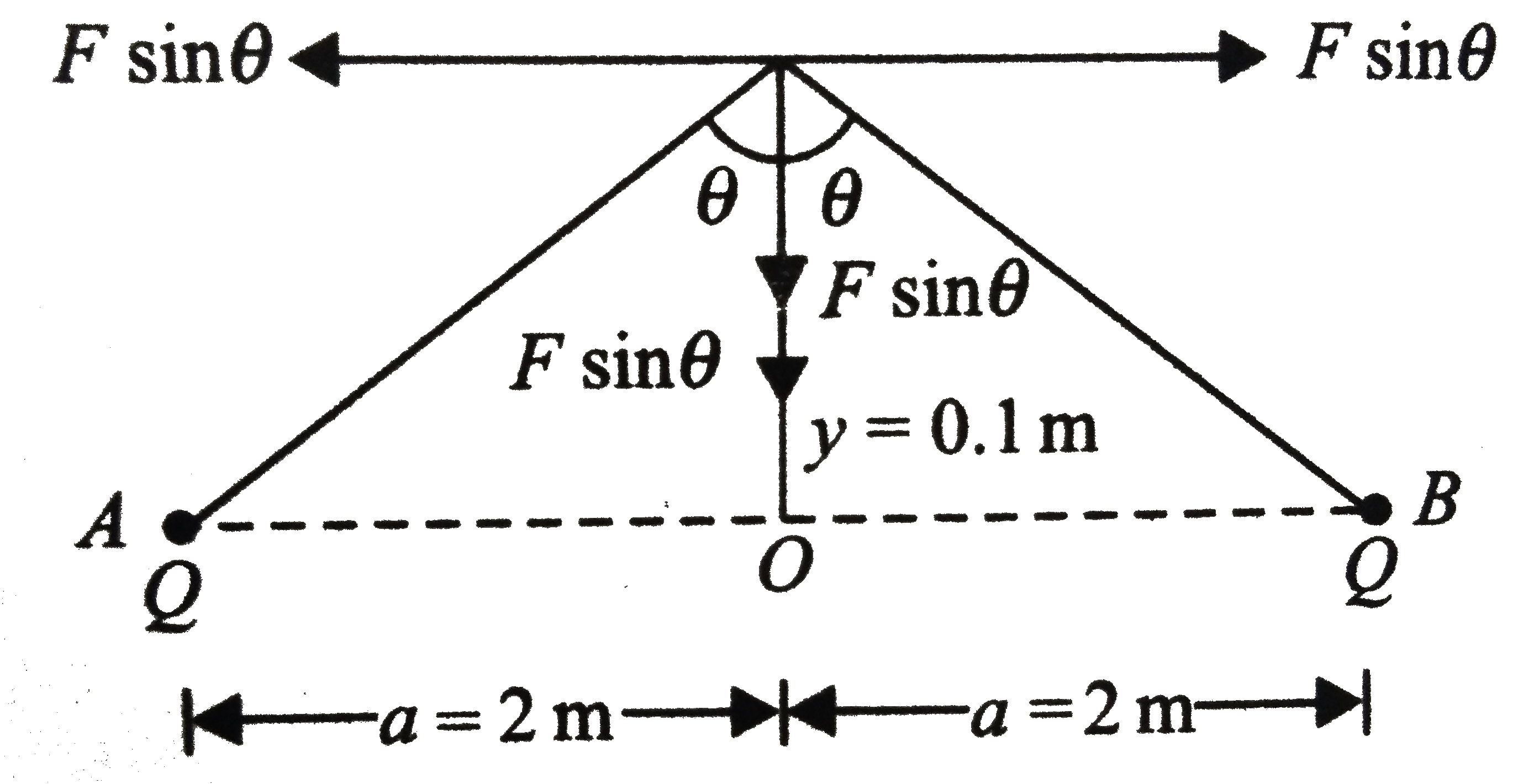
|
|
| 22. |
An eye specialist prescribes having combination of convex lens (f=40cm) in contact with a concave lens (f=25cm). Power of this combination in dioptre is |
|
Answer» `+1.5` |
|
| 23. |
A galvanometer of resistance 40 Omega can measure a current of 2mA for full scale deflection. It is converted into an ammeter having range 6 times the previous value by using proper shunt. Find the resistance of ammeter so formed ? |
| Answer» SOLUTION :`20/3 OMEGA` | |
| 24. |
Match the following: Distance of centre of mass (in m) of the body (shown in column-1) from the axis (shown in column-2) |
|
Answer» <P>(I)(i)(Q) |
|
| 25. |
A ray of light travelling in glass having refractive index mu_g= 3/2, is incident at a critical angle Con the glass- air interface. If a thin layer of water is poured on glass air interface, then what will be the angle of emergence of this ray in air when it emerges from water-air interface ? |
| Answer» ANSWER :C | |
| 26. |
A: If a clock based on simple pendulum is taken to hill it will become slower. R: With increase of height above surface of earth g decreases so T will increase. |
|
Answer» If both ASSERTION & Reason are true and the reason is the correct explanation of the assertion, then mark (1) |
|
| 27. |
There are materials which absorb photons of shorter wavelength and emit photons of longer wavelength .Can there be stable substances which absorb photons of larger wavelength and emit light of shorter wavelength. |
| Answer» SOLUTION :No.in practice ,such STABLE substances can not be obtained because for the PURPOSE metioned in the statement these substances will have to supply energy to the PHOTONS continuously on their own which is not possible for their stable existence. | |
| 28. |
If 3 xx 10^(-9) kg of radioactive ""_(79)Au^(200) has an activity 58.9 Ci, then half life period of Au^(200) is: |
|
Answer» `2.88 xx 10^(2)SEC` `=9.03 xx 10^(15)"atoms"` `R=58.9Ci=58.9 xx 3.7 xx 10^(10)dps` `=21.8 xx 10^(12)dps` Now `R=LAMBDA N and T=(0.693)/(lambda)` `lambda=R/N=(2.18 xx 10^(12))/(9.03 xx 10^(15))=2.41 x 10^(-4) sec^(-1)` and `T=(0.693)/(lambda)=(0.693)/(2.41 xx 10^(-4))=2.88 xx 10^(3)"sec"`. |
|
| 29. |
(a) Solve the above question for part (ii). (b) Solve the above question for part (iii). |
|
Answer» SOLUTION :(a) `B_(1)S, (B) `B_(2)S` |
|
| 30. |
A spgherical shell of radius 'R' and uniformly charged with charge 'Q' is rotating about its axis with frequency 'f' . Find the magnetic moment of the sphere. |
|
Answer» |
|
| 31. |
How will you define the unit of inductance ? |
|
Answer» Solution :i. The inductance of the coil is said to be one henry if a current of 1 A produces unit FLUX LINKAGE in the coil. ii. If `(di)/(dt)=1As^(-1)andepsilon=-" then "L=1H.` III. THEREFORE, the inductance of the coil is one henry if a current CHANGING at the rate of 1 `As^(-1)` induces an opposing emf of 1 V in it. |
|
| 32. |
Find the first three energy levels, using the data of the previous problem. |
|
Answer» |
|
| 33. |
Relative permeability of a material mu_r = 400. Identify the nature of the magnetic material. |
| Answer» SOLUTION :The MATERIAL is a FERROMAGNETIC material. | |
| 34. |
Convert the unit of work done from MKS system to CGS system u |
|
Answer» Solution :DIMENSIONAL formula of ENERGY is `M^(1)L^(2)T^(-2)` . LET U = n ergs `implies n = J`/ergs `:. n_(2)=n_(1)[(M_(1))/(M_(2))]^(1)[(L_(1))/(L_(2))]^(1)[(T_(1))/(T_(2))]^(-2)` `implies n = [(1 kg)/(1g)][(1m)/(1 cm)]^(1)[(1s)/(1s)]^(-2)((n^(2))/(n_(1))=n)` `impliesn=[(1000g)/(1g)][(100cm)/(1cm)]^(2)[(1s)/(1s)]^(-2)` `implies n = [1000]xx[100]^(2)xx[1]^(2)=10^(7)` `:. ` 1 JOULE `= 10^(7)` ergs |
|
| 35. |
Determine the equivalent resistance between point A and B in Omega, considering that connecting wires have no resistance |
Answer» 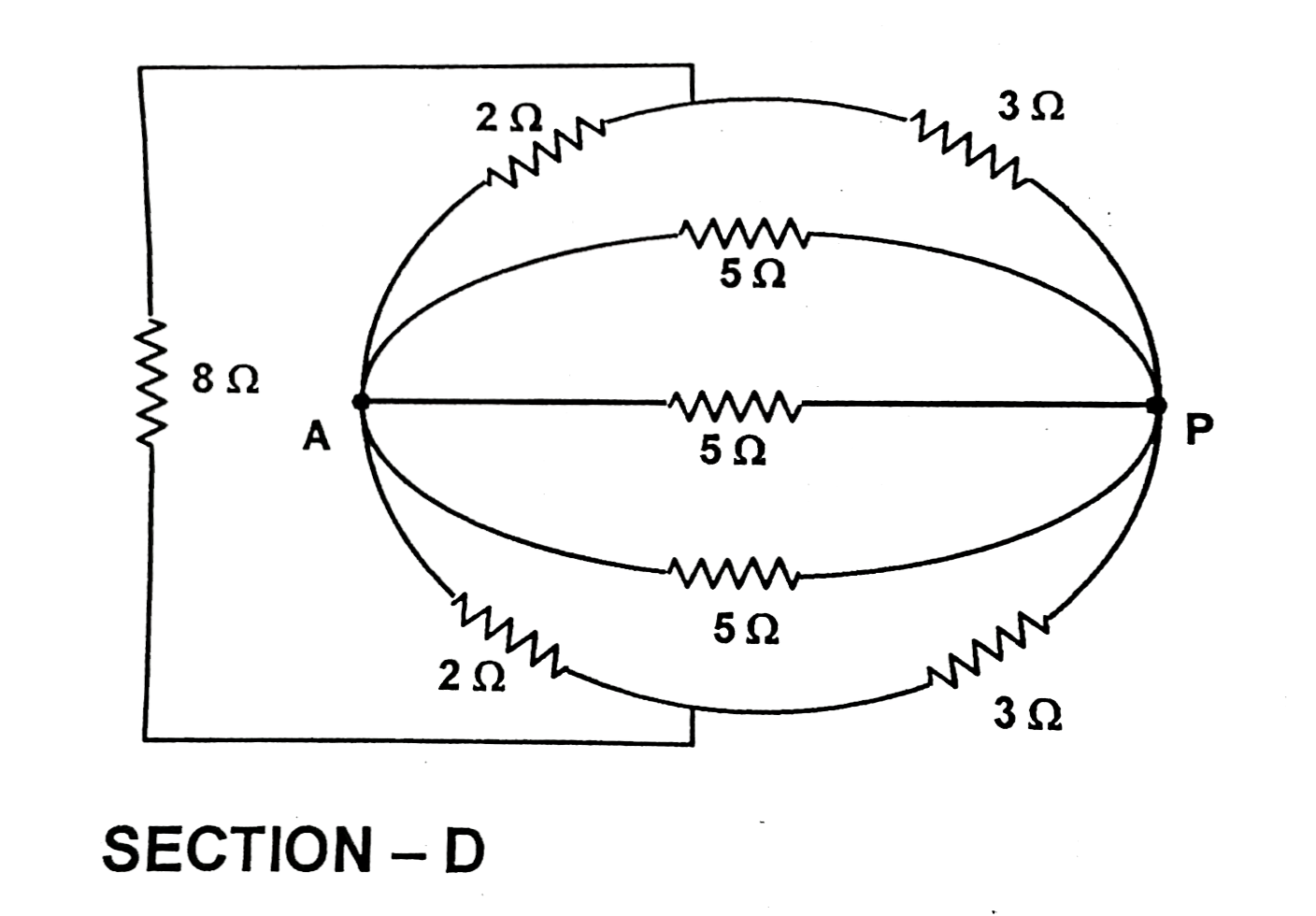
|
|
| 36. |
A toroid has a core (non-ferromagnetic) of inner radius 25 cm and outer radius 26 cm, around which 3500 turns of a wire are wound. If the current in the wire is 11 A, what is the magnetic fields, outside the toroid, inside the core of the toroid and in the empty space surrounded by the toroid are |
|
Answer» `0,3xx 10^(-2) T ,0` |
|
| 37. |
Orbits of a particle moving in a clrcle are such that the perimeter of the orbit equals an integer number of de-Broglie wavelengths of the particle. For a charged particle moving in a plane perpendicular to a magnetic field. The radius of the n^(th) orbital will therefore be proportional to |
| Answer» ANSWER :D | |
| 38. |
The magnetic susceptibility of a material of a rod is 299. The permeability of the material of the rod is (mu_0=4pixx10^(-7) H m^(-1)) |
|
Answer» `3771xx10^(-5) H m^(-1)` `mu=mu_0(1+chi)` Here , `mu_0=4pixx10^(-7) H m^(-1) , chi`= 299 `THEREFORE mu=4pi xx 10^(-7) H m^(-1) (1+299)` `=4xx22/7xx10^(-7) xx 300 H m^(-1) = 3771xx10^(-7) H m^(-1)` |
|
| 39. |
By which velocity a ball is projected vertically so that the distance covered by it in 5th second is twice the distance it covers in the 6th second |
|
Answer» `58.8m/s` |
|
| 40. |
How does the electrostatic force between two point charges change, when a dielectric medium is introduced between them ? |
| Answer» SOLUTION :DECREASES | |
| 41. |
We call the range of energies associated with valence electrons as ? |
|
Answer» |
|
| 42. |
In an electromagnetic wave travelling in air, the amplitudes E_(0) and B_(0) of the electric and magnetic fields are related as (here c is the speed of the wave in air) : |
|
Answer» `E_(0)=cB_(0)` |
|
| 43. |
The intensity of an electric field depends only on the coordinates x and y as follow vec(E)=(a(xhat(i)+yhat(j)))/(x^(2)+y^(2)) where a is a constant and hat(i) and hat(j) are the unit vectors of the x and y-axes. Find the charge within a sphere of radius R with the centre at the origin |
|
Answer» `4 pi epsilon_(0)aR` |
|
| 44. |
A: A metallic shield in the form of a hollow shell may be built to block an electric field. R: In a hollow spherical shield, the electric field inside it is zero at every point. |
|
Answer» Both .A. and .R. are TRUE and .R. is the CORRECT explanation of .A. |
|
| 45. |
A dipole is palced parallelto the electricfieldif W is the workdone in rotating the dipoleby 60^(@)then workdonein rotating it by 180^(@)is |
| Answer» ANSWER :C | |
| 46. |
In the previous question, the percentage of power transmitted to the heavier string through the joint is approximately |
|
Answer» 0.33 |
|
| 47. |
A thin convex lens made of material with refractive index 1.23 is placed in a medium with refractive index 1.56. What will be the nature of the lens now, converging or diverging ? |
| Answer» Solution :As the lens is now SURROUNDED by a denser medium, the light FALLING on it will be DIVERGED. Thus, the lens will act as a DIVERGING lens. | |
| 48. |
When a ray is refracted from one medium to another, the wavelength changes from 6000 Å to 4000 Å. The critical angle for the interface will be |
|
Answer» `COS^(-1) (2/3)` |
|
| 49. |
Calculate the energy in fusion reaction: ""_(1)H^(2) + ""_(1)H^(2) to ""_(2)He^(3) + ""_(0)n^(1), where B.E. Of ""_(1)H^(2) = 2.23 MeV and ""_(2)He^(3) = 7.73 MeV. |
|
Answer» SOLUTION :INITIAL binding energy `BE_1 = (2.23 + 2.23) = 4.46 MEV` Final binding energy `BE_2 = 7.73 MeV` Energy released = (7.73 – 4.46) MeV= 3.27 MeV |
|