

Saved Bookmarks
This section includes 7 InterviewSolutions, each offering curated multiple-choice questions to sharpen your Current Affairs knowledge and support exam preparation. Choose a topic below to get started.
| 1. |
Ohm's law is applicable to |
|
Answer» Diode |
|
| 2. |
A : Newton.s rings are formed in the reflected system when the space between the lends and the glass plate is filled with a liquid of refractive index grater than that of glass, the central spot of the pattern is bright. R : This because the reflection in these cases will be from a denser to a rarer medium and the two interfering rays are reflected under similar conditions. |
|
Answer» Both A and R are true and R is the CORRECT EXPLANATION of A |
|
| 3. |
a large solid sphere with uniformly distributed positive charge has a smooth narrow tunnel through its centre. A small particle with negative charge, initially at far from the sphere, approaches it along the line of the tunnel, reaches its surface with a speed u, and pass through the tunnel . Its speed at the centre ofthe sphere will be : |
| Answer» ANSWER :D | |
| 4. |
The range for a projectile that lands at the same elevation from which it is fired is given by R = (u^(2)//g) sin 2theta. Assume that the angle of projection = 30^(@). If the initial speed of projection is increased by 1%, while the angle of projection is decreased by 2% then the range changes by |
|
Answer» `-0.3%` |
|
| 5. |
A convex lens is immersed in a liquid, whose refractive index is equal to the refractive index of the material of the lens. Then its focal length will |
|
Answer» become zero `(1)/(f_L)=((n_g)/(n_L)-1)((1)/(R_1)-(1)/(R_2))` `n_g=n_L` `therefore (1)/(f_L)=(1-1)((1)/(R_1)-(1)/(R_2))` `therefore (1)/(f_L)=0` `therefore f_L`=Infinite |
|
| 6. |
The radiation corresponding to 3to2 transition of hydrogen atom falls on a metal surface to produce photoelectrons. These electrons are made to enter a magnetic field of 3xx10^(-4)T. If the radius of the largest circular path followed by these electrons is 10.0 mm, the work function of the metal is close to : |
|
Answer» 1.6 eV `(r^(2)e^(2)B^(2))/(2M)=(mv^(2))/(2)` Now `hv=phi+1//2 mv^(2)` `1.89=phi+1//2 mv^(2)` `:.1.89-phi=(r^(2)e^(2)B^(2))/(2m) (1)/(e) eV=(r^(2)e^(2))/(2m) eV` `=(100xx10^(-6)xx1.6xx10^(-19)xx9xx10^(-8))/(2xx9.1xx10^(-31))` Work function `phi=1.89-(1.6xx9)/(2xx9.1)` `=1.89-0.79~=eV` |
|
| 7. |
There is an electric field along x-directionmagnitudeof that electric field increases uniformly along the positive X-direction, at the rat of 10^(4)NC^(-1) per metre. Find the force and torque experimenced by a system having a total dipole moment equal to 10^(-6) cm in the negative X-direction. |
|
Answer» Solution :`dF=F_(1)~F_(2)=qE_(1)~qE_(2)` `=10^(4)xx10^(-6)` `=10^(-2)N` DIRECTION of this force is along negative X-direction. Here no TORQUE acts on the system as `barP//barE` (since `bartau=barPxxbarE`) |
|
| 8. |
A particle thrown vertically upwards has velocity 10 ms^(-1) at half of its height, then maximum height attained by it is : |
|
Answer» Solution :Let u be the initial velcoity Max. height,h=`(u^(2))/(2g)` Applying `v^(2)-u^(2)=2as` Here v=10 `ms^(-1)` and `S=(h)/(2)` `100-u^(2)=-2g(h)/(2)` `100-u^(2)= -3G(h)/(2)` `100-u^(2)= -g xx(u^(2))/(2g)` or `u^(2) =200` `u=sqrt(200)` `:. h=(200)/(20)=10 m` |
|
| 9. |
A fireman wants to slide down a rope. The breaking load for the rope is 3/4th of the weight of the man. With what minimum acceleration sholud the fireman slide down? Acceleration due to gravity is g. |
|
Answer» ZERO |
|
| 10. |
A rocket burns 0.2 kg of fuel per second and ejects it as a gas with velocity of 10 km/s. Calculate the force exerted by the ejected gas on the rocket. |
|
Answer» 1000 N |
|
| 11. |
In Fig.A and B are identical radiators of waves that are in phase and of the same wavelength lambda.The radiators are rotated by distance in lambda, d = 3.00 lambda.The greatest distance from A, along the x - axis, for which fully destructive interference occurs is : . |
|
Answer» `8.75 LAMBDA` SQUARING, we get `x^(2) + d^(2) = (x + (lambda)/(2))^(2)` Now `d = 3 lambda` Solving, `x = 8.875 lambda`. 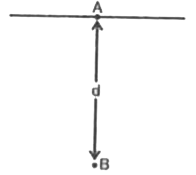
|
|
| 12. |
Five kingdom system of classification suggested by R.H. Whittaker is not based o |
|
Answer» Complexity of BODY organization |
|
| 13. |
Give an example of interference of light in our daily life situation. |
| Answer» SOLUTION :Colours of thin film - BEAUTIFUL colours PRODUCED by a film of oil on the surface of water. | |
| 14. |
The electric flux through a Gaussian surface that encloses three charges given by q_(1) = -14nC, q_(2) = 78.85 nC, q_(3)= -56nC |
|
Answer» `10^(3) NM^(2) C^(-1)` |
|
| 15. |
Stationary waves are |
|
Answer» S.H.M. waves |
|
| 16. |
A plane mirror is placed 22.5 cm in front of a concave mirror of focal length 10 cm. Find where an obiect a can be placed between the two mirrors, so that the first image in both the mirrors coincides. |
|
Answer» 15 cm from the CONCAVE MIRROR |
|
| 17. |
The forward biased diode connection is |
|
Answer»
|
|
| 18. |
A potential barrier of 0.3V exists across a P-N junction (a) If the depletion region is 1 mum wide, what is the intensity of electric field in this region ? (b) An electron with speed 5xx 10^(5) m/s approaches this P-N junction from N-side, what will be its speed on entering the P-side ? |
| Answer» SOLUTION :(a)`3XX10^(5)`V/. ,(B)`3.8xx10^(5)` m/s | |
| 19. |
Define the term 'activity' of a radionuclide. Write its SI unit. |
| Answer» Solution :Activity of a radionuclide is defined as the RATE of DECAY (activity `R=-(dN)/(dt)`) of the given SAMPLE. Its SI unit is a BECQUEREL (1 Bq) or 1 disintegration per SECOND. | |
| 20. |
In an electromagnetic wave, the electric and magnetising fields are 100 V // m and 0.265 A // m. The maximum energy flow is : |
|
Answer» `26.5 W // m^(2)` |
|
| 21. |
There is a glass (mu=1.5) biconvex lens of radius of curvature 5 cm and thickness of the lens is also 5 cm. An object is placed at a distance 20 cm from the front surface of lens. Locate its final image. |
|
Answer» Solution :Since lens is thick so we cannot use lens formula. We can use refraction formula to locate the final image. Refraction formula is given as FOLLOWS : `(mu_(2))/(v)-(mu_(1))/(u)=(mu_(2)-mu_(1))/(R )` 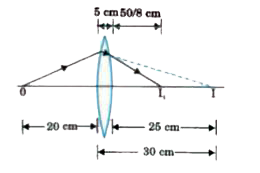 But note that there are two refractions which are taking place here. First refraction is from AIR into glass into air to form the final image. Image of the first refraction will act as object for the second refraction but only after the adjustment of thickness of lens. Let us apply formula for the first refraction. `(1.5)/(v)-(1)/((-20))=(1.5-1)/(+5)` `rArr""(1.5)/(v)+(1)/(20)=(1)/(10)` `rArr""(1.5)/(v)=(1)/(10)-(1)/(20)=(1)/(20)` `rArr""v=30cm` So real image is formed on the other side of surface at a DISTANCE 30 cm from it. Next surface of lens is 5 cm ahead. Hence, the first image is formed at a distance 25 cm ahead of second surface. So for the second refraction this image is one virtual object kept at a distance 25 cm from it. Distance of the virtual object as per sign convention is positive. `u=+25cm`. `(mu_(2))/(v)-(mu_(1))/(u)=(mu_(2)-mu_(1))/(R )` `rArr""(1)/(v)-(1.5)/(+25)=(1-1.5)/(-5)` `rArr""(1)/(v)=(3)/(50)+(1)/(10)` `rArr""(1)/(v)=(8)/(50)` `rArr""v=(50)/(8)cm=6.25cm` Hence final image is formed at a distance 6.25 cm from the REAR surface of lens. And the image is real. |
|
| 22. |
When a rod moves at a relativistic speed v, its mass |
|
Answer» must incrase by a factor of gamma |
|
| 23. |
In the above questions, if the polarity of E_(2) is reversed, then |
|
Answer» current in both ammeters will FLOW in same direction `I_(2) = (E_(2))/(R_(2))` and `I_(1) = (E_(1) + E_(2))/(R_(1))` for `I_(1) = I_(2), R_(1) gt R_(2)` |
|
| 24. |
Which among the curves shown in figure cannot possibly represent electrostatic field lines ? |
|
Answer» Solution :(a) Figure (a) is wrong because, all electric field lines are not locally perpendicular on the charged surface. (B) Figure (b) is wrong because, electric field lines cannot emanate (START) from negative charge. (c) Figure (c) is CORRECT because, it does satisfy all the properties of electric field lines. (d) Figure (d) is wrong because, electric field lines cannot intersect. (e) Figure (e) is wrong because, electrostatic field lines cannot FORM closed LOOPS and they cannot end up in a finite distance. |
|
| 25. |
Two charges of equal magnitudes and at a distance r apart exerts a force F on each other . If the charges are halved and distance between them is doubled, then the new force acting on each charge is : |
|
Answer» `F/8` |
|
| 26. |
A nucleus of mass M is initially at rest.It absorb neutron having m_(N) rest mass compound nucleus divided in two nucleus of m_(1) and 5 m_(1).If wavelength of nucleus with mass m_(1) is lambda,then wavelength of other nucleus will be….. |
|
Answer» `25 lambda` `THEREFORE vecp_(1)+vecp_(2)=0 therefore vecp_(1)=-vecp_(2)` `therefore` Taking only MAGNITUDE `p_(1)=p_(2)` Taking `lambda_(1)=lambda` `therefore (h)/(lambda_(1))=(h)/(lambda_(2))` `therefore lambda_(2)=lambda_(1)` `therefore lambda_(2)=lambda` |
|
| 27. |
In this problem an object is pulled along a ramp but the object starts and ends at rest and thus has no overall change in its kinetic energy ( that is important). Figure 8-10a shows the situation. A rope pulls a 200 kg sleigh ( which you may know) up a slope at incline angle theta=30^(@), through distance d=20 m. The sleigh and its contents have a total mass of 200 kg. the snowy slope is so slippery that we take it to be frictionless. How much work is done by each force acting on the sleigh ? |
|
Answer» Solution :KEY IDEAS (1) During the motion, the forces are constant in MAGNITUDE and direction and thus we can calculate the work done by each with Eq. 8-7 `(W= Fd cos phi)` in which `phi` is the angle between the FORCE and the displacement. We reach the same result with Eq. 8-8 `(W= vec(F)*vec(d))` in which we take a dot product of the force vector and displacement vector. (2) We can relate the net work done by the forces to the change in kinetic energy energy ( or lack of a change, as here) with the work-kinetic energy theorem of Eq. 8-10 `(DeltaK=W)`. Calculations: The first thing to do with most physics problems INVOLVING forces is to draw a free-body diagram to organize our thoughts. For the sleigh, Fig, 8-10b is our free-body diagram, showing the gravitational force `vec(F)_(g)`, the force `vec(T)` from the rope, and the normal force `vec(F)_(N)` from the slope. Work `W_(N)` by the normal force, Let.s start with this easy calculation. The normal force is perpendicular to the 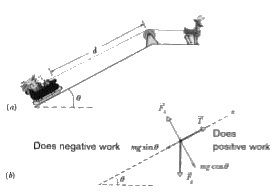 Figure 8-10 (a) A sleigh is pulled up a snowy slope. (b) The freebody diagram for the sleigh. slope and thus also to the sleigh.s displacement. Thus the normal force does not affect the sleigh.s motion and does zero work. To be more formal, we can apply Eq. 8-7 to write `W_(N)=F_(N)d cos 90^(@)=0`. Work `W_(g)` by the gravitational force. We can find the work done by the gravitational force in either of two ways (you pick the more appealing way). From an earlier discussion about ramps (Sample Problem 5.06 and Fig. 5-23), we know that the component of the gravitational force along the slope has magnitude MG `sin theta` and is directed down the slope. Thus the magnitude is `F_(gx)=mg sin theta= (200 kg) (9.8 m//s^(2))sin 30^(@)` `=980N`. The angle `phi` between the displacement and this force component is `180^(@)` . So we can apply Eq. 8-7 to write `W_(g)=F_(gx)d cos 180^(@)=(980N)(20m)(-1)` ` = -1.96xx10^(4)J`. The negative result means that the gravitational force removes energy from the sleigh. The second (equivalent) way to get this result is to use the full gravitational force `vec(F)_(g)` instead of a component. The angle between `vec(F)_(g)` and `vec(d)` is `120^(@)` (add the incline angle `30^(@)` to `90^(@)`). So, Eq. 8-7 gives us `W_(g)=F_(g)d cos 120^(@)=mgd cos 120^(@)` `=(200 kg) (9.8 m//s^(2))(20m)cos 120^(@)` `=1.96xx10^(4)J`. Work `W_(T)` by the rope.s force. We have two ways of calculating this work. The quickest way is to use the work-kinetic energy theorem of Eq. 8-10 `(DeltaK=W)`, where the net work W done by the forces is `W_(N)+W_(g)+W_(T)` and the change `DeltaK` in the kinetic energy is just zero (because the initial and final kinetic energies are the same-namely, zero). So, Eq. 8-10 gives us `0=W_(N)+W_(g)+W_(T)=0-1.96xx10^(4)J+W_(T)` and `W_(T)=1.96xx10^(4)J`. Instead of doing this, we can apply Newton.s second law for motion along the `x` axis to find the magnitude `F_(T)` of the rope.s force. Assuming that the acceleration along the slope is zero (except for the brief starting and stopping), we can write `F_("net. x")= m a_(x)`, `F_(T)-mg sin 30^(@)=m(0)`, to find `F_(T)=mg sin 30^(@)`. This is the magnitude. Because the force and the displacement are both up the slope, the angle between those two vectors is zero. So, we can now write Eq. 8-7 to find the work done by the rope.s force: `W_(T)=F_(T)d cos 0^(@) = (mg sin 30^(@))d cos 0^(@)` `=(200 kg)(9.8 m//s^(@))(sin 30^(@))(20m)cos 0^(@)` `=1.96xx10^(4)J`. |
|
| 28. |
An infinitely long cylinder of radius R is made of an unusual exotic material with refractive index-1 (see figure). The cyliner is palced between two planes whose normals are along the y- direction . The center of the cylinder O lies along the y - axis . A narrow laser beam is directed along the y direction from the lower plate. The laser source is at a horizontal distance x from the diameter in the y - direction. Find the range of x such that light emitted from the lower plane does not reach the upper plane. |
|
Answer» Solution :`rArr` For a material with negative refractive index, from of Snell.s law, is, `- n =(sin theta_i)/(sin theta_r)` `therefore- (-1) = (sin theta_i)/(sin theta_r)` `therefore sin theta_i = sin theta_r` `therefore theta_i = sin theta_r` `rArr` Since two interior angles made bya chord of a circle with its centre are equal, we can write for above figure, `theta_r = theta_r` `rArr` Now, applying Snell.s law at point C, we get `theta._r = theta_e` `rArr` Thus, in magnitudes `theta_i = theta_r= theta._r = theta_e` `rArr` Here, INCIDENT ray `vec(AB)`, first gets deviated by angle `2 theta_i` at first point of incidence B and then again it gets deviated by another angle `2 theta_i` at second point of incidence C. Thus, it undergoes total deviation by angle `4 theta_i` (Here `sin theta_i= sin theta_r)` and so we can consider as if incident light ray undergoes REFLECTION instead of refraction. `rArr` Now, angle `4 theta_i` measured clockwise with RESPECT to Y - axis is such that (in RADIAN), `(pi)/(2) lt 4 theta_i le (3pi)/(2)......(1)` then emergent light does not reach to upper plate. Now, for the right angled `Delta OEB,` since angle `theta_i`is extremely small. `sin theta_i ~~ theta_i = (x)/(R) .....(2)` `rArr` From equation (1), `pi/8 lt theta_i le (3pi)/(8)` `therefore(pi)/(8) lt x/R le (3pi)/(8)` `rArr` Multiplying by R, `(piR)/(8) le x le (3pi R)/(8)` ......(3) `rArr` Above result is required result. |
|
| 29. |
Two long thin parallelconductors of the shapeshown in Fig. carry direct currentsI_(1) and widthof the right-handconductoris equal to b. With bothconductorslying in one plane, find themagnetic interactionforce betweenthem reducedto a unitof their length. |
|
Answer» SOLUTION :We know that Ampere'sforce per unit length on a wireelementin a magnetic field isgiven by `d vec(F_(n)) = I (hat(n) xx hat(B))` where `hat(n)` is the unit vector alongthe directionof current...(1) Now, let us take an element OFTHE conductor`i_(2)` as shwon in the fig. The wireelementis in the magnetic field, PRODUCEDBY the current`i_(1)`which is directednormallyinto the sheetof the paperand itsmagnitudeis given by, `|vec(B)| = (mu_(0) l_(1))/(2pi r)` ....(2) From Eqs. (1) and (2) `d vec(F_(n)) = (I_(2))/(b) dr (hat(n) xx vec(B))`. (BECUASE the currentthroughthe element equals `(l_(2))/(b) dr`) So, `d vec(F_(n)) = (mu_(0))/(2pi) (l_(1) l_(2))/(b) (dr)/(r)`, towardsleft (as `hat(n) _|_^(r) vec(B)`) HENCETHE magnetic force on the conductor: `vec(F_(n)) = (mu_(0))/(2pi) (I_(1) I_(2))/(b) int_(a)^(a + b) (dr)/(r)` (towards left) `= (mu_(0) I_(1) I_(2))/(2pi b) ln (a + b)/(a)` 
|
|
| 30. |
For the transistor circuit shown in Fig., evaluate V_(E), R_, R_(E) given I_(C)=1mA, V_(CE)=3V, V_(BE)=0.5V and V_(C C)=12V, beta=100. |
Answer» Solution :Let the current through the various ARMS be as SHOWN in Fig.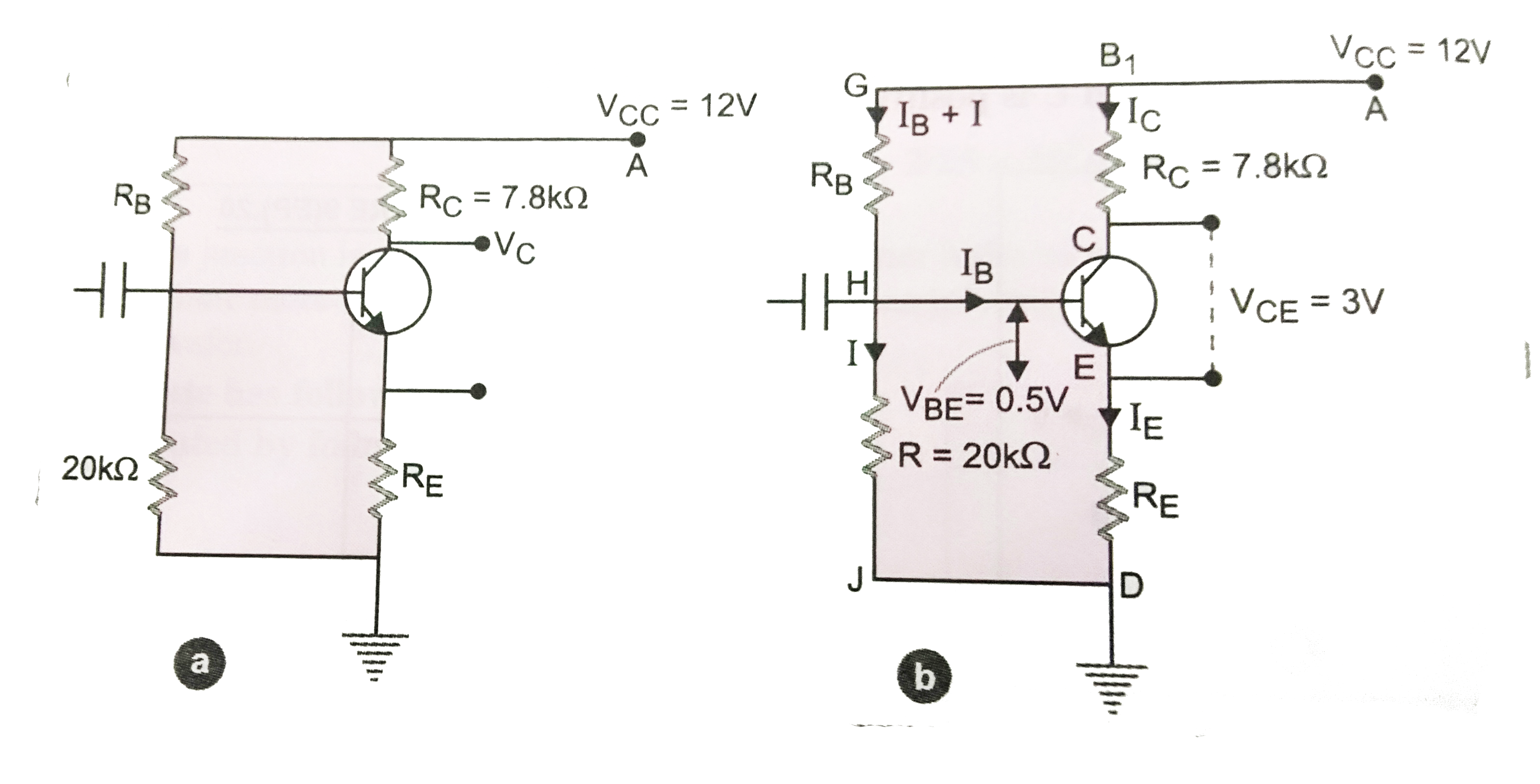 Here, `I_C=1mA=10^(-3)A, V_(CE)=3V, V_(BE)=0.5V, beta=100` `I_B=I_C/beta=10^(-3)/100=10^(-5)A=.01mA` `I_(E)=I_B+I_C=10^(-5)+10^(-3)~~10^(-3)A=I_C` In closed circuit, `AB_(1)CEDA` I_C R_C+V_(CE)+I_(E)R_(E)=V_(C C)` or`I_C R_C+I_C R_(E)=V_(C C)-V_(CE)=12-3=9V[ :' I_(E)=I_C]` or`I_C(R_C+R_(E))=9orR_C+R_(E)=9/10^(-3)=9kOmega` `R_(E)=9kOmega-R_=9kOmega-7.8kOmega=1.2kOmega=1.2xx10^(3)Omega` `V_(E)=I_(E)R_(E)=I_C R_(E)=10^(-3)xx(1.2xx10^(3))=1.2V` Let V= potential difference between H and J, then `V=V_(E)+V_(BE)=1.2+0.5=1.7V` `I=V/R=1.7/(20xx10^(3))A=0.085mA` Now `V_(C C)=(I_B+I)R_B+V` or`R_B=(V_(C C)-V)/(I_B+I)=((12-1.7)V)/((.01+0.085)mA)=(10.3V)/(0.095mA)=108.4kOmega` |
|
| 31. |
What is geostationary satellite ? |
|
Answer» a)`3.08km//s` |
|
| 32. |
If X+1 is a factor of X^2 -3ax +3a-7,then the value of a is- |
|
Answer» -2 |
|
| 33. |
A body of mass 2kg is projected from the ground with a velocity 20ms^(-1) at an angle 30^@ with the vertical. If t_1 is the time in seconds at which the body is projected and t_2 is the time in seconds at which it reaches the ground, the change in momentum in kgms during the time (t_2- t_1) is |
|
Answer» 40 |
|
| 34. |
In the alpha - particle scattering experiment , the shape of the trajectory of the scattered alpha- particles depend upon |
|
Answer» only on impact PARAMETER. |
|
| 35. |
Identify the correct set of monosaccharides present in sucrose (X), lactose (Y) and maltose (Z). |
|
Answer» GLUCOSE,fructosegalactose, glucose glucose,fructose (Y) `to` LACTOSE on hydrolysis gives D- glucose and D- galactose I.e., Lactose `to` D-glucose+ D-galactose (Z) `to` MALTOSE on hydrolysis gives 2 units of glucose i.e., Maltose `to` glucose+ glucose THUS correct option is (b). |
|
| 36. |
A green light is incident from the water to the air water interface at the critical angle (theta). Select the correct statement. |
|
Answer» The entire spectrum of VISIBLE LIGHT will come out of the water at various angles to the normal.  `therefore sin c = (1)/(mu_(W))` mu_(w) = a + (b)/(LAMBDA^(2))` |
|
| 38. |
A wave represented by the equation y=a cos(kx - omegat)is superimposed with another wave to form a stationary wave such that point x=0 is a node. The equation for the other wave is |
|
Answer» `a sin(kx + OMEGA t)` |
|
| 39. |
The electric flux emerging out from 1 C charge is |
|
Answer» `1/(epsi_(0))` [Hint : As per Gauss law electric flux `phi_(E)=Q/(epsi_(0))=1/(epsi_(0))` because q = 1 C] |
|
| 40. |
Relation of amplitude of corelate of electric and magnetic field is …….. |
|
Answer» (A)`E_(0)=B_(0)` Putting `|vec(E )|=E_(0)sin(omega t-kx)` and `|vec(B)|=B_(0)sin(omega t-kx)` `(E_(0))/(B_(0))=c` `therefore E_(0)=cB_(0)` |
|
| 41. |
The velocity of projectile at the point of projection is 2hati + 3hatj m//s. The velocity at a point where the projectile reaches is |
|
Answer» `-2hati+3hatjm//s` |
|
| 42. |
In Germanium impurity donor element have valency: |
|
Answer» 2 |
|
| 43. |
A beam of parallel rays of width b cm propagates in glass at an angle theta to its plane face. What would the beam width b_(1) be after it goes over to air thrugh this face? (The refractive index of the glass is mu) |
|
Answer» `b mu` |
|
| 44. |
A ""^(118)Cd radionuclide goes through the transformation chain. ""^(118)Cd{:(rarr),(30min):}""^(118)In{:(rarr),(45min):}""^(118)Sn (stable) The half lives are written below the respective arrows. At time t= 0 only Cd was present . Find the fraction of nuclei transformed into stable 5^(th) over 60 minutes. |
|
Answer» Solution :`N_(1)=N_(0)e^(-lamda_(1)t)and N_(2)=(N_(0)lamda_1)/(lamda_(2)-lamda_1)(e^(-lamda_(1)t)-e^(-lamda_(2)))` `:.N_(3)=N_(0)-N_(1)-N_2` `N_(0)[1-e^(-lamda_(1)t)-lamda_(1)/(lamda_(2)-lamda_1)(e^(-lamda_(1)t)-e^(-lamda_(2)t))]` `:.N_3/N_0=1-e^(lamda_(1)^(t))-lamda_1/(lamda_(2)-lamda_(1))(e^(-lamda_(1)t)-e^(-lamda_(2)t))` `lamda=(0.693)/30=0.0231"min"^(-1)` `lamda_(2)=(0.693)/45 = 0.0154 "min"^(-1) and t = 60` minutes . On substituting the GIVEN values `N_3/N_0 =0.31 `. |
|
| 45. |
To minimise energy loss due to …………………. and ………………….we take a laminated soft iron core in a transformer. |
| Answer» SOLUTION :HYSTERESIS, EDDY CURRENTS | |
| 46. |
The intensity of a light- beam is 10 Wm^(-2) and it is plane-polarised in vertical direction. It passes through a polaroid whose transmission axis is inclined at angle of 30^(@) with the vertical. The transmitteed light- beam passes through a second polaroid whose transmission-axis is inclined at an angle of 90^(@) with the vertical. (i) What will be the intesity of light emerging from the second polaroid? (ii) If the first polaroid is removed, then? |
|
Answer» |
|
| 47. |
(a)Obtain lens makers formula using the expression n_2/v-n_1/u=((n_2-n_1))/R Here the ray of light propagating from a rarer medium of refractive index (n_1) to a denser medium of refractive index (n_2) is incident on the convex side of sperical refracting surface of radius of curvature R. (b)Draw a ray diagram to show the umage formation by concave mirror when the object is kept between its focus and the pole. Using this diagram, derive the magnification formula for the image formed. |
Answer» Solution :(a)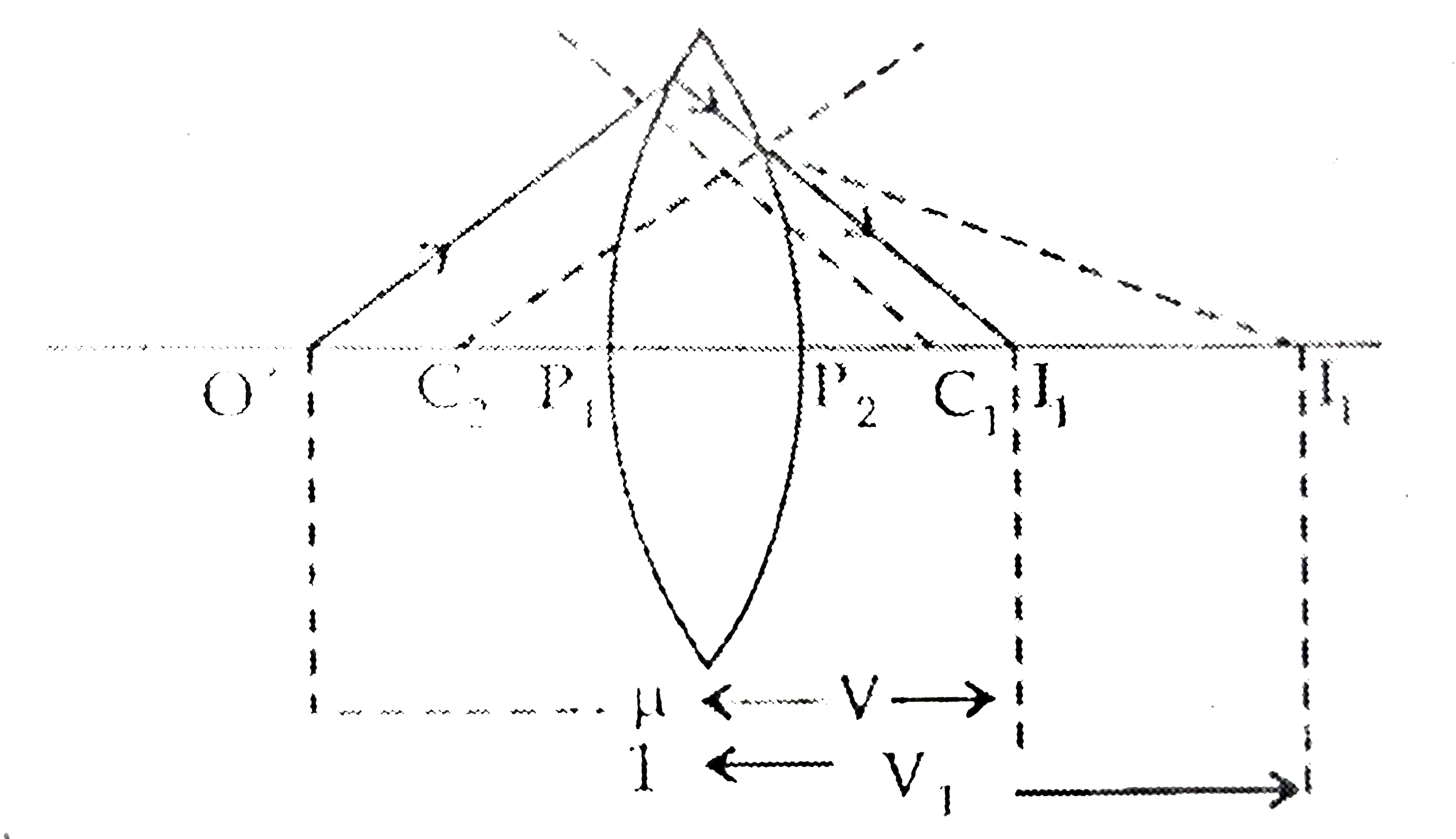 For reaction at the first surface `n_2/v-n_1/mu=((n_2-n_1))/R_1` For the SECOND surface, I, acts as a virtual object (located in the denser medium) whose final real image is formed in the RARER medium at I. So, for refration at this surface is `n_1/V-n_2/v_1=(n_1-n_2)/R_2` FORM above two equations, `1/v=1/mu` `=[n_2/n_1-1][1/R_1=1/R_2]` The point, where image of an object, located at intinity is formed, is CALLED the focus F, of the lens and the DISTANCE f gives its focal length. So, for `mu=prop,v=+f` `1/f[n_2/n_1-1][1/R_1=1/R_2]` (b) 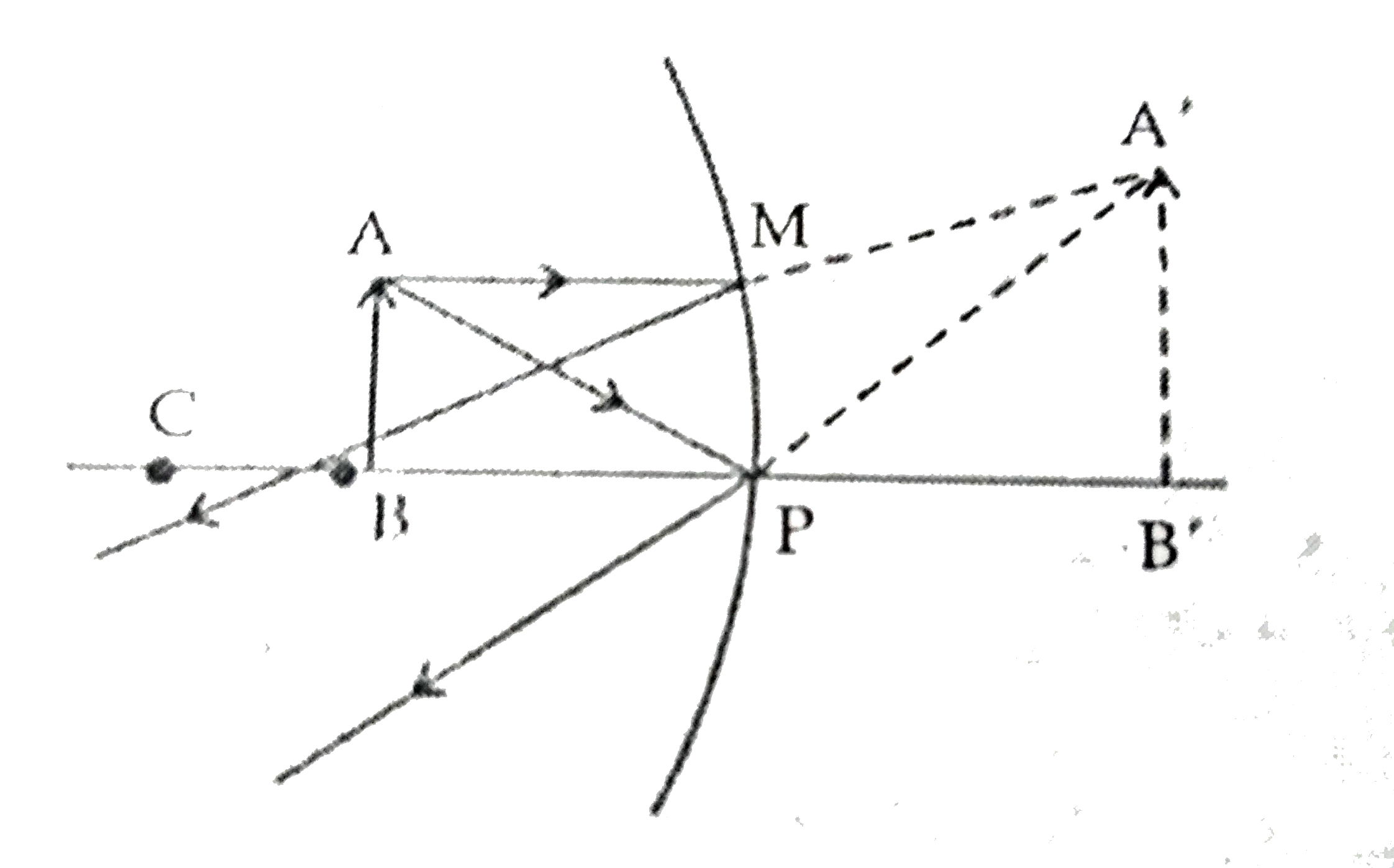 `DeltaABP` is similar to `DeltaA'B'P` So,`(A'B')/(AB)=(B'P)/(BP)` Now,`A'B'=I,AB=O.B'P'=+v` `and BP=-u` So, magnifiction`M=I/O=-v/u`. |
|
| 48. |
The mean energy of a molecule of an ideal gas is |
|
Answer» 2KT `E=(E )/(N)=(3)/(2)KT` |
|
| 49. |
A cyclist is riding with a speed of 28.8 km/h. As he approaches a circular turn on the road of radius 80 m, he applies brakes and reduces his speed at constant tale of 0.6 ms the magniltude of the net acceleration of the cyclist is |
|
Answer» `1MS^(-2)` |
|
| 50. |
A circular coil A has a radius R and current flowing through it is I. Another circular coil B has a radius 2R and if 2I is the current flowing throgh it, then the magneitc field at the centre of the circular coil are in the ratio (i.e, B_A to B_B) of |
|
Answer» `4:1` |
|


