

Saved Bookmarks
This section includes 7 InterviewSolutions, each offering curated multiple-choice questions to sharpen your Current Affairs knowledge and support exam preparation. Choose a topic below to get started.
| 1. |
The diode used in the circuit shown in figure has a constant voltage drop at 0.5 V at all currents and a maximum power rating of 100 mW. What should be the value of the resistance R, connected in series with diode for obtaining maximum current ? |
|
Answer» `200OMEGA` Voltage across RESISTANCE R is `V. = 1.5 -0.5 = 1` VOLT Then , `R = (V.)/I=1/(2xx10^(-1))=5Omega` |
|
| 2. |
An element X with atomic number Z and mass number A is how represented ? |
| Answer» SOLUTION :`Z^(X^A)` | |
| 3. |
Obtain the resonant frequency and Q-factor of a series LCR circuit with L = 3.0 H,C = 27 uF and R= 7.4 Omega. It is desired to improve the sharpness of the resonance of the circuit by reducing its 'full width at half maximum' by a factor of 2. Suggest a suitable way. |
|
Answer» Solution :It is given that `L= 3.0 H, C = 27 muC = 27 xx 10^(-6) F, R= 7.4 OMEGA` Resonant angular frequency of SERIES LCR circuit is `omega_(r) =1/sqrt(LC) = 1/sqrt(3.0 xx 27 xx 10^(-6)) = 111 RAD s^(-1)` and Q-FACTOR `=(omega_(r)L)/R = (111 xx 3.0)/(7.4) = 45` To improve the sharpness by a factor of 2, Q must be doubled. It is obvious that keeping the resonant frequency the same, the value of R be halved from `R = 7.4 Omega` to `3.7 Omega` |
|
| 5. |
What is meant by electromagnetic induction ? |
| Answer» SOLUTION :Whenever the MAGNETIC flux linked with a closed coil CHANGES, an emf (electromotive force) is induced and HENCE an electric current flows in the circuit. | |
| 6. |
A non-conducting ring of radius R having uniformly distributed charge Q starts rotating about x-x' axis passing through diameter with an angular acceleration alpha, as shown in the figure. Another small conducting ring having radius a(altltR) is kept fixed at the centre of bigger ring is such a way that axis xx' is passing through its centre and perpendicular to its plane. If the resistance of small ring is r = 1Omega , find the induced current in it in ampere. (Given q=(16xx10^(2))/(mu_(0))C, R=1m,a=0.1m,alpha="8rad s"^(-2) |
|
Answer» |
|
| 7. |
A small telescope has an objective lens of focal length 150 cm and eyepiece of focal length 5 cm. What is the magnifying power of the telescope for viewing distant object in normal adjustment? If this telescope is used to view a 100 m tall Also tower 3 km away, what is the height of the image of the tower formed by the objective lens? |
|
Answer» Solution :If the telescope is in normal adjustment, i.e., the FINAL image is at infinity. Formula : ` M = (f_o)/(f_e)` since ` f_o = 150 cm , f_e = 5cm` ` therefore M = 150/5 = 30 ` If tall tower is at distance 3 KM from the objective lens of focal length 150 cm. It will form a image at distance `v_o`So, ` (1)/(f_o) = (1)/(v_o) - (1)/(u_o)` ` (1)/(150cm) = (1)/(v_o) - (1)/(-3km)` ` (1)/(v_o) = (1.5 m) - (1)/(3000m)` ` v_o = (3000 XX 1.5 )/(3000 - 1.5)` `= (4500)/(2998.5) = 1.5 m` MAGNIFICATION `m_o =1/O = (h_1)/(h_o) = (v_o)/(u_o)` ` (h_i)/(100m) = (1.5 m)/(3km) = (1.5)/(3000) ` ` h_i= (1.5 xx 100)/(3000) = 1/20 m` ` h_i = 0.05 m. ` |
|
| 8. |
Hertz experimentally proved the existence of e.m. waves. |
|
Answer» It stops ultraviolet rays. |
|
| 9. |
(a) Derive the experience for the forest acting between two long parallel current carrying conductors. Hence , defined 1 A current . (b) A bar magnet of dipole moment 3 A m^2 . rests with its centre on a frictionless pivot. A force F is applied at right angles to the axis of the magnet , 10 cm from the pivot . It is observed that an external magnetic field of 0.25 T is required to hold the magnet in equilibrium at an angle of 30^@with the field. Calculate the value of F. How willthe equilibrium be effected if F is withdrawn? |
|
Answer» Solution :(a) Consider two straight , parallel , long current carrying conductors AB and CD carrying currents `I_1 and I_2`.respectively in same direction and let these be separated by a distance d . Now magnetic field `B_1`developed at a point Q on 2nd conductor due to current `I_1`flowing in Ist conductor is `B_(1)=(mu_0I_1)/(2pid)` As per right hand rule `B_1`is acting to the plane of the PAPER pointing inward . Thus, conductor CD carrying `I_2`is magnetic field which is perpendicular to its LENGTH . Therefore , force experienced by 2nd conductor CD due to `B_1` `F_(21)=B_1I_2l` Where l =length of the 2nd conductor and force per unit length or ` F_(21)=(u_0I_1)/(2pid)I_2l=(mu_0I_1I_2l)/(2pid)` and force per unit length `F_(21)/l=(mu_0I_1I_2)/(2pid)=(mu_0)/(4pi).(2I_1I_2)/d` The force `F_(21)` in accordance with Fleming.s left hand rules is directed towards the conductor AB. In the same way, it is found that force experienced per unit length of wire AB is `(F_(12))/l=(mu_0)/(4pi).(2I_1I_2)/d` and is directed towards CD. If `I_1 =I_2 A`and d = 1, then `F_(12)/rho=(mu_0)/(4pi)xx(2xx1xx1)/1=(mu_0)/(2pi) = 2xx10^(-7)NM^(-1)`. Hence, SI base unit of current i.e. , AMPERE is defined as the value of that steady current which when maintained in each of the two very long straight , parallel conductors of negligible cross-section and placed 1 m apart in vacuum would produce one each of these conductors a force equal to `2xx10^(-7)Nm^(-1)` . (b) Here dipole moment of bar magnet m = 3 A `m^2` , external magnetic field B = 0.25 T , `theta = 30^@` .Let a force F be applied on the magnet at a point P situated at a distance d = 10 cm (or 0.1m) from the centre ( pivot point) O at right angles to the axis of magnet as shown. Since magnet is in equilibrium , net torque acting on the magnet must be zero . Hence `mBsin theta = Fxxd` `impliesF=(mBsin theta)/d=(3xx0.25xxsin30^@)/(0.1)=3.75N` the force F is withdrawn then under the influence of torque `tau=mB sin theta` will oscillate to and from about the its equilibrium position along the magnetic field. 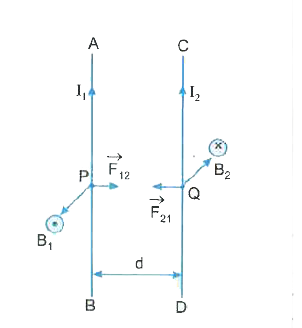 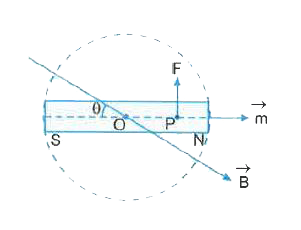
|
|
| 10. |
Assertion :- Due to high inductance of any coil the current attains it peak value relatively late in it . Reason :- Due to self induction , coil opposses the flow of current through it . |
|
Answer» If the Assertion & Reason are True& the Reason is a correct explanation of the Assertion . |
|
| 11. |
Three masses are connected as shown in figure on a horizontal frictionless surface and pulled by a force of 60 N. The tensions T_1 and T_2 are in the ratio |
| Answer» ANSWER :B | |
| 12. |
“बरकान” स्थलाकृति का संबंध हैः |
|
Answer» मरुस्थल से |
|
| 13. |
लूनी नदी कहां बहती है? |
|
Answer» थार मरुस्थल में |
|
| 14. |
A metallic square loop ABCD is moving in its own plane with velocity v in a uniform magnetic field perpendicular to its plane as shown in fig. An electric field is induced |
|
Answer» in AD but not in BC |
|
| 15. |
चाय की उपज के लिए तापमान की आवश्यकता होती है- |
|
Answer» 25° से० से 40° से० |
|
| 16. |
कौन- सा राज्य बाजरा का सबसे बड़ा उत्पादक राज्य है? |
|
Answer» मध्य प्रदेश |
|
| 17. |
Wavelength of laser light can be used as standard of |
| Answer» ANSWER :D | |
| 18. |
A light wave falls normally on the surface of glass coated with a layer of transparent substance. Neglecting secondary reflections, demonstrate that the amplitudes of light waves reflected from the two surfaces of such a laver will be equal under the condition n' = sqrt(n), where n' and n are the refractive indiced of the layer and the glass respectively. |
|
Answer» Solution :Suppose the incident light can be decomposed into waves with intensity `I_(||) & I_(bot)` with oscillations of the electric vectors parallel and perpendicualr to the palne of incidence. For NORMAL incidence we have from Fresnel equations `I'_(bot) = I_(bot) ((theta_(1) - theta_(2))/(theta_(1) + theta))^(2)-rarrI_(bot) ((n - 1)/(n+1))^(2)` where we have used `theta~~ theta` for small `theta`. SImilarly `I'_(||) = I_(||) ((n' - 1)/(n'+1))^(2)` Then the refracted wave will be `I''_(||) = I_(||)(4n')/((n' + 1)^(2))` and`I''_(bot) = I_(bot)(4n')/((n' + 1)^(2))` At the interface with glass `I'''_(bot) = I''_(bot) ((n' - n)/(n' + n))^(2)`, similarly for `I'''_(||)` we see that `(I'_(bot))/(I_(bot)) = (I'''_(bot))/(I''_(bot))` if `n' = sqrt(n)`, similarly for `||` COMPONENT. This shows that the light REFLECTED as a fraction of the incident light is the same on the two SURFACES if `n' = sqrt(n)`. Note:- The statement of the problem given in the book is incorrect. Actual amplitudes are not equal, only the reflectance is equal. 
|
|
| 19. |
Light propogates x cm distance in a medium of refractive index mu in time t_0. In the same time t_0, light propogates a distance of x/6 cm in a medium of refractive index mu’. If mu’= kmu , find the value of k. |
|
Answer» |
|
| 20. |
What is the magnetic induction due to a magnet of pole strength 20A-m and length 20cm at a distance of 0.2m from its centre on the equatorial line? |
| Answer» SOLUTION :`357.8 XX 10^(-7)T` | |
| 21. |
लार ग्रंथि से निकलने वाले रस को क्या कहते है ? |
|
Answer» एंजाइम |
|
| 22. |
A particle is projected from the ground with an initial speed of u at an angle of projection theta. The average velocity of the particle reaches highest point of trajectory is |
Answer» Solution :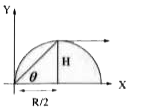 `v_("AVG") =(VECV + vecu)/2 = (u cos thetahati +(u cos thetahati + u SINTHETA))/2` `v_(AV) =v/2sqrt(1+3 cos^(2)theta)` |
|
| 23. |
A steel wire length 20cm and uniform cross sectional area of 1mm2 is tired rigidly at both the ends at 45^@. What will be the change in tension of the wire if the temperature of the wire is decreased to 20^@c . [Y forsteel = 2 xx 10^11 N/m^2. the coefficient of linear expansion for steel= 1.1 xx 10^-5 /(0c)] |
| Answer» SOLUTION :Coefficient of linear expansion`alpha = (Delta)/(L(DeltaT))` There for`(Delta)/(L) = alpha DeltaT-(i)` and `Y = (F. L)/(A Delta L)` (ii) there for F = Y A (Delta L)/(l) = YA alpha Delta T` from (i) F 2 xx 10^11 xx 1 xx 10^-6 xx 1.1 xx 10^-5 xx 25` = 55N. | |
| 24. |
In Thomson's method of determining e/m of cathode rays, magnetic field (B) and electric field ( E) are parallel a parabola is not. Obtained on the screen. The reason is _______ . |
|
Answer» CATHODE rays consist of electrons which carry negative charge |
|
| 25. |
Kamla peddles a stationary bicycle. The pedals of the bicycle are attached to a 200 turn coil of area 0.10 m^2. The coil rotates at half a revolution per second and it is placed in a uniform magnetic field of 0.005 T perpendicular to the axis of rotation of the coil. What is the maximum voltage generated in the coil ? |
|
Answer» |
|
| 26. |
Find the energy and the momentum of an electron occupying the Fermi level in aluminium, in sodium and in copper. |
|
Answer» |
|
| 27. |
What is superposition principle ? |
| Answer» Solution :When TWO waves superpose , TOTAL DISPLACEMENT vectorially add up. | |
| 28. |
Name the charge carriers responsible for conduction of electricity in a metal object semiconductor, electrolytic cell, hydrogen discharge tube and superconductor. |
| Answer» Solution :For a metal object that are free electrons . In case of a semiconductor there are free electrons and HOLES. In electrolytic cell positive and negative ions conduct electricity. A HYDROGEN discharge tube is filled with hydrogen gas as we know that in hydrogen atom the nucleus has one proton and there is one ELECTRON . so in hydrogen discharge tube, current is due to electrons and protons. superconductivity is one peculiar phenomenon at a very low temperature . in this state electron pairs are formed . Electrons start moving in pairs known as cooper pair. so conduction in case of a SUPERCONDUCTOR is through electron pairs or cooper pair. Electro pairs are continuously formed and then broken. it means TWO electrons drift together . but often electrons are exchanged among several pairs. | |
| 29. |
What is an intrinsic semiconductor ? Deduce an expression for its electrical conductivity. |
|
Answer» Solution :INTRINSIC semiconductor is a pure semiconductor . Outer shell of such semiconductors are complete at `0K` and they behave as insulators. At room temperature, due to thermal agitation, a few ELECTRONS are freed creating small HOLES. Thus at room temperature a pure semiconductor will have equal number of free electrons and holes. Electrical conductivity `(sigma)` Consider a block of a semiconductor of length `l` in which the holes and electrons are moving due to ELECTRIC field.  If `n_(e)`, `n_(h)` represent electrons and holes density respectively and `v_(e)`, `v_(h)` their drift velocities, then `I_(e)=en_(e)Av_(e)` and `I_(h)=en_(h)Av_(h)` or total CURRENT, `I=I_(e)+I_(h)=e(n_(e)v_(e)+n_(h)v_(h))A`............`(i)` We know `R=(V)/(I)` and `R=rho(l)/(A)` or `rho(l)/(A)=(V)/(I)` or `rho=(VA)/(Il)=(EA)/(I)` Since `V//l=` Electric intensity `E` Conductivity of semiconductor , `sigma=(1)/(("Resistivity" rho))` or `sigma=(I)/(EA)=(e(n_(e)v_(e)+n_(h)v_(h))A)/(EA)` or `sigma=(e(n_(e)v_(e)+n_(h)v_(h)))/(E)` `=e[n_(e)((v_(e))/(E))+n_(h)((v_(h))/(E))]` `sigma=e[n_(e)mu_(e)+n_(h)+mu_(h)]` where `mu_(e)(=v_(e)//E)` and `mu_(h)(=v_(h)//E)` are called electron and hole mobility respectively. |
|
| 30. |
A hot liquid kept in a breaker cools from 80^(@)C to 70^(@)C in two minutes. If the surrounding temperature is 30^(@)C, then the time of cooling of the same liquid from 60^(@)C to 50^(@)C is : |
|
Answer» 240 s `(theta_(1)-theta_(2))/(t)=k[(theta_(1)+theta_(2))/(2)-theta_(0)]` `:.(80-70)/(2)=k[75-30]`. . . (i) `(60-50)/(t)=k[55-30]`. . .(ii) Dividing (i) by (ii) `t/2=(45)/(25)rArrt=(18)/(5)=3*6" min = 216 SECONDS"` So correct choice is (d). |
|
| 31. |
What Maxwell suggested ? |
| Answer» SOLUTION :LIGHT is an electromagnetic wave propagating with VELOCITY `C = 1/sqrt(mu_0 epsilon_0) = 3 XX 10^8 m s^-1` | |
| 32. |
Which one of the following is an inner orbital complec as well as diamagnetic in behaviour? |
|
Answer» `[Zn(NH_(3))_(6)]^(2+)` |
|
| 33. |
Figure shows a container having adiabatic walls and a freely movable separator which is highly conducting. The separator divides the cylinder in two equal parts A and B each containing 2 moles of ideal diatomic gas at temperature 300 K. Now a heater is switched on in part A, find the heat supplied (in kJ) by heater till pressure in part A is double [TakeR = 25/3 SI units] |
|
Answer» Movable separator is highly CONDUCTING `RARR` Temperature remains same in both chambers at all TIME `rArr` separator doesn’t move or work DONE by gas ` =0 :. nC_v dt = d theta = (2 xx n) (5/2 R) ( 2 T_0 - T_0)""rArr d theta = 25 KJ` |
|
| 34. |
Whatis dipersion? Obtain the equation for dispersive power of a medium. |
|
Answer» SOLUTION :Dispersive POWER `omega` is the ability of the material of the prism to cause dispersion. It is defined as the ratio of the ANGULAR dispersion for the EXTREME colours to the deviation for any mean colour. Dispersive power (`omega`), `omega = ("angular dispersion")/("mean deviation") = (delta _V - delta_R)/(delta)` Substituting `(delta_V - delta_R)` and (`delta`), `omega = ((n_V - n_R))/((n - 1))` |
|
| 35. |
The excess pressure inside a thin spherical bubble, of radius R and surface tension T, istrianglep. What is the work by this outward pressure - developed force during an infinitesimal increase dR in the redius ? |
|
Answer» <P> SOLUTION :THEWORK done, dW= (excesspressure `xx` surface area ) `xx` DR ` =triangle p(4 pi R^(2)) dR` |
|
| 36. |
Pressure is dimensionally similar to |
|
Answer» FORCE |
|
| 37. |
Capacitor C_1 = 2 muF and C_2 = 3muF are connected in series to a battery of emf epsilon= 120 V whose midpoint is earthed. The wire connecting the capacitors can be earthed through a key K. Now, key K is closed. Determine the charge flowing through the sections 1, 2, and 3 in the directions indicated in figure In section 1, |
|
Answer» `- 24 muC` `q_(0)=120xx(6)/(5)` `q_(0)=24xx6=144muC` after earthing, we get path ABDE, `0+60-((q_(0)+triangleq_(1)))/(2)=0` `triangleq_(1)=120-q_(0)=24muC` path ANME `0-60+((q_(0)+triangleq_(2)))/(3)=0` or `triangleq_(2)=180-q_(0)=36muC` 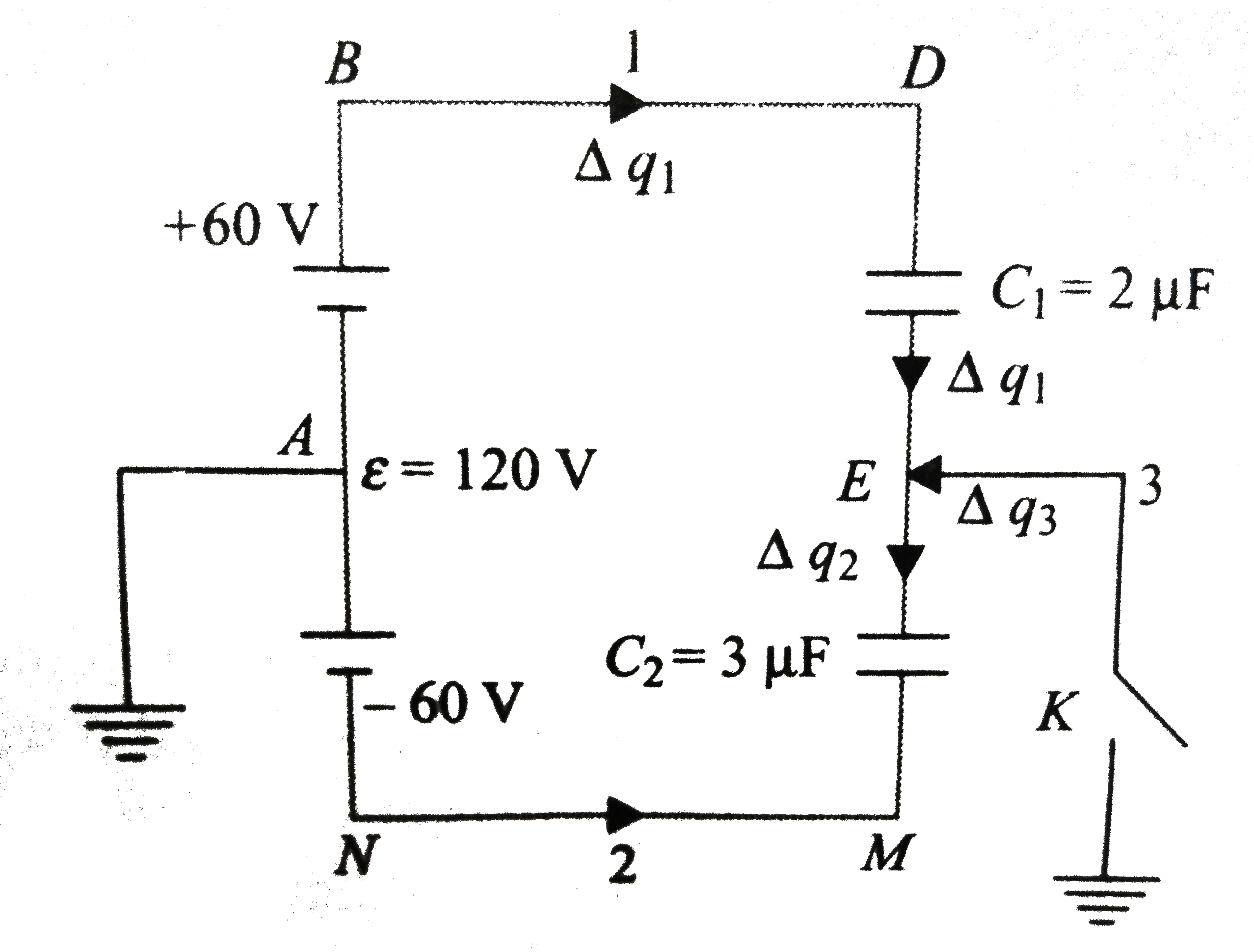 At junction `E,triangleq_(1)+triangle_(3)=triangleq_(2)` or `triangleq_(3)=triangleq_(2)-triangleq_(1)=36+24=60muC` Hence, the charge flown in the direction (1). is `-24muC` (2). is `-36muC`e (3). is `+60muC` |
|
| 38. |
Capacitor C_1 = 2 muF and C_2 = 3muF are connected in series to a battery of emf epsilon= 120 V whose midpoint is earthed. The wire connecting the capacitors can be earthed through a key K. Now, key K is closed. Determine the charge flowing through the sections 1, 2, and 3 in the directions indicated in figure In section 3, |
|
Answer» `- 24 muC` `q_(0)=120xx(6)/(5)` `q_(0)=24xx6=144muC` after earthing, we get path ABDE, `0+60-((q_(0)+triangleq_(1)))/(2)=0` `triangleq_(1)=120-q_(0)=24muC` path ANME `0-60+((q_(0)+triangleq_(2)))/(3)=0` or `triangleq_(2)=180-q_(0)=36muC` 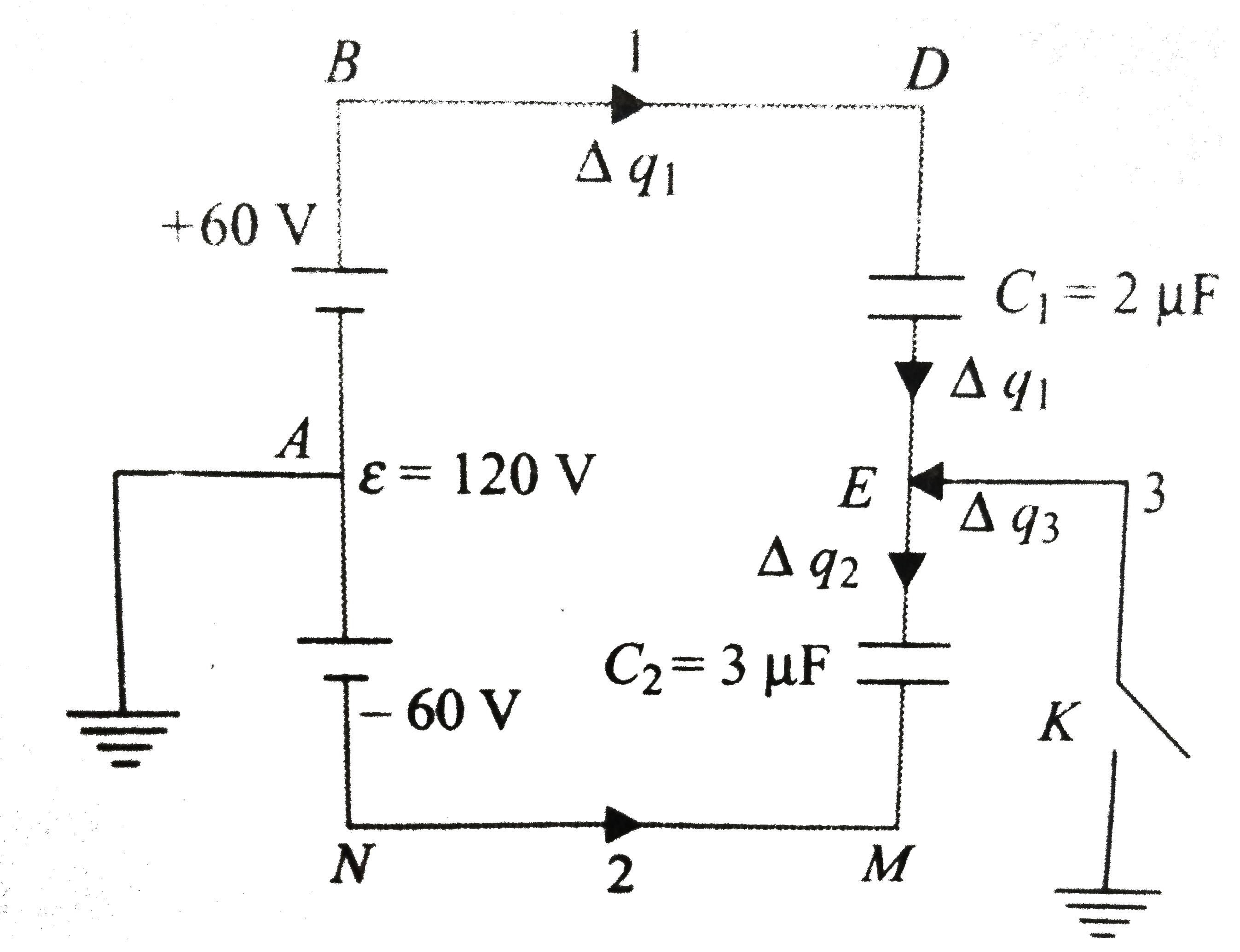 At junction `E,triangleq_(1)+triangle_(3)=triangleq_(2)` or `triangleq_(3)=triangleq_(2)-triangleq_(1)=36+24=60muC` Hence, the charge flown in the direction (1). is `-24muC` (2). is `-36muC`e (3). is `+60muC` |
|
| 39. |
Capacitor C_1 = 2 muF and C_2 = 3muF are connected in series to a battery of emf epsilon= 120 V whose midpoint is earthed. The wire connecting the capacitors can be earthed through a key K. Now, key K is closed. Determine the charge flowing through the sections 1, 2, and 3 in the directions indicated in figure In section 2, |
|
Answer» `- 24 muC` `q_(0)=120xx(6)/(5)` `q_(0)=24xx6=144muC` after earthing, we get path ABDE, `0+60-((q_(0)+triangleq_(1)))/(2)=0` `triangleq_(1)=120-q_(0)=24muC` path ANME `0-60+((q_(0)+triangleq_(2)))/(3)=0` or `triangleq_(2)=180-q_(0)=36muC` 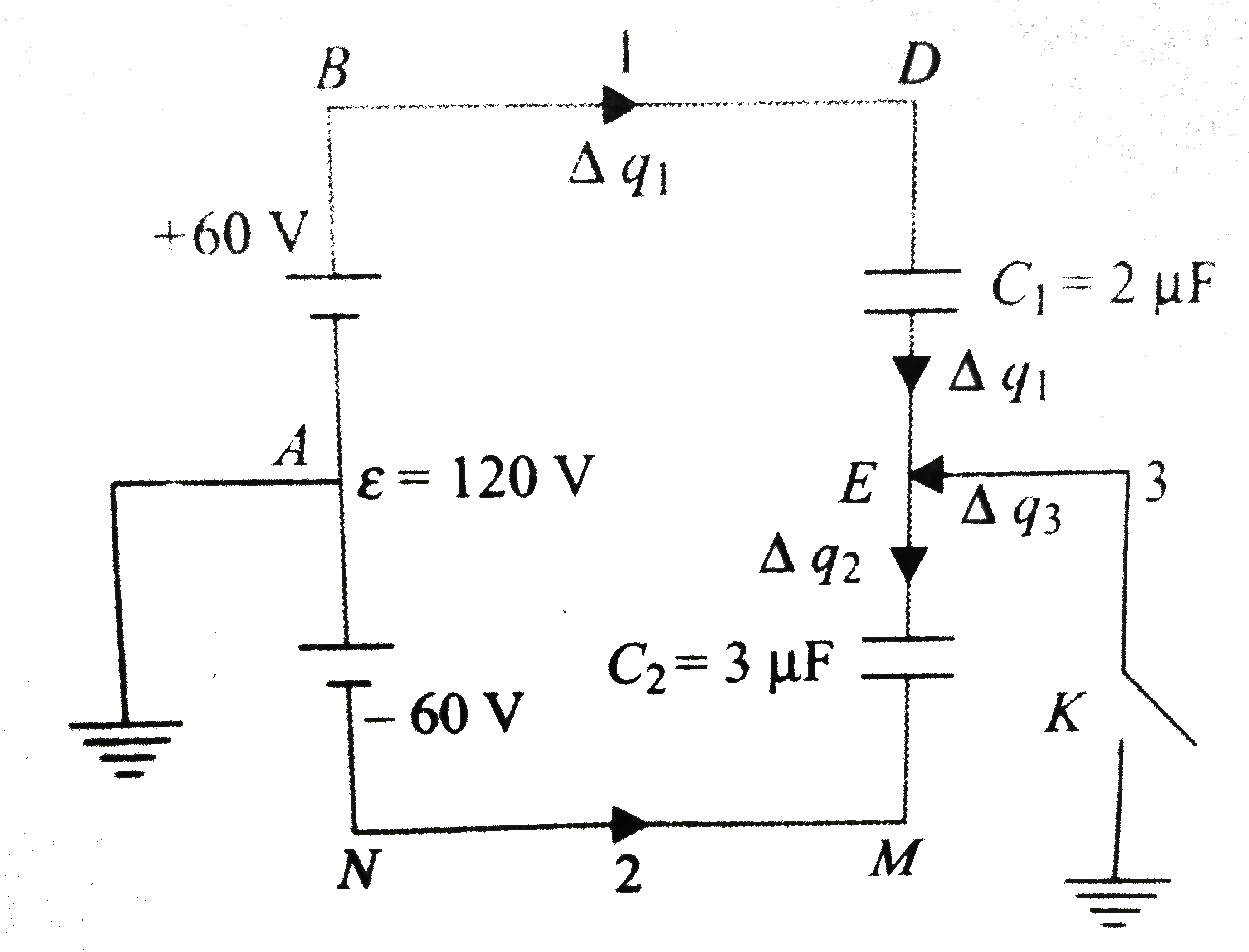 At JUNCTION `E,triangleq_(1)+triangle_(3)=triangleq_(2)` or `triangleq_(3)=triangleq_(2)-triangleq_(1)=36+24=60muC` HENCE, the charge flown in the direction (1). is `-24muC` (2). is `-36muC`e (3). is `+60muC` |
|
| 40. |
One mole of a monatomic ideal gas undergoes an adiabatic expansion in which its volume becomes eight times its initial value. If the initial temperature of the gas is 100 universal gas constant 8.0, the decrease in its internal energy, in , is__________. |
|
Answer» |
|
| 41. |
An electrons is moving round the nucleus of a hydrogen atoms in a circularorbit of radius r. The coulomg forceoversetto Fbetween the two is(where K =( 1)/( 4pi in _0)) |
|
Answer» ` K(E^(2))/(r^(3)) oversetto r ` |
|
| 42. |
Wavelength of light in air is 6000Å. Calculate its wavelength in water(n =4/3) and glass(n= 3/2). |
|
Answer» Solution :Data supplied `c=3xx10^(8)MS^(-1),"" LAMDA=6000Å=6000xx10^(-10)m` Frequency `v=c/(lamda)=(3xx10^(8))/(6000xx10^(-10))=(3xx10^(8))/(6xx10^(-7))=5xx10^(-14)Hz` In water `n_(wa)=4/3=c/(c_(W))` `c_(w)=c/(n_(wa))=(3xx10^(8))/((4//3))=9/4xx10^(8)m//s "" :. lamda_(w)=(c_(w))/v=(9xx10^(8))/(4xx5xx10^(14))=4500Å` In glass `n_(GA)=3/2=c/(c_(g))"" :. c_(g)=c/(n_(ga))=(3xx10^(8))/(3//2)=2xx10^(8)m//s` `:.lamda_(g)=(c_(g))/v=(2xx10^(8))/(5xx10^(14))=4xx10^(-7)=4000Å` |
|
| 43. |
Draw a neat labelled circuit diagram of experimental arrangement for study of photoeletric effect. |
Answer» SOLUTION :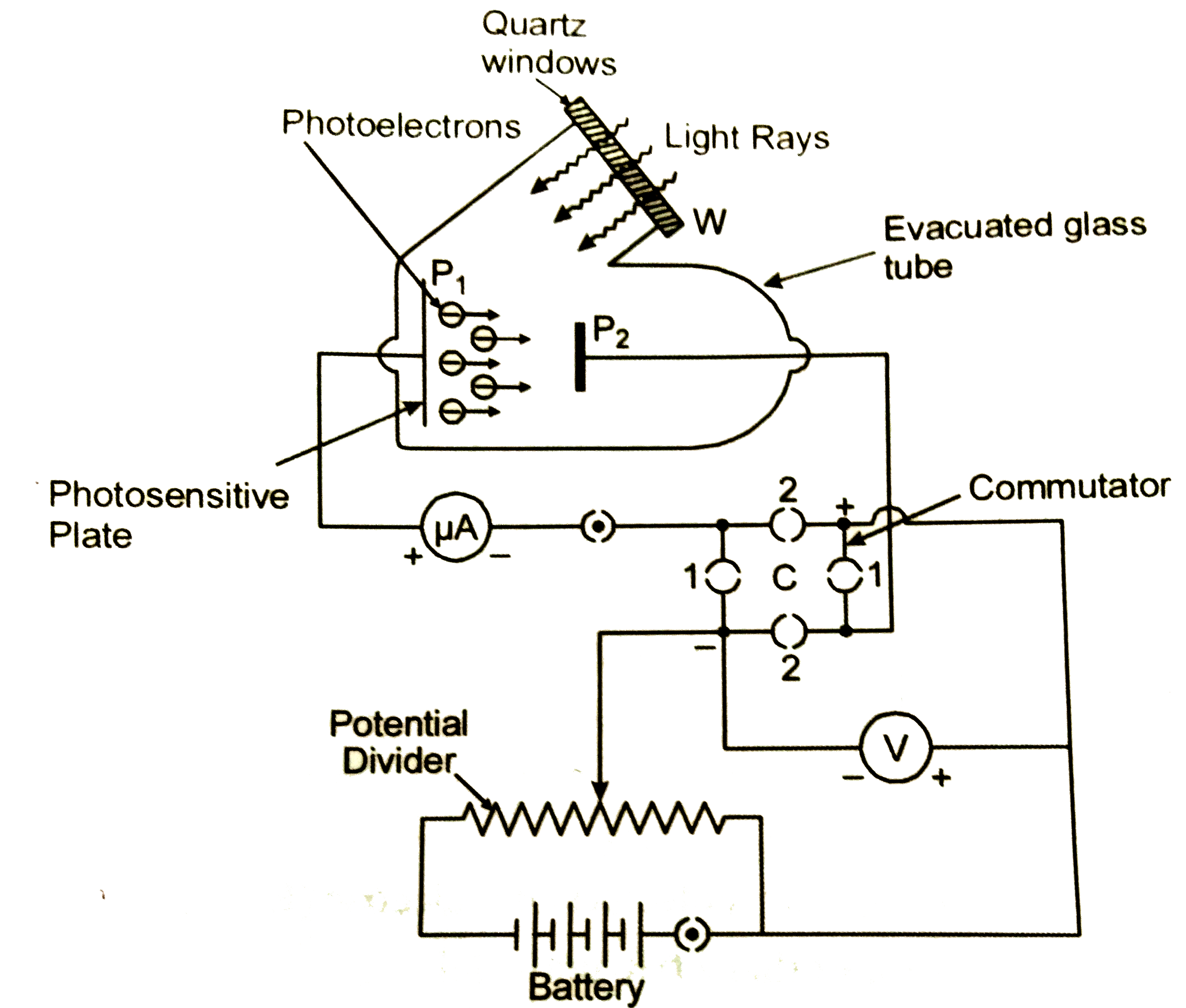
|
|
| 44. |
A reflecting telescope has a large mirror for its objective, with radius of curvature equal to 8cm. What is the magnifying power of the telescope, if the eyepiece used has a focal length of 1.6cm? |
| Answer» SOLUTION :MAGNIFYING power of the telescope = FOCAL LENGTH of the eyepiece/focal length of the OBJECT = 40/1.6 = 25 | |
| 45. |
A resistance of Romega draws current from a potentiometer. The potentio - meter has a total resistance R_(0)Omega (Fig). A voltage V is supplied to the potentiometer. Derive an expression for the voltage across R when the sliding contact is in the middle of the potentiometer. |
|
Answer» Solution :While the slide isin the middle of the POTENTIOMETER only half of its resistance `(R_(0)//2)` will be between the points A and B. Hence, the total resistance between A and B, say, `R_(1)`, will be given by the FOLLOWING expression : `(1)/(R_(1))=(1)/(R)+(1)/((R_(0)//2))RARR R_(1)=(R_(0)R)/(R_(0)+2R)` The total resistance between A and C will be sum of resistance between A and B and B and C, i.e., `R_(1)+R_(0)//2` `therefore` The current flowing through the potentiometer will be `I=(V)/(R_(1)+R_(0)//2)=(2V)/(2R_(1)+R_(0))` The voltage `V_(1)` taken from the potentiometer will be the p roduct of current I and resistance `R_(1)`, `_(1)=IR_(2)=((2V)/(2R_(1)+R_(0)))xxR_(1)` Substituting for `R_(1)`, we have a `V_(1)=(2V)/(2)((R_(0)xxR)/(R_(0)+2R))+R_(0)xx(R_(0)xxR)/(R_(0)+2R)` `V_(1)=(2VR)/(2R+R_(0)+2R) or V_(1)=(2VR)/(R_(0)+4R)` |
|
| 46. |
Calculate the electric potetial at the surface of a gold nucles. Given, the radius of nucleus = 6.6 xx 10^(-15) m and atomic number of gold = 79. |
|
Answer» SOLUTION :Here `r = 6.6 xx 10^(-15)m`, atomic Number z = 79 `:.` Charge on gold nucleus `q = +ze = 79 xx 1.60 xx 10^(-19) C` `:.` Potential at the surface of gold nucleus `V = q/(4 pi epsi_0.r) = (79 xx 1.60 xx 10^(-19) xx 9 xx 10^9)/(6.6 xx 10^(-15)) =1.72 xx 10^7V`. |
|
| 47. |
In the Young's double slit experiment apparatus shown in figure, the ratio of maximum to minimum intensity on the screen is 9. The wavelength of light used is lambda, then the value of y is |
|
Answer» `(lambdaD)/(d)` |
|
| 48. |
For which of the following combinations of working temperatures, the efficiency of Carnot’s engine is maximum ? |
| Answer» Answer :A | |
| 49. |
A hydrogen atom is excited from its ground state to the state with n = 4. (a) How much energy must be absorbed by the atom? Consider the photon energies that can be emitted by the atom as it de-excites to the ground state in the several possible ways. (b) How many different energies are possible, what are the (c) highest, (d) second highest, (e) third highest, (f) lowest, (g) second lowest, and (h) third lowest energies? |
| Answer» SOLUTION :(a) 12.8 EV, (b) 6, (C) 12.8 eV, (d) 12.1 eV, (e) 10.2 eV, (f) 0.661 eV, (g) 1.89 eV, (h) 2.55 eV | |
| 50. |
Six resistors are connected so as to form the edges of a tetrahedron ABCD, the resistances of opposite pairs being equal. (Note that the resistors AB and CD do not touch each other) find the equivalent resistance between A and C. |
|
Answer» `(r_(3))/(2)[(2r_(1)r_(2)+r_(3)(r_(1)+r_(2)))/((r_(1)+r_(3))(r_(2)+r_(3)))]` |
|