Saved Bookmarks
This section includes 7 InterviewSolutions, each offering curated multiple-choice questions to sharpen your Current Affairs knowledge and support exam preparation. Choose a topic below to get started.
| 1. |
Consider a situation (i) that two sound waves, y_(1)=(0.2m)sin504pi(t-x//300)andy_(2)=(0.6m)sin496pi(t-x//300), are superimposed. Consider another situation (ii) that two sound waves, y'_(1)=(0.4m)sin504pi(t-x//300)andy'_(2)=(0.4m)sin504pi(t+x//300), are superimposed. Match the Column-I and Column-II |
|
Answer» |
|
| 2. |
A sound source A and a reflecting surface B move directly toward each other. Relative to the air, the speed of source A is 20.0 m/s, the speed of surface B is 80.0 m/s, and the speed of sound is 329 m/s. The source emits waves at frequency 2000 Hz as measured in the source frame. In the reflector frame, what are the (a) frequency and (b) wavelength of the arriving sound waves? In the source frame, what are the (c) frequency and (d) wavelength of the sound waves reflected back to the source? |
| Answer» SOLUTION :`(a) 2.65 XX 10^3 HZ, (B) 0.124 m , (C ) 3.71 xx 10^3 Hz , (d) 0.0887 m ` | |
| 3. |
A dart is loaded into spring loaded toy dart gun by pushing the spring in by a distance d. For next loading, the spring is compressed a distance 2d. How much faster does the second dart leave the gun compared to first. |
| Answer» Answer :B | |
| 4. |
A copper rod is fixed between two supports. Its temperature was raised by 50^@C. What is the resulting stress in the rod? |
|
Answer» |
|
| 5. |
CH_(3)CONH_(2) & HCONHCH_(3) are called |
|
Answer» Position ISOMERS |
|
| 6. |
For a thin prism on what factor does the magnitude of angle of deviation of light rays depend? |
|
Answer» |
|
| 7. |
A glass slab of thickness 3 cm and refractive index 3/2 is placed on ink mark on a piece of paper.For a person looking at the mark at a distance 2 cm above it, the distance of the mark will appear to be in cm |
|
Answer» 4cm |
|
| 8. |
Read the paragraph and answer the following questions. Paragraph : Orbital velocity is defined as the velocity required to put the satellite into satellite into its orbit around the earth. An artificial satellite is moving in circular orbit around the earth with speed equal to half the value of escape velocity from the earth. The height of the satellite above the surface of earth is |
|
Answer» R Since `v_(0)=(1)/(2)v_(e )=(1)/(2) sqrt((2GM)/(R ))` `THEREFORE (1)/(2)sqrt((2GM)/(R ))=sqrt((GM)/(R+h))`. `R+h=2R rArr h = R`. So CORRECT choice is a. |
|
| 9. |
Read the paragraph and answer the following questions. Paragraph : Orbital velocity is defined as the velocity required to put the satellite into satellite into its orbit around the earth. An artificial satellite is moving in circular orbit around the earth with speed equal to half the value of escape velocity from the earth. The linear momentum of the satellite at the height given in above question is |
|
Answer» `m sqrt(2GM) R` `=m*sqrt((GM)/(2R))*2R=m sqrt(2GMR)` So correct choice is a. |
|
| 10. |
A 10 muFcapacitor is charged to 200 V and is isolated. It is then connected to another 10 muF uncharged capacitor. The total electrostatic energy of the capacitor remains conserved. |
| Answer» Solution :FALSE - Total charge remains conserved but there is loss in electrostatic POTENTIAL ENERGY of the capacitor system. | |
| 11. |
Dioecious plants (papaya, date palm) prevent |
|
Answer» AUTOGAMY but not geitonogamy |
|
| 12. |
When a tuning fork vibrates, the wave produce are, |
|
Answer» Transverse |
|
| 13. |
A coil of resistance 20 Omega and inductance 0.5 henry is switched to dc 200 volt supply. Calculate the rate of increase of current : a) at the instant of closing the switch and b) after one time constant. c) Find the steady state current in the circuit. |
|
Answer» Solution :a) This is the case of growth of CURRENT in an L-R circuit. HENCE, current at time t is GIVEN by `i=i_(0)(l-e^(-t // tau_(L)))` RATE of increase of current, `(di)/(dt)=(i_(0))/(tau_(L))e^(-t // tau_(L))` At t=0 `(di)/(dt)=(i_(0))/(tau_(L))=(E//R)/(L//R)=(E)/(L)` `(di)/(dt)=(200)/(0.5)=400 A//s` b) At `t = tau_(L), (di)/(dt) = (400)e^(-1) =(0.37)(400) = 148 A//s` c) The steady state current in the circuit , is `i_(0)=(E)/(R)=(200)/(20)=10A` |
|
| 14. |
A particle having rest mass m_(0) travel with speed of light in vaccum.Its de-Broglie wavelength will be….. |
|
Answer» `(h)/(m_(0)c)` `lambda=(hxxsqrt(1-(v^(2))/(v^(2))))/(m_(0)v) THEREFORE m=(m_(0))/(sqrt(1-v^(2)/(c^(2))))` `lambda=(hxxsqrt(1-c^(2)/(c^(2))))/(m_(0)v) therefore v=c` `therefore lambda=0` |
|
| 15. |
मान लीजिए कि A={1, 2, 3, 4,..,10) तथा,B={a,b} तो A से B में आच्छादक प्रतिचित्रों (प्रतिचित्रणों) की सख्या |
|
Answer» 1024 |
|
| 16. |
Read the paragraph and answer the following questions. Paragraph : Orbital velocity is defined as the velocity required to put the satellite into satellite into its orbit around the earth. An artificial satellite is moving in circular orbit around the earth with speed equal to half the value of escape velocity from the earth. If the satellite is stopped suddenly in its orbit and allowed to fall freely on the surface of earth then the speed with whichit hits the surface of earth is |
|
Answer» `sqrt((gR)/(G))` `(1)/(2)mv^(2)= (-GMm)/(2R)-[(-GMm)/(R )]` `=(-GMm+2GMm)/(2R)=(GMm)/(2R)` `v=sqrt((GM)/(R ))=sqrt(gR)`. So correct choice is B. |
|
| 17. |
Condider two rods of same length and different specific heats (s_(1), s_(2)), thermal conductivities (K_(1), K_(2)) and areas of cross-section (A_(1), A_(2)) and both having temperatures (T_(1), T_(2)) at their ends. If their rate of loss of heat due to conduction are equal, then |
|
Answer» `K_(1)A_(1) = K_(2)A_(2)` |
|
| 18. |
Find the equivalent capacitance between A and B |
|
Answer» 7C |
|
| 19. |
Mercury fills a glass tube Fig. so that the total column is 20 cm long. The tube is then rocked, so that the mercury begins to oscillate. Find the frequency and the period of the vibrations. |
|
Answer» Hence `omega_(0)=sqrt(2g//l)` |
|
| 20. |
When aboveground nuclear tests were conducted, the explosions shot radioactive dust into the upper atmosphere. Global air circulations then spread the dust worldwide before it settled out on ground and water. One such test was conducted in October 1976. What fraction of the WSr produced by that explosion still existed in October 2006? The half-life of ""^(90)Sr is 29 y. |
|
Answer» |
|
| 21. |
An object is immersed in a fluid. In order that the object becomes invisible, it should |
|
Answer» behave as a perfect reflactor |
|
| 22. |
When a pure semiconcutor is doped with acceptor impurity, we call it as. |
|
Answer» |
|
| 23. |
When you have learned to integrate find the resistance of the conductor of the previous problem and the voltage across it. |
|
Answer» Let us change the variables, nothing that y=a for x=0 and y=D for x=1. DIFFERENTIATING, we obtain `(dy)-dx=(D-a)/l, so dx=(l dy)/(D-a)` Substituting into expression for the resistance, we obtain `R=(4pl)/(pi (D-a)) underset(a)overset(D)int (dy)/(y^2)=(4pl)/(pi (D-a)) [-1/y]_(a)^(D) =(4pl)/(pi aD)` |
|
| 24. |
What will be the a versus x graph for the following graph? |
|
Answer»
`nu=(-nu_(0)x)/(x_(0))+nu_(0)` On differentiating with RESPECT to t, `(dv)/(dt) =-(nu_(0))/(x_(0))(dx)/(dt)+0` or `a =(-nu_(0))/(x_(0))nu` PUTTING `nu` from eqn. (i) in eqn . (ii) `a= -(nu_0)/(x_(0))[(nu_(0))/(x_(0))x+nu_(0)]=(nu_(0)^(2))/(x_(0)^(2))x-(nu_(0)^(2))/(x_(0))` Which is a straight line with positive slope and negative intercept. |
|
| 25. |
In a hydrogen like atom, the energy required to excite the electron from IIIrd orbit is 47.2 eV . What is the atomic number of the atom ? |
|
Answer» 2 |
|
| 26. |
The threshold wavelength of a photosensitive metal is 662.5 nm. If this metal is irradiated with a radiation of wavelength 331.3 nm, find the maximum kinetic energy of the photoelectrons. If the wavelength of radiation is increased to 496.5 nm, calculate the change in maximum kinetic energy of the photoelectrons. (Planck's constant h = 6.625 xx 10^(-34) Js and "speed of light in vacuum" = 3 xx 10^(8)ms^(-1)) |
|
Answer» SOLUTION :GIVEN : `lambda_0=662.5xx10^(-9)` m `lambda=331.3xx10^(-9)`m `lambda.=496xx10^(-9) m ` `h=6.625xx10^(-3)4` Js `C=3xx10^8` m/s `K.E.=hc[1//lambda-1lambda_0]` `=(6.625xx10^(-34))(3xx10^8)[1/(331.3xx10^(-9))-1/(662.5xx10^(-9))]` `K.E.=(6.625xx10^(-34))(3xx10^8)[10^9/331.3-10^9/662.5]` `K.E.=(6.625xx3)xx10^(-34+8+9)[1/331.3-1/662.5]` `K.E.=19.87xx10^(-17)[0.0030-0.0015]` `K.E.=19.87xx10^(-17)[0.0015]` `K.E.=0.0298xx10^(-17)J =2.98xx10^(-19)J` `K.E.=19.87xx10^(-17)[1/331-1/0.493]=19.87xx10^(-17)[0.0030-0.0020]` `=19.87xx10^(-17)xx0.0010` `K.E.=1.98xx10^(-19)` J . |
|
| 27. |
Let a steel bar of length l, breadth b and depth d be loaded at the centre by a load W. Then the sag of bending of beam is (Y = Young's modulus of material of steel) |
|
Answer» `(Wiota^3)/(2bd^3Y` where, W = Load, L= Length =1, Y = Young's modulus |= Moment of inertia = `(bd^3)/12` So, `delta=(Wl^3)/(48Ybd^3)xx12=(Wl^3)/(4Ybd^3)` |
|
| 28. |
A bar magnet having a magnetic moment of 2 xx 10 ^(4) JT ^(-1) is free to rotate in a horizontal plane. A horizontal magnetic field B = 6 xx 10 ^(-4) T exists in the space. The work done in taking the magnet slowly from a direction parallel to the field to a direction 60^(@) from the field is |
| Answer» Answer :B | |
| 29. |
Assertion: As force is a vector quantity, hence electric field intensity is also a vector quantity Reason:The unit of electric field intensity is newton per coulomb. |
|
Answer» Both Assertion and Reason are true and Reason is the CORRECT explanation of Assertion |
|
| 30. |
A long horizontal rod has which can slide along its length, and initially placed at a distance L from one end A of the rod. The rod is set in angualar motion about A with constant angular acceleration a. If the coefficient of friction between the rod and the bead is m, and gravity is neglected, then the time after which the bead starts slipping is : |
|
Answer» infinitesimal L = distance of point :. linear speed `upsilon = Lomega` HENCE `F= mum (L omega)/(t). mLomega^(2)= mum (Lomega)/(t)` `omega=(mu)/(t)` `t=(mu)/(omega)`But=`alpha.t` `:.t=(mu)/(alphaxxt)` or `t^(2)=(mu)/(alpha)` and `t=sqrt(mu)/(alpha)` Hence choice is (a) |
|
| 31. |
The pressure and density of a gas (gamma=1.5) changes for (P,rho) to (P',rho') during adiabatic changes if rho'//rho=32, then P'//Pwill be |
|
Answer» 128 `P(M/rho)^(v)=rho'(M/rho')^(v)` `P/rho'=(P')/(rho'^(v)),((rho')/(rho))^(v)=(P')/P, (P')/P=(32)^(1.5)` `(P')/P=(2^(5))^(3//2)` `(P')/P=2^(15//2` |
|
| 32. |
Centre of mass of the system lies inside disc or square plate and why ? |
| Answer» Solution :INSIDE SQUARE plate, for same mass per UNIT AREA, mass of square plate is GREATER than mass of disc. | |
| 33. |
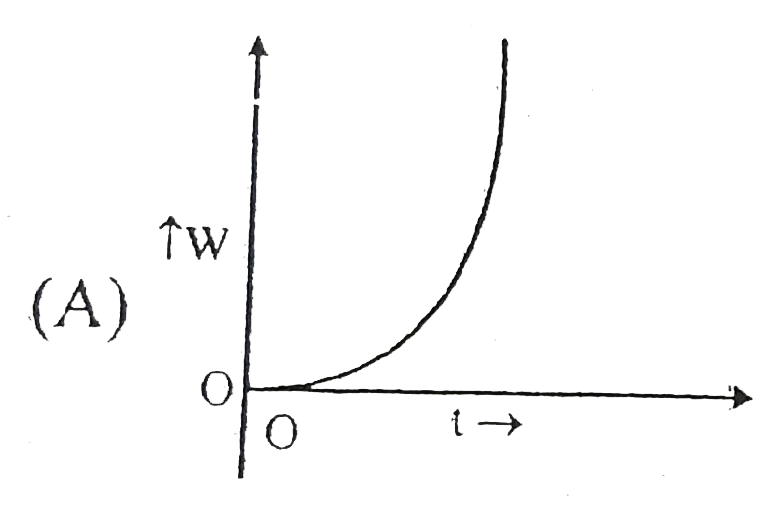
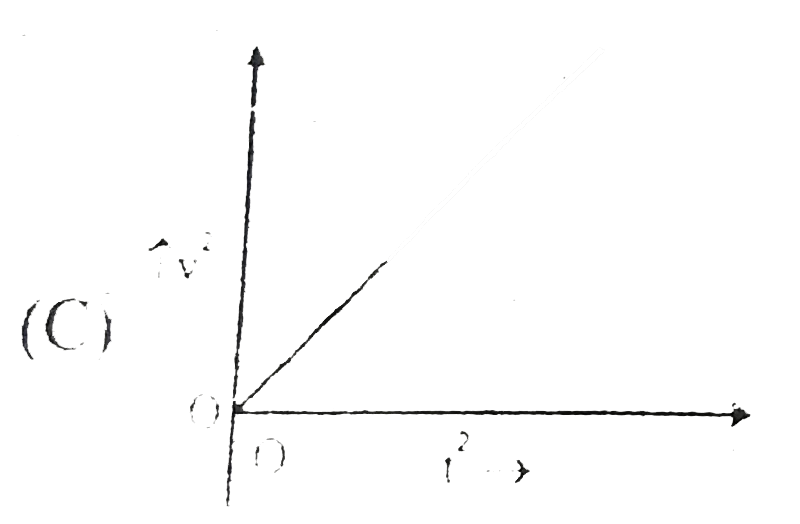
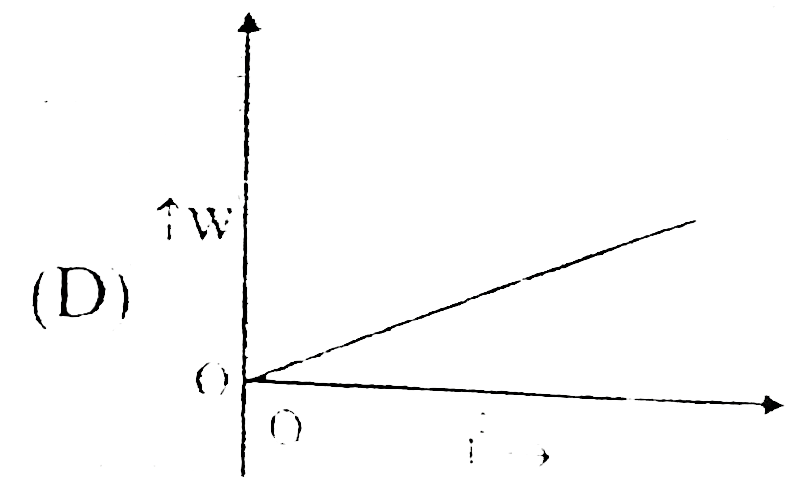
A particle initially at rest on a smooth horizontal surface, is acted on by a constant horizontal force at time t=0 then if W= work, done t=time and v=speed of the particle, the nearly correct graph (s) is //are |
|
Answer»
(A)`w=1/2mv^(2)=1/2m(F/mt)^(2)` (B)`w=1/2(f^(2))/m t^(2)` (C)`v^(2)=(f/m)^(2)t^(2)` (D) `w=1/2(f^(2))/m t^(2)` |
|
| 34. |
The distanceof closet approchof analpha- particlefiredtowardsa nucleuswithmomentump , isr.If themomentum of thealpha- particleis2p, thecorrespondingdistanceof closestapporachis |
|
Answer» A) `r/2` |
|
| 35. |
Electrons when accelerated in a cyclotron acquires "___________". |
|
Answer» ZERO mass |
|
| 36. |
दो समांतर आवेशित चादर जो कि समान प्रकृति के आवेश से आवेशित है, के बीच किसी बिन्दु पर विधुत क्षेत्र की तीव्रता होगी (यदि चादरों का आवेश घनत्व sigma है)- |
|
Answer» `SIGMA/(2epsilon_0)` |
|
| 37. |
In vacuum, speed of light depends upon : |
| Answer» Answer :D | |
| 38. |
An A.C. supply of 350 V, 60 Hz is applied to a full wave rectifier. If internal resistance of each diode is 200Omega and load resistance R_(1)=5k Omega, then the maximum value of output current is ……. |
|
Answer» 0.065 A `I_(m)=I_("rms")XX sqrt(2)` `=(V_("rms")xx sqrt(2))/(R_(2)+2r_(f))` where `r_(f )=` resistance of DIODE in forward bias `=(350xx1.414)/(5000+2xx200)=0.0916A` `therefore I_(m)~~0.092A` |
|
| 39. |
A longdielectriccylinderof radius Rus staticallyplartizedso thatat all the its pointsthe polarizationis equalto P = alpha x , wherealphais a positiveconstant, and ris the distancefrom the axis. Thecylinderis set into ratationabout its axiswith anangularvelocityomega. FInd themagnetic inductionBat the centreof the cylinder. |
|
Answer» Solution :Because of polarization a space charge is present within the cylinder. It's density is `rho_(p) = -"div" vec(P) = -2 alpha` Since the cylinder as a whole is neutrala surface chargedensity `sigma_(p)` must be present on the surfaceof the cylinderalso. This has the magnitude(algebratically) `simga_(p) xx 2pi R = 2 alpha pi R^(2)` or, `sigma_(p) = alpha R` When the cylinder rotes, currents are set upwhich give riseto magenticfields. Thecontributesof `rho_(p)` and `sigma_(p)` can becalculated separaelyand then added. For the surface chargethe current is (for a particular element) `alpha R xx 2pi R dx xx (omega)/(2pi) = alpha R^(2) omega dx` Its contributionto the magentic fieldat the centre is `(mu_(0) R^(2) (alpha R^(2) omega dx))/(2(x^(2) + R^(2))^(3//2))` andthe total magentic field is `B_(s) = int_(oo)^(-oo) (mu_0) R^(2) (alpha R^(2) omega dx)/(2 (x^(2) + R^(2))^(3//2)) = (mu_(0) alpha R^(4) omega)/(2) int_(-oo)^(oo) (dx)/((x^(2) + R^(2))^(3//2)) = (mu_(0) alpha R^(4) alpha)/(2) xx (2)/(R^(2)) = mu_(0) alpha R^(2) SIGMA` As FPR the volume charge density considera circle of radius`r`, radial thickness `dr` and length`dx`. The currentis `-2A xx 2pi r dr dx xx (omega)/(2pi) = -2 alpha r dr omega dx` The total magnetic field due on the the volumecharge distribution is `B_(v) = -int_(0)^(R) dr int_(-oo)^(oo) dx 2pi r omega(mu_(0) r^(2))/(2(x^(2) + r^(2))^(3//2)) = -int_(0)^(R) alphamu_(0) omegar^(3) dr int_(-oo)^(oo)dx (x^(2) + r^(2))^(3//2)` `= -int_(0)^(R) alpha omega r dr xx 2 = -mu_(0) alpha omegaR^(2)` so,`B = B_(s) + B_(v) = 0` |
|
| 40. |
A proton and an electron have same kinetic energy. Which one has greater de Broglie wavelength. Justify. |
|
Answer» SOLUTION :de-Broglie wavelength of the particle is `lambda = (h)/(p) = (h)/(SQRT(2mK))` i.E. `lambda prop (1)/(sqrt(m))` As `m_(e) lt lt m_(p)`, so `lambda_(e) gt gt lambda_(p)` Hence protons have GREATER de-Broglie wavelength |
|
| 41. |
An ideal gas is undergoing a cyclic thermodynamic process in different ways as shown in the corresponding P-V diagrams in column 3 of the table. Consider only the path from state 1 to state 2. W denotes the corresponding work done on the system. The equations and plots in the table have standard notations as used in thermodynamic process. Hereis the ratio of heat capacities at constant pressure and constant volume. The number of moles in the gas in n. Which of the following options is the only correct representation of a process in whichDeltaU = Delta Q- P Delta V? |
|
Answer» (II) (iv) (R) PROCESS 1 to 2 represents isobaric process. 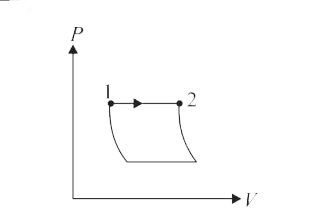 `W_(1 to 2) = P(V_1 - V_2) = PV_1 = PV_2` `Delta U= Delta Q - P Delta V` is correct. No other combination is POSSIBLE. |
|
| 42. |
A short bar magnet oscillates in VMM with a frequency of 10Hz. If a downward current of 15A is established in a long thin vertical wire placed 20 cm west of the magnet, its frequency was found to be 5Hz. If a TG containing 500 turns with radius of each turn 4pi cm is used at that place & a current of 10mA is allowed to pass through it. Find the deflection of magnetic needle in the TG |
|
Answer» Solution :`n=1/(2PI)SQRT((MB_("net"))/I),npropsqrt(B_("net"))rArr(n_(1))/n=sqrt((B_(H)~B)/(B_(H)))` Where `B=(mu_(0))/(2pi)I/r=2xx10^(-7)xx15/20xx10^(2)=15muT` `(5/10)^(2)=((B_(H)hatB)/(B_(H)))` a) if `B_(H)gtBrArr4B_(H)~4B=B_(H)rArr3B_(H)=4B` `B_(H)=4/3B=4/3xx15muT=20muT` In case of T.G. `(mu_(0)ni)/(2rB_(H))=tantheta` `(4pixx10^(-7)xx500xx10^(-2))/(2(4pi)10^(-2)xx20xx10^(-6))=tantheta` `tantheta=25/20`, `theta=tan^(-1)(5/4)` b) if `BgtB_(H)rArr4B-4B_(H)=B_(H)rArr5B_(H)=4B` `rArrB_(H)=4/5xx15muT=12muT=theta-tan^(-1)(25/12)` |
|
| 43. |
If range of an ammeter with resistance 5Omega is to be made double then _______ |
|
Answer» `5OMEGA` resistance should be CONNECTED in parallel to it. `rArr5Omega` resistance should be connected in parallel to a given CURRENT meter. |
|
| 44. |
Two parallel long wires carry currents 18A and 3A. When the currents are in the same direction, the magnetic field at a point midway between the wire is B_(1). If the direction of i_(2) is reversed, the field becomes B_(2). Then the value of B_(1)//B_(2) is |
|
Answer» `5:7` |
|
| 45. |
Name some analog communication system. |
| Answer» SOLUTION :They are telegraphy, telephony, RADIO network, RADAR, TELEVISION network, teleprinting and telex. | |
| 46. |
A capacitor of capacitance C is connected in parallel with a choke coil having inductance I and resistancev R Calculate (a) The resonance frequency and (b) the circuit impedance at resonance . |
|
Answer» SOLUTION :Impedance of `R -L` circuit `Z sqrt((R^(2)) + X_(L)^(2)` Voltage leads the current by phi where `tan phi = X_(L)/R` `i_(1) = (V)/(Z) = (V)/(sqrtR^(2) + X_(L)^(2))` `i_(2) = (V)/(X_(C))` At resonance voltage and current are in same phase for it `i_(2) =i_(1) SIN phi implies (V)/(X_(C)) =(V)/(sqrt(R^(2) + X_(1)^(2))) . (X_(L))/(sqrt(R^(2) + X_(1)^(2)))` `R^(2) + X_(L)^(2) = X_(L) X_(C) implies R_(2) + omega^(2) L^(2) =(L)/(C)` `omega = omega_(r) = sqrt((1)/(LC) - R^(2)/(L^(2)))` At resonance current `i = i_(1) cos phi` `(V)/(Z) = (V)/(Sqrt( R^(2) +X_(L)^(2))) .(R)/(sqrt(R^(2) + X_(L)^(2))) implies (1)/(Z) = (R)/(L//C)` Impedance at resonance `Z = (L)/(CR)` 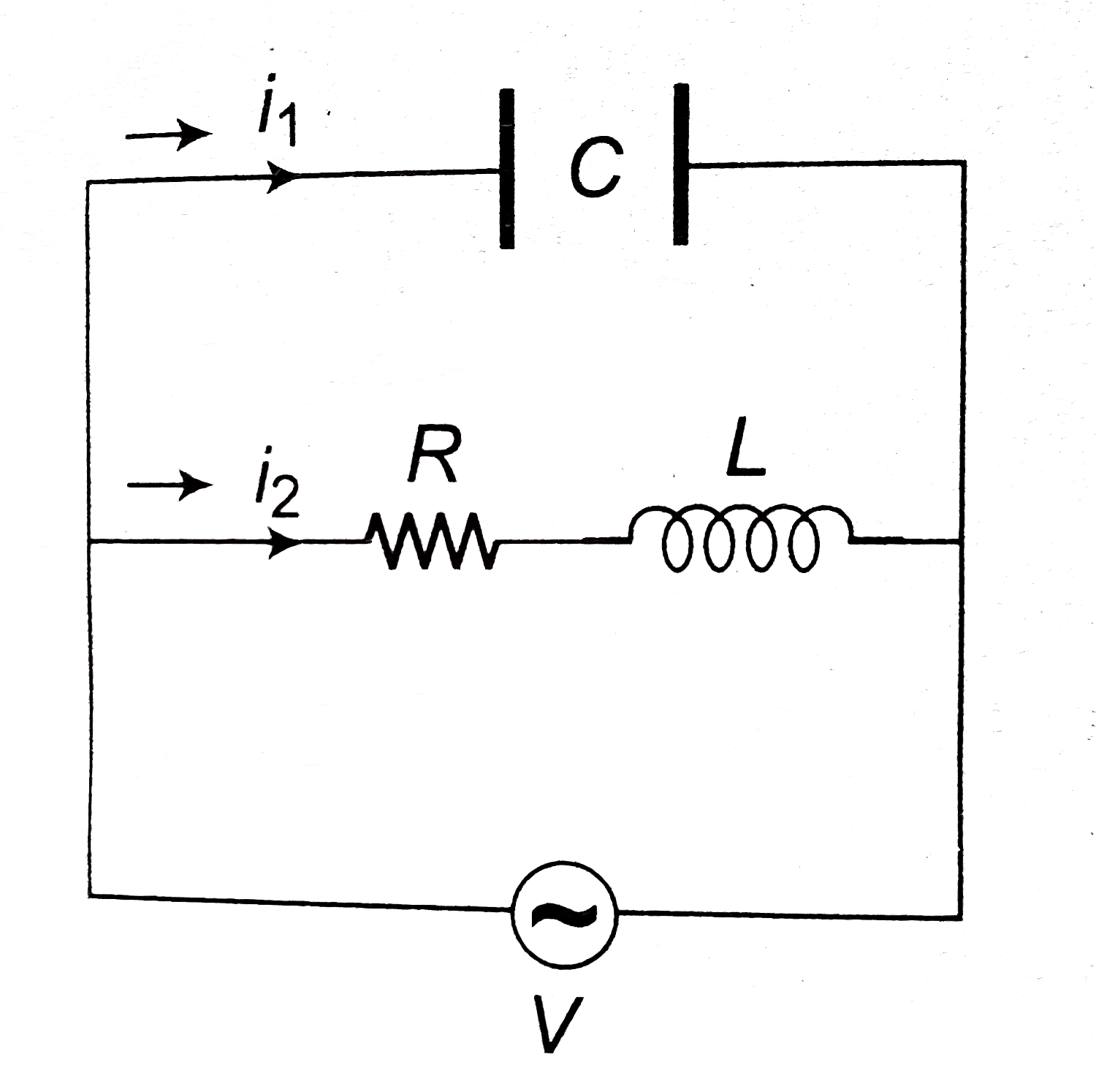 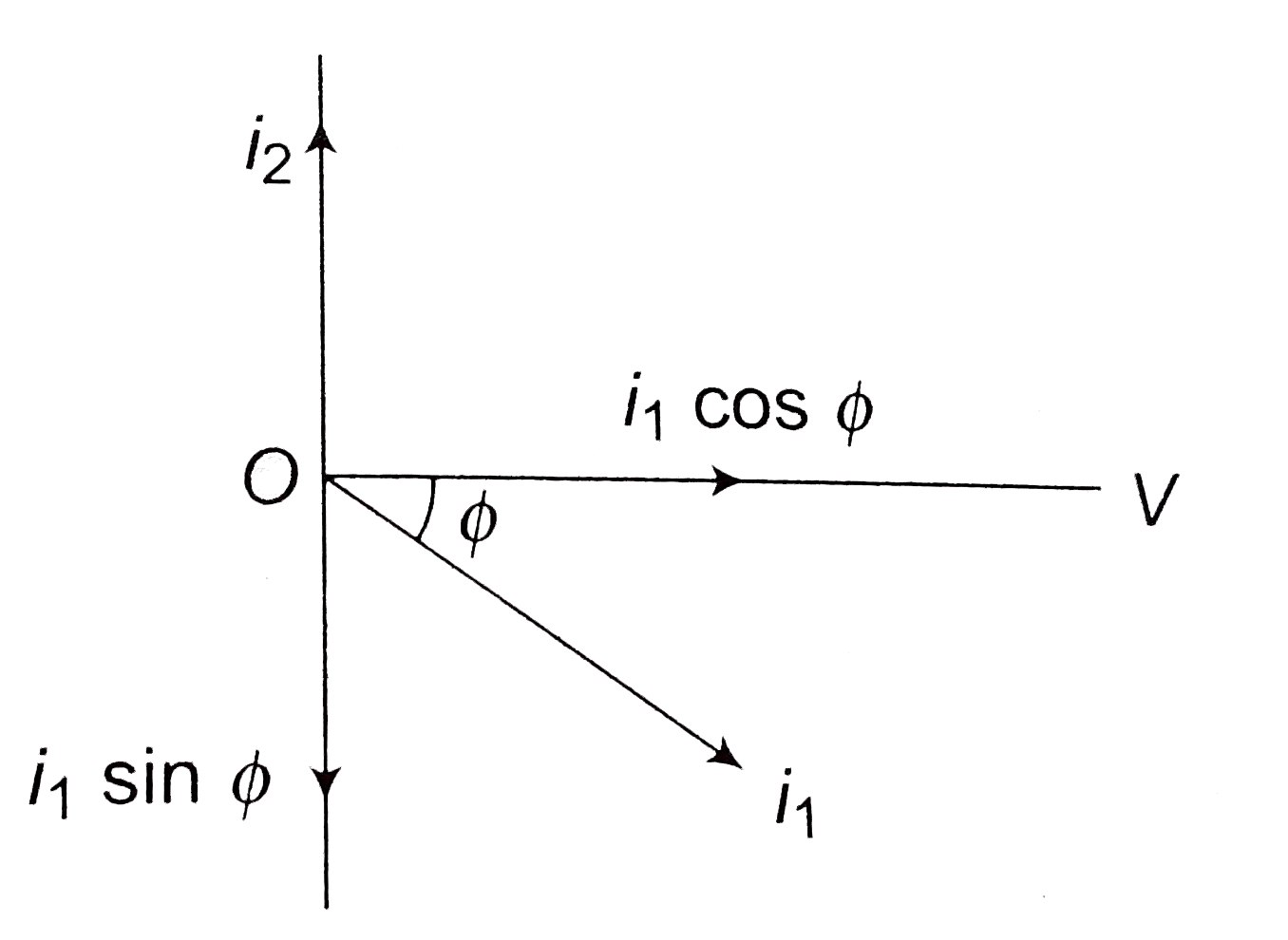 . .
|
|
| 47. |
A watermelon seed has the following coordinates: x = -5.0 m, y = 9.0 m, and z = 0 m. Find its position vector (a) in unit-vector notation and as (b) a magnitude and ( c) an angle relative to the positive direction of the x axis. (d) Sketch the vector on a right-handed coordinate system. If the seed is moved to the xyz coordinates (3.00 m, 0 m, 0 m), what is its displacement (e) in unit-vector notation and as (f) a magnitude and (g) an angle relative to the positive x direction? |
| Answer» Solution :(a) `(-5.0m)HATI+(9.0m)hatj,` (b) 10 m, ( C) `-61^(@)or119^(@)` (d) `119^(@)` counterclockwise from the +x DIRECTION, (e) `Deltavecr=(8.0m)hati-(9.0m)hatj,` (f) 12 m, (g) (`-42^(@),or42^(@)` measured clockwise from +x) | |
| 48. |
According to Ohm's law (R=V/I) as current flowing through a conductor increases, resistance of conductor |
|
Answer» decreases |
|
| 49. |
On the basis of impurity doped how do we classify semiconductors ? |
| Answer» SOLUTION :TWO TYPES,n-type,p-type. | |
| 50. |
The energy, the magnitude of linear momentum, magnitude of angular momentum and orbital radius of an electron in a hydrogen atom corresponding to the quantum number n are E, p, L and r respectively. Then according to Bohr's theory of hydrogen atom, match the expressions in column I with statement in column II. |
|
Answer» |
|