Saved Bookmarks
This section includes 7 InterviewSolutions, each offering curated multiple-choice questions to sharpen your Current Affairs knowledge and support exam preparation. Choose a topic below to get started.
| 1. |
The total energy of a hydrogen atom in its ground state is -13.6 eV. If the potential energy in the first excited state is taken as zero then the total energy in the ground state will be |
|
Answer» `-3.4 EV` |
|
| 2. |
The electric in a circuit varies from +2A to -2A in a time interval of 10^-2s. Another coil of resistance 20 Ohm and inductance 2H is placed near it. What will be the induced current in the second coil? |
|
Answer» 4A |
|
| 3. |
For a common emitter circuit if l_(C)/l_(E) = 0.98 then current gain for common emtter circuit will be |
| Answer» Answer :C | |
| 4. |
DescribeKelvin'smethod to determinedthe resistance ofgalvanometerby usingmeterbridge . |
|
Answer» Solution :Kelvin's method of determinethe resistanceof the galvonometer by using a meter bridge : A galvanometer whose resistanceG is to be determinedis connected in onegap (left gap ) of aWheatstone's meter bridgeand a resistancebox isconnectedin the other gap (right gap). 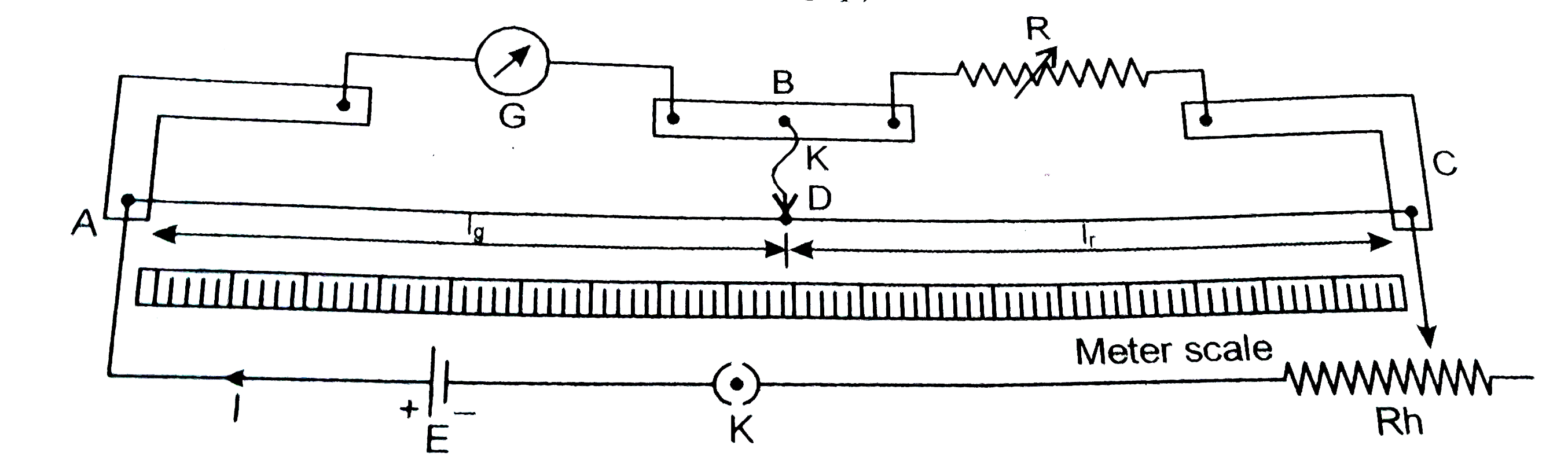 G : Galvanometer R : Resistance from the resistance BOX AC : Metal wire one metre long Rh : Rhoeostat E : Cell K : Plug key K' = Jockey A cell of emfE, keyK and rheostat Rh are connected in series with the bridge wire AC. The juncation B of thegalvanometer and the resistance box is connected to thejockey which can slide along wire AC. A suitable resistance 'R' is taken in the resistance box and a curent 'J' is send round the circuit.Withouttouchingthe jockey toany point of AC,note the deflection in the galvanometer. A rheostat is adjustedto get a suitable deflection(e.g.`0.15, 20` divisions) in the galvanometer. Place the jockey at points A and C and see the deflection on the galvanometer. It should be on opposite sides. By touching the jockey to differentpoints of wire AC, find (obtain) the point of contactD for which the galvanometer showsthe same deflection as before i.e, points B and D are equipotential (i.e,the point givesthe same deflection in the galvanometer with orwithout the contact of the jockey.) In this method,the null pointis not obtained. thus, Kelvin's method is a deflectionmethod. The point D is called the balancedpoint. LET, `l_(g)` and `l_(r)` be the distances of point D from ends A and C of wireAC respectively. The resistanceper unit lengthof wire ACis `sigma`. Here alsoG,R and resistances of wire of lengths `l_(g)` and `l_(r)` FORM FOUR armsof a balancedWheatstone's network. `G/R = ("Resistance of wire AD of length" l_(g))/("Resistance of wire CD of length" l_(r))` `= :. G/R = (sigmal_(g))/(sigma l_(r)) = ((l_(g))/(l_(r)))` `:. G = R ((l_(g))/(l_(r)))` `:. G = R ((l_(g))/(100 - l_(g)))` Thus the resistanceof galvanometer G can becalculatedby knowingthe valuesof R and `l_(g)`in the ABOVEEQUATION . |
|
| 5. |
In case of refractive, angle of deviation is maximum when the angle of incidence is |
| Answer» Answer :C | |
| 6. |
A high-temperature hydrogen plasma with a tempera: ture of 10^(5)K is placed in a placed in a magnetic field with induction of 0.1 T. Find the cyclotron radii of the ions and electrons (i.e. the radii of the orbits in which the positive ions andthe electrons move). |
|
Answer» |
|
| 7. |
A bar magnet of magnetic moment M is bent into a semicircle. What is its new magnet moment ? |
|
Answer» Solution :Initial magnetic moment , M =2l m Where .2l. is the LENGTH of the magnet and .m is the POLE strength . when the magnet is bent in the form of a semicircle of radius .r. the distance between the poles =2r But the length of the magnet , `2l= PI r ` `IMPLIESR= (2l)/(pi)` `:.` Length of the new magnet= Distancebetween the poles `=2.(2l)/(pi) ` New magnetic moment `, M^(1) = 2 xx (2l)/(pi) xx m = (2M)/(pi)` . |
|
| 8. |
When a low flying aircraft passes over head, we sometimes notice a slight shaking of the picture on our TV screen. This is due to |
|
Answer» diffraction of the SIGNAL received from the antenna |
|
| 9. |
A gaseous system undergo a change of state from (1) to (2) by any of the given path -I or path-II as shown in figure As per path-I, Deltaq=-400 cal and Deltaq=-48cal Therefore work done, DeltaW in path -(II) is- |
|
Answer» `-338 CALS` =-386 cals For path-II,`""DeltaE_(II)=DeltaE_(I)=-48+DeltaW` `THEREFORE DeltaW=-386+48=-338cal` |
|
| 10. |
Name the optoelectronic device used to detect optical signals. |
| Answer» SOLUTION :PHOTODIODE. | |
| 11. |
A bullet is fired at an angle of 15^(@) with the horizontal and it hits the ground 3 km away. Can we hit a target at a distance of 7 km by just adjusting its angle of projection ? |
|
Answer» Solution :Range of a projectile, `R=(u^(2) sin 20)/(G)` Here, `R=3 km =3000 m" when "0=15^(@)` `? 3000 =(u^(2) sin 30^(@))/(g) =(u^(2))/(g) xx (1)/(2)` or `(u^(2))/(g)=6000 m =6 km` ? MAXIMUM range `=(u^(2))/(g) =6 km` Hence the bullet can neverhitthe target, whichis 7 km, because its maximum range is 6 km. |
|
| 12. |
The small ozone layer on top of the stratosphere is crucial for human survival. Why ? |
| Answer» Solution :Ultraviolet radiations emitted from SUN are quite harmful to human life, because they damage the genes in the live CELLS. The ..ozone layer.. in the Earth.s atmosphere absorb such hazardous radiations and THUS provides life protection to all HUMANS. Thus, ozone layer BECOMES quite essential for the safe existence of mankind. | |
| 13. |
The potential (in volts) of a charge distribution is given by V(z)=30-5z^(2) for |z|le1m V(z)=35-10|z| for |z|ge1m V(z) does not depend on x and y. If this potential is generated by a constant charge per unit volume rho_(0) (in units of epsilon_(0)) which is spread over a certain regiion, then choose the correct statement. |
|
Answer» <P>`rho_(0)=20 epsilon_(0)` is the entire region |
|
| 14. |
Obtain the formula of path difference at a point on the screen in Young's double slit experiment in term of x, d and D. |
Answer» Solution : One wavefront out of wavefronts emerging from slit S incident on slits S, and S, at the same TIME hence `S_(1)` and `S_(2)` act as coherent sources. Suppose distance between `S_(1)` and `S_(2)` is d which in the order to mm and screen GG. is placed at distance D from PERPENDICULAR bisector of `S_(1)S_(2)`. D is in the order of meter. Interference obtain at a point P on a screen. The maximum or minimum intensity of LIGHT at P depend on the path difference of `S_(1)` and `S_(2)`. Let OP=X. `S_(1)MbotGG.` and draw `S_(2)NbotGG.`. So `S_(1)M=D` and `PM=x-(d)/(2)andS_(2)N=DandPN=x+(d)/(2)` From `DeltaPMS_(1)` `S_(1)P^(2)=S_(1)M^(2)+PM^(2)` `=D^(2)+(x-(d)/(2))^(2)""......(1)` and from `DeltaPNS_(2)` `S_(2)P^(2)=S_(2)M^(2)+PN^(2)` `=D^(2)+(x+(d)/(2))^(2)""......(2)` `S_(2)P^(2)-S_(1)P^(2)=D^(2)+(x+(d)/(2))^(2)-D^(2)+(x-(d)/(2))^(2)` `:.S_(2)P^(2)-S_(1)P^(2)=(x+(d)/(2))^(2)-(x-(d)/(2))^(2)` `=x^(2)+xd+(d^(2))/(4)-x^(2)+xd-(d^(2))/(4)` `:.(S_(2)P-S_(1)P)(S_(2)P+S_(1)P)=2xd` But x and d are very small compare to D so `S_(1)P=S_(2)P=D` can be taken `:.(S_(2)P-S_(1)P)(D+D)=2xd` `:.S_(2)P-S_(1)P=(2xd)/(2D)` `:.S_(2)P-S_(1)P=(xd)/(D)` Hence, path difference of `S_(1)` and `S_(2)` from `P=(xd)/(D)` If `S_(2)P-S_(1)P` (path difference) `=nlamda` where n=0, 1, 2, ......, the intensity of light at point P is maximum (constructive interence). Hence, `nlamda=(x_(n)d)/(D)` `:.xorx_(n)=(nlamdaD)/(d)` where `n=0,pm1,pm2,......,` constructive interference obtained of `n^(th)` order. If `S_(2)P-S_(1)P` (path difference ) `=(n+(1)/(2))lamda` `:.(x_(n)d)/(D)=(n+(1)/(2))lamda` `:.x_(n)=(n+(1)/(2))(lamdaD)/(d)` where `n=0,pm,1pm2,......,` at point P then intensity of light will be minimum (zero) and destructive interference obtained. The distance of bright fringe from the mid point of central bright fringe is x but minimum of zeroth order cannot be obtained hence the formula of destructive interference is `(n-(1)/(2))lamda` where `n=pm1,pm2,......,` |
|
| 15. |
Between the plates of a parallel plate capacitor of capacitanceC, two parallel plates, of the same material and area same as the plate of original capacitor, are placed. If the thickness of these plates is equal to (1)/(5)th of distance between the plates of original capacitor, then capacitance of new capacitor is : |
|
Answer» `(5)/(3)C` |
|
| 16. |
यदि वृत्त की त्रिज्या 3 मीटर तथा चाप की लम्बाई 1 मीटर है, तो वृत्त के केन्द्र पर बना कोण होगा |
| Answer» Answer :C | |
| 17. |
What does the analog (similarity) of bar magnet's and solenoid's magnetic field lines suggest ? |
|
Answer» Solution :The analogy (similarity) of the magnetic field lines of the bar magnet and solenoid is shown as follows: (i) A bar magnet MAY be thought of as a large number of circulating current in analog with a solenoid. (ii) CUTTING a bar magnet in HALF the each piece BEHAVE like an independent magnet. Cutting a solenoid from middle we get two smaller solenoids with weaker magnetic properties. (iii) Like a bar magnet, the magnetic lines in the solenoid are continuous emerging from one face of the solenoid and entering into the other face and form a closed loop. (iv) Like a bar magnet the magnetic field at POINT on the axis, the magnetic field of solenoid at point on axis is `B = (mu_(0) ) /( 4 pi) (2m)/( r^3)`. |
|
| 18. |
A force F acts tangentially on a part of a uniform disc of mass 'm' and radius 'R' hinged at point O. The force exerted by hinge on the portion of disc initially. |
|
Answer» `((4-PI)/(pi))F` 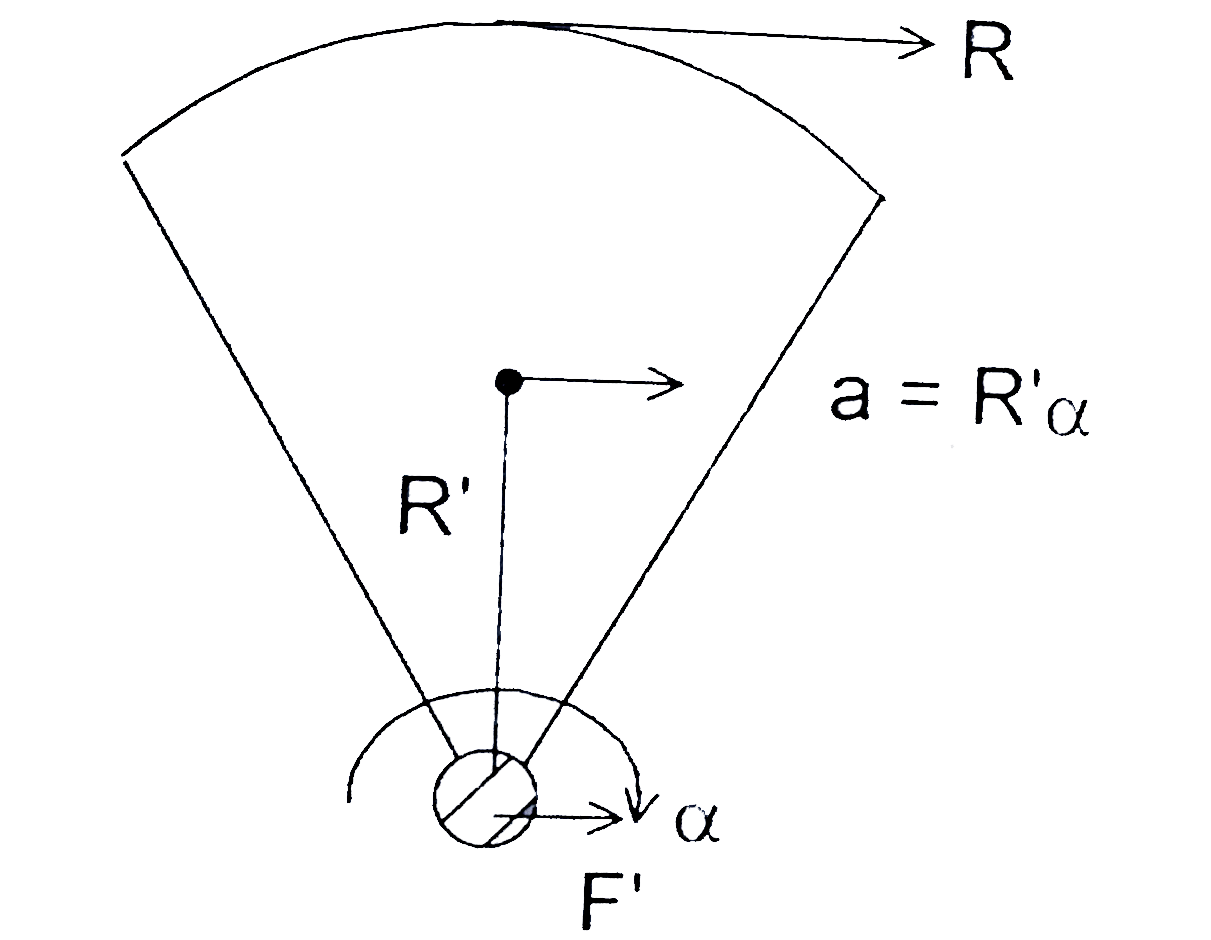 POSITION of C.O.M `= (2R)/(3)(sin((pi)/(6)))/(((pi)/(6))) = (2R)/(pi)=R` Acceleration of C.O.M `= (4F)/(mpi)` Hence `F+F' = (4R)/(mpi)m` `F' = ((4-pi)/(pi))F` |
|
| 19. |
The acceleration of a particle is increasing linearly with time t as bt. The particle starts from origin with an initial velocity u. The distance covered by the particle in time t is : |
|
Answer» `ut +(bt^(3))/(3)` |
|
| 20. |
प्रकाश के परावर्तन की घटना के कारण हम वस्तुओं को - |
|
Answer» समझ पाते हैं |
|
| 21. |
In Yonung's double-slit experiment, two slits which are separated by 1.2 mm are illuminated with a monochromatic light of wavelength 6000 ÅThe interference pattern is observed on a screen placed at a distance of 1 m from the slits. Find the number of bright fringes formed over 1 cm width on the screen. |
|
Answer» 25 |
|
| 22. |
The magnetic field due to a straight conductor of uniform cross - section of radius a and carrying a steady current is represented by |
|
Answer»
|
|
| 23. |
Which one of the following statement is true concerning an object executing simple harmonic motion? |
|
Answer» The object's velocity is never ZERO |
|
| 24. |
The Lenz's force acting on a conducting rod is _____ |
|
Answer» PROPORTIONAL to its velocity |
|
| 25. |
After rationalizing the Denominator of 7/(3sqrt3-2sqrt2)we get the denominator as |
|
Answer» 13 |
|
| 26. |
The edges of an aluminum cube are 10 cm long. One face of the cube is firmly fixed to a vertical wall. A mass of 100 kg is then attached to the opposite face of the cube. Shear modulus of aluminum is 25 xx 10^(9) Pa, the vertical deflection in the face to which mass is attached is |
|
Answer» `3.92xx10^(-7)m` |
|
| 27. |
Three point charges q, q & - 2q placed, at the corners of equilateral triangle of side 'L ' Calculate work done by external force in moving all the charges far apart without acceleration |
|
Answer» `(1)/(4 PI epsilon_(0)) (3 q^(2))/(L)` |
|
| 28. |
Special devices, like the klystron valve or the magnetron valve, are used for production of electromagnetic waves. Name these waves and also write one of their application. |
| Answer» SOLUTION :MICROWAVES. USED in MICROWAVE OVEN. | |
| 29. |
(I) Closed line integral means integral over a closed curve ( or line ) , ( symbol is oint(or ) underset(C ) oint (II) Right hand thumb Rule is used to determine the direction of magnetic moment Which one is correct statement ? |
|
Answer» I only |
|
| 30. |
If the lattice constant of this semiconductor is decreased , then which of the following is correct ? |
|
Answer» All `E_c,E_g,E_v` DECREASE |
|
| 31. |
The average energy of molecules in a sample of oxygen gas at 300K are 6.21 xx 10^(-21)J. The corresponding values at 600K are: |
|
Answer» `12.12xx10^(-21)J` `THEREFORE E.=2E=12.42 xx10^(-21) J` |
|
| 32. |
The plates of a charged parallel plate capacitor attract each other by a force F= ____________, where q = charge on each plate and A = area of each plates. |
| Answer» SOLUTION :`q^2/(2 epsi_0A)` | |
| 33. |
A particle of mass m makes a head-on elastic collision with a particle of mass 2m initially at rest. The velocity of the first particle before and after collision are given to be u_(1) and v_(1). Then which of the following statements is true in respect of this collision? |
|
Answer» For all values of `u_(1), v_(1)` will always be less than `u_(1)` in magnitude and `|v_(1)|=(u_(1))/3` Spring can be in the STATE of extension, compression, or natural length in equilibrium. |
|
| 34. |
A magnetic field vecB=B_0 sin (omegat)hatkcovers a large region where a wire AB slides smoothly over two parallel conductors separated by a distance d as in figure. The wires are in the xy-plane. The wire AB (of length d) has resistance R and the parallel wires have negligible resistance. If AB is moving with velocity v, what is the current in the circuit. What is the force needed to keep the wire moving at constant velocity ? |
|
Answer» Solution :SUPPOSE wire AB is at x =x at .t. TIME, Induced EMF in wire AB, `epsilon=(dphi)/(dt)` `=d/(dt)(AB)` `=d/(dt)[(dx).(B_0 sin (omegat))]` `=dB_0 d/(dt)[x xx sin (omegat)]` `=dB_0 [x d/(dt) sin (omegat)+ sin(omegat)(dx)/(dt)]` `=dB_0[xomegacos (omegat)+VSIN(omegat)]` Now induced current , `I=epsilon/R` `I=(B_0d)/R (x omegacos (omegat)+v sin (omegat)]` Force required to move rod with constant velocity F=IlB `F=I(B_0d)/R [ xomegacos(omegat)+v sin (omegat)](d)[B_0 sin (omegat)]` `F=(B_0^2d^2)/R [ xomega cos (omegat)+ vsin (omegat)] xx sin omegat` |
|
| 35. |
Arrive at Snell's law of refraction, using Huygen's principle for refraction of a plane wave. |
Answer» Solution :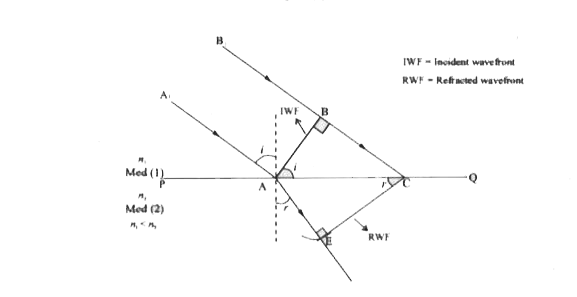 Distance AE=`v_2 TAU , tau` - time taken for opticalpath Distance BC = `v_1tau, i_1` - angle of incidencein medium (1) From the right angled `triangleABC` , sin I = `(BC)/(AC)` and from the right angled `triangleAEC` , sin R =`(AE)/(AC)` Hence, `(sin i)/(sin r)=(BC)/(AE)=(v_i tau)/(v_2 tau)` or `(sin i)/(sin r) =v_1/v_2` ....(1) By definition , absolute R.I of a mediumw.r.t air/vacuum=n=`c/v` for medium (1) = `n_1=c/v_1` for medium (2)=`n_2=c/v_2` So that , `v_1/v_2=n_2/n_1` ...(2) Using (2) in (1) we get `(sin i)/(sin r)=n_2/n_1` where , `n_2 > n_1`. or `n_1 sin i=n_2=sin r` ...(3) i.e., R.I. of medium(1) timessine of angle in the medium (1)=R.I of medium (2) times sine of anglein the medium 2. This expression (3) is known as the Snell.s law . The ratio `n_2/n_1` can be WRITTEN as `n_2` (R.I. of medium (2) w.r.t medium (1) . Note: From (1), `n_2=(sin i_1)/(sin i_2)=v_1/v_2=lambda_1/lambda_2` i.e., `v_1sin i_2=v_2sin i_1, lambda_2sini_1 =lambda_1 sin i_2` and `n_1 sin i_1 = n_2 sin i_2` |
|
| 36. |
Three capacitors of 2 mu F, 3mu F and 6 mu F are joinedin series and the combination is charged by means of a 24 V battery. The potential difference between the plates of the 6 muF capacitor is |
|
Answer» 4V `rArr `Potential DIFFERENCE ACROSS `6 mu F`CAPACITOR, `V_3 = 4V` |
|
| 37. |
How is forward biasing different from reverse biasing in a p-n junction diode ? |
Answer» SOLUTION :DISTINCTION between FORWARD BIASING and REVERSE biasing:
|
|
| 38. |
A star is moving away from an observer with a speed of 500 kms^(-1) .Calculate the Doppler shift if the wavelength of light emitted by the star is 6000Å. |
|
Answer» |
|
| 39. |
Define different types of magnetic materials and give one example in each case. |
|
Answer» Solution :On the basis of their behaviour in a magnetic field, the VARIOUS materials can be classified in three classes. (i) Diamagnetic substances. Those materials, which when placed in a magnetic field, are feebly magnetised in a direction opposite to the MAGNETISING field are called diamagnetic substances. A few examples of diamagnetic materials are : copper, zinc, bismuth, water, sodium chloride, helium, argon etc. When a diamagnetic substance is suspended in a magnetic field, it ARRANGES itself in the direction of the magnetic field. (ii) Paramagnetic substances. Those materials, which when placed in a magnetic field, are feebly magnetised in the direction of the magnetic field, are called paramagnetic substances. A few examples of paramagnetic substances are : aluminium, sodium, antimony, PLATINUM, copper chloride, liquid oxygen etc. When a paramagnetic substance is suspended in a magnetic field it arranges itself to the direction of magnetic field. (iii) Ferromagnetic substances. Those materials, which when placed in a magnetic field are strongly magnetised in the direction of the magnetising field, are ferromagnetic substances. A few examples of ferromagnetic substances are : iron, NICKEL, cobalt, alnico, mercury etc. |
|
| 40. |
If the angle of inclination of the inclined plane is sin^(-1) ((1)/(2)) when the body just starts sliding find the angle of repose and coefficient of static friction between the body and the inclined plane. |
|
Answer» `60^(@) , (2)/(sqrt3)` |
|
| 41. |
ABCDEF is a regular hexagon with point O as centre. The value of vec(AB) +vec(AC)+vec(AD)+vec(AE)+vec(AF) is: |
| Answer» Answer :C | |
| 42. |
The loss of energy in the form of heat in the iron core of a transformer is |
|
Answer» iron LOSS |
|
| 43. |
Two cities are 150 km apart. Electric power is sent from one city to another city through copper wires. The falI of potential per km is 8 volt and the average resistance per km is 0.5 Omega . The power loss in the wire is ..... |
|
Answer» 19.2 W TOTAL voltage drop V = `150 xx 8 = 1200` V Total resistance of wire R=` 0.5 xx 150 = 75 OMEGA ` Power loss in the wire, `(V^(2))/(R) = ((1200)^(2))/(75)` = 19200 W = 19.2 kW |
|
| 44. |
A capacitor 1mF withstands a maximum voltage of 6KV while another capacitor 2mF withstands a maximum voltage of 4KV. If the capacitors are connected in series, the system will withstand a maximum voltage of |
|
Answer» `2KV ` |
|
| 45. |
A cyclotron’s oscillator frequency is 10 MHz. What should be the operating magnetic field for accelerating protons?If the radius of its ‘dees’ is 60 cm, what is thekinetic energy (in MeV) of the proton beam produced by the accelerator. |
|
Answer» Solution : The OSCILLATOR FREQUENCY should be same as PROTON’s cyclotron frequency. Using eqs. We have `B = 2pi mv//q = 6.3 xx 1.67 xx 10^(-27) xx 10^7 // (1.6 xx 10^(-19) ) = 0.66 T` FINAL velocity of protons is `V = r xx 2pi v = 0.6 m xx 6.3 xx 10^7 = 3.78 xx 10^7 m//s` `E= 1//2 mv^2 = 1.67 xx 10^(-27) xx 14.3 xx 10^14 // (2 xx 1.6 xx 10^(-13)) = 7MeV` . |
|
| 46. |
How many NAND gates are used to from an AND gate ? |
|
Answer» 4 |
|
| 47. |
When viewing through a compound microscope , our eyes should be positioned not on the eyepiece but a short distance away from if for best viewing . Why ? How much should be the short distance between the eye and the eyepiece ? |
| Answer» Solution :The light rays coming from an object , after refraction through the eyepiece of the compound microscope passes through a SMALL circular region. If we place our eyes in this region , the image is viewed distinctly . Thisregion is the eye ring or exit ring . If we place our very near to the eyepiece , some of the refracted RAY would not reach the eye and field of viewwould DECREASES. Obviously the RIGHT position of the ring DEPENDS on the distance between the objective and eyepiece of the microscope. | |
| 48. |
A rectangular conducting loop B has its side lengths equal to b and a ( lt lt b). In the plane of the loop there is another very small loop A in shape of a square of side length x. Loop A is placed symmetrically with respect to B with its centre at a distance a from one of its longer side (see Figure). There is a current (i) in loop A which is made to increase at a constant rate of(di)/(dt) = alpha As^(–1). Calculate the emf induced in the bigger loop. |
|
Answer» |
|
| 49. |
A particle is dropped from a height 'H'. The de Broglie wavelength of the particle depends on height as |
|
Answer» H `lambda=(h)/(m SQRT(2gH))` HENCE, `lambda alpha H^(-1//2)` |
|