

Saved Bookmarks
This section includes 7 InterviewSolutions, each offering curated multiple-choice questions to sharpen your Current Affairs knowledge and support exam preparation. Choose a topic below to get started.
| 1. |
A coil of inductance 0.50 H and resistance 100 Omega is connected to a 240 V-50 Hz a.c. supply. What is the maximum current in the coil and the time lag between voltage maximum and current maximum ? |
|
Answer» |
|
| 2. |
At the polarising angle,the angle between reflected and refracted rays is |
|
Answer» `0^(@)` |
|
| 3. |
Derive mvr=(nh)/(2pi) using de-Broglie equation. |
Answer» SOLUTION :
|
|
| 4. |
(a) State Faraday's law of electromagnetic induction. (b) Figure 6.60 shows a rectangular conductor PQRS in which the conductor PQ is free to move in a uniform magnetic field B perpendicular to the plane of the paper. The field extends from x = 0 to x =b and is zero for gt b. Assume that only the arm PQ possesses resistance r. When the arm PQ is pulled outward from x =0 to x = 2b and is then moved backward to x = 0 with constant speed v, obtain the expressions for the flux and the induced emf. Sketch the variations of these quantities with distance 0 le x le 2b. |
|
Answer» Solution :(a) For Faraday.s laws of electromagnetic INDUCTION, see POINT Number 4 under the heading "Chapter At A Glance" (b) Refer to the figure given with the question LET us first consider the forward motion of the arm PQ from x = 0 to x = 2b. Obviously now the magnetic flux linked with the CIRCUIT SPQR is `phi_(B) = BA`. Hence, (i) `phi_(B) = Blx for 0 le x le b`, and (ii) `phi_(B) = Blb for b le x le 2b.` Consequently the INDUCED emf will `varespilon = - (dphi_(B))/dt.` Hence, (i) `varepsilon = - d/dt(Blx) =- Blv "for" 0 le x le b` and (ii) `varepsilon = - d/dt(Blb) = 0 "for" b le x le 2b` Again for the backward motion of the arm PQ from x = 2b to x = 0, the magnetic flux linked with the circuit SPQR is `phi_(B) =Blb le "for" b le x le2b` and (ii)`phi_(B) = Blx "for" 0 le x leb`.(and flux is gradually decreasing) As a result the induced emf will be (iii) `varepsilon = +Blv "for 0le x le b`. variation of magnetic flux and induced emf during forward and backward and motion of the arm PQ is shown Fig. 6.61. 
|
|
| 5. |
Regarding p-type and n-type semiconductors, which of the following statements is true? |
|
Answer» n-type SEMICONDUCTORS have FREE electrons in majority. |
|
| 6. |
A satellite orbits the earth near itssurface. By what amount does the satellite's clock fall behind the earth's clock in one revolution ?Assume that nonrelativistic analysis can be made to compute the speed of the satellite and only the time dialtion is to be taken into account for calculation of clock speeds. |
|
Answer» ` GMm/ R^(2) = mv^(2) / R ` or, ` v = (sqrt GM / R) ` `= [ (6.67 xx 10^(11) NM ^(2) kg)]/6400 xx 10^(3) m ]^(1/2)` `= 7910 m s(^-1). Thus . `v /c = 7910 / 3 xx 10 ^(5) ` or, (sqrt 1 - (v/c)^(2)) = [1 - 6.95 xx 10^(-10)] ^(1/2)` `~~ 1 - 3.48 xx 10^(10) ` The time taken by the satellite to complete one revolution (this is proper time and 5080 s is IMPROPER time. ), `t = (1- 3.48 xx 10^(-10)) xx (5080 s) ` or, `t / 5080 s = 1 - 3.48 xx 10^(-10) ` or, `(t - 5080 s )/ 5080 s = 3.48 xx10^(-6) s .` The satellite's clock falls behind by 1.77 xx 10^(-6)s. `in one revolution . |
|
| 7. |
A dipole lies on the x-axis, with the positive charge +q at x = +d//2 and the negative charge at x = -d//2. Find the electric flux phi_E through the yz plane midway between the charges. |
Answer» Solution :Net FLUX though YZ plane is `2(q/(2epsilon_0)) = q/epsilon_0`. 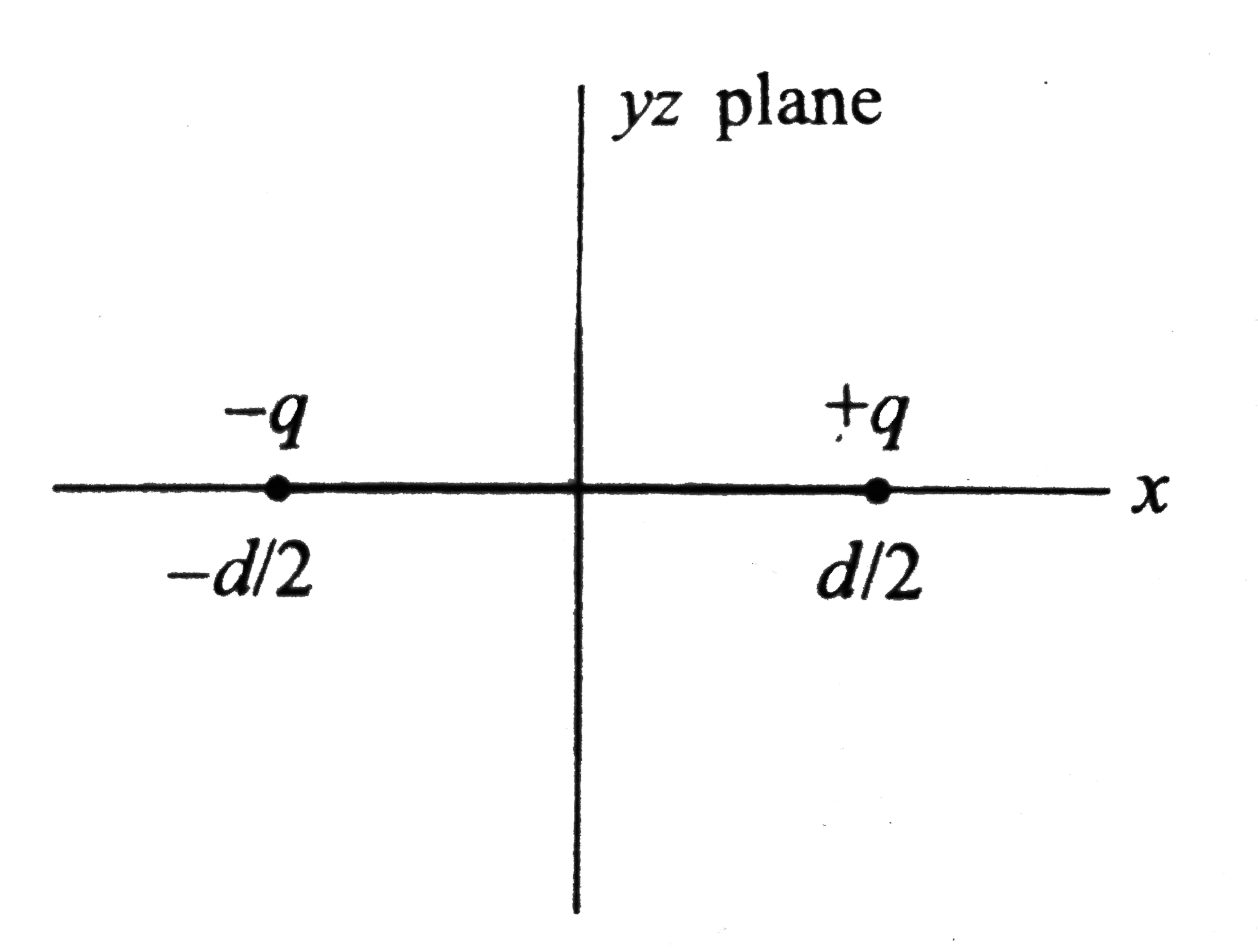 So flux depends upon q but is INDEPENDENT of d. |
|
| 8. |
In an A.C. Circuit, the current is given by I = 6 sin (200pit + pi/6)A The initial value of the current is : |
|
Answer» 1 A |
|
| 9. |
You are given two circuits as shown in fig. which consist of NAND gates . Identify the logic operation carried out by the two circuits . |
Answer» SOLUTION :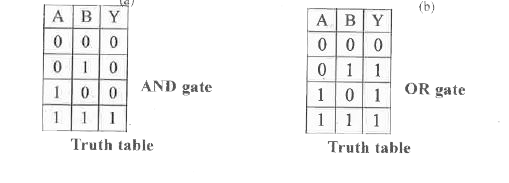
|
|
| 10. |
Light travels in two media A and B with speeds 1.8 xx 10^(8) ms^(-1) and 2.4 xx 10^(8) ms^(-1) respectively. Then the critical angle between them is : |
|
Answer» `SIN^(-1)((2)/(3))` `v_(B) = 2.4 xx 10^(8) ms^(-1)` Light travels slower in denser medium. Hence medium A is a denser medium and medium B is a rarer medium. Here, light travels from medium A to medium B. l=Let C be the critical angle between them. `thereforeC = A_(mu_(c))=(1)/(B_(mu_(A)))=(mu_(B))/(mu_(A))=(v_(A))/(v_(B)).` Refractive INDEX of medium B w.r.t medium A is `therefore sinC=(v_(A))/(v_(B))=(1.8xx10^(8))/(2.4xx10^(8))=(3)/(2)` `RARR "" C = sin^(-1)((3)/(4))`. |
|
| 11. |
State that a currentcarrying loop behaves as a magnetic dipole. Hence writean expression for its magnetic dipole moment . |
|
Answer» Solution :The magnetic FIELD from the centre of a circular LOOP of RADIUS R along the axis is given by `vecB = (mu_(0)I)/ 2 R^(2)/((R^(2) + z^(2))^(3/2))hatk` At large distance `z gt gt R`, therefore `R^(2) + z^(2) approx z^(2)`, we have `vecB = (mu_(0)I)/2 R^(2)/z^(3) hatk` .....(1) Let A be the area of the circular loop `A = pi R^(2)`. So rewriting the equation (1)in TERMS of area of the loop , we have `vecB = (mu_(0)I)/ (2 pi) A/z^(3) hatk` ` vecB = (mu_(0))/(4 pi) (2 I A)/z^(3) hatk ` ...(2) COMPARING equation (2) with equation (1) dimensionally, we get `p_(m) = IA` ltbr. where `p_(m) ` is called magnetic dipole moment . In vector notation, `vecp_(m) = I vecA`......(3) This implies that a current carrying circular loop behaves as a magnetic dipole of magnetic moment `vecp_(m)`. So, the magnetic dipole moment of any current loop is equal to the product of the current and area of the loop. |
|
| 12. |
When a mica plate of thickness 0.1mm is introduced in one of the interfering beams, the central fringe is displaced by a distance equal to 10 fringes. If the wavelength of the light is 6000 A^(0), the refractive index of the mica is |
|
Answer» `1.06` |
|
| 13. |
In the circuit shown in the figure, the ratio of V_(B) asV_(C) is |
|
Answer» `-2//5` NET EMF = 30V. Net `R =5Omega`. `i=(30)/(5)=6A` 
|
|
| 14. |
The speed of sound wave in a medium is 1200m/s. If 2400 waves are passing through a point in the medium inone minute ,the wavelength of the wave is |
|
Answer» 0.5m |
|
| 15. |
A magnetic field vec(B)=-B_(0)hat(i) exists within a sphere of radius R=v_(0)Tsqrt(3) where T is the time period of one revolution of a charged particle starting its motion form origin and moving with a velocity vce(v)_(0) = (v_0)/(2) sqrt(3) hat(i) - v_(0)/(2) hat(j). Find the number of turns that the particle will take to come out of the magnetic field. |
|
Answer» `v_(|/|) =(v_(0)sqrt(3))/(2)` will contributed to helical path. `T=2 pi (m)/(B_(0)Q)` Pitch, `P=v_(|/|)T=(v_(0)sqrt(3))/(2)T` Number of turns `= (R)/(P)=(v_()Tsqrt(3)(2))/(v_(0)sqrt(3)T) =2`. |
|
| 16. |
What is the value of x when the Wheatstone's network is balanced? P=500Omega, Q=800Omega, R=x+400, S=1000Omega |
|
Answer» <P> SOLUTION : `(P)/(Q)=(R )/(S)` `(500)/(800)=(x+400)/(1000)` `(x+400)/(1000)=(500)/(800)` `x+400=(500)/(800)xx1000=(5)/(8)xx1000` `x+400=0.625 xx1000` `x+400=625` `x=625-400` `x=225Omega` |
|
| 17. |
What is the principle of a moving coil Galvanometer ? |
| Answer» SOLUTION :It is BASED on the principle that when a current carrying conductor is PLACED in a magnetic FIELD, it experiences a TORQUE. | |
| 18. |
In Fig a conducting spherical shell of inner radius .x. and outer radius .y. is concentric with a larger conducting spherical shell of inner radius .a. and outer radius .b.. Inner shell has a total charge +3Q and the outer shell has a charge +5Q. Let r be thedistance of any point from the common centre O. |
|
Answer» |
|
| 19. |
When a capacitor having capacity 4xx10^-6F and potential difference 100 volt is discharged, the energy released in joules is: |
|
Answer» 0.01 |
|
| 20. |
State any four characteristics of blackbody radiation spectra. |
|
Answer» Solution :CHARACTERISTICS of blackbody RADIATION spectra: (1) The EMISSIVE power of a blackbody `E_lamda,`for every wavelength`lamda,`increases with increasing temperature. (2) Each curve has a characteristic form with a maximum for `E_lamda` at a certain wavelength `lamda_m` (3) `lamda_m` depends onlyon the absolute temperature of the blackbody and, with increasing temperature, shifts towards SHORTER wavelength (i.e. towards the ultraviolet end of the spectrum). (4) `lamda_mT` = a constant. (5) The area under each curve gives the total radiant power per unit area of a blackbody at that temperature and is proportional to `T^(4)` (Stefan's law). |
|
| 21. |
Are matter waves electro magnetic ? |
| Answer» SOLUTION :No, ELECTROMAGNETIC waves are produced by accelerating charged PARTICLES. | |
| 22. |
The work function of a metal is 4.2 e V, its threshold wavelength is : |
|
Answer» `4000 A^@` |
|
| 23. |
Which of the following is/are examples of periodic motion |
|
Answer» MOTION of BLADES of a fan |
|
| 24. |
In Young's experiment using monochromaticlight , the fringe pattern shifts by a certain distance on the screen when a mica sheet of refractive index 1.6 and thickness 2 micron is introduced in the path of one of the interfering waves. Themica sheet is then removed and the distance between the slits and the screen is doubled. it is found that the distance between successive maxima now is the same as the observed fringe shift upon the introduction of the mica sheet . The wavelength of light is |
|
Answer» `5762 Å` When the DISTANCE between the plane of slits and screen is CHANGED from D to 2D , then `BETA = (2D)/(d) lambda , (D)/(d) (mu -1) t = (2D (lambda))/(d) . . . (2)` `rArr lambda = (1)/(2) (mu -1)t` |
|
| 25. |
The de-Broglie wavelength of a particle of charge q and mass m is lamda. If its kinetic energy be K, then |
|
Answer» `lamda=(H)/(SQRT(MK))` |
|
| 26. |
Use the lens equation to deduce algebraically the following: "An object placed within the focus of a convex lens produces a virtual and enlarged image" |
|
Answer» Solution :`1/v - 1/U = 1/f " or "1/v = 1/f + 1/u` convex lens :f > 0, u < 0 (object on the left) For 0 < | u | < f ` 1/v = 1/f - (1)/(|u|)LT 0 "" i.e. ULT 0 `(image on left , virtual) Also for the case , ` (1)/(|u|) lt (1)/(|u|) i.e. |u| lt| v |`(image enlarged ) |
|
| 27. |
State the Lorenz's force and express it in vector form. Which pair of vectors are always perpendicular to each other? Derive the expression for the force acting on a currentcarrying conductor oflength L in a uniform magnetic field 'B'. |
|
Answer» Solution :When a point charge q(moving with a velocityvlocated at rat given time t) in presence of both the electric FIELD E (R ) and magnetic field B (r ) force on charge q due to B and E is `vec(F) = vec(F)_(e) + vec(F)_(m)=q vec E(r)+ vec(V) xx vec(B) (r)]`The force actsin a direction perpendicular to both the velocity and the magnetic field. If `vec(V) and vec(B)` are parallel or antiparallel `vec(V) xx vec(B)` is zero and maximum when V and B are perpendicular. When a current carrying conductor of length . L is placed in uniform magnetic field. Let the number density of charge carrier (electrons) be n and 'A' is the area of cross section so total number of charge carrier in conductor is nAL. For steady current I flowing in conductor each electron suffers drift velocity `V_(d)` in the presence of `vec(B)` the force `Fm = (naL )qV_(d) xx B` Here nqVd is current density (J) and `nqV_(d)//A` is I. HENCE, `F= [nqV_(d)]AL xxB=J Al xxB = Il xx B` L =VECTOR of magnitude L ( the length of the conductor and with a direction of current (I), which is not a vector). |
|
| 28. |
The average acceleration in one time period in S.H.M. is, |
|
Answer» `AOMEGA` |
|
| 30. |
Four very long wires are arranged as shown in the figure, so that their cross - section forms a square, with connections at the ends so that current I flow through all four wires. Length of each side of the formed such square is b. The magnetic field at the central point P (centre of the square) is |
|
Answer» `(mu_0I)/(PIB)` |
|
| 31. |
मानव नर में जनन और मूत्र प्रणाली की साझी अंत्य वाहिका है - |
|
Answer» मूत्रमार्ग |
|
| 32. |
In Bohr’s model of hydrogen atom, which of the following pairs of quantities are quantized |
|
Answer» ENERGY and LINEAR momentum |
|
| 33. |
Thewavelenght of sodium light in air is 5890Å. The velocity of light in air is 3 xx 10^(8) ms^(-1) The wavelenght of light in a glass of refractive index 1.6 would be close to |
|
Answer» 5890Å |
|
| 34. |
Find the magnitude of the force acting along the direc tion -6hati +2hatj +3hatk which displaces a particle from position (2, -1, 0) to a new position (1, 2, -1) and in doing so does a work of 5 units : |
|
Answer» 7/3 units =`hati+3hatj-hatk` Let |F| be the magnitude of the force then `vecF=|F|xx"UNIT vector along the direction of force"` `vecF=|F|xx([-6hati+2hatj-3hatk])/(sqrt(36+4+9))=(F)/(7)[-6hati+2hatj-3hatk]` Now `W=vecF.vecS` `:. 5=F/7[-6hati+2hatj-3hatk].[-hati+3hatj-hatk]` =`F/7(6+6+3)` or 35=15 F or `|F|=(35)/(15)=(7)/(13)`units. |
|
| 35. |
Two large conducting sphere carrying charges Q_1 and Q_2brought close to each other. Is the magnitude of electrostatic force between them is given exactly by (Q_1Q_2)/(4pi epsilon_@ r^2) ? |
| Answer» Solution :No because coulomb.s law is TRUE only for point in case of large conducting spheres, the distribution of CHARGES on the sphere MAY not be uniform. | |
| 36. |
What is the de Broglie wavelength associated with (a) an electron moving with a speed of 5.4xx10^(6)m//s, and (b) a ball of mass 150 g travelling at 30.0 m/s ? |
|
Answer» SOLUTION :For the electron: Mass `m=9.11xx10^(-31)kg`, speed `v=5.4xx10^(6)m//s`. Then, momentum `p=m=9.11xx10^(-31)(kg) xx 5.4xx10^(6)(m//s)` `p=4.92xx10^(-24)kg m//s` de BROGLIE wavelength, `lambda=h//p=(6.63xx10^(-34)JS)/(4.92xx10^(-24)kg m//s)=0.135nm` For the BALL : Mass `m.=0.150 kg`, speed `v.=30.0 m//s`. Then momentum `p.=m. v.=0.150(kg) xx 30.0(m//s)`. `p.=4.50 kg m//s` de Broglie wavelength `lambda.=h//p.=(6.63xx10^(-14)Js)/(4.50kg m//s)=1.47xx10^(-34)m` |
|
| 37. |
M_((g))toM_((g))^(+3)+3e^(-),DeltaH=600eV M_((g))^(+)to M_((g))^(+3)+2e^(-),DeltaH=500eV Calculate IE_(1) of M: |
|
Answer» 600eV |
|
| 38. |
Why can the interior of a conductor have no excess charge in the static situation? |
| Answer» SOLUTION :From Gauss.s LAW, there is no net charge ENCLOSED by the closed SURFACE. | |
| 39. |
The vagina is covered with a thin layer called |
|
Answer» hymen |
|
| 40. |
Distinguish between an intrinsic semiconductor and p-type semiconductor. Give reason, whya p-type semiconductor is electrically neutral, although n_(h) gt gt n_(e) . |
Answer» Solution : Ap-type SEMICONDUCTOR CRYSTAL is electrically neutral because the charge of ADDITIONAL charge carri- ers (i.e., holes) is just equal and OPPOSITE to that of the ionised cores in the crystal lattice. |
|
| 41. |
if the circuit is connected to a 110 V, 12 kHz supply? Hence, explain the statement that a capacitor is a conductor at very high frequencies. Compare this behaviour with that of a capacitor in a de circuit after the steady state. |
|
Answer» Solution :`I_(max)= (E_(max) )/(sqrt(R^2 + X_C^2) )` `E_(max) = 110 sqrt2 , R = 40 Omega, v = 12 kHz, C = 100 mu F` `I_(max)= 3.88A` B. `tan phi = (-1)/(omega CR) = - 0.2` or `phi` is NEARLY zero at high frequency .C. term being negligible at high frequency ,it ACTS like resistor . For stready dc, `v = 0` and `X_C = oo` . so it acts like an open circuit for dc. |
|
| 42. |
in the above equation if a constant force F is applied on the rod.Find the velocity of the rod as a function of time assuming it started with zero initial velocity. |
|
Answer» Solution :`m(dv)/(dt)=F-ilB`...(1) `i=(Blv)/(R+r)` ..(2) `m(dv)/(dt)=F-(B^(2)l^(2)V)/(R+r)` LET `K=(B^(2)l^(2))/(R+r)` `UNDERSET(0)overset(v)INT(dV)/(F-Kv)=underset(0)overset(t)int(dt)/(m)` `-1/K[ln(F-KV)]_(0)^(v)=t/m` `ln((F-kV)/F)=-(Kt)/m` `F-KV=F_(e)^(-kt//m)` `V=F/K(1-(e)^(-kt//m)` 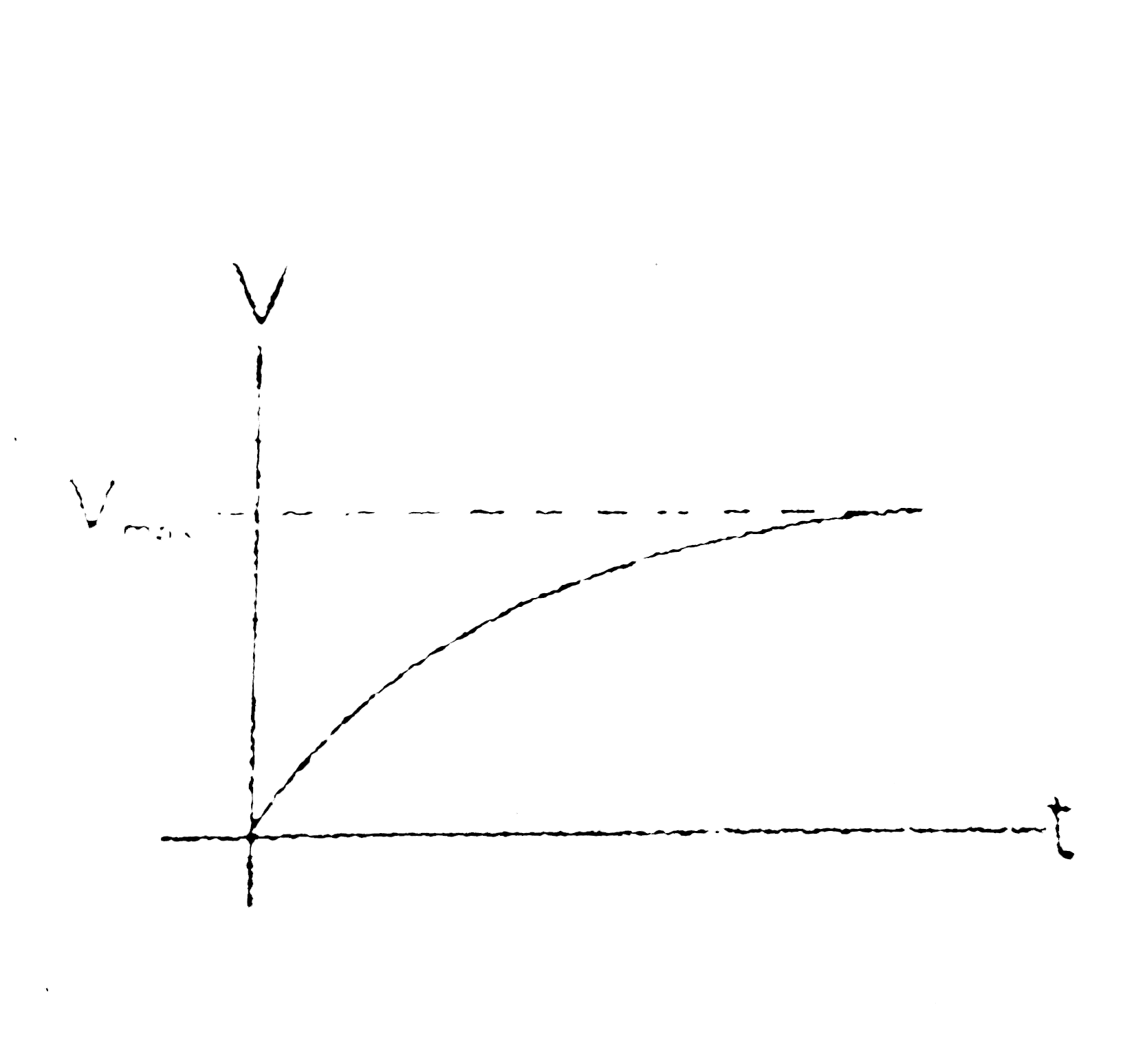
|
|
| 43. |
समुच्चय {1,2,3,4} के अरिक्त उपसमुच्चयों की संख्या है |
|
Answer» 16 |
|
| 44. |
A T.V tower is 150 m tall. If the area around the tower has a population density of 750" km"^(-2), then the population covered by the broadcasting tower is about , (Re = 6400 km) |
|
Answer» `4.5xx10^(6)` |
|
| 45. |
A straight conductor of length 32 cm carries a current of 30A. Magnetic induction at a point which is in air at a perpendicular distance of 12cm from the mid point of the conductor is |
|
Answer» 0.2 gauss |
|
| 46. |
A rectangular coil of sides l and b carrying a current I is subjected to a uniform magnetic field vecB acting perpendicular to its plane. Obtain the expression for the torque on it. |
|
Answer» Solution :We know that a rectangular coil of area A = lb , CARRYING a current I, when placed in a uniform MAGNETIC field B EXPERIENCES atorque `VEC(tau)= (I vecA) xx vecB`. As per question the magnetic field `vecB` acts perpendicular to the plane of the coil. It means that `vecB` is parallel to `vecA`. Hence Torque `|vec(tau)| = IAB sin theta = IAB sin 0^@ = 0` |
|
| 47. |
A nonconducting ring of uniform mass m, radius b and uniform linear charge density lambda is suspended as shown in figure in a gravity free space. There is uniform coaxial magnetic field B_0, pointing up in a circular region of radius 'a' (lt b). Now if this field is switched off, then:- |
|
Answer» There will be induced electric FIELD on periphery of ring, in anticlockwise sense when seen from above ` intvec(E).vec(dl)=-(dphi)/(dt)=-pia^(2)(dB)/(dt)=intEdl` There is force on small element dQ of ring, tangentially Now this force produces torque about axis of ring to rotate in anticlockwise sense, so `tau=int dQExxb=intlambdadlEb=lambdabintEdl=lambdabpia^(2)(dB)/(dt)` So impulse or torque `int taudt=lambdab pia^(2)int_(B_(0))^(2)dB=int taudt=lambdabpi a^(2)B_(0)` `L_(f)-L_(i)=DeltaL=inttau dt =lambda b pia^(2)B_(0) =Iomega` (in magnitude) It is indpendent of time taken `I omega_(f)-Iomega_(i)=lambdab pia^(2)B_(0)` where I is moment of inertia So, `omega_(f)=(lambdab pi a^(2)B_(0))/(mR^(2))` 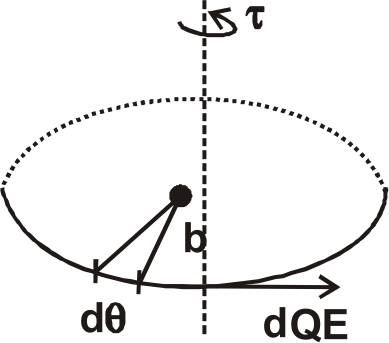
|
|
| 48. |
A ray of light is incident on a glass plate at an angle 60^@. What is the refractive index of glass, if the reflected and the refracted rays are at right angles? |
|
Answer» 44257 |
|
| 49. |
In Bohr atom model the orbit radii are in the ratio. |
|
Answer» 0.043090277777778 |
|
| 50. |
Assertion : An important application of electromagnetic induction is ac generator. Reason : The direction of current changes periodically and therefore the current is called alternating current. |
|
Answer»
|
|