

Saved Bookmarks
This section includes 7 InterviewSolutions, each offering curated multiple-choice questions to sharpen your Current Affairs knowledge and support exam preparation. Choose a topic below to get started.
| 1. |
A body is thrown up with velocity 40 ms^(-1).At same time another body is droped from a height 40m.Their relative acceleration after 1.3 seconds is |
|
Answer» 4g |
|
| 2. |
Two charges + 3.2 xx 10^(-19)C and - 3.2 xx10^(-19)C placed at 2.4A^@ apart form an electric dipole. It is placed in a uniform electric field of intensity 4 xx 10^5 volt/m. The electric dipole-moment is |
|
Answer» `15.36 xx 10^(-29)`coulomb `xx m` |
|
| 3. |
A coil with self inductance of 2.4H and resistance 12Omega is suddenly switched across a 120V direct current supply of negligible internal resistance. Determine (i) the time constant of the coil and (ii) the final steady current |
|
Answer» 0.2 SEC, 10A |
|
| 4. |
The selectivity of a series LCR a.c. circuit is large, when |
|
Answer» L is LARGE and R is large. |
|
| 5. |
A small insect crawls in the direction of electron drift along bare copper wire that carries a current of 2.56A. It travels with the drift speed of the electron in the wire of uniform cross-section area 1mm^2Number of free electrons for copper =8 times 10^22// ccand resistivity of copper =1.6 times 10^-8 Omega m If the insect starts from the point of zero potential atit reaches a point of ……potential after 10 sec |
|
Answer» 80`MU`V |
|
| 6. |
Define negative electric flux. |
| Answer» Solution :Negative electric FLUX : When the LINES of force are ENTERING a SURFACE , the flux is negative . In this case the lines of force CONVERGE. | |
| 7. |
A surface irradiated with light of wave length 480 nm gives out electron with maximum velocity v m/s, the cut off wave length being 600nm. The same surface would release electron with maximum velocity 2V, if it is irradiated by light of wave length |
|
Answer» 320 nm |
|
| 8. |
A small metal plate (work function W) is kept at a distance d from a singly ionized, fixed ion. A monochromatic light beam is incident on the metal plate and photoelectrons re emitted. Find the maximum wavelength of the light beam so that some of the photoelectrons may go round the ion along a circle. |
|
Answer» SOLUTION :Electron is moving around the ion in a Circle of radius .d.. Centripetal force is PROVIDED by Electrostatic force `(1)/(4piepsi_(0))(e^(2))/(d^(2))=(mV^(2))/(d),:.mV^(2)=(1)/(4piepsi_(0))(e^(2))/(d)` `:.K.E=(1)/(8piepsi_(0))(e^(2))/(d)"".......(1)` But `K.E_(max)=(hc)/(LAMDA)-W""......(2)` `:.(hc)/(lamda)-W=(e^(2))/(8piepsi_(0)d)` `:.lamda=(hc8piepsi_(0)d)/(e^(2)+8piepsi_(0)dW)` 
|
|
| 9. |
Statement -I :When we statrt filling the empty bucket with water, then the pitch of sound waves produced keeps on decreasing Statement-II : The frequency of boy's voice is usually greater than that of girls's voice. |
|
Answer» STATEMENT -I is true, Statement -II is true and |
|
| 10. |
(a) Using Ampere's circuital law, obtain the expression for the magnetic field due to a long solenoid at a point inside the solenoid on its axis. (b) In what respect is a toroid different from a solenoid ? Draw and copare the patern of the magnetic field lines in the two cases. (c) How is the magnetic field inside a given solenoid made strong? |
|
Answer» Solution :(b) The toroid is a hollow circular ring on which a large NUMBER of turns of an insulated copper wire are closely wound. Thus, toroid can be viewed as a solenoid which has been BENT into a circular shape to close on itself. Magnetic FIELD lines due to a solenoid and a toroid are given in fig. (a) and (b) respectivley. 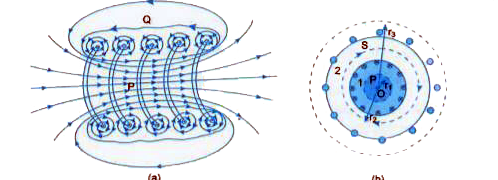 Magnetic field inside a solenoid is uniform, strong and along the axis of solenoid and field lines are almost PARALLEL lines. Magnetic field lines inside a toroid make a closed path. (c ) Magnetic field inside a given solenoid be made strong by INSERTING a soft iron core inside the solenoid. |
|
| 11. |
Assertion: No two electric lines of force can intersect each other. Reason:Tangent at any point of electric line of force gives the direction of electric field. |
|
Answer» Both Assertion and REASON are true and Reason is the CORRECT explanation of Assertion |
|
| 12. |
A balloonist release a ballast bag from a balloon rising at 40 ms at a time when the balloon is 100 m above the ground. If g = 10m/s2 then the bag reaches the ground in: |
|
Answer» `16 s^(-1)` or `t^(2)-8t-20=0` or `t=(8pmsqrt(64+80))/(2)=(8+12)/(2)=10S ` |
|
| 13. |
A potential difference V is applied across a given copper wire. If itsdiameter is doubled keeping all other factors constant, the drift velocity of electrons_____. |
| Answer» SOLUTION :REMAINS UNCHANGED | |
| 14. |
The magnetic resonance imaging is based on thephenomenon of |
|
Answer» ELECTRON spin RESONANCE |
|
| 15. |
The initial concentration of a radioactive substance is N_(0) and its half life is 12 hours. What will be its concentration after 36 hours? |
| Answer» Solution :CONCENTRATION after 36 h = Concentration after 3 half LIVES `=N_(0)((1)/(2))^(3)=(N_(0))/(8)`. | |
| 17. |
A small flat search coil of area 5 cm^(2) with 140 closely wound turns is placed between the poles of a powerful magnet producing magnetic field 0.09 T and then quickly removed out of the field region. Calculate (a) change of magnetic flux through the coil, and (b) emf induced in the coil. |
|
Answer» Solution :Here area of search COIL `A = 5 cm^(2) = 5 xx 10^(-4) m^(2)`, number of turns N = 140, magnetic field B = 0.09 T. (a) Initial magnetic FLUX `(phi_(B))_(i) = NBA = 140 xx 0.09 xx 5 x 10^(-4) = 6.3 xx 10^(-3)` Wb and final magnetic flux `(phi_(B)_(f) = 0. `therefore` Change of magnetic flux through the coil `Deltaphi_(B)=(phi_(B))_(i)-(phi_(B))_(f) = 6.3 xx 10^(-3)Wb` (b) If atime `Deltat` is SPENT in REMOVING the coil out of the magnetic field region, then magnitude of emf induced `|varepsilon| = (Deltaphi)/(Deltat) = (6.3 xx 10^(-3))/(Deltat)V` |
|
| 18. |
In a regular hexagon each corner is at a distance ‘r’ from the centre. Identical charges of magnitude 'Q' are placed at 5 corners. The field at the centre is (K= 1/(4 pi in_0)) |
|
Answer» `KQ//r^2` |
|
| 19. |
A system consisting of light wires and blocks is released from rest as shown in figure. The coefficient of kinetic friction between the blocks and surfaces is 0.1 and masses of blocks m_(1), m_(2) & m_(3) are 4 kg,4kg and 2 kg respectively. The cross section of the wire between m_(2) and m_(3) is 0.003 cm^(2) and its Young's Modulus is 2 xx 10^(11) N//m^(2). Calculate the acceleration of the block m_(2). (b) the longitudinal strain developed in the wire m_(2) and m_(3). |
|
Answer» |
|
| 20. |
The resistance of a nichrome wire at 0^(@)C is 10Omega. If its temperature coefficient of resistance is 0.004//^(@)C find its resistance at boiling point of water. Comment on the result. |
|
Answer» Solution :RESISTANCE of a nichrome wire at `0^(@)C, R_(0)=10OMEGA` Temperature co-efficient of resistance, `alpha=0.004//^(@)C` Resistance at boiling POINT of water, `R_(T)=?` Temperature of boiling point of water, `T=100^(@)C` `R_(T)=R_(0)(1+alphaT)=10[1+(0.004xx100)]` `R_(T)=10(1+0.4)=10xx1.4` `R_(T)=14Omega` As the temperature increases the resistance of the wire also increases. |
|
| 21. |
A deflection magnetometeris set in tan A position. A short bar magnetof moment4 A-m^(2) is placedon one of the arms with its axisin the direction of the earth'sfiled andwith its centre at a distanceof 0.2 m fromthe centreof the needle. Then the deflection in the compass box is found to be |
|
Answer» `0^(@)-0^(@)` |
|
| 22. |
The speed of electron in the orbit of hydrogen atom in the ground state is: |
|
Answer» C |
|
| 23. |
In the experiment to determine the speed of sound using a resonace column, |
|
Answer» prongs of the tuning fork are kept in a vertical plane. so correct CHOICE is (a ) . |
|
| 24. |
A ring of mass m and radius R rests in equilibrium on a smooth cone of semi-vertical angle 45^(@) as shown. The radius of the cone is 2R. the radius of circular crosssection of the ring is r(r lt lt R). What will be the speed of transverse wave on the ring? |
|
Answer» `SQRT(gR)` |
|
| 25. |
A ring of mass m and radius R rests in equilibrium on a smooth cone of semi-vertical angle 45^(@) as shown. The radius of the cone is 2R. the radius of circular crosssection of the ring is r(r lt lt R). What will be the tension in the ring? |
|
Answer» `(MG)/(2sqrt(2)PI)` 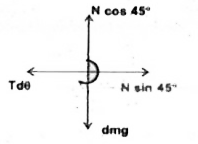 `(N)/(sqrt(2))=T d theta, (N)/(sqrt(2))=(m d theta)/(2pi)G` `rArr T=(mg)/(2pi)` |
|
| 26. |
Assume that the de-Brogile wave associated with an electron can form a standing wave between the atoms arranged in a one dimensional array with nodes at wach of the atomic sites. If is found that one such standing wave is formed if the distance 'd' between the atoms of the array is 2Å. A similar wave in again formed if 'd' is increased to 2.5 7 but not for any intermediate value of d. Find the energy of the electrons in electron volts and the least value of d for which the standing wave of the standing wave of the type described above can form. |
|
Answer» `(P+1). Lambda//2=2.5 Å` `:. Lambda//2=(2.5-2.0)Å=0.5 Å` or `lambda=1 Å=10^(-10) m`. de-Broglie WAVELENGTH is given by `lambda=H/p=(h)/sqrt(2Km)` K= KINETIC energy of ELECTRON `:. K=h^(2)/(2mlambda^(2))=((6.63xx10^(-34))^(2))/(2(9.1xx10^(-31))(10^(-10))^(2))=2.415xx10^(-17) J` `=((2.145xx10^(-17))/(1.6xx10^(-19)))eV=150.8 eV` |
|
| 27. |
Four resistance are connected by an ideal battery of emt 50 volt, circuit is in steady state then the current in write AB is : |
|
Answer» 1A  `R_(eq)=(3)/(4)+(8)/(6)=(25)/(12)impliesi_(0)=(V)/(R_(eq))=24Amp` . `i_(1)=(3)/(4)xx24=18Amp` ., `i_(2)=(4)/(6)xx24=32Amp` . CURRENT the branch `AB` `Deltai=2Amp` . |
|
| 28. |
A rangeof galvanometer is V when 50 Omega resistance is connected is connected in series its rangegets doubled when 500 Omegaresistance is connectedin series galvanometerresistance is |
|
Answer» `100 omega` If I is maximum current flowingthroughgalvanometer then `V= (R+G)I=(50+G)I` where V is the rangeof galvanometerwhen R= 50 `omega`is connectedin serieswith itand g isgalvanometer resistance when 500 `omega`resistnce is conncected in seriesthe rangebecomesdouble `2V=(500 +G)I` or `500 +G =100 +2Grarr G= 400 omega` |
|
| 29. |
Two particles A and B having equal charges +6 C, after being accelerated through the same potential difference, enter a region of uniform magnetic field and describe circular paths of radii 2 cm and 3cm respecitevely. The ratio of mass A to that of B is |
|
Answer» a. `4/9` |
|
| 30. |
A body executes S.H.M. under the influence of one force and has a period T_(1) second and the same body executes S.H.M. with period T_(2) second when under the influence of another force. When both forces act simultaneously and in the same direction, then the time period of the same body is : |
|
Answer» `(T_(1)+T_(2))s` |
|
| 31. |
Two idential coil of 5 turns each carry 1 A and 2 A current respectively. Assume they have common centre with their planes to each other. If their radius is 1 m each and direction of flow of current in the coils are in opposite directions, then the magnetic field produced on its axial line at a distance of sqrt(3) m from the common centre is (in tesla) |
| Answer» Solution :`(5)/(16) mu_0` | |
| 32. |
Obtain an experssion for the magnetic dipole moment of a revolving electron. |
|
Answer» Solution :Magnetic dipole moment of revolving electron : Suppose an electron udergoes circular motion around the nucleus. The circulating electron in a loop is like current in a circular loop (since flow of charge is current ). The magnetic dipole moment due to current carrying circular loop is `vec(mu_(L)) = I vec(A)"" `.........(1) In Magnitude , `mu_(L) = IA` IF T is the time period ofan electron , the current due to circular motion of the electron is I = `(-e)/(T)""`.......(2) Where -e is the charge of an electron. If R is the radius of the circular orbit and v is the velocity of the electron in the ciruclar orbit then `T = (2 pi R)/(v ) "" `...(3) Using equation (2) and equation (3) in equation (1), we get `mu_(L) = (e)/((2pi R)/(v)) pi R^(2) = - (EV R)/(2)""` ...(4) where A = `pi R^(2)` is the area of the circular loop. By definition, angular momentum of the electron about O is `vec(L) = vec(R) xxvec(P)` In magnitude , L = PR = mvR `""`...(5) Using equation (4) and equation (5), we get `(mu_(L))/(L) = -(2)/(mv R) = - (e)/(2m) rArr vec(mu_(L)) = - (e)/(2m) vec(L)` The negative sign indicates that the magnetic moment and angular momentum are in opposite direction. In magnitude. `(mu_(L))/(L) = (e)/(2m) = (1.60 xx 10^(-19))/(2 xx 9.11 xx 10^(-31)) = 0.0878xx 10^(12)` `(mu_(L))/(L) = 8.78 xx 10^(10) C kg^(-1)` = constant The ratio `(mu_(L))/(L)` is a constant and ALSO known as gyro-magnetic ratio `((e)/(2m))` . It must be noted that the gyro-magnetic ratio is a constant of proportionality which connects angular momentum of the electron and the magnetic moment of the electron. According to Neil.s Bohr quatization rule, the angular momentum of an electron moving in a stationary orbit is quantized, which means, l = nh = n `(h)/(2pi)` where, h is the planck.s constant `(h = 6.63 xx 10^(-34) J s)` and number n takes natural numbers(i.e, n = 1, 2,3....). hence, `mu_(L) = (e)/(2m) L = n (eh)/(4pi m) A m^(2)` `mu_(L) = n((1.60 xx 10^(-19))h)/(4pi m) Am^(2) = n ((1.60 xx 10^(-19)(6.63 x 10^(-34)))/(4xx 3.14xx (9.11 xx 10^(-31))))` `mu_(L) = n xx 9.27 xx 10^(-24) A m^(2)` the minimum magnetic moment can be obtained by substituting n = 1, `mu_(L) = 9.27 xx 10^(-24) A m^(2) = 9.27 xx 10^(-24) J T^(-1) = (mu_(L))_(min) = mu_(B)` Where, `mu_(B) = (eh)/(4pi m) = 9.27 xx 10^(-24) A m^(2)` is called Bohr magneton. This is a convenient unit with which ONE can measure atomic magnetic MOMENTS. 
|
|
| 33. |
a. Which law is demonstrated in the above figures? b. State the law. c. Explain the action that takes place in the above figures. |
|
Answer» Solution :a. Lenz.s law. b. The direction of the induced e.m.f. is given by Lenz.s law. The law state that the direction of the induced e.m.f. or current is such as to oppose the CAUSE that produced it. i.e., `varepsilonprop(-dphi_(B))/(dt),varepsilon=(-dphi_(B))/(dt)`, the constant of proportionality is unity. c. If fig E.4a, when the N-pole is introduced in the coil, induced current FLOWS so that the current in the coil is anticlockwise as seen from left. In fig E.4b, as the magnet is TAKEN away, the induced current flowing clockwise at the left end produces a SOUTH pole apposing the MOTION of North pole away. |
|
| 34. |
What is the value of magnetic susceptibility for paramagnetic material ? |
| Answer» SOLUTION :SMALL and POSITIVE | |
| 35. |
If the apparatus used in YDSE is immersed in water then what will happen to the fringe width. |
| Answer» SOLUTION :Fringe width DECREASES because `BETA'=(beta)/(N)` where 'n' is the medium. | |
| 36. |
A radiation of energy E falls normally on a perfectly reflecting surface. The momentum transferred to the surface is |
|
Answer» Solution :Initial momentum of RADIATION, `P_(1)=(E )/(C )` Final momentum of radiation, `P_(2)=-(E )/(C )` `:.` Momentum transferred to the surface `=P_(1)-P_(2)=(2E)/(C )` Thus Correct choice is (d). |
|
| 37. |
Which of the following is not a unit of distance ? |
|
Answer» parsec |
|
| 38. |
The moment of inertia of a thin sheet of mass M of the given shape about the specified axis is |
|
Answer» `(3//2)MR^(2)` |
|
| 39. |
Some physical quantities are given in Column I and some possible SI units in which these quantities may be expressed are given in Column II. Match the physical quantities in Column I with the units in Column II and indicate your answer by darkening appropriate bubbles in the 4xx4 matric given in the ORS. |
|
Answer» |
|
| 40. |
Thick and thin wires give rise to 3 different squares x, y and z as shown in figure. The magnetic field at the centre of |
|
Answer» X, y and Z is zero |
|
| 41. |
A particlewith specific charge q//m is located inside a roundsolenoid at a distance r fromits axis. With the currentswichted into the winding, the magnetic induction of the field generated by thesolenoid amountsto B. Find thevelocity of the particleand the curvatureradius of itstrajectory,n assumingthat duringthe increase of currentflowingin the solenoid the particle shifts by a negligible distance. |
|
Answer» Solution :When the magnetic field is beingset up in the solenoid, and ELECTRIC field will be induced in it, this will acceleratethe CHARGED paritcle. If `B` is the rate, at which the matgnetic field is increasing, then. `pi r^(2) dotB = 2pi r E` or `E = (1)/(2) r dotB` Thus, `m (dv)/(DT) = (1)/(2) r dotB q`, or `v = (qBr)/(2m)`, After the field is set up, the parcticlewill execute a circularmotionof radius`rho`, where `MV = B q rho`, or `rho = (1)/(2) r` |
|
| 42. |
Which conservation law is obeyed in Einstein's photo electric equation? |
|
Answer» Charge |
|
| 43. |
The value of the polynomial 5x − 4x^2 + 3, when x = −1 is |
|
Answer» -6 |
|
| 44. |
What will be the value of the galvanometer constant of 10 turns coil of a tangent galvanometer of radius 11cm ? |
|
Answer» 1000/7 |
|
| 45. |
Radioactive material .A. has decay constant .8 X. and material .B. has decay constant .X.. Initially they have same number of nuclei. After what time, the ratio of number of nuclei of material .B. to that .A. will be 1/e? |
|
Answer» `1/(9lamda)` |
|
| 46. |
In Figure. two pulses travel along a string in opposite directions. The wave speed v is 2.0 mls and the pulses are 6.0 cm apart at t =0. (a) Sketch the wave patterns when t is equal to 20 ms. (b) In what form (or type) is the energy ofthe pulse at t= 15 ms? |
Answer» SOLUTION :At t = 0 sec  (a) At t = 20ms. Distance travelled by the first pulse in 20 ms is `= Vt =2xx 20 xx 10^(-3) = 4cm`. Distance travelled by the second pulse in 20 ms is also `= Vt =2xx 20 xx 10^(-3) = 4cm`  (b) At t = 15 ms, by the principle of SUPERPOSITION resultant wave DISPLACEMENTIS zero. Hence, the shape of the string is straight at t = 15 ms. Hence, total energy is purely kinetic.  t = 15 ms. |
|
| 47. |
In given figure- |
|
Answer» EMITTER is FORWARD biased |
|
| 48. |
The distance between the two ends of the wings of a metallic aeroplane is 5 m. It is moving horizontally with a velocity of 360 km//hr. The carth's magnetic field all around its mouon is 4xx10^(-4) tesla and the angle of dip is 30^(@) Them, |
|
Answer» vertical component of cerths magnetic field is `2 xx 10^(-4)T` `= (360xx1000)/(3600)=100m//s` DISTANCE between the two ends of the wings of the aeroplane. l = 5 m. Intensity of Tarth.s magnetic field, `I = 4 xx 10^(-4)` tesla. Angle of dip at that place, `theta = 30^(@)` Since the aeroplane is moving horizontally, it will cut the magnetic lines of force due to the vertical component of earth.s magnetic field only. Now, the vertical component of Earth.s magnetic field is given by ` V =I sintheta =4XX 10^(-4) xx sin30^(@) =2 xx 10^(-4)` tesla 
|
|
| 49. |
A charged particle moving in a uniform magnetic field penetrates a layer of lead and thereby loses one half of its kinetic energy. How does the radius of curvature of its path change? Carry out calculations for both a relativistic and a nonrelativistic particle. |
|
Answer» (a) NONRELATIVISTIC particles. The momenta of the particle are proportional to the square roots of their kinetic ENERGIES, and therefore also proportional to the radii of their tracks. (B) Relativistic particles. In this CASE the dependence of the momentum on the kinetic energy of the particle is more complex: `p=1/c sqrt(K(2epis_(0)+K))` Hence we obtain the desired ratio of the radii of the tracks. |
|
| 50. |
If a particle is at rest with three velocities of 14 units, 16 units and 26 units on it, then the angle between the directions of the two smaller velocities is : |
|
Answer» 30° `|R|=sqrt(A^(2) + B^(2)+2ABcostheta)` `(26)^(2)=(14)^(2) + (16)^(2) + 2xx16 xx14costheta` On solving `costheta=1/2` or `theta=60^@` |
|