Saved Bookmarks
This section includes 7 InterviewSolutions, each offering curated multiple-choice questions to sharpen your Current Affairs knowledge and support exam preparation. Choose a topic below to get started.
| 1. |
The critical angular velocity w of a cylinder inside another cylinder containing a liquid at which its turbulence occurs depends on viscosity n. density d and the distance x between the walls of the cylinders. Then w is proportional to |
|
Answer» `(ETA)/(X^(2)d)` |
|
| 2. |
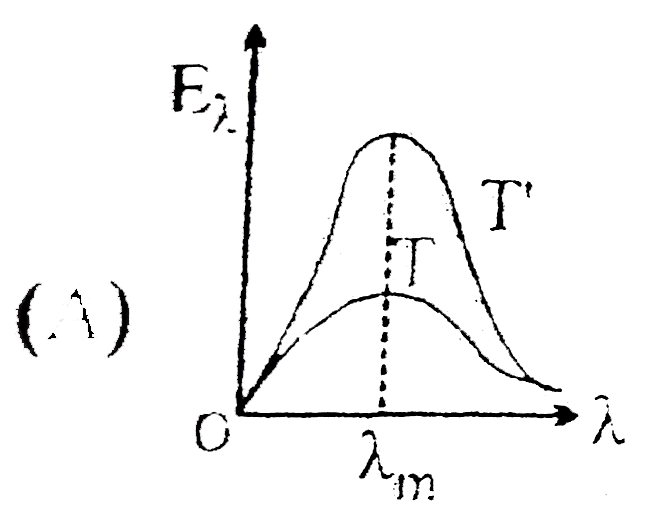
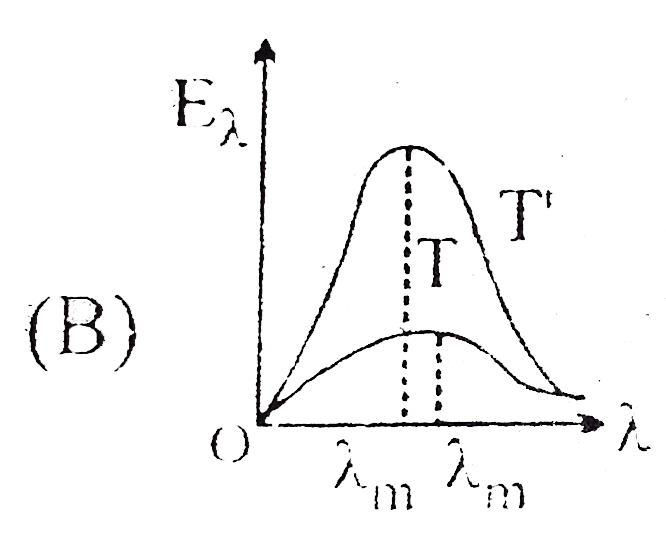
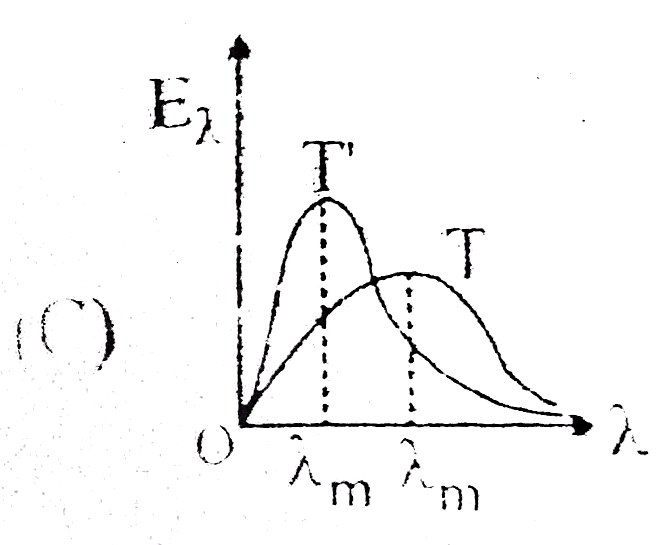
Identify the graph which correctly represents the spectral intensity versus wavelength graph at two temperatures T and T (TleT) |
|
Answer»
|
|
| 3. |
The graph shown in the adjacent diagram, represents the variation of temperature T of two bodies x and y having same surface area, with time (t) due to emission of radiation. Find the correct relation between the emissive and adsoptive powers of the two bodies : |
|
Answer» `E_(x)gtE_(y)` and `a_(y)lta_(y)` According to Kirchhoff.s LAW good emitters are good absorbers `:.a_(x)gta_(y)`. `:.` Coorect choice is (c ). |
|
| 4. |
Who wrote the chapter “What is wrong with Indian films”? |
|
Answer» SATYAJIT RAY |
|
| 5. |
In a video signal for transmission of picture what value of bandwidth is used in communication system? |
|
Answer» 2.4 MHz |
|
| 6. |
……potentail on collector w.r.t. emitter for which photo-electric current become zero is called stopping potential. |
|
Answer» MINIMUM negative |
|
| 7. |
Can the focal length of a thin convex lens be equal to it's radius of curvature ? |
| Answer» SOLUTION :YES, when `MU`=1.5,`R_1`=`-R_1`=R Then 1/f=`(mu-1)``(1/R_1-1/R_2)`IMPLIES f=R. | |
| 8. |
What are the conditions when capacitors is in mixed combination, that is parallel and series combination respectively? |
|
Answer» (III) (IV) (K) |
|
| 9. |
The ratio of wavelength of a photon and that of an electron of same energy E will be |
|
Answer» `SQRT((2m)/(E))` |
|
| 10. |
Displacement current I_(D) is given as |
|
Answer» `I_(D)=in_(0)(dphi_(E))/(dt)` |
|
| 11. |
Pandit Jawaharlal Nehru is very much known as a lover of |
|
Answer» CHILDREN |
|
| 12. |
Planck's constant (h), speed of light in vacuum (c) and Newton's gravitational constant (G) are three fundamental constants. Which of the following combination of these has the dimension of length ? |
|
Answer» `(SQRT(HG))/(C^(3//2))` |
|
| 13. |
An ionised H molecule consists of an electron and two protons . The protons are separated by a small distance of the order of angstrom. In the ground state |
|
Answer» the electron would not move in circular orbits |
|
| 14. |
What did the poet see in the Yellow Wood? |
|
Answer» TWO PATHS DIVERGING in DIFFERENT directions |
|
| 15. |
A circular ring of radius R with uniform positive charge density lambda per unit, length is located in the y-z plane with its centre at the origin O.A particle of mass m and positive charge q is projected from the point P(Rsqrt(3),O,O) on the positive x-axis directly towards O, with an initial kinetic energy (lambda q)/(4epsilon_(o)) |
|
Answer» The PARTICLE corses O and goes to infinity. |
|
| 16. |
The incident intensity on a horizontal surface at sea level from the sun is about 1kW m^(-2). Assuming that 50 per cent of this intensity is reflected and 50 per cent is absorbed, determine the radiation pressure on this horizontal surface (in pascals). |
|
Answer» <P>`8.2xx10^(-2)` Pressure exerted by reflected light `=(1)/(2)((2S)/(c ))` TOTAL radiation pressure on the surface is `P_(rad)=((3)/(2)S)/(c)=(1.5xx10^(3))/(3XX10^(8))=5xx10^(-6)` Pa `(P_(rad))/(P_0)=(5xx10^(-6))/(1xx10^(5))=5xx10^(-11)` |
|
| 17. |
The photoelectric threshold of Tungsten is 2300 A^@. The energy of the electrons ejected from the surface by ultraviolet light of wavelength 1800 A^@ is : (h == 6.6 xx 10^(34) J-s) |
| Answer» Answer :B | |
| 18. |
Consider a uniform electric fieldE=3×10^(3)i N//CWhat is the net flux of the uniform electric flux ofthrough a cube of side 20 cm oriented so that its faces are parellel to the coordinate planes? |
| Answer» Solution :Zero. The NUMBER of lines ENTERING the CUBE is the same as the number of lines leaving the cube. | |
| 19. |
The specific resistance of a wire of length 1m, area of cross-section 0.5 m^(2), is 25 micro-ohm cm. The resistance of the wire is |
|
Answer» `2 xx 10^(-6)` OHMS |
|
| 20. |
Show mathematically that the electric field due to a short dipole at a distance 'd' along its axis is twice the value of field at the same distance along the equatorial line. |
|
Answer» Solution :We KNOW that ELECTRIC field at a distance .d.along AXIS of an electric dipole is ` ""E_("axial") = (1)/( 4 PI in _0).(2pd)/((d^(2) -a^(2)) ^(2)) ` and for short dipole `(a lt lt d), ` we have ` ""E_("axial ")=(1)/(4 pi in _0).(2p)/(d^(3)) ` Again electric field at a distance .d. along the equatorial line of dipole is ` "" E_("equatorial ") = ( 1)/(4 pi in _0).(p)/( (d^(2) +a^(2)) ^(3//2)) ` and in case of a short dipole ` ""E_("equatorial") =(1)/(4 pi in _0).(p)/(d^(3)) ` Comparing (i) and (ii)we, have ` (E_("axial") )/(E_("equatorial")) = 2 or E_("axial") =2xx E_("equatorial")) ` |
|
| 21. |
The parameteralphaand betaare related to each other by the equation |
|
Answer» `ALPHA=(BETA)/((1+ beta))` |
|
| 22. |
Calculate the potential at point (0, 7 cm) due to a point charge of 0.2 muC placed at (0, 2 cm). |
| Answer» SOLUTION :`0.36xx10^(5)J` | |
| 23. |
The length of second hand in a watch is 1 cm. The change in velocity of the tip in 15 second is |
|
Answer» ZERO |
|
| 24. |
A magnet is placed in iron powder and then taken out, then maximum iron powder is at |
|
Answer» Some AWAY from north POLE |
|
| 25. |
The figure shows a schematic diagram showing the arrangement of Youngs'sDouble Slit Experiment If the distance d is varried, then identify the correct statement |
|
Answer» The angular width does not change |
|
| 26. |
The figure shows a schematic diagram showing the arrangement of Youngs'sDouble Slit Experiment If the distance D is varied, then choose the correct statement (s) |
|
Answer» The angular FRINGE width does not CHANGE |
|
| 27. |
How much work would it take to stop an object that has 30 J of kinetic energy? |
| Answer» Solution :To stop an object means to CHANGE its KINETIC energy to zero. So, if the initial kinetic energy is 30 J, then the change in kinetic energy has to be 0-30=-30J. By the work-energy theorem, `W_("total")=DeltaK`, the total AMOUNT of work that would be required is -30J. | |
| 28. |
A radioactive substance is dissolved in a liquid and the solution is heated.The activity of the solution |
|
Answer» Is smaller than that of element |
|
| 29. |
The length of the second's pendulum is increased by 0.1%. The clock : |
|
Answer» gains 43.2 s per DAY `:. (T_(2))/(T_(1))=sqrt((l_(2))/(l_(1)))=sqrt((100.1)/(100))=1.0005`. `impliesT_(2)=2(1.0005)=2.001`s Loss in time for `2" s"=2.001-2=0.001` s. `:.`Lossin time per day `=(0.001)/(2)xx24xx60xx60=43.2` s. So the CORRECT choice is (b). |
|
| 30. |
The transmission of heat by molecular collision is called |
|
Answer» conduction |
|
| 31. |
A cold coke bottle is left open on the pan of a balance and its weight observed from time to time, the weight |
|
Answer» increases |
|
| 32. |
Monochromatic plane waves of light are incident normally on a single slit. Which option correctly shows the diffraction pattern observed on a distant screen? |
|
Answer»
|
|
| 33. |
Einstein was the first to establish the equivalence between mass and energy. According to him, whenever a certain mass (Deltam) disappears in some process, the amount of energy releasedis E=(Deltam)c^(2), where c, is velocity of light in vacuum (=3xx10^(8)m//s). The reverse is also true, i.e., whenever energy E disappears, anequivalent mass (Deltam)=E//c^(2). Read the above passage and answer the following questions: (i) What is the energy released when 1a.m.u. of mass in a nuclear reaction? (ii) Do you want know any phenomenon in which energy materialises? (iii) What values of life do you learn form this famous relation? |
|
Answer» Solution :(i) Here, `Deltam=1a.m.u. =1.66xx10^(-27)kg` `E=(Deltam)c^(2)=1.66xx10^(-27)(3XX10^(8))^(2)=1.49xx10^(-10)J` (ii) Yes, in the phenomenon of pair production. Under suitable conditions, a photon materialises into an electron and a postion : `gamma=e^(-1)+e^(+1)` (ii) Einstein's relation, `E=(Deltam)c^(2)` emphasies that when certain mass disppears, an equivalent amount of energy APPEARS. The reverse is also true. It IMPLIES that to gain somethings, you have to lose another in equivalent amount. No one can have all gains together or all LOSSES together. It also implies that nothing comes for free. You have to pay the price in one form and acquire something in the desired form. |
|
| 34. |
Find the ratio of energies of photons produced due to transition of an electron of hydrogen atom from its . (i)second permitted energy level to the first level, and (ii) the highest permitted energy level to the first permitted level. |
|
Answer» Solution : Energy of an electron in nth permitted energy LEVEL is GIVEN by `E_(n th) = (13.6)/(n^(2)) eV` Energy of photon produced due to transition of an electron from second permitted energy level to the firstlevel ` E = E_(2) =- (13.6)/((2)^(2)) = (-(13.6)/((1)^(2)))eV = 10.4 eV` and energy of photon produced due to transition of an electron from highest permitted energy level to the FIRST level TOTHE firstlevel ` E = E - E_(1) = (13.6)/((oo)^(2)) - (-(13.6)/(1))eV = 13.6eV` `RARR "" (E)/(E) = (10.4)/(13.6) = (3)/(4)` |
|
| 35. |
For a particle undergoing S.H.M. The velocity is plotted againts displacement. The curve will be |
|
Answer» a STRAIGHT line |
|
| 36. |
At the out set it appears as though the principle of superposition is similar to the additive property. But, it is not so. Can you guess the important difference? |
| Answer» SOLUTION :The ELECTROSTATIC FORCES are to be ADDED vectorially. | |
| 37. |
A potential barrier V volts exists across a P-N junction. The thickness of the depletion region is 'd'. An electron with velocity 'v' approaches P-N junction from N-side. The velocity of the electron across the junction is |
|
Answer» `SQRT(V^2 +(2Ve)/(m))` |
|
| 38. |
An electric point dipole is placed at the origin O with its dipolemoment along the X-axis . A pointA is at a distance r from the origin such that OA makes an angle pi//3 with the X -axis if the electric field vec( E) due to the dipole at A makes an angle theta with the positive X-axis, the value of theta is |
|
Answer» `pi//3` |
|
| 39. |
Identify incorrect for electric charge q |
|
Answer» quantised |
|
| 40. |
What is plane polarised light ? Two polaroids are placed at 90^(@) to each other and the transmitted intensity is zero. What happens when one more polaroid is placed between these two, bisecting the angle between them ? How will the intensity of transmitted light vary on further rotating the third polaroid ? (b) If a light beam shows no intensity variation when transmitted through a polaroid, which is rotated, does it mean that the light is unpolarised ? Explain briefly. |
|
Answer» SOLUTION :(a) A plane polarised LIGHT is that in which all electric vectors of propagating light wave are constrained to oscillate in one particular plane perpendicular to the direction of propagation of light wave. Let intensity of light coming out of first polaroid be `I_(0)`, then transmitted intensity through second polaroid, placed at `90^(@)` to first, will be `I=I_(0)cos^(2)90^(@)=0` However, when one more (the third one) polaroid is placed between these two, bisecting the angle between them, i.e., at an angle of `45^(@)` to either polaroid then the intensity of final EMERGENT light will be `I=I_(0)(cos^(2)45^(@)).cos^(2)45^(@)=(I_(0))/(4)` As this additional polaroid is further rotated, let at an instant it is inclined at an angle `alpha` from 1st polaroid or `(90-alpha)` from second polaroid. then the intensity of final emergent light will be `I=(I_(0)cos^(2)alpha)cos^(2)(90^(@)-alpha)` `=I_(0)cos^(2)alphasin^(2)alpha=(I_(0))/(4)sin2alpha`. Thus, intensity of transmitted light I shows variation with `alpha` as shown in figure.  (b) If light beam shows no intensity variation when transmitted through a polaroid which is rotated, then we conclude that the original light is unpolarised one. in this light, plane of vibrations of electric vector randomly changes with time. when this TYPE of light, is passed through a polaroid, the intensity of transmitted light is only one half of the original intensity. however, on rotation of polaroid transmitted intensity remains constant. |
|
| 41. |
At the equator, the effective value of g is smaller than at the this the centripetal acceleration due to the Earth's rotation. The magnitude of the centripetal acceleration must be subtracted from the magnitude of the acceleration due pruely to gravity in order to obtain the effective value of (a) Calcule the fractional diminution of g at the equator. Express your result as a percentage (b) How short would hte Earth's period of rotation have be in order for objects at the equator to the weightless (that is in order for the effective value of g to be zero)? (c) How woud be the period found in part (b) compare with that of a satellite skimming the surface of an aireles Earth? |
|
Answer» |
|
| 42. |
Mean lives of a radioactive substance are 1620 and 405 years for alpha and beta -emission respectively. If alpha and beta decays are simultaneous, then time during which three fourth of the sample will decay is : |
|
Answer» 410 YEARS Also half-life period `T=0.93 tau=0.693 XX 324"years"` But `N/N_(0)=(1/2)^(l/T)` `1/R=(1/2)^(t//T) rArr (1/2)^(2) =(1/2)^(t//T) therefore t/t=2` `t=2T=2 xx 0.693 xx 324=449"years"` |
|
| 43. |
The liberal nationalism stands for: |
|
Answer» freedom for the individual and EQUALITY before law. |
|
| 44. |
In the figure shown, the image of a real object is formed at point 1. AB is the principal axis of the mirror. The mirror must be: |
|
Answer» CONCAVE & placed towards RIGHT I |
|
| 45. |
Saniya and Priya are friends. Both of them know that a small compass needle points always along north south direction. One day Saniya is plotting field due to a bar magnet in the laboratory. She discovers a point where compass needle does not point along N-S. Rather, it sets itself in any arbitrary direction. Saniya thinks first that compass needle has become faulty. Priya then explains to her the real situation. Read the above passage and answer the following questions: (i) How did Priya justify the situation? (ii) If a bar magnet is placed along N-S direction with its north pole pointing north, what is the position of neutral points? (iii) If a bar magnet is placed along N-S direction with its north pole pointing south, what is the position of neutral points? (iv) What values of life do you learn from this piece of knowledge? |
|
Answer» Solution :(i) Priya tells Saniya that while plotting FIELD due to a bar magnet, we obtain the resultant of the magnetic field of magnet and that of earth. At certain points, field due to the magnet becomes equal and opposite to the horizontal component of earth's field. Therefore, net magnetic field due to magnet and due to earth becomes zero at these points. These points are called neutral points. A small compass needle placed at a neutral point shall experience no force/torque due to magnetic field. Therefore, it can set itself in any arbitrary direction, which MAY be different from the USUAL N-S direction. (ii) When north pole of bar magnet is poiting north, two neutral points are obtained along E-W line passing through centre of magnet. (iii) When north pole of bar magnet is pointing south, two neutral points are obtained along the axis of the magnet on opposite sides from the centre of the magnet. (iv) From this piece of knowledge, we learrn that staying neutral in a situation is the best. If you are aligned to one group or person, you are forced to go by the dictates of that group, right or wrong. You are not idependent. If you are non aligned, you can LOOSE your own course of action without killing your CONSCIENCE. |
|
| 46. |
Radius of curvature of plano-convex lens is 10 cm. If its focal length is 30 cm, then its refractive index will be ....... |
|
Answer» 1.1 `1/f=(n-1)(1/R_1-1/R_2)` `(1)/(30)=(n-1)[(1)/(infty)-(1)/(-10)] implies (1)/(30)=(n-1)((1)/(10)) implies` `1/3=n-1 thereforen=4/3=1.33` |
|
| 47. |
Four convex lenses of focal lengths 1 cm, 2 cm, 10 cm and 50 cm are available. Best pair of lenses for making a telescope will be f_(0)=10 cm and f_(e)=50 cm. |
| Answer» SOLUTION :For making is telescope we shall choose lens of 100 cm focal length as OBJECTIVE and lens of focal length 1 cm as the EYEPIECE. | |
| 48. |
Equal lengths of manganin wire and constantan wire, of equal cross-sectional areas, are connected respectively in the left gap and right gap of a Wheatstone bridge which has a wire 90 cm long. If the null point is obtained at 44 cm from the left end, the ratio of the conductivity of manganin to that of constantan is |
|
Answer» `(11)/(14)` `"Also, "(R_(M))/(R_(C))=(l_(M))/(l_(C))=(44)/(90-44)=(44)/(46)=(22)/(23)` `therefore (sigma_(M))/(sigma_(C))=(R_(C))/(R_(M))=(23)/(22)` |
|
| 49. |
Compute the first three energy levels of doubly ionized lithium. What is the ionisation potential ? |
|
Answer» Solution :ENERGY `E_n = -(Z^2 mc^2 alpha^2)/(2n^2)` For hydrogen `Z = 1 and E_n = (-13.6 eV)/(n^2)` For lithium , `Z = 3 :. E_n = (-122.4)/(n^2) eV` `:. E_1 = -122.4 eV` Ionizaiton POTENTIAL = 122.4 VOLTS `E_2 = (-122.4)/4 = -30.8 eV, E_3 = (-122.4)/9 = -13.6 eV, E_4 = (-122.4)/(16) = -7.65 eV`. |
|
| 50. |
Mention the function of any two of the following used in communication system : (i) Transducer (ii) Repeater (iii) Transmitter (iv) Bandpass filter |
|
Answer» Solution :(i) Transducer : A device which converts energy from one form to another form. (ii) Repeater: A repeater is a combination of a receiver and a transmitter. (III) Transmitter : A transmitter PROCESSES the incoming meassage signal so as to make it suitable for transmission through a CHANNEL and for its subsequent reception. [Alternatively: A transmitter is a device used for sending the information in a COMMUNICATION system.] (iv) BANDPASS filter: A bandpass filter blocks lower and higher frequencies and allows only a selective band of frequencies to pass through. |
|