

Saved Bookmarks
This section includes 7 InterviewSolutions, each offering curated multiple-choice questions to sharpen your Current Affairs knowledge and support exam preparation. Choose a topic below to get started.
| 1. |
A thin double convex lens is cut into two equal pieces A and B by a plane containing principal axis. The piece B is further cut into two more pieces pieces C and D by another plane perpendicular to the principal axis. If the focal power of the original lens is P, then thos of A and C are |
|
Answer» <P>`P,P/4` |
|
| 2. |
A 3 kg ball strikes a heavy rigid wall with a speed of 10 ms at an angle of 60°. It gets reflected with the wall is for 0.20 s, what is the average force exerted on the ball by the wall ? |
|
Answer» 150 N `= 2 m upsilon sin theta` `F=(Deltap)/(Deltat)=(2xx3xx10)/(0.2)xx(sqrt3)/(2)=150sqrt3N` (C) is the choice. |
|
| 3. |
Show, that it is impossible to explain the nature of ferromagnetism on the basis of the interaction of magnetic dipoles. |
|
Answer» <P> Solution :Since the CURIC point of ferromagnetic naterials is of the order of hundreds of degrees Celsius, the energy of thermal motion is`vecepsi approx kT ....38 xx 10^(-23) xx 400 approx 5 xx 10^(-21)J` The energy of interaction of two magnetic moments is `epsi_(m)=p_(m) B =2mu_(0)v_(m)^2//4pir^3`. Putting `r approx 1A, p_(m)` we obtain `epsi_(m) approx (4pi xx 9.28^2 xx 10^(48))/(2pi xx 10^(7) xx 10^(-20)) approx 2 xx 10^(-23) J` We SEE that the intoraction energy of magnetic moments is by two orders of magnitude smaller than the energy of thermal motion, therefore inagnetic interaction is INCAPABLE of causing SPONTANEOUS magnetization inside a domain. |
|
| 4. |
Indian Civilization is ............... |
|
Answer» Godless |
|
| 5. |
A current of 10A in the primary of a circuit is reduced to zero at a uniform rate in 10^(-3) sec. If the coefficient of mutual inductance is 3 henry, what is the induced emf? |
| Answer» SOLUTION :`3 xx 10^(4)V` | |
| 6. |
This question is about a closed electrical black box with three terminals A, B and C as show. If is known that the electrical elements connecting the points A, B, C inside the box are resistance (if any) in delta formation. A student is provided a variable power supply, an ammeter and a voltmeter Schematic symbols for these elements are given in part (a). She is allowed to connect these elements externally between only two of the terminals (AB or BC of CA) at a time to form a suitable circuit. (a) Drawa suitable ci9ucuit using the above elemets to measure voltage across the terminals A and B and the current drawn from power supply as per Ohm's law. (b) She obtains the following readings in volt and millampera for the three possible connections to the blace box (b) She obtains the following readings in volt and millampere for the three possible connection to theblack box. {:("AB","BC","AC"),("V(V)/(mA)","V(V)/(mA)","(V(V)/(mA)"),("0.530.54","0.830.17","0.850.15"),("0.770.77","1.650.35","1.700.30"),("1.021.01","2.470.53","2.550.45"),("1.491.51","3.290.71","3.40.60"),("1.982.02","4.110.89","4.250.75"),("2.492.51","4.941.06","5.100.90"):} In each plot V (on Y-axis) -1 (on X-axis) on the graph papers provided. Preferably use a pencil to plot. Culculate the volues of resistances from the plots. Show your calculations below for each plot clearly indicating graph number. ( c) From your calculations above draw the arrangement of resistances inside the box indicating the values. |
|
Answer» (b) SEE graphs for the CALCULATIONS of slopes. `R_(AB)=0.98 kOmega, R_(BC)=4.60 kOmega, R_(CA)=5.67 kOmega` ( C) `(##RES_PHY_CE_E03_067_A02##)` |
|
| 7. |
A rocket has total mass 1000 kg with fuel of 900 kg. It ejects fuel at the rate of 1 kg/s with an exhaust velocity of 2 km//s relative to rocket. The maximum velocity attained by rockct is: |
|
Answer» `2.3 km//s` `=2.303xx2km//sxxlog(1000)/(1000-900)` `=4.6km//s.(log_(10)10=1)` Hence correct choice is (b). |
|
| 8. |
Figure shows a solid conducting sphere of radius 1 m. enclosed by a metallic shell of radius 3 m such that their centress coincide. If outer shell is given a charge of 6 muC and inner sphere is earthed, find megnitude charge on the surface of inner shell |
|
Answer» 1`mu`C |
|
| 9. |
LC oscillators have been used in circuits connected to loudspeakers to create some of the sounds of electronic music. What inductance must be used with a 6.7 muF capacitor to produce a frequency of 10 kHz, which is near the middle of the audible range of frequencies? |
|
Answer» |
|
| 10. |
The equation of a stationary wave is y = 2 sin ((pix)/(15)) cos (48 pit). The distance between a node and its next antinode is |
|
Answer» 22.5 UNITS Distance between node and NEXT antinode `x = (lamda)/4` `x = (lamda)/4 =(30)/4` = 7.5 units |
|
| 11. |
The radius of the first Bohr orbit in the hydrogen atom is ro. The radius of the third Bohr in the hydrogen atom will be_______ . |
| Answer» SOLUTION :`9r_(0).[ becauser_(n) = n^(2) r_(0)]` | |
| 12. |
What is a Zener diode ? Explain how it is used as a voltage regulator . |
|
Answer» Solution :Zener diode `:` Zener diode is a heavily doped germanium (or) silicon p-n JUNCTION diode. It words on reverse bias break down region. The circuit symbol of zener diode is shown in figure. 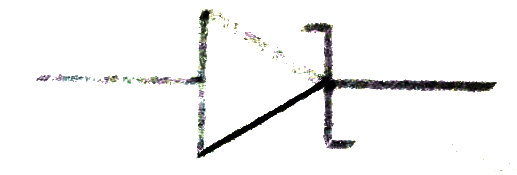 Zener diode can be used as a voltage regulator. In generalzener diodeis connected in reverse bias in the circuits. 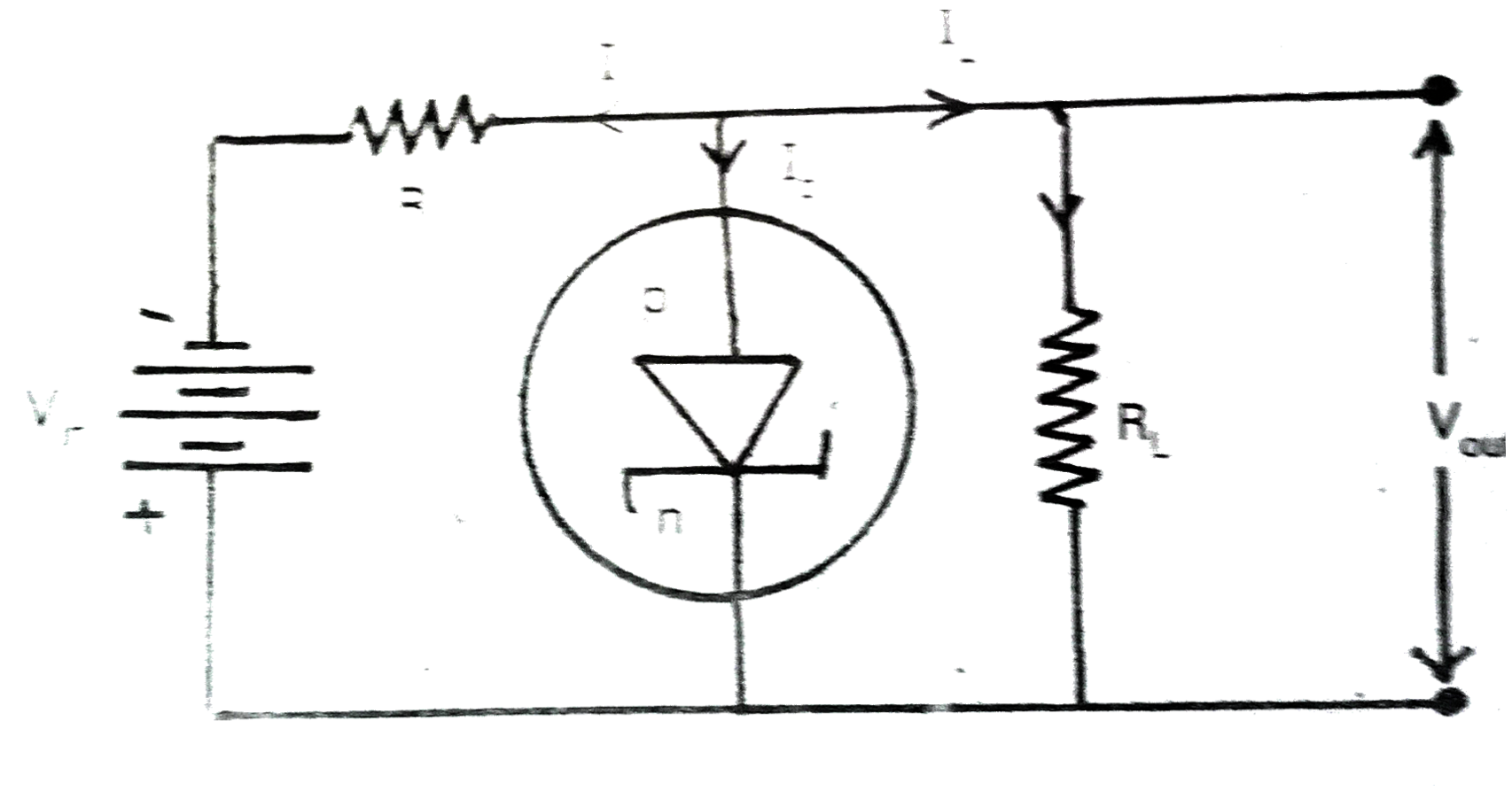 (i) The Zener diode is connected to a battery,through a resistance R.The battery reverse BIASES the zener diode. (ii) The load resistance `R_(L)` is connected across the terminals of the zener diode. (iii) The value of R is selected in such away that in the absenceof load `R_(L)` maximum safe current flows in the diode. (iv) Now consider that load is connected across the diode. The load draws a current. (v) Thecurrent through the diode falls by the same amount but the voltage drops across the load remains constant. (vi) The series resistance 'R' absorbs the output voltage fluctuations, so as to maintain constant voltage across the load. (vii) The voltage across the zener diode remains constant even if the load `R_(L)` varies. Thus, zener diodeworkds as voltage regulator. (viii) If I is the INPUT current,`I_(Z)` and `I_(L)` are zener and load currents. `I= I_(Z) + I_(L), V_( i n) + IR +V_(Z)` But `V_(out) = V_(Z)` `:. V_(out) = V_( i n ) - IR ` |
|
| 13. |
A charge Q is uniformly distributed over a long rod AB of length L as in figure. The electric potential at the point 0 lying at a distance L from the end A is : |
|
Answer» `(Q)/(8piepsilon_0L)` |
|
| 14. |
Assertion: Suceptibility is defined as the ration of intensity of magnetisation I to magnetic intensituy H. Reason: Greater the value of susceptibility smaller the value of intensity of magnetisation I. |
|
Answer» If both Assertain and Reason are TRUE and Reason is the correct explanation of Assertain Thys it OBVIOUS that greater the VALUE of susceptibility of a material greater will be the value of intensity of MAGNETISATION i.e. more easily it can be magnetised |
|
| 15. |
A monochromatic light is travelling in a medium of refractive index n = 1.6. It enters a stack of glass layers from the bottom side at an angle theta = 30^(@). The interfaces of the glass layers are parallel to each other. The refractive indices of different glass layers are monotonically decreasing as n_(m)=n-m Delta n, where n_(m) is the refractive index of the m^(th) slab and Delta n =0.1 (see the figure). The ray is refracted out parallel to the interface between the (m–1)^(th) and mth slabs from the right side of the stack. What is the value of m? |
|
Answer» |
|
| 16. |
A wire carrying current I is tied between points P and Q and is in the shape of a circular arch of radius R due to a uniform magnetic field B (perpendicular to the plane of the paper, shown by xxx) in the vicinity of the wore. If the wire subtends a angle 2theta_0 at the centre of the circle (of which it forms an arch) then the tension in the wire is : |
|
Answer» `(IBR)/( 2 SIN theta_0)` |
|
| 17. |
Draw a ray diagram for a convex mirror showing the image formation of an object placed anywhere in front of the mirror. Use this ray diagram to obtain the expression for its linear magnification. |
Answer» Solution :A ray diagram showing the image formation by a convex mirror of an object AB PLACED in front of it is given in Fig. 9.35. The image is virtual, erect and DIMINISHED in size. Consider `DeltaABP` and `DeltaA.B.P.`. Obviously, the two TRIANGLES are similar triangles. Hence, we have  `(A.B.)/(AB) = (PB.)/(PB)` Following the SIGN convention used, `PB =-u, PB. = +v`, `AB = +H` and `A.B. = +h.`. Thus, we have `h^(.)/h =(+v)/(-u) rArr` linear magnification `m=h^(.)/h =-v/u` 
|
|
| 18. |
In case of infinite long wire electric field is proportional to |
|
Answer» `1//r` |
|
| 19. |
A thin wire ring of radius "r" carries a charge q. Find the magnitude of the electric field strength on the axis of the ring as a function of distance L from the centre. Find the same for L gtgt r. Find maximum field strength and the corresponding distance L. |
|
Answer» Solution :Due to a ring ELECTRIC FIELD strength at a distance "L" from its centre on it can be given as `E = (qL)/(4 PI epsilon_0(L^2 + r^2)^(3//2)) to (1)` For `L gtgt r` we have `E = 1/(4 pi epsilon_0) q/(L^2)` Thus the ring behaves like a point charge. For `F_("Max") , (dE)/(dL) = 0` , From equation (1) we get `(dE)/(dL) = q/(4 pi epsilon_0) [((r^2 + L^2)^(3//2) - 3/2(r^2 + L^2)^(1//2) . 2L^2)/((r^2 + L^2)^3)] = 0` `(r^2 + L^2)^(3//2) = 3/2 (r^2 + L^2)^(1//2) xx 2L^2` On SOLVING we get `L = r/(sqrt2) to (2)` Substituting the value of "L" in equation (1) we get `E = 1/(4 pi epsilon_0) xx (q(r//sqrt(2)))/((r^2 + r^2//2)^(3//2)) = q/(6sqrt(3) pi epsilon_0 r^2)` |
|
| 20. |
Sparking of diamond is due to |
|
Answer» a) reflection |
|
| 21. |
The resistance of a coil for de is 5Omega. In case of ac, the resistance : |
|
Answer» will REMAIN `5OMEGA` |
|
| 22. |
It is desired to obtain a diffraction pattern for electrons using a diffraction grating with lines separated by 10 nm. The mass of an electron is 9.11 xx 10^(-31)kg. Suppose it is desired to observe diffraction effects for a beam of electromagnetic radiation using the same grating. Roughly, what is the required energy of the individual photons in the beam? |
|
Answer» `10^(-6) EV` |
|
| 23. |
In a certain region of space, electric field vecE and magnetic field vecB are perpendicular to each other. An electron enters in the region perpendicular to the direction of both vecB & vecE and moves undeflected. Find the velocity of electron. |
|
Answer» Solution :NET force an electron moving in the combined electric FIELD `VECE` and MAGNETIC field `vecB` is `vecF = - E [vecE + vecv xx vecB]` Since electronmoves undeflected then `vecF = 0 vecE + (vecv xx vecB)= 0 ` `|vecE| = (|vecv| xx | vecB|) rArr |vecv| = (|vecE|)/(|vecB|) ` |
|
| 24. |
Thermal radiations may exhibit the following phenomenon |
|
Answer» INTERFERENCE only |
|
| 25. |
A capacitor of capacitance 50 muF is charged to 100 volts. Its energy is equal to |
|
Answer» `25 xx 10^(-2) J` |
|
| 26. |
When light enters glass, its wavelength |
|
Answer» decreases |
|
| 27. |
A commonly used method of fastening one part to another part is called " shrink fitting." A steel rod has a diameter of 2.0026cm, and a flat plate contains a hole whose diameter is 2.0000cm. The rodis cooled so that it just fits into the hole. When the rod warms up, the enormous thermalstress exerted by the plate holds the rod securely to the plate. By how many Celsius degrees should the rod be cooled? |
|
Answer» |
|
| 28. |
In the above problem the root mean square velocity is |
| Answer» Solution :`C=sqrt((c_(1)^(2)+c_(2)^(2)+c_(3)^(2))/(3))` | |
| 29. |
The graphs in (i) and (ii) show the S-t graph and V -t graph of a body. Are the motions shown in the graphs represented by OAB the same ? |
|
Answer» Solution :The motion shown by the two graphs are not same. (i) In the given s-t graph OA, is a uniform retardation motion. Here, DISPLACEMENT =(average velocity) x (time) `therefore 10=((u+0)/2)xx4` `therefore u=5 MS^(-1)` using `v^2-u^2=2as` `0-5^2=2a(10)` `a=-1.25 ms^(-2)` (ii)In the given V-t graph OA is a uniform retardation of motion a =slope of the line -`(OA)/(OB)=(-4ms^(-1))/(4s)=-1ms^(-2)` Thus the two graphs even though represent uniform retardation MOTIONS, the magnitudes are not equal. |
|
| 30. |
Twoelectric lampsA and Bmarked 220 V, 100 W and220 V, 60 W respectively. Whichof thetwolamps hashigherresistance? |
|
Answer» <P> Solution :As`R = (V^2)/(P), 220 V, 60 W `lamphas higherresistance. |
|
| 31. |
The handle of the carpenter's acrew driver is much thicker than the handle of a watch maker's screw driver. Why ? |
| Answer» SOLUTION :A carpenter drives LARGE screws in HARD wood. Therefore, the torque required is large which is obtained by increasing the radius of the handle. WATCH maker REQUIRES small torque and hence smaller handle. | |
| 32. |
Given that the mass of a molecule of hydrogen is 3.34xx10^(-27) kg. Calculate Avogadro's number. |
|
Answer» Solution :MASS of one molecule of `H_(2)=3.34xx10^(-27)` kg Molecular mass of HYDROGEN `=2xx10^(-3)` kg The Avogadro's NUMBER `N_(A)`, which is the number of molecules in one gram molecule of hydrogen is given by `N_(A)=(2xx10^(-3))/(3.34xx10^(-27))=5.988xx10^(23)` molecules. |
|
| 33. |
Can there be electric potential at a point with zero electric intensity? |
|
Answer» Solution :Yes. There can exist potential at a point where the ELECTRICAL intensity is zero. Ex-1: In the case of charged spherical CONDUCTOR, the intensity of the ELECTRIC field is zero inside that conductor but the potential inside the spherical conductor is constant. Ex-2: Consider the similar CHARGES of equal magnitude separated by a distance. At the mid-point the electric field is zero. But there exists some potential as the potential due to the charge are of same POLARITY. |
|
| 34. |
ABC is an isosceles right angled triangular refecting prism of average refractive index mu. When incident rays on face AB are parallel to face BC, then they emerges from Face AC, which are also parallel to Face BC as shown in figure-I. The prims capable to do so, known as Dove Prism. In figure II, the Dove Prism is used for dispersion of incident light containing red colour and violet colour only. The red colour and violet colour lights are separated (displaced) on screen by a distance Deltal. In reality, each ray of any colour has some width, which can be designated as d. It is clear that an observer candistinguish the red and violet rays that emerges from prism only if Deltalged. Otherwise the bundles of rays will overlap and mix. [Given for Dove Prism in figure II: mu_(R)=sqrt(5/2),Deltamu=mu_(V)-mu_(R)=0.02, sqrt(5)=2.25, EF1m and AB=4cm] Find the maximum value of width d of bundle of rays that can be resolved at the outlet of Dove Prism as shown in the figureII |
|
Answer» `2.25xx10^(-3)m` `/_EMD+/_MDE=/_BEM` `implies beta(90-alpha)=45^(@)` `impliessin(beta+45^(@))gt(1/(mu))` `implies sin beta+cosbeta gt (sqrt(2))/(mu)`……….(1) 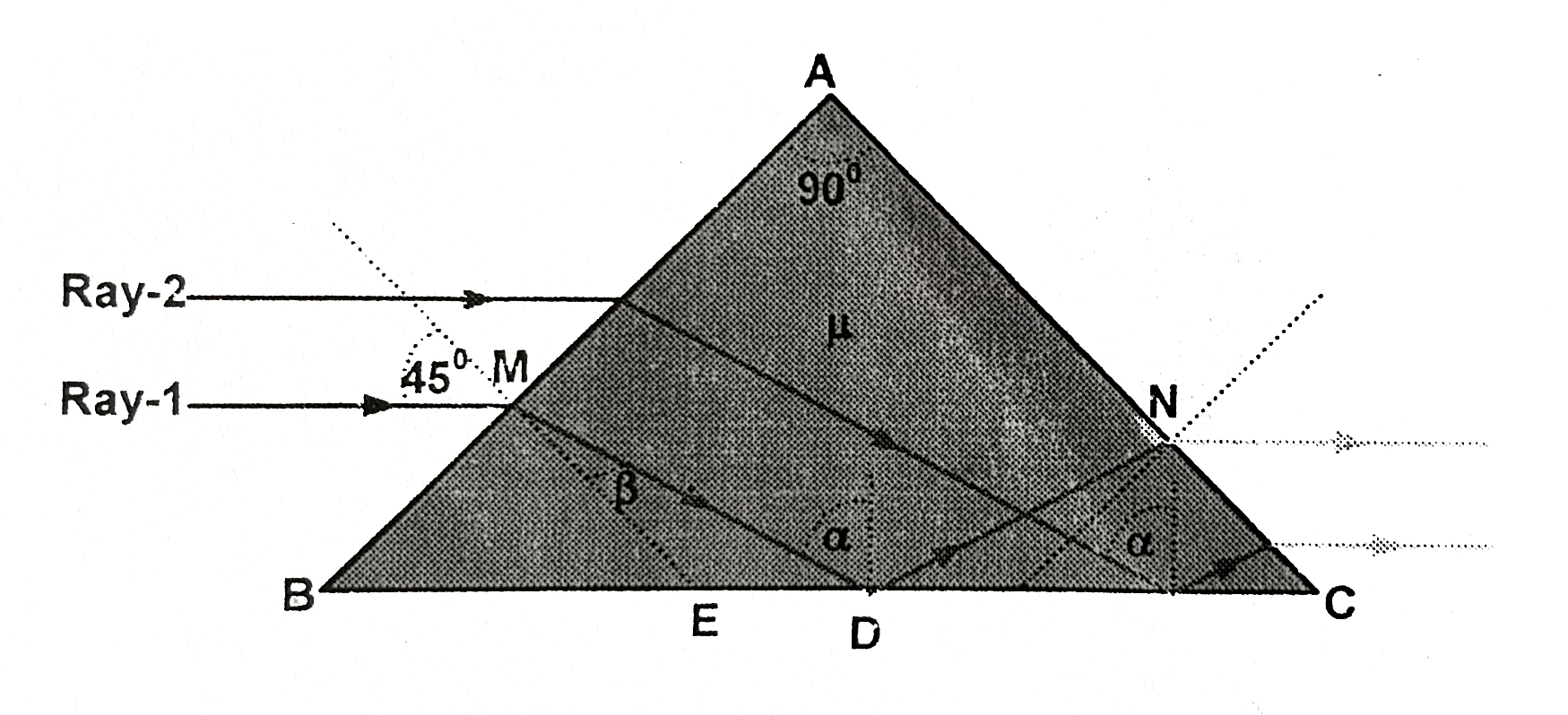 According to law of refraction at point `M`, we can write `1xxsin(45^(@))=musin betaimpliessin betas=1/(musqrt(2))impliescosbeta=sqrt(1-1/(2MU^(2))` Putting these value in equation (1), we have `1/(musqrt(2))+sqrt(1- 1/(2mu^(2))) gt (sqrt(2))/(mu)implies sqrt(2mu^(2)-1) gt 1implies mu gt 1` In figure II: Replace the Dove PRISM, by glass cube of side as `AB` 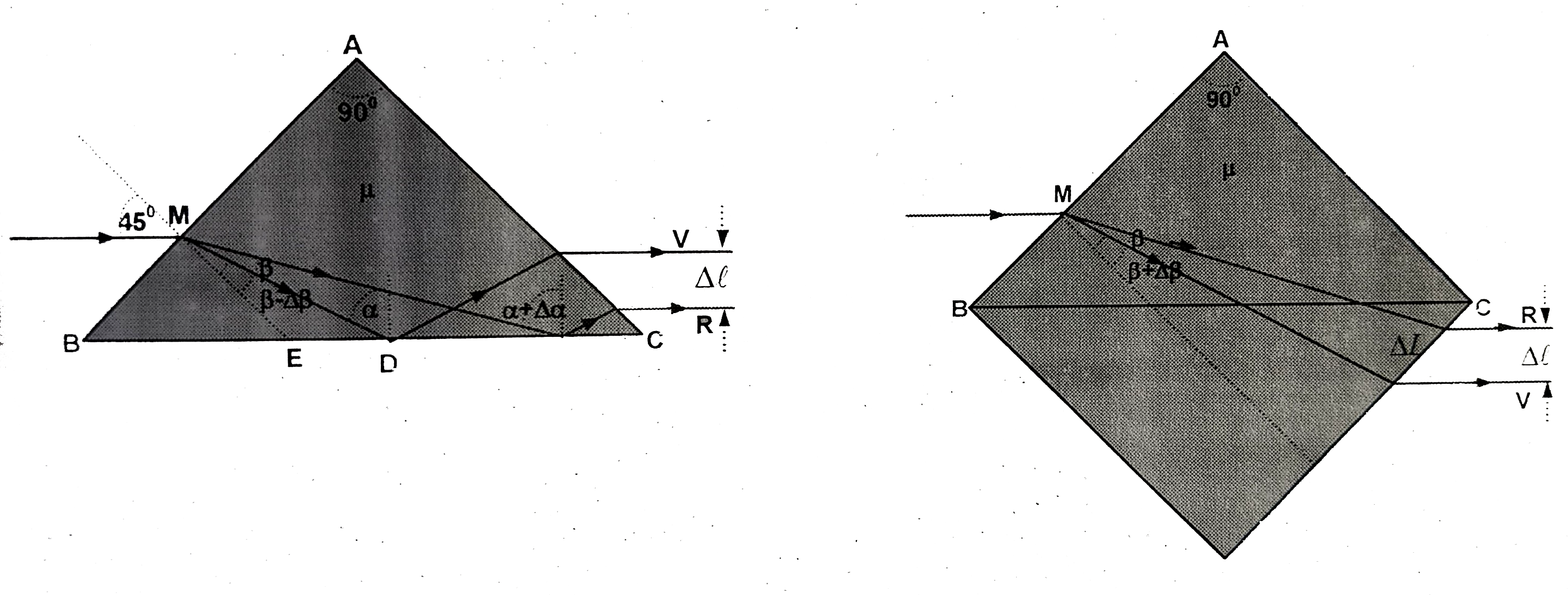 `Deltal=(DeltaL)/(sqrt(2))`.............(2) From geometry, we can write `sinbeta=1/(mu_(R)sqrt(2))` and `sin (beta-Deltabeta)=1/((mu_(R)+Deltamu_(R))sqrt(2))` `DeltaL=a tan beta-a tan (beta-Deltabeta)=1/(sqrt(2mu_(R)^(2)-1))-a/(sqrt(2(mu_(|r)+Deltamu)^(2)-1))` `impliesDelta=a/(sqrt(2mu_(R)^(2)-1))(1-sqrt((2mu_(R)^(2)-1)/(2(mu_(R)+Deltamu)^(2)-1)))=a/(sqrt(mu_(R)^(2)-1))(1-sqrt((2mu_(R)^(2)-1)/(2(mu_(R)+Deltamu)^(2)-1)))` `impliesDeltaL=a/(sqrt(2mu_(R)^(2)-1))(1-sqrt(2mu_(R)^(2)-1)/(2mu_(R)^(2)+4mu_(R)Deltamu+2(Deltamu)^(2)-1))` Neglecting the value `(Deltamu)^(2)`, we have `impliesDelta=a/(sqrt(2mu_(R)^(2)-1))(1-sqrt(1/(1+(4mu_(R)Deltamu)/(2mu_(R)^(2)-1))))-a/(sqrt(2m_(R)^(2)-1))(1-{1+(4mu_(R)Deltamu)/(2mu_(R)^(2)-1)}^(-1/2))` Expand binomially, we have `impliesDeltaL=(2amu_(R)Deltamu)/((2mu_(R)^(2)-1)^(3/2))` Putting this value in equation (2), we have `Deltal=(sqrt(2)amu_(R)Deltamu)/((2mu_(R)^(2)-1)^(3/2))` Secondmethod: `DeltaL=(d/(dbeta)(a tan beta))xxDeltabeta` `DeltaL=(asec^(2)beta)xxDeltabeta` Also `sinbeta=1/(sqrt(2)mu_(R))` `impliescos beta Deltabeta=1/(sqrt(2)mu_(R)^(2))Deltamu` `impliesDeltaL=(asec^(2)betaxxDeltamu)/(sqrt(mu_(R)^(2)cosbeta` `impliesDeltaL=(2amu_(R)Deltamu)/((2mu_(R)^(2)cosbeta)` THIRD method: `Deltal=(DeltaL)/(sqrt(2)), sin alpha = 1/ (mu_(r) sqrt(2)), sin beta=1/(mu_(v)sqrt(2))` `DeltaL=atan alpha =a tan beta` `=[1/(sqrt(2mu_(r)^(2)-1))-1/(sqrt(2mu_(v)^(2)-1))]` `=a[1/2-1/(2sqrt(1+mu_(r)Deltamu))]` `=a/2 [a-(1+mu_(r)Deltamu)^(-1//2)]` `=a/2[1-1+1/2mu_(r)Deltamu]` `=a/4mu_(r)Deltamu` `Deltal=(DeltaL)/(sqrt(2))=a/(4sqrt(2)) mu_(r)Deltamu=(4cm)/(4sqrt(2))xx(sqrt(5))/(sqrt(2))xx2/100` `=(sqrt(5))/100 cm = sqrt(5)xx10^(-4)m` `=2.25xx10^(-4)m` Since : `Deltal ge d` `impliesd le 2.25xx 10^(-4)m` `sqrt(2mu_(v)^(2)-1)=sqrt(2(mu_(r)+Deltamu)^(2)-1)` `impliessqrt(4+4mu_(r)Deltamu)[(Deltamu)^(2)~~0]` `=2sqrt(1+mu_(r)Deltamu)` 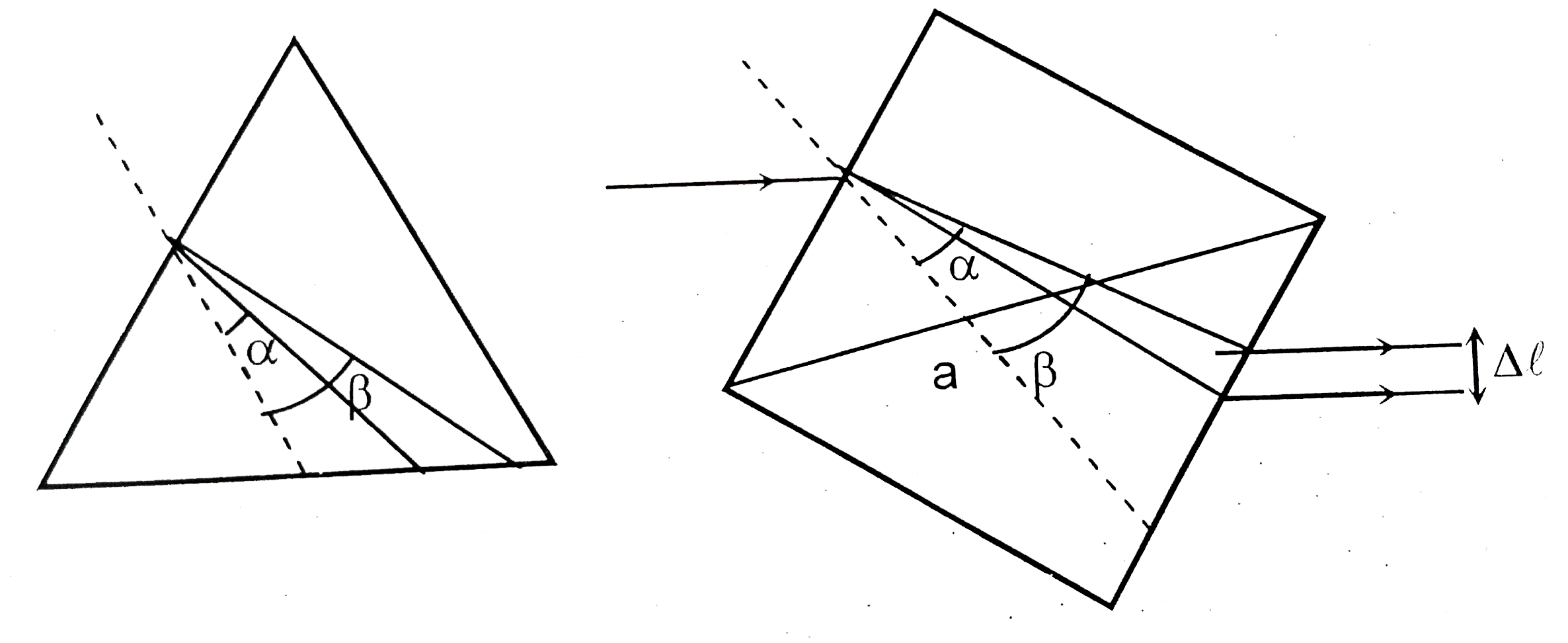
|
|
| 35. |
ABC is an isosceles right angled triangular refecting prism of average refractive index mu. When incident rays on face AB are paralel to face BC, then they emerges from Face AC, which are also parallel to Face BC as shown in figure-I. The prims capable to do so, known as Dove Prism. In figure II, the Dove Prism is used for dispersion of incident light containing red colour and violet colour only. The red colour and violet colour lights are separated (displaced) on screen by a distance Deltal. In reality, each ray of any colour has some width, whcih can be designated as d. It is clear that an observer candistinguish the red and violet rays that emerges from prism only if Deltalged. Otherwise the bundles of rays will overlap and mix. [Given for Dove Prism in figure II: mu_(R)=sqrt(5/2),Deltamu=mu_(V)-mu_(R)=0.02, sqrt(5)=2.25, EF1m and AB=4cm] Choose the INCORRECT option |
|
Answer» As per figure-I, the average refractive index of Dove Prism may be greater than 1 `/_EMD+/_MDE=/_BEM` `implies beta(90-alpha)=45^(@)` `impliessin(beta+45^(@))gt(1/(mu))` `implies SIN beta+cosbeta gt (sqrt(2))/(mu)`……….(1) 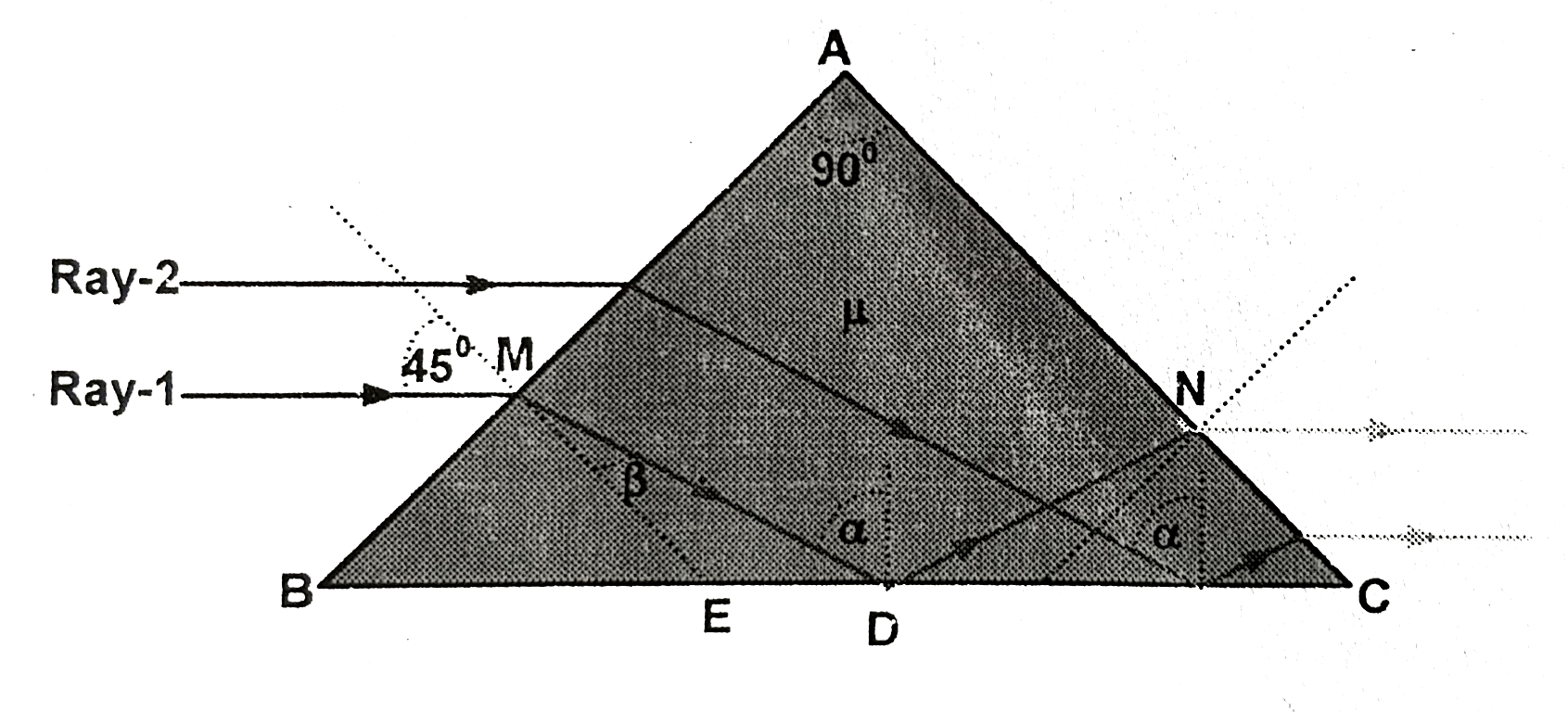 According to law of refraction at point `M`, we can write `1xxsin(45^(@))=musin betaimpliessin betas=1/(musqrt(2))impliescosbeta=sqrt(1-1/(2mu^(2))` Putting these value in equation (1), we have `1/(musqrt(2))+sqrt(1- 1/(2mu^(2))) gt (sqrt(2))/(mu)implies sqrt(2mu^(2)-1) gt 1implies mu gt 1` In figure II: Replace the Dove Prism, by glass cube of side as `AB` 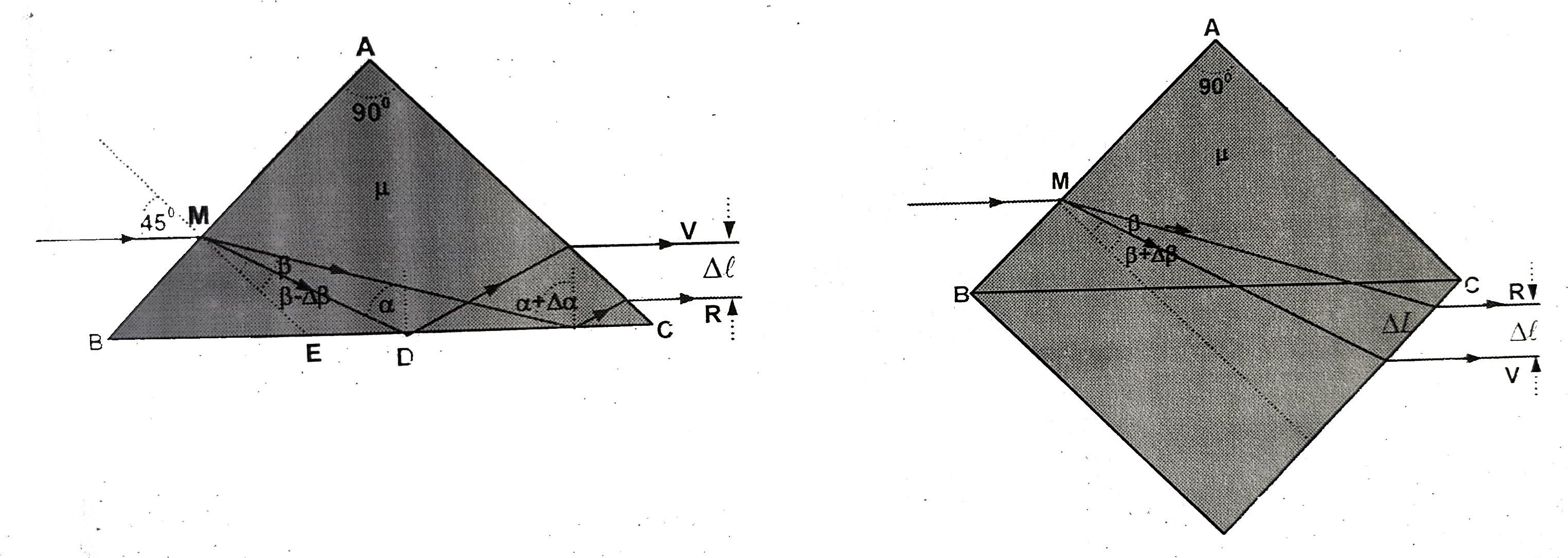 `Deltal=(DeltaL)/(sqrt(2))`.............(2) From geometry, we can write `sinbeta=1/(mu_(R)sqrt(2))` and `sin (beta-Deltabeta)=1/((mu_(R)+Deltamu_(R))sqrt(2))` `DeltaL=a tan beta-a tan (beta-Deltabeta)=1/(sqrt(2mu_(R)^(2)-1))-a/(sqrt(2(mu_(|r)+Deltamu)^(2)-1))` `impliesDelta=a/(sqrt(2mu_(R)^(2)-1))(1-sqrt((2mu_(R)^(2)-1)/(2(mu_(R)+Deltamu)^(2)-1)))=a/(sqrt(mu_(R)^(2)-1))(1-sqrt((2mu_(R)^(2)-1)/(2(mu_(R)+Deltamu)^(2)-1)))` `impliesDeltaL=a/(sqrt(2mu_(R)^(2)-1))(1-sqrt(2mu_(R)^(2)-1)/(2mu_(R)^(2)+4mu_(R)Deltamu+2(Deltamu)^(2)-1))` Neglecting the value `(Deltamu)^(2)`, we have `impliesDelta=a/(sqrt(2mu_(R)^(2)-1))(1-sqrt(1/(1+(4mu_(R)Deltamu)/(2mu_(R)^(2)-1))))-a/(sqrt(2m_(R)^(2)-1))(1-{1+(4mu_(R)Deltamu)/(2mu_(R)^(2)-1)}^(-1/2))` Expand binomially, we have `impliesDeltaL=(2amu_(R)Deltamu)/((2mu_(R)^(2)-1)^(3/2))` Putting this value in equation (2), we have `Deltal=(sqrt(2)amu_(R)Deltamu)/((2mu_(R)^(2)-1)^(3/2))` Secondmethod: `DeltaL=(d/(dbeta)(a tan beta))xxDeltabeta` `DeltaL=(asec^(2)beta)xxDeltabeta` Also `sinbeta=1/(sqrt(2)mu_(R))` `impliescos beta Deltabeta=1/(sqrt(2)mu_(R)^(2))Deltamu` `impliesDeltaL=(asec^(2)betaxxDeltamu)/(sqrt(mu_(R)^(2)cosbeta` `impliesDeltaL=(2amu_(R)Deltamu)/((2mu_(R)^(2)cosbeta)` Third method: `Deltal=(DeltaL)/(sqrt(2)), sin alpha = 1/ (mu_(r) sqrt(2)), sin beta=1/(mu_(v)sqrt(2))` `DeltaL=atan alpha =a tan beta` `=[1/(sqrt(2mu_(r)^(2)-1))-1/(sqrt(2mu_(v)^(2)-1))]` `=a[1/2-1/(2sqrt(1+mu_(r)Deltamu))]` `=a/2 [a-(1+mu_(r)Deltamu)^(-1//2)]` `=a/2[1-1+1/2mu_(r)Deltamu]` `=a/4mu_(r)Deltamu` `Deltal=(DeltaL)/(sqrt(2))=a/(4sqrt(2)) mu_(r)Deltamu=(4CM)/(4sqrt(2))xx(sqrt(5))/(sqrt(2))xx2/100` `=(sqrt(5))/100 CM = sqrt(5)xx10^(-4)m` `=2.25xx10^(-4)m` Since : `Deltal ge d` `impliesd le 2.25xx 10^(-4)m` `sqrt(2mu_(v)^(2)-1)=sqrt(2(mu_(r)+Deltamu)^(2)-1)` `impliessqrt(4+4mu_(r)Deltamu)[(Deltamu)^(2)~~0]` `=2sqrt(1+mu_(r)Deltamu)` 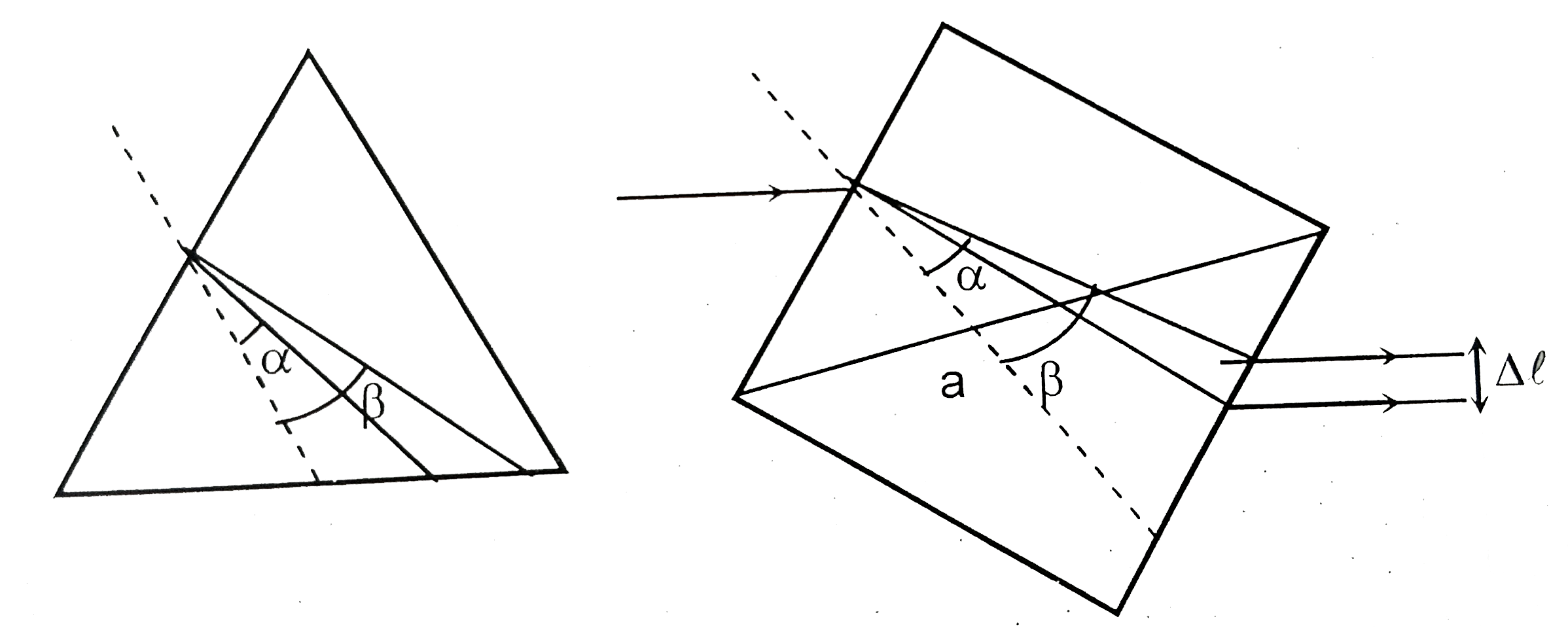
|
|
| 36. |
Two charges +3.2 xx 10^(-19)C and -3.2 xx 10^(-19)C placed at 2.4A^(@) apart form an electric dipole. It is placed in a uniform electric field of intensity 4 xx 10^(5) volt/m. The electric dipole- moment is |
|
Answer» `15.36 XX 10^(-29) "COULOMB" xx m` |
|
| 37. |
(a) What is the escape speed on a spherical asteroid whose radius is 700 km and whose gravitational acceleration at the surface is 4.5 m//s^2? (b) How far from the surface will a particle go if it leaves the asteroid's surface with a radial speed of 1000 m/s? (c) With what speed will an object hit the asteroid if it is dropped from 1000 km above the surface? |
| Answer» SOLUTION :(a) `2.5 xx10^3 m//s`, (B) `1.3 XX 10^5 m,` (C ) `1.9 xx 10^3 m//s` | |
| 38. |
A Source of frequency 10 KHz, when vibrated over the mouth of a closed organ pipe is in unison at300K. The beats produced when temperature rises by 1K is |
|
Answer» 30Hz |
|
| 39. |
A lens behaves as a converging lens in air and a diverging lens in water. The refractive index of the material of the lens is |
|
Answer» between UNITY and 1.33. |
|
| 40. |
In shown figure a triangular wedge and a cylinder each having equal mass m are released from rest. The vertical wall and horizontal surface are frictionless and between the wedge and the cylinder friction is sufficient to allow cylinder to roll over it choose correct option(s) |
|
Answer» Acceleration of wedge is `(G)/(3)` 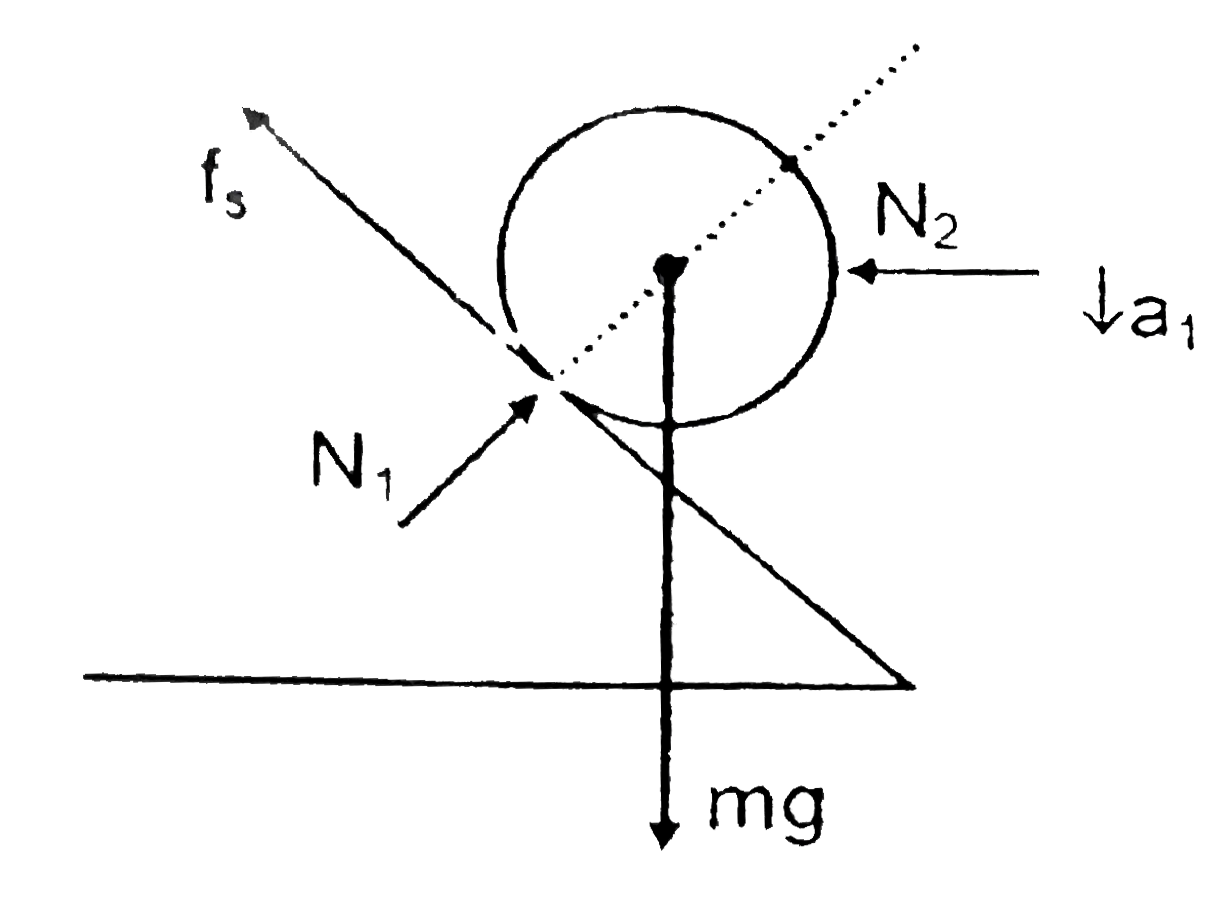 `mg-f_(s)sin45^(@)-N_(1)cos45^(@)=ma_(1)`.(1) `f_(s)R=(mR^(2))/(2)alpha`..(2) 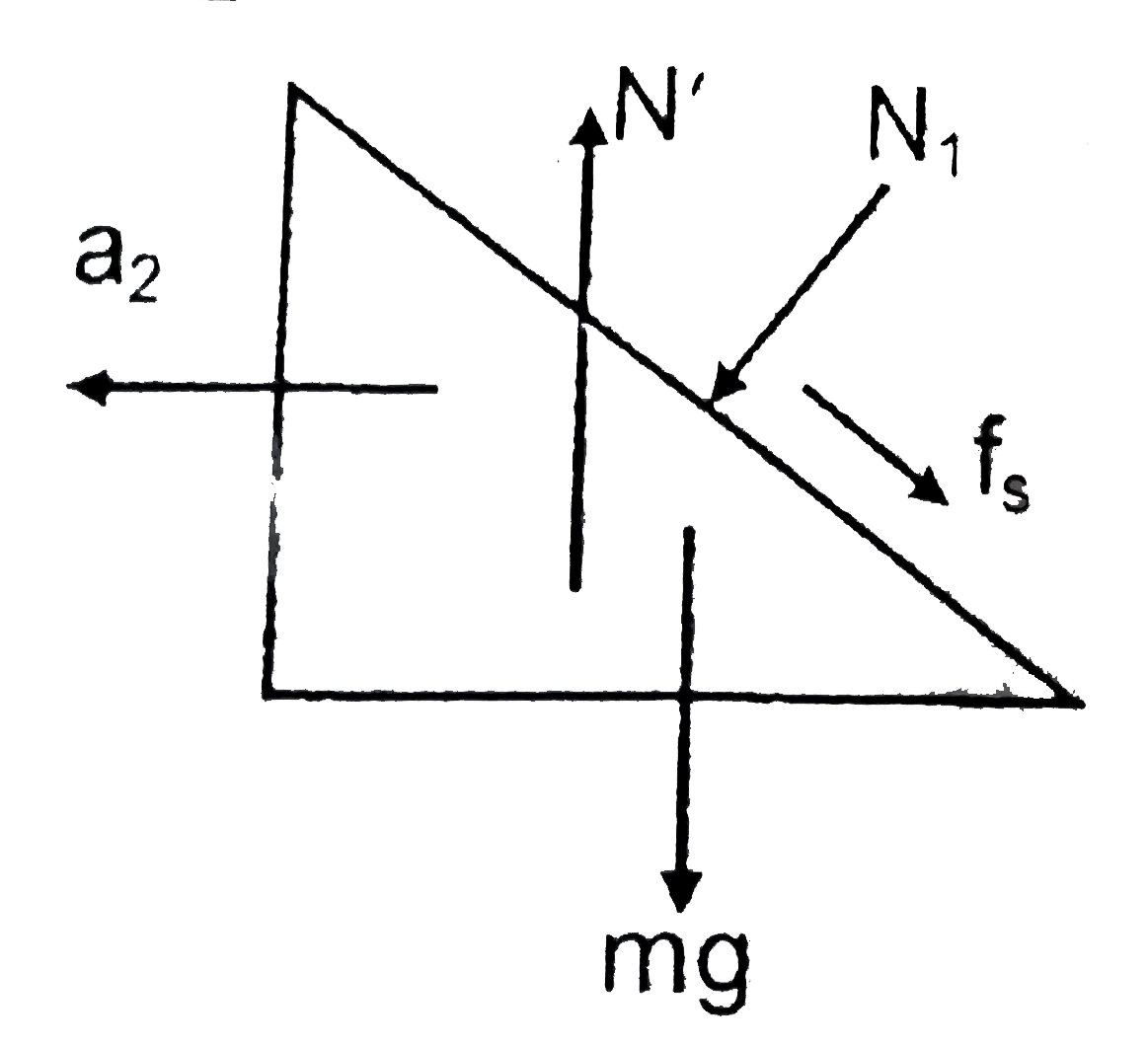 `N_(1)sin45^(@)-f_(s)cos45^(@)=ma_(2)`.(3) for rolling `Ralpha-a_(a)sin45^(@)=a_(2)cos45^(@)`.(4) `mu_(min)=(f_(S))/(N_(1))` contact force `F=sqrt(N_(1)^(2)+f_(S)^(2))` |
|
| 41. |
A rectangular coil pqrs is moved away from an infinite, straight wire carrying a current as shown in figure. Which of the following statements is corrent ? |
|
Answer» There is no induced current in coil pqrs. |
|
| 42. |
A target element A is bombarded with electrons and the wavelengths of the characterstic spectrum are measured. A second characteristic spectrum is also obtained , because of an impurity in the target. The wavelengths of the K_(alpha) lines are 196 pm (element A) and 169 pm (impurity). If the atomic number of impurity is z=(10lambda-1) . Find the value of lambda . (atomic number of element A is 27). |
|
Answer» |
|
| 43. |
Two particles A and B of de-Broglie wavelength lambda_(1) and lambda_(2) combine to form a particle C.The process conserves momentum .Find the de-Broglie wavelength of the particle C.(The motion is one -dimensional). |
|
Answer» <P> SOLUTION :Here `vecPA||vecPB`,hence `P_(C)=p_(A)+p_(B)`….(1)There are four possiblities: (i)`p_(B)gt0,p_(A)ggt0` both are positive . `THEREFORE (h)/(lambda_(c))=(h)/(lambda_(A))+(h)/(lambda_(B))IMPLIES(1)/(lambdaC)=(1)/(lambdaA)+(1)/(lambda_(B))` `therefore lambda_(C )=(lambda_(A)lambda_(B))/(lambda_(A)lambda_(B))` (ii)`p_(A)lt0,p_(B)lt0` both are negative. `therefore (h)/(lambdac)=(-h)/((lambda_(A)))+(-h)/(lambda_(B))` `therefore lamba_(C)=-((lambda_(A)lambda_(B))/(lambda_(A)+lambda_(B)))` (iii)`p_(A)gt0,p_(B)lt0p_(A)` ispositive and `p_(B)` is negative `therefore (h)/(lambda_(C))=(h)/(lambda_(A))-(h)/(lambda_(B))implies(1)/(lambda_(C))=(1)/(lambda_(A))-(1)/(lambda_(B))` `therefore lambda_(C)=(lambda_(A)lambda_(B))/(lambda_(B)-lambda_(A))` (iv)`p_(A)lt0,p_(B)gt0p_(A)` is positive and `p_(B)` is negative `(h)/(lambda_(C))=(-h)/(lambda_(A))+(h)/(lambda_(B))implies(1)/(lambda_(C))=(1)/(lambda_(B))=(1)/(lambda_(A))` `therefore lambda_(C)=(lambda_(A)lambda_(B))/(lambda_(A)-lambda_(B))` |
|
| 44. |
A dust particle of mass 2 mg is carried with a velocity of 100 cm/s. What is the de Broglie wavelength associated with the dust particle? (h = 6.64 xx 10^(-34) J-s) |
|
Answer» `3.32 XX 10^(-31)` m |
|
| 45. |
The nuclear radius of the sodium nuclide {:(23),(11):} Na is half that of the tungsten nuclide""_(74) W. The neutron number of the tungsten nuclide is |
|
Answer» 82 |
|
| 46. |
In a meter bridge the point Dis a neutral point as shown in figure. |
|
Answer» The meter bridge can have no other neutral point for this set of RESISTANCES. In balanced condition of bridge potential at point 8 and null point (D) will be equal. When jokey key is right of point D then VOLTAGE drop in AB wlll be more than voltage drop in AD. Hence, current will fl.ow from B to D. |
|
| 47. |
The figure shows a network of five capacitors connectedto a 100 V supply, Calculate the total energy stored in the network. |
|
Answer» Solution :The network of capacitors can be redrawn as shown here. Obviously CAPACITOR `C_3 of 2 muF` is short circuited and is useless. Capacitance `C_12` of PARALLEL grouping of `C_4 and C_2` is `C_12 = C_1+ C_2=3 + 3 = 6 muF` Capacitance `C_45` of parallel grouping `C_4 and C_5` is `C_(45) = C_4+ C_5 = 3 + 3 = 6 muF` In the network `C_12 and C_45` are in series. So the net capacitance of the ARRANGEMENT `C = (C_12 xx C45)/((C_12 + C45)) = (6 xx3)/((6 xx 3)) = muF = 2muF` `:.` TOTAL energy stored int he network `u =1/2 CV^2 =1/2xx(2muF) xx(100V)^2` `=1/2 xx 2 xx 10^(-6) xx(100)^2 = 10^(-2) J = 0.01J` 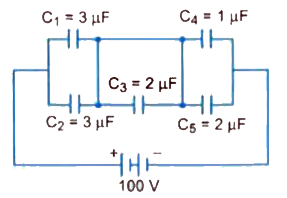
|
|
| 48. |
Doping is_____. |
|
Answer» |
|
| 49. |
A metallic rod of length 'l' is rotated with a frequency v with one end hinged at the centre and the other end at the circumference of a circular metallic ring of radius r, about an axis passing through the centre and perpendicular to the plane of the ring. A constant uniform magnetic field B parallel to the axis is present every where. Using Lorentz force, explain how emf is induced between the centre and the metallic ring and hence obtain the expression for it. |
|
Answer» Solution :We know that a conductor has free charges. If a conductor of LENGTH .I. is moving perpendicular to a uniform magnetic field `vecB` with a velocity `vecv` perpendicular to its length too, then a Lorentz force `vecF` acts on each free charge, where `|vecF| = q vB` Due to this force free charges move along the length of conductor from one end to the other end and exact direction is given by Fleming.s left HAND rule. As a result of this motion of charge, a potential difference is set up between the two ends of conductor. The potential difference developed (i.e., the induced emf) is given by `|varepsilon| = (FI)/q = (qvBl)/q=vBl` Now, consider a conductor rod of length .l. hinged at one end Mand rotating about a NORMAL axis passing through Mwith a frequency v, then for a small element of rod of thickness .de. SITUATED at a distance .x. from the hinged end, the induced emf is `dvarepsilon = Bv DX = B (xomega)dx = B (x.2piv) dx = 2pivB xdx` `therefore` Total induced emf `varepsilon =2pivB int_(0)^(1) xdx = 2pivB. [l^(2)/2] = pivBl^(2)` 
|
|
| 50. |
100 mg mass of nichrome metal is drawn into a wire of area of cross-section 0.05 mm. Calculate the resistance of this wire. Given density of nichrome 8.4 xx 10^3 "kgm"^(-3)and resistivity of the material as 1.2 xx 10^(-6) Omegam. |
|
Answer» Solution :Given mass = 100 mg =`10^2xx10^(-6)=10^(-4)` kg area of CROSS section A = `5xx10^(-2) xx (10^(-3))^2m^2` i.e.,`A=5xx10^(-8)m^2`. DENSITY`D=8.4xx10^3 kgm^(-3), rho=1.2xx10^(-6) Omegam` but density = `"mass"/"volume"` i.e. volume = `"mass"/"density"=10^(-4)/(8.4xx10^3)` `=(0.119xx10^(-7))/(5xx10^*(-8))=0.0238xx10` i.e. length= 0.238 m We know that , `R=(rhol)/A =(1.2xx10^(-6)xx0.238)/(5xx10^(-8))` =0.05712 x 100 or R=5.712 `Omega` Resistanceof the wire = `5.712Omega`. |
|