

Saved Bookmarks
This section includes 7 InterviewSolutions, each offering curated multiple-choice questions to sharpen your Current Affairs knowledge and support exam preparation. Choose a topic below to get started.
| 1. |
A toroid wound with 100 turns /m of wire carries a current of 3 A. The core of toroid is made of iron having relative magnetic permeability of mu_(r)= 5000 mu_(0) under given conditions. The magnetic field inside the iron is …........ (Tackle mu_0 = 4pi xx 10^(-7) T mA^(-1) ) |
|
Answer» 0.15 T `= 5000 xx 4pi xx 10^(-7)` `H=i_(f) = nI_(f)` `B= mu_(r) H""H= 100 xx 3 = 300 "Am"^(-1)` `= 5000 xx 4 xx 3.14 xx 10^(-7) xx 300` `= 60 xx 3.14 xx 10^(-2) = 188.4 xx 10^(-2)` `therefore B ~~ 1.88 T` |
|
| 2. |
A certainpieceof copperis to beshapedinto a conductor of minimumresistance . Itslength and diameter shouldrespectivelybe . |
|
Answer» L,D |
|
| 3. |
Estimate the distance for which ray optics is good approximation for an aperture of 4 mm and wavelength 400 nm. |
|
Answer» SOLUTION :here aperture `a=4mm=4xx10^(-3)m` and wavelength of LIGHT `lamda=400nm=4xx10^(-7)m` `therefore` Distance up to which RAY optics is good `Dle(a^(2))/(lamda)` `impliesD_(max)=(a^(2))/(lamda)=((4xx10^(-3))^(2))/(4xx10^(-7))=40m`. |
|
| 4. |
An isosceles right angled current carrying loop PQR is placed in a uniform magnetic field vecB pointing along PR. If the magnetic force acting on the arm PQ is F, then the magnetic force which acts on the arm QR will be |
|
Answer» `F` [Hint : Net force on entire loop PQR is zero and force on area RP is ALSO zero because here current is ANTIPARALLEL to magnetic field B. `rArrF_(PQ)+F_(QR)=0` or `F_(QR)=-F_(PQ)=-F`] |
|
| 5. |
In the shown circuit, all three capacitor are identical and have capacitance C mu F each. Each resistor has resistance of R Omega. An ideal cell of emf V volts is connected as shown. Then the magnitude of potential difference across cpacitor C_(3) in steady state is : |
|
Answer» `(V)/(3)` Hence `C_(1)` and `C_(2)` can be take in parallel. The potential at point `3` is `(V)/(3)` . `:.` Equivalent circuit of all three capacitors is show Hence potential difference across CAPACITOR `C_(3)` is `=(2C)/(2C+C)xx((2V)/(3)-(V)/(3))=(2V)/(9)` 
|
|
| 6. |
A double convex lens made of glass of refractive index 1.5 has both radii of curvature 20 cm each. Find the focal length of the lens. If an object is placed at a distance of 15 cm from this lens, find the position of the image formed. |
|
Answer» Solution :Here `n = 1.5 , R_(1) = + 20 cm , R_(2) = - 20cm` `(1)/(f) = (n-1) ((1)/(R_(1)) - (1)/(R_(2)))` ` = (1.5 - 1) [(1)/(20) - (1)/(-20)] = 0.5 XX ((2)/(20))` `(1)/(f) = (1)/(20)` f = 20 cm Now, u = - 10 cm and f = + 20 cm From THIN lens formula, `(1)/(v) = (1)/(f) + (1)/(u) = (1)/(20) - (1)/(10) = - (1)/(20)` `therefore` v = - 20 cm MAGNIFICATION, m = `(h_(2))/(h_(1)) = (v)/(u)` `(h_(2))/(5cm) = (-20)/(-10)` Hence a VIRTUAL and erect image of HEIGHT 10 cm is formed at a distance of 20 cm from the lens on the same side as the object. |
|
| 7. |
The variation of force F acting on a body moving along x - axis varies with its position (x) as shown in figure The body is in stable equilibrium stable at |
|
Answer» <P>P |
|
| 8. |
Rutherford's atomic model could account for : |
|
Answer» stability of atoms |
|
| 9. |
Which of the following groups of islands belonging to the Indian territory lies in the Arabian Sea? |
|
Answer» ANDAMAN and NICOBAR Islands |
|
| 10. |
The zero of the polynomial p(x) = -9x + 9 is: |
|
Answer» 0 |
|
| 11. |
Pressure exeted by an electromagneti wave os intesnity .I. on a non - reflecting surface is given by [Here c= speed of light] |
|
Answer» <P>`Ic` |
|
| 12. |
A boy throws n balls per second at regular time intervals.When the first ball reaches the maximum height he throws the second one vertically up .The maximum height reached by each ball is |
| Answer» Answer :B | |
| 13. |
What is the mutual inductance of a two-loop system as shown with centre separation l |
|
Answer» `(mu_(0) pi a^(4))/(8 l^(3))` |
|
| 14. |
If the temperature of the sun increases by 100%, the maximum energy radiated by the sun would correspond to |
|
Answer» RADIO WAVE region |
|
| 15. |
Anaeroplane fliesalonga straightpathA to Bandbackagainthedistancesbetweena and Bis1 andthe aeroplanemaintainsthe constantspeedv . There issteadywindwith aspeedu atan anglethetawithlineAB . determinetheexpression forthe totaltimeofthetrip . |
|
Answer» Solution :VELOCITYOF planealongAB= Vcos ` ALPHA- u costheta` andfor no- driftfromline ` AB: vsin alpha= u sintheta impliessin alpha= ( u sin theta)/( v)` timetakenfromA to B`t_(AB )= (t )/(v cosalpha- UCOS theta)` B to A velocityofplanealongBA ` = v cosalpha+ u costheta ` andfor nodriftfromlineAB`: v sinalpha= usin thetaimpliessin alpha= (u sin theta)/( v)` timetakenfromBtoA: ` v sinalpha= u sinthetaimpliessinalpha=( u sin theta )/( v) ` timetakenfromB to `A: t_(BA)= ( t)/(v cosalpha+ u costheta)` totaltimeteken ` = T_(AB ) +t_(BA) = ( 2v lcosalpha)/( v^2cos ^2alpha- u^2cos ^2theta )= ( 2 vt sqrt((u^2 sin ^2 theta))/(v^2))/(v^2 -u^2 )` 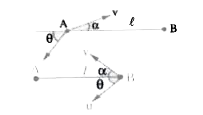
|
|
| 17. |
A pair of adjacent coils has a mutual inductance of 1.5. H. If the current in one coil changes from 0 to 20 A in 0.5 s, what is the change in flux linkage with the other coil? |
|
Answer» SOLUTION :Change of FLUX for SMALL change in CURRENT `dphi=Md_1=1.5(20-0)` weber =30 weber |
|
| 18. |
A quantity X is given by (me^(4))/(8epsilon_(0)^(2)ch^(3)) where m is mass of electron, e is the charge of electron, epsilon_(0) is the permittivity of free space, c is the velocity of light and h is the Planck's constant. The dimensional formula for X is the same as that of : |
|
Answer» length Hence `(d)` is correct CHOICE. |
|
| 19. |
At temperature 0""^(@) Cand 100 ""^(@) C, currents passing through one conductor are resectively 1 A and 0.7 A . Find current through it when its temperature is 1200""^(@) C . (Voltage source is same). |
|
Answer» Solution :We have, `R_(t) = R_(0) { 1 + prop ( t - 0) } ` `THEREFORE R_(t) = R_(0) + R_(0) prop t ` `therefore Rt - R_(0) prop ` t `therefore prop = (R_(t) - R_(0))/(R_(0)t)` `therefore prop = ((V)/(I_(t)) - (V)/(I_(0)) )/((V)/(I_(0)) xx t) ` ` therefore prop = ((1)/(I_(t))-(1)/(I_(0)))/((t)/(I_(0)))= (I_(0))/(t) ((I_(0)-I_(t))/(I_(t) I_(0))) ` `therefore prop = (I_(0) - I_(t))/(I_(t) t)"" `... (1) From equation (1), `prop= (I_(0) - I_(t1))/(I_(t1) xx t_(1)) "" `.... (2) Similarly, `prop = (I_(0) - I_(t2))/(I_(t2) xx t_(2)) "" ` ... (3) From equations (2) and (3) , `(I_(0) - I_(t1))/(I_(t1) xx t_(1))= (I_(0) - I_(t2))/( I_(t2) xx t_(2)) "" `... (4) Substituting give values, `(1- 0.7 )/(0.7 xx 100) = (1 - I_(t2))/( I_(t2) xx 1200)` `therefore (0.3)/(0.7) - (I - I_(t2))/( I_(t2) xx 12)` `therefore 3.6 I_(t2) = 0.7 - 0.7 I_(t2)` 4.3 `I_(t2) = 0.7` `therefore I_(t2) = (0.7)/(4.3) = 0.1627 ` A Note: Dear students, if CURRENT in a given conductor is `I_(0)`at REFERENCE temperature `t_(0)`then relation between currents temperature `t_(1) and t_(2)`is given by, `I_(t2) = I_(t1) xx ( (I_(t1) - I_(0))/(I_(t2) - I_(0))) ( (t_(1) - t_(0))/(t_(2) - t_(0)) ) ` Above formula can be obtained by simplifying equation (4) and then by making `I_(t2)` as subject of equation. |
|
| 20. |
Fuel is consumed at the rate of 50 kg s^(-1) in a rocket. Find the thrust on the rocket if the velocity of the exhaust gases is 2 km s^(-1). Also calculate the velocity of the rocket at the instant, when its mass is reduced to 1/10th of its initial mass if its initial velocity is zero. (neglect gravity) |
|
Answer» SOLUTION :`(dm)/(dt)=50 kgs^(-1) , u=2 km s^(-1)=2xx10^(3)MS^(-1)`, initial velocity, `u_(0)=0` (i)The thrust on the rocket, `F=u(dm)/(dt)=2xx10^(3)xx50=1xx10^(5)N`. (ii) The velocity of the rocket, `v=v_(0)+u "log"_(E )(m_(0))/(m)` `=0+2xx10^(3)log_(e )((m_(0))/(m_(0))xx10) "" (because m = (m_(0))/(10))` `=2xx10^(3)log_(e )10=2xx10^(3)xx2.303 log_(10)10` `=4.606xx10^(3)(m)/(s)` |
|
| 21. |
An ideal spring with spring-constants bung from the celling and a block of mass M is attached to its lower end. The mass is released with the spring initially unstretched. Then the maximum extension in the spring is: |
|
Answer» `(4Mg)/(K)` `:. (2Mgh)/(k)=x^2`But h=x or`x=(2Mg)/(k)` |
|
| 22. |
A body of mass M is rotating about an axis with angular velocity omega.If K is the radius of gyration of the body about the given axis,then its angular momentum is |
|
Answer» `(MK^2)OMEGA^(1/2)`` K (omega)` |
|
| 23. |
An 80 muC charge is given to the 4muF capacitor in the circuit shown in Fig. so the upper plate A is positively charged. An unknown resistance R is connected in the left limb. As soon as the switch S in the central limb is closed, a current of 2 A flows through the 2Omega resistor in the central limb. The capacitive time constant for the circuit is |
|
Answer» `56 mus ` limb. CURRENT through `16Omega` = 1A Current through the left limb = 1 A and R = `11 Omega` `:. tau_(C) = (16/2+2) Omega xx (4 xx 10^(-6)) F = 40 mus` . |
|
| 24. |
Charges on two spherical shells of radius r_(1) and r_(2) are same, then ratio of their electric potential ,will be ...... |
|
Answer» `(r_(1)^(2))/(r_(2)^(2))` |
|
| 25. |
If angle of polarisation of transparent medium is 51^(@), refractive index of medium is ...... |
|
Answer» <P>`0.7771` |
|
| 26. |
A pipe of 30 cm long and open at both the ends produces harmonics. Which harmonic mode of pipe resonates a 1.1 kHz source ? Given speed of sound in air =330 ms^(-1). |
|
Answer» FIFTH harmonic `f_(n) = n xx ((v)/(2L))` `1, 100 = n xx (330)/(2 xx 0.30)` n = 2 |
|
| 27. |
1000 small spherical drops each of radius r and carrying charge q coalesce to form one spherical drop. The potential of big drop is large than that of the smaller one by a factor of: |
|
Answer» 1000 |
|
| 28. |
A vernier calliper has 20 divisions on the vernier scale, which coincide with 19 on the main scale. The least count of the instrument is 0.1mm. The main scale divisions are of : |
|
Answer» `0.5`mm or `1 SD=(1)/(5)CM=(1)/(5)xx10mm=2mm` Hence `(C )` is correct. |
|
| 29. |
An optical communication system. Having an operating wavelength lambda (in metres), can use only x% of its source frequency as its channel bandwidth. The system is to be used for trasnmitting TV signals requiring a bandwidth of F hertz. How many channels can this system transmit simultanously? |
|
Answer» `lambdaF//CX` Bandwidth of channel `=X% "of" (c)/(lambda)=(cx)/(100lambda)` Number of CHANNELS. `n=("Total bandwidth of channel")/("Bandwidth needed per channel")=(cx//100A)/(F)=(cx)/(100lambdaF)` |
|
| 30. |
Water rises to a height of 10 cm in capillary tube and mercury falls to a depth of 3.42 cm in the same tube. If the density of mercury is 13.6 g cm^(-3) and angle of contact is 135°, the ratio of the surface tensions for water and mercury is : |
|
Answer» `1:5.57` `=(10xx1)/(3.42xx1.414xx13.6)=1/(6.57)` CORRECT choice is (C). |
|
| 31. |
A 10 kg block is set moving with an initial speed of 6 m/s on a rough horizontal surface. If the force of friction is 20 N, approximately how far does the block travel before it stops? |
|
Answer» `1.5 m` |
|
| 32. |
Two plane mirrors are placed parallel to each other a distance L apart. A point object O is placed between them, at a distance L/3 from one mirror. Both mirrors form multiple images. The distance between any two images cannot be |
|
Answer» 3L/2 |
|
| 33. |
If 10,000V applied across an X-ray tube, what will be the ratio of de Broglie wavelength of the incident electrons to the shortest wavelength of X-ray produced (elm of electron is 1.7xx10^(11) C/Kg) |
|
Answer» Solution :De Broglie wave LENGTH of incident electron is `lamda_(1)=(h)/(sqrt(2meV))""......(1)` SHORTEST wavelength of X ray photon is `lamda_(2)=(hc)/(Ve)""......(2)` `implies(lamda_(1))/(lamda_(2))=(1)/(c)sqrt(((V)/(2))((e)/(m)))=0.1` |
|
| 34. |
The velocity of a setallite in a parking orbit is |
|
Answer» 8 km/s `=sqrt((4xx10^(14))/(42xx10^(6)))=sqrt((1)/(10)xx10^(8))` `=sqrt(0.1xx10^(8))=sqrt(10)=3.13xx10^(3)` `=3.13km//s.` |
|
| 35. |
Which mirror is to be used to obtain a paralel beam of light from a small lamp? |
|
Answer» Plane MIRROR 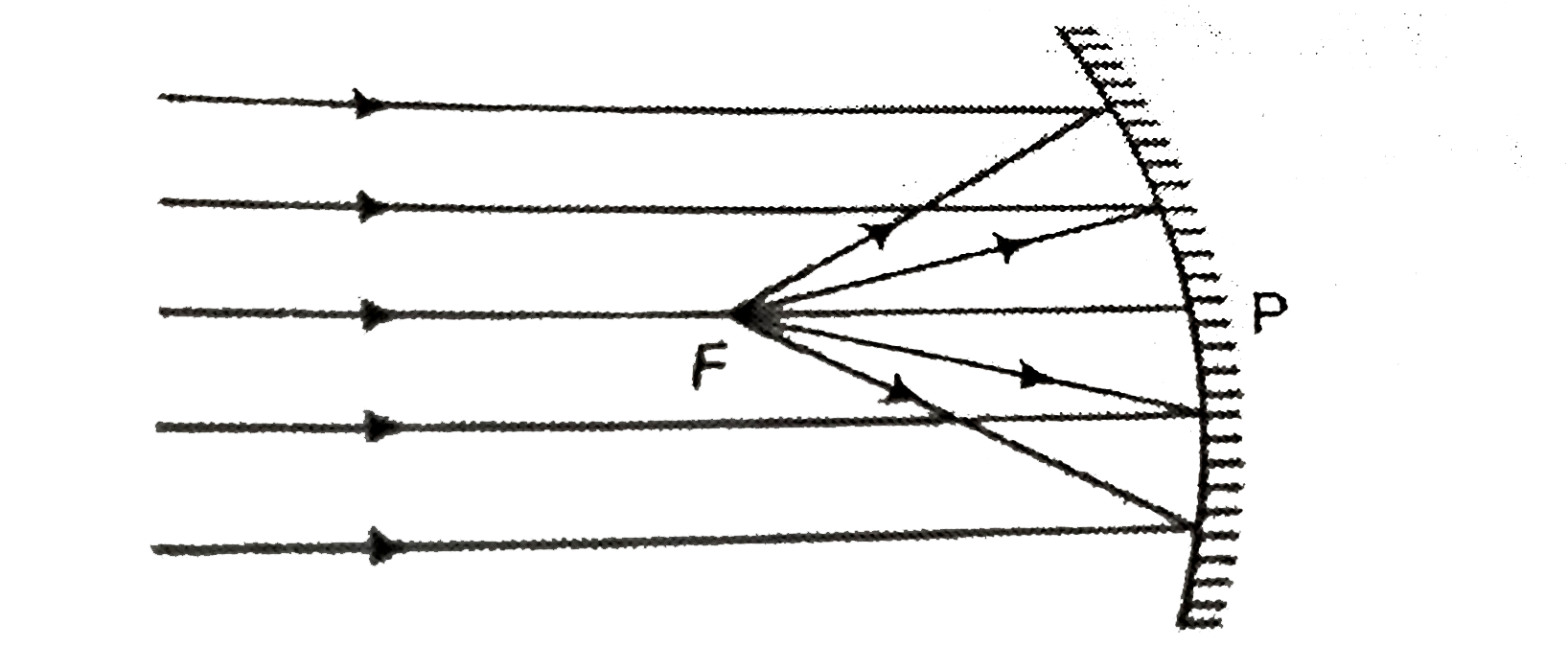
|
|
| 36. |
Counting rate from a radioactive source is 8000 cts per sec. at time t = 0 and after 10 minutes decay is 1000 cts/sce. Calculate (i) half life period, (ii) decay constant and (iii) counting rate after 20 minutes. |
|
Answer» Solution :Data supplied, i `N_0 = 8000 cts//"sec", "" t_1 = 10 "minutes", "" N = 1000 cts//"sec"` `N/(N_0) = 1/(2^n)` `:. 1/(2^n) = 1000/8000 = 1/8 = 1/(2^3)` `:. 2^n = 2^3 , "" n = 3` `t_1 = nT_(1//2) "" :. "" T_(1//2) = (t_1)/n= 10/3 "minutes" = 200 "sec"` i.e. Half LIFE period = `10/3` minutes = 200 sec ii. Decay constant `lambda = (0.6931)/((10//3)) = 0.2079` per minute iii. `t_2 = 20 "min" :. t_2 = NT, "" n = (t_2)/(T_(1//2)) = 20/((10//3)) = 6` `:. N/(N_0) = 1/(2^n) = 1/(2^6) = 1/64` `N = (N_0)/64 = 8000/64= 125 cts//"sec"` . |
|
| 37. |
A satellite in force free space sweeps stationary interplanetary dust at a rate of dM//dt=alphav, where M is mass and v is the speed of satellite and alpha is a constant. The acceleration of satellite is |
|
Answer» `(-alpha v^(2))/(2M)` Retarding force=Rate of change of momentum `="Velocity"xx" Rate of change in mass"=-VXX(dM)/(dt)` `=-vxxalpha v=-alphav^(2)`. (MINUS sign of v due to deceleration) THEREFORE deceleration `=-(alphav^(2))/(M)`. |
|
| 38. |
Two charges +6 muC and -4 muC are placed 15 cm apart as shown. At what distance from A to its right the electronstatic potential is zero (distances in cm) |
| Answer» Answer :B | |
| 39. |
Two diametrically opposite points of a metal ring are connected to two terminals of the left gap of a metre bridge. A resistance of 22 Omega is connected in the right gap. If the null point is obtained at 45 cm from the left end, find the resistance of the metal ring. |
|
Answer» Solution :Data: `R= 22 Omega, L_(X) = 45 cm` `therefore L_(R) =100 - L_(X) = 100-45= 55 cm,` Let X be the resistance of the metal ring. `therefore` The resistance of each half of the metal ring `=X//2`. Therefore, the resistance in the left gap is the effective resisance of the parallel combination of `X//2` and `X//2`. `R_(p) = ((X//2)(X//2))/(X//2 + X//2) = (X^(2)//4)/X = X/4` [ OR `1/R_(P) = 1/(X//2) + 1/(X//2) = 2/(X//2) = 4/Xtherefore R_(P) = X/4`] At balance, `R_(P)/R = L_(X)/L_(R)therefore (X//4)/(22) = 45/55=9/11therefore X/4 = 18 Omega` `therefore X= 4 xx 18 = 72 Omega` The resistance of the metal ring is `72 Omega`. |
|
| 40. |
An oil drop of 12 excess electrons is held stationary under a constant electric field of 2.55 xx 10^4 NC^(-1). (Millikan's oil drop experiment). The density of the oil is 1.26 g cm^(-3). Estimate the radius of the drop, (g = 9.81 ms^(-2), e = 1.60 xx 10^(-19 C)). |
Answer» SOLUTION :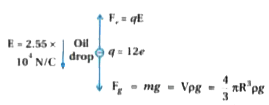 For given oil DROP of charge q, mass m, density p and radius R to remain under equilibrium, vertically upward electric force must be equal to vertically downward gravitational force acting on it. Thus, `Fe(uarr) =Fg(darr)` `therefore qE = 4/3 piR^(3)rho g` (From above figure) `therefore (12e)E = 4/3 pir^(3) rho g` `therefore =((9 xx 1.6 xx 10^(-19) xx 2.55 xx 10^(4))/(3.14 xx 1.26 xx 10^(3) xx 9.81))^(1/3)` `therefore R = 0.9817 xx 10^(-6)` `therefore R = 9.817 xx 10^(-7)` m |
|
| 41. |
A light beam is being reflected by using two mirrors, as in a periscope used in submarines. If one of the mirros rotates by an angle theta, the reflected light will deviate from its original path by the angle 2theta |
|
Answer» `0^(@)` |
|
| 42. |
A small body of mass m=0.30kg starts sliding down from the top of a smooth sphere of radius R=1.00m. The sphere rotates with a constant angular velocity omega=6.0rad//s about a vertical axis passing through its centre. Find the centrifugal force of inertia and the Coriolis force at the moment when the body breaks off the surface of the sphere in the reference frame fixed to the sphere. |
|
Answer» Solution :The EQUATION of motion in the rotating COORDINATE system is, `mvecw=VECF+momega^2vecR+2m(vecvxxvecomega)` Now, `vecv=Rthetavece_0+Rsin thetaoverset(.)varphivece_(varphi)` and `vecw=w^'cos thetavece_r-w^'sin thetavece_0` `(1)/(2m)vecF_(cor)=|{:(vece_r,+vece_0,vece_varphi,,),(0,Rtheta,Rsinthetaoverset(.)varphi,,),(omegacostheta,-omegasintheta,0,,):}|` `=vece_r(omegaRsin^2thetaoverset(.)varphi)+omegaRsinthetacosthetaoverset(.)varphivece_(theta)-omegaRcosthetavece_(theta)` Now on the sphere, `vecv=(-Roverset(.)theta^2-Rsin^2thetavarphi^2)vece_r` `+(Roverset(.)theta-Rsin thetacos thetaoverset(.)varphi^2)vece_(theta)` `+(Rsin thetaoverset(..)varphi+2Rcos theta OVERSET(.)thetaoverset(.)varphi)vece_vaprhi` Thus the equation of motion are, `m(-Roverset(.)theta^2-Rsin^2thetaoverset(.)varphi^2)=N-mgcostheta+momega^2Rsin^2theta+2momegaRsin^2thetaoverset(.)varphi` `m(Roverset(.)theta-Rsinthetacosthetaoverset(.)varphi^2)=mg sin theta+momega^2Rsin thetacostheta+2momegaRsinthetacosthetaoverset(.)varphi` `m(Rsin thetaoverset(..)varphi+2Rcos thetaoverset(.)thetaoverset(.)varphi)=-2momegarRoverset(.)thetacostheta` From the third equation, we get, `underset(.)varphi=-omega` A result that is easy to understand by considering the motion in non-rotating frame. The ELIMINATING `overset(.)varphi` we get, `mRunderset(.)theta^2=mgcostheta-N` `mRunderset(.)theta=mgsintheta` Integrating the last equation, `1/2mRunderset(.)theta^2=mg(1-costheta)` Hence `N=(3-2costheta)mg` So the body must fly off for `theta=theta_0=cos^-12/3`, exactly as if the sphere were nonrotating. Now, at this point `F_(ef)=` centrifugal force `=momega^2Rsintheta_0=sqrt(5/9)momega^2R` `F_(cor)=sqrt(omega^2R^2theta^2cos^2theta+(omega^2R^2)^2sin^2theta)xx2m` `=sqrt(5/9(omega^2R)^2+omega^2R^2xx4/9xx(2g)/(3R))xx2m=2/3momega^2Rsqrt(5+(8g)/(3omega^2R))` 
|
|
| 43. |
A proton and an alpha particle bolh enter a region of uniform magnetic field, B, moving at right angles to the field B. If the radius of circular orbits for both the particles is equal and the kinetic energy acquired by proton is 1 MeV, the energy acquired by the alpha particle will be |
|
Answer» 1MeV |
|
| 44. |
What are Maxwell's equation ? Write these equation. |
|
Answer» Solution :Set of equation formed by Maxwell relating sources of ELECTRIC and magnetic field and current density are called Maxwell.s equation. These EQUATIONS are as FOLLOWS : (1) Gauss.s law for electricity `rarr oint vec(E ). vec(d)A=(Q)/(in_(0))` (2)Gauss.s law for magnetism `rarr oint vec(B).vec(d)A=0` (3) Faraday.s law `rarr oint vec(E).vec(d)l=-(d Phi_(B))/(dt)` (4) Ampere - Maxwell.s law`rarr oint vec(B).vec(d)l=mu_(0)i_(C )+mu_(0)in_(0)(d Phi_(E ))/(dt)` By using these equation and using Lorentz force all basic laws of electromagnetic waves can be MATHEMATICALLY represented. |
|
| 45. |
A voltage V is supplied to a potentiometer wire of resistance R_0. A resistance R is connected as shown. Find voltage across R when the sliding contact is at the middle of potentiometer wire |
| Answer» SOLUTION :`((2VR)/(R_0 + 4R))` | |
| 46. |
A transmitting antenna and a receiving antenna, both of height H, are used for a space wave transmission. At another place, a similar transmission uses a transmitting antenna of height 2H, but the receiving antenna is set very near the ground. The ratio of the radio horizons for these two cases is |
|
Answer» `1:1` |
|
| 47. |
What is cut off voltage |
| Answer» SOLUTION :The minimum negative potential given to the anode of a PHOTO CELL for which the photoelectric current becomes zero is CALLED cut off voltage or stopping potential. | |
| 48. |
The voltmeter of…………………………. range has lower resistance than the voltmeter of…………………….range. |
|
Answer» |
|
| 49. |
Light shining through two very narrow slits produces an interference maximum at point P when the entire apparatus is in air as shown in the following figure. For the interference maximum represented, light through the bottom slit travels one wavelength further than light through the top slit before reaching point P. If the entire apparatus is immersed in water, the angle theta to the interference maximum |
|
Answer» Is unchanged |
|
| 50. |
Explain the origin of spectral lines of hydrogen using Bohr's theory. |
|
Answer» Solution :According to Bohr.s theory of hydrogen atom we know that a radiation photon of energy (E = h V) is emitted when transition of an electron TAKES place from a higher energy state `E_(i)` corresponding to a shell with principal quantum number `n_(i)` to a lower energy state Escorresponding to a shell with principal quantum number `n_(f)` (where `n_(f) lt n_(i) or n_(i)gt n_(f) `). `therefore "" hv = E_(i) -E_(f)` But as per Bohr.s theory, the energy of an electron in its state corresponding to n level is `E_(n) =- (me^(4))/(8 in_(0)^(2) n^(2) h^(2))` `therefore "" h v = E_(i) = E_(f) = - (me^(4))/(8 in_(0)^(2)n_(i)^(2) h^(2)) + (m e^(4))/(8 in_(0)^(2) h^(2)) [(1)/(n_(f)^(2)) - (1)/(n_(i)^(2))]` `rArr ` Frequencyof spectral line `v = (me^(4))/(8 in_(0)^(2) h^(3))[(1)/(n_(f)^(2))- (1)/(n_(i)^(2))]` , where`n_(i)` and `n_(f)`are bothintergers and `n_(i) gt n_(f)`andwavelenghtof spectral line is giveby . `(1)/(lambda) = bar(v) = (v)/(c)= R [ (1)/((2)^(2)) - (1)/(n^(2))] `, where n = 3,4,5,6. whichis the empirical relation for spectral lines of Balmer seires . Similarly , ifwe put`n_(f) = 1`and `n_(i) = n = 2 , 3,4,5,............,we get empirical relation for Lyman series . On SUBSTITUTING`n_(f) = 3,4,5 ` and`n_(i) gt n_(f)` , we getrelationfor Paschen series,Bracket series and Pfundseries of hydrogen atom respectively . |
|