Saved Bookmarks
This section includes 7 InterviewSolutions, each offering curated multiple-choice questions to sharpen your Current Affairs knowledge and support exam preparation. Choose a topic below to get started.
| 1. |
When two identical capacitors are charged individually to different potentials and connected parallel to each other, after disconnecting them from the source : |
|
Answer» NET charge on connected plates is less than the sum of initial INDIVIDUAL charges. |
|
| 2. |
If sigma is the breaking stress of a material of density rho, then the length of the wire of that material that can hang freely without breaking is |
|
Answer» `(SIGMA)/(rho G)` |
|
| 3. |
When ray of light is incident at 58^(@) glass plate, reflected light is completely plane polarised refractive index of glass plate= ...... |
|
Answer» Solution :Here angle of POLARISATION angle of incidence `=theta_(p)-58^(@)` `:.`From Brewster.s law, Refractive INDEX of MEDIUM `m=tan theta_(p)` `:. n tan 58^(@)` `:. n=1.6003` `=1.6` |
|
| 4. |
A capacitor is connected with battery. With battery remains connected some chages are done in capacitor/battery, which are given in Column I. corresponding to it match the two columns. |
|
Answer» <P> |
|
| 5. |
In the circuit symbol of transistor the arrow on the emitter indicates |
|
Answer» The DIRECTION of FLOW of electrons |
|
| 6. |
(a) Deduce the expression, N= N_(0) e^(-lambdat) for the law of radioactive decay. (b) (i) Write symbolically the process expressing the beta^(+) decay of " "_(11)^(22)Na. Also write the basic nuclear process underlying this decay. (ii) Is the nucleus formed in the decay of the nucleus " "_(11)^(22)Na, an isotope or isobar ? |
|
Answer» SOLUTION : (b) (i) The process of `beta^(+)` decay of `" "_(11)^(22)Na` is: `" "_(11)^(22)Na to " "_(10)^(22)Ne + UNDERSET(beta^(+)" particle")(" "_(+1)^(0)e) + underset("neutrino")(nu)` The BASIC nuclear process underlying this decay is : `" "_(+1)^(1)p to " "_(0)^(1)n+" "_(+1)^(0)e+nu` (ii) The nucleus `" "_(10)^(22)Ne` formed due to decay of `" "_(11)^(22)Na` is an isobar. |
|
| 7. |
A free neutron decays spontaneously into |
|
Answer» a PROTON, an ELECTRON and an ANTI NEUTRINO |
|
| 8. |
How would the angular separation of interference fringes in Young's double-slit experiment change when the distance between the slits and screen is doubled ? |
| Answer» SOLUTION :Angular SEPARATION of fringes `(alpha=(lamda)/(d))` in Young.s double slit experiment REMAINS unchanged when the distance D between the SLITS and screen is doubled. | |
| 9. |
Monkey (1) is climbing up a light rope with acceleration of a_(1)=2m//s^(2) and monkey (2) is climbing upto the same rope with acceleration of a_(2)m//s^(2) Choose incorrect options. |
|
Answer» Tension is same in all PARTS of rope. |
|
| 10. |
A double convex lens of refractive index 1.5 has radii of 20 cm. Incident rays of light parallel to the axis will come to converge at a distance from the lens is |
|
Answer» 20 cm |
|
| 11. |
A parallel plate capacitor of capacitance 10muF is connected to a cell of emf 10 V and is fully charged. Now a dielectric slab (k = 3) of thickness equal to the gap between the plates is completely filled in the gap, keeping the cell connected. During the filling process, |
|
Answer» the increase in charge on the capacitor is `200 muC` . Initial charge (before filling the dielectric slab) is `10 xx 10 = 100` `muC`. Final charge (after filling the dielectric slab) is `10 xx 30 = 300 muC`. Increasing in charge is `20 muC`. |
|
| 12. |
Conduction - electron have more mobility than holes because these electrons : |
|
Answer» are lighter |
|
| 13. |
The intensity of sound from a point source is 1.0 xx 10^(-8) W//m^2 at a distance of 5.0m from the source. What will be the intensity at a distance of 25m from the source? |
| Answer» SOLUTION :`4.0 XX 10^(-10) W//m^2` | |
| 14. |
Name the scientists who discovered the generation of electric current by means of magnetic field. |
| Answer» SOLUTION :JOSEPH HENRY and MICHAEL FARADAY | |
| 15. |
The acceleration of a particle moving only on a horizontal xy plane is given by veca=3thati+4thatj, where veca is in meters per secondsquared and t is in seconds. At t = 0, the position vector vecr=(20.0m)hati+(40.0m)hatj locates the particle, which then has velocity vector vecv=(5.00m//s)hati+(2.00m//s)hatj. At t = 4.00 s, what are (a) its position vector in unit-vector notation and (b) the angle between its direction of travel and the position direction of the x axis? |
| Answer» SOLUTION :(a) `(72.0m)HATI+(90.7m)HATJ,` (B) `49.5^(@)` | |
| 16. |
In an A.C. circuit, I_rms and I_0 are related as. |
|
Answer» `[I_(RMS) = PI I_0]` |
|
| 17. |
The angle of incidence for an equilateral prism of refractive index sqrt(3) so that the ray is parallel to the base inside the prism is |
| Answer» Answer :C | |
| 18. |
Which of the following element was discovered by study of Fraunhofer lines |
|
Answer» Hydrogen |
|
| 19. |
The mass of a spaceship is 1000 kg. It is to be launched from the earth's surface out into free space. The value of 'g' and 'R' (radius of earth) are 10 m//s^(2) and 6400 km respectively. The required energy for this work will be : |
|
Answer» `6.4xx10^(10)` joules `=GR^(2)xx(m)/(R )=MGR` `=1000xx10xx6.4xx10^(6)` `=6.4xx10^(10)J` So, correct choice is (a). |
|
| 20. |
A hollow pipe of length 0.8 m is closed at one end. At its open end a 0.5 m long uniform string as vibrating in its second harmonic and it resonates with the fundamental frequency of te pipe. If the tension in the wire is 50 N and the speed of sound is 320 ms^(-1) the mass of the string is : |
|
Answer» 5 grams given by `f_(2) = v//4l_(2) ( v = 320 ms^(-1))` ` f_(1) = sqrt(T//mu)l_(1) ` Both are same `f_(1)= f_(2) ` `rArr "" m = T l_(1) // 2500 ` = 10g So correct choice is (B). |
|
| 21. |
In a biprism experiment, eyepiece is placed at a distance D=1m from the source. The separation (D) between the images of the two coherent sources produced by the biprism is 1mm. A convex lens of focal length 20 cm is placed at a distance 40 cm from eye piece to obtain diminished images of the two coherent sources in the focal plane of the eye piece. The separation (d_(1)) between these two images will be |
|
Answer» 0.57 mm |
|
| 22. |
In a double slit experiment, the two slits are 1mm apart and the screen is placed 1m away. A monochromatic light of wavelength 500 mm is used. What will be the width of each slit for obtaining tenth maxima of double slit within the central maximaof single slit pattern? |
|
Answer» `0.5 MM` |
|
| 23. |
How would you arrange 64 similar cells each having an emf of 2.0 V and internal resistance 2 Omega so as to send maximum current through an external resistance of 8 Omega. |
|
Answer» |
|
| 24. |
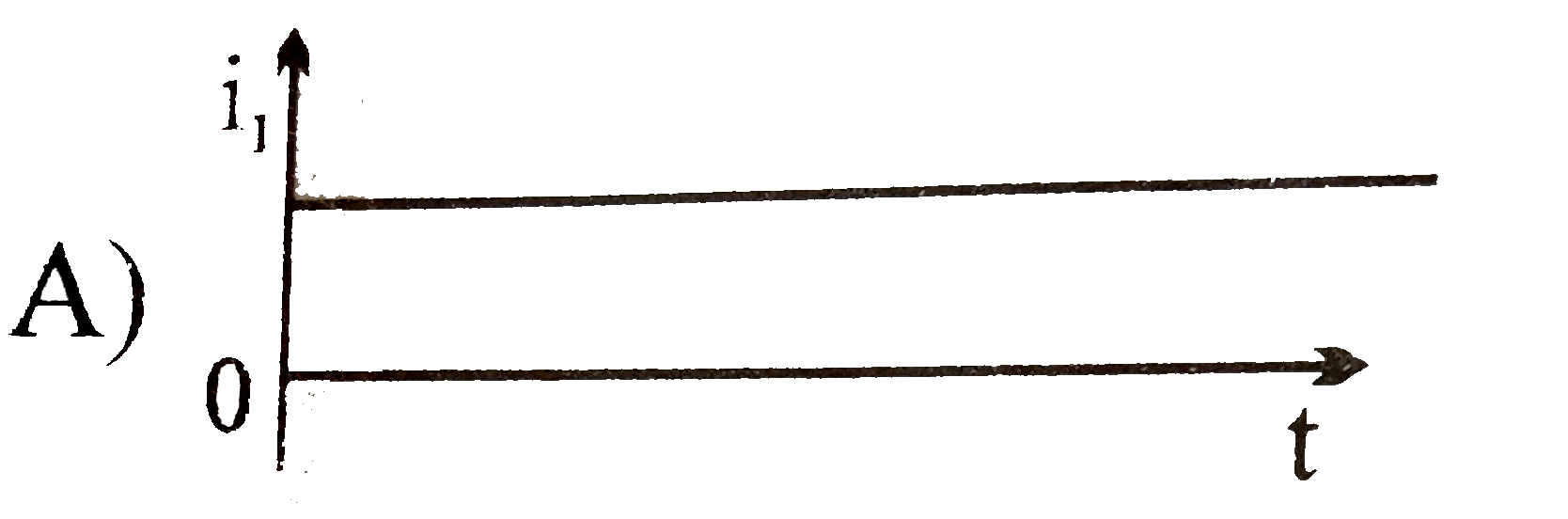
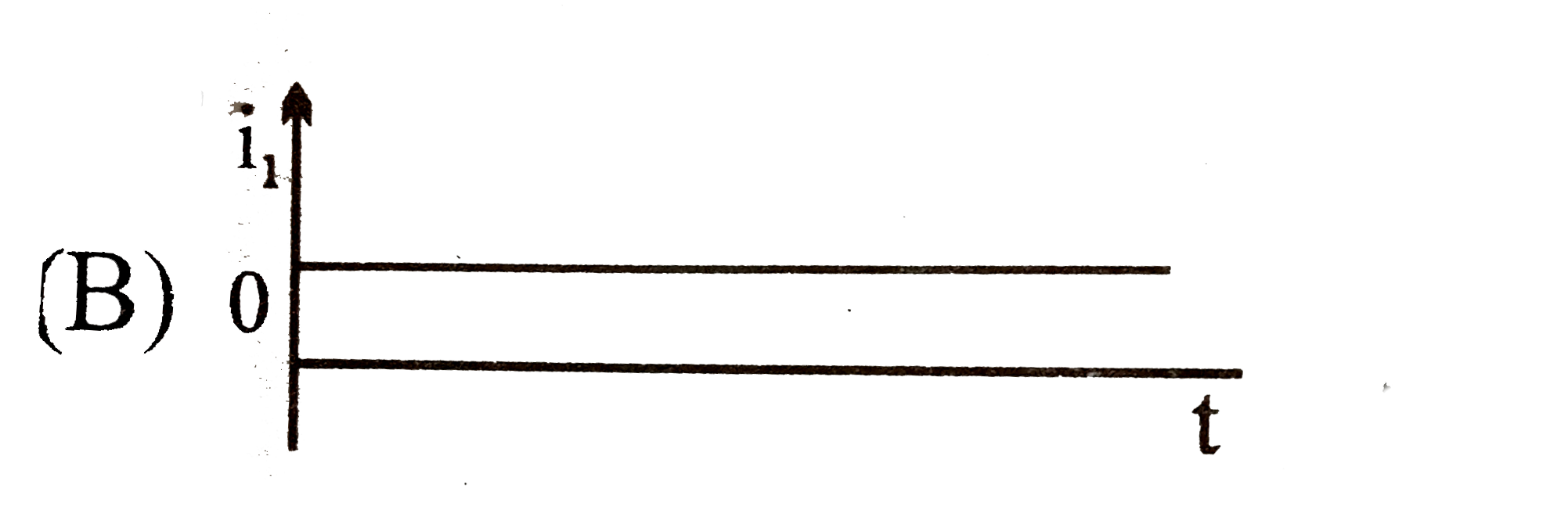
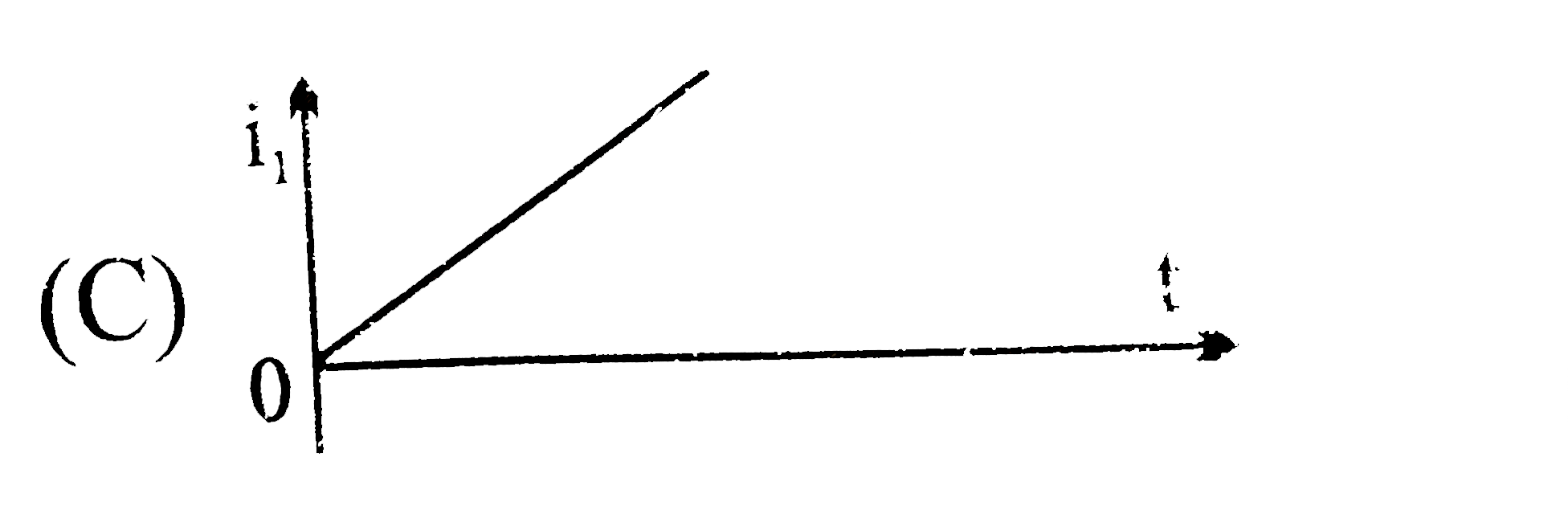
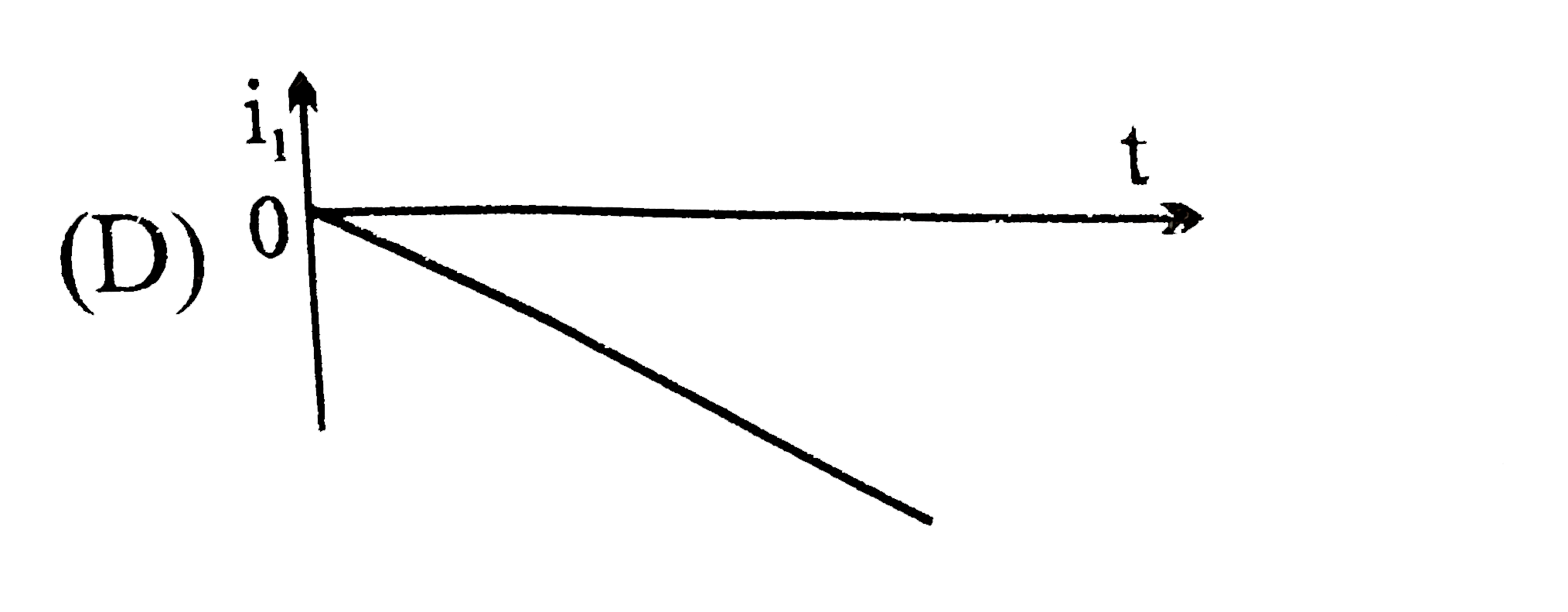
An electric current i_(1) can flow either direction through loop (1) and induced current i_(2) in loop (2). Positive i_(1) is when current is from 'a' to 'b' in loop (1) and positive i_(2) is when the current is from 'c' to 'd' in loop (2) In an experiment, the graph of i_(2) against time 't' is as shown below Which one(s) of the following graph could have caused i_(2) to behave as give above. |
|
Answer»
`i_(2)=-M/R(dI_(1))/(dt)` |
|
| 25. |
A particle of mass .m.and charge q is placed at rest in a unifrom electric field E and then released. The K.E. attained by the particle after moving a distance y is |
|
Answer» `qEy^(2)` |
|
| 26. |
If particles are moving with same velocity, then which has maximum de-broglie wavelength ? |
|
Answer» Proton |
|
| 27. |
How can we increase the sensitivity of a potentiometer ? |
| Answer» Solution :Thesensitivity can be INCREASED by reducing the potential GRADIENT. This can be done by (i) INCREASING the length of the wire and (II) by reducing the current in the MAIN CIRCUIT. | |
| 28. |
There is a small air bubble inside a glass sphere (mu=1.5) of radius 10 cm. The bubble is 4 cm below the surface and is viewed normally from the outside. The apparent depth of the bubble is |
|
Answer» 3 CM below the surface |
|
| 29. |
When a number of liquid drops each of surface charge density sigmaand energy E combine, a large drop is formed. If the charge density of the large drop is 3, its energy is |
| Answer» ANSWER :D | |
| 30. |
A uniformly charged hemisphere of radius b and charge density rho has a hemispherical cavity of radiusa(a=b/2) cut from its centre. If the potential at the centre of the cavity is (nrhob^(2))/(16epsilon_(0)) then n=? |
|
Answer» `V=2pikrho[(b^(2)-a^(2))/2]=pirhok(b^(2)-a^(2))` `b=2a` `v=3pikrhob^(2)` 
|
|
| 31. |
The magnetic field in a travelling electromagnetic wave has a peak value of 20 nt. The peak value of electric field strength is : |
|
Answer» `6 V // m` `=3 xx 10^(8) xx 20 xx 10^(-9)` `= 6 V // m`. |
|
| 32. |
गतिमापी कार की चाल को निम्न में मापता है-? |
|
Answer» m/s |
|
| 33. |
A boat crossing a river moves with a velocity v relative to still water. The river is flowing with a velocity v/2 withrespect to the bank. The angle with respect to the flow direction with which the boat should move to minimize thedrift is– |
|
Answer» `30^(@)` |
|
| 34. |
In an unbiased p-n junction , holes diffuse from the p-region to n- region because |
|
Answer» free electrons in the n-region attract them |
|
| 35. |
A planet of radius R has an acceleration due to gravity of g_(s) on its surface. A deep smooth tunne is dug on this planet, radially inward, to reach a point P located at a distance of (R)/(2) from the centre of the planet. Assume that the planet has uniform density. The kinetic energy required to be given to a small body of mass m, projected radially outward from P, so that it gains a maximum altitude equal to the thrice the radius of the planet from its surface, is equal to (##DSH_NTA_JEE_MN_PHY_C07_E03_017_Q01.png" width="80%"> |
|
Answer» `(63)/(16)mg_(s) R ` `V(x) = {{: (- g_(s) R((3)/(2) - (1)/(2)(x^(2))/(R^(2)) ), " when " x lt R),(-g_(s)R((R)/(x)), " when " x gt R):}}` The energy required to project the body to a MAXIMUM altitude of 3 R from its surface , is `m (V_(B) | x = (R)/(2) - V_(p) | x =4 R ) = (9)/(8) mg_(s)R.` |
|
| 36. |
X-rays fall on a photosensitive surface to cause photoelectric emission. Assuming that the work function of the surface can be neglected, find the relation between the de-Broglie wavelength (lambda) of the electrons emitted to the energy (E_(v)) of the incident photons. Draw the nature of the graph for lambda as a function of E_(v). |
|
Answer» <P> Solution :`E_(V)=phi_(0)+K_("MAX")`As`phi_(0)=0` `implies E_(v)=K_("max")` `implies K_("max")=(p^(2))/(2m)=E_(v)` `implies p=sqrt(2mE_(v))` `:.` Wavelength `(lambda)` of emitted electrons , `lambda=(h)/(p)=(h)/(sqrt(2mE_(v)))` 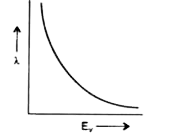
|
|
| 37. |
In Young.s double slit experiment with a mono chromaticlight of wavelength 4000 A^(0) , the fringes width is found to be 0.4 mm . When the slits are now illuminated with a light of wavelength 5000 A^(0) the fringe width will be |
|
Answer» `0.32` MM |
|
| 38. |
The value of electric permittivity of free space is |
|
Answer» `9XX10 ^(9) N C^(2) m^(-2) ` |
|
| 39. |
In a metre bridge , the null point is found at a distance of 33.7 cm from A. If now a resistance of 10 Omega is connected in parallel with S, the null point occurs at 51.9 cm. determine the values of R and S. |
|
Answer» SOLUTION :From the first BALANCE POINT, `R/S = (33.7)/(66.3) ""…..(i)` After S is connected in parallel with a resistance of `12 OMEGA` , the resistance across the gap changes from S to `S_(eq)` where `S_(eq) = (12S)/(S+12)` and hence the new balance CONDITION gives `(51.9)/(48.1) = (R)/(S_(eq)) = (R(S+2))/(12S)` Substituting the value of R/S from equation (i). we get `(51.9)/(48.1) = (S+12)/(12) *(33.7)/(66.3)` which gives `S= 13.5 Omega` Using the value of R/S above. we get R= 6.86 `Omega` |
|
| 40. |
A gyromagnetic ratio of the electron revolving in a circular orbit of hydrogen atoms is 8.8xx10^(10) kg^(-1)given charge of the electron =1.6 xx10^(-19) c |
|
Answer» `1xx10^(-19)c` Magnetic moment M=iA here `i=(ev)/(2pir)` `M=(evr)/(2)` 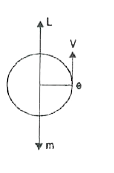 and ANGULARMOMENTUM divindingeq (ii) EQ (ii) we get `(M)/( L)=(e )/(2m)` where M/L =GYROMAGNETICRATIO GIVEN `M//L=8.8xx10^(10) c//kg` `e=1.6xx10^(-19)C` `=8/88xx10^(-29)` `=1/11xx10^(-29) kg` |
|
| 41. |
Two nucleons are at a separation of 1xx10^(-15)m. The net force between them is F_1, if both are neutrons, F_2 if both are protons and F_3 if one is a proton and other is a neutron. In such a case |
|
Answer» `F_2 GT F_1 gt F_3` |
|
| 42. |
A series LCR circuit is connected to an ac source having voltage v=v_(m) sin omega t. Derive the expression for the instantaneous current I and its phase relationship to the applied voltage. (i)Maximum and (ii) minimum. |
|
Answer» Solution :(a) (1) Equivalent impendance (Z) is LCR circuit: The effective resistance offered by a series LCR-circuit is called its impedance. It is DENOTED by Z. Suppose an inductance L, capacitance C and resistance R are connected in series to a source of alternating emf, `V=V_0` sin wt. Let, I be the instantaneous value of CURRENT in the series circuit. Then voltages across the three components are (i) `V_L=X_L I` It is ahead of current I in phase by `90^@`. (ii) `V_C=V_C I`. it lags BEHIND the current I in phase by `90^@`. (iii) `V_R=RI`. It is in phase with current I. 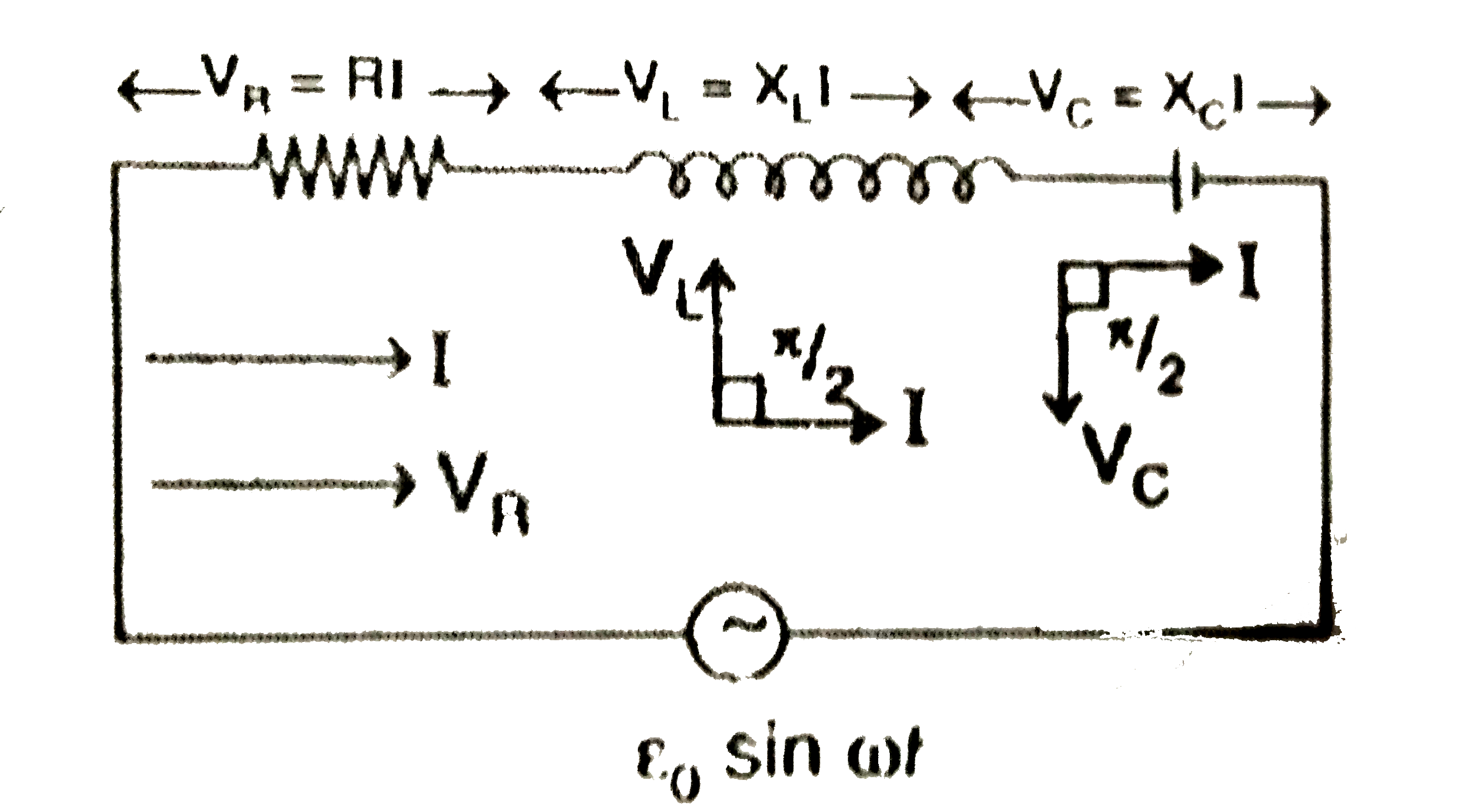 These voltages are shown in the phasor diagram given below : 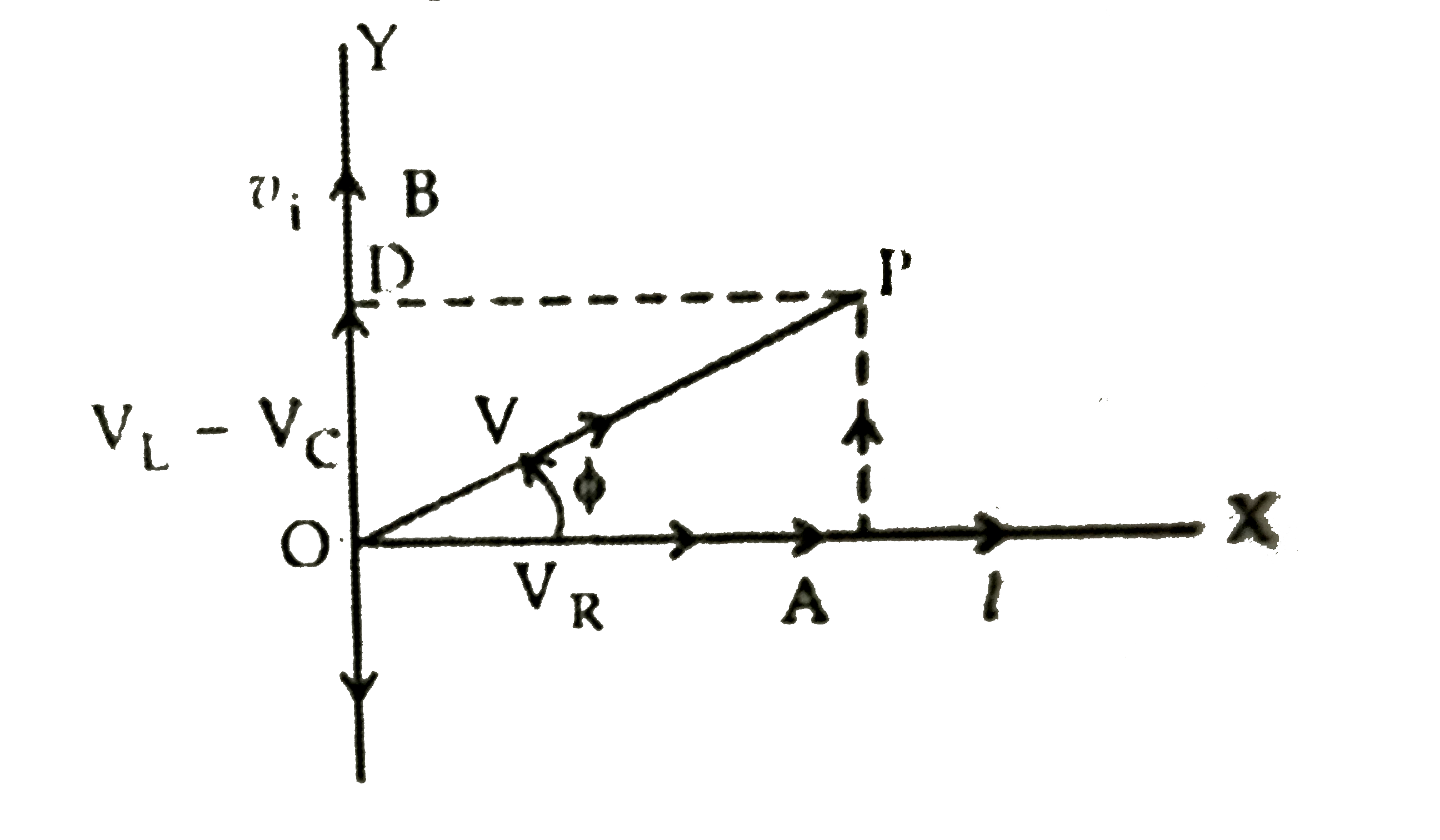 As ` V_L and L_C` are in opposite directions, their resultant is ` OD =V_L-V_C`, in the positive y-direction By paralllelogram law, the resultant voltage is ` V=OP` `=sqrt(OA^2+OD^2)=sqrt(V_(R)^(2)+(V_L-V_C)^2)` ` =sqrt(R^2I^2+(X_LI-X_CI)^2)=Isqrt(R^2+(X_L-X_C)^2)` ` therefore (V)/(I) =sqrt(R^2+(X_L-X_C)^2)`. Clear, `V//I` is the effective resistance of the series LCRcircuit and is called its impedance (Z). ` therefore Z=sqrt(R^2+(X_L-X_C)^2)=sqrt(R^2+(Omega L-(1)/(OmegaC))^2)[{:(because X_L=OmegaL),(X_C=1//OmegaC):}]` (2) When Z=R, then `X_1=X_C` ` therefore Omega L=(1)/(OmegaC) rArr Omega^2LC =1 rArr Omega =(1)/(sqrt(LC))` (3) , From phasor diagram, it follows that in LCR series circuit, V leads I `(X_Lgt L_C)` by phase angle `phi` then `tan phi= (AP)/(OA) =(V_L-V_C)/(V_R)` `tan phi=(IX_L-IX_C)/(IR)rArr tan phi =(X_L-X_C)/(R)` `tan phi =("Reactive Impedance")/("Resistance")` `thereforephi =tan^-1 [("Reactive Impedance ")/("Resistance")]` `because " Impedance " Z=sqrt(R^2+(X_L-X_C)^2)` For resonance, `X_L=X_C therefore Z=sqrt(R^2)rArr Z=R` Hence, for the CONDITION of resonance, impedance is equal to resistance. Power factor : Power factor is defined as the ratio of true power to apparent power. it is denoted by `cos phi`. `therefore "Power factor"cos phi= (R)/(sqrt(R^2+(X_L-X_C)^2))` (i) Power factor is maximum when the circuit contains only R. (ii) Power factor is minimum for purely inductive or capacitive circuit. |
|
| 43. |
A straight wire of lenght L carries a current i. Show that the magnetic field B at apoint distant R from the wire along a perpendicular bisector is B= (mu_0I)/(2 pi R), (L)/(sqrt(L^2 = 4 R^2)) If L rar oo then five the expression for B. |
| Answer» SOLUTION :`(mu_0i)/(2PI R)` | |
| 44. |
The average binding energy per nucleon of an atomic nucleus is about |
|
Answer» 8 eV |
|
| 45. |
The equation of a stationary wave in a metal rod is given by y=0.92 sin.(pix)/(3)sin1000t, where x is in cm and t is in second. The maximum tensile stress at a point x = 1 cm is (npi)/(3)xx10^(8)" dyne cm"^(-2). What is the value of n? [Young's modulus of the material of rod is =8xx10^(11)" dyne cm"^(-2)] |
|
Answer» |
|
| 46. |
Which of the following have X-O-X linkage ? ( Where X is central atom ) (I)Cr_(2)O_(7)^(2-)""(II)S_(2)O_(3)^(2-)""(III)"pyrosilicate"(IV)"Hyponitrus acid" |
|
Answer» `(i)(III)` 
|
|
| 47. |
Four point charge are held fixed at the corners of a sqare of side L as shown in figure. The square has its centre at the origin and sides parallel to the coordinate axes in the XOY plane. The moment of charge configuration is a null vector about the point |
|
Answer» (L/2, 0) |
|
| 48. |
Two heating coils of resistance 10Omega and 20Omega are connected in parallel and connected to a battery of emf 12V and internal resistance 1Omega. The power consumed by them are in the ratio |
|
Answer» `1:4` `(P_(1))/(P_(2))=(R_(2))/(R_(1))=(20)/(10)=(2)/(1)` for constant V |
|
| 49. |
The volume of a sphere is 1.76 cm^3. The total volume of 24 such spheres with due regard to the significant places is |
|
Answer» `0.42 XX 10^2 cm^3` |
|
| 50. |
Two monochromatic coherent point sources S_(1) and S_(2) are separated by a distance >. Each source emits light of wavelength lambda where L gt gt lambda. The line S_(1)S_(2) when extended meets a screen perpendicular to it at point A. Which of the following is correct ? |
|
Answer» The interference fringes are circular in shape |
|