Saved Bookmarks
This section includes 7 InterviewSolutions, each offering curated multiple-choice questions to sharpen your Current Affairs knowledge and support exam preparation. Choose a topic below to get started.
| 1. |
An electron (mass = 9.0xx10^(-31)kg and charge = 1.6xx10^(-19)coulomb) is moving in a circular orbit in a magnetic field of 1.0xx10^(-4)Wb//m^(2). Its period of revolution is _______ . |
|
Answer» `3.5xx10^(-7)s` `B=1xx10^(-4)Wb` `q=1.6xx10^(-19)C` The periodic time of the MOTION of ELECTRON, `T=(2pim)/(qB)` `thereforeT=(2xx3.14xx9xx10^(-31))/(10^(-4)xx1.6xx10^(-19))=3.5xx10^(-7)s` |
|
| 2. |
Law of Reciprocal proportion is valid for |
|
Answer» `CO, CO_2` |
|
| 3. |
An ideal gas is made to go through a cyclic thermodynamical process in four steps. The amount of heat involved are Q_(1) = 600 J, Q_(2) = - 400 J , Q_(3) = - 300 J " and " Q_(4) = 200 Jrespectively. The corresponding work involved are W_(1) = 300 J, W_(2) = - 200 J , W_(3) = - 150 J " and " W_(4) . The value of W_(4) is |
|
Answer» Solution :For cyclic process , `Q = DELTA U + W` or `600 - 400 - 300 + 200 = 300 - 200 - 150 + W_(4)` ` :. W_(4) = 150 J` |
|
| 4. |
A combination of capacitors given is chrged by a cell of emf E as shown: If it is given that V_(ab)i.e. potential difference between points a and b is 4V, then answer the given questions. EMF E of the charging battery is |
|
Answer» 46V |
|
| 5. |
An electric dipole is formed due to two particles fixed at the ends of a light rigid rod of length 1. The mass of each particle is m and charges are -q and +q The system is suspended by a torsionless thread in an electric filed of intensity E such that the dipole axis is parallel to the filed if it is slightly displaced, the period of angular motion is |
|
Answer» `1/(2PI ) SQRT((2qE)/(MI))` |
|
| 6. |
A combination of capacitors given is chrged by a cell of emf E as shown: If it is given that V_(ab)i.e. potential difference between points a and b is 4V, then answer the given questions. Potential difference between points a and c will be |
|
Answer» 4V |
|
| 7. |
Give the justification for validity of ray optics. |
|
Answer» Solution :The distance much smaller then `Z_F`, the spreading DUE to diffraction is smaller compared to the size of the beam. When the distance is approximately `Z_F`, and much more than `Z_F`, the spreading due to diffraction DOMINATES over that due to RAY OPTICS (size of the APERATURE (a)] `Z=(a^(2))/(lambda)` From this equation ray optics is valid in the limit of wave length tending to zero. |
|
| 8. |
A combination of capacitors given is chrged by a cell of emf E as shown: If it is given that V_(ab)i.e. potential difference between points a and b is 4V, then answer the given questions. Potential difference between points d and a will be |
|
Answer» 4V |
|
| 9. |
An average induced e.m.f. of 1 V appears in coil when the current in it is changed from 10 A in one direction to 10 A in opposite direction in 0.5 sec. Self inductance of the coil is |
|
Answer» Solution :Magnitude of `e=L.(dI)/(dt)` `rArr e=L.([10-(-10)])/(0.5)=L xx (20)/(0.5)=L xx 40` `rArr 1= L xx 40 rArr L = (1)/(40)=0.025 H = 25 mH` |
|
| 11. |
The dimensions of Kinetic Energy is- |
|
Answer» `[M^2L^2T]` |
|
| 12. |
Consider a spacecraft in an elliptical orbit around the earth At the lowest point or perigee of its orbit it is 300km above the earth's surface at the highest point or apogee it is 3000km above the earth surface (a) What is the period of the spacecraft's orbit (b) using conservation of angular momentum find the ratio of spacecraft's speed at perigee to its speed at apogee (c) Using conservation of energy find the speed at perigee and the speed at apogee (d) it is derised to have the spacecraft escape from the earth completrly if the spacecraft's rockets are fired at perigee by how much would the speed have to be increased to achieve this? What if the rockets were fired at apogee Which point in the orbit is the most efficient to use ? |
|
Answer» (B) `(v_(1))/(v_(2)) = (94)/(67) = 1.4` (c) `V_(p) = 896 xx 10^(2) sqrt((94)/(67 xx 161))m//sec` `8.35 xx 10^(3)m//s` `V_(a) = 896 xx 10^(@) sqrt((67)/(94 xx 161)) m//sec = 5.95 xx 10^(3)m//s` (d) `DELTAV = 14 xx 10^(2) sqrt67 -V_(p) = 3.09 xx 10^(3)` m//s perigee . |
|
| 13. |
A body starts with initial velocityu and moves with uniform accelelration . When the velocity has increased to 5u, the acceleration is reversed in direction, the magnitude remaining constant. Find its velocity when it returns to the strating point? |
| Answer» ANSWER :A | |
| 14. |
When the kinetic energy of the body executing SHM is 1/3 of the potential energy, the displacement of the body is x% of the amplitude, where x is : |
|
Answer» 33 `IMPLIES(1)/(2)m omega^(2)(r^(2)-y^(2))=(1)/(3).(1)/(2)m omega^(2)y^(2)` `implies""y=(sqrt(3))/(2).r` `(x)/(100)r=(sqrt(3))/(2)rimpliesx=50 sqrt(3)=87` (appx.) Correct choice is ( C ). |
|
| 15. |
Each of the eight conductors in the below figure carries 2.0 A of current into or out of the page . Two paths are indicated for the line integal ointvecB.dvecs. What is the value of the integal for (a) path 1 and (b) path 2 ? |
|
Answer» (B) the value of `ointB.dhats`DEPENDS only CURRENT enclosed, and not the shape of the Amperian LOOP. |
|
| 16. |
In a full wave rectifier circuit operating from 50 Hz mains frequency, the fundamental frequency in the ripple would be: |
| Answer» Answer :D | |
| 17. |
Answer the followingquestion , whichhelp you understand the differencebetween Thomson'smodel and Rutherford's model better. InWhichmodel is it completely wrongto ignore multiple scatteringfor thecalculation ofaverageangleof scatterig of alpha - particles by a thin foil? |
| Answer» Solution :It is wrong to ignore multiplescattering in Thomson.s atom because in this model a singlecollision CAUSES very LITTLE deflection. Theobserved average scatteringanglecan beexplained only by considering MULTIPLE SCATTERING. | |
| 18. |
Two cars 1 & 2 strating from rest are moving with speeds V_1 and V_2m//s (V_1 > V_2). Car 2 is ahead of car '1' by 'S' meters when the driver of car '1' sees car '2' . What minimum retardation should be given to car '1' avoid collision. |
|
Answer» `(V_1 -V_2)/S` |
|
| 19. |
A and B are two electric bulbs with their ratings respectively 40 W, 110 V and 100 W and 110 V. Find their respective filament resistances. If the bulbs are connected in series with a supply of 220 V, which bulb will fuse ? |
|
Answer» Solution :For A bulb : `P_(1) = 40 Omega, V = 110` V Suppose resistance of bulb A is `R_(1)` . ` therefore P_(1) = (V^(2))/(R_(1))` `therefore R_(1) = (V^(2))/(P_(1))` `therefore R_(1) = (110 xx 110)/(40)= 302.5 Omega` So current flowing through it, `I_(1) = (V)/(R) = (110)/(302.5) = 0.3636 ` A For B bulb = `p_(1) = 1000 Omega,` V = 110 V Suppose resistance of bulb B is `R_(2)` , `therefore P_(2) = (V^(2))/(R_(2))` ` therefore R_(2)= (V^(2))/(P_(2))` ` therefore R_(2) = (110 xx 110)/( 100 ) = 121 Omega` `I_(2) = (V)/(R_(2)) = (110)/(121) = 0.9091 ` A Total resistance of circuit when both bulbs are 1V joined in series. `R= R_(1) + R_(2) = 302.5 + 121 = 423.5 Omega`  Current flowing through both bulbs I = `(V)/(R)` `= (220)/(423.5) = 0.52` A here , I` gt I_(1)` , So bulb A will be fused. I `LT I_(2) ` , so bulb B WILLNOT be damaged. |
|
| 20. |
State Gauss' law.Using this law obtain the expression for the electric field due to an infinitely long straight conductor of linear charge density lambda (ii) A wire AB of length L has linear charge lambda =kx, where x is measured from the end A of the wire. The wire is enclosed by a Gaussian hollow surface.Find the expression for the electric flux through the surface. |
|
Answer» Solution :Let as as shown be an element of wire AB situated at a distance x from end A of wire and of THICKNESS DX. Then charge on this element `dg=lambda dx=KX dx ` ` therefore `Total charge on wire `AB ,q = INT dq =underset o oversetto L int kx dx =(1)/(2)kL^(2) ` ` therefore ` In accordance with Gauss.law ,total ELECTRIC flux through the enclosed Gaussian surface `phi_in ` ` = (q)/(in_0)=(kL^(2)) /( 2 in _0) ` 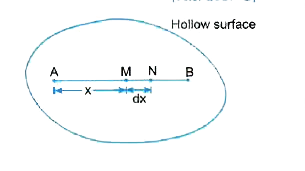
|
|
| 21. |
Answer the followingquestion , whichhelp you understand the differencebetween Thomson'smodel and Rutherford's model better. Keeping otherfactors fixed, it is found experimentally that forsmall thickness t, the numberof alpha - particles scatterd at moderateangles is proportional to t. What duedoes this linear dependenceon t provide ? |
| Answer» Solution :Linear dependence of the numberisof `alpha` -particles SCATTERED atmoderate angle withthicknessof glod foil suggestthat scatteringis predominantly DUE tosinglecollision. Changes of single collision INCREASE LINEARLY with the numberof target ATOMS and hence linearly with thickness of glod foil. | |
| 22. |
A light ray is travelling from rarer to denser medium. State the law relating i and r for retracted ray |
| Answer» SOLUTION :`(SINI)/(SINT)=n_2/n_1` | |
| 23. |
When the charge is considered as point ? |
| Answer» SOLUTION :When the linear size of charged bodies are MUCH smaller than the distance separating them, the size MAY be ignored and the charged bodies are treated as point charges. | |
| 24. |
In a silicon transistor, a change of 7.89 mA in the emitter current, produces a change of 7.8 mA in the collector current, then the base current must change by |
|
Answer» `0.9muA` |
|
| 25. |
What did Sardar Kishan Singh begin to do? |
|
Answer» He BEGAN to DELIVER speech |
|
| 26. |
The electric potential V at any point (x, y, z) in space is given by V =3x^2 where x, y, z are all in metre. The electric field at the point (1 m, 0,2 m) is |
|
Answer» a. `6 V m^(-1)` ALONG NEGATIVE x-axis |
|
| 27. |
Choose the appropriate value for X-rays from the ginen table. |
|
Answer» Solution :Wavelength = 1 NM Frequency `gamma = C/lamda = (3 xx 10^8)/(1 xx 10^-9) = 3 xx 10^17 HZ` |
|
| 28. |
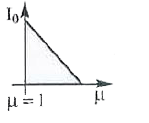
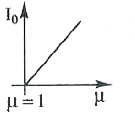
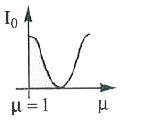
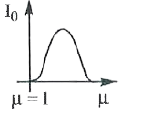
In a YDSE experiment if a slab whose refractive index can be varied is placed in front of one of the slits then the variation of resultant at mid-point of screen with 'mu' will be best represented by [Assume slits of equal width and there is no absorption by slab] |
|
Answer»
|
|
| 29. |
Find the molecular formula of ammonia, if its density at the pressure of 780 mmHg and the temperature of 20^@C is 0.736 kg//m3. |
|
Answer» `M = rho RT//p = 17` kg/kmole Noting that the atomic masses of the ELEMENTS which make up ammonia are `M_1 = 14` kg/kmole (nitrogen) and `M_2= 1` kg/kmole (HYDROGEN), we obtain the equation `M = x_1 M_1 + x_2M_2,` i.e. `17 = 14x_1 + x_2` Its solution in integral NUMBERS is: `x_1= 1 , x_2 = 3`.Hence the molecular formula of ammonia is `NH_3`. |
|
| 30. |
A dropof liquid of diameter 2.8 mm breaks up into 125 identical droplests . The change in energy isnearly (S.T .Of liquid =75 dyne/cm) |
| Answer» Answer :D | |
| 31. |
A 600 kg rocket is set for a vertical firing. If the exhaust speed is 1000 m/s, the gas ejected per second to supply the thrust needed to overcome the wight of rocket is : |
|
Answer» `6kg//s` |
|
| 32. |
What is the magnitude of the centripetal acceleration in above problem ? |
|
Answer» |
|
| 33. |
The force required to move a body up a rough inclined plane is double the force required to prevent the body from sliding down the plane. The coefficient of friction when the angle of inclination of the plane is 60° is |
|
Answer» `1/3` |
|
| 34. |
fixed point, its angular momentum is directed along When a mass is rotating in a plane about a |
|
Answer» a LINE perpendicular to the PLANE of rotation. |
|
| 35. |
What is the meaning of the term “anguish” |
| Answer» Answer :A | |
| 36. |
Suppose the circuit in has a resistance of 15 ohm. Obtain the average power transferred to each element of the circuit, and the total power absorbed. |
|
Answer» Solution :Here, `L = 80 MH = 80 xx 10^(-3) H, C = 60 MU F = 60 xx 10^(-6) , R = 15 ohm, E_(v) = 230 V, v = 50 Hz` `X_(L) = omega L = 2 pi v L 2 xx (22)/(7) xx 50 xx 80 xx 10^(-3) = 25.14 ohm` `X_(C ) = (1)/(omega C) = (1)/(2 pi v C) = (1)/(2 xx (22)/(7) xx 50 xx 60 xx 10^(-6)) = 53.03 ohm` `Z = sqrt(R^(2) + (X_(L) - X_(C )^(2))) = sqrt(15^(2) + (25.14 - 53.03)^(2)) = 31.67 ohm` `I_(v) = (E_(v))/(Z) = (230)/(31.67) = 7.26 A` Average power per cycle transferred to RESISTANCE `P_(R) = I_(v)^(2) R = (7.26)^(2) xx 15 = 790.6` watt Average power per cycle transferred to `L = P_(L) = 0` Average power per cycle transferred to `C = P_(C ) = 0` Total power per cycle absorbed, `P = P_(R ) + P_(L) + P_(C ) = 790.6` watt |
|
| 37. |
What type of pollution is created by compost, according to Mr. Williams? |
|
Answer» AIR pollution |
|
| 38. |
In vacuum, X - rays, Gamma rays and Microwave have …. . |
|
Answer» same wavelength but DIFFERENT velocity |
|
| 39. |
Water is flowing smoothly through a closed pipesystem. At one point A, the speed of the water is 3.0 m s^(-1)while at another point B, 1.0 m higher, the speed is 4.0 m s^(-1) . The pressure at A is 20 kPa when the water is flowing and 18 kPa when the water flow stops. Then |
|
Answer» the pressure at B when water is flowing is 6.7 KPA. `P_1 + rho gh_1 + 1/2 rho v_1^2 = P_2 + rhogh_2 + 1/2 rho v_2^2`….(i) Putting `v_1=30 m s^(-1) , v_2=4.0 m s^(-1) , (h_2-h_1) = 1M , P_1`= 20 kPa we get , `P_2=20+ [ 10^3 xx 9.8 (-1)+ 10^3/2 [ 9-16]]` =20-9.8-3.5 =6.7 kPa Also when the flow stops , `v_1=v_2=0` and then from (i) , `P._2`=18-9.8 = 8.2 kPa |
|
| 40. |
A ray of light passes from diamond to glass. Critical angle is minimum for |
|
Answer» Red |
|
| 41. |
N fundametal charges each of charge .q. are to be distributed as two point charges seperated by a fixed distance, then the maximum to minimum force bears a ratio (N is even and greater than 2) |
|
Answer» `((N-)^(2))/(4N^(2))` |
|
| 42. |
What does men think ? |
|
Answer» They are SUPERIOR to women |
|
| 43. |
(A): Radioactivity of 10^(8)undecayed radio active nuclei of half life of 50 days is equal to that of 1.2 xx 10^(8)number of undecayed nuclei of some other material with half life of 60 days. (R) :Radioactivity is proportional to half life. |
|
Answer» Both .A. and .R. are true and .R. is the CORRECT explanation of .A. |
|
| 44. |
One train is approaching an observer at rest and another train is receding him with same velocity4 ms^(-1). Both the trains blow whistles of same frequency of 243 Hz. The beat frequency in Hz as heard by the observer is (speed of sound in air=320ms^(-1) ) |
|
Answer» |
|
| 45. |
A bullet is fired on a fixed target. It penetrates inside the target through distance d = 4 cm and then stops, mass of bullet is m = 1kg and of target is M = 4kg . Now identical bullet moving with same velocity is fired on identical which is placed at rest on frictionless horizontal surface. The distance ( in mm ) to which the bullet will penetrate inside the target is 4K ( mm). Find K . |
|
Answer» |
|
| 46. |
A square of side d, made from a thin insulating plate, is uniformly charged and carries a total charge of Q. A point charge q is placed on the symmetrical normal axis of the square at a distance d/2 from the plate. How large is the force acting on the point charge ? |
|
Answer» Solution :According to Newton's third law, the insulating plate acts on the POINT charge with a force of the same magnitude (but opposite direction) as the point charge does on the plate. We calculate the magnitude of this latter force. Divide the plate (notionally) inot small pieces, and denote the area of the `i^(th)` piece by `Delta A_(i)`. Because of the uniform charge distibution, the charge on this small piece is `Delta Q_(i) = (Q)/(d^(2)) Delta A_(i)`. and so the electric force ACTING on it is `Fi = EI Qi`, where Ei is the magnitude of the electric field produced by the point charge q at the position of the small piece. . The force acting on the insulating plate, as a whole, can be calculated as the vector sum of the forces acting on the individual pieces of the plate. Because of the axial symmetery, the net force is erpendicular to the plate, and so it is sufficient to sum the perpendicular components of the forces: :br" `F = underset(i)sum F_(i) cos theta_(i) = underset(i)sum E_(i) (q)/(d^(2)) DeltaA_(i) cos theta_(i) = (Q)/(d^(2)) underset(i) sum E_(i) Delta A_(i) cos theta_(i)` Where `theta_(i)` is the angle between the normal to the plate and the line that connects the point charge to the its piece of it. The Sum in the given expression is nothing other than the electric flux through the square sheet produced by the point charge `q : psi = (q)/(6_(epsi_(0)))` Using this and our previous observations, we calculate the magnitude of the force acting on the point charge due to the presence of the charged insulating plates as `F = (QQ)/(6e_(0)d^(2))` 
|
|
| 47. |
Compare the magnetic fields due to a straight solenoid and a bar magnet. |
| Answer» Solution :Both the fields are IDENTICAL. A long straight current carrying SOLENOID BAHAVES as a bar magnet having dipole moment `VECM = N I VECA` | |
| 48. |
Two nucleons are at a separation of 1xx10^(-15)m The net force between them is F_1if both are neutrons, F_2if both are protons and F_3if one is a proton and other is a neutron. In such a case |
|
Answer» `F_(2) GT F_(1) gt F_3` |
|
| 49. |
In the above question dimensions of (b)/(c) are the same as those of |
|
Answer» WAVE velocity |
|
| 50. |
The obtuse angle of Fresnel's biprism is 178^(@). A slit is illuminated by light to wavelenght 6000Å is at distance of 10 cm from the biprism. Find the fringe widht on a screen at a distance of 90 cm from the biprism . The refractive index of the material of the birism is 1.5 |
|
Answer» `0.000344 MM` `mu=1.5,u=10cm` `d=2u(mu-1)alpha` `=(2xx0.1(1.5-1)xx1)/(57)` `beta=(D)/(d)lamda=(1xx6xx10^(-7)xx57)/(0.1)` `=3.4xx10^(-5)m` `=0.034mm` |
|