

Saved Bookmarks
This section includes 7 InterviewSolutions, each offering curated multiple-choice questions to sharpen your Current Affairs knowledge and support exam preparation. Choose a topic below to get started.
| 1. |
In the given circuit, the AC source has omega=50 rad//s considering the inductor and capacitor to be ideal, the correct choice (s) is/are |
|
Answer» The voltage across `100Omega` resistor `=20` `=2/(5sqrt(2)A` at `45^(@)` LEADING `I_(2)=20/(z_(2))=(sqrt(2))/5A` at `45^(@)` lagging `I_(1_(R.M.S.))=1/5A` `I_(2_(R.M.S))=2/5A` 
|
|
| 2. |
(a) Draw a ray diagram to show the working of a compound microscope. Deduce an expression for the total magnification when the final image is formed at the near point. (b) In a compound microscope, an object is placed at a distance of 1.5 cm from the objective of focal length 1.25 cm. If the eyepiece has a focal length of 5 cm and the final image is formed at the near point, estimate the magnifying power of the microscope |
|
Answer» Solution :(a) A ray diagram showing the WORKING of a compound microscope has been shown in Fig. 9.90. Total ANGULAR magnification (Magnifying POWER) of a compound microscope is defined as the ratio of the angle subtended at the eye by the final image to the angle subtended at the eye by the object as viewed directly by placing it at near point of eye. In figure `C_2B" = D`= least distance of distinct vision. Let us imagine the object AB to be shifted to `A_(1)B..`so that it is also at a distance D from the eye.  If `angleAC_(2)B.. = beta` and `angleA_(1)C_(2)B.. =alpha,` then by definition `m=beta/alpha = (tan beta)/(tanalpha)` In `triangleA..B..C_(2), tan beta =(A.B.)/(C_(2)B.)` and in `triangleA_(1)B..C_(2), tan alpha =(A_(1)B.)/(C_(2)B.)` `therefore m_(e) xx m_(0)` Applying lens formula for eyelens, we have `therefore m = m_(0) xx m_(e) =-v_(0)/u_(0)(1+D/f_(e))` As a first approximation `v_(0)=L` , distance between the OBJECTIVE and eye lens or the length of the microscope tube and`u_(0)=f_(0)`, the focal length of objective lens. Hence, `m=-L/f_(0)(1+D/f_(e))` Therefore, to increase the magnifying power of a compound microscope, focal lengths of both objective as well as eye lens should be as small as possible. (b) As per question `u_0 = 1.5 cm, f_(0) = 1.25 cm, f_e = 5 cm` and final image is formed at near point of eye i.e., at least distance of distinct vision D = 25 cm. `1/v_(0) =1/1.25-1/1.5 = 1/7.5` or `v_(0) = 7.5 cm` `therefore` magnifying power `|m| = v_(0)/u_(0) (1+D/f_(e)) = 7.5/1.5(1+25/5) = 30` |
|
| 3. |
(a) Derive the expression for the torque acting on the rectangular current carrying coll of a galvanometer. Why is the magnetic field made radial ? (b) A alpha- particle is accelerated through a potential difference of 10 kV and moves along y-axis. It enters in a region of uniform magnetic field B=2 xx 10^(-3)T acting along y-axis. Find the radius of its path. ["Take mass of "alpha-"particle "=6.4 xx 10^(-27)kg] |
Answer» Solution :(a) Consider a rectangular galvanometer coil PQRS of length land breadth b, carrying a CURRENT L, placed in a uniform magnetic field B such that a vector normal to the plane of the coil subtends an angle `theta` from the direction of dB. 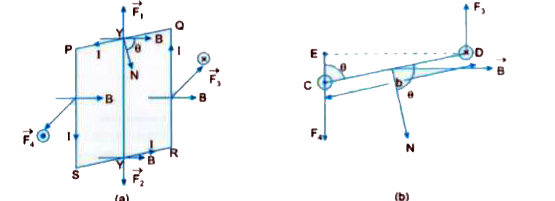 In this situation forces F and E, having magnitude Ib B sin `theta` are acting on arms PQ and RS. The forces are equal, opposite and collinear, hence they cancel out. Again forces `F_(3) and F_4` having magnitude ll B are acting on each of the two arms QR and SP. These forces too are equal and opposite but these are non-collinear and form a couple. Figure (b) represents a top view of the arrangement and from it, we find that the torque of the couple acting on the loop. `tau=(II B) xx b sin theta=l(l b ) B sin theta=IA B sin theta` where A =l b= area of the loop. If anstead of a single loop, we have a rectangular coil having N turns, then torque `tau=NIA B sin theta` In vector notation `vectau=NI( VECA xx vecB)=(vecm xx vecB)," where "vecm=NI vecA`= magnetic moment of current carrying coil. The magnetic field is made radial so that value of `theta` BECOMES `90^@` and in that case torque `tau=NIAB`, whose value does not change even when the coil rotates by a certain angle. (b) Here accelerating voltage `V =10kV =10 xx 10^(3) V,` normal magnetic field `B= 2 xx 10^(-3)T` mass of `alpha` -particles `m=6.4 xx 10^(-27)kg` and charge of `alpha`-particle `q=+2e=2 xx 1.6 xx 10^(-19) =3.2 x 10^(-19)C` Radius of circular path `r=sqrt((2mV)/(qB^(2))) =sqrt(2 xx (6.4 xx 10^(-27)) xx (10 xx 10^(3))/((3.2 xx 10^(-19)) xx (2 xx 10^(-3))^(2)))=10m` |
|
| 4. |
The vertical component of earth's magnetic field is zero at : |
|
Answer» MAGNETIC EQUATOR |
|
| 5. |
A bar magnet of magnetic moment M is bent in shape such that all the parts are of equal lengths. Then new magnetic moment is |
|
Answer» M/3 |
|
| 6. |
The image formed by a convec mirror of focal length 30 cm is a quarter the size of the object what is the distance of the obect from the mirror? |
|
Answer» Solution :F = 0.3, m =`(V)/(U) = (1)/(4) , "" v = (u)/(4) , u = ? ` `(1)/(f) = (1)/(u) + (1)/(v) "" (1)/(0.3) = (1)/(u) + (1)/((u)/(4)) = (1)/(u) + (4)/(u) = (1 + 4 )/(u ) ` u = 1.5 m |
|
| 7. |
Two identical glass (mu_g=3/2) equiconvex lenses of focal length f each are kept in contact. The space between the two lenses is filled with water mu_w=4/3. The focal length of the combination is |
|
Answer» Solution :From lensmaker.s formula In `1/f=(mu_g-1)((1)/(R_1)-(1)/(R_2)),R_1=R,R_2=-R` `1/f=(mu_g-1)(2/R)` `=(3/2-1)(2/R)` `therefore 1/f=1/R` `therefore 1/f=1/R` `therefore f=R` … (1)  FOCAL length of concave lens of water, In `(1)/(f.)=(mu_w-1)((1)/(R_1)-(1)/(R_2)),R_1=-R,R_2=R` `(1)/(f.)=(4/3-1)(-2/R)` `therefore (1)/(f.)=-(2)/(3R)` `therefore f.=-(3f)/(2) [becauseR=f` given] Now for lenses in contact EQUIVALENT focal length be f. `1/F=1/f+(1)/(f.)+1/f` `=2/f+(1)/(f.)` `=2/f+(1)/(f.)` `=(6-2)/(3f)` `=(4)/(3f)` |
|
| 8. |
Resonance frequency for L-C-R, AC seriescircuit is f_0= …… |
|
Answer» `1/(2pisqrt(LC))` `omega_0=1/sqrt(LC)` `therefore 2pif_0=1/sqrt(LC)` `therefore f_0=1/(2pisqrt(LC))` |
|
| 9. |
The advantage of using larger nut bolts is? |
|
Answer» They INCREASE the mass of the system |
|
| 10. |
At the moment t=0 a particle of mass m starts moving due to a force F=F_0 cos omegat, where F_0 and omega are constants. How long will it be moving until it stops for the first time? What distance will it traverse during that time? What is the maximum velocity of the particle over this distance? |
|
Answer» Solution :According to the PROBLEM, the force acting on the particle of mass m is, `vecF=vecF_0 cos omegat` So, `m(dvecv)/(dt)=vecF_0cos omegat` or `dvecv=(vecF_0)/(m)cos omega tdt` Integrating, within the limits. `underset(0)overset(vecv_0)int dvecv=(vecF_0)/(m)underset(0)overset(t)intcos omegadt` or `vecv=(vecF_0)/(momega)sin omegat` It is clear from EQUATION (1), that after STARTING at `t=0`, the particle comes to rest from the first time at `t=pi/omega`. From Eqs. (1), `v=|vecv|=(F_0)/(momega)sin omegat` for `tlepi/omega` (2) Thus during the time interval `t=pi//omega`, the sought distance `s=(F_0)/(MW)underset(0)overset(pi//omega)int sin omega t dt=(2F)/(momega^2)` From EQ. (1) `v_(max)=(F_0)/(momega)` as `|sin omega t|le1` |
|
| 11. |
As Coulomb's law is important in static electricity, _____ law is important in magnetism. |
|
Answer» Kirchhoff's |
|
| 12. |
(a) Draw a neat labelled ray diagram showing the image formation of a distant object by a refracting telescope. Deduce the expression for its magnifying power when the final image is formed at infinity. (b) The sum of focal lengths of the two lenses of a refracting telescope is 105 cm. The focal length of one lens is 20 times that of the other. Determine the total magnification of the telescope when the final image is formed at infinity. |
Answer» Solution :(i) 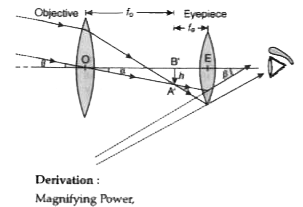 Derivation `:` Magnifying Power, `M = ( tan beta )/( tan alpha) ~= (beta)/( alpha)` Final IMAGE is FORMED at infinity when the image A.B. is formed by the objective lens at the focus of the eye piece. `m = ( h )/( f_(e )) xx ( f_(0))/( h ) ` `= ( f_(0))/( f_(e ))` (b) GIVEN ` f_(0) + f_(e ) = 105, f_(0) = 20 f_(e )` `20 f_(e ) + f_(e ) = 105 ` `f_(e ) = (105)/( 21) = 5 cm` |
|
| 13. |
A 150 m long metal wire connects points A and B. The electric potential at point B is 50V less than that at point A. If the conductivity of the metal is 60 xx 10^(6)mho//m then magnitude of the current density in the wire is equal to: |
|
Answer» `11 xx 10^(-4)A//m^(2)` |
|
| 14. |
Consider a vertical conductor carrying current I in upward direction. P is a point at a distance away from the conductorWhat is the direction of magnetic field at P? |
| Answer» SOLUTION :In to the PLANE of PAPER | |
| 15. |
Which of the following represents the reverse bias characteristic of a zener diode correctly ? |
|
Answer»
|
|
| 17. |
An electric dipole of dipole momentoversetto Pis placed in a uniform electric fieldoversetto E. Obtain the expression for the torque oversetto tauexperienced by the dipole. Identify two pairs of perpendicular vectors in the expression. |
|
Answer» SOLUTION :The torque acting on the dipole `oversetto tau =oversetto p XX oversetto E`. For its derivation ,see ANSWER to SHORT Answer Questions Obviously , (a) ` oversetto tau and oversetto p ,` as well as (b) ` oversetto tau and ovarsetto E ` are mutually perpendicular. |
|
| 18. |
In a nuclear fission 0.1% of mass is converted into energy. The energy released by the fission 1kg mass is |
|
Answer» `2.5 xx10^(7)` KWH |
|
| 19. |
A charge of-9.0 nC is uniformly distributed around a thin plastic ring lying in a yz plane with the ring center at the origin. A -3.0 pC particle is located on the x axis at x=3.0m. For a ring radius of 1.5 m, how much work must an external force do on the particle to move it to the origin? |
| Answer» SOLUTION :`8.9 XX 10^(-11) J` | |
| 20. |
When a capacitor of small capacitance is connected in series with series L-R circuit. The alternating current in the circuit increases. Explain why? |
|
Answer» Solution :Addition of capacitor in the given circuit decreases the impedance Z of the circuit and hence increases current I in the circuit as `I=(V)/(Z)" where "Z=sqrt(R^(2)+X_(L)^(2))" WITHOUT capacitor"` `"and new "Z=sqrt(R^(2)+(X_(L)-X_(C))^(2))` with capacitor |
|
| 21. |
A point particle of mass m is attached to one end of massless rigid non-conducting rod of length l. Another point particle of same is attached to the other end of the rod. The two particles carry equal charges +q and -q respectively. This arrangement is held in a region with the field E such that the rod makes an angle with the field direction : |
|
Answer» The tension in ROD remains constant |
|
| 22. |
An object of size 3.0 cm is placed 14 cm in front of a concave lens of focal length 21 cm. Describe the image produced by the lens. What happens if the object is moved farther from the lens ? |
|
Answer» |
|
| 23. |
Let i_e ,i_e and i_b represent emitter current, collector current and the base current of a transistor, |
|
Answer» `i_c gti_e` |
|
| 24. |
Who collects the money for Lencho? |
|
Answer» Postmaster |
|
| 25. |
In Fraunhoffer diffraction, the wavelength of light incident on the slit (d)/(2)where dis the width of the slit. What will be the number of bright fringes fromed on an infinitely extended screen placed at any distance from the slit ? |
|
Answer» Solution :In Fraunhoffer diffraction condition for maximum is, `dsintheta=(2n+1)(lamda)/(2)""` where, N=1, 2, 3, …… but `lamda=(d)/(2)` is GIVEN. `:.dsintheta=(2n+1)(d)/(4)` `:.sintheta=((2n+1)/(4))` but `sinthetale1` `:.(2n+1)/(4)le1` `:.2n+1le4` `:.2nle3` `nle(3)/(2)` Thus, for integer value of n, its possible value =1, we have TWO first order maxima for n=1 and central maximum forn=0, so we have total three maxima. |
|
| 26. |
(A) : A charged particle is accelerated by a potential difference of V volts. It then enters perpendicularly to a uniform magnetic field. It rotates in a circle. Its angular momentum about center is say L. Now if V is doubled, L also becomes two times. (R) : If V is doubled, kinetic energy will becomes two times and therefore, L also become two times. |
|
Answer» Both 'A' and 'R' are TRUE and 'R' is the CORRECT explanation of 'A'. |
|
| 27. |
In Young's double slit experiment the separation d between the slits is lambda mm, the wavelength of the light used is 5896 Å and distance D between the screen and slits is 100 cm. It is found that the angular width of the fringes is 0.20^(@). To increase the fringe angular width to 0.21^(@) (with same lambda. and D) the separation between the slits needs to change to ..... |
|
Answer» `1.7` mm If `theta` is very SMALL, then `sin theta_(1) theta_(1)` `:. d theta_(1)=lambda` `:. theta_(1)=(lambda)/(d)` `:.theta prop (lambda)/(d) [ :. lambda` and n are same] `:. (theta_(2))/(theta_(1))=(d_(1))/(d_(2))` `:. (0.21)/(0.20)=(2)/(d_(2)) rArr d_(2)` `=(2xx0.21)/(0.20)` `=1.9 mm` |
|
| 28. |
Can a body have a charge of 1.0xx10^(-19) C ? |
| Answer» SOLUTION :No, the minimum amount of CHARGE that is possible is `1.6xx10^(-19)` C | |
| 29. |
A : Nicol prism is used to produce and analyse plane polarised light. R : Nicol prism reduces the intensity of light to zero. |
|
Answer» Both A and R are TRUE and R is the CORRECT EXPLANATION of A |
|
| 30. |
Electric flux through a surface of area 100 m^(2) lying in the x,y plane is (in V-m) if vec(E)=hat(i)=sqrt(2j)+sqrt(3k) |
|
Answer» 100 |
|
| 31. |
A 600 kg rocket is set for a vertical firing. If the exhaust speed is 1000 ms^(-1), the mass of the gas ejected per second to supply the thrust needed to overcome the weight of rocket is |
|
Answer» 117.6 KG `s^(-1)` |
|
| 32. |
A wire of steel of radius r and length l breaks due to weight W .What will be the breaking weight of another steel wire of radius 2r and length 2l ? |
|
Answer» a)4W |
|
| 33. |
In a potentiometer of 10 wires, the balance point is obtained on the 7^(th) wire. To shift the balance point to 9^(th) wire, we should |
|
Answer» decrease resistance in the main CIRCUIT |
|
| 34. |
The I - V characterisic of an LED is |
|
Answer»
|
|
| 35. |
Three coherent waves having amplitudes 12mm. 6mm and 4 mm arrive at a given point with successive phase difference of pi//2. Then the amplitude of the resultant wave is |
|
Answer» 7mm |
|
| 36. |
An aero plane is moving north horizontally with a speed of 200m/sec at a place where the vertical component of the earth's magnetic field is 0.5xx10^-1T. The e.m.f. set up between the tip's of the wings if they are 10m apart is: |
|
Answer» 0.001V |
|
| 37. |
Calculate the Binding energy and and binding energy per nuclcon of an oxygen nucleus (O_(8)^(16)) using the following data (MeV): Mass of proton = 1.007825 u Mass of neutron = 1.00865 u Mass of oxygen nucleus = 15.995 u. |
|
Answer» Solution :Given `m_(E)= 1.007825u, m_(N) = 1.008665 u, M = 15.995u,Z=8, A=16 ` `DeltaM = [Zm_(p)+(A-Z)m_(n)]-M=[8xx1.007825+8xx1.008665]-15.995` `=[8.0626+8.06932]-15.995=16.13192-15.995=0.1369u` Binding ENERGY `E_(b) = 0.13692xx931.5` `E_(b)` =127.54 MeV Binding energy / nucleon `E_(BN)= (E_(b))/(A)` `E_(bn)=(127.54)/(16)` `E_(bn)=7.97` MeV |
|
| 38. |
Two polaroids are set in crossed positions.A third polaroid is placed between the two making an angle angle with the pass axis of the first polaroid. Write the expression for the intensity of light transmitted from the second polaroid. In what orientations will the ransmitted intensity be (i) minimum and (ii) maximum. |
|
Answer» Solution :Let polaroids `P_1` and `P_2`be in crossed position. Let the polaroid`P_2` make an angle with the pass AXIS of polaroid `P_1` Let `I_1` be the INTENSITY of polarised LIGHT emerging our of `P_1` . Then intensity of light after passing through `P_2` will `I_2 = I_1 cos^2 theta` Since `P_3 and P_1` are in crossed position therefore the angle MADE by` P_2 ` with `P_3`is ` (pi/2 - theta)` `therefore ` Intensity of light coming out of `P_3` is ` I_3 = I_2 cos^2 (pi/2 - theta)` ` I_3 = I_2 cos^2 sin^2 theta = I_1 (1/2 sin 20)^2` If ` I_0` is the intensity of the unpolarised light falling on `P_1` then `I_1 = (I_0)/(2)` ` thereforeI_3 = (I_0)/(2) (1/2 sin 20)^2` (i) Minimum outcoming intensity is zero. (ii) Maximum outcoming intensity is received when`theta = pi/4` `therefore (I_3)_(max) = (I_0)/(2) (1/2)^2 = (I_0)/(8) ` |
|
| 39. |
The sensitivity of a potentiometer can be increased by |
|
Answer» increasing the emf of the primary cell |
|
| 40. |
An astronaut standing on the surface of the moon (m=M, radius=R) holds a feather (mass=m) in one hand and a hammer (mass=100m) in the other hand, both at the same height above the surface. If he releases them simultaneously, what is the acceleration of the hammer? |
|
Answer» `(mv^(2))/(R)` |
|
| 41. |
If masses of two point objects is doubled and distance between them is tripled, then gravitational force of attraction between then will nearly |
|
Answer» incease by 225% ` = ((4)/(9)-1)/(1) xx 100 = - 56%,` -ve sign indicates that force of attraction decreases. |
|
| 42. |
If the wavelength of first member of Balmer series of hydrogen spectrum is 6564 A^(@). The wavelength of second member of Balmer series will be : |
|
Answer» `1215Å` |
|
| 43. |
Given vecC= vecAxxvecB and vecD = vecBxxvecA What is the angle between vecCand vecD? |
|
Answer» `30^(@)`  From figure angle between `vecC` and `VECD` is `180^(@)` |
|
| 44. |
A travelling wave represented by y = A sin (omega t - kx) is superimposed on another wave represented by y = A sin (omega t + kx). the resultant is : |
|
Answer» A wave travelling along + x direction Y = 2A sin `omega t `cos kx standingwave For nodes cos kx = 0 `(2pi)/(lambda) x = ( 2n + 1) (pi)/(2) ` `THEREFORE "" x = ((2n + 1)lambda)/(4) . N = 0 , 1,2,3.... ` So, correct CHOICE is d. |
|
| 45. |
The electric lines of force do not intersect. Why? |
|
Answer» SOLUTION :If they intersect, at the point of intersection there should be electrical FIELD in TWO directions, which is not POSSIBLE. So they do not intersect. |
|
| 46. |
The rate of flow of electric charge is |
|
Answer» ELECTRIC current |
|
| 47. |
Take a strong cylindrical electromagnet connected to AC source and place a light metallic disc at the top of it. When the current is switched 'on', the disc is thrown up in the air. a. Why does the disc go up? b. How is the repulsive force produced? |
|
Answer» Solution :a. Induced CURRENTS are produced in the disc which acts in such a manner that it OPPOSES the increase of magnetic flux through it. As a result the disc is thrown up. b. When the circuit is switched on, the current starts growing through the solenoid. As the current grows, the magnetic lines along the axis of the solenoid and HENCE magnetic flux through the disc ALSO increases from zero to some finite value. Induced currents are produced in the disc which opposes the increase of magnetic flux through it. Hence the disc is thrown up. |
|
| 48. |
A block of wood floats in water in a vessel 1/10 of its volume exposed. Sufficient oil of density 0.8 g//cm^(3) is poured into the vessel till the block is completely submerged. What percentage of its volume in the water now? |
|
Answer» 0.8 |
|
| 49. |
Obtain approximately the ratio of the nuclear radii of the gold isotope " "_(79^(197)Au and the silver isotope " "_(47)^(107)Ag. |
|
Answer» Solution :We KNOW that nuclear RADIUS is given by R=`R_(0) (A)^(1/3)` `therefore (R(" "_(79)^(197)AU))/(R(" "_(47)^(107)Ag))=(197/107)^(1/3)=1.23`. |
|
| 50. |
A parallel plate capacitor of capacity 100 muF is charged by a battery of 50 V. The battery remains connected and if the plates of the capacitor are brought closer so that the distance between them becomes half the original distance, the additional energy given by battery to capacitor in joules is : |
|
Answer» `125xx10^(-3)` |
|


