

Saved Bookmarks
This section includes 7 InterviewSolutions, each offering curated multiple-choice questions to sharpen your Current Affairs knowledge and support exam preparation. Choose a topic below to get started.
| 1. |
The resonant frequency of a circuit is 100Hz .If the capacitor is replaces by anothere capacitor of capacity =4 times the original capacity , then the resonant frequency will be : |
|
Answer» 25Hz |
|
| 2. |
A particle is moving eastward with velocity of 5 m/s. In 10 seconds, the velocity change to 5 m/s north wards. The average acceleration in this time |
|
Answer» `1/ SQRT2 m/s^2` NORTH west |
|
| 3. |
First overtone frequency of a closed pipe of length l_1is equal to the 2^(nd)harmonic frequency of an l_2open pipe of length. The ratio l_1/l_2 = |
|
Answer» `3/4` `I_(1)/I_(2)=3/4` |
|
| 4. |
The two planets have radius r_(1) and r_(2), densities d_(1) and d_(2). The ratio of acceleration due to gravity on them is : |
|
Answer» `r_(1)d_(2): r_(2)d_(1)` `therefore (g_(1))/(g_(2))=(R_(1)d_(1))/(R_(2)d_(2))` THUS correct choice is (d). |
|
| 5. |
Let S be an imaginary closed surface enclosing mass m.Let dvec(S) be an element of area on S, the direction of dvec(S) being outward from S. Let vec(E) be the gravitational intensity at dvec(S). We define phi = phi_(s)vec(E).dvec(S), the integration being carried out over the entire surface S. |
|
Answer» `PHI = -Gm` |
|
| 6. |
In fig25-29, how much charge is stored on the parallel-plate capacitors by the 10.0 V battery? One is the filled with air, and the other the filled with a dielectric for which k=3.00,both capacitors have a plate area of 5.00 times 10^-3 m^2 and a plate separation of 2.00 mm. |
| Answer» SOLUTION :`8.85 TIMES 10^-10 C` | |
| 7. |
An optical instrument uses a lens of power 100 D for objective lens and 50 D for its eyepiece. When the tube length is kept at 25 cm the final image is formed at infinity. (a) Identify the optical instrument. (b) Calculate the magnification produced by the instrument. |
|
Answer» Solution :Here focal LENGTH of objective lens `f_(0)= (1)/(P_(0))= (1)/(100) `m =0.01 m = 1.0 cm , focal length of eyepiece `f_(e) = (1)/(P_(e)) = (1)/(50) m = 0.02 m = 2.0 ` cm length of the tube L = 25 cm and final image is being formed at infinity. (a) The instrument is a compound microscope because both `f_(0)` and `f_(e)` ,are small and comparatively speaking `f_(0) LT f_(e)` (b) Magnification produced m =- `(L.D)/(f_(0).f_(e))=- ((25cm)xx(25 cm))/((1.0 cm)xx(2.0cm))=-312.5` |
|
| 8. |
What fraction (in per cent) of free electrons in a metal at T=0 has kinetic energy exceeding half the maximum energy? |
|
Answer» SOLUTION :The fraction is `eta= int_(1/2E_(max))^(E_(max))E^(1//2)dE// int_(0)^(E_(max))E^(1//2)dE= 1-2^(-3//2)= 0.646 or 64.6%` |
|
| 9. |
(A): If vecr_(1) and vecr_(2) be the initial and final displacement in time t,then vecr_(avg)=(vecr_(2)-vecr_(1))/(t) (R ):The average velocity of a particle having initial and final velocity vecv and vecv_(2) is (vecv_(1)+vecv_(2))/(2), for uniform acceleration |
|
Answer» |
|
| 10. |
A parachutist after bailing out falls 50 m without friction When parachute opens, he descends at 2 ms and reaches the ground with a speed of 3 m l At what height did he bailout ? |
|
Answer» 191 m When parachute opens `3^(2)=v^(2)-2xx2xxh` 4h=980-9 or `h=(971)/(4)` Total HEIGHT `=(971)/(4)+50=(1171)/(4)PROP 293 m` |
|
| 11. |
Draw a plot showing the variation of photoelectric current versus the intensityof incident radiation on a given photosenstive surface. |
Answer» SOLUTION :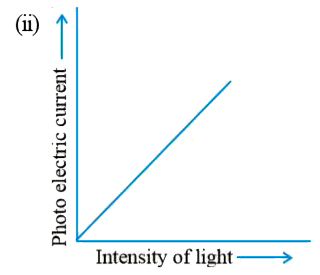
|
|
| 12. |
Imagine an infinitely long one-dimensional ionic erystal-a chain of alternating positive and negative ions with a distance a between them (Fig.). Find the force with which one half of the chain acts on an arbitrary ion and compare the result with the force to acting between the two adjacent ions. Calculation accuracy should be better than 0.001. |
|
Answer» `F = -(e^2)/(4 pi epsilon_0 a^2) (1 - 1/(2^2) + 1/(3^2) - 1/(4^2) + …) =` `= -(e^2)/(4 pi epsilon_0 a^2) (3/(1^2.2^2) + 7/(3^2.4^2) + 11/(5^2.6^2) + ..)` Compute the value of the series in the brackets to THREE significant digits. To obtain the REQUIRED accuracy, we may discard all terms below 0.001, i.e. we may take the sum of the first ten terms in the series. We obtain `3/(1^2.2^2) + 7/(3^2.4^2) + ....+ 39/(19^2.20^2)` = `= 0.82128 ~~ 0.82` Hence `F = -0.82 (e^2)/(4pi epsilon_0 a^2)` This means that neglecting the interactions with all the ions except the nearest neighbours results in an ERROR of no greater than 20% . |
|
| 13. |
Civilization is the state of development of ..... |
|
Answer» people |
|
| 14. |
In the investigation of the alpha-decay of polonium, alpha-particles with energies of 5.30 and 4.50 MeV were detected. Find the energy of the gamma-rays emitted in the decay, taking account of the recoil of the nucleus. |
|
Answer» `epsi_(gamma)=5.30-4.50=0.80MeV`. HOWEVER, this estimate is too rough, since it takes no account of the recoil energy of the nucleus. Certain problems in nuclear physics demand a much higher accuracy. Consider the energy LEVEL DIAGRAM for the case of polonium decay. The letter `Pb^(**)` with an asterisk denotes the excited lead nucleus which emits gamma-photons. The total energy of the transition is `epsi_(1)=K_(1alpha)+R_(1),"where "K_(1alpha)=5.30MeVandR_(1)` is the recoil energy of the nucleus. Since `R_(1)-4K_(1alpha)//206`, it follows that `epsi_(1)=5.30+(5.30xx4//206)=5.40MeV` Similarly, the energy liberated in the course of the second transition is `epsi_(2)=4.50+(4.50xx4//206)=4.58MeV` The energy of the gamma-photon is `epsi_(gamma)=epsi_(1)-epsi_(2)=5.40-4.58=0.82MeV` Note that because the mass of the lead nucleus is large, we can neglect the recoil energy resulting from the emission of a gamma-photon. 
|
|
| 15. |
Find the (a) maximum frequency, and (b) minimum wavelength of X-rays produced by 30kV electrons. |
|
Answer» Solution :Here the accelerating voltage `V=30kV=30xx10^(3)V` (a) MAXIMUM frequency of X-rays produced `v_(MAX)=(E)/(H)=(eV)/(h)=(1.6xx10^(-19)xx30xx10^(3)J)/(6.63xx10^(-34)J)=7.24xx10^(18)Hz` (b) The minimum wavelength of X-rays produced `lamda_("min")=(c)/(v_(max))=(3XX10^(8))/(7.24xx10^(18))=4.1xx10^(-11)m=0.041nm`. |
|
| 16. |
The force experienced by a unit charge when placed at a distance of 0.10 m from the middle of an electric dipoleon its axial line is 0.025 N and when it is placed at a distance of 0.2 m, the force is reduced to 0.002 N. Calculate the dipole length. |
|
Answer» |
|
| 17. |
An infinite nonconducting sheet has surface charge density s. There is a small hole in the sheet as shown in the figure. A uniform rod of length l having linear charge density lambda is hinged in the hole as shown. If the mass of the rod is m, then the time period of oscillation for small angular displacement is |
|
Answer» `pisqrt((mepsilon_0)/(3sigmalambda))` `r=Ia` or `a=-tau//I=(sigma)/(2epsilon_(0))lambda(l^(2))/(4)(12)/(ML^(2))sin theta` `a=-((3sigmalambda)/(2mepsilon_(0))theta)` (for SMALL angle) `tau=(2pi)/(omega)=2pisqrt((2mepsilon_(0))/(3sigmalambda))` 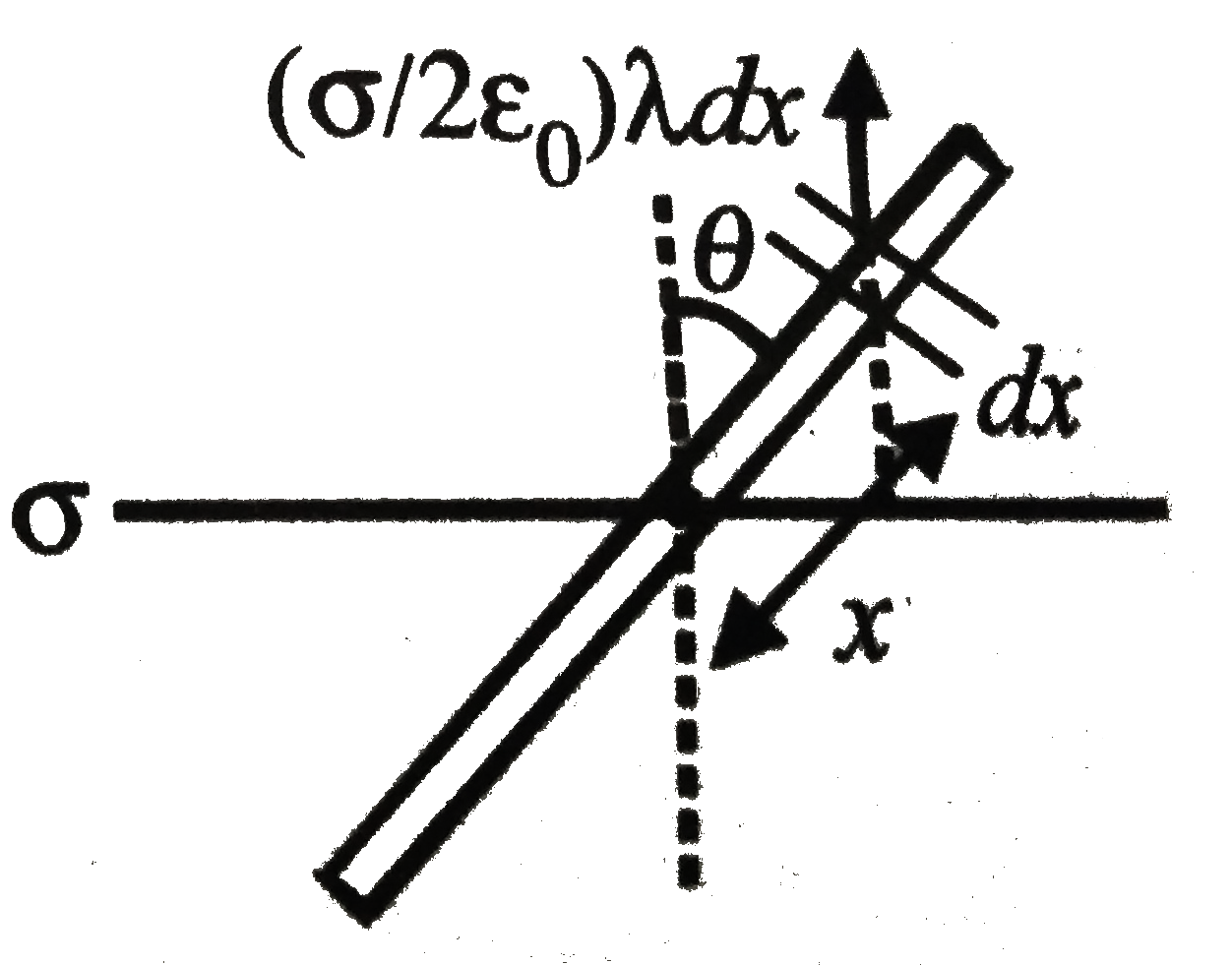
|
|
| 18. |
(A) the trajetory traced by an incident particle depends on the impact parameter of collision. (R) the impact parameter is the perpendicular distance of the initial velocity vector of the incident particle from the centre of the target nucleus. |
|
Answer» if both assertion and reason are TRUE and reason is the CORRECT EXPLANATION of assertion. |
|
| 19. |
The de-Broglie wavelength of a neutron at 27^(@)C is lamda, what will be the corresponding wavelength at 927^(@)C ? |
|
Answer» `lamda/2` `implies lamda=(h)/(sqrt(3mk_(B)T)) or lamda PROP (1)/(sqrtT)` `therefore lamda_(2)=lamda_(1)sqrt((T_(1))/(T_(2)))=sqrt((273+27)/(273+927))lamda=(lamda)/(2)`. |
|
| 20. |
Four charges of +q, +q, +q and +q are placedat the corners A, B, C and D of a square. Find the resultantforce on the charge at D. |
|
Answer» SOLUTION :Let SIDE= a, `BD=sqrt(2)a` force `F_(1)=(1)/(4pi in_(0)) . (Q^(2))/(a^(2)) ` (A to D) force `F_(2)=(1)/(4pi in_(0)).(q^(2))/(a^(2))` (C to D) `:. F_(1) = F_(2) =F`  RESULTANT of `F_(1) and F_(2)=sqrt(F_(1)^(2) +F_(2)^(2)) =sqrt(2).F` force DUE to charge at B is `F_(3) =(1)/(4pi in_(0)) .(q^(2))/((sqrt(2)a)^(2)) =(1)/(2) (1)/(4pi in_(0)) (q^(2))/(a^(2))` (B to D) Resultant force on change at `D=sqrt(2)F+F_(3)` `=sqrt(2) (1)/(4pi in_(0)).(q^(2))/(a^(2))+(1)/(2) (1)/(4pi in_(0)) .(q^(2))/(a^(2))` `=(1)/(4pi in_(0)) (q^(2))/(a^(2)) [sqrt(2) +(1)/(2)]=(q^(2))/(8pi in_(0) a^(2)).[1+2sqrt(2)]` |
|
| 21. |
By suitable example show that particle or wave nature depend on type of experiment. |
|
Answer» Solution :When we see an object by our particel and wave nature both are IMPORTANT. The gathering and focussing mechanism of light EYE lens is well described in wave picture . Absorption of light by cone and rod CELLS on retina REQUIRE PHOTON of light. |
|
| 22. |
Two spheres of masses (m) and (M-m) are prepared from a sphere of mass M. They are kept at a distance x. For what ratio of m/M the gravitational attraction between them will be maximum |
|
Answer» SOLUTION :The GRAVITATIONAL force of attraction between the two spheres is `F=(GM(M-m))/x^2=((GMm)/x^2)-(Gm^2)/x^2` The force to be maximum, `Df/dm=GM/x^2=0=2Gm/x^2 THEREFORE Gm/x^2=2Gm/(x^2) thereforeM=2m or m/M=1/2` |
|
| 23. |
In the above question, if the rays were to converge beyond C, then find the nature of final image formed. |
Answer» Solution : IMAGE is virtual, iniverted an deminished. 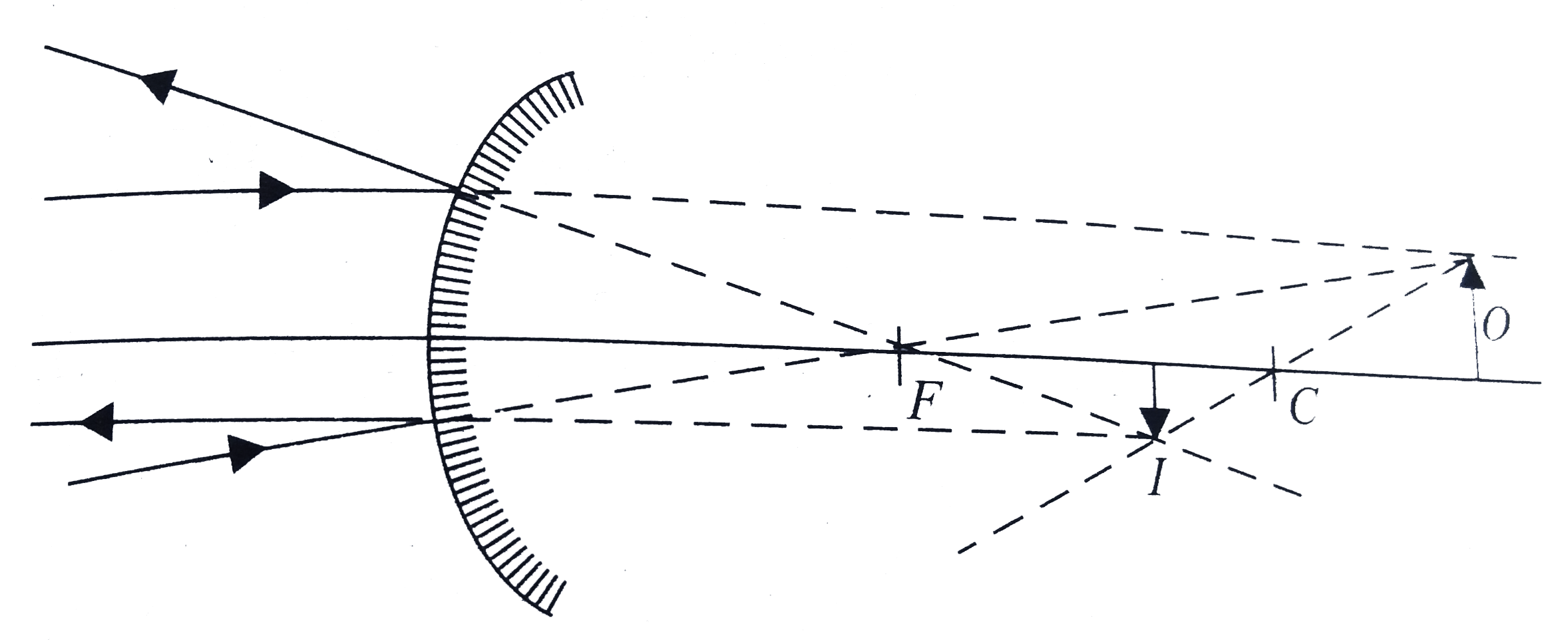
|
|
| 24. |
A steel ball is dropped from the roof of a building .An observer standing in front of a window 1.5 m high notes that the ball takes 1/10 s to fall from the top to the bottom of the window .The ball reappears at the bottom of the window 2s after passing it on the way down,if the collision between the ball reappears at the bottom of the window 2s after passing it on the way down.If the collision between the ball and the ground is perfectly elastic,then find the height of the building?Take g=10 m//s^(2). |
|
Answer» Solution :SINCE collison is perfectly elastic,the speed of the BALL just before collision is equal to the speed of the ball just after collision .Hence time of descent is equal to the time of ascent.Therefore time taken by the ball to reach the GROUND from the bottom of the window is 1 sec. LET u be the speed of the ball when it is at the top of the window `implies1.5=u(1)/(10)+(1)/(2)xx10xx(1)/(100).(vecs=uvect+(1)/(2)vecat^(2))impliesu=14.5m/s` `therefore` ball is dropped hence its initial speed is 0 It t be time taken by the ball to acquire the speed of 14.5 m/s,then `14.5=0+10xxt,(vecv=vecu+vecat)impliest=1.45` sec Hence total time of descent is given by `T=1.45+(1)/(10)+1=2.55s` If H be the HEIGHT of the building ,then `H=0+(1)/(2)gt^(2)` `impliesH=(1)/(2)xx10xx(2.55)^(2)impliesH=32.5m` |
|
| 25. |
If (2x)/3 − y/2 + 1/6 = 0 and x/2 + (2y)/3 = 3 then |
| Answer» Answer :A | |
| 26. |
How does one explain the emission of electrons from a photosensitive surface with the help of Einstein's equation? |
|
Answer» Solution :Explanation of emission of electrons from the PHOTOSENSITIVE surface Einstein's Photoelectric EQUATION is `hv=phi_(0)+K_("MAX")` When a photon of ENERGY hv is incident on the metal, some part of this energy is UTILIZED as work function to eject the electron and reminaing energy appears as the kinetic energy of the emitted electon. |
|
| 27. |
A block of mass 2m is hanging at the lower and of a ropeof mass m and length the l, the other end being fixed to the ceililng. A pulse of wavelength lamda_(0) is produced at the lower of the rope. The time taken by the pulse to reach the other end of the rope is: |
|
Answer» `2sqrt((l)/(g))(sqrt(3 )-1)` Then `v_(x) = sqrt((2M + (max)/(l))(g)/(m//l))= sqrt((2l + x))g` Then time taken to go from bottom to top will be T = `underset(0)overset(L)(INT)(DX)/(sqrt((2l +x))g) = 2sqrt((l)/(g))(sqrt(3) -sqrt(2))`. |
|
| 28. |
Interstellar space has an extremely weak magnetic field of the order of 10^(-12)T. Can such a weak fleld be of any significant consequence? Explain. |
| Answer» Solution :(f} Because of very weak magnetic FIELD, RADIUS of circular paths followed by charged particles in Cosmic rays are FOUND to be very large `(because R= (mV)/( B_q) )`. Over gigantic interstellar distances (distances between stars) such a change in radius BECOME significant and that is why cosmic rays are greatly deflected from their PASSAGES. | |
| 29. |
A long spring is stretched by 2 cm having potential energy as V. If the spring is stretched by 10 cm, the potential energy would be |
|
Answer» 25 U |
|
| 30. |
How many types of semiconductors are there ? What are they ? |
| Answer» SOLUTION :TWO, INTRINSIC and EXTRINSIC. | |
| 31. |
In Young's double slit experiment the intensity of light at a point on the screen where the path difference is lambda, is I. If intensity at another is 1/4, then possible path differences at this point are |
|
Answer» `(LAMBDA)/(2), (lambda)/(3)` |
|
| 32. |
The compression ratio of an automotive petrol engine is about 1 7. Assuming the Poisson constant for the airfuel mixture to be 1.38 find the maximum efficiency of this engine and compare it with the actual efficiency, which does not exceed 25%. |
|
Answer» |
|
| 33. |
अण्डाशय से ऊसाइट के निकलने को कहते हैं ? |
|
Answer» प्रसव |
|
| 34. |
What we call the angle between the incident ray produced and refracted rey ? |
| Answer» SOLUTION :ANGLE of DEVIATION | |
| 35. |
Explain how frequency of incident light varies with stopping potential. |
|
Answer» Solution :(i) To study the effect of frequency of INCIDENT light on stopping potential, the intensity of the incident light is kept constant. (ii) The variation of photocurrent with the COLLECTOR electrode potential is studied for radiations of different frequencies and a graph drawn between them is shown in FIGURE from the graph, it is clear that stopping potential varyover different frequencies of incident light.  (iii) Greater the frequency of the incident radiation, larger is the corresponding stopping potential. (iv) This implies that as the frequency is increased, the photoelectrons are emitted with greater kinetic energies so that the retarding potential needed to stop the photoelectrons is also greater.  (v) Now a graph is drawn between frequency and the stopping potential for different metals( Figure) . (vi) From this graph, it is found that stopping potential varies linearly with frequency. (vii) Below a certain frequency called threshold frequency, no ELECTRONS are emitted,hence stopping potential is zero. (viii) But as the frequency is increased above threshold value, the stopping potentialvaries linearly with the frequency of incident light. |
|
| 36. |
An electron of mass m, moves around the nucleus in a circular orbit of radius .r. under the action of centripetal force .F.. The equivalent electric current is |
|
Answer» `(E)/(2PI)SQRT((F)/(mr))` |
|
| 37. |
A 50 kW carrier is to be modulated to a level of 10%. What is the total side band power in each case. |
|
Answer» <P> SOLUTION :`P_("SIDE BAND")=1/2 m^2 P_("CARRIER")``=1/2(0.1)^2xx50=0.25kW` |
|
| 38. |
A galvanometer of resistance 5 Omega can be converted into a voltmeter of range 0 - V voltmeter of range 0 - V volts by connecting a resistance R Omega in series with it. How much resistance will be required to charge its range to 0 - V/2 volts? |
|
Answer» Solution :As GALVANOMETER of resistance G can be converted into a voltmeter of range 0- V volts by adding a SERIES resistance `R Omega`, hence `R = V/(I_g) - G implies I_(g) = V/(R + G)` Let a resistance `R. Omega` be joined in series with galvanometer to convert it into a voltmeter of range `V. = V/2` volts , then `R. = (V.)/(I_g) - G = (V//2)/(V//R + G) - G = (R + G)/(2) - G = (R - G)/(2)`. |
|
| 39. |
The rms velocity of a particle is v at pressure p. If the pressure increases by two times , then the rms velocity will be |
|
Answer» 4 v `v_("rms")=SQRT((3RT)/(M))` `"so" v_("rms")propsqrt(T)` As rms velocity is independent of pressure , Hence there will be no change in rms velocity. |
|
| 40. |
A hole is …………. In charge. |
|
Answer» neutral |
|
| 41. |
Which of the following lenses L_1,L_2, and L_3 will you select to construct a best possible (i) telescope , (ii) microscope ? Which of the selected lenses is to be used as objective and eyepiece in each case ? {:("Lenses","Power","Aperture"),(L_1,6D,1 cm ),(L_2,3D,8 cm ),(L_3,10D ,1cm ):} |
| Answer» Solution :A MICROSCOPE should have an objective of very small FOCAL length and small apertureand an EYEPIECE of COMPARATIVELY larger focal length and larger aperture. So lens `L_3` is to be usedas objective and `L_1` as eyepiece. | |
| 42. |
A ballon has 8 gm of air. A small hole is pierced into it. The air escapes at a uniform rate of 7cm/s. If the ballon shrinks in 5.6 second, the average force acting on the ballon is |
|
Answer» `10^-4 N` |
|
| 43. |
Where was Gafur's straw? |
|
Answer» SOMEONE stole his STRAW |
|
| 44. |
Two ratio active radii x and y initially contain an equal no.of atoms. Their half life are 1 hr, 2 hrs. The ratio of their rates of disintegra- tion after 2 hrs from the start is |
|
Answer» `1:1` |
|
| 45. |
Fusion reaction take place at high temperature because |
|
Answer» ATOMS are ionized at high temperature |
|
| 47. |
Consider the following two statements regarding a linearly polarized plane electromagnetic wave : (A) the electric field and the magnetic field have equal average values. (B) the electric energy and the magnetic energy have equal average values. |
|
Answer» A is FALSE but B is true. |
|
| 48. |
A force of (10hat i -3hat j + 6 hat k) newton acts on abody of AAA mass 100 g and displaces it from (6hat i + 5hat j — 3hat k) metre (10hat i-2hat j+7hat k) metre. The work done is : |
|
Answer» 21I |
|
| 49. |
Assertion : A and B are two conducting spheres of same radius. A being solid and B hollow. Both are charged to the same potential. Then, charge on A= charge on B. Reason : Potentials on both are same. |
|
Answer» If both ASSERTION and REASON are TRUE and Reason is the CORRECT explanation of Assertion. |
|
| 50. |
Assertion: Short wave hands are used for transmission of radio wave to a large distance. Reason: Short waves are reflected from ionosphere. |
|
Answer» |
|