

Saved Bookmarks
This section includes 7 InterviewSolutions, each offering curated multiple-choice questions to sharpen your Current Affairs knowledge and support exam preparation. Choose a topic below to get started.
| 1. |
At whichplace earth magnetic field becomes horizontal |
|
Answer» MAGNETIC DIPOLE |
|
| 2. |
Show that for a material with refractive index mu ge sqrt(2)~ , light incident at any angle shall be guided along a length perpendicular to the incident face. |
Answer» Solution : `rArr` As shown in the figure , consider a light ray `vec (PQ)`, MADE incident on the surface AB of a denser transparent medium, with angle of incidence i, After refraction, ray `vec(QR)` is incident at point R on the surface of RARER medium with angle of incidence `pi` . If `pi GE` C then light ray will have total inernal reflection again and again but it will not COM out of walls AC and BD. (Where C= cirtical angle of GIVEN denser medium w.r.t rarer medium).Thus, `phit ge C` `therefore90^@ - r ge C""(because phi + r + 90^@)` `therefore sin (90^@ - r) ge sin C` `cos r ge (1)/(mu) "" ( because sin C = 1/mu)` `thereforecos r ge 1`........(1) `rArr` Applying Snell.s law at point Q, (1) sin i `= mu sin r` `therefore sin r = (sin i)/(mu)`.......(2) `rArr` Now ` cos r sqrt( 1 - sin^2 r)` `= sqrt(1 - (sin^2 i)/(mu^2))` ` = sqrt(mu^2 - sin^2 i)/(mu)` `therefore mu cos r = sqrt(mu^2 - sin^2 i)/(mu)` `therefore cos r = sqrt(mu^2 -sin^2 i).........(3)` `rArr` From equation (2) and (3), `sqrt(mu^2 - sin^2i) ge 1` `thereforemu^2 - sin^2 i ge 1` `rArr` But maximum value of sin i is 1. Hence if above codition is satisfied for ` i = 90^@` then for all the value of i , above condition will be satisfied, Hence taking sin `i = sin 90^@ = 1,` `mu^2 - 1 ge 1` `therefore mu^2 ge 2` `therefore mu ge sqrt(2)` `rArr` Above relation gives required condition. |
|
| 3. |
Write any two properties of ferromagnetic material. |
| Answer» SOLUTION :HIGH SUSCEPTIBILITY and permiability. | |
| 4. |
Arrange the following materials in the increasing order of their resistivity. Copper, Platinum, Silver, Aluminum |
|
Answer» COPPER, SILVER, PLATINUM, ALUMINUM |
|
| 5. |
An aeroplane with a wingspan of 30 meters flies at a horizontal speed of100 metres per second in a region where the vertical components of the magnetic field due to earth is 5.0xx10^(-4) weber/ m^(2). What is the potential difference between the tips of the wings? |
|
Answer» |
|
| 6. |
Column I shows different sets of standing waves in a string of length L whose ends are fixed or free according to respective figure and Column - II shows possible equations for them where symbols have usual meaning: |
|
Answer» |
|
| 7. |
In a tug of war one team is slowly giving way to the other . What work is being done and by whom ? |
| Answer» SOLUTION :Here work is done by WINNING team. The work done is equal to the product of RESULTANT force applied by the two teams and the DISPLACEMENT that the LOSING team suffers. | |
| 8. |
An electric charde q is moving with a velocity v in the direction of a magnetic field B. The magnetic force acting on the charge is |
| Answer» Answer :B | |
| 9. |
An electron moves straight inside a charged parallel plate capacitor of uniform charge density sigma . The time taken by the electron to cross the parallel plte capacitor when the plates of the capacitor are kept constant magnetic field of induction vec(B) is ......... . |
|
Answer» `epsilon_(0)(elB)/(sigma)` |
|
| 10. |
Can dispersive power of a prism be negative? Give reason for your answer. |
| Answer» Solution :No, it is ALWAYS positive becauseR.I. for VIOLET COLOUR is alwasy GREATER than the R.I. for red colour. | |
| 11. |
In an arrangement of two concentric conducting shells, with centre at origin and radii a and b (a lt b), charges Q_(1) and Q_(2) are given to inner and outer shell, then the potential V at a distance r from the origin is (r lt a ) |
|
Answer» `V = (kQ_(1))/(a ) + (kQ_(2))/(b)` |
|
| 12. |
For the given figure, calculate zero correction |
|
Answer» `-0.02mm` |
|
| 13. |
Seven identical rods of material of thermal conductivityK are connected as shown in figure. All the rods are of identical length L and cross sectional area A_1. If one end A is kept at 100^@C and the other end B is kept at 0^@C, what would be the temperature of the junctions C, D and E (T_C,T_D and T_E) in the steady state? |
|
Answer» `T_C gt T_E gt T_D`  Let `H_1,H_2,H_3,H_4,H_5,H_6` and `H_7` be the rate of heat flow through AE,AC,CD,CE,EB,ED and DB respectively. Then `H_1=(KA_1(100-T_E))/L ,H_2 = (KA_1(100-T_C))/L` `H_3=(KA_1(T_C-T_D))/L , H_4=(KA_1 (T_C-T_E))/L` `H_5=(KA_1(T_E-0))/L , H_6=(KA_1(T_E-T_D))/L` `H_7=(KA_1(T_D-0))/L because H_1=H_5` `therefore (KA_1(100-T_E))/L =(KA_1(T_E-0))/L` `T_E=50^@ C`...(i) `becauseH_4=H_6` `therefore (KA_1(T_C-50))/L =(KA_1(50-T_D))/L` (using (i)) `T_C+T_D=100` ...(ii)`because H_2=H_3+H_4=H_7` `therefore (KA_1(100-T_C))/L=(KA_1(T_C-T_D))/L + (KA_1(T_C-50))/L=(KA_1(T_D))/L` (Using (i)) `2T_C-2T_D=50` ...(iii) Solving (ii) and (iii) ,we get `T_C=62.5^@C, T_D=37.5^@C rArr T_C gt T_E gt T_D` |
|
| 14. |
A moving coil glavanometer of resistance 20 Omega gives a full scale deflection when a current of 1 mA is passed through it. It is to be converted into an ammeter reading 20 A on full scale. But the shunt of 0.005 Omega only is a vailable. What resistance should be connected in series with the glavanometer coil ? |
|
Answer» 59.995 `OMEGA` |
|
| 15. |
The harmonic wave y_i = (200xx 10^(-3)) cos pi (2.0x - 50 t) travels along a string toward a boundary at x =0 with a second string. The wave speed on the second string is 50 m/s. Write expressions for reflected and transmitted waves. Assume SI units. |
|
Answer» Solution :(a) `(6.67 XX 10^(-4)) COS pi (2.0 x + 50t)` (b) `(2.67 xx 10^(-3)) cos pi (1.0 x - 50 t)` SI units |
|
| 16. |
Proton and alpha-particle have the same de-Broglie wavelength. What is same for both of them ? |
|
Answer» TIME PERIOD |
|
| 17. |
A longsolenoidhas 1000 per meterand carries a curretn of 1A it has a soft iron core of mu_(r) =1000 the core is heatedbeyond the curie temperature T_(c ) |
|
Answer» the h field in the solenoid is unchanged but the B field DECREASES drasticaly |
|
| 18. |
A galvanometer has a resistance of 100 Omega and a full scale range of 50 muA. It can be used as a voltmeter or as a higher range ammeter, provided a resistance is added to it. Pick the correct range and resistance combination (s). |
|
Answer» 50V range with `10 K Omega` resistance in series |
|
| 19. |
What is the difference between a hydrogen molecule and HCI molecule? |
| Answer» SOLUTION :`H_2` is non-polar and HCI-polar. | |
| 20. |
For a ray refracted through a prism of angle 60^(@), thte angle of incidence is equal to angle of emergence, each equal to 45^(@). Find the refractive index of material: |
|
Answer» 1.414 1 = e = `45^(@), A = 60^(@)` For I = e, deviation is minimum `therefore D_(min) = 45^(@) + 45^(@) - 60^(@) = 30^(@)` `MU=(sin""(A+D)/(2))/(sin""(A)/(2))=1.41` |
|
| 21. |
Show that the normal component of electrostatic field has a discontinuity from one side of a charged surface to another given by (E_2-E_1). overset(^^)(n)=(sigma)/(epsi_0) Where overset(^^)(n) is a nuit vector normal to the surface at a point and sigma is the surface charge density at that point . (The direction of overset(^^)(n) is from side 1 to side 2.) Hence show that just out side a conductor , the electric field is sigma overset(^^)(n)//epsi_0. (b) Show that the tangential component of electrostatic field is continuous from one side of a charge surface of another. use the fact that work done by electrostatic field on a closed loop is zero. ) |
|
Answer» Solution :(a) Normal component of electric field INTENSITY due to a thin infinite plane sheet of charge on left side. `vec(E_1)=-(SIGMA)/(2epsi_0)overset(^^)n` and on right side `2=vec(E_2)=(sigma)/(2epsi_0)overset(^^)n` Discontinuity in the normal component from ONE side to the other is `vec(E_1)-vec(E_2)=(simga)/(2epsi_0)overset(^^)n+(sigma)/(2epsi_0)overset(^^)n=(sigma)/(epsi_0)overset(^^)n` or `(vec(E_2)-vec(E_1))overset(^^)n=(sigma)/(epsi_0)overset(^^)n.overset(^^)n=(sigma)/(epsi_0)` inside a closed conductor `vec(E)_1=0 E=vec(E)_2=(sigma)/(epsi_0)overset(^^)n` (b) To show that the tangential component of electrostatic field is CONTINUOUS from one side of a charged surface to another, we use the fact thatworkdone by electrostatic field on a closed loop is ZERO. |
|
| 22. |
A small bar of paramagnetic substance placed in a non magnetic field, then in which direction does it move ? |
| Answer» SOLUTION :From WEAK to STRONG MAGNETIC FIELD | |
| 23. |
AssertionIf velocity of charged particle in a uniform magnetic field at some instant is (a_(1)hat(i)-a_(2)hat(j))and at some other instant is (b_(1)hat(i)+b_(2)hat(j)), then a_(1)^(2)+a_(2)^(2)=b_(1)^(2)+b_(2)^(2) Reason Magnetic force cannot change velocity of a charged particle. |
|
Answer» If both ASSERTION and Reason are true and Reason is the correct EXPLANATIONOF Assertion. |
|
| 24. |
The potential barrier in the depletion layer is due to |
|
Answer» ions |
|
| 25. |
A photographic plate placed at a distance of 5 cm from a weak point source is exposed for 3 s. If the plate is kept at a distance of 10 cm from the source, the time needed for the same exposure is |
|
Answer» 3s |
|
| 26. |
In the adjacent circuit given here, the current passing through 6Omega resistor is |
|
Answer» 0.4A `I. = (4)/(4 +6) XX I = 4/10xx 1.2A = 0.48A` |
|
| 27. |
The de Broglie wavelength of particle of KE is lambda. What will be the wavelength of the particle, if its KE is K/4 ? |
|
Answer» `LAMBDA` |
|
| 28. |
When a sky wave is reflected on to the ground |
|
Answer» frequency of the reflected WAVE is different to that of INCIDENT wave |
|
| 29. |
Fig. shows a ball having a charge q fixed at a point A. Two identical balls of mass m having charge +q and -q are attaached to the end of a light rod of length 2a. The system is released from the situation shown in fig. Find the angular velocity of the rod when the rod turns through 90^(@) |
|
Answer» `(SQRT(2)q)/(3piepsilon_(0)ma^(3))` |
|
| 30. |
A small object area 6 cm xx 3 cm is placed (plane normal to principal axis) at 10 cm in front of convex mirror of focal length 5 cm. Find the area of the image formed by the mirror. |
| Answer» SOLUTION :`4CM xx2 CM` | |
| 31. |
An FM signal has a resting frequency of 105 MHz and highest frequency of 105.03 MHz when modulation by a signal of frequency 5kHz. Determine (i) frequency deviation and (ii) carrier swing. |
|
Answer» Solution :RESTING frequency (F) = 105 MHz Frequency of the signal `(f_s)` = 5 KHZ Highest frequency of the MODULATED wave, `(f_m)` = 105.03 MHz. Frequency deviation `= Deltaf = ?` Carrier swing (CS) = ? Frequency deviation `(Deltaf) = f_m -f ` `Deltaf = 105.03 - 105 =0.03 MHz ` Carrier swing `= 2 xx Deltaf = 2 xx 0.03 = 0.06 MHz ` ` = 60 kHz`. |
|
| 32. |
A nucleus moving with a velocity vec(v) emits an alpha - particle. Let the velocities of thealpha - particle and the remaining nucleus be vec(v)_(1) and vec(v)_(2) and their masses be m_(1) and m_(2). |
|
Answer» `vec(V), vec(v)_(1)` and `vec(v)_(2)` must be parallel to each other. |
|
| 33. |
If 30g of a solute of molecular weight 154 is dissolved in 250 g of benzene. What will be the elevation in boiling point - (Given : K_(b(C_(e)H_(6))) = 2.6 K Kg mol^(-1)) |
|
Answer» `3.05` `DeltaT_(b) = (2.6 xx 30 xx 1000)/(250 xx 154)` `DeltaT_(b) = (78 xx 4)/(154) = 2.05` |
|
| 34. |
The modulus of the vector product of two vectors is (1)/(sqrt(30)) times their scalar product. The angle between vectors is |
|
Answer» `(pi)/(6)` `:.tantheta=(1)/(sqrt(3))ortheta=30^(@)=(pi)/(6)` |
|
| 35. |
Light of wavelength 589 nm is used to view an object under a microscope. The aperature of the objective has a diameter of 0.900 cm. Find (a) The limiting angle of resolution. (b) What is the maximum limit of revolution for this microscope Using visible light of any wavelength you desire (c) What effect would this have on the resolving power. If water (mu = 1.33)fills the space between the object and objective. |
|
Answer» Solution :Here `lamda = 589 nm = 589 xx 10^(-9) m` `a = 0.900 cm = 0.900 xx 10^(-2) m` `Delta theta = 1.22 (lamda/a) = 1.22 ((589 xx 10^(-9)m)/(0.900 xx 10^(-2)m) ) rad` ` = 7.89 xx 10^(-5) rad ` (B)To obtain the smallest angle corresponding to the maximum limit of resolution, we have to use the shortest wavelength (`lamda` = 400nm) in the visible spectrum. Limiting angle of resolution `Delta theta = 1.22 ((400 xx 10^(-9) m)/(0.900 xx 10^(-2) m) )= rad = 5.42 xx 10^(-5) rad ` (c ) Wavelength of light in water, `lamda_w= (lamda_a)/(MU) = (589 nm)/(1.33) = 443nm ` `theta = 1.22 ((443 xx 10^(-9)m)/(0.900 xx 10^(-2) m) ) rad = 6.00 xx 10^(-5) rad ` Since `Delta theta `in this case is less than that in case (a), resolving power increases. |
|
| 36. |
Internet communication uses optical fibre cables because of |
|
Answer» low cost |
|
| 37. |
A ball is thrown straight upward with a speed v from a point h meter above te ground.The time taken for the ball to strike the ground is |
|
Answer» `(v)/(G)[1+sqrt(1+(2HG)/(V^(2)))]` |
|
| 38. |
A plane light wavewith wavelength lambda = 0.65mum falls normally on a large glass plate whose opposite side has a large and an opaque strip of width a = 0.30mm (Fig.) A screen is placed at a distance b = 110 cm from the plate. The height h of the ledge is such that the intensity of light at point 2 of the screen is the heighest possible. making use of Fig. find the ratio of intensities at point 1 and 2. |
Answer» Solution : Using the method of problem `5.103` we can immediately write down the amplitudes as `1` and `2`. We get: At `1` amplitude `A_(1)~ const [underset(-oo)OVERSET(0)int E^(- ipiu^(2)//2)DU + e^(-I delta)underset(v)overset(oo)int e^(- ipiu^(2)//2)du ]` At `2`amplitude `A_(2)~ const [underset(-oo)overset(0)int e^(- ipiu^(2)//2)du + e^(-I delta)underset(0)overset(oo)int e^(- ipiu^(2)//2)du]` where `v = a sqrt((2)/(b lambda))` is the parameter of CORNU's spiral and consatnt factor is common to `1` and `2`. With the sual notation `C = C(v) = underset(0)overset(v)int cos. (pi u^(2))/(2) du` `S = S(v) = underset(0)overset(v)int (pi u^(2))/(2) du` and the result `underset(0)overset(oo)int cos .(pi u^(2))/(2) du = underset(0)overset(oo)int sin .(pi u^(2))/(2) du = (1)/(2)` We find the ratio of intensituies as `(I_(2))/(I_(1)) = |(((1)/(2)-C)-i((1)/(2)-S) + e^(-i delta)((1 - i))/(2))/((1-i)/(2) + e^(-i delta) {((1)/(2) - C) - i((1)/(2) - S)})|^(2)` (The constant in `A_(1)` and `A_(2)` must be the same by symmetry) In our csse, `a = 0.30mm, lambda = 0.65 mu m, b = 1.1 m` `v = 0.30 xx sqrt((2)/(1.1xx 0.65)) = 0.50` `C(0.50) = 0.48 S(0.50) = 0.06` `(I_(2))/(I_(1)) = |(0.02 - 0.44i + e^(-i delta)((1-i))/(2))/((1-i)/(2)e^(i delta) + 0.02 - 0.44i)|^(2) = |(1+(0.02 - 0.44i)sqrt(2)e^(i delta)+(ipi)/(4))/(1+(0.02-0.44i)sqrt(2)e^(-i delta) +(ipi)/(4))|^(2)` But `0.02 - 0.44i = 0.44e^(i alpha), alpha = 1.525 rad (~~ 87.4^(@))` So `(I_(2))/(I_(1)) = |(1+ 0.44xx sqrt(2) xx e^(i(delta - 0.740)))/(1+0.44 xx sqrt(2) xx e^(-i(delta + 0.740)))|^(2) =(1+2 (0.44)^(2) + 2sqrt(2) xx 0.44 cos (delta - 0.740))/(1+2(0.44)^(2) + 2sqrt(2) xx 0.44 cos (delta + 0.740))` `i_(2)` is maximum when `delta - 0.740 = 0` (modulo `2pi`) Thus in that case `(I_(2))/(I_(1)) = (1.387 + 1.245)/(1.387 + 1.245 cos (1.48)) = (2.632)/(1.5) ~~ 1.75` |
|
| 39. |
In an oscillating LC circuit, L = 5.97 mH and C= 4.00 muF. The maximum charge on the capacitor is 3.00 muC. Find (a) the maximum current and (b) the oscillation period. |
|
Answer» |
|
| 40. |
Consider two hollow glass sphers, one containing water and the other containg mercury. Each liquid fills about one tenth of the volume of the sphere. In zero gravity environment : |
|
Answer» water and mercury FLOAT freely inside the spheres So correct CHOICE is (b). |
|
| 41. |
A long straight vertical conductor carries a current of 8A in the upward direction. What the magnitude of the resultant magnetic induction at a point in the horizonatal plane at a distance of 4 cm from the conductor towards South? (The horizontal compo-nent of earth's magnetic induction =4xx10^(5)T) |
|
Answer» `2sqrt2xx10^(-5)T` |
|
| 42. |
(A):The position -time graph of a body moving uniformly is a straight line parallel to position axis. (R ):The area under position -time graph in a uniform motion gives the velocity of an object |
|
Answer» |
|
| 43. |
A magnetic dipole of magnetic moment 6 xx 10^(-2)A m^(2) and moment of inertia 12 xx 10^(-6) kg m^(2) performs oscillations in a magnetic field of 2 xx 10^(-2)T. The time taken by the dipole to complete 20 oscillations is (pi = 3) |
|
Answer» 36 s Moment of inertia (I) `= 12xx10^(-6)kg m^(2)` Magnetic field (B) `= 2xx10^(-2)T` We know that, TIME (t) `= 2PI sqrt((I)/(MB))` `= 2pi sqrt((12xx10^(-5))/(6xx10^(-2)xx2xx10^(-2)))` `= 2pi sqrt((12xx10^(-2))/(12))` `= 2pi x10^(-1)` For 20 oscillation Time (t) `= 20xx2pi xx10^(-1)=12s` |
|
| 44. |
A cyclotron oscillator frequency is 10 MHZ. What should be the operating magnetic field for accelerating protons? (m_p=1.67 xx 10^-27kg, e = 1.6 xx 10^-19C) |
| Answer» SOLUTION :REFER solved PROBLEMS EXAMPLE 2 | |
| 45. |
A projectile of mass m is projected with a velocity v making an angle 45° with the horizontal. The magnitude of the angular momentum of the projectile about the point of projection when the harticle is at its maximum height h is : |
|
Answer» zero And maximum height, `H=(v^(2)in^(2)45^@)/(2g)=v^(2)/(4g)` `:.` Angular momentum= Linear momentum `xxbot`distance `L=(mv)/sqrt(2)xxv^(2)/(4g)=(mv^(3))/(4sqrt(2))g` 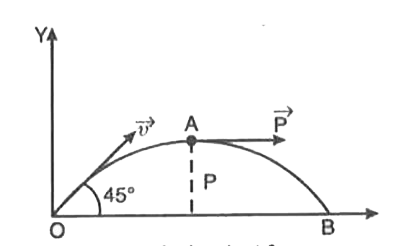
|
|
| 46. |
A 0.25kg block oscillates on the end of the spring with a spring constant of 200N/m. If the oscillation is started by elongating the spring 0.15m and giving the block a speed of 3.0m/s, then the maximum speed of the block is |
|
Answer» 0.13m/s |
|
| 47. |
A point object is placed in front of two plane mirrors as shown in figure Total number of images formed, If OA = 0, OB = 0, andtheta = 110^@ |
|
Answer» 3 or 4 |
|
| 48. |
A full-wave p-n diode rectifier uses a load resistor of 1500 Omega . No filter is used. The forward bias resistance of the diode is 102. The efficiency of the rectifier is |
|
Answer» `81.2%` |
|
| 49. |
The distance between the points of suspension and centre of oscillation for a compound pendulum is : |
|
Answer» `(k^2 - l^2)/(2)` |
|