

Saved Bookmarks
This section includes 7 InterviewSolutions, each offering curated multiple-choice questions to sharpen your Current Affairs knowledge and support exam preparation. Choose a topic below to get started.
| 1. |
As per Bohr's theory when electrons jump from higher energy orbits to second orbit (n=2 state), the emitted spectral lines belong to _______ series. |
| Answer» SOLUTION :Balamer | |
| 2. |
Find (V_A-V_B) in an electric field barE = (2hati + 3hatj+4hatk) NC^(-1) where bar(r_A) = (i -2 j+barK)m bar(R_B): =(2i+j-2veck)m. |
| Answer» Answer :B | |
| 3. |
The K.E of the electron is E when the incident wavelength is lamda. To increase the K.E of the electron to 2E, the incident wavelength must be |
|
Answer» `2lamda` |
|
| 4. |
State the principle of a transformer |
| Answer» Solution :MUTUAL induction : the PHENOMENON of production of an opposing emf in a coll DUE to the change in CURRENT in the neighbouring coll | |
| 5. |
In a p -n junction, a) new holes and conduction electrons are produced continuously throughout the material b) new holes and conduction electrons are produced continuously throughout the material except in the depletion region c) holes and conduction electrons recombine continuously throughout the material d) holes and conduction electrons recombine continuously throughout the material except in the depletion region. |
|
Answer» Only a and d are CORRECT |
|
| 6. |
A magnetised needle of magnetic moment 4.8 xx 10^(-2) Am^(2) is placed at 30^(@) with the direction of a uniform magnetic field of 3 xx 10^(-2)T. If the needle is pivoted through its centre of mass and is free to rotate in the plane of the magnetic field, find the angular frequency of small oscillations. The moment of inertia of the needle about its axis of rotation is 2.25 xx 10^(-5) Kg-m^(2) |
|
Answer» Solution :Angular frequency `, omega=sqrt((MB)/(I))` `= sqrt((4.8 xx 10^(-2) xx 3 xx 10^(-2))/(2.25 xx 10^(-5)))` `= 8 " RAD "s^(-1)` . |
|
| 7. |
The B.E. per nucleon of ""_(1)H^(2) and ""_(2)He^(4) are 1.1 MeV and 7 MeV respectively. If two deuteron (""_(1)H^(2)) nuclei react to form single helium nucleus, the energy released |
|
Answer» 13.9 MEV `E="energy of "H_(2)^(4)-"energy of "2_(1)H^2` `=(4 xx 7-2 xx 1.1 xx 2)MeV=(28-4.4)MeV` `E=23.6 MeV` |
|
| 8. |
भारत में सर्वप्रथम कौन-से अभ्यारण्य को बाघ परियोजना के रूप में घोषितकिया गया? |
|
Answer» जिम कार्बेट अभ्यारण्य |
|
| 9. |
A plot between lnk vs 1/T is represented for a reaction which has equilibrium constant = k as follows(##ALN_JEE_SCR_TST_01_E01_033_Q01.png" width="80%"> Thten the correct plot for its reverse reaction is: |
|
Answer»
Reverse REACTION will have keq `=1/k.` In `1/k =- ((- DELTAH^(@)))/(RT) + ((- Delta S^(@)))/(R)` ln `k = (-Delta H^(@))/(RT) + (Delta S ^(@))/(R)` |
|
| 10. |
Explain Rutherford's explanation for scattered alpha-particles. |
|
Answer» Solution :Rutherford suggested that since large number of a-particles are scattered at very small angles, atoms must be LARGELY hollow. Since the gold foil is very thin, it can be assumed that `alpha` particles will suffer not more than one scattering during their PASSAGE through it. `alpha`-particles are nuclei of helium atoms and CARRY two + 2e charge and have the mass of the helium atom. For gold Z = 79, the nucleus of gold is about 50 times heavier than an a-particle it is assume that stationary THROUGHOUT the scattering process. Under these assumptions, the trajectory of an a-particle can be computed using Newton.s second law of motion and the Coulomb.s law for force of repulsion between the O-particle and the positively charged nucleus. The MAGNITUDE of Coulomb.s repulsive force `I^(2)=(1)/(4pi epsi_(0)) *((Ze)(2e))/(r^(2))` wherer the distance between the c-particle and the nucleus and `epsi_(0)`is the permittivity of vacuum. The force is directed along the line joining the cparticle and the nucleus and varies continuously with the displacement of `alpha`-particle |
|
| 11. |
A series LCR circuit is connected to an a.c. source having voltage V = V_(m) sin omega t. Derive the expression for the instantaneous current I and its phase relationship to the applied voltage. Obtain the condition for resonance to occur. Define 'power factor'. State the conditions under which it is (i) maximum and (ii) minimum. |
|
Answer» Solution :From the phasor diagram we have `V_(m)^(2) = V_(Rm)^(2) + (V_(Cm) - V_(Lm))^(2)` `= i_(m)^(2)[R^(2) + (X_(C) - X_(L))^(2)]` `i_(m) = (V_(m))/(sqrt(R^(2) + (X_(C) - X_(L))^(2))`  The current is seen to lead the voltage by an angle `phi` where `tan phi = (X_(C) - X_(L))/(R )` Hence `i = i_(m) sin(OMEGA t + phi)` Where `i_(m) = (V_(m))/(sqrt(R^(2) + (X_(C) - X_(L))^(2))` and `phi = tan^(-) [((OMEGAL -(1)/(omega C)))/(R )]` Condition of resonance : `omega L - (1)/(omega C = 0` or `omega L = (1)/(omega C` or `omega = (1)/(sqrt(LC))` Power factor equals the cosine of the phase angle power factor i.e., power factor, `COS phi = (R )/(Z)` Power FACTORIS maximum when `cos phi = 1` i.e.,when R = Z or `X_(L) = X_(C)`. Power factor is minimum when `cos phi = 0` i.e., when `R = 0`. |
|
| 12. |
Multiple images are formed in a thick mirror. Which image looks brightest? |
|
Answer» |
|
| 13. |
A transistor is used in the common emitter mode as an amplifier. Then, a) the base emitter junction is forward biased b) the base emitter junction is reverse biased c) the input signal is connected in series with the voltage applied to bias the base emitter junction d) the input signal is connected in series withthe voltage applied to bias the base collector junction |
|
Answer» a and C are CORRECT |
|
| 14. |
Thin glass (refractive index 1.5) lens has optical power of - 5 D in air. Its optical power in a liquid medium with refractive index 1.6 will be : |
|
Answer» 1 D and `(1)/(f_(a)) = (1.5 - 1) ((1)/(R_(1)) - (1)/(R_(1)))` Then`f_(m) = 160 cm` `P_(m) = (mu)/(f_(m)) = (1.6)/(1.6) = 1D` |
|
| 15. |
Light appears to travel in a straight line because.... |
|
Answer» it is not ABSORBED by surrounding |
|
| 16. |
Some equipotential surfaces are shown in figure(29.E3) What can you say about the magnitude and the direction of the electric field? |
|
Answer» Solution :` (a) The angle between POTENTIAL edl=dv CHANGE in potential =10V=dV ` ` As E=rdV ` ` (As potential surface) ` ` S0, Edl=dv ` ` rArr Edlcos(90+30) =-dV ` ` rArr E(10xx10^-2)cos120=-dV ` ` E=200V//m ` MAKING an angle 120 with yaxis (b) As ELECTRIC field intensity is rto potential surface ` So, E=r ` ` rArr =60vq ` ` So, E=v.m=V.M. ` |
|
| 17. |
If v_1and v_2 be the velocities at the end of focal chord of projectile path and u is the velocity at the vertex of the path, then |
|
Answer» `v_1^2 + v_2^2 = U^2` |
|
| 18. |
To make the central fringe at the centre O, mica sheet of refractive index 1.5 is introdced. Choose the correct statement (s). |
|
Answer» The THICKNESS of sheet is `2(sqrt(2) - 1)d` infront of `S_(1)` |
|
| 19. |
What is the color code for a resistor of resistance 350mOmega with 5% tolerance? |
| Answer» SOLUTION :ORANGE, GREEN, SILVER AND GOLD | |
| 20. |
An electron moving with the speed 5 xx 10^6 m per second is shooted parallel to the electric field of intensity 1 xx 10^3 N/C. Field is responsible for the retardation of motion of electron. Now evaluate the distance travelled by the electron before coming to rest for an instant, (mass of e = 9.1 xx 10^(-31)kg) |
|
Answer» 0.7 cm `qE = mA` `therefore a=(qE)/m =(1.6 XX 10^(-19) xx 10^(3))/(9.1 xx 10^(-31))` `therefore a=0.1758 xx 10^(15) m//s^(2)` Now equation of motion `v^(2) -v_(0)^(2) = 2ad` `therefore d =(v^(2)-v_(0)^(2))/(2A)`, where `v=0, v_(0)=5 xx 10^(6) m//s` `therefore =(25 xx 10^(12))/(3516 xx 10^(11)) = 0.00711 xx 10 = 0.0711` m `=7.11 cm = 7 cm` |
|
| 21. |
In the circuit shown in figure reading of voltmeter is V_(1) when only S_(1) is closed, reading of voltmeter is V_(2) when only S_(2) is closed and reading of voltmeter is V_(3) when both S_(1) and S_(2) are closed. Then 1) V_(3) gt V_(2) gt V_(1) 2) V_(2) gt V_(1) gt V_(3) 3) V_(3) gt V_(1) gt V_(2) 4) V_(1) gt V_(2) gt V_(3) |
|
Answer» Solution :In series `PD prop R` When only `S_(1)` is CLOSED `V_(1)=(3R)/(R+3R)(E)=(3)/(4)E=0.75E` When only `S_(2)` is closed `V_(2)=(6R)/(6R+R)(E)=(6)/(7)E=0.86E` and when both `S_(1) and S_(2)` are closed combined resistance of `6R and 3R` is 2R `therefore V_(3)=(2R)/(2R+R)(E)=((2)/(3))E=0.67E` `therefore V_(2) GT V_(1) gt V_(3)` |
|
| 22. |
Two bodies are projected from the same point in the directions making an angle alpha_1 and beta_2 with horizontal and strike at the same point in the horizontal plane through a point of projection. If t_1 and t_2 are their time of flights. Then (t_1^2 - t_2^2)/(t_1^2 + t_2^2) = |
|
Answer» `(TAN (alpha_1 - alpha_2))/(tan (alpha_1 + alpha_2))` |
|
| 23. |
A monochromatic beam falls on a reflection grating with period d = 1.0mm at a glancing angle alpha_(0) = 1.0^(@). When it is diffracted at a glancing angle alpha = 3.0^(@) a Fraunhofer maximum of second order occurs. Find the wavelength of light. |
Answer» Solution : Tha path difference between waves REFLECTED at `A` and `B` is `d(COS alpha_(0) -cos alpha)` and maxima `d(cos alpha_() - cos alpha) = k lambda, k = 0, +- 1, +- 2,………` In our case, `k = 2` and `alpha_(0), alpha` are smalll in radius. Then `2lambda = d((alpha^(2) - alpha_(0)^(2))/(2))` Thus `lambda - ((alpha^(2) - alpha_(0)^(2))d)/(4) = 0.61 MU m` for `alpha = (3PI)/(180), alpha_(0) = (pi)/(180), d = 10^(-3)m` |
|
| 24. |
On what factors the maximum kinetic energy of the emitted photoelectrons depend ? |
| Answer» SOLUTION :It DEPENDS up on only frequency of the incident LIGHT and is INDEPENDENT of it,s INTENSITY . | |
| 25. |
What happens in a transistor when both the emitter and collector are reverse biased ? What is this condition known as ? |
| Answer» SOLUTION :When both the EMITTER and COLLECTOR are reverse biased, no CURRENT flows through the transistor as there is no conduction due to majority charge carriers across- the emitter-base or collector-base JUNCTION. This condition is known as cut-off state. | |
| 26. |
Two blocks of mass m and 2m are kept in contact on a smooth horizontal surface. A horizontal pushing force F is applied on mass 2m in case I and on mass m in case II. Then the ratio of normal reaction between the blocks in case I to that in case II is : |
|
Answer» `1 : `1 In case II : `a_(2) = (F)/(3m) implies N_(2) = 2M a_(2) = (2F)/(3)``N_(1) : n_(2) = 1 : 1` |
|
| 27. |
Turpentine oil is flowing through a tube of length I and radius r. The pressure difference between the two ends of the tube is p. The viscosity of oil is given by eta = (p(r^(2) - x^(2)))/(4 vl) where , v is the velocity of oil at distance x from the axis of the tube. the dimensions of eta are |
|
Answer» `[M^(@) L^(@)T^(@)]` |
|
| 28. |
A spherical earthen vessel with a hole is heated in a furnace till it becomes red hot. When it is taken out, the hole will appear |
|
Answer» as BRIGHT as the rest of the vessel |
|
| 29. |
The potnetial at point A, in the circuit, is (Point N is grounded, i.e. the potential of that point is zero.) |
|
Answer» 10 V |
|
| 30. |
A ball is projected with velocity 20sqrt(2) m/sec at an angle of 45^(@) with horizontal towards a fixed solid hemi-cylinder as shown in figure such that it collide with the cylinder at its highest point of trajectory. If the collision is perfectly elastic. Then (take sqrt(3)=1.7 and sqrt(7)=2.7, g=10m//s^(2)) |
|
Answer» maximum height attained by the ball from the horizontal surface is 35 m before collision with the horizontal surface. |
|
| 31. |
Differentiate between permissible and experimental errors? |
| Answer» Solution :Experimental error is the difference between standard VALUE of the physical quantity and the value we determine EXPERIMENTALLY, while the permissible errors are those errors which ENTER into our calculations due to LIMITATION of instruments. | |
| 32. |
Two capacitors with capacitances C_(1) and C_(2) are connected in series. Find the resultant capacitance. |
Answer» SOLUTION :When the capacitors are connected in series (Fig. 24.10), their charges are redistributed so that the charges of all the capacitors are  equal. To make SURE that this is so, consider using Fig. 24.10, what will happen if the system is DISCHARGED by shortcircuiting the POINTS at potentials`varphi_(1) and varphi_(2)`. We have `varphi_(1)-varphi.=q//C_(1), varphi.-varphi_(2)=q//C_(2)` For the system as a whole, Q C g/C. Adding the two former equations and comparing the result with the third, we obtain the formula sought. |
|
| 33. |
Explain the reason for glittering of diamond |
| Answer» SOLUTION :Diamond appears dazzing because the internal refleecton of LIGHT happens inside the diamond. The refractive index of only diamond is about 2.417. It is much larger than that for ordianry GLASS which is about only 1.5 The cirtical angle of diamond is about `24.4^(@)`. It is much less than that of glass. A skilled diamond cutter makes use of this larger range of angle of incidence `(24.4^(@) to 90^(@) "inside the diamond")`. to ensure that light entering the diamond is total internally reflected form the many cut face before getting out. This GIVES a SPARKING effect for diamond. | |
| 34. |
The velocity of sound in gas in which two waves of wavelength 1.0 m and 1.01 m produces 4 beats/s is : |
|
Answer» 360 m/s Now `b = v_(1) - v_(2) = (v)/(1) = (v)/(1.01) ` 4 = v `[ 1 - (1)/(1.01) ] ` `RARR "" v = 404ms^(-1)` . HENCE the correct CHOICE is (b). |
|
| 35. |
A ball is dropped from a height 'h'. If the coefficient of restitution is 'e', the height to which the ball rise after the nth rebound is: |
|
Answer» `h.E^(n)` `:. e^(n)=(v_(1))/(v_(0))xx(v_(2))/(v_(1))xx(v_(3))/(v_(2))xx…xx(v_(n))/(v_(npm1)).TOE^(n)-(v_(n))/(v_(0))` `:. E^(n)=(sqrt(2ghn))/(sqrt(2gh))implies e^(2n)=(h_(n))/(h)impliesh_(n)=e^(2n)h` |
|
| 36. |
The maximum range of a gun horizontally is 16km. If g = 10m//s^2, then the muzzle velocity of the shell must be |
|
Answer» 160 m/s |
|
| 37. |
A certain planet completes one rotation about its axis in time T. The weight of an object placed at the equator on the planet's surface is a fraction f (f is close to unity) of its weight recorded at a latitude of 60^(@).The density of the planet (assumed to be a uniform perfect sphere is given by- |
|
Answer» `(4-f)/(1-f)(3PI)/(4GT^(2))` |
|
| 38. |
To activate the reaction(n,alpha) with stationary B^(11) nuclei, neutrons must have the threshold kinetic energy T_(th)=4.0MeV. Find the energy of this reaction. |
|
Answer» Solution :We have `4.0=(1+(m_(n))/(M_(B^(11))))|Q|` or `Q=(11)/(12)xx4MeV= -3.67MeV` |
|
| 39. |
Using Lenz's law, predict the direction of induced current in conducting rings 1 and 2 when current in the wire is steadily decreasing. |
Answer» Solution :According to Lenz.s law, a current will be induced in the COIL which will produce a FLUX in the OPPOSITE direaction. If the current decreases in the wire, the induced CURRENTFLOWS in ring1 in clockwise direaction, the induced current flows in ring 2 in ANTI - clockwise direaction. 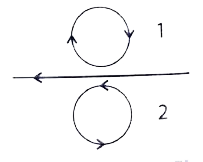
|
|
| 40. |
Hydrogen atom is said to be in its ground state when its orbiting electron |
|
Answer» has LEFT the atom |
|
| 41. |
The focal lengths of the objective and eyepiece of a compound microscope are 8mm and 2.5 cm respectively . A man with normal near point (25 cm)can focus distinctly the microscope . What is the separation between the lenses and magnification power of the instrument ? |
|
Answer» SOLUTION :Forthe OBJECTIVE, `f_o =0.8 CM andu_(o) =-0.9 cm ` From `1/v-1/u=1/f`, we get `v_o =(0.8xx(-0.9))/(-0.9+0.8)=7.2 cm ` For the EYEPIECE ,`f_e =2.5 cm and v_e=-25 cm ` `therefore u_e=(v_ef_e)/(f_e-v_e)=(-25xx2.5)/(2.5+25)=-(25)/(11)=-2.27 cm ` `therefore` The distance between the two lenses `=v_(o)+u_e=7.2+2.27=9.47 cm ` `therefore` Magnification power , `m=(v_o)/(u_o)xx(v_e)/(u_e)=(7.2)/(0.9)xx(25/25)/(11)=88` |
|
| 42. |
An ideal p-n junction diode can withstand currents up to 10mA under forward bias. The diode has a potential difference of 0.5V across it which is assumed to be independent of current. What is the maximum voltage of the battery used to forward bias the diode when resistance of 200 Omegais connected in series with it |
|
Answer» 2.5V |
|
| 43. |
A ray of light is incident at an angle of 45^@ (ralative to the normal) on a thin film of a liquid with an index of refraction of sqrt(2). Assuming that the medium of both sides of the film is air, find the minimum thickness of the film required for constructive interference in the reflected light for sodium light of wavelenght 600 nm. |
|
Answer» 122 nm |
|
| 44. |
Whatare permanent magnets? Give one example. |
| Answer» Solution :Those SUBSTANCES which can retain their ferromagneticproperty at a ROOM temperature for a long period of time are KNOWN as PERMANENT magnets. | |
| 45. |
Two charged spheres when placed in air attract with a force F. Keeping the distance between the charges constant, the spheres are immersed in a liquid of relative permittivity K. Then the spheres will |
|
Answer» INCREASES K times |
|
| 46. |
An inductor coil and a capacitor and a resistance of 5Omega are connected in series to an a.c. source of rms voltage 30 V. When the frequency of the source is varied, a maximum r.m.s. current of 5 A is observed. If this inductor is connected in parallel with a resistance 5Omega to a battery of emf 25 V and internal resistance 2.0Omega, the current drawn from the battery is |
|
Answer» `150/17 A` |
|
| 47. |
A clear crystalhas a critical angle of 24.4^(@) for green light. What is the polaring angle of incidence ? |
|
Answer» |
|
| 48. |
Sketch the image formation of a convex lens when the object is between C and F. |
Answer» SOLUTION :
|
|
| 49. |
Two sound waves having a phase difference of 60^(@) have path difference of : |
|
Answer» 2 `lambda` here `phi = 60^(@) = pi//3` `therefore x = (lambda)/(2pi) XX (pi)/(3) = (lambda)/(6)`. correct choice is (d). |
|
| 50. |
A bus starts from rest with an acceleration of 1 m//s^(2) A man who is 48 m behind the bus starts with a uniform velocity of 10 m s^(-1). Then after how much time the man will catch the bus ? |
|
Answer» 12 s Disatnce COVERED by man in t `s=10xxt` `:. 10t=48+(1)/(2)t^(2)implies t=8` s. |
|


