Saved Bookmarks
This section includes 7 InterviewSolutions, each offering curated multiple-choice questions to sharpen your Current Affairs knowledge and support exam preparation. Choose a topic below to get started.
| 1. |
According to Debyes law the specific heat at extremely low temperatures value with temperature T as |
|
Answer» `T` |
|
| 2. |
A vector needs three quantities for its specification. Name the three independent quantities conventionally used to specify the earth's magnetic field. |
| Answer» Solution :(i) Magnetic declination, (ii) ANGLE of dip, and (iii) HORIZONTAL component of earth.s magnetic field are the three independent quantities conventionally USED to specify the earth.s magnetic field at a GIVEN place. | |
| 4. |
A satellite of mass m orbits around the Earth of mas M in an elliptical orbit of semi - major and semi - minor axes 2a and a respectively. The angular momentum of the satellite about the centre of the Earth is |
|
Answer» `pimsqrt((GMA)/(4))` |
|
| 5. |
A and B are two wires of copper of equal cross-section and A is longer than B. The specific resistance of |
|
Answer» A is greater than B |
|
| 6. |
Which of the following is not a transducer |
|
Answer» loudspeaker |
|
| 7. |
Draw a labelled diagram of compound microscope. Derive expression for its magnifying power. |
Answer» SOLUTION :It is an instrument used to see highly magnified image of tiny objects. 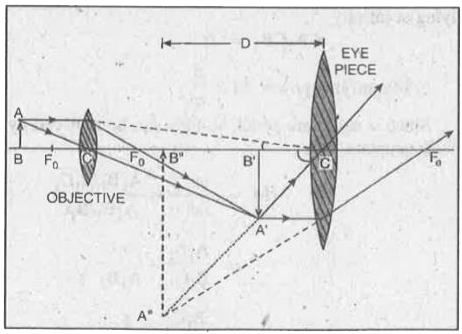 Construction. It consists of an objective of small focal length and short aperture. The eye piece has moderate focal length and aperture larger than objective. The lenses are held co-axially at the free ends of a coaxial tube at a fixed distance. The hold of the tube can be moved by rack and pinion arrangement. LET a tiny object AB be placed in front of objective at a distance more than `f_(0)`. Its real and enlarged image is formed at A.B.. The image A.B. acts as an object for eye piece and forms final image at A.. B.. i.E., at a distance D, the least distance of distinct vision. Magnifying Power of MICROSCOPE is defined as the ratio of the angle subtended on the eye by the final image to the angle subtended on the eye by the object, when both the final image and the object are situated at least distance of distinct vision. Magnifying power, `M = (BETA)/(alpha)` Since angles are small, therefore `tan beta = beta` and `tan alpha=alpha` `:. M=(tan beta)/(tan alpha)=(A.. B.. // D)/(AB // D)=(A.. B..)/(AB)` or `M=(A..B..)/(A.B.) xx (A.B.)/(AB)=M_(e) xx M_(0)`, where `M_(e)` and `M_(0)` are the magnifying powers of eye piece and the objective. `M_(0)=(A.B.)/(AB)=(CB.)/(CB)` But CB is nearly equal to (`-f_(0)`) and CB. is equal to the length of the tube L (since the image A.B. is formed very close to eye lens] `M_(0)=(L)/((-f_(0)))` Also `M_(e)=1+(D)/(f_(e))` [As in simple microscope] |
|
| 8. |
(a) Why photoelectric effect can not be explained on the basis of wave nature of light ? Give reasons. (b) Write the basic features of photon picture of electromagnetic radiation on which Einstein's photoelectric equation is based. |
|
Answer» Solution :(a) According to wave theory. (i) The maximum kinetic energy of the emitted electron should be directly proportional to the intensity of INCIDENT radiations but it is not observed EXPERIMENTALLY. Also maximum kinetic energy of the emitted electrons should not depend upon incident frequency according to wave theory, but it is not so. (ii) Electron emission should take place at all FREQUENCIES of radiations i.e., there should not exist the threshold frequency. This FACT contradicts experimental observation. (iii) There should be a time lag in photo-electric emission but according to observation PHOTOELECTRIC emission is instantaneous. (b) According to photon picture : (i) Each quantum of radiation has energy hv. (ii) In photo-electric effect the electrons in the metal absorbs this quantum of energy (hv). |
|
| 9. |
A compound (P) on reaction with "Q" in basic medium (KOH) gives a bad smelling compound (CH_(3)CH_(2)NC). Compound Q can be prepare by reaction of acetone with calciumhypochlorite (Ca(OCl)_(2))P and Q can |
|
Answer» `CH_(3)-CH_(2)-NH_(2)&CHCl_(3)` |
|
| 10. |
How are beta-rays emitted from a nucleus, when it does not contain electrons ? |
|
Answer» `""_(0)n^(1) rarr ""_(1)H^(1)+""_(-1)E^(0)+bar(v)` Hence the nucleus emits electrons, although it does not contain it. |
|
| 11. |
A boat moves perpendicular to the bank with a velocity of 7.2 km/h. The current carries it 150 m downstream, find the velocity of the current. The width of the river is 0.5 km |
|
Answer» `0.4 MS^(-1)` |
|
| 12. |
The image of an object formed by a plane mirror is : |
|
Answer» virtual |
|
| 13. |
If each diode in figure has a forward bias resistance of 25Omega and infinite resistance in reverse bias, what will be the values of the currentI_(1), I_(2), I_(3) and I_(4)? |
Answer» SOLUTION :In above figure, diode in branch CD is reverse biased. Hence its resistance is `oo` and so current passing through it is `I_(3)=0` and so it can be removed from given network.  In figure (2) `I_(1)=I_(2)+I_(4)""(1)` Here resistance in branches ABand EF are same and so: `I_(2)=I_(4)=(I_(1))/(2)""....(2)` Applying Kirchhoff.s second law along CLOSED PATH GEFHG, `-150I_(2)-25I_(1)= -5` `therefore 150I_(2)+25I_(1)=5` `therefore 150 I_(2)+25(2I_(2))=5` `therefore 200I_(2)=5` `therefore I_(2)=0.025A` `therefore I_(4)=0.025A ""(because I_(2)=I_(4))` From equation (1), `I_(1)=I_(2)+I_(4)` `therefore I_(1)=0.025+0.025=0.05A` |
|
| 14. |
A circular loop of 100 turns and radius 10 cm is placed witih its plane at an angle of 60^(@) with the magnetic meridian. Calculate the angle made with the magnetic meridian by a small magnetic needle placed at the center of the loop when 1-A current is placed through it. The horizontal component of the earth's field is 3.6 x 10^(-5)T. |
|
Answer» |
|
| 15. |
In the Arcitc region hemispherical houses called Igloos are made of ice. It is possible to maintain a temperatureinside an Igloo as high as 20^(@)C because– |
|
Answer» ICE has high thermal CONDUCTIVITY |
|
| 16. |
The electric field I a region is given gy vecE=(E_(0)x)/(b)hati. Find the charge contained in the ubical volume bounded by the surfaces x=0, x=a, y=0, y=0,z=0 and z=a. take E_(0)=5xx10^(3)NC^(-1),a=1cm and b=2cm. |
|
Answer» |
|
| 17. |
X-rays travel in space with the velocity of: |
|
Answer» COSMIC rays |
|
| 18. |
In a standard YDSE setup if the screen is kept tilted as shown, find the distance OA if first maximum is formed at A. Wavelength of light emitted by source is lambda |
|
Answer» `(Dlambda SEC theta)/(d+LAMBDA tan theta)`  `OB = y tan theta` `O'B = D-y tan theta` position of 1st maximum above the axis `y = (lambda(O'B))/(d)` `y = (lambda(D - y tan theta))/(d) = (lambda D)/(d) - (lambda y tan theta)/(d)` `y[1+(lambda tan theta)/(d)] = (lambda D)/(d)` `y = (lambda D)/(d+lambda tan theta)` Then position of 1st maximum from centre of SCREEN is OA `Cos theta = (y)/(OA)` `OA = y sec theta` `:.OA = (lambda D sec theta)/(d + lambda tan theta)` |
|
| 19. |
If light travels from vacuum to water, its wavelength |
|
Answer» increases |
|
| 20. |
The minimum value of effective capacitance that can be obtained by combining 3 capacitors of capacitances 1 pF, 2 pF and 4 pF is |
|
Answer» `(4)/(7)PF` `(1)/(C_(eq))=(1)/(1)+(1)/(2)+(1)/(4)` `(1)/(C_(eq))=(4+2+1)/(4)` `(1)/(C_(eq))=(7)/(4)` `C_(eq)=(4)/(7)pF` |
|
| 21. |
A step-up transfermer operates on 220 V line and supplies 2.2 A. The ratio of primary and secondary winding is 11:50. The output voltage in the secondary is |
|
Answer» 220 V |
|
| 22. |
Equation of a linear S.H.M. is x=10 sin[pit/6], where all quantities are expressed in C.G.S. units, What is the amplitude of S.H.M ? |
|
Answer» SOLUTION :We have `x=10sin((pit)/6)` The general expression of DISPLACEMENT is `x=asinomegat` By comparing these EQUATION, we have ` therefore a=10cm` |
|
| 23. |
Lissajou's figure obtained by combining x = A sin oemgat and y=A sin(omegat+pi//4) will be : |
|
Answer» an ellipse |
|
| 24. |
A system consisting of a smooth movable wedge of angle alpha and a block A of mass m are connected together with a massless spring of spring constant k, as shown in the figure. The system is kept on a frictionless horizontal plane. If the block is displaced slighlly from equilibrium and left to oscillate, find the frequency of small oscillations. |
Answer» Solution :Suppose that the relative displacement of the block A w.r.t the WEDGE is X at same time t, and the corresponding displacement of the block along the horizontal is x.. The total energy of the system canbe written as 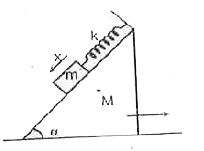 `E = (1)/(2) M ((DX.)/(dt))^(2) + (1)/(2) m [((dx)/(dt)) cos alpha - ((dx)/(dt))^(2) sin^(2) alpha]` `M ((dx.)/(dt)) = m ((dx)/(dt) cos alpha - (dx.)/(dt))`...(ii) which gives `(dx.)/(dt) = (m)/(M +m) ((dx)/(dt)) cos alpha` and substituting in the equation for total energy gives: `omega = sqrt((k)/(m_("red") cos^(2) alpha + m sin^(2) alpha)) " where " m_("red") = (mM)/(m + M)` |
|
| 25. |
Define the term 'self-inductance of a coil. Write its SI unit. |
|
Answer» |
|
| 26. |
The phenomenon of perfect diamagnetism in superconductors is called _____. |
| Answer» SOLUTION :MEISSNER EFFECT | |
| 27. |
A ray of light incident normally on to one face just grazes through the second face of the glass prism of refractive index (3)/(2). Calculate the angle of the prism . |
|
Answer» |
|
| 28. |
When air is blown in between the two balls, will they attract or repel? |
| Answer» Solution :Primary Voltage should not change while doing experiment. When we use 3v instead of 2v, POTENTIAL GRADIENT will change. HENCE balancing LENGTH will change. | |
| 29. |
A long resistance wire is stretched between two iron nails. A battery of 2V is applied across the wire. One end of a torch bulb is connected to nail and other end is made in contact as shown in figure. - How this principle is used to determine internal resistance of cell |
|
Answer» INCREASES |
|
| 30. |
An inductor of 10mH is connected to a 18V battery through a resistor of 10kOmegaand a switch. After a long time, when the maximum current is set up in the circuit, the current is switched off. Calculate the current in the circuit after 2 mus . |
|
Answer» Solution :Given that `L = 10mH = 10^(-2) H, R= 10 k Omega = 10^4 Omega` and E = 18V , we KNOW that `I_0 = E/R= (18)/(10^4) A= 18 XX 10^(-4)A ` Time constant, `tau_L = L/R = (10 xx 10^(-3))/(10 xx 10^3) = 10^(-6)` sec We know that , `I= I_0 e^(-(R//L)t)` here `t = 2 mus = 2xx 10^(-6)S, I_0 = 18 xx 10^(-4)A` `I = 18 xx 10^(-4) = 2.48 xx 10^(-4)A` |
|
| 31. |
Einstein established the idea of photons on the basis of Planck's quantum theory. According to his idea, the light of frequency f or wavelength lamda is infact a stream of photons. The rest mass of each photon is zero and velocity is equal to the velocity of light (c) = 3 xx 10^(8) m.s^(-1). Energy, E = hf, where h = Planck's constant = 6.625 xx 10^(-34)J.s. Each photon has a momentum p = (hf)/(c), although its rest mass is zero. The number of photons increase when the intensity of incident light increases and vice-versa. On the other hand, according to de Broglie any stream of moving particles may be represented by progressive waves. The wavelength of the wave (de Broglie wavelength) is lamda= (h)/(p), where p is the momentum of the particle. When a particle having charge e is accelerated with a potential difference of V, the kinetic energy gained by the particle is K= eV. Thus as the applied potential difference is increased, the kinetic energy of the particle and hence the momentum increase resulting in a decrease in the de Broglie wavelength. Given, charge of electron, e = 1.6 xx 10^(-19)C and mass = 9.1 xx 10^(-31) kg. A proton is 1836 times heavier than an electron and has same charge as that of electron. For what velocity of the proton will its de Broglie wavelength be 4455 Å |
|
Answer» `10^(6) m.s^(-1)` |
|
| 32. |
the electric field intensity at all points is space is given byvecE=sqrt3hati-hatj volts/meter. A square frame LMNO of side 1 meter is shown in the figure. The point N lies in x-y plane. The initial angle between line ON and x -axis istheta = 60^(@)The work done by electric field in taking a point charge 1muC from origin O to point M is |
|
Answer» `0muJ` |
|
| 33. |
the electric field intensity at all points is space is given byvecE=sqrt3hati-hatj volts/meter. A square frame LMNO of side 1 meter is shown in the figure. The point N lies in x-y plane. The initial angle between line ON and x -axis istheta = 60^(@) The square frame LMNO is now rotated about z-axis by an angle 30^(@) such that thetaeither increases or decreases. then pick up the correct statement . |
|
Answer» the MAGNITUDE of electric flux INCREASE from initial value as ` theta` is increased. |
|
| 34. |
the electric field intensity at all points is space is given byvecE=sqrt3hati-hatj volts/meter. A square frame LMNO of side 1 meter is shown in the figure. The point N lies in x-y plane. The initial angle between line ON and x -axis istheta = 60^(@)the magnitude of electric flux through area enclosed in square frame LMNO is |
|
Answer» 0 VOLT/metre |
|
| 35. |
If vecC= vecA+vecB then |
|
Answer» `vecC` is always greater than `|VECA|` |
|
| 36. |
Which of the following doesn.t represent the refractive index of medium-2 with respect to medium-1 ? |
|
Answer» `n_(21)=(SIN theta_1)/(sin theta_2)` |
|
| 37. |
Magnetic field lines do not intersect because, …... |
|
Answer» at point of intersection, two VALUES of MAGNETIC field are OBTAINED which is not POSSIBLE. |
|
| 38. |
A potential dufference of 300V is applied between the plates of a plane capacitor spaced 1 cm apart. A plane parallel glass plate with a thickness of 0.5cm and a plane parallel paraffin plate with a thickness of 0.5 cm are placed in the space between the capacitor plates find. (i) Intensity of electric field in each layer. (ii) The drop of potential in each layer. (iii) The surface charge density of the charge on capacitor the plates. Given that :k_(glass) = 6,,k_("paraffin") = 2 |
Answer» 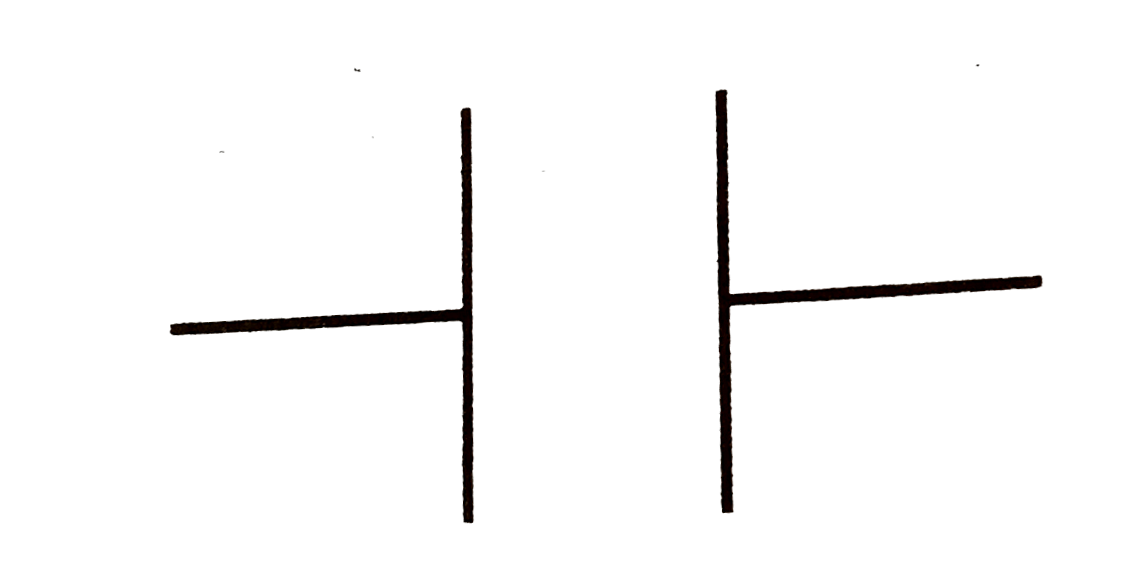 `{:(C_(1) = (6in_(0)A)/(d//2),,rArrC_(1)=12C,,):}` `{:(C_(2) = (2in_(0)A)/(d//2),,rArrC_(2)=4C,,):}` 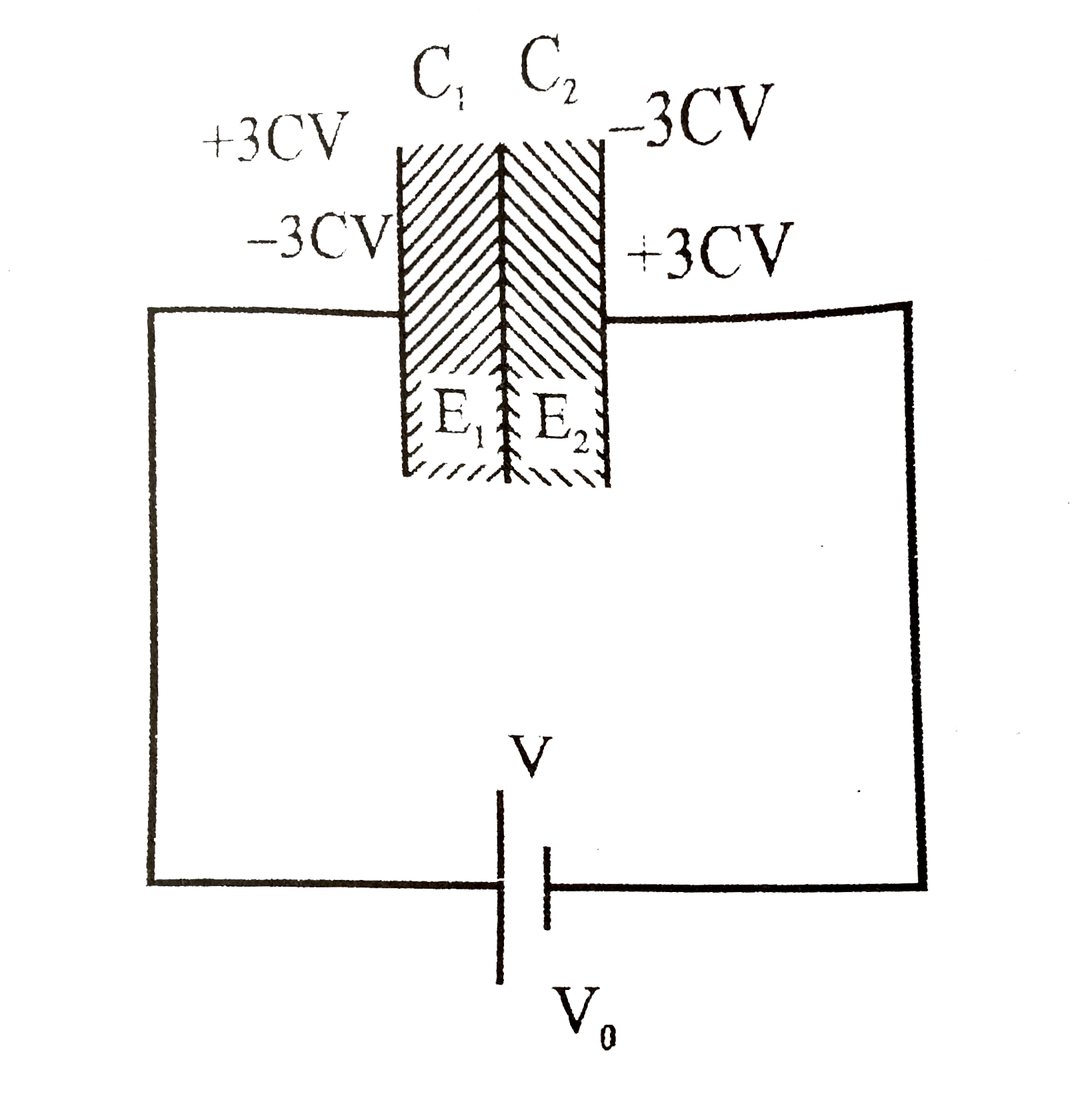 `{:(C_(EQ) = (4Cxx12C)/(16C),,rArrC_(eq)=3C,,):}` (ii) Potential will drop in inverse ratio of caapacity `(V_(1))/(V_(2)) = (4C)/(12C)= (1)/(3)` `V_(1) = (1)/(4) XX 300 = 75"volt"`, `V_(2) = (3)/(4) xx 300 "volt" = 225"volt"` (i) `V_(1) = E_(1)d_(1) rArr E_(1) = 1500 V//m` `V_(2) = E_(2)d_(2) rArr E_(2) = 4500 V//m` |
|
| 39. |
Which of the following reaction is possible ? |
|
Answer» `CH_(3)-Broverset(OH)RARR` |
|
| 40. |
The current flows from A to B in a straight wire as shown in figure and it is decreasing with time. The induced current in loop placed near to it____ |
|
Answer» In clockwise direction |
|
| 41. |
Breakdown voltage means …….. |
|
Answer» voltage at which current BECOME zero in REVERSE BIAS. |
|
| 42. |
The illustrates how B the flux density inside a sample of unmagnetised ferromagnetic material variesis keptfor the sample to be suitable for making a permanent magnet |
|
Answer» OQ should be LARGE OR SHOULDBE small |
|
| 43. |
Three equal masses each of mass 'm' are placed at the three-corner of an equilateral triangle of side 'a' If a fourth particle of equal mass is placed at the centre of triangle, then rate force acting on it, is equal to |
|
Answer» `(GM^(2))/(a^(2))` |
|
| 44. |
Consider the charge configuration as shown in the figure . Calculate the electric field at point A. If an electron is placed at points A, what is the acceleration exerienced by this electron? (mass of the electron =9.1xx10^(-31) kg and charge of electron =-1.6xx10^(-19)C). |
|
Answer» Solution :By using superposition the net electric field at point A is `vecE_(A)=(1)/(4piepsilon_(0))(q_(1))/(r_(1A)^(2))hatr_(1A)+(1)/(4piepsilon_(0))(q_(2))/(r_(2A)^(2))hatr_(2A)` where `r_(1A)` and `r_(2A)` are the distances of point A from the two charges respectively. `vecE_(A)=(9xx10^(9)xx1xx10^(-6))/((2xx10^(-3))^(2))(hatj)+(9xx10^(9)xx1xx10^(-6))/((2xx10^(-3))^(2))(hati)` `=2.25xx10^(9)hatj+2.25xx10^(9)hati=2.25xx10^(9)(hati+hatj)` The magnitude of electric field `|vecE_(A)|=sqrt((2.25xx10^(9))^(2)+(2.25xx10^(9))^(2))=2.25xxsqrt(2)xx10^(9)NC^(-1)` The direction of `vecE_(A)` is given by `(vecE_(A))/(vecE_(A))=(2.25xx10^(9)(hati+hatj))/(2.25xxsqrt(2)xx10^(9))=((hati+hatj))/(sqrt(2))` which is the unit VECTOR along OA as shown in the figure . 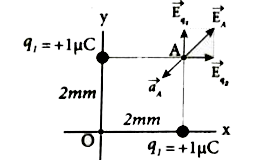 The acceleration experienced by an electronplaced at point A is `veca_(A)=(VECF)/(m)=(qvecE_(A))/(m) =(-1.6xx10^(-19)xx(2.25xx10^(9))(hati+hatj))/(9.1xx10^(-31))` `=-3.95xx10^(20)(hati+hatj)N` The electron is accelerated in a direction exactly OPPOSITE to `vecE_(A)` |
|
| 45. |
An ideal gas enclosed in a vertical cylindrical container supports a freely moving piston of mass M. The piston and cylinder have equal cross sectional area A. When the piston is in equilibrium, the volume of the gas is V_(0) and its pressure is P_(0). The piston is slightly displaced from the quilibrium position and released. Assuming that the system is completely isolated from its surrounding, the piston executes a simple harmonic motion with frequency : |
|
Answer» <P>`(1)/(2pi)(V_(0)MP_(0))/(A^(2)GAMMA)`  FBD of piston at equilibrium `impliesP_("atm")A+mg=P_(0)A""…(1)` FBD of piston when piston is pushed down a distance x. `P_("atm")+mg-(P_(0)+dP)A=m""(d^(2)x)/(dt^(2))""...(2)` Process is adiabatic `impliesPV^(gamma)=Cimplies-dP=(gammaPdV)/(V)` Using 1, 2, we get `f=(1)/(2pi)sqrt((A^(2)gammaP_(0))/(MV_(0)))` So, correct choice is (b). |
|
| 46. |
A long wire PQR is made by joining two wires PQ and QR of equal radii. PQ has length 4.8 m and mass 0.06 kg. QR has length 2.56 m and mass 0.2 kg. The wire PQR is under a tension of 80 N. A sinusoidal wave-pulse of amplitude 3.5 cm is sent along the wire PQ from the end P. No power is dissipated during the propagation of the wave-pulse. Calculate A) the time taken by the wave -pulse to reach the other end R of the wire and B) the amplitude of the reflected and transmitted wave pulses after the incident wave pulse cross the joint Q. |
|
Answer» 0.14 s, 1.5 CM, 2 cm |
|
| 48. |
The electric field between two large, parallel, metal plates is approximately uniform, especially away from the edges where there can be some fringing. Suppose the plate separation is 8.00 cm. If the electric force on an electron placed in the uniform field has a magnitude of 7.90 xx 10^(-16) N, (a) what is the potential difference between the plates and (b) is the force directed toward the plate with the higher potential or the lower potential? |
| Answer» SOLUTION :(a) `395` V, (B) lower POTENTIAL to higher potential | |
| 49. |
The three similar torque ( tau) are acting at an angle of 120degree with each other. The resultant torque will be? |
|
Answer» ZERO |
|
| 50. |
A cylindrically shaped piece of collagen (a substance found in the body in connective tissue) is being stretched by a force that increases from 0 to 3.0xx10^(-2)N. The length and radius of the collagen are, respectively, 2.5 and 0.091 cm, and Young's modulus is 3.1xx10^(6)N//m^(2). If the strtching obeys Hooke's law, what is the spring constant k for collagen ? |
|
Answer» `3.5xx10^(3)N//m` |
|