

Saved Bookmarks
This section includes 7 InterviewSolutions, each offering curated multiple-choice questions to sharpen your Current Affairs knowledge and support exam preparation. Choose a topic below to get started.
| 1. |
Coefficient of emission of a surface does NOT depend upon |
|
Answer» WAVELENGTH of radiation |
|
| 2. |
If the earth suddenly stops rotating about its axis the value of g at the equator will: |
|
Answer» remains same `therefore` The value of gravity increases by `Rw^(2)`. So, the correct CHOICE is (C ). |
|
| 3. |
You are given resistacne wire of length 50 cm and a battery of negligible resistacne In which of the folowing cases is larges amount of heat generated? |
|
Answer» When the wire is CONNECTED to the battery directly (a) `H_(1)=(V^(2)t)(R )` (b)Resistacne of each part will be `R//2` when they are connected in parallel the resistacne will be `R//4` Hence `H_(2)=(4V^(2)t)/(R )` (c )In case of four wires connected in parallel the resistacne will be `R//8` `therefore H_(3)=(8V^(2)t)/(R)` (d) `H_(4)=(V^(2)t)/([R//2])=(2V^(2).t)/(r)` Hence largest amount of heat will be generated in case of four parts connected in parallel. |
|
| 4. |
The x-z plane separates two media A and B with refractive indices mu_1 and mu_2 respectively. A ray oflight travels from A to B. Its directions in the two media are given by the unit vectors, vecr_A = a hati + b hatjandvecr_B = alpha hati +beta hatj respectively where hati & hatj are unit vectors in the x and y directions. Then |
|
Answer» `mu_1 a = mu_2 ALPHA` |
|
| 5. |
Define the term electric potential due to a point charge . Calculate the electric potential at the centre of a square , of side sqrt2 m , having charges 100 mu C , -50 mu C , 20 mu Cand -60 mu Cat the four corners of this square . |
|
Answer» Solution :As shown in Fig distance of centre point O from the corners of square i.e., `r = AO = BO = CO = DO = (1)/(2) sqrt((sqrt2)^(2) + (sqrt2)^(2)) = 1m` `therefore` Net electric potential at point O `V = (1)/(4 PI in_(0) r) [q_(1) + q_(2) + q_(3) + q_(4)]` `= (9 xx 10^(-9))/(1) [ 100 - 50 + 20 - 60] mu C = (9 xx 10^(9) xx 10 xx 10^(-6))/(1) = 9 xx 10^(4) V` 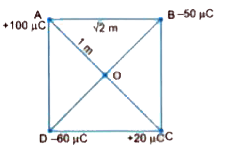
|
|
| 6. |
Unploarised light of intensity I_(0) falls on a Nicol prism.The light emerging from this Nicol Prism falls on another Nicol whose polarising axis is inclined to that of first by an ange 30^(@).The light emerginh from the second Nicol has the intensity: |
|
Answer» `(I_(0))/(sqrt2)` `I = 1/2 COS^(2) 30^(@) = (I_(0))/(2) ((sqrt3)/(2))^(2) = 3/8 I_(0)` |
|
| 7. |
An aluminium wire of length 0.6 m and cross-sectional area 10^(-6)m^(2) is connected to a steel wire of the same crosssectional area and length 0.866 m. The compound wire is loaded with 10 kg. Find the lowest frequency of excitation for which the joint in the wire is a node. Also find the number ofnodes, excluding the two at the ends of the wire. The density of aluminium is 2600kg//m^(3) andthatofsteel is 7800 kg//m^(3) |
|
Answer» |
|
| 9. |
A ray incident at 15^@ on one refracting surface of a prism of angle 60^@ suffers deviation of55^@ , What is the angle of imergence? |
| Answer» Answer :D | |
| 10. |
Resistivityof a conductor of lengthl andcross - sectionA is rho . Ifits lengthis doubledandareaof cross-sectionis halved, thenits new resistivitywill be . |
| Answer» Solution :Resistivityonly depends onmaterial of conductor. | |
| 11. |
If the binding energy of the electron in a hydrogen atom is 13.6 eV, the energy required to remove the electron from the first excited state Li^(+2) is ....... |
|
Answer» 30.6 eV `:.` The ENERGY required =30.6 eV |
|
| 12. |
Arod ofmass m lengthl can rotate without friction about the centre ofa verticalring . There is a unifrommafgnetic filedB intotheplane of the ring. Avariableemf epsilon is applied between thecentreand the rotating end of the rod . Caulcate the current whichkeeps the rod rotatingwithunifrom speed omega and theemfrequried to maintain therequiredcurrent |
|
Answer» |
|
| 13. |
How much energy must a gamma ray photon have, if it is to materialize into a pair of electron and positron with each particle having a K.E. of 1 MeV |
|
Answer» |
|
| 14. |
A constant voltage is applied between the two ends of a metallic wire. If both the length and the radius of the wire are doubled, the rate of heat developed in the wire |
|
Answer» will be DOUBLED |
|
| 15. |
A closed coil of50 turns of 300cm^(2) area and of resistance 40 Omegais held at right angles to a uniform field of 2xx10^(-2)T. Find the charge induced in the coil, when it is turned through an angle of 30^(@) about an axis perpendicular to the field. |
|
Answer» |
|
| 16. |
Calculate the electric and magnetic fields produced by the radiation coming from a 100W bulb at a distance of 3m. Assume that the efficiency of the bulb is 2.5% and it is a point source. |
|
Answer» Solution :The bulb, as a point source, radiates light in all directions uniformly. At a distance of 3 m, the surface area of the sorrounding sphere is `A=4pir^(2)=4pi(3)^(2)=113m^(2)` The intensity at this distance is `I=("POWER")/("Area")=(100Wxx2.5%)/(113m^(2))` `=0.022W//m^(2)` Half of this intensity is provided by the electric field and half by the magnetic field. `(1)/(2)I=(1)/(2)(epsilon_(0)E_(rms)^(2)c)` `=(1)/(2)(0.022W//m^(2))` `E_(rms)=SQRT((0.022)/((8.85xx10^(-12))(3xx10^(8))))V//m` `=2.9V//m` The value of E found above is the root mean square value of the electric field. SINCE the electric field in a light beam s sinusoidal, the peak electric field, `E_(0)` is `E_(0)sqrt(2)E_(rms)=sqrt(2)xx2.9V//m=4.07V//m` Thus, you see that the electric field strength of the light that you use for reading is fairly large. Compare it with electric field strength of TV or FM waves, which is of the ORDER of a few microvolts per metre. Now, let us calculate the strength of the magnetic field. It is `B_(rms)=(E_(rms))/(c)=(2.9Vm^(-1))/(3xx10^(8)ms^(-1))=(9.6xx10^(-9)T)` Again, since the field in the light beam is sinusoidal, the peak magnetic field is `B_(0)=sqrt(2)B_(rms)=1.4xx10^(-8)T`. Note that although the energy in the magnetic field is equal to the energy in the electric field, the magnetic field strength is evidently very weak. |
|
| 17. |
According to Mandela, what is the greatest wealth of a nation? |
|
Answer» minerals |
|
| 18. |
An object is midway between the lens and the mirror as shown. The mirror's radius of curvature is 20.0 cm and the lens has a focal length of -16.7 cm, Considering only the rays that leaves the object and travels first towards the mirror, locate the final image formed by this system. Is this image real or virtual? Is it upright or inverted? What is the overall magnificaiton? |
|
Answer» Solution :Image formed by mirrorUsing mirror FORMULA `1/v+1/u=1/f=2/F(as `f=R//2`) we have, `1/v_1+1/-12.5=2/-20` `:. v_1=-50 cm` `m_1=-v/u=-(-50)/(-12.5)=-4` i.e. image formed by the mirror is at a distance of `50cm` fromthe mirror to the left of it. It is inverted and four times LARGER. Image formed by lens Image formed by mirror ACTS as an object for lens. It is at a distance 0.25.0 cm to the left of lens. Using the lens formula, `1/v-1/u=1/f` We have, `1/v_2-1/25=-1.67` `:. v_2=-50.3cm` and`m_2=v/u=-50.3/25=-2.012` overall magnification is `m=m_1xxm_2=8.048` Thus, the final image is at a distance `25.3 cm` to the RIGHT of the mirror, virtual, upright enlarged and `8.048` times. positions of the two IMAGES are shown in figure. 
|
|
| 19. |
A ray of light passes through an equilateral glass prism in such a manner that the angle of incidence is equal to the angle of emergence and each of these is equal to (3)/(4)th of the angle of prism. The refractive index of the prism material is |
|
Answer» `(3)/(2)` `therefore" Angle of MINIMUM deviation "delta_(m)=(2xx45^(@))-60^(@)=30^(@)` `therefore""n=(sin((A+delta_(m))/(2)))/(sin((A)/(2)))=(sin(60^(@)+30^(@))/(2))/(sin((60^(@))/(2)))=(sin45^(@))/(sin 30^(@))=(1//sqrt2)/(1//2)=sqrt2` |
|
| 20. |
Two wires of resistances 6Omega and 9 Omega are connected in series and this combination is connected to another wire of |
|
Answer» |
|
| 21. |
A small telescope has an objective lens of focal length 140 cm and eyepiece of focal length 5.0 cm. What is the megniftying power of the telescope for viewing distant objects when (a) the telescope is in normal adjustment (i.e, when the final image is at infinity ) (b) the final image is formed at the least distance of distinct vision (25cm) ? |
|
Answer» Solution :`a.|m| = (f_(0))/(|f_(0)|)= (140)/(5) = 28 ` B . `m = (f_(0))/(|f_(e)|) [ 1 + (f_(e))/(D) ]= (140)/(5) [ 1 + (5)/(25) ] = 33.6 ` |
|
| 22. |
Derive the mathematical relation between refractive indices n_(1)and n_2 of two media and radius of curvature R for refraction at a convex spherical surface. Consider the object to be a point one lying on the principal axis in rarer medium of refractive index nt and a real image formed in the denser medium of refractive index n_2. Hence, derive lens maker's formula. (ii) Light from a point source in air falls on a convex spherical glass surface of refractive index 1.5 and radius of curvature 20 cm. The distance of light source from the glass surface is 100 cm. At what position is the image formed ? |
|
Answer» Solution :(i)For relation `n_(2)/v -n_(1)/u =(n_(2)-n_(1))/R`, (ii)It is given here that `u= -100 cm, R = + 20 cm, n_(1) = 1` (for air) and `n_2 = 1.5` (for GLASS). We KNOW that for refraction through a spherical surface `n_(2)/v -n_(1)/u =(n_(2)-n_(1))/R` `therefore 1.5/v -1/(-100) = (1.5-1)/20` or `1.5/v = 0.5/20 -1/100 = 1.5/100 rArr v= 100 cm` |
|
| 23. |
(A): Mass defect in nuclear reactions is less than 1% (R) : In nuclear reaction, change in BE/N is generally less than 1%. |
|
Answer» Both .A. and .R. are true and .R. is the CORRECT EXPLANATION of .A. |
|
| 24. |
A car moving towards an approaching bike. The bike is moving with a velocity 30ms^(-1). Frequency of horn sounded by the car is 100 Hz, while it is observed by bike rider as 120 Hz. The actual duration of horn is 6 s. Find the time interval for which the bike rider hears it. (Take velocity of sound in air as 330ms^(-1)) |
|
Answer» 5s |
|
| 25. |
A student performs an experiment for determintion of g= (4pi^(2)L)/(T^(2)) L~~1m and the commits an error of DeltaL for the length, the time of n oscillations with the stop watch least count DeltaT. For which of the following data the measurement of g will be more accurate? |
|
Answer» `DELTA= 0.5, DeltaT=0.1,N=20` |
|
| 26. |
Two coherent radio point sourcesthat are separated by 2.0m are radiating in phase with a wavelength of 0.25 m . Ifa detectormoves in a large circle aroundtheir midpoint , at how many points will thedetectorshow a maximum signal ? |
|
Answer» 10 |
|
| 27. |
Consider a uniform wire of length l. Cross-sectional area A, Young's modulus of the material of the wave is Y. Some information related to the wire is given in column-1 and dependence of theresult is given in column-2. Then match the approprite choice between the columns and match the list given in options {:("Column-I""""Column-II"),("(A) Let us suspend wire vertically from a""""(p) Young'sModulus" ),("rigud support and attach a mass m at"),("its lower end. If the mass is slightly pulled"),("down and released, it executes S.H.M"),("of a time period which will depend on"),("(B) Work done in stretching the wire up to length"" ""(q) elongation (x)"),(l+x "will depend on"),("(C) If the given is fixed between two rigid""""(r) length (l)"),("supports and its temperature is decreased"),("thermal stress that develops in the wire"),("will depend on"),("(D) If the wire is pulled at its ends equal and""""(s) area of cross-section (A) "),("opposite forces of magnitude F so that it"),("undergoes an elongation x, according to"),("Hook's law, F=kx, where k is the force"),("constant.Force constant (k) of the wire"),("will depend on"):} |
|
Answer» |
|
| 28. |
The height at which the weight of a body becomes 1//16^(th), its weight on the surface of earth (radius R), is: |
|
Answer» 4 R `(1)/(16)=(R^(2))/((R+R)^(2)) rArr (1)/(4)=(R )/(R+h)` `R+h=4R` `h=3R`. THUS correct choice is (d). |
|
| 29. |
A verical thin rod is hinged at point P, due to slight push rod starts to rotate.The velocity of centre of mass of rod just after turning angle 0 is [L is length of rod] (## AAK_TST_09_NEET_19_PHY_E09_041_Q001 ##) |
|
Answer» `SQRT((6g)/L) sin`0/2` |
|
| 30. |
Two wires of same material having lengths and radii in lhe ratio of 3 : 4 and 3 : 2 respectively are connected in parallel with a potential source of 6V. The ratio of currents flowing through them I_(1) : I_(1)= ..... . |
|
Answer» `1:3` `R = (RHO L)/(A) = (rho l)/(pi r^(2)) ` `therefore R prop (l)/(r^(2))` `therefore (R_(1))/(R_(2)) = (l_(1))/(l_(2)) xx ((r_(2))/(r_(1)) )^(2)` `therefore (R_(2))/(R_(1)) = (l_(2))/(l_(1)) xx ((r_(1))/(r_(2)) )^(2) "" ` .... (1) But V = `I_(1) R_(1) = I_(2) R_(2)` `therefore (I_(1))/(I_(2)) = (R_(2))/(R_(1)) "" `..... (2) From equation (1) and (2) , `(I_(1))/(I_(2)) = (4)/(3) xx ((3)/(2))^(2) = (4)/(3) xx (9)/(4) = (3)/(1)` |
|
| 31. |
Two bodies having the same mass 5kg each have different surface areas 20m^2 and 10m^2 in contact with a horizontal plane. If the coefficient of friction is 0.4, the forces of friction that come into play when they are in motion will be in the ratio |
| Answer» ANSWER :A | |
| 32. |
A rhinoceros beetle rides the rim of a small disk that rotates like a merry-go-round. If the beetle crawls toward the center of the disk, do the following (each relative to the central axis) increase, decrease, or remain the same for the beetle-disk system: (a) rotational inertia, (b) angular momentum, and ( c) angular speed? |
| Answer» SOLUTION :(a) DECREASES, (b) same (net = 0, so L is conserved), ( C) INCREASES. | |
| 33. |
What is the net flux of the uniform electric field of Exercise - 15 through a cube of side 20 cm oriented so that its faces are parallel to the coordinate planes? |
| Answer» Solution :(a) 30 `Nm^(2)//C`(B) 15 `Nm^(2)//C` | |
| 34. |
The rate of emission of photoelectrons is __ to the intensity of the light. |
| Answer» SOLUTION :PROPORTIONAL | |
| 35. |
What made noise like artillery bombardment? |
|
Answer» Hailstones |
|
| 36. |
Neutrons produced in fission can be slowed down even by using ordinary water. Then, why is heavy water used for this purpose? |
| Answer» Solution :A MATERIAL which is rich in HYDROGEN SERVES as a BETTER moderator. | |
| 37. |
The threshold frequency for photoelectric effect on sodiune corresponds to a wavelength of 5000 Å. Its function is |
|
Answer» `4 xx 10^(-19)` J |
|
| 38. |
Let f_k (x)=1/{k(sin^k x +cos^k x),wherex in R.andk>=1 then f_4(x)-f_6(x) equals |
|
Answer» `1/4` |
|
| 39. |
Statement-I : If a positive is charge free to move then it moves from higher potential to lower potential. Statement -I : Force one positive charge is along vec(E), which is H.P. to L.P. |
|
Answer» If both Statement-I and Statement-II are true, and Statement-II is the CORRECT EXPLANATION of Statement -I. |
|
| 40. |
Two copper wires with their lengths in the ratio 1 : 2 and resistances in the ratio 1 : 2 are connected (i) in series (ii) in parallel with a battery. What will be the ratio of drift velocities of free electrons in two wires in (i) and (ii) ? |
|
Answer» (i)in SERIES n eA, ` (V_d) =neA_2(V_d)_ 2 rArr((V_d)_1)/((V_d)_2) = 1 ` (ii)`i_1 R_1 = i_2 R_2 rArr ((V_d)_1)/((V_d)_2) = (2)/(1) ` |
|
| 41. |
A hollow metallic tube a length L and closed at one end produces resonance with a tuning fork of frequency n. The entire tube is then heated carefully. So that at equilibrium temperature its length changes by l. If the change in velocity V of sound is v, the resonance will now be produced by tuning fork whose frequencyis : |
|
Answer» `(V-v)/(4(L+l))` |
|
| 42. |
Linear momenta of an electron and a proton are same. The ratio of their de-Broglie wavelengths is _____. |
|
Answer» <P> Solution :`1:1` [As per relation `LAMDA=(H)/(p)` if `p_(1)=p_(2)` then `lamda_(1)=lamda_(2)`]. |
|
| 43. |
A tangent galvanometer has a reduction factor of 0. 2A . It gives a deflection of 45^(@) when connected to a bettery of 6 Vhaving internal resistance of 15 Omega . Find the galvanometer resistance. |
|
Answer» |
|
| 44. |
A piece aluminium and germanium each, are cooled from T_1 K to T_2 K . The resistance of : |
|
Answer» each of them DECREASES |
|
| 45. |
The lenses made of materials mu = 1.5 with which are silvered at one surface are given in column I and their focal powers are given is column - II. Radius of curvature of each spherical surface is R. Match the two columns. |
|
Answer» |
|
| 46. |
If the momentum of electron is changed by p_(m) then the de-Broglie wavelength associated with it changes by 0.50%. The initial momentum of electron will be : |
|
Answer» `400p_(m)` |
|
| 47. |
Which of the following, the most suitable material for making permanent magnet is |
|
Answer» Steel |
|
| 48. |
For an L shaped conducting rod placed in an uniform magnetic field vecB rotating with constant angular velocity omega about an axis passing through one of its ends A and normal to the plane of the conductor induced emf |
|
Answer» ACROSS AC equals `omega B l_(1)^(2)` |
|
| 49. |
The flow of free electrons in a conductor constitutes ………………….. . |
| Answer» SOLUTION :ELECTRIC CURRENT | |
| 50. |
A circular platform is free to rotate in a horizontal plane about a vertical axis passing through its centre. A tortoise is sitting at the edge of the platform. Now the platform is given an angular velocity omega_(0). When the tortoise moves along a chord of the platform with a constant velocity (with respect to the platform), the angular velocity of the platform omega(t) will vary with time t as : |
|
Answer»
As there is no external torque .L. will remain CONSERVED for the system. THUS `Iomega` = constant and M.I. will first decrease as the tortoise moves from A to C and then increase as it moves from C to B. The angular VELOCITY first-increases and becomes maximum at C, then decreases and is minimum at B. This is represented by (c ) choice graphically. 
|
|


