Saved Bookmarks
This section includes 7 InterviewSolutions, each offering curated multiple-choice questions to sharpen your Current Affairs knowledge and support exam preparation. Choose a topic below to get started.
| 1. |
(A) : Various regular polygons are formed by a constant length current carrying wire. The magnetic field at their centers increases with increase in number of turns. (R) : A magnetic dipole in a uniform magnetic field experiences a net force. |
|
Answer» Both 'A' and 'R' are true and 'R' is the CORRECT EXPLANATION of 'A'. |
|
| 2. |
A car moving with a velocity v, overtakes a person moving with a velocity v_2. The ratio of frequencies of sound Just before and after overtaking, is: |
|
Answer» `(c-v_(1))(c-v_(2))/((c+v_(1))(c+v_(2))` |
|
| 3. |
A point charge causes an electric flux of -1.0xx10^(3) Nm^(2)//C to pass through a spherical Gaussian surface of 10.0 cm radius centred on the charge. If the radius of the Gaussian surface were doubled, how much flux would pass through the surface? |
| Answer» SOLUTION :`1.9 xx10^(5) N m^(2) //C` | |
| 4. |
The slope of the graph showing the variation of potential difference V on x-axis and current I on y-axis gives the conducts |
|
Answer» condutance |
|
| 5. |
In the circuit shown in figure the emf E of the battery is increased linearly from zero to 28 V in the interval 0 le t le 14 s. (a) find the energy gained by the 10 V cell in the interval 0 le t le 14 s. (b) At what time the 10 V cell begin to charge? |
|
Answer» (B) 7 s |
|
| 6. |
In the diffraction pattern due to single slit of width 'a' with incident light of wavelength lambda with angle of diffraction theta, the condition for the first minimum is |
|
Answer» `lambda SIN theta = a` |
|
| 7. |
What is the basic mechanism for the emission of beta^(-) or beta^(+) particles in a nuclide? Give an example by writing explicitly a decay process for B’ emission. Is (a) the energy of the emitted beta^(-) particles continuous or discrete, (b) the daughter nucleus obtained through beta-decay an isotope or an isobar of the parent nucleus ? |
|
Answer» Solution :The basic mechanism for the emission of a B’ particle in a nuclide is the transformation of a neutron into a proton and a Bf particle is ejected out of nucleus. As a result, the atomic number of nuclide increases by one. As an example consider the following REACTION `" "_(15)^(32)PTO" "_(16)^(32)S+" "_(-1)^(0)e+bar(nu)` or `" "_(27)^(60)Coto" "_(28)^(60)Ni+" "_(-1)^(0)e+nu` Similarly at the time of `beta^(+)` decay a proton inside a nucleus transforms into neutron along with the emission of a `beta^(+)` particle. An example is `" "_(11)^(22)Nato " "_(10)^(22)Ne + " "_(-1)^(0)e + nu` As a result of `beta` emission the atomic number of nucleus decreases by one. (a) The energy of the emitted B-particle is continuous. (b) The daughter nucleus obtained through B-decay is an ISOBAR of the parent nucleus because mass number of both parent and daughter nuclei are same. |
|
| 8. |
A pipewhichcan beswiveled in a verticle planeis mounted on a cart . The cart movesuniformly along a horizontal path with a velocity v_(1) = 2m//s . At whatangle alpha ot the horizontal shouldthe pipe be placedso that drop of rain fallingverticlewith a velcoity v_(2) = 6m//s move parallel to the wallsof thepipe withouttouchingthem . |
| Answer» SOLUTION :`TAN^(-1) (3)` | |
| 9. |
A particle is given a velocity(v_(e ))/(sqrt(3)) in a vertically upward direction from the surface of the earth, where v_(e ) is the escape velocity from the surface of the earth. Let the radius of the earth be R. The height of the particle above the surface of the earth at the instant it comes to rest is : |
|
Answer» 3R Conserving energy: `U_(i)+K_(i)=U_(f)+K_(f)` `-(GMm)/(R)+(1)/(2)m((v_(e))/(sqrt(3)))^(2)=-(GMm)/((R+h))` Solving, we get `h=(R )/(2)` |
|
| 10. |
Three concurrent forces of the same magnitude are in equilibrium. What is the angle between the forces ? Also name the triangle formed by the forces as sides : |
|
Answer» `60^(@)`, equilatreal TRIANGLE. |
|
| 11. |
In the circuit givenn below, both batteries are ideal. EMF E_(1) of battery 1 has a fixed value but emf E_(2) of battery 2 can be varied between 1.0 V and 10.0 V the graph gives the currents through the two batteries as a function of E_(2), but are not marked as shown plot corresponds to which battery. but both plots, current is assumed to be negative when the direction of the current through the battery is opposite the direction of that battery's emf. (direction of emf is from negative to positive). Q. The resistance R_(1) has value |
|
Answer» `10Omega` 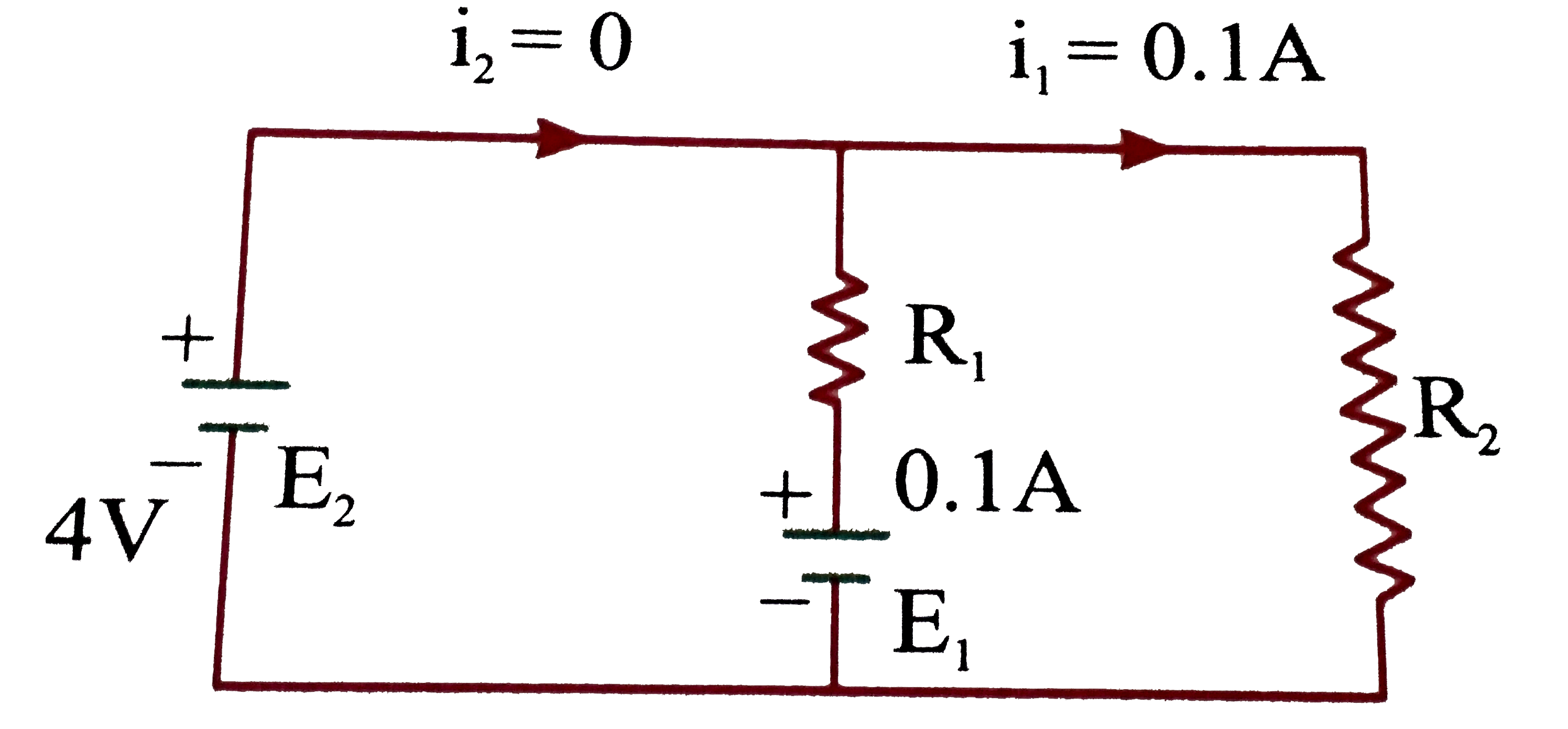 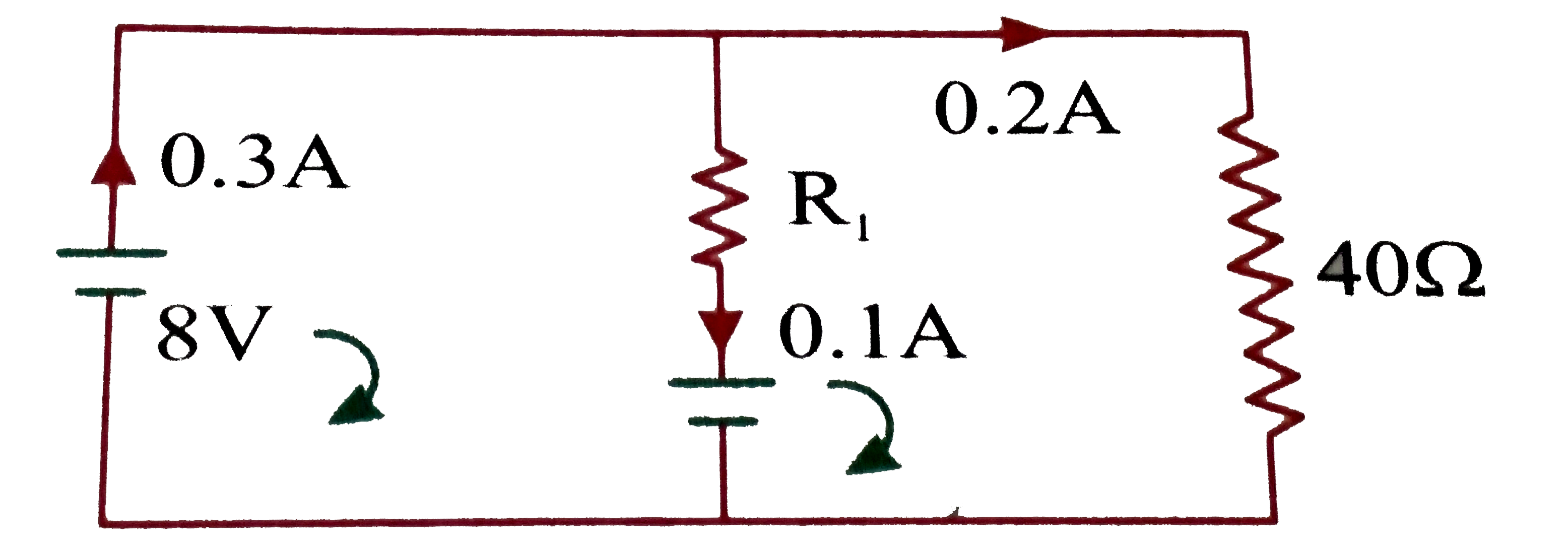 `i_(1)=0.1A,E_(2)=4V` `i_(2)=0` As `0.1R_(1)+0.1R_(2)+0.1R_(2)-E_(1)=0.1` `R_(2)-4V=0` `R_(2)=40Omega` Now `i_(2)=0.3A`, `i_(1)=-0.1A` `E_(2)=8V` Now `0.1R_(1)+E_(1)-8=0` `0.1+3-E_(1)=0` `0.2R_(1)-4=0impliesR_(1)=(4)/(0.2)=20Omega` `E_(1)=2+4=6V` |
|
| 12. |
A charged capacitor and an inductor are connected in series. At time t = 0, the current is zero, but the capacitor is charged. If T is the period of the resulting oscillations, the next time after t = 0, the maximum voltage across the inductor is |
|
Answer» T |
|
| 13. |
What is coordination number of atom in cubic close packing |
|
Answer» 12 |
|
| 14. |
A fish is 60 cm under water ( mu=4//3). A bird directly overhead looks at the fish. If the bird is at a distance of 120 cm from the water surface, (a) What is the apparent position of the fish as seen by the bird and (b) what is the apparent position of the bird as seen by the fish? |
|
Answer» Solution :When the bird sees the fish: The fish and the bird are shown in the following FIGURE alongwith the corresponding coordinate system. A ray of light now travels from the fish, through water, ACROSS the interface, through air and reaches the birs. Here, MEDIUM 1 is water and medium 2 is air. ` d_(1)=-60 cm, mu_(1)=(4)/(3), mu_(2)=1` As `(mu_(1))/(d_(1))=(mu_(2))/(d_(2)) or d_(2)=(mu_(2))/(mu_(1))d_(1)` , we get `d_(2)=-45 cm` Thus, the fish appears to be 45 cm below the water-air interface. Image of fish is formed at I. When the fish sees teh bird: The fish and the bird are shown in the following figure along with the corresponding coordinate system. A ray of light now travels from the bird, through air, across the interface, through water and reaches the fish. Here, medium 1 is air and medium 2 is water. `d_(1)=+120cm, mu_(1)=1, mu_(2)=(4)/(3)` As `(mu_(1))/(d_(1))=(mu_(2))/(d_(2))` or `d_(2)=(mu_(2))/(mu_(1))d_(1)` we get `d_(2)=160 cm` Thus, the bird appears to be 160 cm above the water-air interface. Image of bird is formed at I. 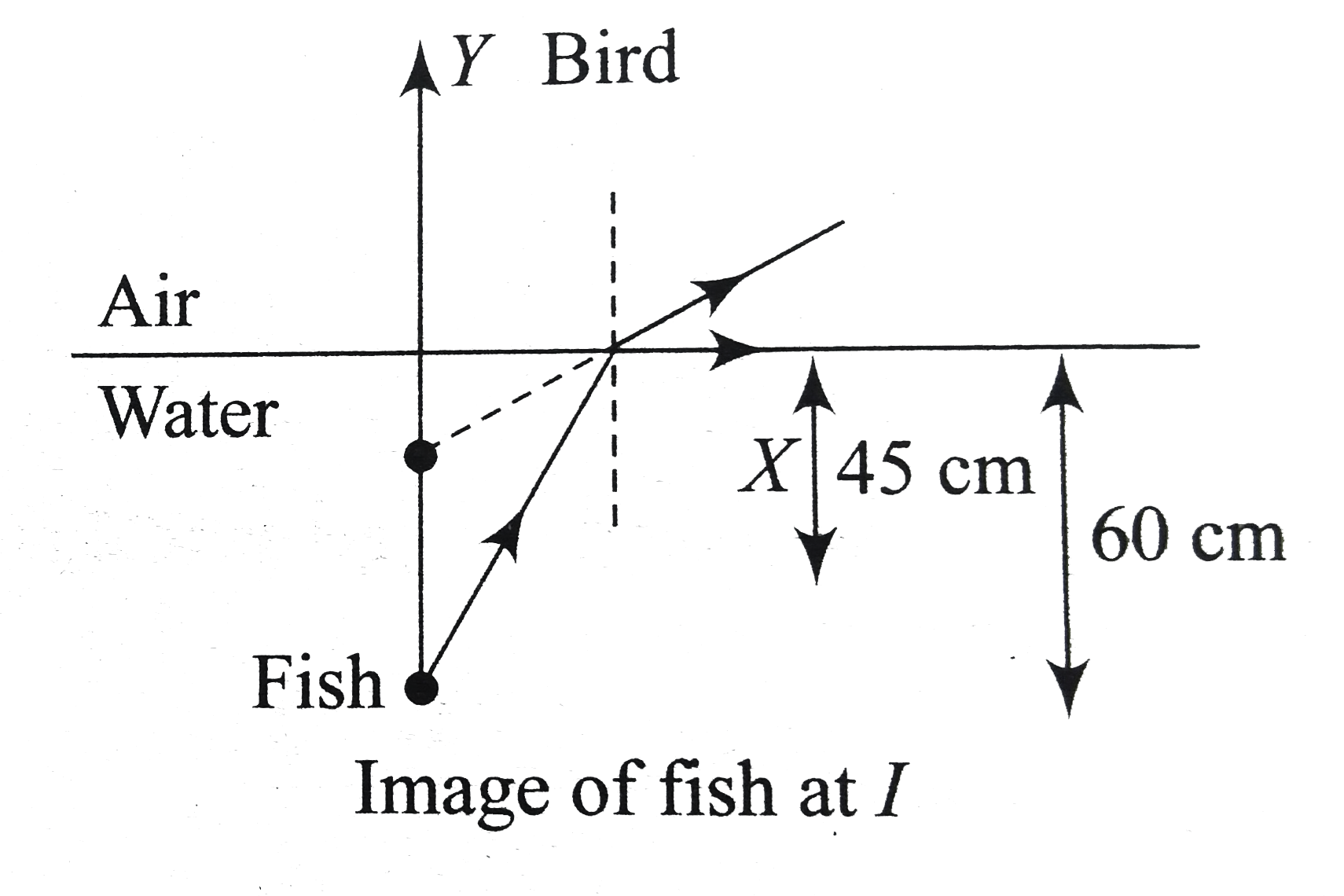 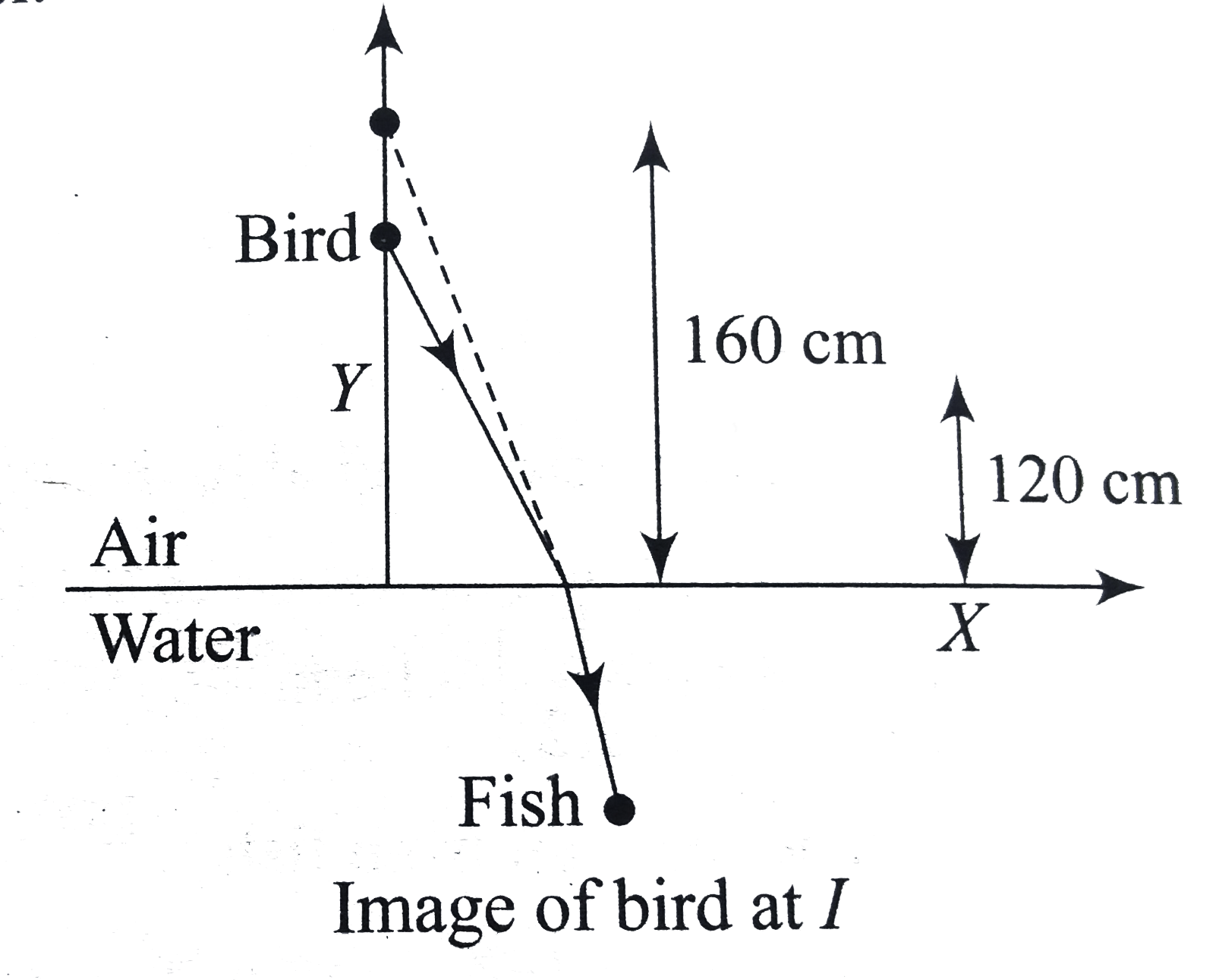
|
|
| 15. |
A whistle of frequency 385Hz rotates in a horizontal circle of radius 50cm at an angular speed of 20 radians s^-1 the lowest frequency heard by a listener a long distance way at rest with velocity to the centre of the circle given velocity of sound equal to 340 ms^-1 is |
|
Answer» 396Hz `v_S=romega=0.50 times20=10 ms^-1` `N.=v/(v+v_s)n=(340 times385)/(340+10)=374 Hz` |
|
| 16. |
Two positive point charges of magnitude Q each are separated by a distance "2a". A test charge 'g_0' is located in a plane which is normal to the line joining these charges and midway between them. The locus of the points in this plane for which the force on the test charge has a maximum value is |
|
Answer» a circle of RADIUS `r=a//sqrt2` |
|
| 17. |
What was Diwan's order? |
|
Answer» To keep DISTANCE from Khejadali |
|
| 18. |
Draw a neat labelled diagram to show (i) primary rainbow and (ii) secondary rainbow. |
Answer» SOLUTION :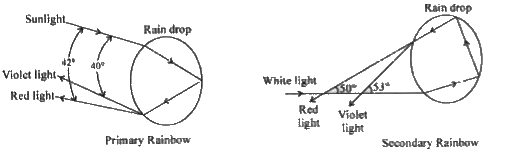
|
|
| 19. |
Two objects with masses m_(1) and m_(2) are moving along the x-axis in the positive direction with speeds v_(1) , and v_(2) , respectively, where v_(1) is less than v_(2) . The speed of the centre of mass of this system of two bodies is |
|
Answer» GREATER than `v_(2)` |
|
| 20. |
The refractive index of the material of an equilateral prism is 1.3. The angle of minimum deviation due to the prism would be |
|
Answer» `30^(@)` |
|
| 21. |
A nucleus of _84Po^210 originally at rest emits an alpha-particles with speed v. What will be the recoil speed of the daughter nucleus ? |
|
Answer» `4v//206` |
|
| 22. |
The process responsible for energy production in the Sun is ................ . |
| Answer» SOLUTION :NUCLEAR FUSION | |
| 24. |
A magnet takes a minute to make 30 oscillations in a magnetic field. If the strength is doubled, then the time period of oscillation (in S) is |
|
Answer» `SQRT2` |
|
| 25. |
(A): Cobalt -60 is useful in cancer therapy. (R): Cobalt-60 is a source of gamma-radiations capable of killing cancerous cells. |
|
Answer» Both .A. and .R. are true and .R. is the CORRECT EXPLANATION of .A. |
|
| 26. |
Given the mass of iron nucleus as 55.85u and A=56, find the nuclear density? |
|
Answer» Solution :`m_(Fe) = 55.85 , "" u = 9.27 xx 10^(-26) kg` Nuclear density = `("MASS")/("VOLUME") = (9.27 xx 10^(-26))/((4 pi//3)(1.2 xx 10^(-15))^(3) xx 1/56` `= 2.29 xx 10^(17) kg m^(-3)` The density of matter in NEUTRON stars (an astrophysical object) is comparable to this density. This shows that matter in these objects has been compressed to such an extent that they resemble a big nucleus. |
|
| 27. |
Three uncharged capacitors A, B and C are connected as shown in the figure. The charge on capacitor B is , the steady state. |
|
Answer» `14muC` |
|
| 28. |
(A) : Photoelectric effect can only be explained by the particle nature of light. (R): For every metal there exists a limiting frequency of the incident light called, threshold frequency, below which electron einission is not possible. |
|
Answer» A and R are TRUE and R is the CORRECT explanation of A. |
|
| 29. |
Two infinite sheets of unifrom charge density +sigma and -sigma are parallel to each other as shown in the figure. Electric field at the |
|
Answer» points to the LEFT or to THTE right of the sheets is zero. |
|
| 30. |
(a) The current through two inductors, of self-inductance 12 mH and 30 mH respectively, is increasing with time at the same rate. Draw graphs showing the variation of the (i) emf induced with the rate of change of current in each inductance, (ii) energy stored in each inductor with the current flowing through it. (b) Compare the energy stored in the coils if the power dissipated in the coils is the same. |
|
Answer» Solution :(a) (i) Here `L_(1) = 12 mH, L_(2) = 30 mH and (dI_(1))/DT = (dI_(2))/dt = .K.` (say) Then `varepsilon_(1)= - L_(1) (dI_(1))/dt = - kL_(1) and varepsilon_(2) = - L_(2) (dI_(2))/dt = - kL_(2)` Graphs showing variation of induced emf with rate of CHANGE of current in each coil are shown in Fig. 6.53. (ii) ENERGY stored `U = 1/2 LI^(2)` HENCE `U_(1) = 1/2 L_(1)I_(1)^(2) and U_(2) = 1/2 L_(2)I_(2)^(2)` variation of energy stored in each inductor with the current flowing through them are shown in Fig. 6.54. (b) As power is defined as the rate of consumption of energy and power dissipated in the two coils is the same, hence energy of the two coils is also the same. 
|
|
| 31. |
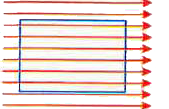
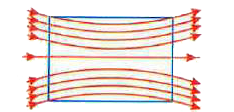
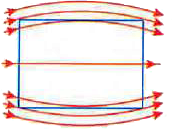
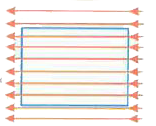
A uniform magnetic field exists in certain space in the plane of the paper and initially it is directed from left to right. When a rood of soft iron is placed parallel to the field-direction, the magnetic lines of force passing within the rod will be represented by figure |
|
Answer»
|
|
| 32. |
ABCD is a square of side 1m. Charges of +3nC, -5nC and +3nC are placed at the comers A, B and C respectively. Calculate the work done in transferring a charge of 12mu c from D to the point of intersection of the diagonals? |
|
Answer» Solution :Diagonal = BD= AC= 1.414m Half of diagonal = AO = BO= CO= 0.707m. Electric potential due system of charges `V= (1)/(4pi in_(0)) [(q_(1))/(r_(1)) + (q_(2))/(r_(2)) + (q_(3))/(r_(3))]` Electric potential at the centre O of square `V= 9 xx 10^(9) [(3 xx 10^(-9))/(0.707) -(5 xx 10^(-9))/(0.707) + (3 xx 10^(-9))/(0.707)]` `V_(0)= 12.7298V` Electric potential at the corner D of square `V= 9 xx 10^(9) [(3 xx 10^(-9))/(1)- (5 xx 10^(-9))/(1.414) + (3 xx 10^(-9))/(1)]` `V_(D)= 22.176V` WORK done to transfer `12mu C` charge from D to 0 `W=q[V_(D)-V_(0)] 12 xx 10^(-6) [22.176- 12.7298]` `W= 1.1335 xx 10^(-4)J` 
|
|
| 33. |
How does the refractive index of a layer of ionosphere change for propagation of a radio wave, if the rate of ionisation increases? |
|
Answer» |
|
| 34. |
Under certain circumstances, a nucleus can decay be emitting a particle more massive than an alpha - particle. Consider the following decay processes : ""_(88)^(223)Ra to ""_(82)^(209)Pb + ""_(6)^(14)C ""_(88)^(223)Ra to ""_(86)^(219)Rn + ""_(2)^(4)He Calculate the Q-values for these decays and determine that both are energetically allowed. |
|
Answer» Solution :`""_(88)^(223)Ra to ""_(82)^(209)Pb + ""_(6)^(14)C + Q` `:. Q = [m_N ""_(88)^(223)Ra - m_N ""_(82)^(209)Pb - m_N ""_(6)^(14)C] Jc^2` = `{:(223.018497-),(208.981075):}/({:(14.037422-),(14.003242):}/(0.034180))` `= 31.84 MEV` `""^(223)Ra = 223.018497 u` `""^(209)Pb = 208.981075 u` `""_(6)^(14)C = 14.003242 u` `""^(219)RN = 219.009475 u` `""^(4)He = 4.002603` `""_(88)^(223)Ra to ""_(86)^(219)Rn + ""_(2)^(4)He + Q` `Q = [m_N ""_(88)^(223)Ra - m_N ""_(86)^(223)Rn - m_N ""_(2)^(4)He]c^2` = `{:(223.018497-),(219.009475):}/({:(4.009022-),(4.002603):}/(0.006419))` `= 5.98 MeV` |
|
| 35. |
Describe the Bohr quantum conditions in terms of the wave theory: demonstrate that an electron in a hydrogen atom can move only along those round orbits which accommodate a whole number of de Broglie waves. |
|
Answer» <P> Solution :The Bhor CONDITION`oint p d x=oint(2pi ħ)/(lambda)d x= 2 pi n ħ` For the CASE when `lambda` is constant (for example in circular ORBITS) this means `2pi r=n lambda` Here `r` is the radius of the circular ORBIT. |
|
| 36. |
A ball is projected with velocity of 20 sqrt(2) m/s at angle of 45^(@) with horizontal and at the same instant another plate is rotating with constant angular velocity omega(omega = pi//4 "rad/sec") in vertical plane as shown in the figure. If the mass of the plate is much larger than the mass of the ball, the plate is initially in horizontal position and collision is perfectly elastic, then choose the correct statement(s) |
|
Answer» TIME when the ball collides with the place is 2 (St unit) |
|
| 37. |
For a certain orgas pipe, three succes ssive resonance frequencies are observed ol 425, 595 and 765 Hz respectively. Thking the speed of sound in air to be 340 m/s (a) Explain whether the pipe is closed at one end or open at both ends b) Determine the fundamental frequency and length of the pipe. |
|
Answer» Solution :a) The given frequencies are in the RATIO 425 : 595 : 765, i.e., 5:7:9 and clearly these are oddintegers so the given pipe is closed at one end. b) From part (a) it is clear that the FREQUENCY of 5th harmonic (which is 2ndovertone) is 425 Hz So `425 = 5f_c (or) f_c = 85Hz`. Further as `f_C= v/(4L) ,L =v/(4f_C) =340/(94 xx85) =1m` |
|
| 38. |
A conducting loop is held stationary normal to the magnetic field between the north and south poles of two fixed permanent magnets can you hope to generate a current in the loop? |
| Answer» Solution :No current is PRODUCED only if there is a CHANGE in MAGNETIC flux. | |
| 39. |
A point object is placed at a distance of 25cm from a convex lens of focal length20cm .If a glass slab of thickness t and refractive index1.5 is inserted between the lens and object.The image is formed at infinity .Find the thickness? |
| Answer» ANSWER :A | |
| 40. |
(a) Derive the expression for the torque acting on a current carrying placed in a magnetic field. (b) Explain the significance of a radial magnetic when current carrying coil is kept in it. |
Answer» Solution :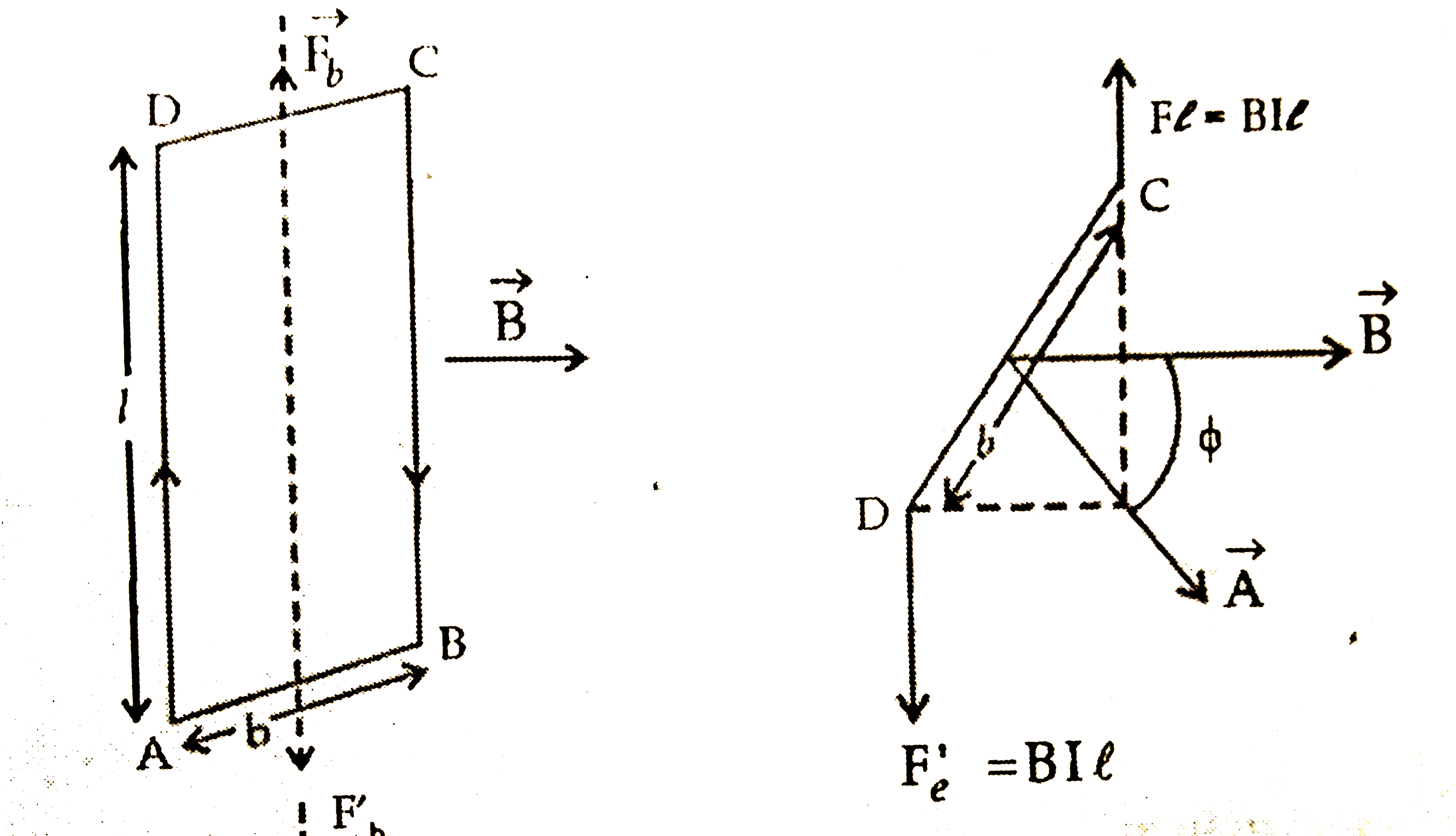 Let us consider a rectangular coil ABCD carrying I, Placed in a magnetic FIELD B making an angle `theta` with the plane of the coid and `phi` with the area vector of the plane. `vec(F_(b))=vec(-F_(b))` `vec(F_(I))=vec(-F_(I))` So, they cancel out in pairsbut `vecF_(l)" and "vec(-F_(I))` provide torque to the ractangular coil ABCD. `tau="(Force )(Arm of Couple)"` `tau="Force"xx"Perpendicular distance between two action lines of forces"` `tau=I l B xx b cos theta` `tau=IlB b sin phi` let the number of turns be N `{:(tau="NIA B sin "phi,"{l" xx b=A),(tau="MB sin "phi, "NIA = M"):}""{{:(theta+phi=90^(@)),(theta=90^(@)-phi),(costheta=sinphi):}` Magnetic diploe moment `vec(tau)=vec(M)xxvec(B)` 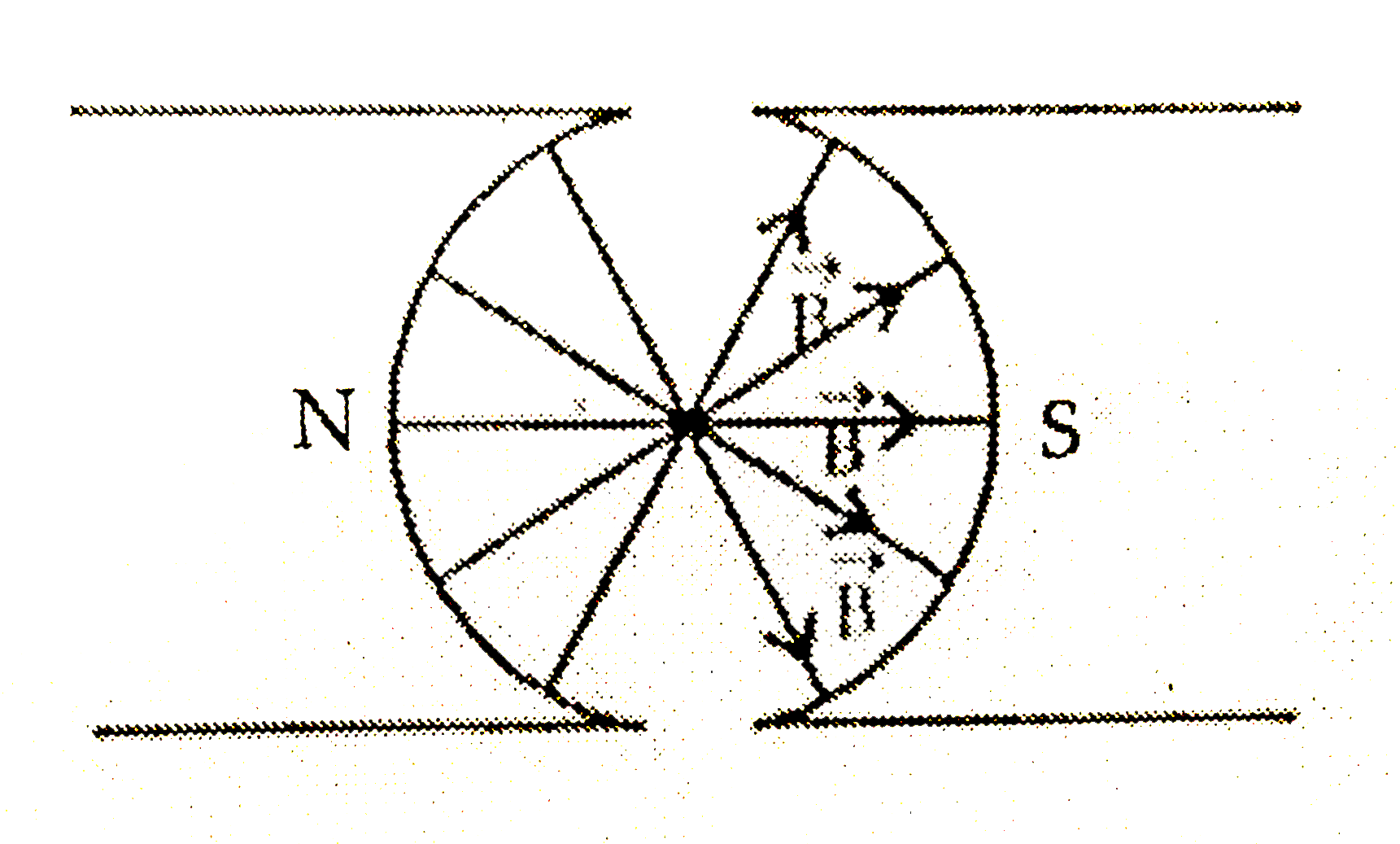 Significance of radical magnetic field : When apply radical field as shown in the FIGURE `phi` is always equalsto `90^(@)`. `tau=MB sin 90^(@)` `sin 90^(@)=1` Hence, Torque MAXIMUM and constant. |
|
| 41. |
A pop-gun consistsofa cylindrical barrel 3 cm^(3) in cross-section closed at one end by a cork and having a well fitting piston at the other. If the piston is pushed slowly in, the cork is finally ejected, giving a pop, the frequency of which is found to be 512 Hz. Assuming that the initial distance between the cork and the pistonwas25 cm and that there isno leakage of air,calculate the force required to eject the cork. Atmospheric pressure = 1kg wt//cm^(2), v = 340 m/s. |
|
Answer» <P> Solution :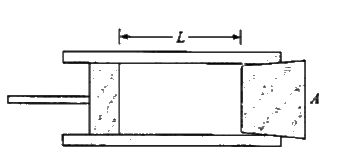 When the cork is ejected,the situation is shown in figure-6.77. Let the position ofthe piston fromendy4 belcm. So, this forms a closedpipeof length1. It produces a note of frequency512 Hz. Now `N = (v)/(4L) ` or `512 = (340)/(4L)` `L = (340)/(512 xx 4) = 0.166 m` = 16.6 CM Before the piston is moved, `P = 1 kg wt//cm^(2)` and `V = 25 xx 3 cm^(3)`. When the cork is ejected, let pressure be p'. The volume of air inside `v' = 16.6 xx 3 cm^(3)` From BOYLE's law, `PV = P'V' ` ` (1)(25xx 3) = `P' xx (16.6 xx 3)` `P' ((25)/(16.6))kg wt//cm^(2)` = 1.5 kg wt// cm^(2)` Thus pressure inside the barrel = `1.5 kg wt//cm^(2)` Pressure difference = pressure inside - pressure outside = `(1.5 - I)kg wt//cm^(2)` = `0.5 kg wt//cm^(2)` Force on piston = pressure xx area = `0.5 xx3` 1.5 kg wt |
|
| 42. |
Two concentric spherical shells have radii R and 2R. The outer shell is grounded and the inner one is given a charge +Q. A small particle having mass m and charge – q enters the outer shell through a small hole in it. The speed of the charge entering the shell was u and its initial line of motion was at a distance a=sqrt(2)R from the centre. (a) Find the radius of curvature of the path of the particle immediately after it enters the shell. (b) Find the speed with which the particle will hit the inner sphere.Assume that distribution of charge on the spheres do not change due to presence of the charge particle |
|
Answer» (B). `V=sqrt(u^(2)+(Qq)/(4pi iin_(0)mR))` |
|
| 43. |
What is the energy of the electron revolving in third orbit expressed in eV? |
|
Answer» 1.51 eV `E=(-2pi^(2) me^(4) Z^(2)K^(2))/(n^(2) h^(2))=-(13.6)/(n^(2)) eV` `E=-(13.6)/((3)^(2))=-(13.6)/(9)=1.51eV` (n=3 for 3RD Bohr.s orbit). |
|
| 44. |
An inclined plane is located at anglealpha = 53^(@) to the horizontal. There is a hole at point B in the inclined plane as shown in the figure. A particle is projected along the plane with speed v_(0)at an anglebeta = 37^(@)to the horizontal in such a way so that it gets into the hole. Neglect any type of friction. Find the speed v_(0)(in ms^(-1)) if h = 1 m and l = 8m. |
|
Answer» 9 |
|
| 45. |
In the following question a statement of assertion (A) is followed by a statement of reason (R ) A : capacitor is a device which stores electric energy in the form of electric field . R : Net charge on the capacitor is always zero. |
|
Answer» If both Assertion & Reason are TRUE and the reason is the correct explanation of the assertion , then mark (1). |
|
| 46. |
A coil of surface area 100 cm^2 having 50 turns is held perpendicular to the magnetic field of intensity 0.02 "Wb m"^(-2). The resistance of the coil is 2 Omega . If it is removed from the magnetic field in 1s, the induced charge in the coil is ____ |
|
Answer» 5 C `therefore Q=(50xx100xx10^(-4)xx0.02)/2` `therefore` Q=0.005 C |
|
| 47. |
A battery of emf 2 V is applied across the block of a semiconductor of length 0.1 m and the area of cross-section 1xx10^(-4)m^(2). If the block is of intrinsic silicon at 300K, find the magnitude of tatal current. What will be the order of magnitude of total current if germanium is used instead of silicon? Given that for silicon ay 300K, electron mobility, mu_(e)=0.135m^(2) V^(-1)s^(-1), hole mobility mu_(h)=0.048m^(2)V^(-1)s_(-1), instrisic carrier concentration, n_(i)=1.5xx10^(16)m^(-3). For germanium at 300K, electron mibility mu_(e_(2))=0.39m^(2)V^(-1)s^(-1), hole mobility, mu_(h)=0.19m^(2)V^(-1)s_(-1), instric carrier concentration is 2.4xx10^(19)m^(-3). |
|
Answer» Solution :For silicon Total current, `I=EA(n_(e)v_(e)+n_(h)v_(h))` or `I_(s)=eA(n_(e)E mu_(e)+n_(h)Emu_(h))` `=eA(n_(e)mu_(e)+n_(h)mu_(h))E` `=eA (e_(e)mu_(e)+n_(h)mu_(h))V/I` `=(1.6xx10^(19))xx(1xx10^(4))[(1.5xx10^(16))xx(0.135)+(1.5xx10^(16))xx0.048]xx2/0.1` `=8.7xx10^(-7)A` For Germanium `I_(G)=(1.6xx10^(-19))xx(1xx10^(-4))[(2.4xx10^(19))xx0.39+(2.4xx10^(19))xx0.19]xx2/0.1` `=4.46xx10^(-3)A` `I_(G)/I_(s)=(4.46xx10^(-3))/(8.7xx10^(-7))~~0.512xx10^(4)~~10^(4)` THEREFORE, the total current in germanium is about four orders of the total current in silicon. |
|
| 48. |
Solar constant of the sun is the energy received by earth per minute per cm^(2). Its dimensions will be : |
|
Answer» `[ML^(2)T^(-3)]` `:.sigma=(ML^(2)T^(-2))/(L^(2)xxT^(1))` `=ML^(0)T^(-3)` HENCE `(b)` is the right choice. |
|
| 49. |
Which of the following is the correct prefix with the word "healthy |
|
Answer» Semi-healthy |
|
| 50. |
Calculate the value of the resistance R in the circuit shown in Fig. so that the current in the circuit is 0.2 A. What would be the potentialdifference between points B and E ? |
|
Answer» Solution :In the circuit shown here resistance of 5`Omega`joinedbetween B and C, and resistance of 10`Omega`joined between C and D are in series and FORM a resistance of 15`Omega` . Now this resistance of 15`Omega`is in PARALLEL arrangement with resistances of 10`Omega` and 30`Omega`between the points B and E. Hence equivalent resistance R. between B and E points is given by `(1)/(R.) = 1/15 + 1/10 + 1/30 = 1/5 rArr R.= 5Omega` So the equivalent circuit may be REDRAWN as in Fig.Applying Kirchhoff.s law to the circuit BEFAB, we have` -0.2 xx 5 - 0.2 xx R-3-0.2 xx 15+8=0 ` ` R = 5Omega` and potential difference between B and E, `V_B - V_E = 0.2 xx 5 = 1.0 V` |
|