Saved Bookmarks
This section includes 7 InterviewSolutions, each offering curated multiple-choice questions to sharpen your Current Affairs knowledge and support exam preparation. Choose a topic below to get started.
| 1. |
Statement I: The de-Broglie wavelength lamda of a particle of mass m moving with a velocity v is given by relation lamda=(h)/(mv) Statement II : The de-Broglie wavelength of an electron which is accelerated from rest through a potential of 150 volt 1Å. |
|
Answer» A. Statement-I is FALSE, statement-II is TRUE. |
|
| 2. |
A metallic rod of mass per unit length 0.5kgm^(-1) is lying horizontally on a smooth inclined plane which makes an angle of 30^(@) with the horizontal. The rod is not allowed to slide down by flowing a current through it when a magnetic field of induction 0.25 T is acting on it in the vertical direction. The current flowing in the rod to keep it stationary is. |
|
Answer» 11.32 A  To keep rod in stationary, `mgsintheta=ilBcostheta` `thereforemg TANTHETA=ilB` `thereforei=(mg tantheta)/(LB)` `thereforei=(m/l)(g tantheta)/B` `thereforei=(0.5xx9.8xxtan30^(@))/0.25` `thereforei=(0.5xx9.8xx1)/0.25` `thereforei=11.316A` `thereforei~~11.32A` |
|
| 3. |
The pulley arrangements to Fig.(A) and (B), are identical. The mass of the rope is negligible. In (A) the mass mi s lifted up by attaching a mass 2m to the other end of the rope. In (B) m is lifted up by pulling the other end of the rope with a constant downward force F=2mg. In which case the acceleration of 'm' is more? |
|
Answer» |
|
| 4. |
An infinite number of identical capacitors each of capacity I mF are connected as shown in the figure. The equivalent capacity between A and B |
| Answer» ANSWER :C | |
| 5. |
Wavelengths of two notes in air are 80/175 m and 80/173 m. Each note produces 4 beats/s, with a third note of a fixed frequency. The speed of sound in air is |
|
Answer» 400 m/s |
|
| 6. |
A narrow tube is bent in the form of a circle of radius R, as shown in the figure. Two small holes S and D are made in the tube at the positions right angle to each other. A source placed as S generates a wave of intensity I_0 which is equally divided into two parts , one part travels along the longer path, while the other travels along the shorter path. Both the part waves meet at the point D where a detector is placed. If a minima is formed at the detector then, the magnitude of wavelength lambda of the wave produced is given by: |
|
Answer» `2piR` |
|
| 7. |
In Boolean expression which gate is expressed as y = bar(A +B) |
|
Answer» OR |
|
| 8. |
In a straight conductor of uniform cross-section charge q is flowing for time t. Let s be the specific charge of an electron. The momentum of all the free electrons per unit length of the conductor, due to their drift velocity only is |
| Answer» Answer :A | |
| 9. |
The self-inductance of the motor of an electric fan is 10H. In order to impart maximum power at 50Hz, it should be connected to a capacitance of: |
| Answer» ANSWER :A | |
| 10. |
Using Bohor's postulates, obtain the expression for the total energy of the electron in the stationary states of the hydrogen atom. Hence draw the energy level diagram showinghow the line spectra correspondingto Balmer series occur due to transition between energylevels. |
|
Answer» <P> Solution :According to Bohr's postulates, in a hydrogen atom, a single electron revolves arround a nucleus of charge +e. For an electron moving with a uniform speed in a circular orbit as a GIVEN RADIUS, the centripetal force is providedby Coulomb force of attraction between the electron and the nucleus. The gravitational attraction may be neglected as themass of electron and proton is very small.`So, (Mv^(2))/(r)=(ke^(2))/(r^(2)) "where "{:(m to "mass of electron"),(r to "radius of electronic orbit"),(v to "velocity of electron"):}` `ormv^(2)=(ke^(2))/(r) "" `...(i) ` "Again," mvr=(nh)/(2pi)` `v=(n lambda)/(2 pi m r)` From equation (i), we get `m((n lambda)/(2 pi m r)) = (ke^(2))/(r)=r=(n^(2)h^(2))/(4pi^(2)kme^(2)) "" ` ...(ii) (i) Kinetic energy of electron, `E_(k) =(1)/(2) mv^(2)=(ke^(2))/(2r)` Using eq' (ii), we get `E_(k) =(ke^(2))/(2)(4pi^(2)kme^(2))/(n^(2)h^(2))=(2pi^(2)k^(2)me^(4))/(n^(2)h^(2))` (ii) Potential energy `E_(p)=(-k(e)xx (e))/(r)=(-ke^(2))/(r)` Using equation (ii), we get, `E_(p) =-ke^(2)xx(4pi^(2)kme^(2))/(n^(2)h^(2))= (-4pi^(2)k^(2)me^(4))/(n^(2)h^(2))` Hence, total energy of the electron in the nth orbit `E= E_(p) +E_(k)` `=(-4pi^(2)k^(2)me^(4))/(n^(2)h^(2))+(2pi^(2)k^(2)me^(4))/(n^(2)h^(2))=(-2pi^(2)k^(2)me^(4))/(n^(2)h^(2))= -(13.6)/(n^(2))eV.` When the electron in a hydrogen atom jumps from higher energy LEVEL to the lower energy level, the difference of energies of the two energy levels is emitted as a radiation of particular wavelength. It is called a spectral line. In H-atom, when an electron jumps from the orbit `n_(i)` to orbit `n_(f')` the wavelength. It is called a spectral line. in H-atom, when an electron jumps from the orbit `n_(i)` to orbit `n_(f)` the wavelength of the emitted radiation is given by, `(1)/(lambda)=R((1)/(n_(f)^(2))-(1)/(n_(i)^(2)))` where `R to "Rydberg's constant" = 1.09678 xx 10^(7) m^(-1).` For Balmer series, `n_(f) = 2 and n_(i) = 3,4,5, ...` `(1)/(lambda)=R((1)/(2^(2))-(1)/(n_(i)^(2)))` where,`n_(i)=3, 4, 5, ...` These spectral lines lie in the visible region. 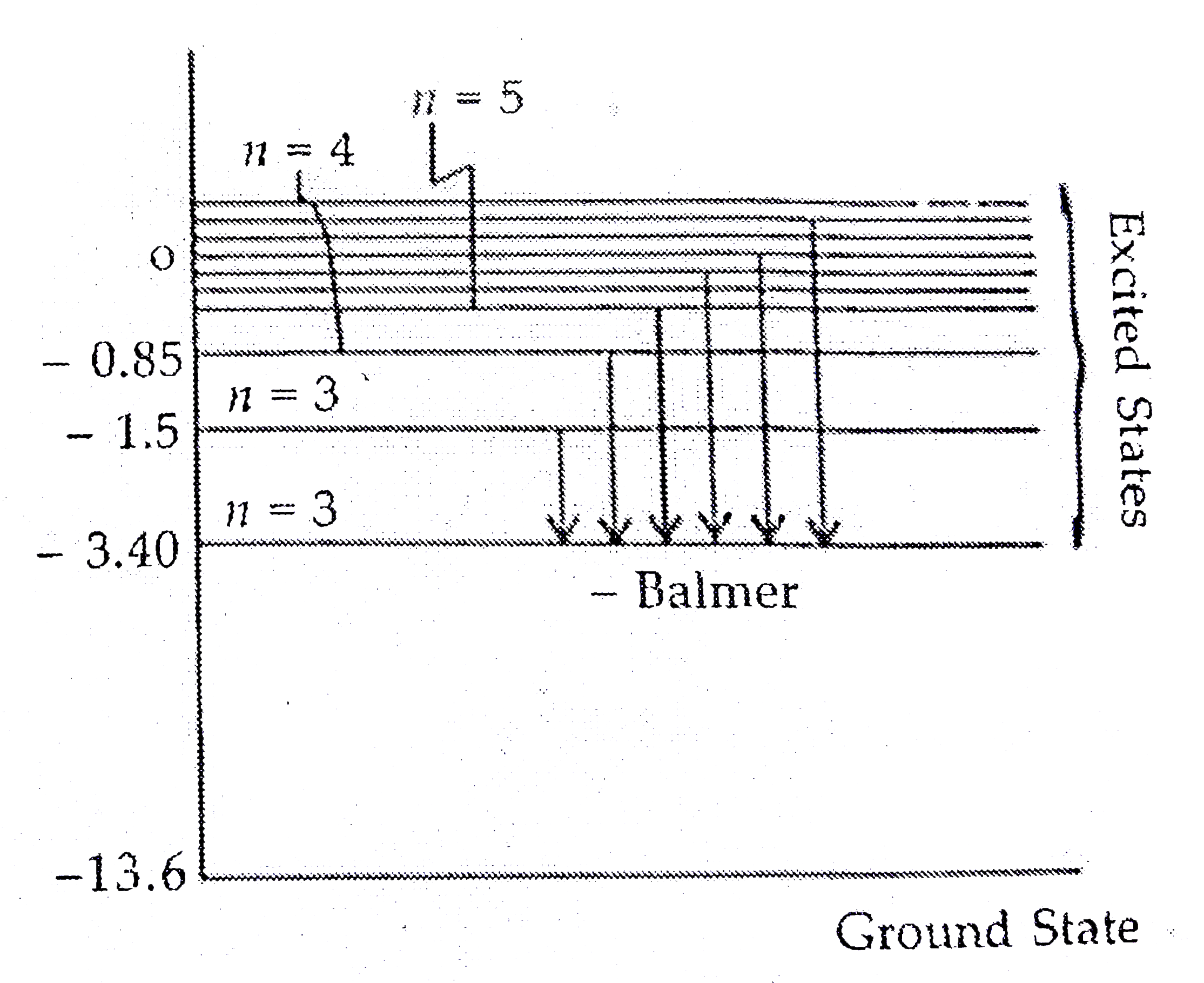
|
|
| 11. |
A narrow tube is bent in the form of a circle of radius R, as shown in the figure. Two small holes S and D are made in the tube at the positions right angle to each other. A source placed as S generates a wave of intensity I_0 which is equally divided into two parts , one part travels along the longer path, while the other travels along the shorter path. Both the part waves meet at the point D where a detector is placed. The maximum intensity produced at D is given by: |
|
Answer» `4I_(0)` |
|
| 12. |
A radio or T.V. set which uses valves does not start operating immediately when it is switched on, whereas a set containing only transistors does operate immediately because |
|
Answer» transistor set has a lower resistance |
|
| 13. |
A narrow tube is bent in the form of a circle of radius R, as shown in the figure. Two small holes S and D are made in the tube at the positions right angle to each other. A source placed as S generates a wave of intensity I_0 which is equally divided into two parts , one part travels along the longer path, while the other travels along the shorter path. Both the part waves meet at the point D where a detector is placed. If a maxima is formed at a detector then, the magnitude of wavelength . lambda. of the wave produced is |
|
Answer» `PIR` |
|
| 14. |
Two elelctric bulbsP and Q have theirresistancein the ratio of 1: 2. Theyare connected in series acrossa battery. Findthe ratio of the power dissipation inthesebulbs. |
|
Answer» Solution :FORMULA staling that current are EQUAL RATIO POWERS Power =FR ( The current in the two bulbs , is the same as they are connected in SERIES. `( P_1)/( P_2)=( I^(2) R_1) /( I^(2) R_2) =(R_1)/(R_2) ` ` (1)/(2) ` |
|
| 16. |
Match the options of the following columns. {:("Column I", "Column II"),("For real extended object,if image formed by a single mirror is erect, and if the size of image is smaller than object, the mirror is", (P)"Concave"),("For real extended object, if the size image is smaller than object, the mirror is", (Q)"Convex"),("For real extended object, if image formed by asingle mirror is erect and if the size of image is larger than object, then mirror is""",(R)"(f,f)"),("For spherical mirrors, a line u=v will cut the curve between u and v at a point.", (S) "(2f,2f)"):} |
|
Answer» |
|
| 17. |
At what point of the projectile path the speed is minimum ? At which point maximum ? |
| Answer» SOLUTION :at the HIGHEST POINT, at the PROJECTION point. | |
| 18. |
Draw a plot showing the variation of binding energy per nucleon versus the mass number A. Explain with the help of this plot the release of energy in the processes of nuclear fission and fusion. |
|
Answer» Solution :Binding ENERGY Curve : The variation of average B. E. per NUCLEON with mass number A is shown in fig. Inferences : (i) Average B.E. per nucleon for light nuclei like `._(1)^(1)H` and `._(1)^(2)H` small. (ii) For mass number 2 to 20, the peaks are sharply defined. So that, `._(2)^(4)He, ._(6)^(12)C, ._(8)^(16)O, ._(10)^(20)Ne` etc, are more stable than the nuclei in their neighbourhood.. (iii) The nuclei having INTERMEDIATE mass number 56 have maximum binding energy as 8.8 Me V/N e.g. `._(26)^(56)Fe`. Such nuclei are most stable. (iv) The BE/nucleons decreases gradually after mass number `._(26)^(56)Fe` to `._(92)^(238)U`. the heavy nuclei are relatively less stable. (v) Binding energy per nucleons is small for both light and heavy nuclei. When light nuclei fuse to form a heavy nucleus, high value of binding energy energy is released in nuclear fusion. When a heavy nucleus splits into a light nuclei, high value of binding energy is released in nuclear fission. 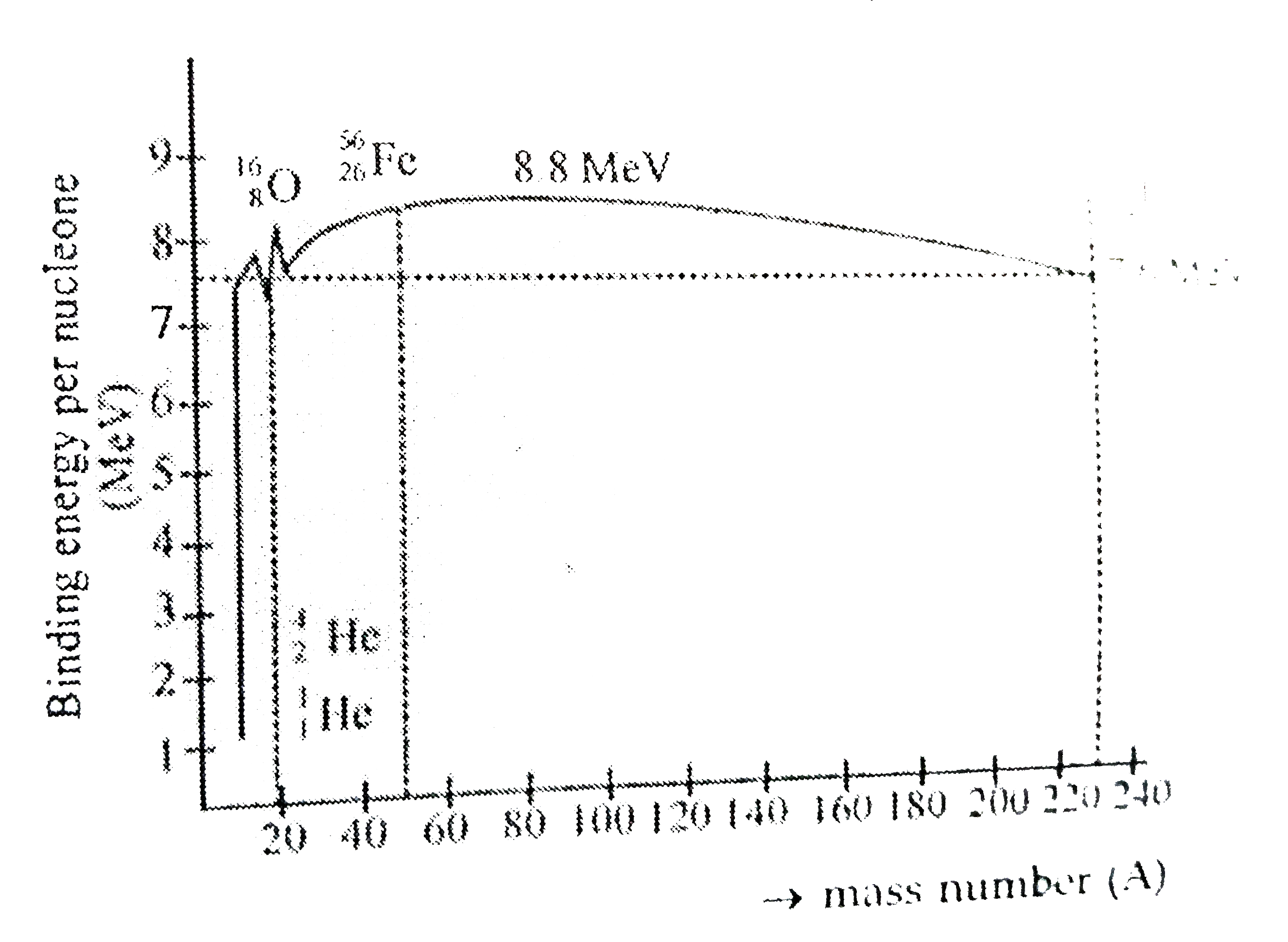
|
|
| 19. |
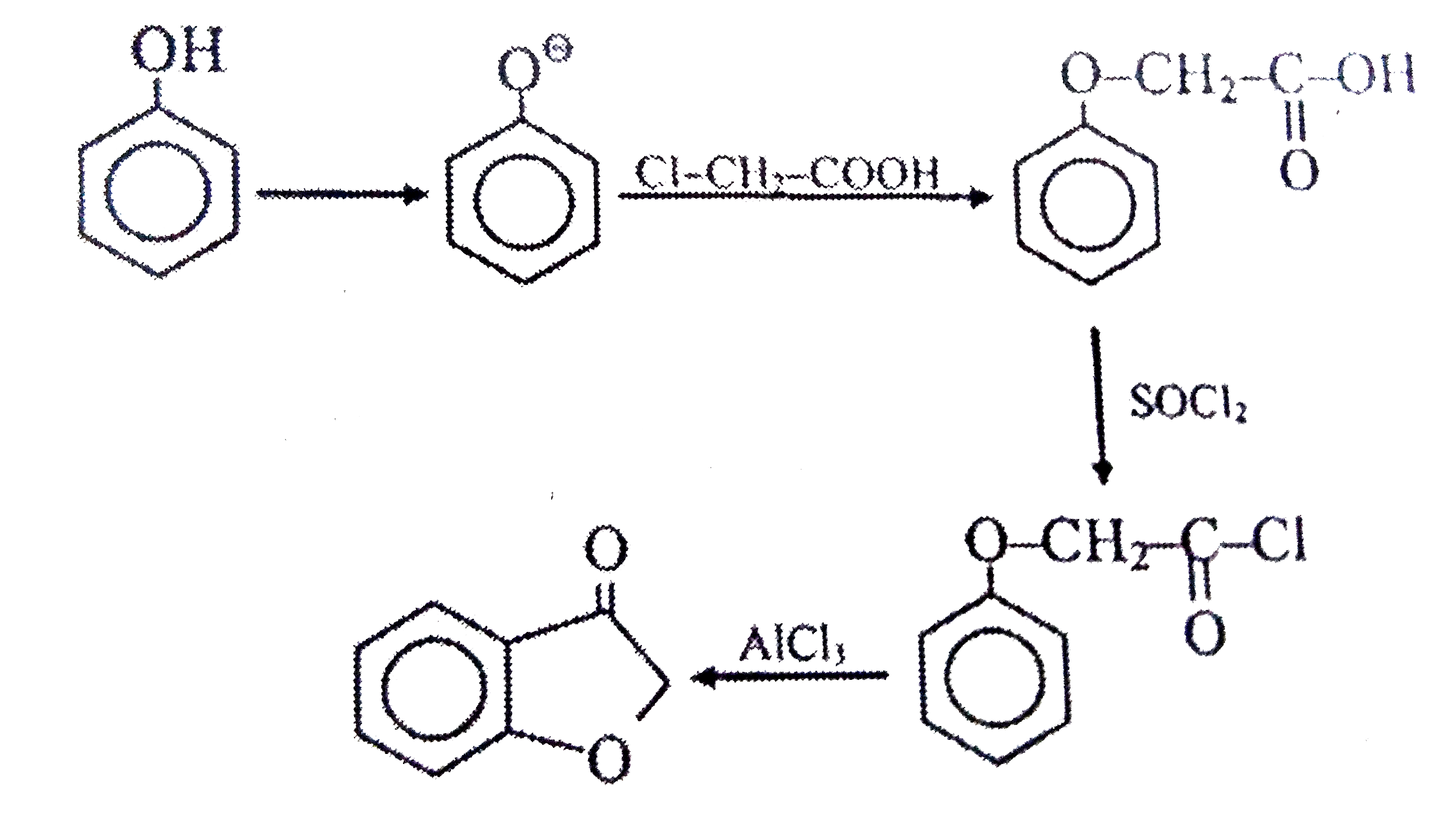
Identify 'Z' in the given sequence of reaction . |
|
Answer»
|
|
| 20. |
From long distance, shortwave radio broadcasting_____________ wave is used. |
|
Answer» ground |
|
| 21. |
A body is thrown up with a velocity 10% more than the escape velocity v_(e ). When the body escapes the gravitational pull of the earth the velocity still left in the body is : |
|
Answer» `0.1v_(e )` `therefore` Velocity of BODY after escaping the gravitational fieldis `v=SQRT(x^(2)-1) "" v_(e )=sqrt(((121)/(100)-1))-v_(e )=sqrt((21)/(100))v_(e )` `=0.458 v_(e )` So CORRECT choice is (c ). |
|
| 22. |
An electron of mass m and charge e initially at rest gets accelerated by a constant electric field E. The rate of change of de-Broglie wavelength of this electron at time t ignoring relativistic effects is |
|
Answer» `(dlamda)/dt = - h/(eEt)` |
|
| 23. |
In a circuit, the value of the alternating current is measured by hot wire ammeter as 10 ampere. What will be its peak value ? |
|
Answer» `10 A` `THEREFORE I_m=sqrt2xxI_(rms)` =1.414 X 10 =14.14 A |
|
| 24. |
The half- life of .^238U for alpha-decay is 4.5xx10^19 years. How many disintegrations per second occur in 1g of .^238U ? (Avogadro.s number = 6.023 xx 10^23 "mol"^(-1) ) |
|
Answer» Solution :Half-life `T=4.5xx10^9xx365xx86400s=1.419xx10^17` s `lambda=0.693/T = 0.693/(1.429xx10^17)=4.882xx10^(-19) s^(-1)` Number of `.^238U` atoms in 1g , `N="Avogardo.s number"/"MASS number"=(6.023xx10^23)/238=2.530xx10^21` Number of disintegration per second, `(dN)/(dt)=lambdaN=4.882xx10^(-18)xx2.530xx10^21` `=1.235xx10^4 s^(-1)` |
|
| 25. |
A galvanometer gives full scale deflection with 0.006 A current. By connecting it to a 4990 Omegaresistance, it can be converted into a voltmeter of range 0-30 V. If connected to a(2n)/249 Omega resistance, it becomes an ammeter of range 0-1.5AThe value of n is |
|
Answer» Solution :`i_g(G+4990)=V IMPLIES 6/1000(G+4990)=30 i_g=4990 Omega` `G+4990=30000/6=5000 implies G=10 Omega` `V_(ab)=V_(cd) implies j_gG=(1.5-j_g)S` `6/1000 times 10=(1.5-6/1000)S` `S=60/1494=(2N)/249 implies n=(249 times 30)/1494=2490/498=5` 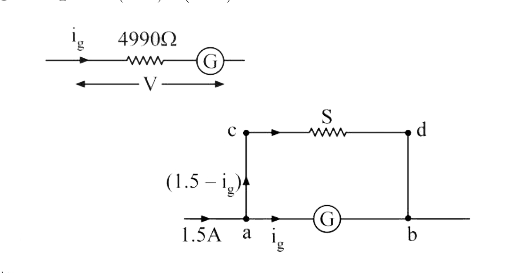
|
|
| 26. |
Why does a diamond sparkle with greatbrilliance? |
| Answer» Solution :Refractive index of DIAMOND is large. Hence its CRITICAL angle is small . When faces of diamond are cut suitably, the LIGHT RAYS entering through the surface undergo total internal REFLECTIONS repeatedly and come through only few faces. Hence diamond sparkles when we see the emerging light in its direction. | |
| 27. |
The equation of a stationary wave is given by y=0.02cos(pix/0.04)sin20pit. The wavelength of the wave is, |
|
Answer» 0.04m |
|
| 28. |
Figure shows the stopping potential (V_(0)) for the photo electron vers ((1)/(lambda)) graph, for two metals A and B, lambda being the wavelength of incident light. How is the value of Planck's constant determined from the graph ? |
|
Answer» SOLUTION :We know that `V_(0)=(h)/(e ) (v-v_(0))= (hc)/(e ) ((1)/(lambda)-(1)/(lambda_(0)))`. So `V_(0)- (1)/(lambda)` graph is a straight line graph whose SLOPE has a magnitude of`(hc)/(e )` . Thus, Planck.s constant`h= (e )/(C )xx ("Slope of " V_(0)-(1)/(lambda)` aph for any photosensitive METAL) |
|
| 29. |
A proton and alpha particle, after accelerating through same potential difference enters into a uniformmagnetic field perpendicular to their velocities, find the radius ratio of proton and alpha particle:- |
|
Answer» `1:2` `r_p/r_alpha =sqrt(m_p/m_alpha)sqrt(q_n / q_p) = sqrt(1/4)sqrt(2/1)=1/sqrt2` |
|
| 30. |
A uniform magnetic field is directed out of the page. A charged particle , moving in the plane of the page, follows a clockwise spiral of decreasing radius as shown. A reasonable explanation is : |
|
Answer» the charge is POSITIVE and slowing down |
|
| 31. |
Figure shows the stopping potential (V_(0)) for the photo electron vers ((1)/(lambda)) graph, for two metals A and B, lambda being the wavelength of incident light. If the distance between the light source and the surface of metal A is increased, how will the stopping potential for the electrons emitted from it be affected ? Justify your answer. |
| Answer» Solution :Stopping potential remains UNCHANGED because it SOLELY depends on the frequency (or WAVE LENGTH) of INCIDENT radiation and is independent of all other factors. | |
| 32. |
For a particle of mass m enclosed in a one-dimentional box of length L, the de-Broglie concept would lead to stationary waves, with nodes at the two ends. The energy values allowed for such a system (with n as integers) will be: |
|
Answer» `(H^(2))/(8mL^(2))N^(2)` `E=(p^(2))/(2M)=((nh)/(2L))^(2)*(1)/(2m)=(h^(2)n^(2))/(8mL^(2))` |
|
| 33. |
Describethe working principleof a moving coil galvanometer. Why is necessaryto use (i) a radial magnetic field and (ii) a cylindrical soft iron core in a galvanometer ? Write the expression for currentsensitivity of thegalvanometer . Can a galvanometer as such be used formeasuring the current ? Explain. |
|
Answer» Solution :Working and Principle of moving coil galvanometer Necessity of (i) radial magnetic FIELD (ii) cylindrical soft iron core Expression for current sensitivity Explanation of use of Galvanometer to measure current. When a coil, carrying current, and free to ROTATE about a fixed axis, is placed in a UNIFORM magnetic field, it EXPERIENCES a torque (Which is balanced by a restoring torque of suspension). (i) To have deflection proportional to current/ to maximize the deflecting torque acting on the current carrying coil. (ii) To make magnetic field radial/to increase the strength of magnetic field. Expression for current sensitivity. `I_(s)=(theta)/I` or `(NAB)/K` where `theta` is the deflection of the coil No The galvanometer, can only detect current but cannot measure them as it is not calibrated. The galvanometer coil is likely to be damaged by currents in the (mA/A) range] |
|
| 34. |
Let us list some of the factors, which could possibly influence the speed of wave propagation : (i) nature of the source ii) direction of propagation (iii) motion of the source and/or observer iv) wavelength v) intensity of the wave On which of these factors, if any, does the speed of light in a medium (say, glass or water), depend ? |
|
Answer» Solution :(a) The speed of light in vacuum is a universal constant independent of all the FACTORS listed and anything else. In particular, note the SURPRISING fact that it is independent of the relative motion between the source and the observer. This fact is a basic axiom of Einstein’s special theory of relativity. (b) Dependence of the speed of light in a medium: (i) does not depend on the nature of the source (wave speed is determined by the properties of the medium of propagation. This is also true for other waves, e.g., sound waves, WATER waves, etc.). (ii) independent of the direction of propagation for isotropic media. (III) independent of the motion of the source relative to the medium but depends on the motion of the observer relative to the medium. (iv) depends on wavelength. (v) independent of INTENSITY. [For high intensity beams, however, the situation is more complicated and need not concern us here.] |
|
| 35. |
A 15.0 muF capacitor is connected to a 220 V, 50 Hz source. Find the capacitive reactance and the current (rms and peak) in the circuit. If the frequency is doubled, what happens to the capacitive reactance and the current ? |
|
Answer» Solution :The capacitive REACTANCE is `X_(C )=(1)/(2pi v C)=(1)/(2pi (50Hz)(15.0xx10^(-6)F))=212Omega` The rms current is `I=(V)/(X_(C ))=(220V)/(212Omega)=1.04A` The peak current is `i_(m)=sqrt(2)I=(1.41)(1.04A)=1.47A` This current oscillates between +1.47A and –1.47 A, and is ahead of the voltage by `pi//2`. If the frequency is doubled, the capacitive reactance is HALVED and consequently, the current is doubled. |
|
| 36. |
Verify this result for the simple configuration of two charges of the same magnitude and sign placed at a certain distance apart. |
| Answer» Solution :In this case the neutral point is the mid-point of the line joining the two charges. If the free CHARGE is moved slightly from its position along the line connecting the charges, the RESTORING force will bring the charge BACK to its ORIGINAL position. But if it moved along a direction normal to the line, then it will move further due to the EFFECT of the resultant force . Thus the free charge is not in stable equilibrium. | |
| 37. |
A regular polygon of n-sides with n vertices. On all but one vertex (n - 1) point masses each of mass m are placed. The vacant vertex has position vector 'veca' w.r.t. the centre of polygen. What is the position vector of the centre of mass of polygon ? |
|
Answer» `(1)/(N-1)a` `((n-1)m.d+ma)/(n.m)=0` `therefore (n-1)d=-a` or `d=-(1)/(n-1)a` (neglecting - ve sign which INDICATES only the direction of position vector) |
|
| 38. |
A particle of charge per unit mass alpha is released from origin with a velocity vecv=v_(0)hati in a magnetic field vec(B)=-B_(0)hatk for xle(sqrt(3))/2 (v_(0))/(B_(0)alpha) and vec(B)=0 for xgt(sqrt(3))/2 (v_(0))/(B_(0)alpha) The x-coordinate of the particle at time t((pi)/(3B_(0)alpha)) would be |
|
Answer» `(SQRT3)/(2)(v_(0))/(B_(0)ALPHA)+(sqrt3)/(2)v_(0)(t-(pi)/(B_(0)alpha))` |
|
| 39. |
Interference is observed in a chamber with air present inside the chamber.The chamber is then evacuated and the same light is again used to produce interference. A careful observer will see |
|
Answer» no change in the pattern |
|
| 40. |
A copper rod of length l rotates an angular velocity omega in a uniform magnetic field B as show in figure . What is the induced emf across its ends ? |
|
Answer» Solution :The ROD is supposed to be the combination of a number of infinitesimal ELEMENTS . SPEED of each element is different Consider an element at a DISTANCE `l` from O. Speed of this element is `OMEGAL` and is perpendicular to its length . `implies epsilon = int vBdl,` As v = `omega l , epsilon= omegaB int_(0)^(L) ldl = (1)/(2) omegaB L^(2)` .O. turns out to be .+. and P the .-. ve terminal. |
|
| 41. |
The equivalent inductance between points P and Q in figure is : |
|
Answer» 2H |
|
| 42. |
Saheb's home, before Delhi, was in |
|
Answer» Bengal |
|
| 43. |
A Person standing on a tower throws a stone vertically upward with a velocity u and drops another stone downward with the same initial velocity. Which stone will strike earth with larger velocity ? |
| Answer» SOLUTION :YES, This happens when the BODY changes its direction of motion under ACCELERATION. | |
| 44. |
Two charges 2 nano coulombs and -6 nano coulombs are separated by 16cm in air. The resultant electric intensity at the zero potential point which lies in between them and on the line joining them is |
|
Answer» `15000 NC^(-1)` |
|
| 45. |
The width of forbidden gap in silicon crystal is 1.1eV. When the crystal is converted into P-type semiconductor, then the distance of fermi energy level from valance band is |
|
Answer» EQUAL to 0.55eV |
|
| 46. |
सामुदायिक संसाधन कौन नहीं है? |
|
Answer» मंदिर |
|
| 47. |
In the figure shown below, an ideal gas is carried around the cyclic process. How much work is done in one cycle if P_(0) = 8 atm and V_(0) = 7.00 litre? |
|
Answer» 5656 J |
|
| 48. |
Two lenses of power +1.5D and -0.5D are kept in contact on their principal axis . What is the effective power of the combination ? |
| Answer» SOLUTION :`P=P_1+P_2` =1.5-0.5 = 1 D | |
| 49. |
Tow charges pm10 mu C are placed 5.0 mm apartdeterminethe electric field at (a)a pointp onthe axisof the dipole15 cm away from its centre o ont the side of the positivecharge as(a) and (b)a point q 15 cm away from o on a line passing through o and normal to the axis of the dipole as |
|
Answer» Solution :(a) fieldat p due to charge + 10 `muc` `=(10^(-5) c)/(4pi(8.854 xx10^(-12)C^(2)N^(-1)m^(-2)))xx(1)/((15+0.25)^(2)xx10^(-4)m^(2))` `=3.86 xx10^(6) NC^(-1)` along PA in thisexamplethe ratios OP/OB is quite LARGE (=60)thuis we can expect to get approximately the saem result as above by directly using field at a distance r form the centreon the axis of the dipolehas a magnitude field at Q dueto charge =-10 `muc`at a clearlythe COMPONENTS of thesetwo forces with equal magnitudes cancel alongthe directionOQbut add up along the direction PARALLEL to BA thereforethe resultant electric fieldat Q due to the two charges at A and B is `=1.33xx10^(5) NC^(-1)` along BA as in (a) we can expectto get approximately the same result by directly using the formula for dipolefieldat a pointon the normal to the axis of thedipole `E=(P)/(4pi epsilon_(0)r^(3))` `=1.33 xx10^(5) NC^(-1)` The directionof electric fieldin the this case is opposite to the direction of the dipole maoment vector again the result agrees with that obtained before |
|