

Saved Bookmarks
This section includes 7 InterviewSolutions, each offering curated multiple-choice questions to sharpen your Current Affairs knowledge and support exam preparation. Choose a topic below to get started.
| 1. |
The particle moves along x-axis from x= x_1 to x=x_2 under the influence of force F= 2x, then work done in the process : |
|
Answer» ZERO |
|
| 2. |
In the unmagnetised state of a ferromagnetic substance, all the domains in it are |
|
Answer» PARALLEL to each other |
|
| 3. |
A solenoid wound over a rectangular frame . If all the linear dimensions of the frame are increased by a factor 3 and the number of turns per unit lengthremains the same , the self inductance increased by a factor of :- |
|
Answer» 3 |
|
| 4. |
._92U^238undergoes - alpha decay giving rise to thorium. What Is the mass number of the daughter nuclide? |
|
Answer» Solution :`._92U^238 OVERSET(ALPHA- "DECAY")to ._90X^234 + ._2He^4+Q` (ENERGY ) Hencemass number ofdaughternucleuss = 234. |
|
| 5. |
Which of the following, if any, act as a source of electromagnetic waves? (i) A charge moving with a constant velocity (ii) A charge moving in a circular orbit (iii) A charge at rest.Give reason. |
| Answer» SOLUTION :A CHARGE MOVING in a CIRCULAR ORBIT | |
| 6. |
In a biprism experiment, the distance of the third bright band from the central band when blue light of wavelength 4000 A.U. is used in the same as the second bright band from the central band, when red light is used the wavelength of red light is : |
|
Answer» 6000 A.U. |
|
| 7. |
The magnetic induction at the centre of a solenoid of length 2 cm and diameter 4 cm is 3xx10^-3 Wb//m^2. What is value of magnetic flux through the cross-section of the solenoid at the centre of the solenoid? |
|
Answer» SOLUTION :AREA or cross-section `=pir^2=pi(2xx10^-2)^2=4pixx10^-4 ` :.`phi=BA=B` `pir^2=3xx10^-3xx4pixx10^-4=12pixx10^-7=3.8xx10^-6 WB.` |
|
| 8. |
A pair of capacitors is connected in parallel while another identical pair in series. Which pair would be more dange rous to handle after being connected to the same voltage source? |
| Answer» SOLUTION :The pair connected in parallel. Charge being higher can CAUSE high DISCHARGE current. | |
| 9. |
Weak back-ground noise from a classroom set up the fundamental stationary wave in a card-board tube of length 80 cm with two open end. What frequency do you hearfrom the tube (a) Ifyou jam your ear against one end ? (b) If your move your ear away enough so that the tube has two open ends. Take v = 320 m/s. |
|
Answer» |
|
| 10. |
A metal conductor of length 1 m rotates vertically about one of its ends at a constant angular velocity of 5 rad s^(-1) If the horizontal component of earth's magnetic field is 0.4 xx 10^(-4) T, the emf developed between the two ends of the conductor is |
| Answer» Solution :Induced emf `=1/2Blomega^(2)=1/2 xx 0.4 xx 10^(-4) xx 1 xx (5)^(2)=5 xx 10^(-5)V=50muV` | |
| 11. |
Maxwell noticed that Ampere's circuital law is inconsistant where the electric current changes with time. He showed that consistency required an additional source of magnetic field. a.What is the current called and which is responsible for the magnetic field ?b.Given the expression for this type of current.c.How it differs from conduction current ? |
|
Answer» SOLUTION :a. Displacement CURRENT is TIME varying electric FIELD. b.Displacement current `I=epsilon A (dE)/(dt)` C. Displacement current is time varying electric field while conduction current is due to the flow of electrons in the circuit. Displacement current does not exist under steady conditions, while conduction current exists even if the flow of electrons is at uniform rate. |
|
| 12. |
The counting rate observed from a radioactive source at t=0 second was 1600 counts per second and t =8 seconds it was 100 counts per second. The counting rate observed as counts per second t = 6 seconds will be |
|
Answer» 250 |
|
| 13. |
Find the angular separation between the consecutivebright fringes in a Young.sdouble slit experiment with blue - green light of wavelength 500 nm . The separation between the slitsis 2.0 xx10^(-3) m . |
|
Answer» `0.14^(0)` |
|
| 14. |
An electron beam having a speed of 10^(7)ms^(-1) passes through the two plates of a parallel plate capacitor. The electric intensity between the plates is 20 Vm^(-1) and the length of the plates is 10 cm. Calculate the deflection angle of the beam, if the mass of electron, m=9.1xx10^(-31)kg and charge on electron,e=1.6xx10^(-19)C. |
|
Answer» |
|
| 15. |
A coil of 4 henrey is connected to an A.C. source of frequency 50 Hz. What is the inductive reactance of the coil ? |
|
Answer» SOLUTION :L = 4 HENRY, v= 50 Hz `X_L = omega L = (2 pi XX 50 xx 4) OHM` |
|
| 16. |
Focal length of a convex lens of refraction Index 1.5 Is 2 cm. The focal length of lens when immersed in a liquid of refractive index of 1.25 will be. |
| Answer» Solution :5 c | |
| 17. |
A hydrogen atom is paramagnetic. A hydrogen molecule is ..... . |
|
Answer» (A) DIAMAGNETIC |
|
| 19. |
A rectangular wire loop of sides 8 cm and 2 cm with a small cut is moving out of a region of uniform magnetic field of magnitude 0.3T directed normal to the loop. What is the emf developed across the cut if the velocity of the loop is 1cms^(-1) in a direction normal to the (a) longer side, (b) shorter side of the loop? For how long does the induced voltage last in each case? |
|
Answer» Solution :a. `B=0.3T,""l=8xx10^(-2)m,V=1xx10^(-2)ms^(-1)` `varepsilon=Blv=0.3xx10^(-2)xx8xx10^(-2)=0.24mV` `v=(l)/(t) therefore t=(l)/(v)=(2cm)/(1cm//s)=2SEC` b. The EMF developed when the velocity of loop is in the DIRECTION normal to the shorter side `varepsilon=0.3xx10^(-2)xx2xx10^(-2)=0.06mV` `t=(l)/(v)=(8cm)/(1cm//s)=8sec` |
|
| 20. |
A parallel plate air capacitor has capacity 'C' distance of separation between plates is 'd' and potential difference 'V' is applied between the plates force of attraction between the plates of the parallel plate air capacitor is : |
|
Answer» `(C^(2)V^(2))/(2D^(2))` Force on second plte with CHARGE `sigmaA` `F = E_(1) ( sigmaA)` `:. F = (sigma^(2)A)/(2 epsilon_(0))` [ From equation (1) ] But `sigma= (Q)/(A)` `:. F=((Q^(2))/A^(2).A)/(2epsilon_(0))=(Q^(2))/(2epsilon_(0)A)=(Q^(2))/(2Cd)[ because epsilon_(0)A = Cd]` `:. F =(C^(2)V^(2))/(2Cd) "" [ because Q = CV]` ` :. F = (CV^(2))/(2d)` |
|
| 21. |
For a certain metal the threshold frequency is v_(0). If light of frequency 2v_(0) is incident on it the electron come out with a maximum velocity of 4xx10^(6) m/s. If light of frequency of 5v_(0) is incident on it the maximum velocity of the photo electron will be |
|
Answer» `8XX10^(6)` m/s |
|
| 22. |
Which one of the following statements best explains why it is possible to define an electrostatic potential in a region of space that contains an electrostatic field? |
|
Answer» Work must be done to bring TWO POSITIVE charges closer together |
|
| 23. |
In the arrangement shown in figure, the mass of ball 1 is (n = 1.8) times larger than that of rod 2. The length of rod is l = 1m. The ball is set on the same level as the lower end of the rodand then released, find the time taken by the ball to reach at the level of the upper end of the rod. The masses of pulleys, threads and the friction may be neglected. |
|
Answer» |
|
| 24. |
instruments used in astronomical investigations are : |
|
Answer» microscops |
|
| 25. |
During an adiabatic compression of 2 moles of a gas, 100 of work was done. The change in the internal energy will be: |
|
Answer» Solution :According to first law of thermodynamics `DQ =dU + DW` For adiabatic process `dQ =0" "therefore dU =-dW` As work is done on the gas `therefore dW =-100 J`. `therefore dU =-(-100 J) =100 J`. Thus, CORRECT choice is (d). |
|
| 26. |
Temperature above which a ferromagnetic substance begins to behave as a paramagnetic substance is known as |
|
Answer» NEUTRAL TEMPERATURE, |
|
| 27. |
Figure shows an arrangement of four identical ractangular plates A, B ,C and D each of area S. Find the charges appearing on each face (from left to right) of the plates. Ignore the separation between the plates in comparison to the plate dimensions. |
|
Answer» Potential DIFFERENCE between plastes A & B is independent of `Q_(1)` `x=(-Q_(2)^(c))/(a+b+c)` `Q_(1)=y+x+y-Q_(2)-x` `y=(Q_(1)+Q_(2))/2` `V=(Q_(2)ca)/((a+b+c)Svarepsilon_(0))` 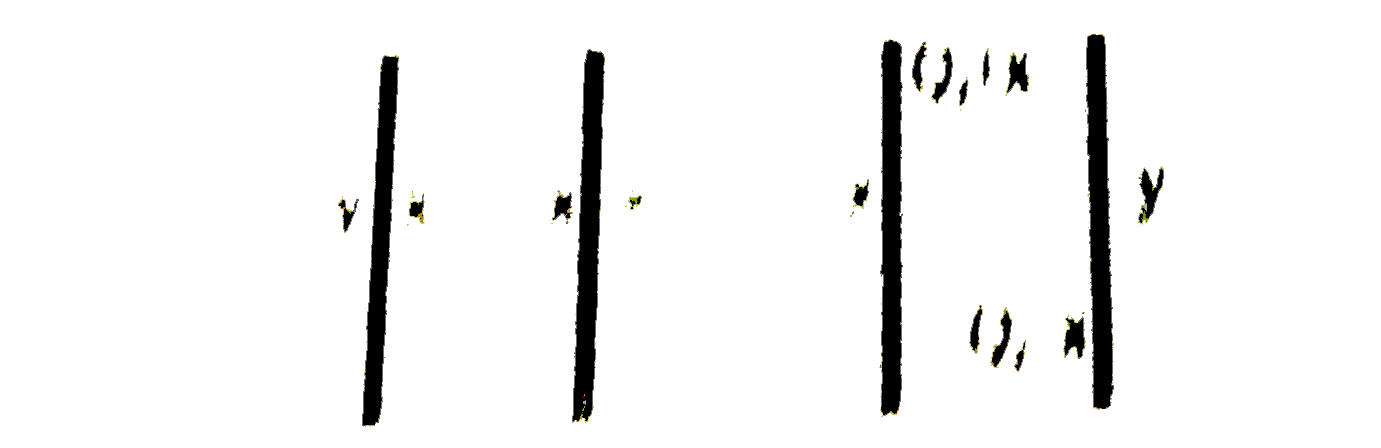
|
|
| 28. |
A signal geberatir supplies a sine wave if 20V, 5 to the circuit shown in the figure. Then. |
|
Answer» the current in the resistive BRANCH is 0.2A |
|
| 29. |
Two parallel vertical metallic bars XX. and YY., of negligible resistance and separated by a length .l., are as shown in Fig. The ends of the bars are joined by resistance R_1 and R_2A uniform magnetic field of induction B exists in space normal to the plane of the bars. A horizontal metallic rod PQ of mass m starts falling vertically, making contact with the bars. It is observed that in the steady state the powers dissipated in the resistance R_1 and R_2 are P_1 and P_2respectively. Find an expression for R_1,R_2 and the terminal velocity attained by the rod PQ. |
Answer» Solution : Let `v_0`be the terminal velocity ATTAINED by the rod PQ (in the steady state). If `i_1` and `i_2`be the currents flowing through R, and R, in this state, then current flowing through the rod PQ is i= `i_1+i_2`(see the circuit diagram) as shown in Fig. ` therefore `Applying Kirchoff.s loop RULE, yields `i_1 R_1 = Bv_0 l ` and `i_2 R_2 = Bv_0 l` ` therefore i_1+i_2 = Bv_0 l ((1)/(R_1) + (1)/(R_2)) `......(i) Given that `P_i = i_1^2 R_1 = (B^2 v_0^2 l^2)/(R_1)`.....(ii) and `P_2 = i_2^2 R_2 = (B^2 v_0^2 l^2)/(R_2)`.....(III) Also in the steady state, the acceleration of PQ = 0. ` rArr mg= B (i_1 + i_2 )l` or `mg = B^2 l^2 v_0 ((1)/(R_1) + (1)/(R_2))`...(IV) Multiplying both sides by `v_0`,we get `mg v_0 = B^2 l^2 v_0^2 ((1)/(R_1) + (1)/(R_2)) = P_1 + P_2` [FromEq. (ii) and (iii)] ` therefore ` The terminal velocity is `v_0 = (P_1 + P_2)/(mg)` Substituting for `v_0`in Eq. (ii), `P_1 = (B^2 l^2)/(R_1) ((P_1 + P_2)/(mg))^2 rArr R_1 = [ (Bl(P_1 + P_2))/(mg)]^2 XX (1)/(P_1)` Similarly from eq. (iii) ` R_2 = [ (Bl(P_1 + P_2))/(mg)]^2 xx (1)/(P_2)` |
|
| 30. |
A square non - conducting loop , 20 cm , on a side is placed in a magnetic field . The centre of side AB coincides with the centre of magnetic field . The magnetic field is increasing at the rate 2 T /s . The potential difference betweeen B andC is : |
| Answer» ANSWER :d | |
| 31. |
Two capacitors C_(1) and C_(2) arecharged to 120 V and 200 V respectively. It is found that by connecting them together the potential on each one can be made zero. Then |
|
Answer» `5 C _(1) = 3C_(2)` `Q_(1) = C_(1)V_(1)= 120 C_(1)` Charge on SECOND capacitor, `Q_(2) = C_(2) V_(2) = 200 C_(2)` Connecting both of them. If potential on both of them become ZERO then `Q_(1) = Q_(2)` `120 C_(1) = 200 C_(2)` `:. 3 C_(1) = 5 C_(2)` |
|
| 32. |
How arethe characteristic X-rays spectrum formed? |
| Answer» Solution :When high ENERGY cathode rays fall on the target of an X-ray tube, deep rooted electrons of the target atoms may come out. If, say, a K- shell electron comes out of an atom, the vacancy is filled up by an electron of the IMMEDIATELY outer shells (L,M, ...). This electron transition PRODUCES as X-ray photon, whose frequency characterisesthe target atom. This is CHARACTERISTIC X-ray. | |
| 33. |
The antenna current of an AM transmitter is 8A when only the carrier is sent but it increases to 8.93A when the carrier is modulated. Find percent modulation. |
|
Answer» SOLUTION :The modulated or total power carried by AM wave `P_(tau)=P_(C)(1+(m^(2))/(2))` Id R is load RESISTANCE, `I_(m)` is the current when carrier is modulated and `I_(c)` the current when un-modulated, then `(P_(tau))/(P_(C))=(I_(m)""^(2)R)/(I_(c)""^(2)R)"":.I+(m^(2))/(2)=(I_(m)""^(2)R)/(I_(c)""^(2)R)` Given `I_(m)=8.93A,I_(c)=8A` `:.m^(2)=2[((8.93)/(8.0))^(2)-1]:.m=0.7` Therefore, percentage modulation `=70%` |
|
| 34. |
A person is facingmagnetic north an electron in frontof him files horizontally towards the north and deflects towards easthe is in at |
|
Answer» NORTHERN himispher |
|
| 35. |
Assertion If current shown in the figure is increasing, then Reason IF current passing through an inductor is constant, then both ends of the inductor are at same potential. |
|
Answer» If both Assertion and Reason are CORRENT and Reason is the corrent explanation of Assertion. Further `i` = COSTANT `rArr(di)/(dt)=0or V_(L)=0`. |
|
| 36. |
What was the fear in Douglas' mind |
|
Answer» to be defeated |
|
| 37. |
The physical quantities not having same dimensions are : |
|
Answer» speed and `(mu_(0)in_(0))^(-1//2)` Hence correct choice is `(C )`. |
|
| 38. |
The rainbow by light waves which have suffered two internal reflections is called ? |
| Answer» SOLUTION :SECONDARY RAINBOW. | |
| 39. |
Derive an expression for the energy stored in a parallel plate capacitor. On charging a parallel plate capacitor to a potential V , the spacing between the plates is halved and a dielectric medium of in_(r) = 10 is introduced between the plates , without disconnecting the d.c. source . explain , using suitable expressions , how the (i) capacitance , "" (ii) electric field , and (iii) energy density of the capacitor change . |
|
Answer» SOLUTION :LET initial capacitance of a capacitor be C ` = (in_(0) A)/(d)` (i) When spacing between the plates is halved (i.e., `d. = (d)/(2))` and a dielectric medium of `in_r = 10` is INTRODUCED between the plates , new capacitance of the capacitor will be `C. = (in_(0) in_r A)/(d.) = (in_0 xx 10 xx A)/((d/2)) = 20 "" (in_(0) A)/(d) = 20 C ` (ii) Initial ELECTRIC field `E = (V)/(d)` As battery remains connected hence V. = V but `d. = (d)/(2)` `therefore` New electric field `E. = (V.)/(d.) = (V)/((d/2)) = 2 "" (V)/(d) = 2 E ` (iii) Energy density of capacitor U = `1/2 in_(0) E^(2)` `therefore` New energy density of capacitor `u. = 1/2 in_(0) , E.^(2) = (1)/(2) in_(0) xx 10 xx (2E)^(2) = 40 u` |
|
| 40. |
A spherical shell of radius r carries a uniformly distributed surface charge q on it. A hemispherical shell of radius R(gt r) is placed covering it with its centre coinciding with that of the sphere of radius r. The hemisphere has a uniform surface charge Q on it. The charge distribution on the sphere and the hemisphere is not affected due to each other. Calculate the force that the sphere will exert on the hemisphere. |
|
Answer» |
|
| 41. |
The equation of a wave is y = 4 sin {pi/2(2t + x/8)}where y , x are in cm and time in seconds. The phase difference between two position of the same particle which are occupied at time interval of 0.4 s is x pixx10^(-1) , what is the value of x ? |
|
Answer» |
|
| 42. |
A nucleus .A. decays into .b. with half life .T_(1). and B decays into .C. with half life T_(2), Graphs are drwan between number of atoms/activity versus time which are as shown, then |
|
Answer» BC are CORRECT |
|
| 43. |
(i) Obtian the expression for the cyclotron frequency. (ii) A deuteron and a proton are accelerated by the cyclotron. Can both be accelerated with the same oscillator frequency ? Give reason to justify your answer. |
| Answer» Solution :(ii) For ACCELERATING a charged particle the OSCILLATOR frequency should be same as the cyclotron frequency, which depends upon the charge as well as mass of charged particle `(v = (Bq)/(2 PI m))` As MASSES of a deuteron and a proton particles are different, they cannot be accelerated with the same ocillator frequency. | |
| 44. |
The angular acceleration of a particle moving along a circular path with uniform speed is |
|
Answer» uniform but NON zero |
|
| 45. |
Where was the Royal music Academy? |
|
Answer» India |
|
| 46. |
A ray of light passes normally through a slab (mu = 1.5) of thickness 't'. If the speed of light in vacuum be "C', then time taken by the ray to go across the slab will be |
|
Answer» `t/C` |
|
| 47. |
A galvanometer is being converted into an ammeter by joining a shunt across it. Higher the range of ammeter __________ isthe value of shunt resistance. |
|
Answer» |
|
| 48. |
In the modified whetstone bridge (fig), find the concition for no charge in deflection of the galvanometer on opening or closing the key K. |
|
Answer» |
|
| 49. |
Draw the plot of amplitude versus omega for an amplitude modulated wave whose carrier wave (omega_c) is carrying two modulating signals, omega_1 and omega_2 (omega_2gtomega_1). [Hint: Follow derivation from Eq of NCERT text book of XII) of Fundamental Physics . (ii) Is the plot symmetrical about omega_c? Comment especially about plot in region omegaltomega_2 (iii) Extrapolateand predict the problems one can expect if more waves are to be modulated. (iv) Suggest solutions to the above problem. In the process can one understand another advantage of modulation in terms of bandwidth? |
|
Answer» Solution :(i) Let the TWO modulating signals `A_(m_1) sin omega_(m_1)t` and `A_(m_2) sinomega_(m_2)t` be superimposed on CARRIER signal `A_c sim omega_c t`. Thesignal produced is `x(t) = A_(m_1)sin omega_(m_1) t + A_(m_2)sin omega_(m_2) t + A_c sin omega_c t` To produce amplitude modulated wave the signal `x (t)` is passed through a square law device which produces an output given by `y (t) = B[A_(m_1) sin omega_(m_1) + A_(m_2) sinomega_(m_2) t + A_(c) sinomega_(c)t ]+ C [ A_(m_1) sinomega_(m_1) t + A_(m_2) sinomega_(m_2 )t + A_c sim omega_c t]^2` `B = [A_(m_1) sinomega_(m_1) t + A_(m_2) sinomega_(m_2) t + A_(c) sinomega_(c) t] + C [(A_(m_1) sinomega_(m_1) t + A_(m_2) sinomega_(m_2)t)^2 + A_(c)^(2)sin^2omega_ct` `+ 2A_c sin omega_ct (A_(m_1) sinomega_(m_1) t + A_(m_2) sinomega_(m_2)t)]` `= B [ A_(m_1) sinomega_(m_1) t + A_(m_2) sinomega_(m_2)t + A_c sin omega_ct]` `+ C [A_(m_1)^(2) sin^2 omega_(m_1) t + A_(m_2)^(2)sin^2 omega_(m_2)t + 2A_(m_1) A_(m_2) sin omega_(m_1) t sin omega_(m_2)t` `+A_(c)^(2) sim^2 omega_ct + 2A_c (A_(m_1) sinomega_(m_1) t sin omega_c t + A_(m_2) sinomega_(m_2)t sin omega_c t)]` `= B [ A_(m_1) sinomega_(m_1) t + A_(m_2) sinomega_(m_2)t + A_c sin omega_c t]` `+ C [ A_(m_1)^(2)sin^2 omega_(m_1) t + A_(m_2)^(2)sin^(2) omega_(m_2)t + A_(m_1) A_(m_2) { cos (omega_(m_2) - omega_(m_1)) t - cos (omega_(m_2) + omega_(m_1))} + A_c^(2) sin^(2) omega_ct` `+ A_c A_(m_1) {cos(omega_c - omega_(m_1)) t - cos (omega_c + omega_(m_1)) t } + A_c A_(m_2) { cos (omega_c - omega_(m_2)) t - cos (omega_c + omega_(m_2))t}]` In the above amplitude modulated waves, the frequencies present are `omega_(m_1) , omega_(m_2) , omega_c , (omega_(m_2) - omega_(m_1)), (omega_(m_2) + omega_(m_1)) , (omega_c - omega_(m_1)), (omega_c + omega_(m_1)), (omega_c - omega_(m_2))` and `(omega_c + omega_(m_2))` The plot of amplitude versus `omega` is shown in figure (ii) From figure , we note that frequency spectrum is not symmetrical about `omega_c`. Crowding of spectrum is present for `omega LT omega_c`. (iii) if more waves are to be modulated then there will be more crowding in the modulating signal in the REGION `omega lt omega_c`. That will result more chances of mixing of signals. (iv) To accommodate more signals, we should increase band width and frequency of carrier waves `omega_c`. This shows that large carrier frequency enables to carry more INFORMATION (i.e., more `omega_m`) and the same will inturn increase band width. 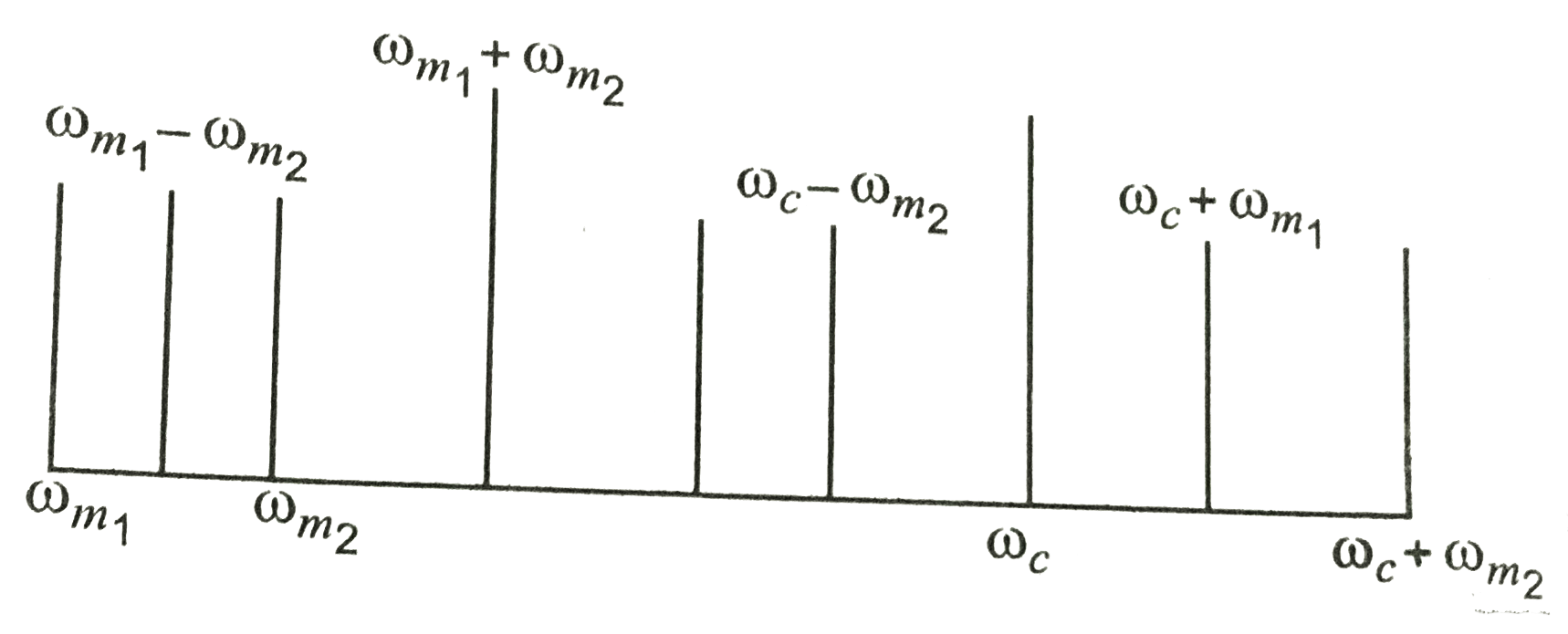
|
|
| 50. |
The rate of loss of heat by radiation frombody at 400^(@)C is R. then radiation from it when the temperature of the ball is 627^(@)C. Then the rate of loss of heat per unit area will be |
|
Answer» 2R `R_(2)=5R`. |
|